Feeds:
Posts
Comments

Archive for the ‘environment’ Category

solarF

In Monday’s New York Times’ Green Inc. blog, I take a look at two recently approved solar energy contracts in California that offer a rare look at the economics of large-scale solar power plants:

California regulators have approved contracts for more than 8,600 megawatts of renewable energy, to be generated mostly by big solar power plants for the state’s largest utilities. But the details of those deals and the emerging economics of green energy often remain shrouded in secrecy, subject to confidentiality agreements.

That black box cracked open a bit on Thursday, when the California Public Utilities Commission gave the green light to two 25-year power purchase agreements between Pacific Gas & Electric and BrightSource Energy, a solar power plant builder based in Oakland, Calif.

When approving contracts for 310 megawatts of solar electricity, the utilities commission also signed off on an apparently first-of-its-kind technology royalty agreement between BrightSource and PG&E.

You can read the rest of the story here.

Read Full Post »

AuroraBiofuels

photo: Aurora Biofuels

In today’s New York Times, I write about Aurora Biofuels, an Alameda, Calif.-based startup that says it has developed a strain of algae that will double production of biodiesel:

According to Robert Walsh, the chief executive of the company, Aurora’s breakthrough was to develop algae mutations that can ingest carbon dioxide regardless of the intensity of sunlight.

“Algae have a built-in mechanism to be effective at low light and as it gets brighter during the day their uptake of carbon dioxide levels off,” said Mr. Walsh. “We’ve been able to go in and alter strains by natural mutation to cause the algae to deal with light across the whole spectrum. The algae continue to uptake C02 through brighter light and are more productive.”

You can read the rest of the story here.

Read Full Post »

Stirling SunCatcher

photo: Tessera Solar

Another day, another Big Solar deal.

Tessera Solar on Wednesday said it will build a 1.5 megawatt Stirling solar dish power plant outside Phoenix to supply electricity to utility Salt River Project.

The announcement follows Tuesday’s spate of solar power plant deals. As I wrote in The New York Times, utility Southern California Edison (EIX) agreed to buy 550 megwatts of solar electricity that will be generated by two massive thin-film photovoltaic power plants to be built by First Solar (FSLR). Later in the day on Tuesday, First Solar said that it had struck a deal with the Los Angeles Department of Water and Power to supply 55 megawatts from a PV farm to be constructed in Southern California’s Imperial Valley.

Tessera Solar is the development arm for Stirling Energy Systems, the maker of the SunCatcher solar dish. The company is developing two huge California projects — a 850-megawatt, 34,000-dish solar farm to be built on 8,230 acres to supply power to Southern California Edison and a 750-megawatt power plant complex for San Diego Gas & Electric (SRE).

The 60-dish Salt River Project solar farm is but a fraction of the California solar farms’ size but will serve as a demonstration project for Tessera’s technology.

Most notable, given the years-long licensing process for big solar power projects in places like California, Tessera plans to break ground next month and bring what it calls the Maricopa Solar plant online in January 2010.

Tessera will lease the project site from Salt River Project and sell the electricity to the utility under a 10-year power purchase agreement.

Read Full Post »

esolar_8

photo: eSolar

Last week Green Wombat wrote about how solar power plant developer eSolar may avoid conflicts over endangered species by building its solar farms on privately owned agricultural land rather than in desert areas home to a variety of protected wildlife.

At the opening ceremony of eSolar’s Sierra demonstration power plant outside Los Angeles on Aug. 5, Wildlands Conservancy executive director David Myers gave a speech praising the Pasadena company for not building power plants in fragile desert ecosystems while criticizing competitors. The Wildlands Consevancy, a Southern California non-profit, has spent hundreds of millions of dollars buying up and preserving broad swaths of the Mojave Desert.

What my story did not point out was a connection between the Wildlands Conservancy and eSolar. The Wildlands Conservancy’s biggest backer has been Southern California investor and environmentalist David Gelbaum, who also serves on the green group’s board.  Gelbaum’s Quercus Trust is an investor in eSolar and dozens of other green tech startups.

Read Full Post »

esolar_8

photo: eSolar

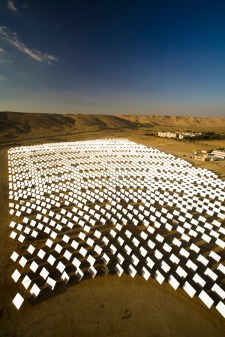
eSolar on Wednesday fired up its five-megawatt Sierra “power tower” solar farm outside Los Angeles during an opening ceremony that featured such green tech luminaries as Google.org climate change director Dan Reicher and Dan Kammen of the University of California at Berkeley.

But the speaker that caught my eye was environmentalist David Myers, executive director of the Wildlands Conservancy, a Southern California non-profit that is working with California Senator Dianne Feinstein to put hundreds of thousands of acres of the Mojave Desert off limits to industrial-scale solar power plants.

“By siting their project on disturbed lands, eSolar has avoided degrading treasured public lands and core areas of biodiversity,” said Myers. “This is an important distinction from the solar firms that propose to industrialize 600,000 acres of pristine California desert lands belonging to the American people.”

I’ve written extensively on Green Wombat and Grist about eSolar’s technology and CEO Bill Gross’ vision of a software-driven solar revolution that taps computing power to drive down renewable energy costs. (Google-backed (GOOG) eSolar has a partnership with energy producer NRG (NRG) to build power plants for Southern California Edison (EIX), PG&E (PCG) and other utilities.)

But eSolar’s strategy of building relatively small-scale modular solar farms on privately owned agricultural land is also allowing it to avoid — so far — fights over endangered species that have slowed big solar power plants planned for federally owned land in the Mojave Desert.

While Myers was praising eSolar at the Sierra ceremony, his environmental group, as I wrote in Wednesday’s New York Times, has been raising issues about the impact of Tessera Solar’s planned 8,230-acre, 850-megawatt power plant on such Mojave species as the desert tortoise, Mojave fringe-toed lizard and Nelson’s bighorn sheep.

Meanwhile, Defenders of Wildlife, a local chapter of the Sierra Club and other national and grassroots environmental groups are worried about the impact of BrightSource Energy’s 400-megawatt Ivanpah solar farm on the imperiled desert tortoise. The Sierra Club chapter recently proposed that BrightSource move the solar power plant to avoid disturbing habitat currently occupied by desert tortoises.

eSolar has spent $30 million acquiring previously disturbed ag land — mostly in California. While that should speed development of its solar farms as it won’t need federal approval to build, there’s no guarantee, of course, that the Pasadena, Calif.-based startup won’t also run into critter problems.

Just ask Ausra, the Silicon Valley solar company that’s building a 177-megawatt power plant on ag land in San Luis Obispo County on California’s central coast. That project has been bogged down in disputes over the solar farm’s consequences for a plethora of species and the cumulative impact of two other solar power plants planned for the same area that First Solar (FSLR) and SunPower (SPWR) want to build.

Still, eSolar’s focus on location, location, location could pay off. While the five-megawatt Sierra demonstration plant is a small project, the fact that company was able to get it built in a year is no doubt a competitive advantage.

“This plant delivers the lowest-cost solar electricity in history,” said Gross, the founder of tech incubator Idealab, at the ceremony in the L.A. ex-urb of Lancaster.  “We currently compete with natural gas and as we continue to drive down the cost, we will even compete with coal.”

And if eSolar continues to carefully select sites for its solar farms it won’t have to worry about environmentalists like David Myers of the Wildlands Conservancy.

“You can see why the entire environmental community is so excited about a firm that’s model is to use disturbed lands,” said Myers after slamming an unnamed eSolar competitor for trying to build a solar farm in what he described as a fragile desert ecoystem. “We can’t say enough great things about eSolar.”

With that, Gross walked over to a computer, pressed a button and 24,000 mirrors began to focus sunlight on two water-filled boilers sitting atop two towers. As the intense heat vaporized the water, steam flowed to a power block to drive an electricity generating turbine.

Read Full Post »
eSolar Sierra

photo: eSolar

The U.S. Department of Energy on Friday began accepting applications for at least $3 billion in direct funding of renewable energy power plant projects.

The funding, part of the federal stimulus package, is in lieu of a 30 percent investment tax credit that green energy developers can take on their projects. Given that most solar and wind developers carry no tax liabilities, they have relied on investment banks and other investors to front the hundreds of millions and billions of dollars in financing needed for their projects in exchange for the tax credits. But as the economy tanked along with investment banks, demand for so-called tax equity partnerships evaporated.  Big Solar projects stalled and wind developers delayed turbine orders.

Curiously, the Department of Energy said on Friday that the $3 billion would fund some 5,000 projects. That works out to about $600,000 per power plant. But a single 250-megawatt solar power plant alone can cost more than a $1 billion and would thus soak up $300 million or 10% of the funding pool.

The question is, will DOE end up funding a few large-scale green energy projects that could start to give, say, the solar thermal industry economies of scale, or will it spend the money on hundreds of smaller renewable energy facilities?

That’s a crucial issue for solar developers like Tessera Solar/Stirling Energy Systems, eSolar and BrightSource Energy, which is backed Google (GOOG), Morgan Stanley (MS) and VantagePoint Venture Partners as well as a clutch of oil giants – Chevron (CVX), BP (BP) and Norway’s StatoilHydro.

Also left unsaid in the DOE’s announcement was the fact that renewable energy projects need to break ground by the end of 2010 to qualify for the direct funding. Which is why BrightSource, Nextera Energy (a subsidiary of utility giant FPL Group (FPL) ) and Tessera Solar are eager to expedite the lengthy California licensing process and get their projects approved before New Year’s Eve 2010 so they can put shovel to dirt and start shoveling cash into their coffers.

Read Full Post »

Stirling SunCatcher

photo: Tessera Solar

When it comes to renewable energy, Texas has been all about Big Wind. But this week the Lone Star State took on its first Big Solar project when San Antonio utility CPS Energy signed a 27-megawatt deal with Tessera Solar.

Houston-based Tessera is the solar farm developer for Stirling Energy Systems, which makes a Stirling solar dish. Resembling a giant mirrored satellite receiver, the 25-kilowatt solar dish focuses the sun’s rays on a Stirling engine, heating hydrogen gas to drive pistons that generate electricity. (Last year Irish green energy firm NTR pumped $100 million into Scottsdale, Ariz.-based Stirling Energy Systems and created Tessera to develop solar power plants using the Stirling dish, called the SunCatcher.

Stirling Energy Systems previously signed deals with Southern California Edison (EIX) and San Diego Gas & Electric (SRE) to supply up to 1,750 megawatts of electricity from some 70,000 solar dishes to be planted in the Mojave and Sonoran deserts.

Other solar developers privately have cast doubt on Stirling’s ability to make good on those contracts, arguing the SunCatcher is just too expensive and complex to compete against solar thermal technologies that rely on mirrors to heat liquids to create steam that drives electricity-generating turbines.

But earlier this week, Stirling unveiled the latest generation of the SunCatcher at Sandia National Laboratories in Albuquerque, N.M. The new SunCatcher has shed 5,000 pounds and its Stirling hydrogen engine contains 60% fewer parts than the previous version, according to the company.

The SunCatcher also uses a fraction of the water consumed by competing solar thermal technologies being developed by startups like BrightSource Energy and Ausra — no small deal in the desert. Tessera solar farms also can be built in modules, meaning that when a 1.5 megawatt pod of 60 SunCatchers is installed it can immediately begin generating electricity — and cash.

California utility PG&E also went modular Thursday when it signed a 92-megawatt deal with New Jersey’s NRG (NRG) for electricity to be generated by a Southern California solar power plant using eSolar’s technology. Google-backed (GOOG) eSolar’s builds its solar power tower plants in 46-megawatt modules. The power plants take up much less land than competing solar thermal technologies, thanks to eSolar’s use of sophisticated software to control small mirrors that are packed close together.

NRG earlier this month signed a deal to build a 92-megawatt eSolar-powered solar farm in New Mexico near the Texas border.

eSolar CEO Bill Gross says his solar farms will generate electricity cheaper than natural gas-fired power plants, a claim PG&E (PCG) appears to confirm in its submission of the deal to the regulators. (Thanks to Vote Solar for pointing to the document.)

Read Full Post »

Stirling Energy Systems Solar One project

image: URS

Green Wombat spent several months looking into allegations that California labor unions are using environmental laws to pressure  solar developers to hire union workers to build large-scale solar power plants. The story was published last Friday in The New York Times:

SACRAMENTO — When a company called Ausra filed plans for a big solar power plant in California, it was deluged with demands from a union group that it study the effect on creatures like the short-nosed kangaroo rat and the ferruginous hawk.

By contrast, when a competitor, BrightSource Energy, filed plans for an even bigger solar plant that would affect the imperiled desert tortoise, the same union group, California Unions for Reliable Energy, raised no complaint. Instead, it urged regulators to approve the project as quickly as possible.

One big difference between the projects? Ausra had rejected demands that it use only union workers to build its solar farm, while BrightSource pledged to hire labor-friendly contractors.

As California moves to license dozens of huge solar power plants to meet the state’s renewable energy goals, some developers contend they are being pressured to sign agreements pledging to use union labor. If they refuse, they say, they can count on the union group to demand costly environmental studies and deliver hostile testimony at public hearings.

If they commit at the outset to use union labor, they say, the environmental objections never materialize.

You can read the rest of the story here.

Read Full Post »

ibm-smarter-planet

While the U.S. Department of Energy on Tuesday issued nearly $8 billion in loans to Ford (F), Nissan and Tesla Motors to manufacture electric cars and batteries, IBM unveiled an initiative to develop a next-generation battery technology that would allow those vehicles to travel 400 miles or more on a charge.

Big Blue will investigate the potential of lithium air technology to replace current state-of-the-art lithium ion batteries. Lithium air potentially could pack 10 times the energy density of lithium ion storage devices by drawing oxygen into the batteries to use as a reactant. As a result lithium air batteries would weigh less than lithium ion batteries, C. Spike Narayan, manager of science and technology at IBM’s Almaden Research Center, told Green Wombat.

So besides powering cars, lithium air batteries could store electricity generated from solar power plants and wind farms, turning them into 24/7 energy sources.

But don’t expect to see the super-charged batteries anytime soon.”This is a five-to-10-year project,” says Narayan. “The first phase is to go after the big science problems. Then we’re ready to engage with automotive companies and battery manufacturers.”

The technological hurdles are high and even IBM (IBM), with its expertise in nanotechnology, green chemistry and supercomputing, won’t try to go it alone. It’s seeking partners at research universities and government laboratories to crack the tech challenges, which include developing a membrane that will strip water out of the air before it enters the battery and the development of nano materials to prevent layers of lithium oxide from interfering with chemical reactions.

IBM intends to limit its role in the battery business to R&D. “We have no desire to make batteries,” says Rich Lechner, IBM’s vice president for energy and the environment. “We will license the IP.”

In another sign that climate change and the imminent imposition of carbon caps are creating opportunities for Big Business and rearranging the competitive landscape, IBM also announced “Green Sigma,” an alliance of erstwhile competitors that will offer solutions to companies seeking to shrink their carbon footprint.

Green Sigma includes business software giant SAP (SAP), Cisco (CSCO), Johnson Controls (JCI) and Honeywell (HON). Dave Lebowe, an IBM executive with the Green Sigma program, acknowledged the potential for conflicts of interests among these frenemies but said such problems were outweighed by the upside of bringing together a broad range of expertise to help customers cut their CO2 emissions and save money.

Read Full Post »

eSolar Sierra
photo: eSolar

California may be in the midst of licensing dozens of massive megawatt solar power plants but New Mexico may be first state out of the gate with a big project using next-generation solar thermal technology. On Thursday, New Mexico Governor Bill Richardson announced that Pasadena, Calif.-based eSolar and utility giant NRG Energy will build a 92-megawatt solar thermal power plant — the state’s first — near the Texas border that will go online in 2011.

“The New Mexico Public Utilities Commission has approved the project, we have the permits and  we already have the land so we’ll be breaking ground in 2010,” eSolar CEO Bill Gross told Green Wombat. “We already have the equipment and the financing partner, NRG. We’re ready to go.”

In February, Google-backed (GOOG) eSolar agreed to supply its technology to NRG (NRG) to develop solar farms generating 500 megawatts.

eSolar will use fields of mirrors to focus the sun on water-filled boilers that sit atop towers. The heat vaporizes the water and the resulting steam drives electricity-generating turbines. Competitors use large, slightly curved — parabolic — mirrors to focus sunlight. That requires big and expensive steel frames to hold the glass in place.  eSolar’s solution: make small flat mirrors the size of an LCD television screen that clamp on to a  5 x 12-inch frame and then use software and Big Iron computing to position the mirrors to create a “dynamic parabola” out of the entire heliostat field.  Gross says eSolar’s small heliostats can be cheaply manufactured take up less land than conventional mirrors.

That means eSolar can build modular power plants near urban areas and transmission lines, lowering costs and avoiding some of the endangered species fights that have slowed Big Solar projects in California. (See Green Wombat’s column on Grist for a first-hand look at eSolar’s Sierra demonstration plant in Southern California.)

The New Mexico solar farm will be built on 450 acres of agricultural land about 10 miles from El Paso, Texas. Utility El Paso Electric (EE), which serves parts of New Mexico, will buy the electricity generated by the solar power plant — enough to power 74,000 homes  — under a 20-year power purchase agreement. Terms of the deal were not disclosed.

“We think there’s room for a lot more solar power plants at this price,” says Gross. “The sun is very good in New Mexico and all the economics that make this project work are very good there.”

In March, First Solar (FSLR) said it would build a 30-megawatt thin-film photovoltaic solar farm in northeastern New Mexico.

eSolar’s five-megawatt Sierra demo plant outside Los Angeles, pictured above, has begun producing steam and will soon start generating electricity — “It’s the only solar power tower operating in North America,” Gross says.

Next year, ground will be broken on an eSolar power plant in India and NRG and eSolar have a deal to supply utility Southern California Edison (EIX) with 245 megawatts of solar electricity.

“The idea of these plants dotting the desert and producing electricity has been our dream for a long time,” says Gross, “and now it’s a reality.”

Read Full Post »

« Newer Posts - Older Posts »

Design a site like this with WordPress.com
Get started