Feeds:
Posts
Comments

Archive for the ‘enviro startups’ Category

In the world’s single-largest investment in solar technology, the oil-rich emirate of Abu Dhabi announced Wednesday it will spend $2 billion to jumpstart a home-grown photovoltaics industry. The cash will fund what is undoubtedly the planet’s best-financed startup, Masdar PV, which will build manufacturing facilities in Germany and Abu Dhabi to produce thin-film solar modules that can be used in rooftop solar systems or solar power plants.

Masdar PV is the latest project of the Masdar Initiative, Abu Dhabi’s $15 billion renewable energy venture designed to transform the emirate into a green technology powerhouse. Masdar is best known for its plans to build Masdar City, a “zero-carbon, zero-waste” urban center.

Thin-film solar cells are essentially “printed” on glass or flexible metals, allowing them to be integrated into building materials like roofs and walls. Though thin-film solar is less efficient at converting light into electricity, it uses a fraction of the expensive silicon needed by conventional bulky solar modules and can be produced much more cheaply – provided economies of scale are achieved.

Thus Masdar PV’s big solar bet. “You have to be working at scale to drive costs out of the system,” Steve Geiger, Masdar’s director of special projects, told Fortune in a phone call from Abu Dhabi. “We have to do it at scale and we have to do it in volume in multiple markets.”

One of those markets is the United States, where Masdar PV could give established players like First Solar (FSLR) and startups such as Nanosolar, Heliovolts and Global Solar some formidable competition.

The gamble Masdar PV is taking is that it’s investing billions in an older but proven thin-film technology that may well be left in the dust by more exotic, cheaper and efficient technologies under development by a host of startups.

Masdar PV aims to have a gigawatt of annual production capacity in place by 2014. To get there, Geiger says the company has hired a management team that includes former top executives from First Solar and other thin-film industry veterans.

A leading solar technology company that Geiger declined to identify will provide the manufacturing equipment for Masdar PV’s factories. Judging from his description, the likely supplier is Applied Materials (AMAT), the world’s biggest computer-chip equipment maker that has a burgeoning business building the machines that make thin-film solar cells of the type that Masdar PV will produce.

“We usually partner with large companies that have managerial skills, technology and market access, but we were very fortune that we picked up a top management team and thought it was strong enough to do as a 100% Abu Dhabi Masdar company,” says Geiger, who will oversee Masdar’s thin-film solar venture.

Masdar PV’s first plant is scheduled to go online in Germany toward the end of 2009 with the second to begin production in Abu Dhabi by mid-2010. “Very clearly we need to look at expansion beyond those two physical facilities,” Geiger says. “We really have to look at America and the Asian markets as well.

Thin-film is just one of three solar strategies that Masdar is pursuing by funneling petrodollars into green energy startups. In March, Masdar unveiled Torresol Energy, a joint venture with a Spanish company that will build large-scale solar thermal power plants to supply electricity to utilities. Masdar has also made investments in other solar thermal companies as well as thin-film startups pursuing different technologies. Finally, Masdar wants to produce polysilicon, the basic material of conventional solar cells.

As Masdar chief Sultan Ahmed Al Jaber recently told Green Wombat, “We want to cover the whole value chain – from research to labs to manufacturing to the deployment of technologies.”

Geiger uses an analogy for Masdar’s green energy ambitions that may be more familiar to petroleum-dependent Americans – and should serve as a wake-up call to get serious about carbon-free energy. “The model might be the vertically integrated oil industry,” he says. “It clearly makes sense to have a consolidated power provider.”

Read Full Post »

The souring economy hasn’t dissuaded green tech investors from making big bets on renewable energy. On Wednesday, solar power plant builder BrightSource Energy announced it had raised $115 million from a group of investors that include Google.org, the search giant’s philanthropic arm, and oil giants Chevron and BP.

The investment in the Oakland, Calif.-based startup is Google’s (GOOG) second big solar energy play in the past two months. In April, Google.org joined a $130 million round for eSolar, a Pasadena solar power plant company whose chairman is Idealab founder Bill Gross.

BrightSource Energy, started by American-Israeli solar pioneer Arnold Goldman, has contracts to supply California utility PG&E (PCG) with up to 900 megawatts of solar electricity from power plants to be built in the Mojave Desert on the California-Nevada border. BrightSource has developed a new solar technology, dubbed distributed power tower, that focuses fields of sun-tracking mirrors called heliostats on a tower containing a water-filled boiler. The sun’s rays superheat the water and the resulting steam drives an electricity-generating turbine. (Artist rendering of BrightSource’s planned Ivanpah plant above.)

Given that a 500-megawatt solar power plant can cost more than $1 billion to build, $115 million is but a drop in the bucket. But it will allow BrightSource, which previously raised $45 million, to proceed with the development of its technology as it seeks project financing for construction of its first power plants.

And it can’t hurt to have such high-profile backers when you negotiate power purchase agreements with utilities. Besides Google, BP Alternative Energy (BP) and Chevron Technology Ventures (CVX), previous investors participating in the new round include Morgan Stanley (MS), VantagePoint Venture Partners, Draper Fisher Jurvetson and DBL Investors.

Another new BrightSource investor is Norweigan oil and gas behemoth StatoilHydro (STO). Apparently, even Big Oil has seen the light when it comes to hedging its bets with green energy.

Read Full Post »

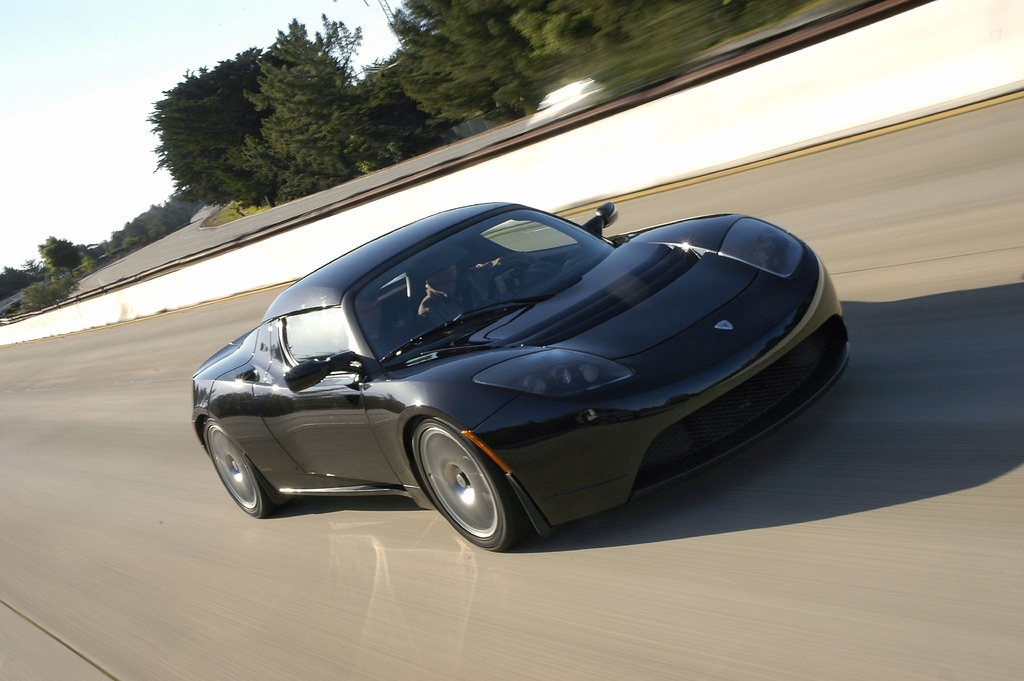
Monday night, Green Wombat swung by SF Green, one of a growing number of green tech networking events sprouting up around San Francisco and Silicon Valley. The draw – beyond drinks with a standing-room-only crowd of bright-eyed twenty-and-thirtysomethings in a San Francisco art gallery – was the appearance of leading venture capitalist Ray Lane of Kleiner Perkins Caufield & Byers and Darryl Siry of Tesla Motors, maker of the Roadster electric supercar.

Despite the fact that Tesla has sued a Kleiner company, Fisker Automotive – which is producing an electric hybrid sports sedan – for alleged intellectual property theft, no sparks flew. (Though at Fortune’s recent Brainstorm Green conference, Lane couldn’t resist taking a jab at allegations that Fisker founder Henrik Fisker appropriated Tesla technology when he did design work for the Silicon Valley startup: “It’s ridiculous,” Lane said. “Henry Fisker wouldn’t know a drive train from a glass of water. He’s a designer.)

Siry, Tesla’s vp of sales, marketing & service, said five of the $100,000 Roadsters have rolled off the assembly line so far with one car tooling around Los Angeles, and others in the Bay Area and London. By year’s end, Tesla, which has been wrestling with drive train problems, should have more than 100 cars on Bay Area roads, home to many the company’s tech titan customers.

Tesla has raised $145 million, Siry noted, and will do another round before an IPO. The Roadster will always be a limited production marquee car but to mass produce its next vehicle, a five-seat sports sedan code-named White Star, Tesla will need that IPO or project financing. Siry also sketched a future where Tesla might supply electric drive trains to automakers in exchange for project financing.

“Tesla is a tech company wrapped in an automotive brand,” he said at the event co-sponsored by VentureBeat.

Lane and Kleiner Perkins have gone beyond investing in electric car companies to running one. Lane is chairman of Think North America, the U.S. arm of Norwegian electric carmaker Think Global. Kleiner and Rockport Capital took a 50 percent stake in the North American operation, which launched last month.

The Think and Fisker investments are emblematic of a new direction for VCs who have jumped into the green tech game. Unlike the first dot-com era or even the current Web 2.0 age, there’s no quick exit on the horizon for investments in green tech companies that may be years away from producing a product and require hundreds of millions, if not billions, in project financing to build car factories or solar energy power plants.

Lane compared investing in green tech to the long-term horizon needed for investing in biotech startups, where the key is to hit milestones that allow investors to calculate valuations.

Still, it’s a big gamble, given rising commodity prices and global economic upheaval.

Kleiner is also an investor in solar power plant startup Ausra. “Steel prices are killing us,” Lane said. Ausra’s power plants consist of hundred of acres of mirrors mounted on steel frames. “With Ausra, we [calculate] we could deliver solar thermal electricity at 12 cents a kilowatt-hour. But with steel prices, who knows?”

A shortage of qualified green tech workers has become an issue, according to Lane. The nascent solar power plant business relies on recruiting engineers and project developers from the carbon-based industry. “Talented people in project development at companies like Bechtel are maxed out for years on building projects,” he said.

Read Full Post »

California startup Amyris engineers microbes to transform them into molecular oil refineries, digesting sugar to produce low-carbon equivalents of gasoline, diesel and jet fuel. Now in a bid to commercialize its technology, Amryis has struck a deal to create a joint venture with Brazilian ethanol giant Crystalev to produce biodiesel from sugarcane.

Some three-quarters of Brazil’s cars run on ethanol made from domestic sugarcane but the country imports diesel. “This is a game changer,” Amyris co-founder Jack Newman told Green Wombat this week at Fortune’s Brainstorm Green conference in Pasadena. “It gives us the ability to make a difference in terms of scale by tapping into existing agricultural land and Brazil’s ethanol infrastructure. It’s a great step forward for Amyris, and Brazil gets the option of producing ethanol or diesel from same resources.”

Most biodiesel today is made from soybeans or recycled vegetable oil and does not offer the same performance as petroleum-based diesel. The biodiesel produced by Amyris’ custom-designed microbes matches that performance and can be used in existing engines while cutting greenhouse-gas emissions by 80 percent, according to Newman, a microbiologist who is Amyris’ senior vice president of research.

If Amyris, an Emeryville-based company backed by marquee venture capitalists Khosla Ventures and Kleiner Perkins Caufield & Byers, can replicate its laboratory success in the field the environmental benefits could substantial.

For Brazil to become self-sufficient in diesel it would otherwise have to plant more soy, which means cutting down more of the Amazon rainforest that already is being destroyed to plant soy destined for North American dinner tables. Sugarcane grown on reclaimed pasture land and distilled with Amyris technology can produce ten times as much diesel per acre as soy. “You won’t have to displace crops into the rainforest area,” Newman says.

Production of the Brazilian biodiesel is expected to begin in 2010 if all goes according to plan and the necessary regulatory approvals are obtained.

“One of the reasons Brazil is so excited about the technology is that this gives them a biodiesel option with this great infrasture they already have,” Newman says. “It could provide them with 90 billion gallons a year without having to reclaim new land.”

Read Full Post »

torresol2.gif

Abu Dhabi is not content to just sell you the oil that fuels your SUV; now its going to sell you sunshine to keep your lights on and power your electric car when the internal combustion engine goes the way of the buggy whip. Masdar, the oil-rich emirate’s $15 billion renewable energy venture, and Spanish technology company Sener on Wednesday announced a joint venture called Torresol Energy to build large-scale solar power plants in Australia, Europe, the Middle East, North Africa and the United States.

Torresol initially will invest $1.2 billion in three solar power plants to be built in Spain but the company is targeting the global “sunbelt” for future expansion. Masdar will take a 60 percent ownership stake in Torresol with Sener holding a 40 percent stake. A Torresol spokesman declined to reveal the dollar amount of the investment. A prime market for Torresol will be the U.S. desert Southwest, where companies like Ausra, BrightSource Energy, Solel and Abengoa Solar are competing for contracts with utilities PG&E (PCG), Arizona Public Service (PNW) and Southern California Edison (EIX). Torresol potentially could shake up that market, given its very deep pockets and ability to independently finance billion-dollar solar power plants.

The venture is just the latest move by Abu Dhabi to control what Masdar CEO Sultan Ahmed Al Jaber described to Green Wombat recently as “the whole value chain” of renewable energy, from research and development to manufacturing silicon for solar cells to the large-scale deployment of green technology.

The irony is too rich to leave unsaid: A leading oil producer invests billions in carbon-free energy while a leading consumer of fossil fuels – the United States – continues to subsidize Big Oil while while offering only tepid support for green technology. It is inevitable that climate change will foster the rise of renewable energy – the only question is which countries and companies will profit from the new energy economics. It is entirely possible that the U.S. will trade energy dependence of one kind – on Middle East oil – for another – on Middle East and European solar technology – in the era of global warming. It’s no coincidence that most of the solar energy companies with contracts to build utility-scale power plants in California and the Southwest have overseas roots – Ausra hails from Australia, BrightSource was founded by American-Israeli pioneer Arnold Goldman, Solel is based in Israel and Abengoa is headquartered in Spain.

Torresol plans to build solar power plants using a technology it calls a Central Tower Receiver system. It’s similar to technology used by competitors like BrightSource in that fields of mirrors called heliostats focus the sun’s rays on tower that contains a receiver. In this case the receiver is filled with salt which when heated vaporizes water to create steam that drives an electricity-generating turbine. The company says it intends to have 500 megawatts of solar electricity online by 2012.

Read Full Post »

Cacleantech_logo
If you want to know what enviro startups Silicon Valley movers and shakers think could be the next big green thing, the California Clean Tech Open is a good leading indicator. Last night in San Francisco the Open named six winners in its second annual startup competition. Each winner receives a $100,000 "startup in a box" package that includes $50,000 in cash from such sponsors as Google (GOOG), Advanced Micro Devices (AMD), Lexus (TM) and California’s Big Three utilities – PG&E (PCG), Southern California Edison (EIX) and San Diego Gas & Electric (SRE). The winners also get $50k worth of legal, marketing, accounting and public relations services from such heavyweights as Silicon Valley law firm Wilson Sonsini Goodrich & Rosati. The opportunity to mingle with the entrepreneurs, venture capitalists and potential clients who judge the contest probably represents the biggest win of all for these startups.  Now the winners:

AMD Smart Power Award
The Lucid Design Group of Oakland, Calif., takes a Web 2.0 approach to environmental monitoring, providing real-time feedback on a building or home’s energy and water usage through an online dashboard. The idea: people will be motivated to cut their electricity and water consumption when they see how much and when power is being used by various appliances.

ENVIRON Foundation and Grundfos Air, Water and Waste Award
Overland Park, Kan., startup Microvi Biotech is using biotechnology to treat waste water, sewage and control pollution.

Google Green Building Award

BuildFast of San Carlos, Calif., makes environmentally sensitive prefab housing kits to erect buildings in disaster zones or in low-income areas.

Lexus Transportation Award
Los Angeles’ Syncromatics is developing technology that uses GPS and mobile phone networks for real-time online tracking of buses to improve efficiency and cut fuel costs.

PG&E, SCE and SDG&E Renewables Award
Rohnert Park, Calif.-based 1-Solar
is designing lower-cost and longer-life power inverters for solar
arrays and other renewable energy systems. Inverters convert the direct
current produced by such systems into the alternating current used in
households and businesses.

PG&E, SCE and SDG&E Energy Efficiency Award
Nila of Sherman Oaks, Calif., makes LED lighting systems for Hollywood that it says consume 50 to 75 percent less electricity than traditional lighting used in the entertainment industry.

Read Full Post »

Logo_ccto
The California Clean Tech Open startup competition has named 50 finalists, and this year companies vying for $600,000 in cash and services need to be as green as their products. Entrepreneurs will be judged, in part, on the sustainability of their business model and business practices. In other words, it’s not enough to come up with the killer enviro app, you have to be as carbon neutral as possible. To that end, the competition is providing finalists with "sustainability starter kits" to to put contestants on the green path from the get-go.  The competition is backed by such Silicon Valley heavyweights as Advanced Micro Devices (AMD), Google (GOOG) and SunPower (SPWR) as well as more than a dozen  venture capital firm. Other sponsors include the big three California utilities – PG&E (PCG), Southern California Edison (EIX) and San Diego Gas & Electric (SRE).

The California Clean Tech Open offers a look at where entrepreneurs – and the judges – think the green wave will be breaking next. This year, the contest named finalists in six categories:  Air, Water & Waste;  Energy Efficiency; Green Building; Renewables; Smart Power; and Transportation. Some of the finalists that caught Green Wombat’s eye include Friendly Cow Biogas, which is developing a methane digesters to turn cow poop into biogas; Civil Twilight, which is making streetlights that dim when the moon is full; Vertical Landscape’s system of transforming load-bearing walls of buildings to support vegetation; SolarAire, which has created a solar-powered air conditioning system; Grid Saver, whose home appliance remote control system allows utilities to manage power usage; and High Merit Thermoelectrics, which  converts waste heat from heavy truck exhaust systems to electricity to run the vehicle’s alternator, power steering pump, and air conditioner pump.

Read Full Post »

Cacleantech_logo_6 Five startups took home prizes worth half a million dollars Tuesday at the California Clean Tech Open awards ceremony at San Francisco City Hall.

The business plan competition, sponsored by Silicon Valley venture capitalists, entrepreneurs, academics and environmental groups, is designed to jump-start clean technology innovation. A day before California Governor Arnold Schwarzenegger signed into law the state’s landmark global warming legislation, several hundred people gathered in city hall to hear San Francisco Mayor Gavin Newsom, VC and clean tech money man Vinod Khosla and other speakers hail California’s green revolution. “We don’t need to wait for permission from the president of the United States” to fight global warming, Newsom told the crowd.

Each winner scored a “startup in a box” package worth $50,000 in cash and $50,000 worth of legal, accounting, public relation and executive search services. Check out the winners after the jump.

(more…)

Read Full Post »

« Newer Posts

Design a site like this with WordPress.com
Get started