Feeds:
Posts
Comments

Archive for the ‘energy’ Category

In The New York Times on Thursday, I write about how California regulators are helping revive a once-thriving solar hot water market:

California regulators on Thursday approved a $350 million program to subsidize the installation of solar water heaters to reduce greenhouse gas emissions.

The program will allocate $250 million for the replacement of hot water heaters fueled by natural gas and $100.8 million for those powered by electricity.

Solar hot water systems typically consist of a storage tank and a rooftop array that collects heat from the sun to warm the water.

Customers of California’s three big investor-owned utilities will receive rebates of up to $1,500, or about 30 percent of the cost of replacing a residential natural-gas hot water heater with a solar system. Owners of multi-family commercial buildings are eligible for up to $500,000 in incentives.

The California Public Utilities Commission reserved 60 percent of the funds to install solar hot water systems on those buildings, with the balance going to single-family homes.

Homeowners with electric hot water heaters can receive up to $1,010 to install a solar hot water system and owners of commercial buildings will get up to $250,000. Only about 10 percent of hot water systems in California are electric, according to the utilities commission.

The program’s goal is to replace 585 therms of natural gas -– the equivalent of installing 200,000 solar hot water systems — and 150 megawatts of electricity by 2017. Incentives decrease over the eight-year life of the program.

“Today’s decision will increase consumer confidence and understanding of solar water heating technology and its benefits,” Michael R. Peevey, president of the utilities commission, said in a statement.

You can read the story of the story here.

Read Full Post »

Could we really be as dependent on fossil fuels in 2034 as we are today? In The New York TImes on Friday, I write about a projection from energy consultants Black & Veatch that sees fossil fuels continuing to play a dominant role in the United States a quarter century from now:

A quarter century from now the United States’ reliance on fossil fuels will have declined only marginally, according to a projection from Black & Veatch, the engineering and energy consulting firm.

In 2034, a mix of coal, natural gas and other fossil fuels will supply 68 percent of the nation’s energy needs, compared to 76 percent today. The share of energy production from renewable sources, including solar and wind, in 2034 will rise to 13 percent from 5 percent. Nuclear power will supply only 2 percent more electricity than it does in 2010, the firm said.

Those numbers were part of a presentation that Black & Veatch made to utility executives and other clients in Sacramento this week and which Mark Griffith, a managing director at the company, shared with The Times.

“We’re not assuming that greenhouse gas legislation leads to a immediate shutdown of all coal plants, nor does it lead to going directly to natural gas or renewables,” said Mr. Griffith.

However, Mr. Griffith acknowledged that a number of factors remain in flux that could change those dynamics, including the final shape of a cap-and-trade system – if one is implemented – and whether the United States imposes a requirement that all states obtain a percentage of their electricity from renewable sources.

You can read the rest of the story here.

Read Full Post »

In The New York Times on Thursday, I write about a report from Bloomberg New Energy Finance that shows China has become the dominant solar module supplier in the huge California market:

China’s rise as a major solar module maker has been meteoric, but perhaps nowhere has its ascension been faster than in California, the United States’ largest solar market.

The Chinese company Yingli Solar has captured 27 percent of California’s solar market, according to a preliminary report.
Over the last three years, China’s share of the California market, in terms of supplied megawatts, has risen to 46 percent, from 2 percent, according to a preliminary report by Bloomberg New Energy Finance, a research and consulting firm.

At the same time, the share supplied in California by American companies has declined to 16 percent, from 43 percent.

“The ascendancy of Chinese manufacturers would be noteworthy regardless of market conditions, but is particularly telling in a time when purse-strings are still tight,” the report said.

At the beginning of 2009, Chinese solar companies supplied 21 percent of the market; by year’s end their stake had more than doubled.

You can read the rest of the story here.

Read Full Post »

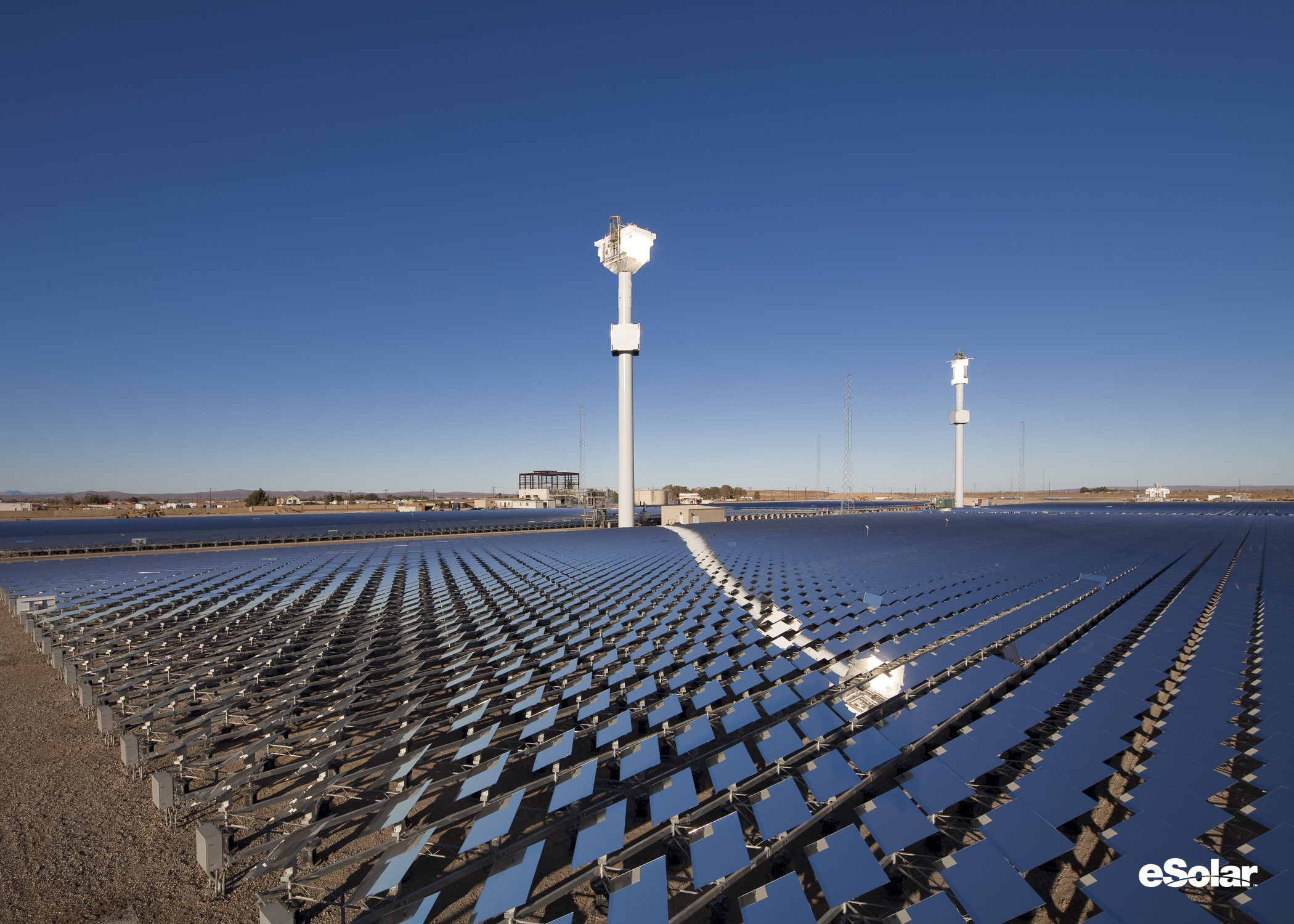
photo: eSolar

In Saturday’s Los Angeles Times, I write about a ground-breaking solar thermal deal struck by eSolar of Pasadena, Calif., to build two gigawatts of power plants in China over the next decade:

ESolar Inc. of Pasadena signed an agreement Friday to build a series of solar thermal power plants in China with a total capacity of 2,000 megawatts, in one of the largest renewable energy deals of its kind.

Coming four months after an Arizona company, First Solar, secured a contract to build an equally large photovoltaic power plant in China, the ESolar deal signals China’s emergence as a major market for renewable energy.

“They’re moving very fast, much faster than the state and U.S. governments are moving,” said Bill Gross, ESolar’s chairman and the founder of Idealab.

Under the agreement, ESolar will provide China Shandong Penglai Electric Power Equipment Manufacturing Co. the technology and expertise to build solar “power tower” plants over the next decade. Those solar farms would generate a total of 2,000 megawatts of electricity; at peak output that would be equivalent to a large nuclear power plant. The terms of the agreement were not disclosed.

The initial project, which includes a 92-megawatt solar power plant to be built this year, will be located in the 66-square-mile Yulin Energy Park in the Mongolian desert in northern China. The region has become a hot spot for renewable energy, with the 2,000-megawatt First Solar project planned 60 miles to the north.

You can read the rest of the story here.

Read Full Post »

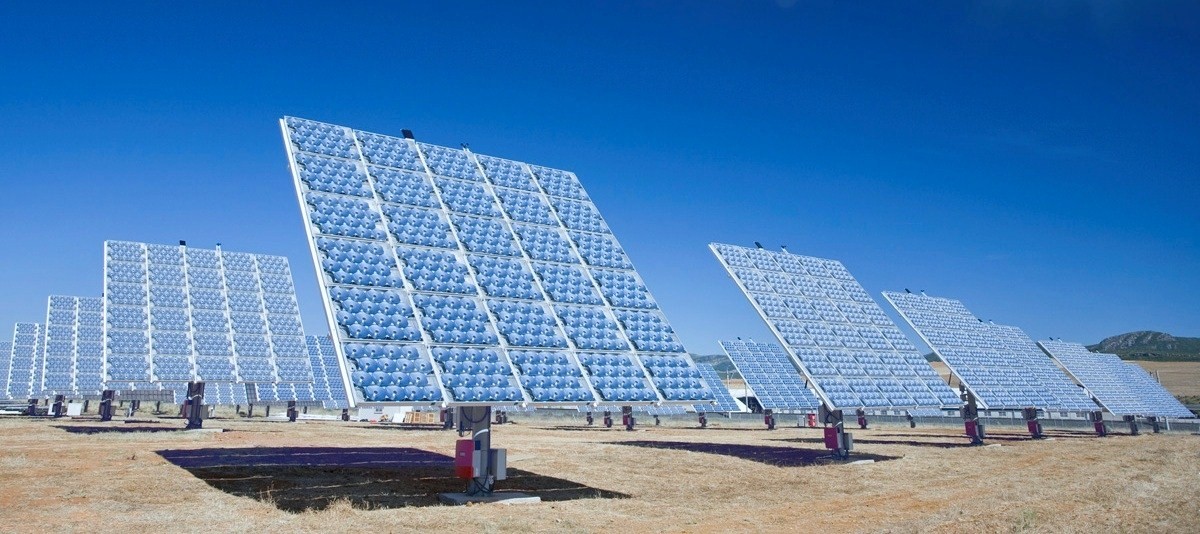
image: SolFocus

In The New York Times on Wednesday, I write about the year-end green tech investing numbers for 2009:

In a flurry of dealmaking bolstered by government subsidies for renewable energy, venture capitalists invested $5.6 billion in green technology companies worldwide in 2009, according to a preliminary report released Wednesday by the Cleantech Group and Deloitte.

That represents a 33 percent drop over the $8.5 billion invested in 2008 — a reflection, the report said, of the global economic downturn. But the overall amount of venture capital fared much worse, retreating to 2003 levels, according to the report, whereas clean technology investments were on track to match 2007 levels.

“In 2009, clean-tech went from a niche category to become the dominant category in venture capital investing,” said Dallas Kachan, managing director of the Cleantech Group, a San Francisco market research and consulting firm. “Clean-tech continued to outpace software and biotech.”

The report’s preliminary survey showed that there were 557 deals in the clean technology space in 2009, compared to 567 deals in 2008 and 488 in 2007.

Solar companies secured $1.2 billion in 2009 — 21 percent of the total and the largest share of venture funding. The biggest deal of the year also went to a solar company, Silicon Valley’s Solyndra, which raised $198 million at the same time it secured a $535 million federal loan guarantee to build a solar module factory.

You can read the rest of the story here.

Read Full Post »

image: Tessera Solar

In a follow-up to my New York Times story Tuesday on Senator Dianne Feinstein’s bill to ban renewable energy production in parts of California’s Mojave Desert, I take a look at some of the incentives in the legislation that could speed green energy projects:

In Tuesday’s Times, I write about Senator Dianne Feinstein’s bill to create two Mojave Desert monuments in California that would ban renewable energy projects on lands that are both coveted for solar farms and valued for their sweeping vistas and populations of rare wildlife.

The mere prospect of the legislation has derailed several massive solar power plants planned by Goldman Sachs and other developers. But Mrs. Feinstein, a California Democrat, has included provisions in the bill that could, if enacted, accelerate renewable energy development and ease tensions over endangered species that are slowing other solar projects outside the monument area.

In a big concession to renewable-energy advocates, Mrs. Feinstein would allow transmission lines to be built through existing utility rights-of-way in the monument to transmit renewable energy from other desert areas to coastal metropolises. That will not likely sit well with some of the senator’s environmental allies. (Nor will a provision that permanently designates areas of the desert for off-road vehicle use.)

The legislation also features a pilot program to assemble huge tracts of land -– at least 200,000 acres — to be used as endangered species habitat to make up for areas lost to renewable energy production.

You can read the rest of the story here.

Read Full Post »

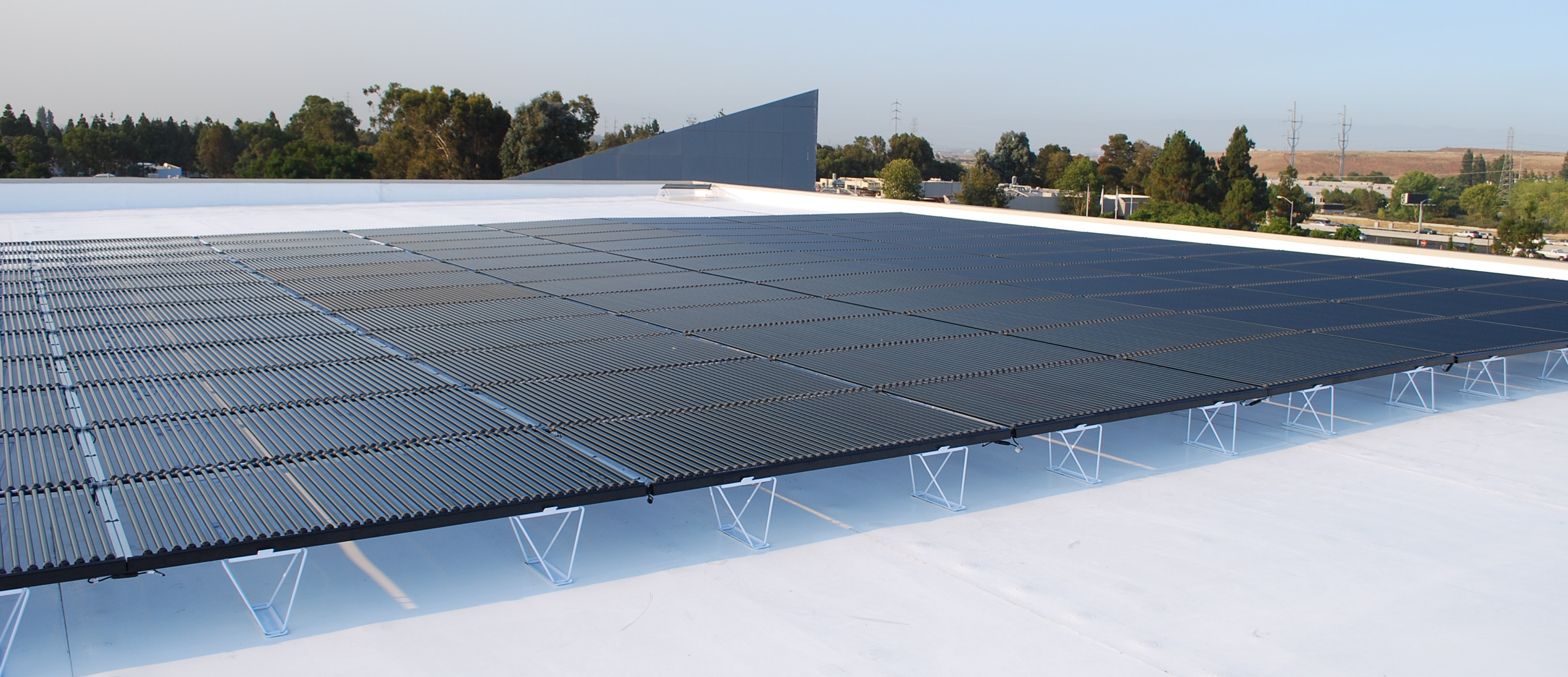
photo: Solyndra

In my Green State column in Grist this week, I talk to Ryan Pletka, a renewable energy expert at engineering and consulting firm Black & Veatch, who has been conducting economic analysis for California’s Renewable Energy Transmission Initiative.  The rapid evolution of the solar market has prompted Pletka to rethink the the need for massive new transmission projects in California:

California’s ambitious goal of obtaining a third of its electricity from renewable sources by 2020 has spawned a green energy boom with thousands of megawatts of solar, wind, and biomass power plants planned for … the middle of nowhere.

And therein lies the elephant in the green room: transmission. Connecting solar farms and geothermal plants in the Mojave Desert and wind farms in the Tehachapis to coastal metropolises means building a massive new transmission system. The cost for 13 major new power lines would top $15.7 billion, according to a report released in August by the state’s Renewable Energy Transmission Initiative.

The initiative, called RETI, is an attempt to build a statewide green grid in an environmentally sensitive way that will avoid the years-long legal battles that have short-circuited past transmission projects.

But the rapidly evolving solar photovoltaic market may moot the need for some of those expensive and contentious transmission lines, requiring transmission planners to rethink their long-term plans, according to Black & Veatch, the giant consulting and engineering firm that does economic analysis for RETI.

In short, solar panel prices have plummeted so much as to make viable the prospect of generating gigawatts of electricity from rooftops and photovoltaic farms built near cities.

“This has pretty significant implications in terms of transmission planning,” Ryan Pletka, Black & Veatch’s renewable energy project manager, told me last week. “What we thought would happen in a five-year time frame has happened in one year.”

You can read the rest of the column here.

Read Full Post »

Photo: Ausra

Ausra has become the latest credit-crunched solar startup to seek a buyer/investor to bankroll its expansion. As I write Tuesday in The New York Times:

Disrupting trillion-dollar energy markets is expensive, as solar companies like OptiSolar and Solel have found. Both sold out to larger, deep-pocketed companies this year.

Now Ausra, a high-profile solar company bankrolled by some of Silicon Valley’s top venture capital firms, has become the latest renewable energy startup to put itself on the block.

Ausra, which makes solar thermal equipment to generate electricity, is in negotiations with three large international companies interested in taking a majority ownership stake in the venture, according to a person familiar with the situation.

The negotiations were first reported by Reuters.

All three potential acquirers are companies that make equipment for conventional power generation. Ausra declined to comment. Founded in Australia to build solar power plants, Ausra relocated to Silicon Valley and secured funding in 2007 from marquee venture capital firms Khosla Ventures, Kleiner Perkins Caufield & Byers and other investors.

Ausra soon filed plans to build one of the first new solar farms in California in 20 years. The company also built a factory in Las Vegas to manufacture long mirror arrays that focus the sun on water-filled tubes to create steam to drive electricity-generating turbines.

But as the credit crunch made building billion-dollar solar power plants an increasingly dicey proposition, Ausra switched gears earlier this year to focus on supplying solar thermal equipment to other developers.

You can read the rest of the story here.

Read Full Post »

artist_picture_of_project

Image: SolarReserve

Ok, I’m exaggerating a bit in the headline above but we’re getting closer to solar farms that will provide baseload power, operating at night and under cloudy conditions. As I write on Tuesday in The New York Times:

The holy grail of renewable energy is a solar power plant that continues producing electricity after the sun goes down.

A Santa Monica, Calif., company called SolarReserve has taken a step toward making that a reality, filing an application with California regulators to build a 150-megawatt solar farm that will store seven hours’ worth of the sun’s energy in the form of molten salt.

Heat from the salt can be released when it’s cloudy or at night to create steam that drives an electricity-generating turbine.

The Rice Solar Energy Project, to be built in the Sonoran Desert east of Palm Springs, will “generate steady and uninterrupted power during hours of peak electricity demand,” according to SolarReserve’s license application.

So-called dispatchable solar farms would in theory allow utilities to avoid spending billions of dollars building fossil fuel power plants that are fired up only a few times a year when electricity demand spikes, like on a hot day.

SolarReserve is literally run by rocket scientists, many of whom formerly worked at Rocketdyne, a subsidiary of the technology giant United Technologies. Rocketdyne developed the solar salt technology, which was proven viable at the 10-megawatt Solar Two demonstration project near Barstow, Calif., in the 1990s.

You can read the rest of the story here.

Read Full Post »

img_2914

photo: Todd Woody

California utility PG&E on Monday announced two new Big Solar deals that will likely to ramp up the debate over solar thermal power plants’ thirst for water in the desert Southwest. As I write in The New York Times:

The West’s water wars are likely to intensify with Pacific Gas and Electric’s announcement on Monday that it would buy 500 megawatts of electricity from two solar power plant projects to be built in the California desert.

The Genesis Solar Energy Project would consume an estimated 536 million gallons of water a year, while the Mojave Solar Project would pump 705 million gallons annually for power-plant cooling, according to applications filed with the California Energy Commission.

With 35 big solar farm projects undergoing licensing or planned for arid regions of California alone, water is emerging as a contentious issue.

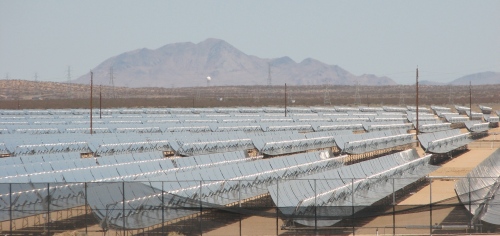
The Genesis and Mojave projects will use solar trough technology that deploys long rows of parabolic mirrors to heat a fluid to create steam that drives an electricity-generating turbine. The steam must be condensed back into water and cooled for re-use.

Solar trough developers prefer to use so-called wet cooling in which water must be constantly be replenished to make up for evaporation. Regulators, meanwhile, are pushing developers to use dry cooling, which takes about 90 percent less water but is more expensive and reduces the efficiency –- and profitability – of a power plant.

NextEra Energy Resources, a subsidiary of the utility giant FPL Group, is developing the Genesis project in the Chuckwalla Valley in the Sonoran Desert. The twin solar farms would tap about 5 percent of the valley’s available water.

You can read the rest of the story here.

Read Full Post »

« Newer Posts - Older Posts »

Design a site like this with WordPress.com
Get started