Feeds:
Posts
Comments

Archive for the ‘energy’ Category

photo: REC Solar

I wrote this story for Grist, where it first appeared.

Every time I fly over Phoenix, Las Vegas, or some other sprawling sun-scorched Southwest city, two thoughts come to mind: Who had the bright idea of putting black shingles on all those desert subdivisions, and why aren’t those roofs covered in solar panels?

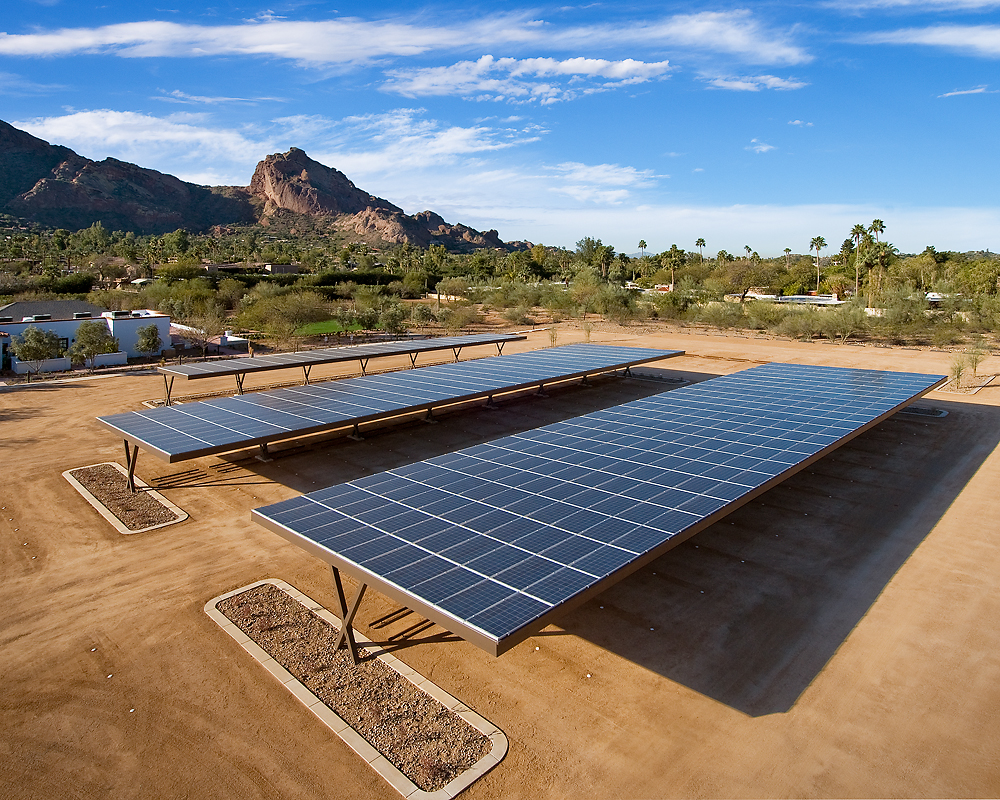
Apparently the administrators at the Southern Arizona VA Health Care System in Tucson had the same idea. This week REC Solar, a California company, announced a deal to install a 2.9-megawatt photovoltaic array on the hospital’s carports. That’s in addition to the 302-kilowatt system ground-mounted system REC Solar currently is building for the veteran’s hospital.

At 2.9 megawatts, the new parking lot installation will apparently be the nation’s largest solar carport complex and will supply a big chunk of the 900,000-square foot facility’s electricity demand. (At peak output, an array of that size would be able to supply electricity to roughly 3,000 average-sized homes, provided their owners didn’t run the air conditioning 24/7.)

The solar panels generate electricity while the carports will help to keep the vehicles underneath cooler. Three years ago, Google put solar panels on carports at its sprawling Silicon Valley headquarters and then installed electric car charging stations in the parking spaces. A San Diego company called Envision Solar builds “solar groves” — tree-like carports with solar panel canopies — in parking lots for companies such as Dell.

While the Arizona deal highlights the opportunity to generate clean electricity from parking lots — those vast wastelands that symbolize the nation’s oil addiction — it also underscores the government’s role in driving demand and creating a market for green technology.

While the Obama administration has doled out billions of dollars in stimulus money for renewable energy projects, it has also directed federal agencies to practice what it preaches. That means increasing the energy efficiency of the government’s own huge real estate holdings, replacing federal automotive fleets with cars that run on alternative fuels, and generating electricity from renewable energy.

As I wrote earlier this week, the United States military has become one of the biggest green forces. The Navy, for instance, is aiming to cut its dependence on fossil fuels in half by 2020 by converting ships to run on electric hybrid propulsion systems, fueling fighter jets with biofuels, and installing everything from smart meters to solar arrays at all naval bases.

In other words, there’s a lot of government carports out there ready to go solar.
Read Full Post »

photo: NRDC

I wrote this story for Grist, where it first appeared.

The climate war has shifted to California.

Proposition 23, an initiative that would suspend Assembly Bill 32 (AB 32), the state’s landmark global warming law, provides the first ballot box test for climate change legislation — and for the prospects of reviving a national cap-and-trade bill.

So far, much of the media attention has focused on Prop 23’s funding. It’s being underwritten by the Texas oil companies Tesoro and Valero along with other mostly out-of-state petrochemical and fossil fuel interests. Prop 23 supporters have contributed more than $6.5 million to the campaign.

But a review of opposition fundraising — for the No on 23 campaign — offers a revealing look at what amounts to a fight for the future, a struggle between the industrial behemoths of the old fossil fuel economy and a startup coalition of environmental groups, Silicon Valley technology companies, financiers, and old-line corporations looking to profit from decarbonizing California.

“The choice that is before California is between the new clean economy versus the dirty old economy,” says Annie Notthoff, California advocacy director for the Natural Resources Defense Council. “The Silicon Valley folks who are willing to invest in the new clean energy economy with their dollars are tangible evidence that this is an economic issue as well as an environmental one.”

The NRDC has emerged as one of the key fundraisers, funneling more than a million dollars to the No on 23 campaign to date. Big green groups such as NRDC and the Environmental Defense Fund took the lead on forging alliances with Fortune 500 companies in the unsuccessful effort to pass national climate change legislation. In contrast, the heavy hitters in California’s Prop 23 battle are green tech entrepreneurs and venture capitalists, who have traditionally shied away from electoral politics.

The last stand for climate change has brought John Doerr, a leading green tech investor with Kleiner Perkins Caufield & Byers, to the table. Doerr has given $500,000 to defeat Prop 23. And he’s not alone.

Wendy Schmidt, founder the 11th Hour Project, a Silicon Valley environmental grant-making nonprofit (and wife of Google chief executive Eric Schmidt), donated $500,000 to NRDC’s No Prop 23 Committee. (Disclosure: The Schmidt Family Foundation is a financial supporter of Grist’s, and Wendy Schmidt is a member of the Grist Board.)

Google itself hasn’t contributed to the No campaign, but last week the search giant’s green energy chief, Bill Weihl, assured a gathering at the company’s Silicon Valley headquarters that, “We’re strongly behind the No on 23 campaign” and the global warming law, known as AB 32.

When asked about Google’s potential financial support for the No campaign, company spokesperson Parag Chokshi said, “Google has been a very strong supporter of AB 32 and wants it to be implemented. We’ll continue to monitor the situation as we move forward.”

To date, the heaviest hitter on Team No is Thomas Steyer, the press-shy founder of San Francisco hedge fund Farallon Capital Management. Steyer, a big donor to Democratic candidates, has pledged $5 million and stepped forward to co-chair the No on 23 Committee with George Schulz, the Republican former secretary of state.

“I personally come at this issue as a businessperson who cares about the economic future of California as well as the environmental and security issues here,” Steyer said on a conference call late last month. “The right way to frame this is that we have a fairly stark choice to either move forward or turn back the clock.”

“We have 12,000 companies in California working on clean energy already,” he added. “It’s going to be one of the dominant spaces in the world and for us to excel and lead in this area we need a consistent regulatory framework for investment.”

Yet another mainstream investor is Robert Fisher, former chair of The Gap, the San Francisco-based clothing empire. Like Schmidt, Fisher has put up a half million dollars for the NRDC fund. And Southern California investor Anne Getty Earhart, an heir to the Getty oil fortune, donated $250,000 directly to the No campaign.

“What makes this unusual is that this is not your classic tree-huggers-versus-big business battle,” says Steve Maviglio, a longtime California Democratic operative and the chief spokesperson for the No on Prop 23 campaign. “Environmentalists, dyed-in-the-wool businessmen, tech companies — they have all been very active in fundraising, active on the lecture circuit and before editorial boards.”

You can read the rest of the story here.

Read Full Post »

photo: Todd Woody

In a followup to my story in Wednesday’s New York Times about recycling farmland and toxic waste sites for renewable energy projects, I take a deeper dive into why some farmers in the California’s San Joaquin Valley want to stop raising crops and start growing electrons:

In an article in The New York Times on Wednesday, I wrote about an ambitious plan to build one of the world’s largest solar energy complexes on 30,000 acres of farmland in the San Joaquin Valley of California.

Elsewhere, big renewable energy projects have encountered opposition from farmers, ranchers and environmentalists who worry about the impact of solar power plants on agriculture, wildlife and scarce water supplies.

But farmers in the San Joaquin Valley’s Westlands Water District are embracing solar power as a solution to their water woes. And environmental groups are backing the project as a way to avoid fights over building solar power plants in pristine desert areas.

In the 1960s, the west side of the San Joaquin Valley was transformed from a desert to one of the nation’s most productive agricultural centers thanks to a huge irrigation project that transports water from Northern California and distributes it to 600,000 acres of farmland through 1,034 miles of underground pipes.

Decades of irrigation and drainage problems led to a buildup of salt in the soil that forced the water district to spend $100 million to acquire and retire 100,000 acres of land from most agricultural production. Drought and environmental disputes over the impact of water diversions on endangered fish, meanwhile, slashed water deliveries to Westlands farmers.

The water district hopes to make money off salt-contaminated land by providing an initial 12,000 acres to Westside Holdings, a firm that has proposed building a 5,000-megawatt photovoltaic power complex called the Westlands Solar Park.

And farmers like Mark Shannon have agreed to lease their parched land to Westside, reluctantly concluding there’s more money to be made by growing electrons than crops.

“Last year, we received only 10 percent of our water supply and we idled 85 percent of this ranch,” said Mr. Shannon of the 5,300-acre property that his family has farmed for three generations. “My dad is 67 and I can’t believe how many times I’ve called him and he’s in tears — he just always figured he’d pass this land on to me.”

Mr. Shannon took me up in a small plane for a bird’s-eye view of the impact of the water crisis on his land, where brown fields surround green patches of almonds and pistachios. Beyond his farm are dry lands that stretch to the horizon, property owned by the Westlands Water District and taken out of irrigated production.

“Last year, we had over 250,000 acres in the district that didn’t get farmed,” said Sarah Woolf, a Westlands spokeswoman. “Then you have drainage issues coupled with the long-term reliability of the water supply.”

Desperate farmers have been spending millions of dollars drilling hundreds of deep groundwater wells, which in turn has caused subsidence problems.

In other parts of California, the prospect of covering square miles of farmland with solar panels has stirred outrage among some rural residents. But Mr. Shannon and Westlands officials don’t expect any significant opposition in the San Joaquin Valley.

The reason: if farmers such convert their land to solar farms, their water allocations will be redistributed to their neighbors.

You can read the rest of the story here.

Read Full Post »

photo: Todd Woody

In Wednesday’s New York Times, I write about a growing movement to repurpose farmland and toxic waste sites for big renewable energy projects:

LEMOORE, Calif. — Thousands of acres of farmland here in the San Joaquin Valley have been removed from agricultural production, largely because the once fertile land is contaminated by salt buildup from years of irrigation.

But large swaths of those dry fields could have a valuable new use in their future — making electricity.

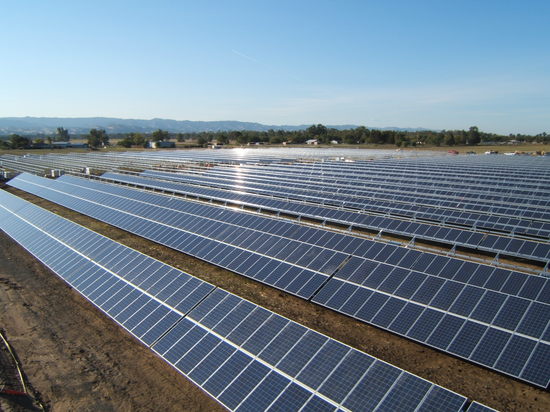
Farmers and officials at Westlands Water District, a public agency that supplies water to farms in the valley, have agreed to provide land for what would be one of the world’s largest solar energy complexes, to be built on 30,000 acres.

At peak output, the proposed Westlands Solar Park would generate as much electricity as several big nuclear power plants.

Unlike some renewable energy projects blocked by objections that they would despoil the landscape, this one has the support of environmentalists.

The San Joaquin initiative is in the vanguard of a new approach to locating renewable energy projects: putting them on polluted or previously used land. The Westlands project has won the backing of groups that have opposed building big solar projects in the Mojave Desert and have fought Westlands for decades over the district’s water use. Landowners and regulators are on board, too.

“It’s about as perfect a place as you’re going to find in the state of California for a solar project like this,” said Carl Zichella, who until late July was the Sierra Club’s Western renewable programs director. “There’s virtually zero wildlife impact here because the land has been farmed continuously for such a long time and you have proximity to transmission, infrastructure and markets.”

Recycling contaminated or otherwise disturbed land into green energy projects could help avoid disputes when developers seek to build sprawling arrays of solar collectors and wind turbines in pristine areas, where they can affect wildlife and water supplies.

The United States Environmental Protection Agency and the National Renewable Energy Laboratory, for instance, are evaluating a dozen landfills and toxic waste sites for wind farms or solar power plants. In Arizona, the Bureau of Land Management has begun a program to repurpose landfills and abandoned mines for renewable energy.

In Southern California, the Los Angeles Department of Water and Power has proposed building a 5,000-megawatt solar array complex, part of which would cover portions of the dry bed of Owens Lake, which was drained when the city began diverting water from the Owens Valley in 1913. Having already spent more than $500 million to control the intense dust storms that sweep off the lake, the agency hopes solar panels can hold down the dust while generating clean electricity for the utility. A small pilot project will help determine if solar panels can withstand high winds and dust.

“Nothing about this is simple, but it’s worth doing,” Austin Beutner, the department’s interim general manager, said of the pilot program.

All of the projects are in early stages of development, and many obstacles remain. But the support they’ve garnered from landowners, regulators and environmentalists has attracted the interest of big solar developers such as SunPower and First Solar as well as utilities under pressure to meet aggressive renewable energy mandates.

Those targets have become harder to reach as the sunniest undeveloped land is put off limits.

Last December, Senator Dianne Feinstein, Democrat of California, introduced legislation to protect nearly a million acres of the Mojave Desert from renewable energy development.

But the senator’s bill also includes tax incentives for developers who build renewable energy projects on disturbed lands.

For Westlands farmers, the promise of the solar project is not clean electricity, but the additional water allocations they will get if some land is no longer used for farming.

“Westlands’ water supply has been chronically short over the past 18 years, so one of the things we’ve tried to do to balance supply and demand is to take land out of production,” said Thomas W. Birmingham, general manager of the water district, which acquired 100,000 acres and removed the land from most agricultural production. “The conversion of district-owned lands into areas that can generate electricity will help to reduce the cost of providing water to our farmers.”

You can read the rest of the story here:

Read Full Post »

Image: Google

I wrote this story for Grist, where it first appeared.

Google is officially in the green energy business. The search giant announced on Tuesday that its Google Energy subsidiary signed a 20-year power purchase agreement with NextEra Energy. Google will begin buying 114 megawatts of electricity from an Iowa wind farm on July 30.

Google, of course, cannot directly use the clean green energy generated by the wind farm; that power goes into the local grid. So Google Energy will sell the power on the regional spot market, where utilities and electricity retailers go to buy power when demand spikes and they have a shortfall. Google will use the revenue from spot market sales to buy renewable energy certificates (RECs) which will offset its greenhouse gas emissions.

Many companies buy RECs in an attempt to be carbon neutral, obtaining them from third-party brokers. But by purchasing RECs directly tied to the renewable energy it is also buying, Google is getting a bigger bang for its buck.

“By contracting to purchase so much energy for so long, we’re giving the developer of the wind farm financial certainty to build additional clean energy projects,” Urs Hoelzle, Google’s senior vice president for operations, wrote on a blog post Tuesday.

“The inability of renewable energy developers to obtain financing has been a significant inhibitor to the expansion of renewable energy,” he added. “We’ve been excited about this deal because taking 114 megawatts of wind power off the market for so long means producers have the incentive and means to build more renewable energy capacity for other customers.”

In a statement on its site, Google also noted that its motivations for signing long-term renewable energy contracts are not entirely altruistic.

“Through the long term purchase of renewable energy at a predetermined price, we’re partially protecting ourselves against future increases in power prices,” the company stated. “This is a case where buying green makes business sense.”

It remains to be seen how big a green power purchaser Google will become. (The company has also invested directly in a wind project built by NextEra Energy, the biggest American wind power producer.)

But Dan Reicher, Google.org director of climate change and energy programs, told me earlier this year that finding clean ways of powering Google’s massive data centers led in part to the establishment of Google Energy.

“This interest in procuring green electrons is part of what’s driven Google Energy,” he said.

Read Full Post »

Image: Solexant

I wrote this post for Grist, where it first appeared.

Back in the 1980s and ’90s, the region surrounding Portland was dubbed the Silicon Forest for the cluster of computer chip companies that had flocked to Oregon to set up shop.

Now those old-growth tech companies are giving way to a new generation of solar startups that are sprouting up around Portland’s green metropolis, sometimes in old semiconductor factories that have been revamped to produce photovoltaic modules.

Germany’s SolarWorld built the United States’ largest solar module plant in the Portland suburb of Hillsboro in 2008, and on Tuesday Silicon Valley company, Solexant, announced it will open its first commercial factory in the area.

The facility will be Oregon’s first thin-film solar module plant. As the name implies, thin-film solar cells are essentially printed on flexible metal or other materials. Although such technology is less efficient at converting sunlight into electricity than standard crystalline silicon cells made by companies like SolarWorld, thin-film solar’s great promise is that solar cells can be made cheaper, which will lower the cost of photovoltaic power.

Solexant describes itself as a third-generation thin-film solar company. It has revealed few details about its technology other than it has developed a “nanocrystal ink” to make higher efficiency solar cells at a lower cost than its competitors. The technology was first developed at the Lawrence Berkeley National Lab in California.

Investors clearly think the San Jose startup is on to something. Last month, the company raised a $41.5 million round of funding.

To lure Solexant north, Oregon has offered the company a $25 million loan and an $18.75 million tax credit to help build a factory in Gresham, east of Portland. The plant will produce 100 megawatts’ worth of solar modules a year and employ up to 200 people, according to Solexant. (The company currently operates a two-megawatt pilot production line in San Jose.) In exchange for the tax credit, Solexant has agreed that 97 of the new plant’s 200 jobs will go to county residents.

“We are pleased to welcome Solexant to Oregon, North America’s leading solar manufacturing center,” Gov. Ted Kulongoski said in a statement. “This investment will mean jobs immediately for Oregonians with the promise of more in the future. In addition, this company brings a new technological facet to Oregon’s already booming solar manufacturing base and will help us continue to be a global leader in solar manufacturing.”

Read Full Post »

In The New York Times on Wednesday, I wrote that California Attorney General Jerry Brown has filed a lawsuit against Fannie Mae and Freddie Mac over the mortgage giants’ quashing of the PACE solar loan program:

The California attorney general’s office on Wednesday sued Fannie Mae and Freddie Mac over actions by the mortgage finance companies that have derailed a popular financing program that allows homeowners to pay for energy efficiency improvements through a surcharge on their property taxes.

This month, the Federal Housing Finance Agency, which oversees Fannie and Freddie, issued guidelines to lenders that restricted the ability of homeowners to participate in the financing programs, called Property Assessed Clean Energy, or PACE. Twenty-two states have authorized the programs, which have drawn $150 million in stimulus funding support from the Obama administration.

When a city or state pays for energy efficiency upgrades through the program, a lien is placed on the home. The liens, like other property tax assessments, take priority over the mortgage if the homeowner defaults. The housing agency instructed lenders that they could not accept such PACE liens.

In recent months, some banks have declined to refinance mortgages for homes that carry the liens.

In the lawsuit, filed in United States District Court in Oakland, Calif., Jerry Brown, the California attorney general and Democratic candidate for governor, asked that the court declare that participation in PACE programs does not violate the standards of Fannie and Freddie, which are government chartered. The suit also asks that an injunction be issued to prevent them from taking action against homeowners whose properties have PACE liens.

The Federal Housing Finance Agency was also named as a defendant.

The suit alleges that the housing agency’s actions violated California law, which authorizes PACE programs, and are “severely hampering California’s efforts to assist thousands of California homeowners to reduce their energy and water use, help drive the state’s green economy, and create significant numbers of skilled, stable and well-paying jobs.”

“The actions of these government-sponsored, shareholder-owned private corporations have placed California’s PACE programs – and the hundreds of millions of dollars in federal stimulus money supporting them – at immediate risk while benefiting their own pecuniary interests,” the suit states.

You can read the rest of the story here.

Read Full Post »

In The New York Times on Wednesday, I write about the return of J.R. Ewing, the oil tycoon villain of the “Dallas” television show. Except this time, he’s pushing solar energy:

J.R. Ewing returns to the small screen on Tuesday, and the boys down at the Cattleman’s Club just might need a double bourbon when they hear what he has to say.

Larry Hagman, the actor who played the scheming Texas oilman on the long-running television show “Dallas,” is reprising his role as J.R. in an advertising campaign to promote solar energy and SolarWorld, a German photovoltaic module maker.

“In the past it was always about the oil,” Mr. Hagman says in a TV commercial that is being unveiled Tuesday at the Intersolar conference in San Francisco.

“The oil was flowing and so was the money. Too dirty, I quit it years ago,” he growls as he saunters past a portrait of a grinning J.R. in younger days and a wide-screen television showing images of an offshore oil rig and blackened waters.

Doffing a 10-gallon hat, he heads outside into the sunshine and gazes at a solar array on the roof of the house. “But I’m still in the energy business. There’s always a better alternative.”

“Shine, baby shine,” he says with his trademark J.R. cackle.

In real life, Mr. Hagman, 78, lives on an estate in the Southern California town of Ojai where he installed a massive 94-kilowatt solar system, thought to be the world’s largest residential array, several years ago.

You can read the rest of the story here.

Read Full Post »

I wrote this post for Grist, where it first appeared.

As the Great Recession drags on in California — unemployment rate: 12.4 percent, state government in a state of collapse — the solar boom continues.

The Golden State’s decade-long program to install 3,000 megawatts of photovoltaic arrays on residential and commercial rooftops kicked off in 2007, not too long before the global economic collapse began.

Only three years in, the program — known as the California Solar Initiative — has achieved 42 percent of its 1,750 megawatt target in markets served by the state’s three, big investor-owned utilities, according to a report released Friday by the California Public Utilities Commission. Completed projects account for 20 percent of that 42 percent figure, while another 22 percent are pending installations. (In 2009, the solar program eliminated 180,136 tons of carbon, the equivalent of taking 31,000 cars off the road.)

Demand for solar is accelerating even as the housing market remains in the doldrums. Applications for the solar rebate program hit a high of 134 megawatts in April, and in the first six months of 2010 a total of nearly 300 megawatts’ worth of projects were received.

“The monthly demand for new applications has been well over 1,000 applications per month for the past year,” the report stated.

And Californians’ appetite for solar has grown even as the rebate for new photovoltaic systems has declined, as it is designed to do over the life of the program.

State and federal tax incentives have cut the cost of a solar array roughly in half. And last year’s global glut of photovoltaic modules and the influx of Chinese solar companies into the U.S. market has led to drops in the price of solar panels. (Installation costs still account for about half the price of a solar array.) Overall, the cost of solar systems smaller than 10 kilowatts has dropped by 15 percent between 2007 and 2010 while the price of bigger arrays has fallen 10 percent, according to a report released Friday by the California Public Utilities Commission. (In general, a 10-kilowatt solar array could power a large home or commercial building.)

But one of the biggest factors persuading Californians to go solar appears to be the increasing availability of solar leases. These financial arrangements allow homeowners to have a system installed at little or no upfront cost in exchange for a monthly fee.

Companies such as SolarCity, Sungevity, and SunRun offer solar leases and retain ownership of the rooftop arrays. In 2009, such ownership of solar systems enrolled in the state program jumped 155 percent. Forty percent of the megawatts now generated through the program are owned by leasing companies or other third parties.

Fueling that trend has been the hundreds of millions of dollars that financial giants such as U.S. Bancorp have poured into solar financing funds for SolarCity, Sungevity, and SunRun. So far this year, PG&E Corporation, the parent company of California utility PG&E, has created funds totaling $160 million to finance solar leases for SolarCity and SunRun customers.

Read Full Post »

photo: PG&E

I wrote this post for Grist, where it first appeared.

Amid the hullabaloo over government-chartered mortgage giants derailing the green financing program known as Property Assessed Clean Energy, or PACE, the march toward distributed generation of renewable energy — that is, generating electricity from decentralized sources such as rooftop solar panels or backyard wind turbinescontinues.

Case in point: The Sacramento Municipal Utility District (SMUD) announced Wednesday that it had awarded contracts to San Francisco’s Recurrent Energy to install 60 megawatts’ worth of solar panels in the region surrounding California’s state capital.

Rather than construct a central solar power station, Recurrent will scatter a dozen five-megawatt installations around two cities in Sacramento County. Each installation will be located near an existing substation, which means that the solar arrays can be plugged directly into the grid without requiring any expensive transmission upgrades.

As I wrote earlier this year in Grist, when SMUD put 100 megawatts of renewable energy contracts out for bid, the allocation sold out within a week. The utility is paying the solar developers a standard premium for their photovoltaic energy — called a feed-in-tariff. But according to calculations done by Vote Solar, a San Francisco non-profit that promotes solar energy, SMUD will pay no more for this clean green solar electricity than it does for fossil-generated power at peak demand times. A 40-percent plunge in solar module costs over the past year has made solar photovoltaic energy increasingly competitive with natural gas, the main fossil fuel used in California to generate electricity.

California’s two big investor-owned utilities, PG&E and Southern California Edison, have launched similar distributed generation programs, which will bring 1,000 megawatts of photovoltaic installations online over the next five years. At peak oputput, that’s the equivalent of a nuclear power plant.

Two weeks ago, PG&E cut the ribbon on the first project to come online as part of its 500-megawatt distributed generation initiative. The two-megawatt Vaca-Dixon Solar Station is built near a utility substation 50 miles north of San Francisco.

It took just nine months to install the fields of solar panels for the Vaca-Dixon station — that’s light speed in a state where the first new big solar thermal power plant in 20 years, BrightSource Energy’s Ivanpah project, has been undergoing licensing for nearly three years.

Solar thermal power plants generate electricity by using mirrors to focus the sun on a liquid-filled boiler. The process creates create steam that drives a conventional turbine which can generate hundreds of megawatts of electricity. Solar thermal projects, by nature, are large centralized facilities, the clean and green versions of a big fossil-fuel power plant.

Photovoltaic farms, on the other hand, generate electricity when sunshine strikes semiconducting materials in a solar cell. If you want to produce more power, you just keep adding solar panels.

While BrightSource hopes to secure a license for its solar thermal project soon, the developer of a hybrid biomass solar trough power plant to be built in California’s Central Valley pulled the plug on the project last month, after spending 18 months and untold millions of dollars in the licensing process before the California Energy Commission.

PG&E has been depending on both those solar thermal projects to supply electricity to help it meet its renewable energy mandates. No wonder then, the utility’s growing enthusiasm for solar panel power. Photovoltaic farms do not have to be approved by California Energy Commission and can be built on already degraded land or close to cities.

And as I reported last month, the developer of another project being built to generate electricity for PG&E, the Alpine SunTower, decided to drop solar thermal technology made by its partner, eSolar, in favor of photovoltaic panels. The official explanation for the switch was that project was being downsized due to transmission constraints and solar panels proved a better fit.

But one has to wonder if economics as much as energy was behind the change. If so, deals like the one SMUD struck could be a recurrent theme.

Read Full Post »

« Newer Posts - Older Posts »

Design a site like this with WordPress.com
Get started