Feeds:
Posts
Comments

Archive for the ‘energy’ Category

The risky nature of Big Solar projects has been driven home with California regulators’ move to kill a controversial $1.3 billion transmission line that would have connected massive solar power stations in the desert to coastal cities.

“These projects are unlikely to proceed,” wrote Jean Vieth, an administrative law judge with the California Public Utilities Commission, in a ruling rejecting San Diego Gas & Electric’s Sunrise Powerlink transmission line.

Phoenix-based Stirling Energy Systems in 2005 scored a contract to provide SDG&E (SRE) with up to 900 megawatts of electricity to be generated by as many as 36,000 solar dishes. A few months later, the utility filed an application to build the Sunrise Powerlink, a new transmission line to connect the Stirling power plants and other renewable energy projects to the coast.

But the utility’s proposal to build 150-foot-high transmission towers right through wilderness areas of Anza-Borrego State Park, home to a host of protected species, triggered a long-running fight with green groups that generated an 11,000-page environmental impact report. On Halloween, Vieth issued a ruling that found that despite state mandates to cut greenhouse gas emissions, the environmental impact of the transmission project was frightening.

“The potentially high economic costs to ratepayers and the potential implications for our [greenhouse gas] policy objectives do not justify the severe environmental damage that any of the transmission proposals would cause,” concluded Vieth in a 265-page decision.

The battle isn’t over — the public utilities commission will vote in December whether to accept the judge’s ruling. They will also consider an alternative decision issued by a commissioner assigned to review the case. That decision would let SDG&E build a transmission line along a different route under certain conditions.

But the case highlights the conflicting environmental values that will dog solar power projects. In other words, just what trade-offs are we willing to make to secure a planet-friendly source of energy? In this case, the judge ruled that to avoid the environmental damage of a massive new transmission line, the preferred alternative is to build more fossil-fuel plants close to San Diego along with a smaller-scale solar power station and a huge increase in rooftop solar arrays. The judge acknowledged that such an alternative “would cause substantially more GHG emissions than the proposed project and other transmission proposals.”

The judge’s second preferred alternative was to build only renewable-energy projects near San Diego that would not require big new transmission lines. Some Sunrise Powerlink opponents argue that San Diego has enough roof space to generative massive amounts of electricity from photovoltaic solar panels. (The cost of such an undertaking was left unsaid.)

Public Utilities Commissioner Dian Grueneich’s alternative decision would allow San Diego Gas & Electric to build Sunrise Powerlink along a more environmentally-benign route if the utility could prove that most of the transmission line would carry renewable energy so as to offset the 100,000 tons of greenhouse gases emitted during its construction. “Reliance on a single 900-megawatt contract (the Stirling Energy Systems contract) is too risky,” she wrote.

So where does this leave Stirling? COO Bruce Osborn didn’t immediately respond to a request for comment. But earlier this year, he told Green Wombat that even if Sunrise Powerlink was killed, there’s enough existing transmission capacity to carry electricity from the power plant’s first 300-megawatt phase. Stirling also has a 20-year contract to supply up to 850 megawatts of electricity to utility Southern California Edison (EIX), a deal not contingent on Sunrise Powerlink.


Read Full Post »

The economy may be all trick and no treat, but you wouldn’t know it from First Solar, one of the few public solar cell makers and thus a bellwether for the industry. This week the Tempe, Ariz.-based company reported solid third-quarter earnings and unveiled two deals that mark a big expansion in the U.S. market.

It agreed to supply solar installer SolarCity with 100 megawatts of thin-film modules and made a $25 million investment in the Silicon Valley startup – which represents a 10% stake, valuing SolarCity at $250 million. The other deal didn’t get much attention – it was buried in the earnings report – but is significant nonetheless. First Solar (FSLR) will team up with utility giant Edison International (EIX)‘s power plant subsidiary, Edison Mission Energy, to develop large-scale solar power stations. (First Solar just completed a 2.4 megawatt project for Southern California Edison as part of the utility’s 250-megawatt commercial rooftop initiative and will finish by year’s end a 12-megawatt solar power plant in Nevada for Sempra (SRE).)

“By combining Mission’s extensive track record of power project development with First Solar’s low-cost systems and construction capability, we believe we’ve created a powerful engine for future growth in the U.S. utilities segment,” First Solar CEO Mike Ahearn said during the company’s earnings call Wednesday, according to a transcript published by the Seeking Alpha business blog.

But it was Ahearn’s comments on the European market – 85% of First Solar’s business is in Germany, for instance – that is of most interest to investors.

While he predicts the European market will remain strong – First Solar expects its 2009 net sales to range from $2 billion to $2.1 billion, up from $1.22 to $1.24 for 2008 – he did note some red flags, particularly for utility-scale solar power stations.

“Our review indicates that solar projects lending outside of Germany has essentially stopped for the time being,” Ahearn said. “Today, we have identified potential financial risk in our customer base that represent approximately 15% to 20% of our planned sales in Europe in 2009.”

“We believe most of our European customers outside of Germany have sufficient balance sheet strength to bridge any near-term projects delays,” he added.

During the Solar Power International conference in San Diego this month, there was much buzz that solar companies that had ramped up their production capacity over the past couple of years would be hit by an oversupply of solar modules just as customers get crunched by the credit crisis.

But Ahearn told analysts on Wednesday that First Solar’s thin-film modules – which are made by depositing solar cells on plates of glass and use minimal amounts of expensive silicon – would continue to sell for less than conventional cells and thus remain attractive to customers. “We therefore assume that any price competition is unlikely to have a sustained impact on First Solar,”  he said.

Despite First Solar’s moves into the U.S. market, Ahearn acknowledged the immediate future is uncertain. While Congress extended a key investment tax credit for eight years as part of the financial bailout package, investors have lost their appetite for tax equity partnerships that would buy those credits from solar companies in exchange for financing the construction of power plants.

“In the short-term, our review indicates that the traditional investors in tax equity – financial institutions – have largely stopped participating,” Ahearn said. “We assume some of these investors will return to the market in 2009, but the timing and future cost of this funding is difficult to predict. The possibility of more expensive tax equity and its impact on solar electricity prices for both new and pending projects remains a major uncertainty going into 2009.”

Read Full Post »

In a move that will bring thin-film solar panels to the U.S. residential market, First Solar has signed a deal to provide installer SolarCity with 100 megawatts’ worth of solar arrays over the next five years. First Solar is also investing $25 million into SolarCity, the Silicon Valley startup backed by Tesla Motors founder Elon Musk.

This is First Solar’s initial foray into the home market — and apparently the first of any thin-film solar module maker. Thin-film solar panels are made by depositing solar cells on sheets of glass or flexible material and use little of the expensive silicon that forms the heart of more bulky conventional solar modules. That makes thin-film panels cheaper, although they are less efficient at converting sunlight into electricity. And thin is in for homeowners who prefer less-obtrusive panels on their roofs.

SolarCity CEO Lyndon Rive told Green Wombat that First Solar’s more economical panels will allow the company to expand to the East Coast and other areas that do not heavily subsidize solar. SolarCity installs solar panels at no cost to the homeowner and then leases them back for a monthly charge. “What matters is not efficiency but cost per kilowatt-hour,” Rive says, noting that solar programs like California’s reduce rebates to panel makers as the number of installations increase. “We need solutions that address declining subsidies.”

Added SolarCity communications director Jonathan  Bass: “When we talk to customers their four biggest priorities are cost, cost, cost and aesthetics.”

Beginning in early 2009, SolarCity will start receiving 20 megawatts’ worth of First Solar panels a year. Rive won’t disclose how many megawatts SolarCity currently installs annually, but 20 megawatts would seem to represent a significant expansion of the startup’s operations. Over the past two years, SolarCity has installed solar arrays for 2,500 homes and small businesses and a spokeswoman says the First Solar deal would supply enough panels for about 5,000 homes a year.

The deal also marks a move to diversify on the part of Tempe-Ariz.-based First Solar (FSLR)  — known as the Google (GOOG) of solar for its once-stratospheric stock price. The company, backed by Wal-Mart’s (WMT) Walton family, had primarily focused on the overseas commercial rooftop market. This year though First Solar has signed deals to build thin-film solar power plants for utilities like Southern California Edison (EIX) and Sempra (SRE).

First Solar on Wednesday reported that third quarter revenues rose 30% to $348.7 million from the second quarter and was up 119% from the year-ago quarter. Profit spiked 42% to $99.3 million from the second quarter and increased nearly 116% from a year ago.

Read Full Post »

photo: Ausra

The promise and peril of large-scale renewable energy was on display Thursday as California’s first solar power plant of the 21st century went online near Bakersfield. Under blue skies, Governor Arnold Schwarzenegger and other politicians heralded the five-megawatt Ausra solar station as the vanguard of a new era of alternative energy that would combat the effects of climate change while building a green economy.

Then the CEO of one of the nation’s largest utilities stepped up to the podium and delivered a reality check. “As we all know the capital markets are in disarray,” said PG&E chief Peter Darbee, whose utility has a contract to buy 177 megawatts of electricity from Ausra. “They’re down 40%. The capital markets are going to distinguish between high-risk projects and low-risk projects and the high-risk projects are not going to get financed in the future.”

But he added, “PG&E stands ready to take on the challenge of financing renewables.”

The utility may just have to.

At the solar industry’s big annual conference in San Diego last week, renewable energy executives were euphoric over Congress’ 11th-hour passage this month of an eight-year investment tax credit that would allow big solar power plants to get up and running, eventually allowing for economies of scale crucial to driving down the price of green electricity. Then a dark clouded drifted over the sun-splashed proceedings in the form of three somber-suited men bearing ominous PowerPoint presentations.

The message from Wall Street: The credit crunch will wallop big solar plant projects that need billions of dollars in financing to get built.

Here’s why. It gets a bit arcane but bear with the wombat. The renewable energy legislation passed as part of the financial bailout package allows solar companies to take a 30% tax credit on the cost of building a power plant. Now most of these companies are startups and have no way to monetize, as they say on the Street and in Silicon Valley, those tax credits as they’re not profitable. Instead, a solar company must essentially trade the tax credits to a firm that can use them in exchange for cash to finance construction.

So investors form something called a tax equity partnership, in which they agree to finance, say, a solar power plant in exchange for the tax credits generated by the project. The problem, according Tim Howell, managing director of renewable energy for GE (GE) Energy Financial Services, is that investors’ appetite for tax equity partnerships has taken a nose dive just as the market will be flooded with solar tax credits from a growing number of projects currently being licensed. For instance, he said, 1,000 megawatts of solar projects would generate $1.5 billion in tax credits.

That means there has to be enough investment dollars – or “capacity” in Wall Street lingo – available to buy those tax credits from the solar power companies.  “Competition for tax capacity, which is a scarce resource in tough financial times, is a problem we have to solve,” Howell told a packed ballroom in San Diego.

John Eber, managing director of JPMorgan Capital (JPM), flashed a PowerPoint that showed the total value of the tax equity market at $15 billion last year with 40% going to renewable energy projects, mainly wind. Now that investment banks-which put together the partnerships and sometimes invested their own capital-are all but an extinct species on Wall Street, only an estimated $875 million will be available for all solar projects in 2008. In contrast, he noted, just the solar power plant projects already announced  would need between $6 billion and $8.5 billion in tax equity funding.

“Tax equity is becoming increasingly hard to raise for renewable energy projects,” said Keith Martin, a project finance attorney at the Washington firm Chadbourne & Parke. “Several large institutional investors who put money into renewable energy deals in the last three years have dropped out of the market.”

That, they said, means untried technologies from startups will face higher hurdles to attract investors.

In conversations Green Wombat has had with solar power plant executives over the past couple of weeks, they acknowledge that financing will be much harder to come by but they’re hardly ready to throw in the towel.

“There’s probably a gigawatt of press releases and 200 megawatt of plants that acutally will go live in 2010,” says John Woolard, CEO of Oakland-based BrightSource Energy, which has a contract with PG&E to deliver up to 900 megawatts of electricity.

His point: Despite gigawatts of signed utility deals, only a few power plants will actually be built in the next couple of years when financing is expected to be the toughest to obtain. “In 2011, it’s reasonable that 500 to 600 megawatts could happen,” he says. “Those aren’t big numbers for the tax equity market, but if you believe everything that’s been announced is going to be built, then it is a big market.”

California utilities, however, are counting on that big market to meet a state mandate to obtain 20% of their electricity from renewable sources by 2010 with a 33% target for 2020. PG&E (PCG), for instance, has signed 20-year power purchase agreements for more than 2.5 gigawatts of solar electricity.

When Congress extended the solar investment tax credit it also lifted a ban on utilities claiming the tax subsidy. Hence PG&E chief Peter Darbee’s statement Thursday that his utility would be willing to make sure its projects get funded by using the company’s considerable capital clout.

“We certainly could look at potentially funding or investing in renewable projects,” PG&E senior vice president Greg Pruett told Green Wombat Thursday. While he said PG&E has no specific projects in mind, it might consider financing construction of solar power plants through a tax equity partnership or a direct investment.

“Say we have a solar thermal company and they have a proven technology and they have done a demonstration plant, but because of the markets they can’t get financing,” says Pruett. “We might consider investing so they can build the plant and get it online.”

He says it’s less likely that PG&E would get into the solar construction business itself.

While it’s anyone’s guess how the markets will shake out by the time solar companies start making the rounds in New York, it’s clear that a shakeup in the nascent solar power plant business is in the offing.

Read Full Post »

photos: Ausra

Silicon Valley startup Ausra fired up a five-megawatt solar power plant outside Bakersfield Thursday, the first big solar station to go online in California in nearly two decades.

Ausra has a 20-year contract with utility PG&E (PCG) for a 177-megawatt solar power plant to be built some 70 miles away on the Carrizo Plains in San Luis Obispo County. But like competitors who also aim to sell solar technology untried on a large scale, Ausra constructed the demo plant, called Kimberlina, as a proof of concept for investors who will have to be persuaded in these tight times to pony up half a billion dollars or more in project financing. “It’s important because this is the technology banks’ engineers want to see so they’re comfortable recommending financing for the Carrizo Plains site,” Ausra CEO Robert Fishman told Green Wombat.

At Kimberlina’s unveiling Thursday, PG&E CEO Peter Darbee warned against letting the financial crisis derail the fight against global warming.  “The capital markets are going to distinguish between high-risk projects and low-risk projects and the high-risk projects are not going to get financed in the future,” he said. “PG&E stands ready to take on the challenge of financing renewables.”

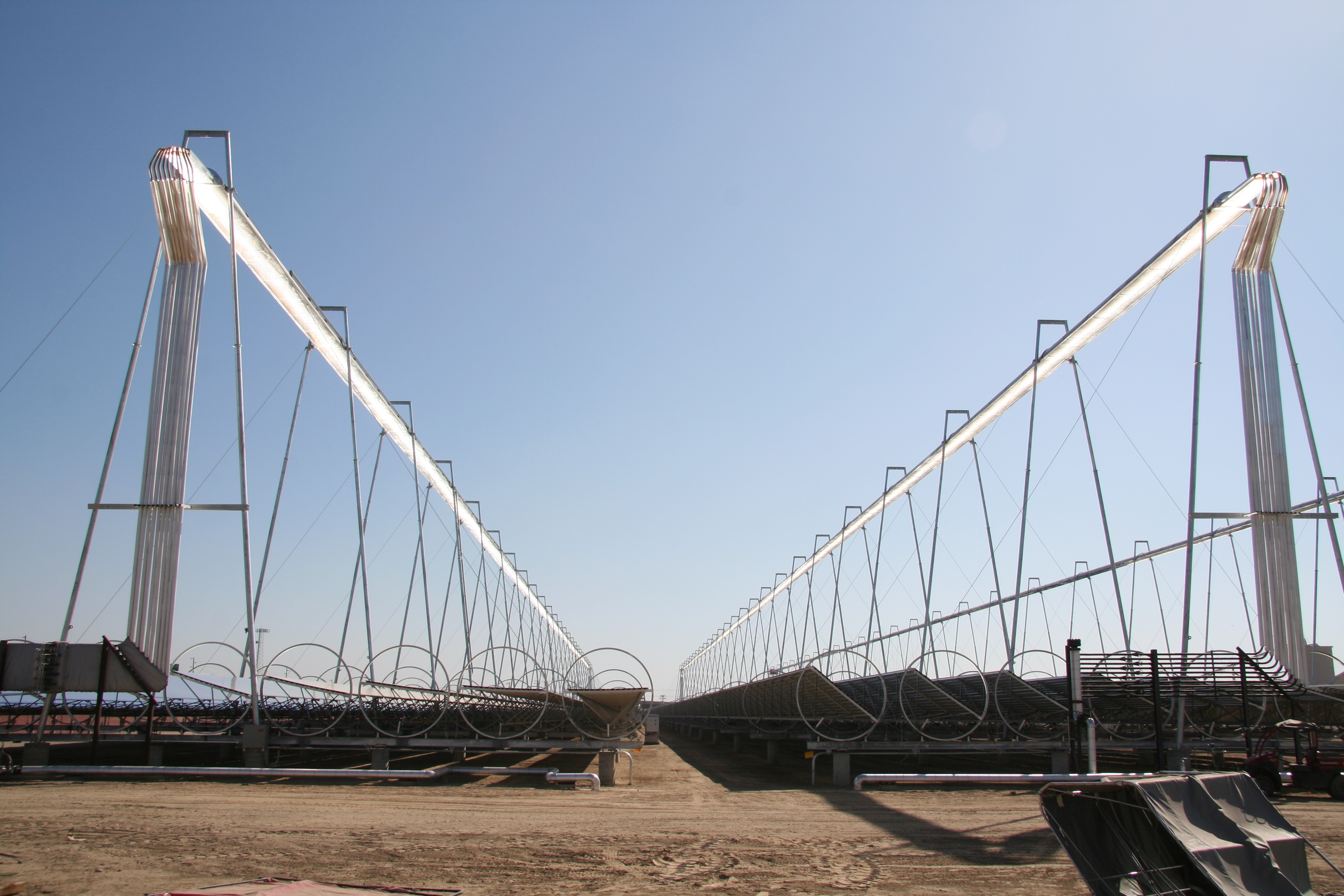
While Ausra built Kimberlina to show that its compact linear fresnel reflector technology can generate utility-scale electricity, the plant is also designed to demonstrate that solar tech can be deployed for other industrial uses. At heart, a solar thermal power plant is a steam machine. In Ausra’s case, long rows of flat mirrors that sit low to the ground. concentrate sunlight on water-filled pipes that hang over the mirrors to create steam. That drives an electricity-generating turbine, but Ausra and other companies are looking to sell the steam as well.

For instance, take a drive around Bakersfield and you’d think you were in Texas, what with all the oil rigs rocking back and forth across a treeless landscape. Bakersfield oil is thick and heavy, so steam is injected into the ground to make it flow. Fishman wants oil companies to stop burning expensive natural gas to boil water and start using the sun.

“We’ve been doing a lot of show and tell,” says Fishman, referring to the Kimberlina plant, which sits just off the Bakersfield oil patch’s main highway. “If you look at putting a solar generator in, the economics look pretty good.”

Each 1,000-foot row, or line, of Ausra mirrors generates six megawatts of heat, according to Fishman, who says the company has talked to potential clients who would need anywhere between five and 50 lines.

Ausra also is exploring other markets for its steam technology, such as food processing.

Rival power plant builder eSolar, the Pasadena startup incubated by Bill Gross’ Idealab and funded in part by Google (GOOG), also sees other markets for its green tech. Last month, eSolar, which has a contact to supply utility Southern California Edison (EIX) with 245 megawatts of electricity, licensed its technology to stealth renewable fuels startup Sundrop, based in Pojoaque, N.M., north of Santa Fe.

Sundrop CEO John Stevens will say little about the Kleiner Perkins-backed company’s plans. “Sundrop uses low-cost concentrated solar energy to drive renewable energy into fuels,” he wrote in an e-mail. “We will produce low-cost renewable fuels.  We expect to be demonstrating scale production in 2009-2010.”

eSolar CEO Asif Ansari told Green Wombat his company will provide fields of mirrors called heliostats to Sundrop along with software and control systems to concentrate the sun’s rays on a tower. (Venture Beat uncovered documents that indicates Sundrop may plan to produce hydrogen and other fuels.)

“Basically, we’re a technology company; we don’t want to be in the construction business,” says Ansari. “What we really are trying to develop here is a standard global platform for delivering concentrated solar energy to any target that can be used for a variety of applications.”

Besides using solar energy to produce such fuels as hydrogen, Ansari, like Ausra, sees the oil industry as a potential market. He says the food processing and fertilizer industries also could substitute eSolar’s technology for natural gas to make steam.

Back in Bakersfield, California Governor Arnold Schwarzenegger presided over the official opening of Ausra’s Kimberlina solar plant on Thursday. (Live streaming his appearance.) “California is going green and it’s going green really fast,” the governator said before an audience that included PG&E chief executive Peter Darbee and Silicon Valley venture capitalists Ray Lane and Vinod Khosla.

The solar power station is plugged into the grid and will supply PG&E with enough electricity to power about 3,500 homes in central California. The mirror arrays were made at Ausra’s robotic factory in Las Vegas.

“This represents the best of American and Australian ingenuity and get-it-done attitude,” said Fishman at the ceremony, referring to Ausra’s roots in Sydney. “People don’t need to think of Ausra as an alternative energy company. As of today it is simply an energy company.”

Schwarzenegger gave the signal and Kimberlina officially came online, the 1,000-foot-long mirror arrays rotating toward the sun.

Read Full Post »

photos: SolarWorld

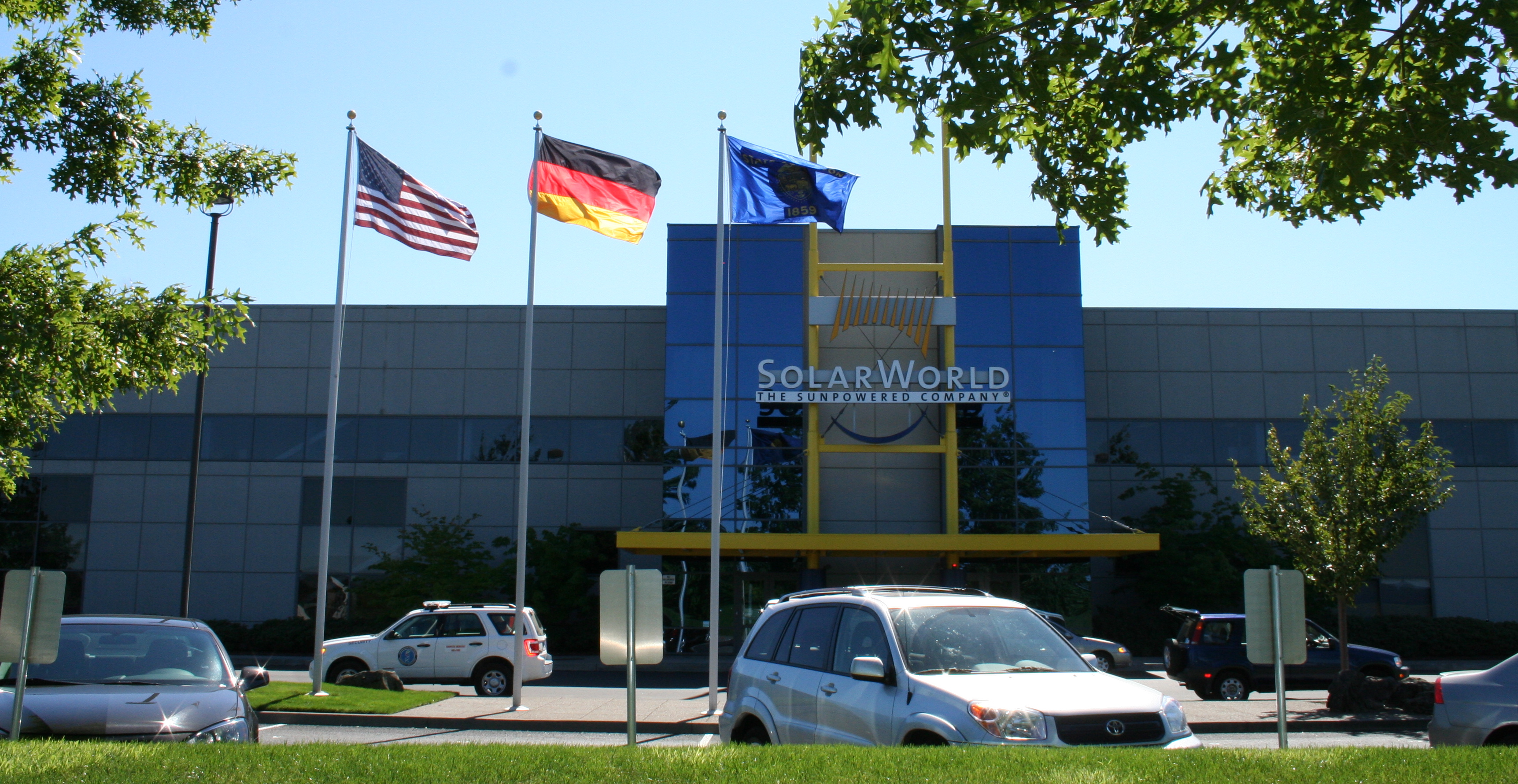
HILLSBORO, Ore. – A solar cell factory has sprouted in Oregon’s Silicon Forest amid the region’s old-growth semiconductor plants. And who is providing these well-paid, high-tech green jobs, investing in America rather than fleeing to Asia to set up shop? The Germans.

Bonn-based SolarWorld AG on Friday officially flips the switch on the United States’ largest solar cell plant. (See the Fortune video here.) The company, the world’s fifth largest solar cell manufacturer, has recycled a former Komatsu factory built to produce silicon wafers for the chip industry  Last week, SolarWorld America president Boris Klebensberger gave Green Wombat a sneak peak at the new Hillsboro plant and talked about why a German company, whose domestic solar market is the planet’s largest, is pursuing a made-in-America strategy. (SolarWorld’s German rival Solon AG, meanwhile, on Friday opened a smaller solar module plant in Tucson, Ariz.)

“I know a lot of people will say, ‘You idiot, Boris. You can’t manufacture in the U.S.,’ ” says Klebensberger, 39, who sports a hoop earring and has a penchant for saying what’s on his mind.

That has been the conventional wisdom. While thin-film solar companies like First Solar (FSLR), Solyndra and Energy Conversion Devices (ENER) have built factories in the U.S., traditional silicon-based module makers such as SunPower (SPWRA) have outsourced production overseas.

But SolarWorld is counting on its expertise in manufacturing in high-cost Germany and its new American branding to give it a competitive advantage. “Made in America is a very big selling point,” says SolarWorld marketing director Anne Schneider. “Customers like that.”

Like other solar cell makers, SolarWorld is trying to build a brand around an increasingly commoditized product. “Even in a commodity business this is a brand,” says Klebensberger. “If you have to choose between two products that are technologically the same,  you’ll probably choose the one made in the U.S.”

SolarWorld jumped into the U.S. market in 2006 when it acquired Royal Dutch Shell’s solar cell factory in Camarillo, Calif., and a silicon ingot plant in Vancouver, Wash. “This was an opportunity for SolarWorld to establish itself in the U.S. market very quickly and get an employee base,” says Klebensberger, who also serves as COO of SolarWorld’s global operations.

The company was founded in 1998 by, as Klebensberger puts it, “five crazy guys who people thought were on drugs” when they said they were going into the solar business. (Klebensberger was employee No. 7.) But Germany’s lucrative incentives for renewable energy quickly turned the nation into a solar powerhouse and SolarWorld went public in 1999. Revenues – $931 million last year – have been growing around 30%-40% annually and the company has a market cap of $3.1 billion.

SolarWorld saw a potentially huge opportunity in the U.S. but the Shell plant was relatively small – producing 80 megawatts of solar cells annually – so Klebensberger went shopping for a new factory. He ruled out California – too expensive – before settling on Hillsboro, 20 miles west of Portland.

The cost of living was reasonable – at least compared to California – and Oregon is on the forefront of promoting sustainability and the green economy. And just as importantly, Intel (INTC) and other chip companies had opened semiconductor factories, or fabs, in the area in the 1980s and ’90s. “A lot of our workforce came from established chip companies or those that closed their fabs,” says Klebensberger, sipping tea from a coffee cup emblazoned with “Got Silicon?”

“The manufacturing and product is different but the raw starting material is the same and there’s a lot of similarity in the equipment,” adds Gordon Bisner, vice president of operations and a chip industry veteran. “There’s a lot of the same skill sets from a maintenance and engineering standpoint and understanding the basic manufacturing principles and what it takes to manufacture a product successfully in the United States.”

Klebensberger’s team found an old Komatsu silicon wafer fab that had stood empty for years. They bought the 480,000-square foot building for $40 million last year and began retrofitting it. “We needed a quick ramp-up,” says Klebensberger. “This business is all about speed.”

The retrofit took about 15 months – though the minimalist gray industrial decor of the Komatsu era remains. When fully built out in a couple of years, the plant will produce 500 megawatts’ worth of solar cells annually and employ 1,400 workers. In the meantime, the target is 100 megawatts by the end of 2008, and 250 megawatts in 2009.

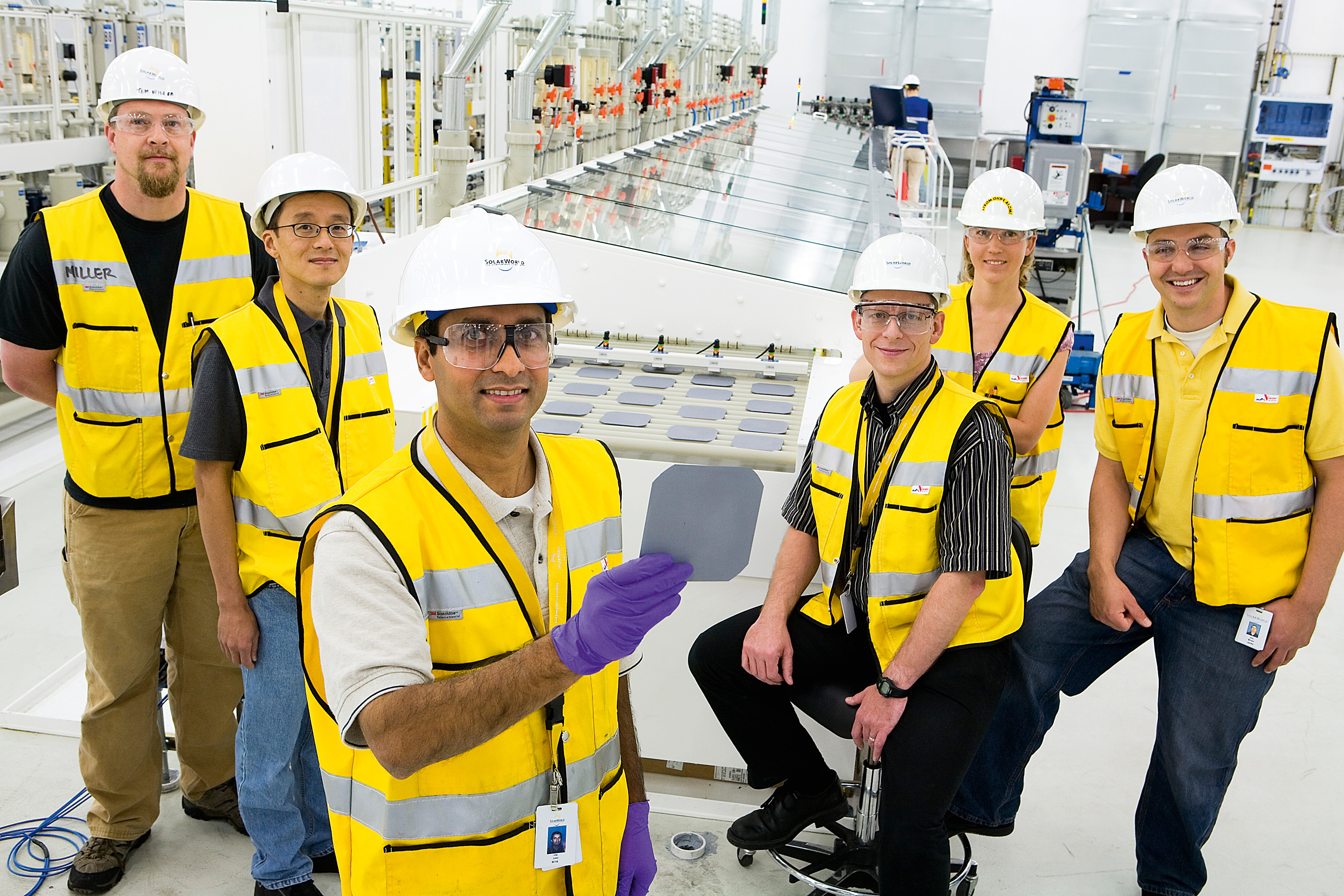
In one corner of the building, a room of steel vats cook up polysilicon, producing eight-foot-long silicon ingots in the shape of giant silver pencils. Those ingots are taken to another room where wiresaw machines slice them into wafers. The wafers then travel down a conveyor belt where robots wash them and scan for imperfections.

“What’s critical here is the equipment,” says Bisner over the hum of the machines. “Our competitive advantage is how we use the equipment, how can we get every little bit of photovoltaic cell out of the end of the line. It takes equipment, it takes technology and it takes people too.”

In an adjoining room, the wafers are imprinted with contacts and transformed into photovoltaic cells. Depending on customer demand, SolarWorld will sell both silicon wafers and finished cells. The company currently gets 10% to 15% of its revenues from the U.S.

SolarWorld isn’t the only solar company wanting a made-in-America label. Sanyo this week announced it will build a solar cell factory in Salem, south of Portland. And Chinese solar giant Suntech (STP) earlier this month acquired a California-based solar installer and announced a joint venture with San Francisco-based MMA Renewable Ventures (MMA) to build solar power plants. Suntech chief strategy officer Steven Chan told Green Wombat this week that Suntech will likely open factories in the U.S. within a couple years.

Says Klebensberger, “We provide green jobs. We’re not just talking about it, we’re doing it.”

Read Full Post »

SAN DIEGO – California Governor Arnold Schwarzenegger made a surprise appearance at the solar industry’s annual confab Monday night, warning not to use the financial crisis as an excuse to abandon the fight against global warming.

“We should not give in to those who say environmental goals should take a back seat until the economy improves,” said Schwarzenegger, kicking off the Solar Power International conference. “That’s short-sighted thinking. Tough economic times mean we need more solar, more green jobs.”

The governator’s championing of solar energy through California’s million solar roofs initiative and its landmark global warming law has made Schwarzenegger something of a patron saint of the solar industry, and the audience was on its feet cheering the perma-tanned politician.

The solar power conference is a barometer of the industry’s growth. When Schwarzenegger last appeared at the conference in 2006, 6,000 attendees crammed the San Jose Convention center. This week an estimated 20,000 people have descended upon San Diego for the event. (For techies, think of it as the Consumer Electronics Show and Macworld rolled into one.)

The crowd was in a festive mood. Solar stocks were up dramatically Monday with the bounce back on Wall Street – First Solar (FSLR) spiked nearly 23% and Suntech (STP) rose 21% as was SunPower (SPWRA). And ten days ago Congress slipped into the financial bailout package an eight-year extension of a crucial 30% solar investment tax credit, lifted a $2,000 tax credit limit for homeowners who install solar arrays and allowed utilities to claim the investment tax credit for solar installations. “Imagine it took a financial rescue plan to get a tax credit for solar,” Schwarzenegger remarked.

The Republican governor used the occasion to champion California, as he is his wont, giving kudos to Southern California Edison (EIX) for the utility’s plans to install 250-megawatts’ worth of solar panels on warehouse roofs. “I can envision going up in a helicopter and up and down California and see no more warehouses without solar panels.”

“Solar is the future, it cannot be stopped,” he added.

Read Full Post »

Photos: Solyndra

SAN FRANCISCO – The chatter of the Financial District types who lunch at One Market is a bit deafening, so I’m sure I’ve misheard when Solyndra CEO Chris Gronet tells me how much funding his stealth solar startup has raised. “You said $60 million, right?” I ask.

“$600 million,” he replies.

That pile of cash from investors ranging from Silicon Valley venture capitalists to Richard Branson to the Walton family wasn’t the only big number Solyndra revealed to Green Wombat in anticipation of the solar panel manufacturer’s public debut Tuesday after operating undercover for more than three years. “We have $1.2 billion in orders under contract,” says Kelly Truman, the Fremont, Calif.-based company’s vice president for marketing and business development.

The stealth startup is a Silicon Valley archetype, along with the baby-faced Web 2.0 mogul and the millionaire stock-option secretary. But perhaps no company in recent memory has managed to hire more than 500 people and build a state-of-the-art thin-film solar factory – in plain view of one of the Valley’s busiest freeways – without attracting much attention beyond a few enterprising green business blogs.

Thin-film solar has been something of a Holy Grail in Silicon Valley, with high-profile startups like Nanosolar – with nearly $500 million in funding itself – all vying to be first to market with copper indium gallium selenide solar cells. CIGS cells can essentially be printed on flexible materials or glass without using expensive silicon. While such solar cells are less efficient at converting sunlight into electricity, production costs are expected to be significantly lower than making traditional silicon-based modules. (Thin-film companies like First Solar (FSLR) – also backed by the Waltons – use an older technology.)

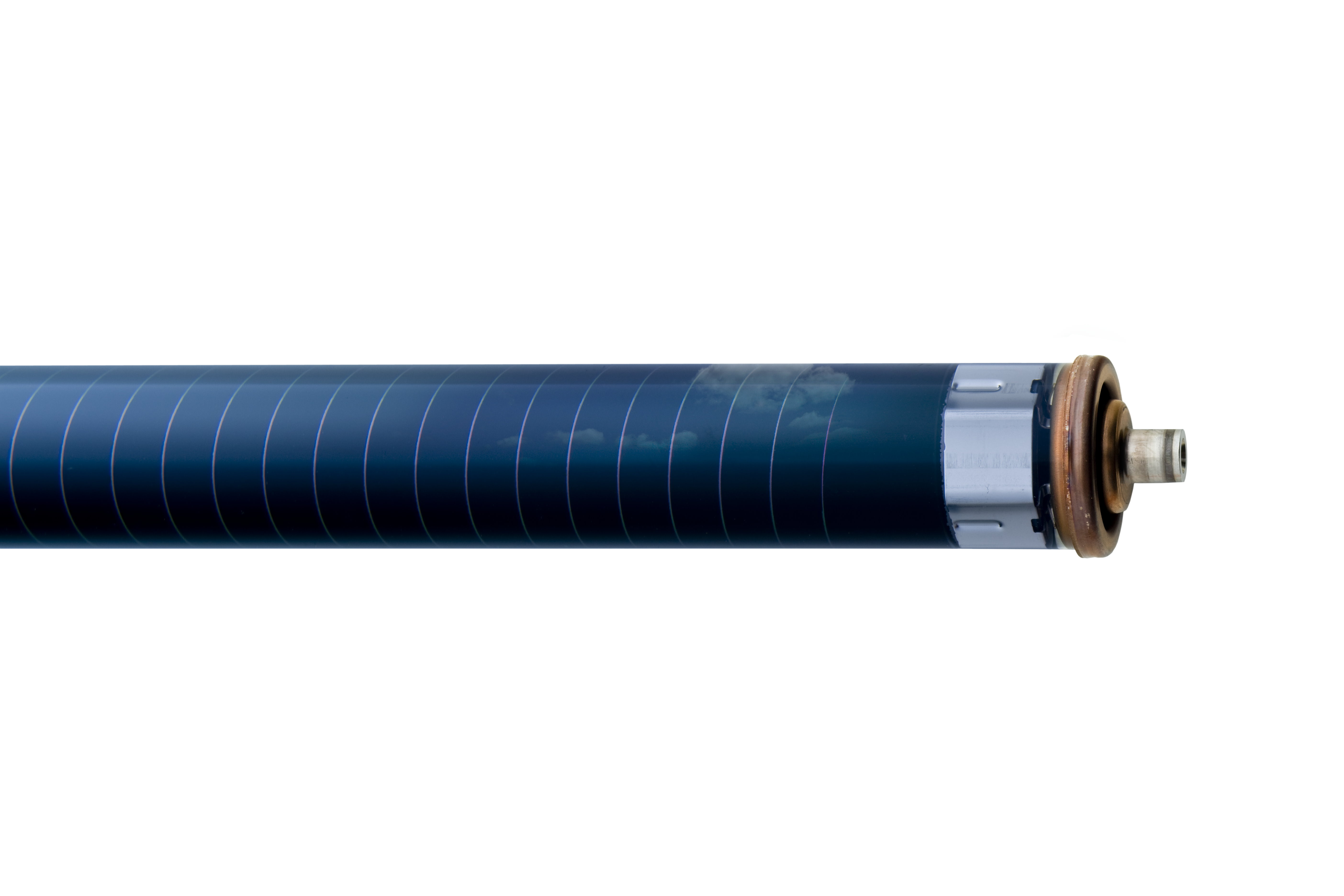
Yet Solyndra bursts onto the scene with a factory operating 24/7 and a billion-dollar book of business. The reason for Solyndra’s secrecy – and success with investors and customers – is sitting in a bazooka-sized cylinder propped up beside Truman at the restaurant. He pulls out a long, black glass tube that is darkened by a coating of solar cells.

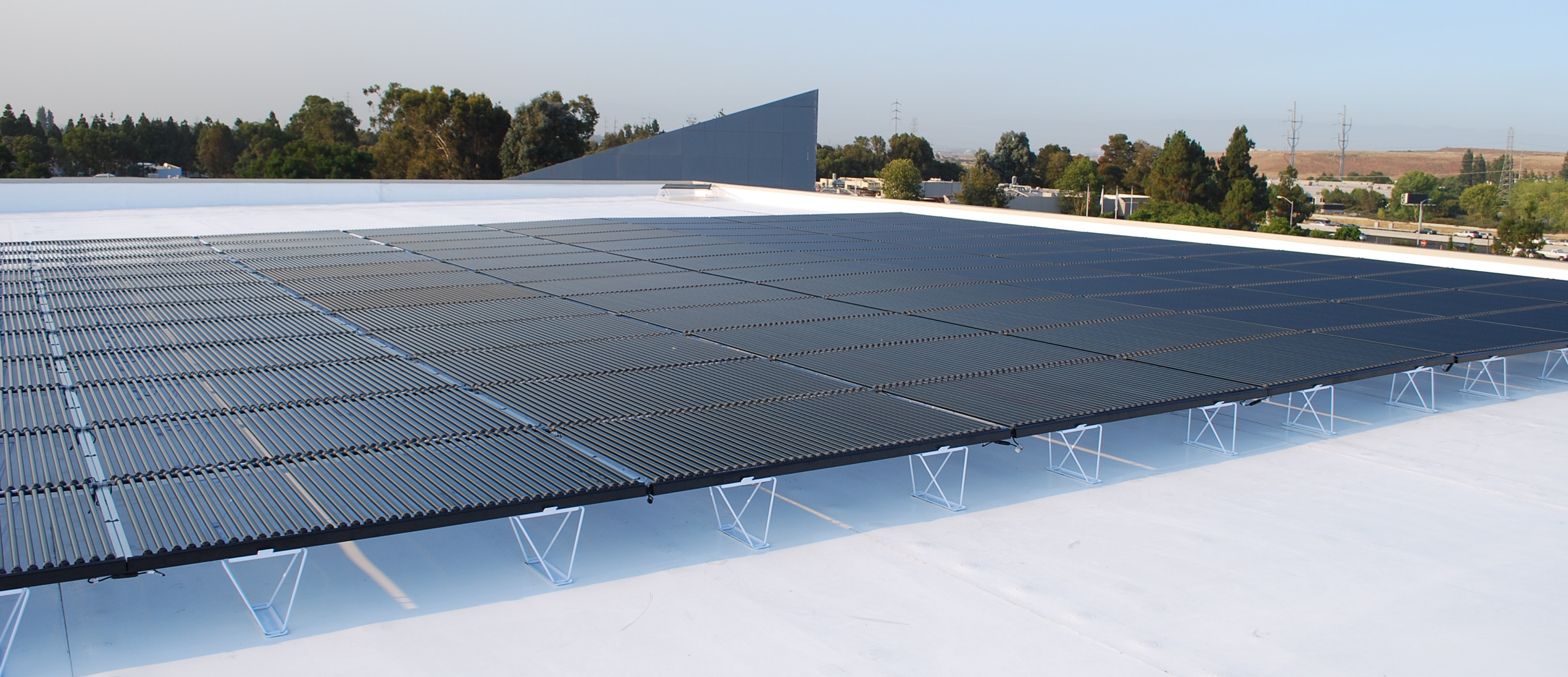
The cylindrical shape is the key, according to CEO Gronet. Conventional rooftop solar panels must be tilted to absorb direct sunlight as they aren’t efficient at producing electricity from diffuse light. But the round Solyndra module collects sunlight from all angles, including rays reflected from rooftops. That allows the modules, 40 to a panel,  to sit flat and packed tightly together on commercial rooftops, maximizing the amount of space for power production.

“We can cover twice as much roofspace as conventional solar panels and they can be installed in one-third the time,” says Gronet, a boyish 46-year-old who holds a Stanford Ph.D. in semiconductor processing and was an 11-year veteran of chip equipment maker Applied Materials (AMAT) before he started Solyndra in May 2005.

And because air flows through the panels they stay cooler and don’t need to be attached to the roof to withstand strong winds. That means installers simply clip on mounting stands and then snap the panels together like Legos.

“For flat commercial rooftops this is game-changing technology,” said Manfred Bachler, chief technical officer at European solar installation giant Phoenix Solar, in a statement.

Solyndra’s target is the 30 billion square feet of flat roofspace found on big box stores and other buildings in the U.S., according to Navigant Consulting – a potential $650 billion solar market.  The emerging business model is for a solar developer to finance, install and operate a commercial solar array and then sell the electricity to the rooftop owner. Solyndra’s business is to supply the solar panels to the installers, a market crowded with competitors like SunPower (SPWRA) and Suntech (STP).

A good chunk of the $600 million the company has raised has gone toward building its 300,000-square-foot solar fab. A video Gronet and Truman played for me shows a highly automated factory, with robotic assembly lines and robot carts moving the solar modules through the production process.

The fab – which can produce 110 megawatts’ worth of solar cells a year – already is shipping panels to big customers like Solar Power in the U.S. and Germany’s Phoenix Solar – three-quarters of its $1.2 billion in orders are destined for European companies. Solyndra is in the process of obtaining permits for a second 420-megawatt fab in Fremont; upon its completion, Solyndra would become one of the biggest solar cell manufacturers in North America. (Gronet says a third fab will be built in Europe, Asia or the Middle East.)

That has helped Solyndra attract a long list of investors, from Silicon Valley VCs like CMEA and US Venture Partners to Madrone Capital – the Walton family’s (WMT) private equity fund – and Masdar, the Abu Dhabi company whose mission is to transform the oil-rich emirate into a green tech powerhouse. Another high-profile investor is Richard Branson’s Virgin Green Fund.

“We looked at 117 solar companies and have made two investments, including Solyndra,” says Anup Jacob, a partner at Virgin Green Fund and a Solyndra board member. “Dr. Chris Gronet and his team came out of Applied Materials and really took the best and brightest of Silicon Valley. They’re great scientists and operations people.”

Jacob told Green Wombat that Virgin hired Stanford scientists to evaluate Solyndra’s technology and engineering firms to vet its solar factory. “Because we’re late-stage investors, we were able to look at all their major competitors,” he says. “There’s a number of well-heeled solar companies that have said they are going to do a lot of things but haven’t delivered.”

Virgin concluded that Solyndra could make good on its promise to make solar competitive with traditional sources of electricity. “As a rooftop owner, all you care about is how much electricity you can get from your rooftop at the cheapest price possible,” he says.

One challenge, he adds, was keeping mum about Solyndra. “I gotta tell you that Richard Branson is a guy who loves to talk about what’s he’s doing and it was real effort to honor Solyndra’s wishes to keep quiet.”

Read Full Post »

Illustration: Principle Power

A Seattle-based renewable energy startup, Principle Power, has signed an agreement to build a deep-sea, 150-megawatt wind farm to be constructed on floating platforms off the Oregon coast.

The deal with the Tillamook Intergovernmental Development Agency – which includes the local utility for a coastal county west of Portland – is very early stage but foreshadows two technological trends in the wind industry: massive megawatt turbines placed on deep-ocean platforms.

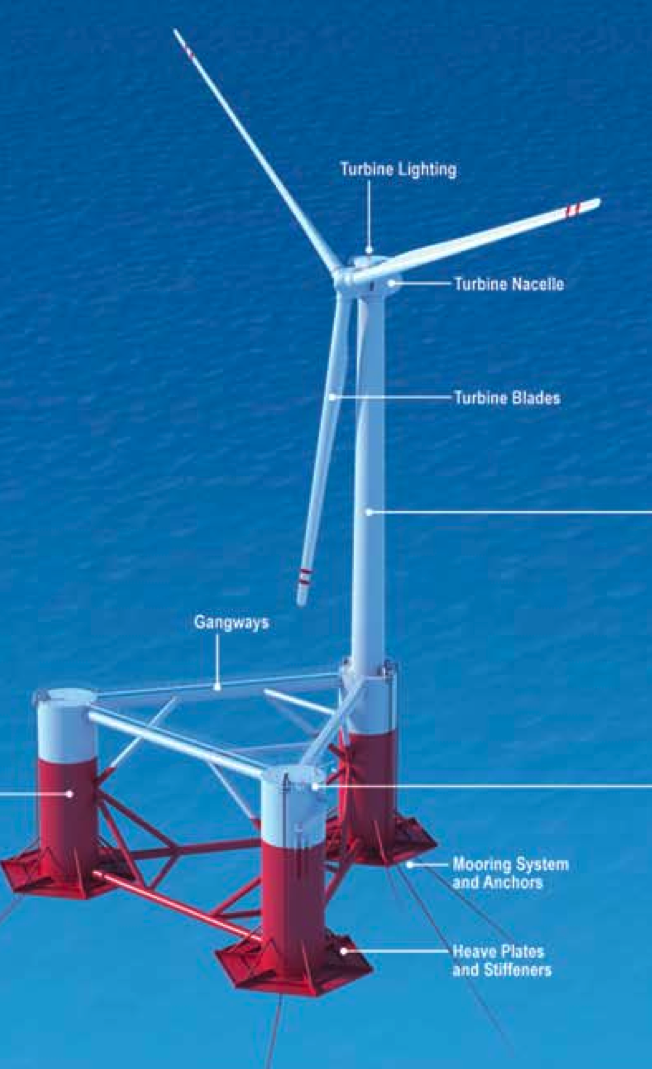
Principle Power co-founder Jon Bonanno tells Green Wombat that each floating platform – called a WindFloat – will feature a 5-megawatt turbine. By contrast, the biggest biggest land-based turbines are typically 2.5 megawatts, while General Electric (GE) makes a 3.6-megawatt turbine designed for offshore use.

Bigger turbines offer better economies of scale (important given the steep cost of developing offshore wind farms), and since a deep-ocean wind turbine is not visible from the coast, they avoid the not-in-my-backyard fights that dog near-shore projects. (Clipper Windpower of Carpinteria, Calif., is developing a ten-megawatt monster for England’s Crown Estate, while European wind companies like Enercon has been testing turbines in the six megawatt range.)

“It’s becoming an increasingly important component of the mix in Europe,” says Ethan Zindler, head of North American research for New Energy Finance, a London-based firm. “I think a lot of it is conceptual at this point. There’s still a lot of barriers in turbine design and transport.”

Beyond the technological challenges of supersizing a turbine, there’s the issue of how to get a 300-foot-tall windmill out to sea without breaking the bank. Various wind companies are tackling the problem but Principle Power’s solution is to license the WindFloat technology from a Berkeley, Calif.-based startup called Marine Innovation & Technology. The company’s founders, who previously worked on offshore platforms for the oil industry, designed the WindFloat to be semi-submersible. “The design and size of the WindFloat enables the overall structure to be assembled onshore and towed to its final location, significantly reducing construction costs,” according to Principle Power.

“The WindFloat has undergone concept development validation through numerical modeling, third party engineering verification and extensive wave tank testing,” Bonanno said in an e-mail, noting that he expects a full-scale prototype to be built within a year.

Depending on the permitting process and Principle’s ability to obtain project financing, Bonanno anticipates the wind farm to be up and operating between 2013 and 2015.  Early estimates peg the cost of the wind farm at about $375 million.

Pat Ashby, the general manager of the 19,000-customer Tillamook People’s Utility District, says his utility has a capacity of 50 megawatts so it would most likely serve as an interconnection point to transmit electricity from the wind farm to the regional power grid. “Our substations are all along the coast,” he says. “There’s only a dozen miles or less to get to a substation.”

According to Ashby, the cost of laying a transmission line is about $1 million a mile. On the other hand, if the wind farm is too close to shore, residents will likely get riled up about the impact on their views. “We’ve already had an organized group come forward to express their concerns,” he says.

Bonanno notes that if the wind farm was placed five miles off the coast, the turbines would appear to be the size of a thumb from the shore; at ten miles they would not be visible.

Read Full Post »

photo: eSolar

After months of failed attempts in Congress to extend crucial renewable energy tax credits, the end-game came with lightning speed Friday afternoon: The House of Representatives passed the green incentives attached to the financial bailout package approved by the Senate Wednesday night and President Bush promptly signed the legislation into law.

There were goodies for wind, geothermal and alternative fuels, but the big winner by far was the solar industry.

“It feels like we should be popping the champagne,” said a Silicon Valley solar exec Green Wombat met for lunch minutes after Bush put pen to paper.

That it took the biggest financial crisis since the Great Depression to save billions of dollars of renewable projects in the pipeline for the sake of political expediency does not bode well for a national alternative energy policy. But the bottom line is that the legislation passed Friday sets the stage for a potential solar boom.

  • The 30% solar investment tax credit has been extended to 2016, giving solar startups, utilities and financiers the certainty they need for the years’ long slog it takes to get large-scale power plants and other projects online. The extension is particularly important to those Big Solar projects that need to arrange project financing in the next year or so.
  • The $2,000 tax credit limit for residential solar systems has been lifted, meaning that homeowners can get a 30% tax credit on the solar panels they install after Dec. 31. That will save a bundle – especially for those who live in states with generous state rebates – and goose demand for solar panel makers and installers like SunPower (SPWRA) and First Solar (FSLR). (If you buy a $24,000 3-kilowatt solar array in California – big enough to power the average home –  you can claim a $7,200 federal tax credit. Add in the state solar rebate and the cost of the system is cut in half.)
  • Utilities like PG&E (PCG), Southern California Edison (EIX) and FPL (FPL) can now themselves claim the 30% investment tax credit for large-scale solar power projects. That should encourage those well-capitalized utilities to build their own solar power plants rather than just sign power purchase agreements with startups like Ausra and BrightSource Energy.

“The brakes are off,” says Danny Kennedy, co-founder of Sungevity, a Berkeley, Calif., solar installer that uses imaging technology to remotely size and design solar arrays. “In just six months since our launch we’ve sold about a hundred systems. With an uncapped tax credit for homeowners going solar, we expect business to boom.”

While elated sound bites from solar executives have been flooding the inbox all afternoon – along with invites to celebratory after-work drinks – solar stocks took a drubbing (along with the rest of the still-spooked market) after initially soaring on the news.

SunPower ended the trading day down 5% while First Solar shares dropped 8%. The bright spot was China’s Suntech (STP), which on Thursday announced a joint venture with financier MMA Renewable Ventures to build solar power plants as well as the acquisition of California-based solar panel installer EI Solutions.

Congress didn’t treat the wind industry so generously. The production tax credit for generating renewable energy was extended by just one year, guaranteeing the industry’s will continue to live year by year (at least through 2009). But given that 30% of all new power generation built in the United States in 2007 was wind, and that the amount of wind power installed by the end of 2008 is expected to rise 60% over the record set last year, the wind biz should do just fine.

But Congress did give a break to those who buy small-scale wind turbines. Systems under 100 kilowatts qualify for a 30% tax credit up to $4,000. Homeowners get a $1,000 tax credit for each kilowatt of wind they install, though the credit is capped at $4,000.

“This is a huge breakthrough for small wind,” says Scott Weinbrandt, president of Helix Wind, a San Diego-based manufacturer of 2-and-4-kilowatt turbines.

Read Full Post »

« Newer Posts - Older Posts »

Design a site like this with WordPress.com
Get started