Feeds:
Posts
Comments

Archive for the ‘energy efficiency’ Category

google-powermeter

Google has become the utility of the digital age, something we click on as much as we flick on a light switch or turn on the water tap. Now the search giant is literally getting into the utility business with the development of smart grid software that gives consumers real-time information on their electricity consumption.

Called the PowerMeter, the prototype online dashboard is designed to download data from smart meters and display current electricity use and show how much power your refrigerator, big-screen television and other appliances are using at any point in time.

“We believe that by building a ‘smarter’ electricity grid, we can use the synergies of information and technology to give consumers better tools to track and reduce their energy use and, by doing so, save money and reduce greenhouse gas emissions,” wrote engineering executive Bill Coughran and Dan Reicher, Google.org’s director of climate change and energy initiatives, in a filing Monday with the California Public Utilities Commission. “Down the road, consumers should have access to additional information such as the source and mix of their power.”

The Google (GOOG) executives urged California regulators to adopt policies to give consumers direct access to their real-time electricity usage in an open-source format. “The goal is to foster a thriving ecosystem of partners where third-parties develop and provide products to help consumers decrease and manage their energy demand and save money,” Coughran and Reicher wrote. “For example, a third-party could offer a service that analyzes a household’s electricity usage data, identifies inefficient appliances or practices in the home, and offers tips on how to reduce energy or provides special discounts on efficient appliances or electronic equipment.”

Utilities across the country are rolling out so-called smart meters that allow the real-time monitoring of electricity use, letting them charge variable rates depending on demand. The idea promoted by Google and other smart grid proponents is that once people become aware of how much electricity their various appliances and gadgets consume – and how much it costs them – they’ll start, say, running the dishwasher at night when electricity demand and rates are lower. That will help utilities cut their costs and over the long run avoid building new carbon-spewing power plants to meet peak demand.

Google’s move comes as the Obama administration pushes to upgrade the nation’s aging analog electricity grid, including $11 billion in the stimulus package for smart grid-related initiatives.

Google says PowerMeter, now being tested among Google employees, will be a free, open source application. “Google tool is only one of many ways to provide consumers with this information,” the company stated in its utilities commission filing. “Our primary goal is for consumers to get this information, whether through our tool or another source.”

It remains to be seen how the Google initiative affects the fortunes of startups like Tendril, Greenbox and others developing software and services for utilities to let their customers monitor their electricity consumption.

Google says it’s currently working with utilities and device makers. Green Wombat is waiting to hear back from Google on which ones, but a good bet would be General Electric (GE), which struck a partnership last year with the search giant to develop smart grid technology. Also likely on the list is PG&E (PCG), which has been collaborating with Google on plug-in hybrid electric car and vehicle-to-grid research.

Then there’s IBM (IBM), which has become the leading player integrating smart grid technology for utilities and managing the data produced by a digital power grid. (Big Blue last week announced it is building the world’s first nationwide smart grid for the Mediterranean island nation of Malta.)

So will Google PowerMeter save consumers money while saving the planet? That’s the early word from Google employees – not exactly the most neutral of sources – who’ve been testing the smart grid app, according to testimonials Google posted online.

“By monitoring my energy use, I figured out that the bulk of my electricity was caused by my two 20-year-old fridges, my incandescent lights and my pool pump, which was set to be on all the time,” wrote “Russ, hardware engineer.” “By replacing the refrigerators with new energy-efficient models, the lights with CFLs and setting the pool pump to only run at specified intervals, I’ve saved $3,000 in the past year and I am on track to save even more this year!”

Read Full Post »

stirling-dishes

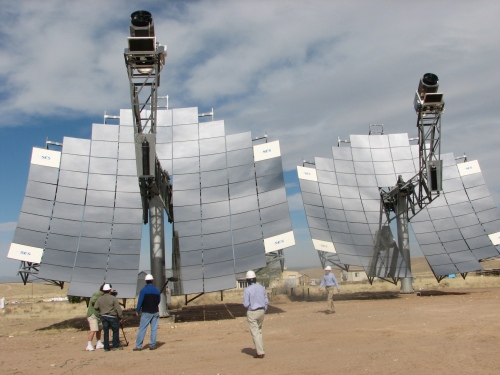
photo: Todd Woody

Fifty-four billion dollars is nothing to sneeze at, of course. That’s the amount in the $825 billion economic stimulus package –  introduced by House Democrats Thursday – set aside for renewable energy, electric car batteries, energy efficiency and other green projects.

It’s a start, but that’s less than 7% of the entire stimulus package (or, about enough to pay for the Iraq war for five months, or somewhat more than what the federal government is spending to bail out Bank of America). The lion’s share of the cash is devoted to smart grid technology and transmission lines, with a second big chunk going toward energy efficiency retrofits of public housing and weatherization of low-income homes.

That’s good news for a host of startups developing smart grid technology. But the the bill does not address the most pressing issue facing renewable energy companies today: the credit crunch has dried up financing just as billions are needed to fund factories and the construction of solar power plants and wind farms that will be connected to smart grids and new transmission lines. In recent weeks, layoffs have hit the solar industry. OptiSolar – a Bay Area thin-film solar startup that’s building a 550-megawatt photovoltaic power plant to supply electricity to utility PG&E (PCG) – reported to have furloughed half its workforce. And according to The Oregonian newspaper,  SpectraWatt, a solar cell maker spun off from chip giant Intel (INTC) last year, has shelved plans for a factory in Hillsboro, Ore.  Friday morning, Kate Galbraith at The New York Times’ Green Inc. blog reported that layoffs have now hit the wind industry.

The retrenchment comes as utilities are counting on solar power plants and wind farms to come online in the next two years to help them meet mandates to obtain a growing percentage of the electricity they sell from renewable sources. In California, for instance, PG&E, Southern California Edison (EIX) and San Diego Gas & Electric (SRE) have signed more than four gigawatts’ worth of contracts for electricity to be produced by large-scale solar power stations that will cost billions to build.

Solar startups rely on a provision that allows them to take a 30% tax credit on the cost of building a power plant. Now most of these companies are startups and have no way to use those tax credits as they’re not profitable. Instead, a solar company must essentially trade the tax credits to a firm that can use them in exchange for cash to finance construction. But investors in these deals have all but disappeared as the financial crisis takes its toll. Which is why solar and wind lobbyists are pushing Congress to make the tax credits “refundable” – meaning those companies that don’t have tax liabilities can trade the credits for cash that can be used to finance power plants. “Due to the recession, projects are now being put on hold, factories are closing and workers face potential layoffs unless Congress refines the tax credits now so they work as originally intended,” said Solar Energy Industries Association CEO Rhone Resch in a statement.

The stimulus package unveiled Thursday undoubtedly will be subject to change, but as written it will boost efforts to modernize and digitize the United States’ aging analog power grid. The bill includes:

  • $11 billion for smart grid research and development, pilot projects and the construction of new transmission lines to connect green energy power plants to the power grid. The government will fund 50% of the cost of utilities’ smart grid investments.
  • $8 billion in loan guarantees for renewable energy transmission projects.
  • $6.9 billion in grants to state and local governments for energy efficiency and carbon reduction programs.
  • $6.7 billion for renovation of federal buildings, of which $6 billion must be used for energy efficiency retrofits.
  • $6.2 billion for home weatherization programs for low-income families.
  • $2.5 billion for energy efficiency retrofits of public housing.
  • $2.4 billion for carbon sequestration – so-called clean coal – demonstration projects.
  • $2 billion for energy efficiency and renewable energy research (which includes $800 million for biomass and $400 million for geothermal research).
  • $2 billion in loan guarantees and grants for advanced vehicle battery research.

The smart grid billions will be a boon to companies like Silver Spring Networks, Gridpoint and eMeter that develop software to allow utilities to monitor and manage electricity use in real-time and provide that data to their customers.  “We think 2009 is going to be a good year for us,” eMeter president Larsh M. Johnson told Green Wombat last month. “We’ve seen continued demand from utilities for our services.”

But the billions for the smart grid can be considered a down payment: According to an estimate by research firm New Energy Finance, the price tag for modernizing the power grid over the next 15 years will be $450 billion.

Read Full Post »

tendril

In case you missed it, this Green Wombat story appears in the current issue of Fortune.

A house that thinks

The high-tech networks that Reliant Energy is installing in the homes of its 1.8 million customers will help them save electricity.

By Todd Woody, senior editor

(Fortune Magazine) — Inside a white-brick house nestled in Houston’s leafy Montrose neighborhood, a gray handheld video display sits on the living room coffee table. But this is no ordinary remote control. Called the Insight and made by Tendril, a Boulder startup, the device communicates wirelessly with the home’s utility meter, letting you track real-time information about the cost of the electricity you consume.

The house is actually a demonstration project set up by Reliant Energy (RRI), a reseller of electricity with $12 billion a year in sales. Glen Stancil, Reliant’s vice president for smart energy R&D, taps the Insight’s screen. “Right now we’re spending $1.40 per hour,” he says, noting that the electricity prices and usage are updated every ten seconds. (Customers can also access the same data on the web or their iPhones.)

Stancil presses another button. “The bill so far is $86, and for the month it looks like it’s headed to $367,” he says. The Insight system also warns that you’ll fork over another $100 this month if you crank up the air conditioner a couple of notches. So keep your hands off the thermostat.

That’s just the kind of behavior that Reliant Energy CEO Mark Jacobs would like to see. Until now, Reliant has made its money by entering contracts with utilities for a fixed amount of power at a fixed price and then reselling it to its 1.8 million customers. If demand unexpectedly soars on a hot afternoon as everyone turns up the air conditioning, Reliant often must buy extra power on the spot market, where prices can spike as much as 60%.

That cuts into profits. “It’s like running a beachfront hotel, charging the same room rate all year round, and then building more rooms to guarantee that everyone has a room on the busiest weekends,” says Jacobs.

In November, Reliant started installing the Insight in homes, which means it will be able to pass along those high spot prices to its customers, or better yet, in sweltering Texas, let customers buy a month’s worth of cool at a set price – say, 72 degrees for $200 or 74 degrees for $160.

The Insight offers another advantage – Jacobs believes it will encourage his customers to cut back on electric use and save money. “What if you knew you could run your clothes dryer at five o’clock, and it would cost $3,” says Jacobs, “or you could wait until eight o’clock at night, and it would be only a dollar?”

PG&E (PCG), Southern Edison International (EIX) and other utilities are rolling out smart meters but have yet to to integrate them with smart energy systems for the home. But Reliant operates in a competitive, deregulated electricity market. If homeowners get cool technology that helps them avoid the unpleasant surprise of a big electric bill, Jacobs believes Reliant will retain more customers. And then there’s the green angle. “We as an industry are the single largest emitter of greenhouse gas, and our goal is to help our customers use less, spend less, and emit less,” says Jacobs.

For Jacobs, a 46-year-old Goldman Sachs (GS) veteran, smart energy technology is just the wedge to shake up what he calls “an industry in the Dark Ages” while opening new markets for his company, whose stock has been walloped by the one-two punch of Houston’s Hurricane Ike and the credit crunch.

Hurdles, however, remain. Will consumers already suffering from information overload want to obsessively monitor their electricity habit? Will a sweating Houstonite on a 104-degree day say to hell with the cost and crank up the AC anyway? Jacobs isn’t worried. He believes nothing influences behavior better than knowing the true price of what you’re buying.

Read Full Post »

deutsche-bank-green-bankPresident-elect Barack Obama may dismiss notions of a New New Deal to stave off a Great Depression 2.0, but signs of a Rooseveltian shift in thinking abound.

Case in point: This week, Deutsche Bank called for the establishment of a “national infrastructure bank” to create “green” jobs, fight global warming and ensure U.S.  energy independence by investing in an array of projects – from energy efficiency to upgrading the Eisenhower-era power grid to large-scale renewable energy power plants.

The idea of a national infrastructure bank is not new – versions have been proposed by Obama and Senators Chris Dodd (D-Conn.) and Chuck Hagel (R-Neb.) to finance the repair of the nation’s crumbling highways, water systems and cities. Deutsche’s twist is to give such an institution a green mission.

“We believe this confluence opens up an historic opportunity for a new U.S. administration and Congress to take a global leadership position on the issue of the environment and energy security, while addressing current financial problems,”  wrote Deutsche Bank’s Climate Change Investment Research team in its report.

“We’re calling for the national infrastructure bank to go green because in the long run it will save us money and create more jobs,” Deutsche senior investment analyst Bruce Kahn told Green Wombat.

He says Deutsche Bank is not putting a dollar figure on the capitalization of such bank, but the report notes others have suggested a $100 billion investment would generate two million green jobs.

Deutsche Bank (DB) recommends a green infrastructure bank focus on energy efficiency, the transmission grid, renewable energy and public transportation. The green bank would dispense federal funding, make grants to states and cities, issue loans to governments and companies, underwrite public and private bonds, and provide tax credits for public and private projects.

In Deutsche Bank’s analysis, the biggest bang for the buck would come from a massive retrofit program to increase the energy efficiency of the nation’s commercial buildings and make sure the 1.8 million new homes constructed every year are green. Buildings consume as much as 50% of the electricity generated in urban areas and emit about 20% of the country’s greenhouse gases. The work of installing energy-efficient heating, lighting and air conditioning systems is labor intensive and would spike demand for green building materials.

Upgrading and digitizing the power grid to create a “transmission super highway” to bring solar and wind energy from the deserts and Great Plains to the cities could generate as many as 500,000 jobs, according to an estimate by the American Wind Energy Association. The price tag to modernize the grid: $450 billion over the next 15 years by New Energy Finance’s estimate.

One area given short shrift by the Deutsche report is how a green infrastructure bank would support large-scale renewable energy power plants. Wind farms and solar power stations typically require billions of dollars in financing to get built and rely on investors buying the tax credits the projects generate. Those investors have been in short supply thanks to the credit crunch and the collapse of the Wall Street banks that often put up the cash for such deals.

“Everyone’s lost money, there’s no tax equity to be had,”  says Kahn. “But we expect that tax credit equity investors will return to the market, not next month, but in the next couple of years.” Kahn says an infrastructure bank could support green energy power plant projects through loans and loan guarantees.

A green bank would also be good business for Deutsche Bank.

“We have large number of investments at stake, current investments in all these sectors,” says Kahn. “It provides an investment opportunity as this infrastructure bank would not be able to exist all on its own. It would need private capital to invest alongside it.”

Read Full Post »

BERKELEY, Calif. – The Berkeley City Council Tuesday night gave final approval for the nation’s first municipal program to finance solar arrays for homes and businesses.

The city’s Sustainable Energy Financing District could accelerate the adoption of rooftop solar by overcoming one of the biggest obstacles to homegrown green energy: the $20,000 to $30,000 upfront costs and long payback time for a typical solar system.

Here’s how the program will work: Berkeley will seek bond financing up to $80 million for the solar program – enough to install solar arrays on 4,000 homes and pay for some energy efficiency improvements. For those who sign up, Berkeley will pay for the solar arrays and add a surcharge to the homeowners’ tax bill for 20 years. When the house is sold, the surcharge rolls over to the new owner.

According to city staff, a typical solar array will cost $28,077 – you won’t find many McMansions in this city by the bay) – and after state rebates, $22,569 will need to be financed at an estimated interest rate of 6.75%. Berkeley is counting on obtaining a favorable interest rate given that the debt will be secured by property tax revenue. (And to answer the inevitable question, the foreclosure rate in Berkeley is low and property values have been relatively stable. How the meltdown on Wall Street will affect the program is another matter.)

For a typical solar system, the homeowner will be assessed an extra $182 a month on her property tax bill. To put that in perspective, the property tax bill on a $800,000 house – your basic middle-class home here if it was bought within the past three years – runs about $900 a month.

Electric bills are relatively low in Berkeley due to the temperate climate – Green Wombat’s was $15 in August. The real benefit of the program may come if it is used for solar hot water systems and expanded to pay for energy efficiency measures, such as installing new windows and insulation in Berkeley’s housing stock, most of which dates from the early 20th century.

The remaining hurdle is for the city to secure financing at a favorable rate. Once that is obatined, the program. which has won the support of local utility giant PG&E (PCG), should also be boon for solar panel makers and installers like SunPower (SPWR), SunTech (STP), Akeena (AKNS) and Sungevity.

The solar program is designed to help Berkeley meet a voter-approved mandate to cut its greenhouse gas emissions 80 percent by 2050.

Read Full Post »

Green Wombat often highlights high tech when it comes to tackling global warming and energy independence. But a new study from the University of California’s Lawrence Berkeley National Laboratory shows that simply installing white roofs on homes and commercial buildings – to reflect the sun’s rays rather than absorb them – can reduce air-conditioning costs by 20% and could save $1 billion a year in energy outlays in the United States.

Switch to cool sidewalks and roads and the savings rise to $2 billion annually, according to the study by scientists Hashem Akbari and Surabi Menon and California Energy Commissioner Art Rosenfeld to be published in the journal Climate Change.

The scientists calculated that a global white roofs and roads effort would offset 44 billion metric tons of greenhouse gas emissions, or more than a year’s worth of carbon, and help stablize future C02 emission increases.

“The 44 Gt CO2-equivalent offset potential for cool roofs and cool pavements would counteract
the effect of the growth in CO2-equivalent emission rates for 11 years,” according to the authors.

Such emission reductions, of course, can be securitized into tradable carbon credits, which the study estimates would be worth $1.1 trillion. Regulated carbon market exist in places like Europe but securities based on cool roofs have not yet been created.

A global cool roofs agreement could avoid the pitfalls of Kyoto-style accords, the scientists note.  “Installing cool roofs and cool pavements in cities worldwide does not need delicate negotiations between nations in terms of curbing each country’s CO2 emission rates.”

It’s one of those low-tech, commonsense solutions to both energy use and global warming – one used for thousands of years in the regions like the Mediterranean; those picturesque villages overlooking the sea are white-washed for a reason.

In California, commercial buildings with flat roofs have been required to cool it since 2005. But one of the biggest hurdles in the U.S. to doing the white thing may be homeowner associations that dictate everything from the color of your mailbox to where you place your rubbish bin. The vast majority of homes in California either have standard black shingle roofs or Spanish-style red tiles. A proposal to paint those roofs white will likely incite architectural outrage.

But there’s another, albeit much more expensive solution, to hot roofs: Cover them with solar panels.

photo: California Energy Commission

Read Full Post »

HALF MOON BAY, Calif. – Green Wombat has been at Fortune’s Brainstorm Tech conference the past few days, the highlight of which for me was leading a session on energy with Vint Cerf. Known as the “father of the Internet” for his role in co-creating its underlying technology, Cerf is now a Google (GOOG) vice president and its chief Internet evangelist.

The idea: Brainstorm with 40 high-powered participants – everyone from Idealab’s Bill Gross (chairman of solar power plant company eSolar) to Stan Williams of Hewlett-Packard’s (HPQ) Quantum Systems Labs to venture capitalist Richard Wong of Accel Partners. The task we set out: Devise solutions to Al Gore’s challenge last week for the United States to obtain 100% of its electricity from renewable energy by 2018. Piece of cake.

Sorry, Al, we didn’t come up with a 12-step plan to kick America’s addiction to the black stuff – oil and coal. But the wide-ranging discussion underscored the complexity of the challenge and the fact that a solar-power-plant and wind-farm building boom is but one part of the big fix.

First, said one participant, we must create the “energy Internet.” In other words, a smart transmission grid that can get electricity generated from desert solar power stations and High Plains wind farms to other regions of the country as well as manage “distributed energy” from such things as rooftop solar panels. Another technological challenge that must be overcome: energy storage to capture electricity produced by solar and wind power stations for use when the sun isn’t shining and the wind isn’t blowing.

For many in the room, just as critical is the need to reduce energy demand, increase public awareness and devise the right economic incentives to promote green power and lower electricity consumption. As more than a few participants noted, Americans use more than twice as much electricity per capita as Europeans.

Gross suggests establishing a floor on electricity prices – say 10 cents/kilowatt hour – to allow renewable energy companies to get up and running and achieve economies of scale to compete against coal and natural gas.

Given the techie crowd –  Silicon Valley is just over the hill from Half Moon Bay – some of the more interesting ideas were about how to use software and Web  2.0 tools to change consumer behavior and awareness about energy consumption. For the home there needs to be an energy meter that provides constant feedback on the electricity usage – and the charges incurred –  of individual appliances and gadgets, like that laptop you left plugged in. Your mobile GPS-enabled phone could monitor your driving habits, suggesting ways to consolidate trips, report your fuel efficiency and ping you about your home energy use. Another idea;  Embed carbon footprint data in individual products, so that consumers can scan them with their phones when making purchasing decisions.

(Another provocative idea that Cerf discussed with me before the session: How to re-architect the suburbs when the aging baby boom generation begins to abandon their McMansions in search of housing and a lifestyle less isolated and closer to shops and services.)

Beyond technological innovation, the overriding sentiment was that the president and Congress must show leadership in establishing a national renewable energy policy that commits the resources and sense of urgency of a 21st century Manhattan project.

Coincidentally, the day before the session I moderated a panel at Google on renewable energy sponsored by the California Clean Tech Open, a contest that provides seed capital and services to incubate green startups with promising business plans. This year’s finalists, announced Tuesday, include several companies developing software and services to monitor and cut home and business energy consumption. Judging by the overflow crowd – some 350 people with a line out the door – there’s no shortage of talent in the Valley interested in green tech.

Among those present was Bob Cart, CEO of San Francisco-based Green Volts, which is developing concentrating photovoltaic power plants. Green Volts was a 2006 Clean Tech Open winner and Cart told Green Wombat that less than two years later the company is breaking ground this week on its first power plant, which will generate two megawatts of electricity for utility PG&E (PCG).

Green tech innovation can come from some improbable places. Rock star and home-brew technologist Neil Young closed out Brainstorm Tech on Wednesday by taking the stage for an interview with Time Inc. editor-in-chief John Huey.  Young has been working with a far-flung group of technologists and auto enthusiasts to convert a 1959 Lincoln Continental Mark IV into a 100-mpg, Internet-enabled bio-electric-hybrid. He told Huey the Continental is just one of several green car projects he has under way.

“We have an onboard fuel creation device on an Envoy in Adelaide, Australia,” Young said. That prompted Cerf to ask from the audience, “You mentioned onboard fuel production. This car doesn’t happen to run on piss, does it?”  Young laughed, “It could.”

The songwriter and political provocateur said he was focusing on land yachts  – the Continental stretches to 19.5 feet.  “Americans, a lot of them are big, and they like big cars and long highways.”

Read Full Post »

“Years ago we came to the conclusion that global warming was a problem, it was an urgent problem and the need for action is now. The problem appears to be worse and more imminent today, and the need to take action sooner and take more significant action is greater than ever before” — PG&E Chairman and CEO Peter Darbee

The head of one of the nation’s largest utilities seemed to be channeling Al Gore on Tuesday when he met with a half-dozen environmental business writers, including Green Wombat, in the PG&E (PCG) boardroom in downtown San Francisco. While a lot of top executives talk green these days, for Darbee green has become the business model, one that represents the future of the utility industry in a carbon-constrained age.

As Katherine Ellison wrote in a feature story on PG&E that appeared in the final issue of Business 2.0 magazine last September, California’s large utilities — including Southern California Edison (EIX) and San Diego Gas & Electric (SRE) — are uniquely positioned to make the transition to renewable energy and profit from green power.

First of all, they have no choice. State regulators have mandated that California’s investor-owned utilities obtain 20 percent of their electricity from renewable sources by 2010 with a 33 percent target by 2020. Regulators have also prohibited the utilities from signing long-term contracts for dirty power – i.e. with the out-of-state coal-fired plants that currently supply 20 percent of California’s electricity. Second, PG&E and other California utilities profit when they sells less energy and thus emit fewer greenhouse gases. That’s because California regulators “decouple” utility profits from sales, setting their rate of return based on things like how well they encourage energy efficiency or promote green power.

Still, few utility CEOs have made green a corporate crusade like Darbee has since taking the top job in 2005. And the idea of a staid regulated monopoly embracing technological change and collaborating with the likes of Google (GOOG) and electric car company Tesla Motors on green tech initiatives still seems strange, if not slightly suspicious, to some Northern Californians, especially in left-leaning San Francisco where PG&E-bashing is local sport.

In a wide-ranging conversation, Darbee, 54, sketched sketched a future where being a successful utility is less about building big centralized power plants that sit idle until demand spikes and more about data management – tapping diverse sources of energy — from solar, wind and waves to electric cars — and balancing supply and demand through a smart grid that monitors everything from your home appliances to where you plugged in your car. “I love change, I love innovation,” says Darbee, who came to PG&E after a career in telecommunications and investment banking.

Renewable energy

“On renewable energy what we’ve seen is the market is thin,” says Darbee. “Demand just from ourselves is greater than supply in terms of reliable, well-funded companies that can provide the service.”

PG&E so far has signed power purchase agreements with three solar startups — Ausra, BrightSource Energy and Solel — for up to 1.6 gigawatts of electricity to be produced by massive solar power plants. Each company is deploying a different solar thermal technology and uncertainty over whether the billion-dollar solar power stations will ultimately be built has prompted PG&E to consider jumping into the Big Solar game itself.

“We’re looking hard at the question of whether we can get into the business ourselves in order to do solar and other forms of renewables on a larger scale,” Darbee says. “Let’s take some of the work that’s been done around solar thermal and see if we can partner with one of the vendors and own larger solar installations on a farm rather than on a rooftop.”

“I like the idea of bringing the balance sheet of a utility, $35 billion in assets, to bear on this problem,” he adds.

It’s an approach taken by the renewable energy arm of Florida-based utility FPL (FPL), which has applied to build a 250-megawatt solar power plant on the edge of the Mojave Desert in California.

For now, PG&E is placing its biggest green bets on solar and wind. The utility has also signed a 2-megawatt deal with Finavera Renewables for a pilot wave energy project off the Northern California coast. Given the power unleashed by the ocean 24/7, wave energy holds great promise, Darbee noted, but the technology is in its infancy. “How does this technology hold up against the tremendous power of the of the Pacific Ocean?”

Electric cars

Darbee is an auto enthusiast and is especially enthusiastic about electric vehicles and their potential to change the business models of both the utility and car industries. (At Fortune’s recent Brainstorm Green conference, Darbee took Think Global’s all-electric Think City coupe for a spin and participated in panels on solar energy and the electric car.)

California utilities look at electric cars and plug-in hybrids as mobile generators whose batteries can be tapped to supply electricity during peak demand to avoid firing up expensive and carbon-spewing power plants. If thousands of electric cars are charged at night they also offer a possible solution to the conundrum of wind power in California, where the breeze blows most strongly in the late evenings when electricity demand falls, leaving electrons twisting in the wind as it were.

“If these cars are plugged in we would be able to shift the load from wind at night to using wind energy during the day through batteries in the car,” Darbee says.

The car owner, in other words, uses wind power to “fill up” at night and then plugs back into the grid during the day at work so PG&E can tap the battery when temperatures rise and everyone cranks up their air conditioners.

Darbee envisions an electricity auction market emerging when demand spikes. “You might plug your car in and say, ‘I’m available and I’m watching the market and you bid me on the spot-market and I’ll punch in I’m ready to sell at 17 cents a kilowatt-hour,” he says. “PG&E would take all the information into its computers and then as temperatures come up there would be a type of Dutch auction and we start to draw upon the power that is most economical.”

That presents a tremendous data management challenge, of course, as every car would need a unique ID so it can be tracked and the driver appropriately charged or credited wherever the vehicle is plugged in. Which is one reason PG&E is working with Google on vehicle-to-grid technology.

“One of the beneficiaries of really having substantial numbers of plug-in hybrid cars is that the cost for electric utility users could go down,” says Darbee. “We have a lot of plants out there standing by for much of the year, sort of like the Maytag repairman, waiting to be called on for those super peak days. And so it’s a large investment of fixed capital not being utilized.” In other words, more electric and plug-in cars on the road mean fewer fossil-fuel peaking power plants would need to be built. (And to answer a question that always comes up, studies show that California currently has electric generating capacity to charge millions of electric cars.)

Nuclear power

Nuclear power is one of the hotter hot-button issues in the global warming debate. Left for dead following the Three Mile Island and Chernobyl disasters, the nuclear power industry got a new lease on life as proponents pushed its ability to produce huge amounts of carbon-free electricity.

“The most pressing problem that we have in the United States and across the globe is global warming and I think for the United States as a whole, nuclear needs to be on the table to be evaluated,” says Darbee.

That’s unlikely to happen, however in California. The state in the late 1970s banned new nuclear power plant construction until a solution to the disposal of radioactive waste is found. PG&E operates the Diablo Canyon nuclear plant, a project that was mired in controversy for years in the ’70s as the anti-nuke movement protested its location near several earthquake faults.

“It’s a treasure for the state of California – It’s producing electricity at about 4 cents a kilowatt hour,” Darbee says of Diablo Canyon. “I have concerns about the lack of consensus in California around nuclear and therefore even if the California Energy Commission said, `Okay, we feel nuclear should play a role,’ I’m not sure we ought to move ahead. I’d rather push on energy efficiency and renewables in California.”

The utility industry

No surprise that Darbee’s peers among coal-dependent utilities haven’t quite embraced the green way. “I spent Saturday in Chicago meeting with utility executives from around the country and we’re trying to see if we can come to consensus on this very issue,” he says diplomatically. “There’s a genuine concern on the part of the industry about this issue but there are undoubtedly different views about how to proceed and what time frames to proceed on.”

For Darbee one of the keys to reducing utility carbon emissions is not so much green technology as green policy that replicates the California approach of decoupling utility profits from sales. “If you’re a utility CEO you’ve got to deliver earnings per share and you’ve got to grow them,” he says. “But if selling less energy is contradictory to that you’re not going to get a lot of performance on energy efficiency out of utilities.”

“This is a war,” Darbee adds, “In fact, some people describe [global warming] as the greatest challenge mankind has ever faced — therefore what we ought to do is look at what are the most cost-effective solutions.”

Read Full Post »

Pge_cfl
In the U.S.’ biggest compact fluorescent light bulb giveaway, California utility PG&E began handing out 1 million energy-efficient CFLs today. The bulbs use 75 percent less electricity than conventional incandescent lighting and they’ve become something of an icon in the fight against global warming given that lighting accounts for a big chunk of greenhouse gas emissions. Wal-Mart (WMT) in particular has jumped on the CFL bandwagon, announcing Tuesday it had already exceeded its goal of selling 100 million bulbs by the end of 2007. 

The PG&E (PCG) giveaway is part of its efforts to push 20 million CFLs into customers’ homes by the end of the year. PG&E spokesperson Keely Wachs told Green Wombat that the utility will spend $1.25 million on the freebies. Or more accurately, PG&E customers will spend that as the giveaway comes under the utility’s state-mandated energy efficiency efforts whose costs regulators permit to be recouped through electricity rates. "The benefits of handing these out and the energy efficiency that will be realized far outweigh our costs to customers," Wachs says.

PG&E estimates over the lifetime of the 1 million bulbs – if they’re installed in California homes – will save more 400,000 megawatts of electricity and eliminate 200,000 tons of greenhouse gases. Tomorrow PG&E will announce a deal with Safeway (SWY) grocery stores to sell CFLs at a discount.

Read Full Post »

Green_roof
photo: 416style

Talk about green buildings. California regulators on Thursday proposed that all new residential housing developments in the Golden State be energy self-sufficient by 2020, and that all new commercial buildings be "zero net energy" by 2030. The California Public Utilities Commission also ordered the state’s investor-owned utilities to collaborate on creating a single efficiency program to help meet California’s mandate to slash greenhouse gas emissions.

"A comprehensive, integrated long-term strategy to achieve maximum energy savings in residential new construction is both very promising and critically needed," wrote Commissioner Dian Grueneich and Administrative Law Judge Kim Malcolm in a 148-page proposed decision. "[Annual] potential energy savings could be as high as 500 megawatts. These savings are substantial and would provide long term, permanent energy savings and can lead to the development of new technologies and the training of design and construction professionals that will extend to the retrofit market."  The commission estimated that new carbon-neutral commercial buildings would save up to 950 megawatts a year, or the equivalent of two large power plants. Commercial building consume about a third of California’s electricity production.

But the commission was vague on how to actually make buildings energy self-sufficient. Presumably that would involve a combination of energy efficiency measures and power generation from solar panels and other sources of renewable energy. And while the commission regulates big utilities like PG&E (PCG), Southern California Edison (EIX) and San Diego Gas & Electric (SRE), it cannot impose energy efficiency standards on the building industry. The California Energy Commission and local governments will have more influence on that front. Still, the utilities spend hundreds of millions of dollars each year on energy efficiency programs and can offer lucrative incentives to building owners to go green. And some residential builders, such as Lennar (LEN), already are beginning to sell new homes with solar panels integrated into their roofs.

Read Full Post »

« Newer Posts - Older Posts »

Design a site like this with WordPress.com
Get started