Feeds:
Posts
Comments

Archive for the ‘climate change’ Category

masdar-city.jpg

While the United States Congress hems and haws over extending relatively modest tax incentives to encourage renewable energy development, Abu Dhabi is spending $15 billion in a drive to make the oil-rich emirate an epicenter of green technology. Called the Masdar Initiative, it’s best known for plans to build Masdar City, a “zero-carbon, zero-waste” urban center.

But Abu Dhabi’s ambitions extend far beyond making Masdar City a showcase for sustainable development, as Masdar Initiative CEO Sultan Ahmed Al Jaber made clear when Green Wombat sat down with him on Tuesday when he was in San Francisco to accept the “Cleantech Leader of the Year” award at the annual Cleantech Forum. “We have decided to establish the Silicon Valley of renewables in Abu Dhabi,” says Al Jaber. “We want to cover the whole value chain – from research to labs to manufacturing to the deployment of technologies.”

To that end, Masdar is collaborating with European and U.S. universities – including MIT and Columbia – to develop a research institute. The Masdar Clean Tech Fund has invested $250 million in renewable energy ventures and Al Jaber, who will be speaking at Fortune’s Brainstorm: Green conference in April, says a second fund is in the works. “We’ll invest wherever the opportunity goes,” he says. “We’re keen on developing renewable energy infrastructure in California; we’re just looking for the right opportunity.”

Masdar City will be a tax-free zone in a bid to lure makers of photovoltaic equipment and other green energy manufacturers. When Al Jaber says Abu Dhabi wants to own the whole supply chain, he means that literally, beginning with polysilicon, the basic building block of solar cells. “We’re looking at manufacturing polysilicon, thin-film for photovoltaics, wind energy components,” he says. “We’re no longer interested in only being a consumer of technology or an off-taker of specific equipment. We want to transform ourselves into a more knowledge-based economy. ”

He expects the renewable energy and waste-reduction technologies developed to build Masdar City – its expected population is 50,000 – to be exported to help retrofit existing cities. “A city of this size would require 820 megawatts of power, but we will reduce energy requirements to 220 megawatts from integrating new designs from day one.”

“This city is going to literally re-engineer urban planning,” he claims.

Abu Dhabi’s ambitions will create opportunities for U.S., European and Asian green tech firms and Al Jaber acknowledges that forming the right partnerships will be the biggest challenge in fulfilling the emirate’s green dreams.

But he says he sees no irony in one of the world’s biggest oil-exporting nations going green. The bottom line: it’s all about power and markets.

“Abu Dhabi recognizes that the global energy markets are evolving and are evolving with substantial growth in alternative energy,” Al Jaber says. “It’s only going to go up. Does that make it a threat or an opportunity? It’s a great opportunity if we invest in it now.”

Read Full Post »

solana1.jpgArizona Public Service, Arizona’s largest utility, announced plans Thursday for a 280-megawatt solar power plant to be built 70 miles southwest of Phoenix by Spanish company Abengoa Solar. What’s striking about the deal is that it offers a rare glimpse inside the economics of Big Solar. And as the renewable energy industry pushes Congress to extend crucial green tax credits, the jobs that will be spawned by the Solana Generating Station and the economic ripple effect of the huge construction project is Exhibit A in why fighting global warming can be a win-win when it comes to the economy and the environment.

All the previous contracts for 100+ megawatt solar power plants have been in California, where utilities PG&E (PCG), Southern California Edison (EIX) and San Diego Gas & Electric (SRE) have shrouded power purchase agreements in secrecy.

APS (PNW), on the other hand, has lifted the green veil a bit, giving some indication of the current cost of producing utility-scale solar electricity and the larger economic impact. According to APS, the utility will pay around $4 billion over 30 years for the greenhouse gas-free electricity generated by Solana that will light 70,000 homes. That comes to about $133 million a year for the life of the power purchase agreement.

Abengoa spokesman Peter Kelley told Green Wombat that the exact kilowatt per hour rate the company is paying APS is confidential. No doubt though that the utility will pay a premium per kilowatt/hour for its first large-scale solar energy deal compared to electricity produced by a coal or natural-gas fired power plant. That cost disparity is likely to evaporate when the United States moves to price carbon — either through a carbon tax (unlikely) or a cap-and-trade system that requires fossil-fuel power plants to pay if they exceed limits on CO2 emissions. And the cost of financing carbon-spewing power plants will grow in coming years as Wall Street shies way from projects that carry climate change risks. And as solar power plant components and systems go from being one-off prototypes to mass-produced commodities, the cost of solar electricity is expected to drop even further.

Abengoa and APS are not revealing the construction cost of Solana but solar power plants of that size can run half a billion dollars or more. Of course, once built their operating costs are significantly lower than conventional power plants; the fuel — the sun — after all is free.

In the meantime, the Solana Generation Station is expected to inject about $1 billion into the Arizona economy as Abengoa hired 1,500 workers to build the power station and 85 others to operate it, according to APS. The utility estimates that the ripple affect will create another 11,000 to 15,000 jobs.

Abengoa is using a solar trough design for the plant. A tried and true technology, solar trough plants deploy long rows of parabolic mirrors to heat liquid-filled tubes to produce steam that drives electricity-generating turbines. The Solana plant will also store heat in silos of molten salt. The heat can be released when the sun is not shining to run the turbines. “The molten storage will extend the operating hours of the plant both during cloud cover and when sun goes down,” Kelley says. That means Solana can continue to generate electricty as long as six hours after sunset.

The big “if” for Solana is the 30 percent investment tax credit that expires at the end of 2008. If Congress fails to extend the credit, the cost of such solar power plants will jump, jeopardizing their economic viability

Solana is likely to be just the first big solar power plant in Arizona. Utilities there must obtain 15 percent of their electricity from renewable sources by 2025 and with little wind or geothermal available in Arizona, the state is likely to place a big bet on Big Solar.

Read Full Post »

For a state steeped in the mythology of Big Oil, Big Coal (plants) and well, big everything, Texas does not necessarily come to mind when you think of Big Green.

It’s a reputation somewhat undeserved, given the Texas-sized wind farms sprawling across the hundreds of thousands of acres of the state’s ranch lands. Now there are signs that California’s solar boom is spreading eastward. One leading indicator: Silicon Valley solar power plant startup Ausra is opening an outpost in the Lone Star State and hiring an executive to “lead the development of stand-alone solar thermal power projects in Texas using Ausra’s proprietary Compact Linear Fresnel reflector technology and the sale of solar field to utility scale customers,” according to a job description posted last week at the Berkeley Institute of the Environment at the University of California, Berkeley.

Like a growing number of states, Texas has a so-called renewable energy portfolio standard that mandates a certain portion of its electricity supply come from green sources. (Unlike most other states that require utilities to obtain a set percentage of electricity from renewable sources, Texas sets a total green energy target and ups the ante every two years. For instance, the 2009 target of 3,272 megawatts rises to 5,880 megawatts in 2011. Texas utilities are allocated a share of those megawatts based on their sales.)

But if you want to sell solar to Texans you have to be in Texas. That’s because when it comes to electricity, Texas is literally a country onto itself: the Texas power grid is not connected to the rest of the country (except for some outbound transmission lines) and all renewable energy must be generated within the state. (Unlike, say, California, which can buy electricity produced by solar power plants in neighboring Nevada or Arizona.)

“Texas is another California-sized market that’s growing rapidly and seeking clean options in the portfolio,” Ausra executive vice president John O’Donnell tells Green Wombat. “While solar resources are somewhat lower than the Mojave, west Texas is a very good solar region and we see major opportunities going forward.”

O’Donnell wouldn’t reveal details about Ausra’s Texas plans (though the job posting says Ausra aims to build 1-to-2 gigawatts worth of solar power plants a year). But Texas clearly is in the market for green energy. Utility TXU’s (TXU) cancellation of several massive megawatt coal-fired plants (and Wall Street’s growing aversion to such projects) along with the ratcheting up of renewable energy mandates means the state will increasingly be looking to solar and wind to fill the void.

Utility El Paso (EE) is accepting bids to supply for 300-megawatts of green energy while Austin Energy is committed to obtaining at least 100 megawatts of solar energy under the city’s goal of going carbon neutral by 2020.

With wide open spaces and plenty of sunshine and flat land, look for other solar power plant players to beat a path to Texas in the coming months.

Read Full Post »

infinia-stirling-dish.jpgA passel of high-profile high-tech investors  — including Khosla Ventures, Paul Allen’s Vulcan Capital and Bill Gross’ Idealab — are backing yet another new player in the increasingly hot market for large-scale solar power, pumping $50 million into Infinia, a Kennewick, Wash., company manufacturing a Stirling solar dish.

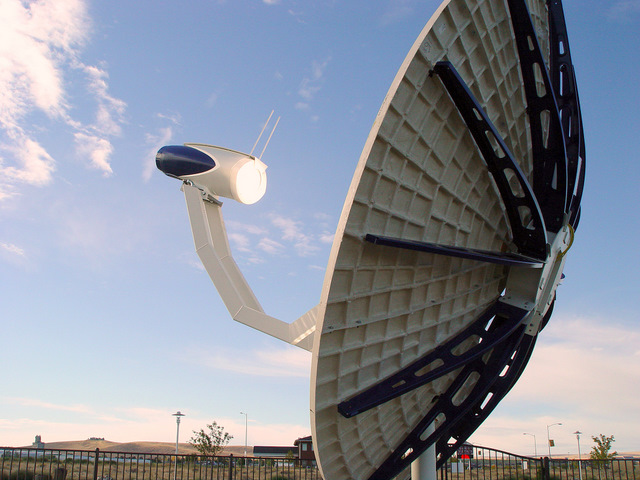
The Stirling dish has a storied — if unfulfilled – history in the annals of solar energy. It marries a Stirling heat engine, 17th-century invention, with a mirrored dish that looks like a super-sized version of a home satellite receiver. The solar dish focuses the sun’s rays on the Stirling engine, heating a gas inside that drives pistons to generate electricity. Stirling dishes are much more efficient at converting sunlight into electricity than solar thermal technologies that use mirrors to heat liquid-filled tubes to create steam to drive electricity-generating turbines. But while solar thermal plants exist today, the Stirling solar dish has never been deployed on a large scale since work on the technology began in earnest following the oil shocks of the 1970s.

Stirling Energy Systems of Phoenix in 2005 signed contracts with utilities Southern California Edison (EIX) and San Diego Gas & Electric (SRE) to build up to build tens of thousands of Stirling dishes to produce up to 1.75 gigawatts of greenhouse gas-free electricity. Though the company operates a six dishes in a prototype power plant at Sandia National Laboratories New Mexico, it is still working to get production costs down and rivals have questioned whether Stirling Energy Systems will be able to fulfill its deals. (See Green Wombat’s 2007 Business 2.0 magazine article on Stirling Energy Systems here. )

infinia-stirling-engine.jpgBut Infinia CEO J.D. Sitton tells Green Wombat that his company has perfected the Stirling dish to make it competitive with large-scale solar thermal as well as new photovoltaic technologies like thin-film solar. Infinia aims to deploy its Stirling dishes in smaller configurations so that solar power plants can be located near cities and at other sites that don’t require vast stretches of desert land where solar thermal plants are typically built. Each 21-foot-high, 15-foot-wide solar dish can generate 3-kilowatts (compared to 25 kilowatts for Stirling Energy Systems’ dish).

Infinia won’t itself become a solar developer but will provide its dishes to for power plants that range in size from 1 megawatt to 150 megawatts or more. In contrast, most solar thermal power plants now being planned are in the 400-500 megawatt range.

“We fly in the face of what has been the conventional wisdom in the solar thermal field that to be competitive you have to have a very large system,” says Sitton. “We can be deployed within city limits and be connected to existing transmission systems. No additional transmission capacity is required.”

“Our approach is that the winning solutions will be those that generate for most kilowatts for the least cost,” he adds. “This is a game about capital efficiency.”

That, of course, has been the mantra of leading green tech investor Vinod Khosla, who has disparaged photovolatic solar systems as too expensive to displace fossil-fuel generated power. Khosla also is backing Palo Alto solar thermal startup Ausra, which last year signed a deal to supply solar electricity to California’s largest utility, PG&E (PCG). Serial entrepreneur Bill Gross’ Idealab is funding solar thermal startup eSolar, which also is being backed by Google (GOOG).

Infinia contends the design of its Stirling dish system makes it competitive with solar thermal technologies. First, the Stirling engine uses helium rather than hydrogen, which typically must be periodically replenished. “We have no lubrication inside the machine and it needs no maintenance,” Sitton says. “We use helium in a hermetically sealed system.”

Second, he says the Infinia dish is made of six panels of glass rather than the 76 panels on the Stirling Energy Systems dish. “That gives us lower production costs and lower capital costs,” says Sitton. “We brought in large-scale manufacturer from the beginning. It’s not like we built a prototype and now have to reduce the cost to produce it.”

The first prototype went online last October and Sitton says Infinia is building a second at Sandia. Field tests will be conducted later this year in California and Nevada. He says Infinia is currently negotiating with solar developers and full-scale production is set to begin in November. Infinia has been in business since the 1980s, building Stirling engines for other applications. But the green tech boom and demands from utilities for renewable energy led the company to focus on solar.

Whether Infinia beats Stirling Energy Systems to market remains to be seen but look for the deals it signs with solar developers for a good indication of just how viable its technology is likely to be.

Read Full Post »

coal_fired_power_plant.jpgThree major Wall Street investment banks have pledged to adhere to a set of “Carbon Principles” to assess the risk — ecological and economic — of investing in planet-warming fossil fuel power plants. But does this signal that Wall Street’s ardor for Big Coal is cooling, or are we seeing a rather sophisticated greenwash that will allow further investment in dirty power to carry a green seal of approval?

Probably a bit of both.

Citi (C), JPMorgan Chase (JPM) and Morgan Stanley (MS) collaborated with with such coal-dependent utilities as American Electric Power (AEP), NRG Energy (NRG) and Southern Company (SO) along with national green groups Environmental Defense and the Natural Resources Defense Council to draft the Carbon Principles.

In short, the banks — all of which have come under fire from environmentalists for financing power projects that are a major contributor to climate change — have agreed to evaluate the economic viability of coal-fired plants in light of a widely expected national cap on greenhouse gas emissions. Such a cap would force utilities to reduce their carbon spew or pay a price per ton of carbon dioxide emitted over the limit.

But there’s some caveats here. According to the Carbon Principles, the financing criteria “does not establish specific performance criteria that companies or their projects must meet nor does it lay out specific types of transactions that the financial institutions will avoid.”

In other words, absent a hard target for power plant emissions, the banks can continue financing those projects, principles or not. (The Sierra Club lists proposed coal-fired power plants and their financiers here.) “There was resistance on part of the financial institutions to set specific targets or reductions,” Mark Brownstein, Environmental Defense’s managing director of business partnerships, told Green Wombat. “Banks do not see themselves as regulators but they are responsible to shareholders and investors with regard to risk.”

Still, says Brownstein, “I think that if the principles are honestly implemented, if companies honestly wrestle with data they collect and do honest due diligence, it will make a difference in the direction of investment in the utility space. We’ll see much less conventional coal, and more investment in renewable energy and low-carbon coal technologies.”

“I think we’ve been surprised, frankly,” adds Brownstein, “for whom these principles and this due diligence is in fact new.” Brownstein previously was an executive with New Jersey-based utility Public Service Enterprise Group (PEG), which was one of the utilities that worked on the Carbon Principles.

Whether the Carbon Principles result in any canceled coal projects remains to be seen, but Brownstein says that one consequence might be a higher cost of capital for those plants that do obtain financing.

JPMorgan spokesman Brian Marchiony told Green Wombat in an e-mail that, “We are certainly going to take a harder look at those projects and encourage other alternative energy options.”

Citi and Morgan Stanley did not respond to requests for comment.

Marchiony says that JPMorgan already had been using some environmental criteria to screen fossil fuel power plants. “We’ve added additional questions to our checklist and strengthened those that we were already asking in order to incorporate the carbon issue more formally into the financing discussion,” he says.

Given growing opposition to new coal-fired power plants from local communities and regulators, the big investment banks had already been reconsidering coal-related investments.

Brownstein says Environmental Defense will continue to push for Wall Street’s disengagement from Big Coal. “We very much look at these principles as a floor and not a ceiling,” he says. “We feel as an organization it would be both environmentally irresponsible and financially irresponsible for them to move ahead and invest in conventional coal.”

Read Full Post »

img_2914.jpg

Israeli solar power plant developer Solel announced Monday it has scored $105 million in funding from London-based investment firm Ecofin — yet another sign that the market for large-scale solar energy projects is reaching critical mass.

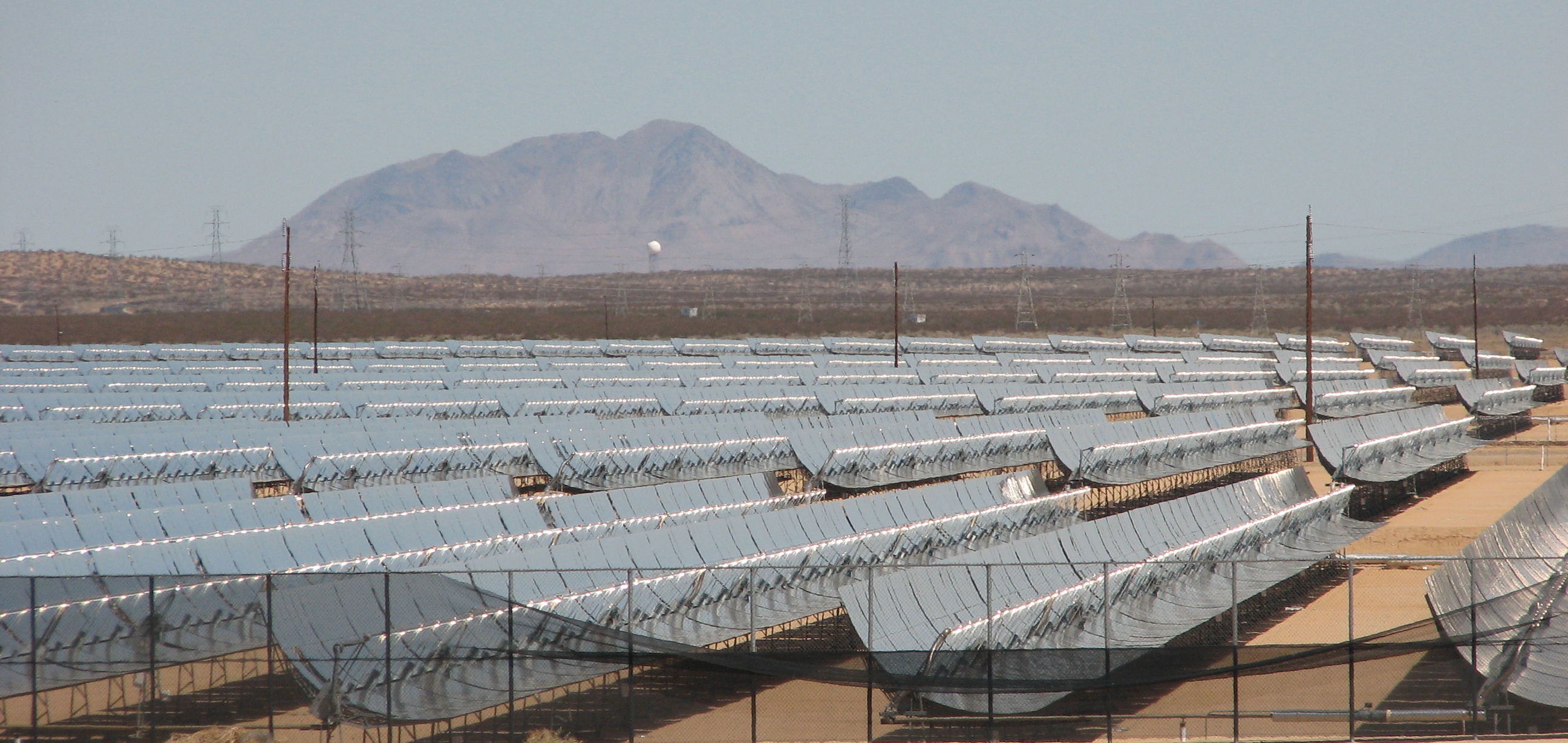
Solel last July signed the world’s largest solar power deal when it agreed to supply California utility PG&E (PCG) with 553 megawatts of green electricity to be produced by a massive solar thermal power plant to be built in the Mojave Desert. The company’s solar trough technology is also used in nine solar power plants (photo above) that were built in the Southern California desert in the 1980s. (In a solar trough power plant, long rows of parabolic mirrors focus the sun’s rays on tubes of liquid suspended over the arrays to create steam that drives an electricity-generating turbine.)

Raising $105 million is impressive and it’s certainly a big number. But given that a 500-megawatt solar power plant can easily cost $1 billion or more to build, it’s a relative drop in the bucket. However, it will allow Solel to move forward with the project and line up project financing for the PG&E plant while it negotiates more deals with other utilities — it won’t say which, but likely candidates are Southern California Edison (EIX) and San Diego Gas & Electric (SRE).

Competitors BrightSource Energy and Ausra have solar power plant applications before the California Energy Commission and have signed or are negotiating power purchase agreements with PG&E.

“Everyone is realizing that the market is there for thousands of megawatts of peaking power,” Solel CEO Avi Brenmiller recently told Green Wombat. “As time goes by we see energy prices rising and utilities are focusing their efforts to get solar thermal power because this is the right solution in the southwest United States.”

The Ecofin investment in Solel is notable also given the uncertainty surrounding solar power at the moment due to Congress’ failure to extend the solar investment tax credit in the recently enacted energy bill. The 30 percent credit is considered crucial to help solar energy companies secure financing for power plants and achieve economies of scale. The tax credit expires at the end of 2008 but solar energy proponents and their allies on Wall Street say they’re confident that Congress will take up legislation this session to extend it for as long as eight years.

Read Full Post »

brightsource-ivanpah.png

When President Bush signed the energy bill into law last month, much was made of the legislation’s mandate that automakers dramatically boost the fuel efficiency of their fleets. Less noticed was that the bill dropped a provision that would have extended the solar investment tax credit — a measure viewed as essential to transforming solar energy from a niche business into a multi billion-dollar industry that can generate gigawatts of greenhouse gas-free electricity.

The timing couldn’t be worse. With the current solar credit set to sunset, as it were, at the end of 2008, Big Solar is at at a tipping point: Utilities and renewable energy companies are in the midst of negotiating massive megawatt power purchase deals whose financing depends on the 30 percent investment tax credit, or ITC.

“I think there is a major concern that this will stall all the beneficiaries of the ITC,” said Joshua Bar-Lev, vice president for regulatory affairs for solar power plant developer BrightSource Energy. The Oakland, Calif.-based startup is negotiating a 500-megawatt agreement with California utility PG&E and is proceeding with plans to build a 400-megawatt solar thermal power station on the Nevada border (artist rendering above).

Solar energy companies, utilities like PG&E (PCG) and Edison International (EIX) as well as financiers such as Morgan Stanley (MS) and GE Energy Financial Services (GE), had pushed for an eight-year extension of the investment tax credit to give Big Solar projects enough time to get off the ground and start to achieve economies of scale. The provision also would have allowed utilities to claim the credit for solar projects they build. The measure drew support from both sides of the aisle in Congress but died — by one vote in the Senate — when Bush threatened to veto the energy bill because the solar tax credit would be financed by repealing previous tax breaks given to Big Oil.

“The Congressional leadership is very strong in their support of the ITC; they will put this on the table In 2008,” said Chris O’Brien, a Sharp Solar executive and chairman of the Solar Energy Industries Association, in an e-mail. “The solar industry will continue to contact legislators in key states.”

House Speaker Nancy Pelosi and the Democratic leadership in the Senate have pledged to re-introduce renewable energy tax credit legislation this session. “Speaker Pelosi has said repeatedly that she hopes to address that this year,” Drew Hammill, a spokesman for Pelosi, told Green Wombat. “We’re just getting started but there’s bipartisan support for the tax credit.”

Publicly, at least, no one in the solar industry will say that the uncertainty over the tax credit is affecting planned projects. “Our expectation is that there will be another tax bill that will address this issue,” said Kevin Walsh, managing director of the renewable energy group at GE Energy Financial Services. “We’re working on a number of [solar thermal] deals but it’s too early to disclose them.”

In recent months, PG&E has signed deals for more than a gigawatt of electricity — enough to light more than 750,000 homes — with solar power plant developers. Such power purchase agreements can take more than a year to hammer out and the permitting and construction of a solar power station can take another three to five years.

“We’re continuing to move forward with negotiations and with contracts that have already been signed, but certainly the absence of the ITC could potentially impact future projects,” said PG&E spokesman Keely Wachs. “Without the credit, it does increase the cost of that energy and of course it also sends a very clear market signal as to our country’s energy priorities.”

Silicon Valley solar startup Ausra is building a 177-megawatt solar power plant on the Central California coast to supply electricity to PG&E and is pursuing deals with Florida’s FPL (FPL) and other utilities.

“Just like any business, the solar industry prefers a predictable system for the future,” wrote Holly Gordon, Ausra’s director of regulatory and legislative affairs, in an e-mail. “It will be more difficult to plan for our projects while the situation remains uncertain. While we are currently seeing excellent demand for solar energy at market prices, we need a long term extension of the renewable energy tax credits to ensure market stability and investor confidence as the market continues to grow.”

Read Full Post »

ausra-16.jpgBig Solar is on a roll in California.

For the second time in seven weeks, the California Energy Commission has voted to accept an application for a massive megawatt solar power plant. The commission on Wednesday certified as “data adequate” Silicon Valley startup Ausra’s application to build a 177-megawatt solar on the state’s central coast. That means Ausra’s Carrizo Energy Solar Farm has cleared a significant regulatory hurdle and the commission will begin a year-long review process. If all goes well, construction will begin in 2009 and the plant will start producing electricity in 2010. (To get an idea of the complexity of the California licensing process and why the acceptance of an application is a big deal, you just need to scan Aura’s 1,000-page application package.

The Ausra move follows the commission’s Oct. 31 vote to greenlight for review BrightSource Energy’s planned 400-megawatt power station complex to be built in the Mojave Desert on the Nevada border.

Ausra, backed by A-list venture capitalists Vinod Khosla and Kleiner Perkins Caufield & Byers, has signed a 20-year power purchase agreement with utility giant PG&E (PCG) for the greenhouse gas-free electricity generated by the Carrizo plant in eastern San Luis Obispo County. BrightSource (backed by Morgan Stanley (MS) and VantagePoint Venture Partners), meanwhile, continues to negotiate with the utility for a 500-megawatt power purchase deal.

Read Full Post »

ausra-solar-field.jpg

Here’s another sign that Big Solar’s time has come: Silicon Valley startup Ausra is building the United States’ first solar power plant factory.

When the 130,000-square-foot facility goes online in April outside Las Vegas, robots will assemble mirror arrays and other equipment that will then be trucked to solar power plant building sites in California and the Southwest. Ausra, backed by venture capitalists Vinod Khosla and Kleiner Perkins Caufield & Byers, signed a deal with utility PG&E (PCG) in November to supply electricity generated by a 177-megawatt solar thermal power station to be built on California’s central coast.

“Steel, flat glass and standard boiler pipe flows into the factory and completed solar fields come out ready for installation,” John O’Donnell, Ausra’s  executive vice president, told Fortune’s Green Wombat from Nevada over the din of construction noise. “We wound up working with one of Australia’s leading builders of car production systems to develop robotic assembly, weld, bond and paint systems for the mirror units.”

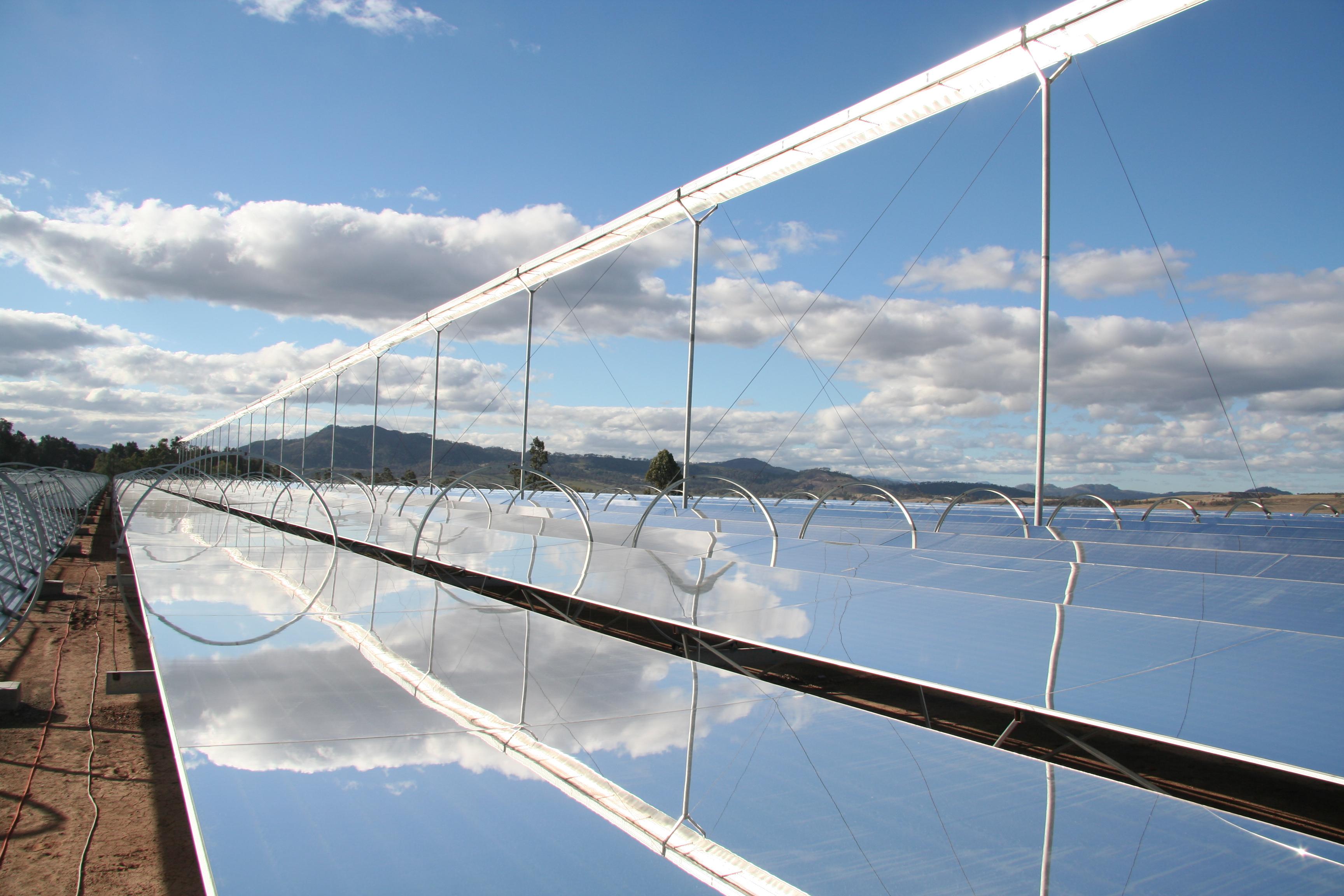
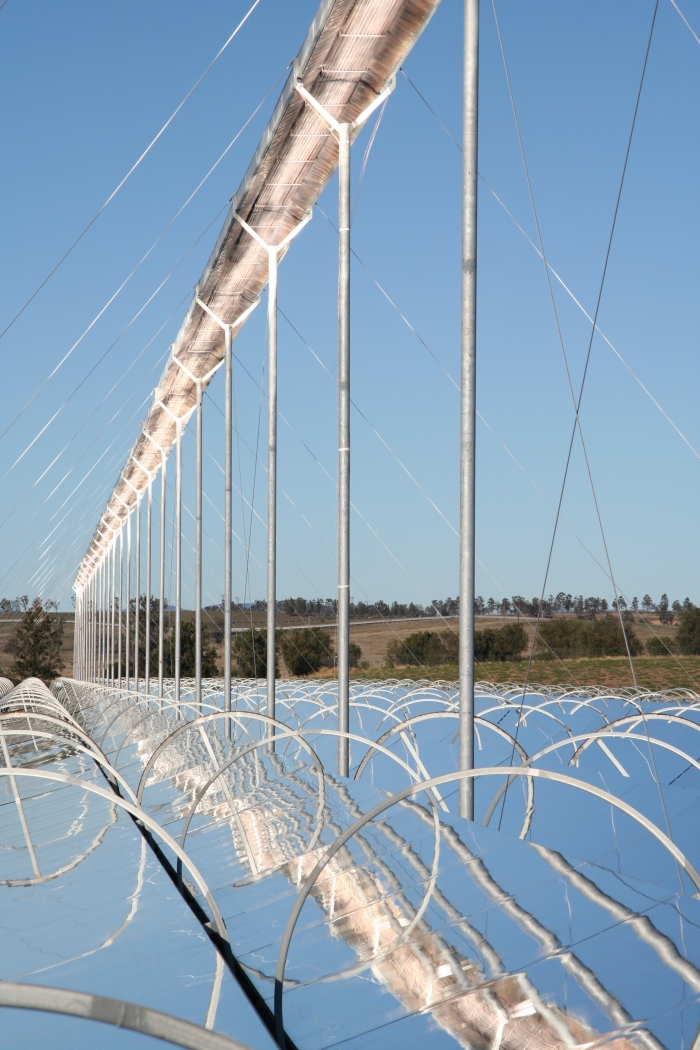
Ausra will deploy large arrays of long mirrors that concentrate sunlight on water-filled pipes that hang over the reflectors. As the water is heated up to 545 degrees Fahrenheit the resulting steam drives a standard turbine to generate electricity. O’Donnell says the Las Vegas factory, located near McCarran International Airport, will employ about 50 people and be able to produce 70 megawatts worth of solar equipment a month — implying Ausra has many more big power deals on the table.

The facility marks the emergence of Nevada as a player in the solar power industry. “We see Nevada as one of the best markets for solar power,” says O’Donnell. “It’s the business climate in Nevada, the solar resource and a rapidly growing market for electric power. The main reason for being here is the combination of a transportation center, a workforce and a central location for where we think all the power plants will be. We looked at locations in California, Phoenix and here. Taking the five-year view, we would like to build a lot of power plants in the Southwest so we asked, ‘Where is the best location. What are the transportation options?’ ”

Nevada’s proximity to California means that solar power plants can be built on its side of the border to ship electricity to densely populated Southern California as well as the booming Las Vegas region. O’Donnell says Nevada offered Ausra a standard package of tax incentives but nothing extra to locate the factory in the Silver State.

“As the world transitions to clean energy, Nevada will be a leader in building and delivering clean power to our state, to our region, and to our country,” said Nevada Development Authority CEO Somer Hollingsworth in a statement.

Nevada will get a run for its money from sun-drenched Arizona, where Phoenix-based Stirling Energy Systems plans to build factories to manufacture Stirling dishes for solar power plants that will supply electricity to Southern California Edison (EIX) and San Diego Gas & Electric (SRE).

Read Full Post »

kevin-rudd.jpgAustralian voters on Saturday tossed out the decade-old government of conservative Prime Minster John Howard, installing Labor Party leader Kevin Rudd (left) as the new PM. Howard was a staunch ally of the Bush administration on climate change, joining it in refusing to ratify the Kyoto Accord despite — or because of — Australia’s status as the planet’s biggest per-capita emitter of greenhouse gases.

Australia is a proverbial canary in the coal mine when it comes to suffering the consequences of climate change, and Saturday’s election may foreshadow how environmental issues will play out elsewhere in the coming years. With the peter-garret-mp.jpgcountry in the grip of the worst drought on record, global warming — and the Howard government’s emu-in-the-sand stance that prompted corporate Australia to push its own climate change agenda — became a hot campaign topic. The Australian Labor Party’s environment spokesman, former Midnight Oil front man Peter Garret (right) — a rock-star-environmentalist-turned-politico — hammered the government at every turn. Meanwhile, Rudd promised to sign Kyoto, up investment in green technology and establish a nationwide carbon trading market to help achieve a 60 percent reduction in greenhouse gas emissions by 2050. Labor also set a target of obtaining 20 percent of this coal-dependent nation’s electricity from renewable sources by 2020.

Just how much Labor’s climate change policies contributed to its landslide victory is up for debate, though such was the voters’ wrath that it appears that even Howard will lose his seat in Parliament, the first sitting prime minister to do so since 1929. But here’s one indicator: The Australian Greens scored 20 percent of the votes in some electorates and will take as many as six seats in the Senate, possibly giving the environmental party the balance of power in the upper house. The Greens also contributed to the Labor landslide because under Australia’s preferential voting system, ballots cast for unsuccessful Green candidates were re-directed to the ALP.

So with a charismatic greenie like Garrett as Australia’s presumptive new environment minister, Australia is set to become the Scandinavia of the South Pacific, right? Not quite. Australia’s current prosperity owes much to the resource boom under way as China buys up just about any mineral that can be dug out of the ground. (See my Fortune colleague Brian O’Keefe’s excellent story on the iron ore gold rush in Western Australia.)

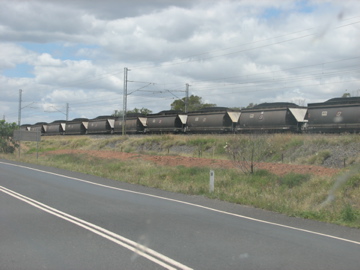
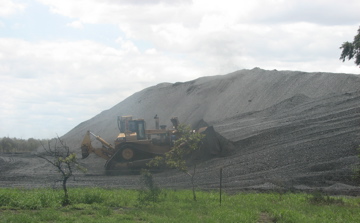
img_3574.jpgGreen Wombat got a first-hand look at the pressures Rudd will face during a visit last month to Queensland, the new PM’s home state. Driving through central Queensland’s coal belt, a never-ending procession of trains piled high with the black stuff flanked the two-lane highway, running 24/7 between the mines and the port, where China-bound coal ships are stacked up by the dozens off shore. Bulldozers scaled mountains of coal sitting on the side of the road, scooping up bucketfuls to be put on a conveyor belt that straddled the highway to connect to a train depot. At the Dingo roadhouse, a big color-coded wall map charts central Queensland’s major coal seams and Shift Miner Magazine is on sale, chronicling the explosion in coal mining that has turned places like Rockhampton into boom towns. Riding in from the Rockhampton airport, a former coal miner-turned-taxi img_3569.jpgdriver tells me she rues passing up the chance a couple years’ back to buy a house for $A10,000 in a nearby mining town; such homes now go for $A300,000. Out on a cattle ranch about 500 kilometers from Rockhampton, a mining company is drilling for gold but rancher John Dennis tells me he hopes they find something else. “Black gold,” he says. “Coal.” (The biggest corporate takeover attempt now under way Down Under is Aussie mining giant BHP Billiton (BHP)’s $150 billion offer for rival Rio Tinto (RTP).)

So no surprise that Rudd wants to spend $A500 million on so-called clean coal technology to capture and store greenhouse gas emissions from coal-fired power plants. While sun-drenched Australia has some of the world’s best solar resource it currently gets about 86 percent of its electricity from coal. In fact, in recent years, Australian solar energy companies like Ausra have relocated to California, frustrated by the government’s lack of support for renewable energy. But with the new Labor government pledging to fund a $A150 million Energy Innovation Fund to stop the brain drain as well as increase the mandatory renewable energy targets, Australia may be the next frontier for green business.

Read Full Post »

« Newer Posts

Design a site like this with WordPress.com
Get started