Feeds:
Posts
Comments

Archive for the ‘climate change’ Category

photo: Southern California Edison

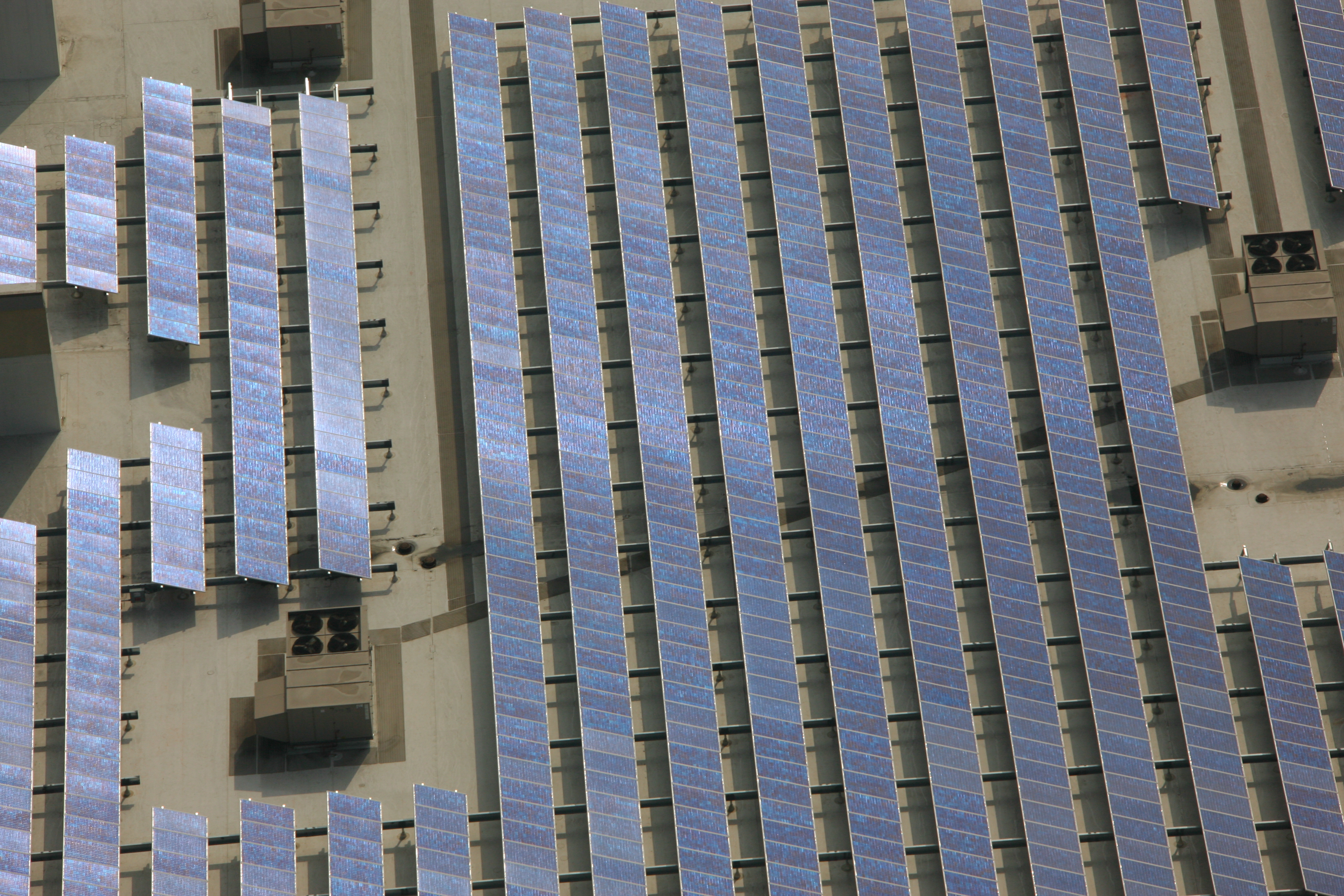
When Southern California Edison unveiled plans to install 250 megawatts’ worth of solar panels on warehouse roofs back in March, it was hailed as a ground-breaking move. In one fell swoop, the giant utility would cut the cost of photovoltaic power, expand the solar market and kick-start efforts to transform untold acres of sun-baked commercial roof space into mini-power plants.

There’s just one problem: the solar industry is fighting the billion-dollar plan. In briefs filed with the California Public Utilities Commission, solar companies, industry trade groups and consumer advocates argue that allowing a utility to own and operate such massive green megawattage will crowd out competitors who can’t hope to compete with a project financed by Edison’s ratepayers.  (In California, shareholders of investor-owned utilities are guaranteed a rate of return for approved projects, while utility customers bear a portion of the costs in the form of higher rates.)

The five-year plan “would establish SCE as the monopoly developer of commercial-scale distributed solar in its service territory,” wrote Arno Harris, CEO of Recurrent Energy, a San Francisco company that sells solar electricity to commercial customers. “This would irreparably impair the development of a competitive solar industry.”

Southern California Edison (EIX) is the first utility in the United States to propose such a “distributed generation” scheme and the dispute is being watched closely as a test case for the viability of producing renewable electicity from hundreds of millions of square feet of commercial rooftops. Such systems can be plugged directly into existing transmission lines and tend to generate the most solar power when electricity demand spikes – typically on summer afternoons when people crank their air conditioners. Having such green energy on tap would save utilities from having to build expensive and planet-warming fossil fuel-powered “peaker plants” that sit idle except when demand suddenly rises.

Even critics hail Edison’s move as “bold” and “visionary” and no one disputes that in California the development of big rooftop solar has lagged. For instance, the state’s $3.3 billion “million solar roofs” initiative is designed to put smaller-scale solar panels on homes and businesses and provides generous rebates for systems under 1 megawatt. At the other end of the scale, the state’s big utilities have been signing contracts to buy electricity from solar thermal power plants to be built in the desert. Left out of the subsidy game are incentives for the 1-to-2 megawatt arrays well-suited for commercial buildings.

Southern California Edison says it’s filling that gap and will energize the solar industry, not crush it. The utility plans to lease 65 million square feet of commercial rooftop space in the “Inland Empire” region of Southern California for solar arrays that would generate enough electricity to power 162,000 homes.

“SCE’s financial stability and business reputation will increase the probability that 250 MW of solar PV systems will be available to meet the state’s solar rooftop goals over the next five years,” the utility’s attorneys wrote in a brief filed with the utilities commission, which must approve the program. “In so doing, a solar PV program can improve efficiencies … to reduce costs and jump start the competitiveness of solar PV for widespread application on California roofs.”

There’s no doubt the program will be a boon for solar module makers. For instance, thin-film solar cell company First Solar (FSLR) is supplying 33,000 panels for the program’s first project, a 600,000-square-foot roof array in the inland city of Fontana. However, Southern California Edison intends to contract for union labor to install the solar systems and tap its own capital and a rate hike to finance the project. That won’t leave many opportunities for solar installers and financiers like SunPower (SPWR), SunEdison and MMA Renewable Ventures (MMA).

“Even though this program is kind of taking bread out of our own mouth, the demand for solar will keep going up,” says Mark McLanahan, senior vice president of corporate development at MMA Renewable Ventures, a San Francisco firm that finances commercial solar arrays.

“What they have announced is extremely visionary,” McLanahan tells Green Wombat. “It’s game changing and opens up whole new realms of what solar can do. That’s exciting.”  On the other hand, he says, “It’s certainly possible that a young, growing industry that is pretty fragmented could be hurt by this rather than helped.”

A solution advanced by some solar industry critics is for Southern California Edison to open up the entire program to competitive bidding, not just the procurement of solar panels. The utility vehemently opposes the idea, arguing it would work against the economies of scale it says it can bring to the program.

Whether regulators will approve Southern California Edison’s request for a rate hike to pay for the initiative – and at electricity rates that are significantly higher than those set for other solar programs – remains to be seen. The commission’s own ratepayer advocate has questioned whether utility customers will get their money’s worth.

The utilities commission is unlikely to issue a final decision until next year. In the meantime, you can bet the state’s other big utilities – PG&E (PCG) and San Diego Gas & Electric (SRE) – and solar companies will be watching to see whether the sky’s the limit for big rooftop solar or whether a ceiling is about to be placed on the industry’s ambitions.

Read Full Post »

For those readers who missed Green Wombat’s feature story on the solar land rush in the July 21 issue of Fortune – available here at Fortune.com – I reprint below.

The Southwest desert’s real estate boom

From California to Arizona, demand for sites for solar power projects has ignited a land grab.

By Todd Woody, senior editor

(Fortune Magazine) — Doug Buchanan grins with relief when he sees the carcasses. He has just driven up a steep dirt road onto a vast, sunbaked mesa overlooking the Mojave Desert in western Nevada. There, a few feet from the trail, lie the corpses of two steers. A raven perches on one, the only object more than three feet above the ground on this pancake-flat plateau. Cattle, dead or alive, qualify as good news in Buchanan’s line of work. If cattle are present, that means grazing is permitted, and that in turn means that this land is most likely not protected habitat for the desert tortoise.

Buchanan, 53, is scouting sites for a solar power company called BrightSource Energy, an Oakland-based startup backed by Google and Morgan Stanley. The blunt, fifth-generation Californian, who used to survey the same area for natural-gas power sites, knows that the presence of an endangered species such as the tortoise could derail BrightSource’s plans to build a multibillion-dollar solar energy plant on the mesa.

BrightSource badly wants these 20 square miles of federal land on what is called Mormon Mesa. The company was in such a hurry to stake its claim with the U.S. Bureau of Land Management that it applied for a lease sight unseen. That’s an expensive gamble for a startup, given that application fees alone run in the six figures. “I usually like to go out and kick the tires before filing a claim,” Buchanan says, “but there’s a lot of competitive pressure these days to move fast.”

That’s putting it mildly. A solar land rush is rolling across the desert Southwest. Goldman Sachs, utilities PG&E and FPL, Silicon Valley startups, Israeli and German solar firms, Chevron, speculators – all are scrambling to lock up hundreds of thousands of acres of long-worthless land now coveted as sites for solar power plants.

The race has barely begun – finished plants are years away – but it’s blazing fastest in the Mojave, where the federal government controls immense stretches of some of the world’s best solar real estate right next to the nation’s biggest electricity markets. Just 20 months ago only five applications for solar sites had been filed with the BLM in the California Mojave. Today 104 claims have been received for nearly a million acres of land, representing a theoretical 60 gigawatts of electricity. (The entire state of California currently consumes 33 gigawatts annually.)

It’s not just a federal-land grab either. Buyers are also vying for private property. Some are paying upwards of $10,000 an acre for desert dirt that a few years ago would have sold for $500.

No doubt the prospect of potential riches is overheating expectations. But California and surrounding states have mandated massive increases in renewable energy in the next few years. That has led some experts at Emerging Energy Research of Cambridge, Mass., to predict that Big Solar could be a $45 billion market by 2020.

Meanwhile, the land rush is setting the stage for a showdown between solar investors and those who want to protect a fragile environment that is home to the desert tortoise and other rare critters. The Southwest is on the cusp of what could be a green revolution. And the biggest obstacle of all may be … environmentalists.

***

Over the past year a parade of executives bearing land claims have made the trek to a stucco BLM office just off the interstate in the dusty city of Needles, Calif., a 110-mile drive south from Las Vegas. (It’s the town where the late “Peanuts” cartoonist, Charles M. Schulz, briefly lived as a boy; in the comic strip, Snoopy’s brother Spike is a resident.) The Bush administration has instructed the BLM to facilitate renewable-energy projects (along with nonrenewable ones). But Sterling White, the BLM’s earnest Needles field manager, is also concerned about what could happen if they transform the Mojave into a collection of giant power stations. “One of our biggest challenges is the cumulative impact of these projects,” he says.

Nearly 80% of the land that White’s office oversees is federally protected wilderness or endangered-species habitat. That leaves about 700,000 acres for solar power plants, only some of which are near transmission lines. Land leases are handed out on a first-come, first-served basis, but White is also supposed to weed out speculators from genuine solar developers based on loose criteria such as who is negotiating with utilities and who is applying for state power licenses. White has yet to approve a single lease, but he has summarily rejected four because they lie in protected-species habitat.

***

Solar prospectors tend to be as secretive about their land as forty-niners were about the veins of gold they discovered. Most bids are placed by limited-liability corporations with opaque names that conceal their ownership. And no one has been as quick to move into the Mojave – or as tightlipped about it – as Solar Investments.

That entity, it turns out, is Goldman Sachs’s solar subsidiary. The investment bank’s designs on the desert are a topic of intense interest and speculation. Goldman declined to comment. But here’s what we know:

Solar Investments filed its first land claim in December 2006 and within a month had applied for more than 125,000 acres for power plants that would produce ten gigawatts of electricity. Many of the sites lie close to the transmission lines that connect the desert to coastal cities. (Goldman has also staked claims on 40,000 acres of the Nevada desert.)

Nobody expects Goldman to begin operating solar plants. It will probably either partner with another developer or sell its limited-liability company (and its leases) outright. The firm has been making the rounds of solar developers. “The conversation’s been pretty wide-ranging, primarily as an investor interested in financing deals,” says one solar energy executive approached by Goldman. “But there’s clearly an element of interest in our technology.” Goldman has requested permission to install meteorological equipment on its sites and is evaluating “competing technologies, including solar dish systems, power towers, and large-scale photovoltaic arrays,” according to a letter Goldman sent to the BLM in August 2007.

Competitors are lining up behind Goldman, staking claims on some of the same sites in hopes the bank will abandon them. PG&E and FPL, for instance, are in the queue after Goldman on one site. Solel, an Israeli solar company that last year scored a contract to deliver 553 megawatts to PG&E, is third in line behind Goldman on another.

“I view Goldman as a very interesting indicator of things to come,” says Brian McDonald, PG&E’s director of renewable-resource development. “They’re usually ahead of the curve – you can extract a huge amount of value if you get in early.” There’s other smart money here too. A Palo Alto startup called Ausra received $40 million from the elite green venture capitalists Vinod Khosla and Kleiner Perkins Caufield & Byers. Ausra has signed a deal with PG&E and announced its intention to construct a gigawatt’s worth of projects a year.

Most of the power production contemplated for the Mojave will rely on solar thermal technology – the common approach in large-scale generation projects – in which arrays of mirrors heat liquids to produce steam that drives electricity-generating turbines. But a secretive Hayward, Calif., startup called OptiSolar has filed claims on 105,300 acres to build nine gigawatts’ worth of photovoltaic power plants, which employ solar panels similar to those found on residential rooftops. (The company also has applied for leases on 21,800 acres in Arizona and Nevada.) To put those ambitions in context, the biggest photovoltaic power plant operating today produces 15 megawatts. Says OptiSolar executive vice president Phil Rettger: “We have a proprietary technology and a business approach that we’re convinced will let us deploy PV at large scale and be competitive with other forms of renewable energy.”

***

With the prime BLM sites quickly being snapped up – recently the agency temporarily stopped accepting new land claims while it develops a desertwide solar policy – competition is growing for private land. Here, too, the emphasis on secrecy borders on the obsessive. A request to view a piece of desert that is up for sale is treated as if I had asked to visit Area 51.

Waiting outside a roadside diner in southwestern Arizona – I’ve promised not to say where – with BrightSource senior vice president Tom Doyle, I expect to see a weather-beaten farmer come chugging up in a battered pickup. Instead, a pale-green Volvo SUV driven by a physician glides into the parking lot. The doctor, who wishes to remain anonymous, acquired the land two years ago as the renewable-energy boom got underway. “We thought we’d put solar on it – that’s the reason we bought it,” the doctor says as we pile into the Volvo and head into the desert to visit the site. After about five miles we turn off the road and come to a stop in a rocky patch of desert framed by low-slung mountains and buttes. Doyle quizzes the physician about water rights, endangered species, and access to transmission lines before moving out of earshot to talk dollars. The whole process takes only about 20 minutes – the two sides ultimately decide not to do a deal – and then Doyle is on to visit the next potential property.

Such is the land frenzy that farmers in Arizona were paid $45 million for 1,920 acres by Spanish solar company Abengoa so that it could build a 280-megawatt power plant; the land had an assessed value of a few hundred thousand dollars. The company also plunked down $30 million for 3,000 acres in the California Mojave that had traded hands for $1.25 million nine years earlier. That prompted developer Scott Martin to put his adjacent 300-acre parcel – land he had bought only a few months earlier for $457,500 – on the market for $3 million. Also for sale: a $15 million, 3,000-acre tract near Palm Springs, which Martin began shopping around to solar executives like Ausra’s Perry Fontana. When I join Fontana to check out the site, a onetime World War II air base outside the Mojave ghost town of Rice, he says, “I probably get three calls a day from brokers or landowners.” As if on cue, his Bluetooth earpiece lights up with a cold call from a broker peddling some land near Needles.

***

Green energy is not about to get a green light from all environmentalists. “We’re going to challenge these big solar projects, and there’s going to be tremendous environmental battles,” says veteran California activist Phil Klasky, a member of several green groups who helped lead a campaign in the 1990s that scuttled a radioactive-waste dump planned in tortoise territory in the Mojave. “Large solar arrays will have an impact on surrounding critical habitat for the desert tortoise and other threatened species. We have to fight global warming, but just because it’s solar doesn’t make it right.”

The developers are worried about resistance. “I remember the spotted owl,” says Fred Morse, a former Department of Energy official who is a senior advisor to Abengoa’s U.S. operations. The widespread logging of ancient forests, home to the northern spotted owl, set off epic environmental fights in the 1980s and ’90s. As Morse puts it, “The Mohave ground squirrel or the desert tortoise – any one of them could become a cause.”

Solar energy companies may make for less tempting targets than timber barons, but development of the desert has never been attempted on such a scale. The result is that some environmentalists find themselves anguished over which side to take. “We’ve had our share of conflicts over endangered species in this state, no doubt about it,” says Kevin Hunting, a biologist and a deputy director of the California Department of Fish and Game, which enforces the state endangered-species laws. “We’re actively looking to strike that critical balance between the state’s renewable-energy goals and conserving species that are vulnerable. It’s challenging.”

California wildlife regulators, for instance, have peppered Ausra with requests for more biological surveys on the site of a 177-megawatt solar power plant to be built in San Luis Obispo County. The feds could also require Ausra to prepare a plan to protect the San Joaquin kit fox, a process that could take years and shred the project’s economic viability.

Worse for developers, state and federal law require wildlife officials to consider the total impact of multiple projects when weighing whether to approve any individual facility. Next door to Ausra’s solar farm, for example, is OptiSolar’s planned 550-megawatt power plant, which would cover 9 1/2 square miles of potential endangered-species habitat with solar panels. Will the regulators approve one? Both? Nobody knows.

In the meantime, the solar land rush is unlikely to cool down. Which is why Morse wants to keep quiet Abengoa’s $30 million real estate deal. The company is applying to build a 250-megawatt solar power plant on the site, and it may be in the market for more land. “We don’t want to publicize that purchase,” he says, “as the speculators will be coming out of the woodwork.”

Read Full Post »
For some on the right coast, the current renewable energy craze seems like a rerun of that ’70s show, the province of California dreamers and pie-in-the-sky Silicon Valley techies. But increasingly it’s all about Big Business, a point driven home Thursday by a deal struck by two decidedly non-crunchy granola types: billionaire oilman T. Boone Pickens and General Electric chief Jeffrey Immelt.

Pickens’ Mesa Power placed an order for 667 GE (GE) wind turbines for the first phase of a massive 4,000-megawatt, 400,000-acre West Texas wind farm called the Pampa Wind Project. When completed in 2014, Pampa is expected to produce enough clean green energy to light up 1.3 million homes, according to Mesa. Each of those 667 turbines alone can generate 1.5 megawatts of electricity. The first phase of the project will cost $2 billion, with a good chunk of the cash going to GE.

That a legendary wildcatter like Pickens sees big money to be made from renewable energy in an oil state like Texas is just another sign that green is not a fad but the future. “You find an oilfield, it peaks and starts declining, and you’ve got to find another one to replace it,” Pickens said in a statement. “It can drive you crazy. With wind, there’s no decline curve.” (Just how much money Pickens will make off wind will depend on whether Congress extends a production tax credit that makes such projects viable.)

When it comes to energy, Texas is literally its own country, as the Lone Star State is not plugged into the national power grid and must generate nearly all its electricity within its borders. Aggressive efforts by Texas regulators and entrepreneurs to make the state energy independent by upgrading its transmission system and tapping wind power are models for the rest of the country.

Read Full Post »

The souring economy hasn’t dissuaded green tech investors from making big bets on renewable energy. On Wednesday, solar power plant builder BrightSource Energy announced it had raised $115 million from a group of investors that include Google.org, the search giant’s philanthropic arm, and oil giants Chevron and BP.

The investment in the Oakland, Calif.-based startup is Google’s (GOOG) second big solar energy play in the past two months. In April, Google.org joined a $130 million round for eSolar, a Pasadena solar power plant company whose chairman is Idealab founder Bill Gross.

BrightSource Energy, started by American-Israeli solar pioneer Arnold Goldman, has contracts to supply California utility PG&E (PCG) with up to 900 megawatts of solar electricity from power plants to be built in the Mojave Desert on the California-Nevada border. BrightSource has developed a new solar technology, dubbed distributed power tower, that focuses fields of sun-tracking mirrors called heliostats on a tower containing a water-filled boiler. The sun’s rays superheat the water and the resulting steam drives an electricity-generating turbine. (Artist rendering of BrightSource’s planned Ivanpah plant above.)

Given that a 500-megawatt solar power plant can cost more than $1 billion to build, $115 million is but a drop in the bucket. But it will allow BrightSource, which previously raised $45 million, to proceed with the development of its technology as it seeks project financing for construction of its first power plants.

And it can’t hurt to have such high-profile backers when you negotiate power purchase agreements with utilities. Besides Google, BP Alternative Energy (BP) and Chevron Technology Ventures (CVX), previous investors participating in the new round include Morgan Stanley (MS), VantagePoint Venture Partners, Draper Fisher Jurvetson and DBL Investors.

Another new BrightSource investor is Norweigan oil and gas behemoth StatoilHydro (STO). Apparently, even Big Oil has seen the light when it comes to hedging its bets with green energy.

Read Full Post »

“Years ago we came to the conclusion that global warming was a problem, it was an urgent problem and the need for action is now. The problem appears to be worse and more imminent today, and the need to take action sooner and take more significant action is greater than ever before” — PG&E Chairman and CEO Peter Darbee

The head of one of the nation’s largest utilities seemed to be channeling Al Gore on Tuesday when he met with a half-dozen environmental business writers, including Green Wombat, in the PG&E (PCG) boardroom in downtown San Francisco. While a lot of top executives talk green these days, for Darbee green has become the business model, one that represents the future of the utility industry in a carbon-constrained age.

As Katherine Ellison wrote in a feature story on PG&E that appeared in the final issue of Business 2.0 magazine last September, California’s large utilities — including Southern California Edison (EIX) and San Diego Gas & Electric (SRE) — are uniquely positioned to make the transition to renewable energy and profit from green power.

First of all, they have no choice. State regulators have mandated that California’s investor-owned utilities obtain 20 percent of their electricity from renewable sources by 2010 with a 33 percent target by 2020. Regulators have also prohibited the utilities from signing long-term contracts for dirty power – i.e. with the out-of-state coal-fired plants that currently supply 20 percent of California’s electricity. Second, PG&E and other California utilities profit when they sells less energy and thus emit fewer greenhouse gases. That’s because California regulators “decouple” utility profits from sales, setting their rate of return based on things like how well they encourage energy efficiency or promote green power.

Still, few utility CEOs have made green a corporate crusade like Darbee has since taking the top job in 2005. And the idea of a staid regulated monopoly embracing technological change and collaborating with the likes of Google (GOOG) and electric car company Tesla Motors on green tech initiatives still seems strange, if not slightly suspicious, to some Northern Californians, especially in left-leaning San Francisco where PG&E-bashing is local sport.

In a wide-ranging conversation, Darbee, 54, sketched sketched a future where being a successful utility is less about building big centralized power plants that sit idle until demand spikes and more about data management – tapping diverse sources of energy — from solar, wind and waves to electric cars — and balancing supply and demand through a smart grid that monitors everything from your home appliances to where you plugged in your car. “I love change, I love innovation,” says Darbee, who came to PG&E after a career in telecommunications and investment banking.

Renewable energy

“On renewable energy what we’ve seen is the market is thin,” says Darbee. “Demand just from ourselves is greater than supply in terms of reliable, well-funded companies that can provide the service.”

PG&E so far has signed power purchase agreements with three solar startups — Ausra, BrightSource Energy and Solel — for up to 1.6 gigawatts of electricity to be produced by massive solar power plants. Each company is deploying a different solar thermal technology and uncertainty over whether the billion-dollar solar power stations will ultimately be built has prompted PG&E to consider jumping into the Big Solar game itself.

“We’re looking hard at the question of whether we can get into the business ourselves in order to do solar and other forms of renewables on a larger scale,” Darbee says. “Let’s take some of the work that’s been done around solar thermal and see if we can partner with one of the vendors and own larger solar installations on a farm rather than on a rooftop.”

“I like the idea of bringing the balance sheet of a utility, $35 billion in assets, to bear on this problem,” he adds.

It’s an approach taken by the renewable energy arm of Florida-based utility FPL (FPL), which has applied to build a 250-megawatt solar power plant on the edge of the Mojave Desert in California.

For now, PG&E is placing its biggest green bets on solar and wind. The utility has also signed a 2-megawatt deal with Finavera Renewables for a pilot wave energy project off the Northern California coast. Given the power unleashed by the ocean 24/7, wave energy holds great promise, Darbee noted, but the technology is in its infancy. “How does this technology hold up against the tremendous power of the of the Pacific Ocean?”

Electric cars

Darbee is an auto enthusiast and is especially enthusiastic about electric vehicles and their potential to change the business models of both the utility and car industries. (At Fortune’s recent Brainstorm Green conference, Darbee took Think Global’s all-electric Think City coupe for a spin and participated in panels on solar energy and the electric car.)

California utilities look at electric cars and plug-in hybrids as mobile generators whose batteries can be tapped to supply electricity during peak demand to avoid firing up expensive and carbon-spewing power plants. If thousands of electric cars are charged at night they also offer a possible solution to the conundrum of wind power in California, where the breeze blows most strongly in the late evenings when electricity demand falls, leaving electrons twisting in the wind as it were.

“If these cars are plugged in we would be able to shift the load from wind at night to using wind energy during the day through batteries in the car,” Darbee says.

The car owner, in other words, uses wind power to “fill up” at night and then plugs back into the grid during the day at work so PG&E can tap the battery when temperatures rise and everyone cranks up their air conditioners.

Darbee envisions an electricity auction market emerging when demand spikes. “You might plug your car in and say, ‘I’m available and I’m watching the market and you bid me on the spot-market and I’ll punch in I’m ready to sell at 17 cents a kilowatt-hour,” he says. “PG&E would take all the information into its computers and then as temperatures come up there would be a type of Dutch auction and we start to draw upon the power that is most economical.”

That presents a tremendous data management challenge, of course, as every car would need a unique ID so it can be tracked and the driver appropriately charged or credited wherever the vehicle is plugged in. Which is one reason PG&E is working with Google on vehicle-to-grid technology.

“One of the beneficiaries of really having substantial numbers of plug-in hybrid cars is that the cost for electric utility users could go down,” says Darbee. “We have a lot of plants out there standing by for much of the year, sort of like the Maytag repairman, waiting to be called on for those super peak days. And so it’s a large investment of fixed capital not being utilized.” In other words, more electric and plug-in cars on the road mean fewer fossil-fuel peaking power plants would need to be built. (And to answer a question that always comes up, studies show that California currently has electric generating capacity to charge millions of electric cars.)

Nuclear power

Nuclear power is one of the hotter hot-button issues in the global warming debate. Left for dead following the Three Mile Island and Chernobyl disasters, the nuclear power industry got a new lease on life as proponents pushed its ability to produce huge amounts of carbon-free electricity.

“The most pressing problem that we have in the United States and across the globe is global warming and I think for the United States as a whole, nuclear needs to be on the table to be evaluated,” says Darbee.

That’s unlikely to happen, however in California. The state in the late 1970s banned new nuclear power plant construction until a solution to the disposal of radioactive waste is found. PG&E operates the Diablo Canyon nuclear plant, a project that was mired in controversy for years in the ’70s as the anti-nuke movement protested its location near several earthquake faults.

“It’s a treasure for the state of California – It’s producing electricity at about 4 cents a kilowatt hour,” Darbee says of Diablo Canyon. “I have concerns about the lack of consensus in California around nuclear and therefore even if the California Energy Commission said, `Okay, we feel nuclear should play a role,’ I’m not sure we ought to move ahead. I’d rather push on energy efficiency and renewables in California.”

The utility industry

No surprise that Darbee’s peers among coal-dependent utilities haven’t quite embraced the green way. “I spent Saturday in Chicago meeting with utility executives from around the country and we’re trying to see if we can come to consensus on this very issue,” he says diplomatically. “There’s a genuine concern on the part of the industry about this issue but there are undoubtedly different views about how to proceed and what time frames to proceed on.”

For Darbee one of the keys to reducing utility carbon emissions is not so much green technology as green policy that replicates the California approach of decoupling utility profits from sales. “If you’re a utility CEO you’ve got to deliver earnings per share and you’ve got to grow them,” he says. “But if selling less energy is contradictory to that you’re not going to get a lot of performance on energy efficiency out of utilities.”

“This is a war,” Darbee adds, “In fact, some people describe [global warming] as the greatest challenge mankind has ever faced — therefore what we ought to do is look at what are the most cost-effective solutions.”

Read Full Post »

California startup Amyris engineers microbes to transform them into molecular oil refineries, digesting sugar to produce low-carbon equivalents of gasoline, diesel and jet fuel. Now in a bid to commercialize its technology, Amryis has struck a deal to create a joint venture with Brazilian ethanol giant Crystalev to produce biodiesel from sugarcane.

Some three-quarters of Brazil’s cars run on ethanol made from domestic sugarcane but the country imports diesel. “This is a game changer,” Amyris co-founder Jack Newman told Green Wombat this week at Fortune’s Brainstorm Green conference in Pasadena. “It gives us the ability to make a difference in terms of scale by tapping into existing agricultural land and Brazil’s ethanol infrastructure. It’s a great step forward for Amyris, and Brazil gets the option of producing ethanol or diesel from same resources.”

Most biodiesel today is made from soybeans or recycled vegetable oil and does not offer the same performance as petroleum-based diesel. The biodiesel produced by Amyris’ custom-designed microbes matches that performance and can be used in existing engines while cutting greenhouse-gas emissions by 80 percent, according to Newman, a microbiologist who is Amyris’ senior vice president of research.

If Amyris, an Emeryville-based company backed by marquee venture capitalists Khosla Ventures and Kleiner Perkins Caufield & Byers, can replicate its laboratory success in the field the environmental benefits could substantial.

For Brazil to become self-sufficient in diesel it would otherwise have to plant more soy, which means cutting down more of the Amazon rainforest that already is being destroyed to plant soy destined for North American dinner tables. Sugarcane grown on reclaimed pasture land and distilled with Amyris technology can produce ten times as much diesel per acre as soy. “You won’t have to displace crops into the rainforest area,” Newman says.

Production of the Brazilian biodiesel is expected to begin in 2010 if all goes according to plan and the necessary regulatory approvals are obtained.

“One of the reasons Brazil is so excited about the technology is that this gives them a biodiesel option with this great infrasture they already have,” Newman says. “It could provide them with 90 billion gallons a year without having to reclaim new land.”

Read Full Post »

Fortune editor-at-large David Whitford reports this week from Fortune’s Brainstorm Green conference:

PASADENA, Calif — Climate-change legislation is coming, that’s the first point to emerge Monday from two panels at Fortune’s Brainstorm: Green conference — one that looked at politics and policy, the other at the costs, risks and opportunities that await us all in a carbon-constrained America. But new regulations may not be coming as fast as we think, that was one surprise. And by itself, legislation won’t be enough.

None of the experts who spoke could imagine a bill of any kind being signed into law within the next year at the earliest. Most stretched the timetable to as far as 2011. There are lots of reasons for that, but here’s what it comes down to, says California Attorney General (and former governor) Jerry Brown: “The threat [of global warming] is more obscure to the average person, and the costs [of legislation] are very real.” That clash, he says, “will make significant climate change legislation rather difficult.”

A lot revolves around coal. It doesn’t matter how some House Democrats may feel about the need for prompt action to stave off global warming. As long as they represent coal districts (as 27 of them do), they’ll have a hard time passing a law that hurts their constituents’ pocketbooks. The challenge lies in devising legislation that’s tough enough to do the job, says Fortune’s Marc Gunther, but not so tough that it has no chance of ever being approved.

Fred Krupp, who leads the Environmental Defense Fund, was hopeful nonetheless. He sees an “enormous upwelling of pressure” within the business community that will make a cap-and-trade system for reducing carbon emissions a reality in the next 18-24 months. “America has to get on with this,” he said, and not just in the policy arena.

Want to be the next Bill Gates or Warren Buffett? Krupp asked. Enormous rewards await those who can devise ways to suck carbon out of smokestacks, or even out of the air. “If we use the profit motive,” Krupp said, “and only if we use the profit motive, we will solve this.”

Read Full Post »

brightsource_energy.jpgCalifornia utility PG&E on Tuesday announced contracts to buy up to 900 megawatts of electricity generated by solar power plants to be built in the Mojave Desert by BrightSource Energy. It’s one of the biggest solar deals to date — enough to power some 600,000 homes — and is another sign that that the shift from fossil fuels to carbon-free energy is well underway, at least in California.

But is it too late? PG&E (PCG) first announced it was negotiating a power purchase agreement with BrightSource, then called Luz II, on Aug. 10, 2006. Around that time, the United States’ leading climate scientist, NASA’s James Hansen, warned that the world had only a decade to take drastic action to cut carbon emissions and avert future catastrophe from global warming.

It took nearly two years alone to just hammer out the PG&E-BrightSource deal and the world now has eight years left to radically ramp up alternative energy sources. By the time the first BrightSource 100-megawatt solar power plant (image above) goes online it will be 2011 and the last one will begin generating electricity for PG&E just as the climate change alarm clock goes off. If you believe Hansen, hitting the snooze button will not be an option.

Of course, there’s no guarantee the BrightSource plants will actually be built — it will take billions to construct them and the investment climate is not exactly sunny these days, clouded by Wall Street’s meltdown and the looming expiration of a crucial solar investment tax credit. (Personally, Green Wombat is betting BrightSource pulls it off — though April Fool’s Day probably was not the best date to unveil such a deal. The Oakland, Calif.-based company was founded by solar pioneer Arnold Goldman, its CEO, John Woolard, hails from Silicon Valley and the startup is backed by Morgan Stanley (MS) and some savvy venture capitalists. )

Given the moral and regulatory imperative — California utilities must obtain 20 percent of their electricity from renewable sources by 2010 and a third by 2020 — why is large-scale solar proceeding at the pace of a Mojave Desert tortoise? (Almost three years ago, for instance, Southern California Edison (EIX) and San Diego Gas & Electric (SRE) unveiled agreements with Phoenix’s Stiring Energy Systems to buy up to 1,750 megawatts of solar electricity. Ground has yet to be broken on any of the planned power plants.)

Partly it’s because the years-long negotiations between utilities and solar power plant companies is something of a black box. Details of these power purchase agreements are kept confidential but are estimated to be worth billions — if a recent $4 billion dealstruck by utility Arizona Public Service with solar power plant builder Abengoa Solar is any indication. Regulated utilities are by their nature big and bureaucratic and can be expected to be extra-cautious when they’re placing bets on untried solar technology from companies like BrightSource and Ausra.

“Transactions of this magnitude require a fair amount of time to negotiate and due diligence must also be performed,” PG&E spokeswoman Jennifer Zerwer told Green Wombat in an e-mail. “The original [BrightSource agreement] announced in August 2006 was for 500 megawatts; the final agreement expanded on the original . . . and culminated in the execution of five separate power purchase agreements for up to 900 MW.”

Another factor is a regulatory structure that is an artifact of the fossil fuel age. California requires extensive environmental review of new power plant projects — be they clean and green or down and dirty — a process that can take a 18 months or more. And the best solar sites often are on federal land in the Mojave — securing a lease for that land is another 18-month-long process.

Still, one looks to history. When the United States entered World War II, it retooled its factories in a matter of months to produce planes and tanks. Climate change is an amorphous but no less dangerous threat and speeding up the regulatory timetable will be crucial in the fight against global warming.

The clock, after all, is ticking.

Read Full Post »

beacon-solar-energy-project.jpg

Utility giant FPL has filed plans with California regulators to build a $1 billion, 250-megawatt solar power plant in the Mojave Desert. The move marks the first time that a major player — in this case a Fortune 500 company — has jumped into the nascent Big Solar market.

Juno Beach, Fla.-based FPL’s renewable energy arm, FPL (FPL) Energy, will operate the Beacon Solar Energy Project, which will connect to the transmission system operated by Los Angeles’ municipal utility, the Los Angeles Department of Water and Power. FPL Energy spokesman Steve Stengel declined to say whether the company had struck a deal with LADWP to buy the electricity produced by the Beacon project. “We are currently in discussions with a potential customer on a power purchase agreement for this project,” he wrote in an e-mail. “However, due to confidentiality considerations, I cannot elaborate at this time.”

California law requires the state’s investor-owned utilities — PG&E (PCG), Southern California Edison (EIX) and San Diego Gas & Electric (SRE) — to obtain 20 percent of their electricity from renewable sources by 2010 and 33 percent by 2020. But public utilities like LADWP only have to set green energy targets, 13 percent by 2010 and 20 percent by 2017 in Los Angeles’ case. Under California’s global warming law, the state’s greenhouse gas emissions must be reduced to 1990 levels by 2020.

Those renewable energy mandates have been driving the market for large-scale solar power plants, but so far California’s Big Three utilities have placed their bets on startups like Ausra, BrightSource Energy and Stirling Energy Systems.

FPL Energy, however, is no stranger to the California solar market. It currently operates seven of nine “solar trough” power plants that were built by Israeli solar pioneer Luz International in the 1980s and early ’90s in the Mojave at Kramer Junction and Harper Dry Lake.

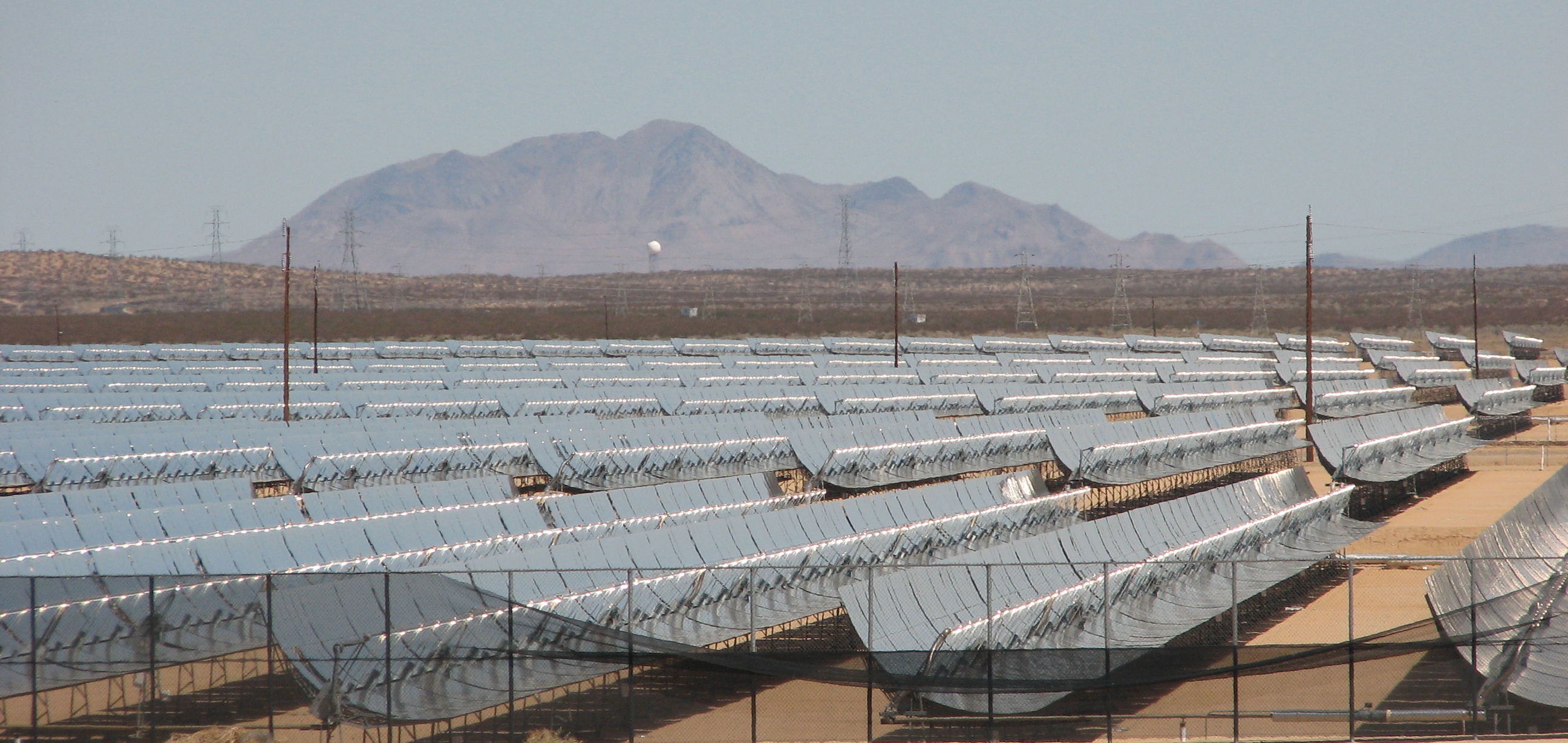
The plants use long rows of parabolic mirrors to focus the sun’s rays on tubes of synthetic oil suspended above the arrays. The hot oil is used to create steam which drives electricity-generating turbines. The company’s new power plant (artist rendering above) will built on 2,012 acres of former farmland near California City and will also use solar trough technology.

FPL tends to be tight-lipped about its plans but in a recent interview with Green Wombat, FPL Energy senior vice president Michael O’Sullivan acknowledged the company is bidding on contracts with utilities throughout the Southwest. “We do not develop through the issuance of press releases,” he says, “and there’s a lot of thinly capitalized solar developers trying to get attention by running around the Southwest announcing projects.” Unlike competitors developing new solar technology, FPL is sticking with the tried and true. “One reason we’re focused on solar trough technology like we have out at Kramer is that it’s a proven, financeable technology,” O’Sullivan says.

In a letter accompanying the Beacon Solar application to the California Energy Commission, O’Sullivan estimated the project would create 1,000 jobs during the two-year construction phase and 66 permanent positions once it goes online in 2011.

Read Full Post »

virgin-galactic-spaceshiptwo-feather-1.jpgIt is an article of faith these days that any company worth its public relations budget must proclaim loudly and frequently its good green intentions. So it was rather refreshing to hear one of Richard Branson’s top lieutenants – Will Whitehorn, chief of Virgin Galactic – cast his company’s enviro-friendly initiatives as strictly business.

“We’re not doing this to be environmentally kosher,” declares Whitehorn, referring to Virgin’s efforts to develop greenhouse-gas free biofuels for its jets and forthcoming spaceship, “we’re doing this to ensure our company’s survival.”

The occasion for Whitehorn’s remarks was one of those “green salons” that have become popular in San Francisco of late. You know, gather a group of so-called thought-leaders – executives, environmentalists, venture capitalists, journalists – in a chi-chi restaurant and let the ideas and sauvignon blanc flow. Easy enough to skewer, particularly when the well-compensated are dining on ahi tuna skewers, but you never know where the conversation will go, and in this case it strayed interestingly off-topic. The subject du jour was a white paper on corporate greenwashing from Bite Communications, the public relations firm that organized the recent lunch. Among those on hand were Whitehorn and execs from Chinese solar panel maker Suntech (STP), fuel-cell maker Bloom Energy, utility PG&E (PCG), and VantagePoint Venture Partners, investor in electric car startup Tesla Motors and solar power plant builder BrightSource Energy.

Whitehorn held center court, tracing Virgin’s trip down the green path a decade ago when the company forecast a dramatic rise in oil prices and tried to gauge the impact on its airline and new railway business. As a result, he says, Virgin spent big bucks on energy-efficient locomotives to hedge against future fuel cost spikes.

“This is not really a question of being green,” says Whitehorn, who expresses annoyance that Branson’s pledge last year to invest $3 billion in biofuels research and development was portrayed in the media as a charitable deed. “We’re doing this to make money and we’re creating a more sustainable economy in the process.”

“We’ve got to get away from this idea of doing these things as good works,” he adds. “We’re doing what we’re doing to create a profitable business for the future.”

It’s a meme increasingly being advanced by some environmentalists, most notably by the black sheep of the movement, Ted Nordhaus and Michael Shellenberger, whose 2004 essay, “The Death of Environmentalism” riled the green elite. The Berkeley duo’s new book, Break Through: From the Death of Environmentalism to the Politics of Possibility, calls for reframing global warming from a doom-and-gloom scenario to an opportunity for unbridled economic prosperity by investing in green technologies. Their central argument: only when people and societies achieve a certain level of material wellbeing do they have the luxury of supporting environmental preservation. In other words, greed is green.

Whitehorn also took aim at companies that proclaim themselves carbon neutral, scorning the notion that corporate greenhouse gas emissions can be offset by merely buying carbon credits. “We’re not going to be carbon neutral – it’s impossible,” he says of Virgin. “You need to get out and do something other than buy someone else’s carbon problem.”

Still, Kristina Skierka, director of Bite’s clean-tech practice, wanted to know just how green Virgin Galactic can be, given its business model of ferrying the rich into outer space for a couple of hundred grand a pop. “If we use biofuels we will get the emissions down to near zero,” Whitehorn claims. “This is about a new type of launch system; the carbon impacts will be negligible.

He says space tourism is just the launching pad, as it were, for a host of space-based ventures. “If you look at space as an industrial place to conduct human activities, it has huge advantages.”

Virgin’s next frontier is the deep blue sea. According to Whitehorn, the company recently created a skunk works to develop a “radical” new submarine technology for a startup to be called, what else, Virgin Oceanic.

Read Full Post »

« Newer Posts - Older Posts »

Design a site like this with WordPress.com
Get started