Feeds:
Posts
Comments

Archive for the ‘climate change’ Category

photo: Ausra

The promise and peril of large-scale renewable energy was on display Thursday as California’s first solar power plant of the 21st century went online near Bakersfield. Under blue skies, Governor Arnold Schwarzenegger and other politicians heralded the five-megawatt Ausra solar station as the vanguard of a new era of alternative energy that would combat the effects of climate change while building a green economy.

Then the CEO of one of the nation’s largest utilities stepped up to the podium and delivered a reality check. “As we all know the capital markets are in disarray,” said PG&E chief Peter Darbee, whose utility has a contract to buy 177 megawatts of electricity from Ausra. “They’re down 40%. The capital markets are going to distinguish between high-risk projects and low-risk projects and the high-risk projects are not going to get financed in the future.”

But he added, “PG&E stands ready to take on the challenge of financing renewables.”

The utility may just have to.

At the solar industry’s big annual conference in San Diego last week, renewable energy executives were euphoric over Congress’ 11th-hour passage this month of an eight-year investment tax credit that would allow big solar power plants to get up and running, eventually allowing for economies of scale crucial to driving down the price of green electricity. Then a dark clouded drifted over the sun-splashed proceedings in the form of three somber-suited men bearing ominous PowerPoint presentations.

The message from Wall Street: The credit crunch will wallop big solar plant projects that need billions of dollars in financing to get built.

Here’s why. It gets a bit arcane but bear with the wombat. The renewable energy legislation passed as part of the financial bailout package allows solar companies to take a 30% tax credit on the cost of building a power plant. Now most of these companies are startups and have no way to monetize, as they say on the Street and in Silicon Valley, those tax credits as they’re not profitable. Instead, a solar company must essentially trade the tax credits to a firm that can use them in exchange for cash to finance construction.

So investors form something called a tax equity partnership, in which they agree to finance, say, a solar power plant in exchange for the tax credits generated by the project. The problem, according Tim Howell, managing director of renewable energy for GE (GE) Energy Financial Services, is that investors’ appetite for tax equity partnerships has taken a nose dive just as the market will be flooded with solar tax credits from a growing number of projects currently being licensed. For instance, he said, 1,000 megawatts of solar projects would generate $1.5 billion in tax credits.

That means there has to be enough investment dollars – or “capacity” in Wall Street lingo – available to buy those tax credits from the solar power companies.  “Competition for tax capacity, which is a scarce resource in tough financial times, is a problem we have to solve,” Howell told a packed ballroom in San Diego.

John Eber, managing director of JPMorgan Capital (JPM), flashed a PowerPoint that showed the total value of the tax equity market at $15 billion last year with 40% going to renewable energy projects, mainly wind. Now that investment banks-which put together the partnerships and sometimes invested their own capital-are all but an extinct species on Wall Street, only an estimated $875 million will be available for all solar projects in 2008. In contrast, he noted, just the solar power plant projects already announced  would need between $6 billion and $8.5 billion in tax equity funding.

“Tax equity is becoming increasingly hard to raise for renewable energy projects,” said Keith Martin, a project finance attorney at the Washington firm Chadbourne & Parke. “Several large institutional investors who put money into renewable energy deals in the last three years have dropped out of the market.”

That, they said, means untried technologies from startups will face higher hurdles to attract investors.

In conversations Green Wombat has had with solar power plant executives over the past couple of weeks, they acknowledge that financing will be much harder to come by but they’re hardly ready to throw in the towel.

“There’s probably a gigawatt of press releases and 200 megawatt of plants that acutally will go live in 2010,” says John Woolard, CEO of Oakland-based BrightSource Energy, which has a contract with PG&E to deliver up to 900 megawatts of electricity.

His point: Despite gigawatts of signed utility deals, only a few power plants will actually be built in the next couple of years when financing is expected to be the toughest to obtain. “In 2011, it’s reasonable that 500 to 600 megawatts could happen,” he says. “Those aren’t big numbers for the tax equity market, but if you believe everything that’s been announced is going to be built, then it is a big market.”

California utilities, however, are counting on that big market to meet a state mandate to obtain 20% of their electricity from renewable sources by 2010 with a 33% target for 2020. PG&E (PCG), for instance, has signed 20-year power purchase agreements for more than 2.5 gigawatts of solar electricity.

When Congress extended the solar investment tax credit it also lifted a ban on utilities claiming the tax subsidy. Hence PG&E chief Peter Darbee’s statement Thursday that his utility would be willing to make sure its projects get funded by using the company’s considerable capital clout.

“We certainly could look at potentially funding or investing in renewable projects,” PG&E senior vice president Greg Pruett told Green Wombat Thursday. While he said PG&E has no specific projects in mind, it might consider financing construction of solar power plants through a tax equity partnership or a direct investment.

“Say we have a solar thermal company and they have a proven technology and they have done a demonstration plant, but because of the markets they can’t get financing,” says Pruett. “We might consider investing so they can build the plant and get it online.”

He says it’s less likely that PG&E would get into the solar construction business itself.

While it’s anyone’s guess how the markets will shake out by the time solar companies start making the rounds in New York, it’s clear that a shakeup in the nascent solar power plant business is in the offing.

Read Full Post »

SAN DIEGO – California Governor Arnold Schwarzenegger made a surprise appearance at the solar industry’s annual confab Monday night, warning not to use the financial crisis as an excuse to abandon the fight against global warming.

“We should not give in to those who say environmental goals should take a back seat until the economy improves,” said Schwarzenegger, kicking off the Solar Power International conference. “That’s short-sighted thinking. Tough economic times mean we need more solar, more green jobs.”

The governator’s championing of solar energy through California’s million solar roofs initiative and its landmark global warming law has made Schwarzenegger something of a patron saint of the solar industry, and the audience was on its feet cheering the perma-tanned politician.

The solar power conference is a barometer of the industry’s growth. When Schwarzenegger last appeared at the conference in 2006, 6,000 attendees crammed the San Jose Convention center. This week an estimated 20,000 people have descended upon San Diego for the event. (For techies, think of it as the Consumer Electronics Show and Macworld rolled into one.)

The crowd was in a festive mood. Solar stocks were up dramatically Monday with the bounce back on Wall Street – First Solar (FSLR) spiked nearly 23% and Suntech (STP) rose 21% as was SunPower (SPWRA). And ten days ago Congress slipped into the financial bailout package an eight-year extension of a crucial 30% solar investment tax credit, lifted a $2,000 tax credit limit for homeowners who install solar arrays and allowed utilities to claim the investment tax credit for solar installations. “Imagine it took a financial rescue plan to get a tax credit for solar,” Schwarzenegger remarked.

The Republican governor used the occasion to champion California, as he is his wont, giving kudos to Southern California Edison (EIX) for the utility’s plans to install 250-megawatts’ worth of solar panels on warehouse roofs. “I can envision going up in a helicopter and up and down California and see no more warehouses without solar panels.”

“Solar is the future, it cannot be stopped,” he added.

Read Full Post »

photo: eSolar

If Wall Street’s implosion can feel remote on the West Coast, where green tech startups largely rely on Silicon Valley venture capital, there may be no escaping the fallout from the credit crunch.

Still, even those renewable energy companies tapping East Coast cash have powered ahead amid the chaos on the Street. Take SolarReserve, a Santa Monica, Calif.-based solar power plant developer. A day after Lehman Brothers filed for bankruptcy last week, the stealth startup announced a $140 million round of funding from investors that included Citigroup (C) and Credit Suisse (CS).

Lehman does hold small stakes in wind turbine maker Clipper Windpower of Carpinteria, Calif., and Ormat Technologies, a Reno, Nev., geothermal developer. “Lehman’s exit from wind is not good news, but it’s not the end of the world,” says Ethan Zindler, head of North American research for New Energy Finance, a London-based research firm. And while Lehman holds stock lent to it from solar cell companies like SunPower (SPWR) and Evergreen Solar – potentially diluting their earnings per share if the stock is not returned – Lehman is not a big player in solar.

That’s not the case with Goldman Sachs (GS) and Morgan Stanley (MS). Both are major solar and wind investors and both were forced this week to reorganize themselves into bank holding companies to stave off shotgun marriages with other institutions. Spokespeople for Goldman and Morgan Stanley told Green Wombat that the firms’ transformation into more conventional commercial banks – at least a two-year process- will not change their green investing strategies.

But if there appears to be little immediate collateral damage from the financial crisis for green tech startups, there are longer-term consequences. Solar power plants, wind farms and other large-scale renewable energy projects require billions of dollars in bank financing.

“Credit is just going to get more expensive,” says Zindler. “We’ve already seen some pull-back for some big solar and wind deals. Bigger developers who have solid balance sheets will be OK but the smaller guys could be in trouble.”

Says Bill Gross, chairman of solar power plant developer eSolar: “I think if you’re going to get project financing, you’re just going to have to show higher returns to get people to take the money out of the mattress.”

But Gross, the founder of Pasadena, Calif.-based startup incubator Idealab, argues that given soaring electricity demand and fossil fuel prices, large-scale renewable energy projects will be an attractive investment, paricularly since utilities typically sign 20-year contracts for the power they produce. eSolar, which is backed by Google and other investors, has a long-term contract to supply Southern California Edison with 245 megawatts of green electricity. Gross says eSolar has a pipeline of other projects and interest in the company remains high, particularly overseas.

“If you can make projects that can compete with fossil fuels on a parity basis, those projects are going to be financed,” he says, “because they’re safe returns for 20 years and I think money is going to flow to them.”

Rob Lamkin, CEO of solar power plant startup Cool Earth, echoed that sentiment. “The credit crisis does give me pause,” says Lamkin, whose Livermore, Calif.-company has raised $21 million in venture funding and is developing “solar balloons” that use air pressure to concentrate sunlight on solar cells. “But the energy problem is so big that I don’t see problems raising project financing.”

The key for developers of utility-scale projects – particularly solar power plants – will be keeping their costs under control; not an easy thing when deploying new technologies amid a commodities boom.

Dita Bronicki, CEO of geothermal power plant developer Ormat Technologies (ORA), does not anticipate trouble obtaining project financing. “I think the cost of money is going to go up, but a company like Ormat with an operating fleet and operating cash flow will not be as affected,” Bronicki says. “Small companies will find that lenders will be more picky in what they will invest.”

Green entrepreneurs tend to be an optimistic bunch, so it’s not surprising they still think the future looks bright. But they had reason to be sunny this week – amid Wall Street’s meltdown, the U.S. Senate on Tuesday passed, at long last,  extensions of crucial renewable energy investment tax credits and other goodies to goose green tech, such as a tax credit worth up to $7,500 for buyers of plug-in electric cars. The Senate action now must be reconciled with similar legislation in the House of Representatives.

Solar projects, for instance, would qualify for a 30% investment tax credit through 2016.

“That is one thing that will help project finance,” says Gross. “So many people are sitting on the sidelines right now and if the investment tax credit passes that will help get these projects financed.”

Read Full Post »

After a year of stalemate that threatened to strangle the nascent United States solar industry, the U.S. Senate on Tuesday passed energy legislation that extends a key investment tax credit until 2016.

The 30% solar tax credit was part of a package of green energy incentives that includes a one-year extension of the production tax credit crucial to the wind industry and a $2,500-$7,500 tax credit for people who buy plug-in electric vehicles. (That should make General Motors (GM) happy as it prepares to roll out its ever-increasingly expensive Volt plug-in electric hybrid.)

Homeowners also won an extension of a tax credit for installing solar panels and the $2,000 cap on such systems was lifted. Put in a small wind turbine or a geothermal heat pump and you can claim up to a $4,000 and $2,000 tax credit, respectively.

The big winner was the solar industry. Congress’ failure to extend the investment tax credit threatened to scuttle scores of multibillion-dollar solar power plants in the pipeline and undermine mandates that utilities like PG&E (PCG) and Southern California Edison (EIX) obtain a growing percentage of their electricity from renewable sources.

The legislation now returns to the House of Representatives, which earlier passed a similar version of the Senate bill.

Read Full Post »

Green Wombat’s story on the Royal Turbine is in the latest issue of Fortune and available online here and below.

Her majesty’s big, honkin’ windmill

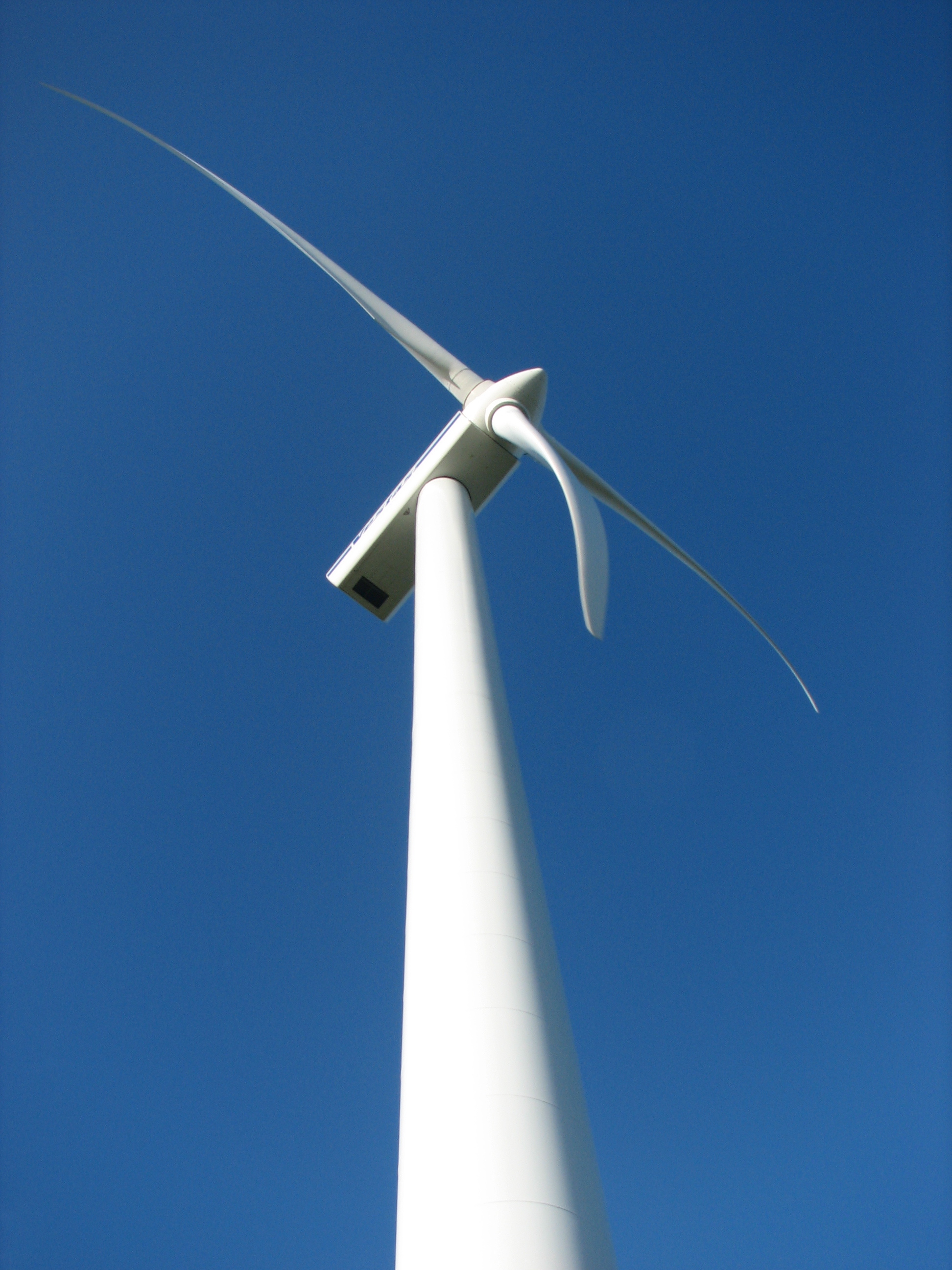
The Queen of England is buying the world’s largest wind turbine, which towers over Big Ben and will light up thousands of British homes.

By Todd Woody, senior editor

(Fortune Magazine) — It’s been a century or so since Britain ruled the waves, but Queen Elizabeth II will soon reign over the wind. Earlier this year the Crown Estate, which manages royal property worth $14 billion and controls the seas up to 14 miles off the British coast, agreed to purchase – for an undisclosed sum – the world’s largest wind turbine.

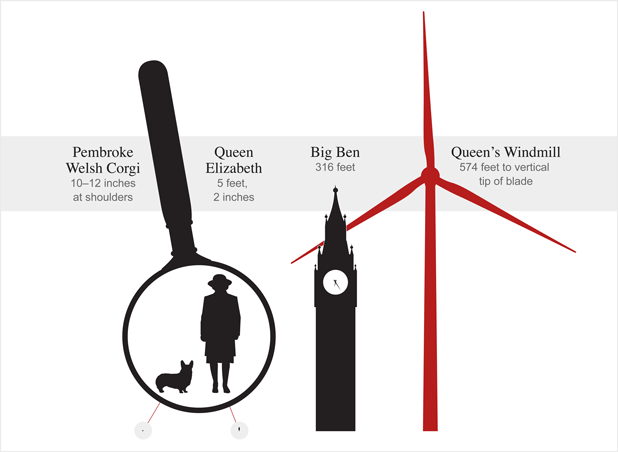
It’s a 7.5-megawatt monster to be built by Clipper Windpower of Carpinteria, Calif. Now the Royal Turbine is getting even bigger: Clipper has revealed to Fortune that Her Majesty’s windmill has been supersized to ten megawatts, producing five times the power generated by typical big turbines currently in commercial operation. The giant’s wingspan stretches the length of two soccer fields. At 574 feet, the turbine soars over Big Ben and roughly equals 111 Queen Elizabeths (the actual queen) plus one corgi stacked on top of one another.

The Queen’s turbine will displace two million barrels of oil as well as 724,000 tons of CO2 over its lifetime. This prototype will be the flagship for Clipper’s Britannia Project, an effort to create a new generation of massive-megawatt turbines to be placed on deep-sea floating platforms. When the windmill goes online in 2012 somewhere off the British coast, it could power 3,700 average homes.

Rule, Britannia, indeed.

Read Full Post »

photo: Todd Woody

Green Wombat’s story in the new issue of Fortune magazine on the solar power plant-fueled boom in demand for wildlife biologists is now online here. The photo above of the blunt-nosed leopard lizard was taken at a state reserve in San Luis Obispo County.

Or you can read the story below.

The hottest tech job in America

Giant solar plants are being built where dozens of protected species live. That’s good news for wildlife biologists.

By Todd Woody, senior editor

(Fortune Magazine) — It looks like a scene from an old episode of The X-Files: As a red-tailed hawk circles overhead and a wild pronghorn sheep grazes in the distance, a dozen people in dark sunglasses move methodically through a vast field of golden barley, eyes fixed to the ground, GPS devices in hand. They’re searching for bodies.

In this case, however, the bodies belong to the endangered blunt-nosed leopard lizard, and the crew moving through the knee-high grain are wildlife biologists hired by Ausra, a Silicon Valley startup that’s building a solar power plant for utility PG&E on this square mile of central California ranchland.

With scores of solar power stations planned for sites in the Southwest, demand for wildlife biologists is hot. They’re needed to look for lizards and other threatened fauna and flora, to draw up habitat-protection plans, and to comply with endangered-species laws to ensure that a desert tortoise or a kit fox won’t be inadvertently squashed by a solar array.

That has engineering giants like URS (URS, Fortune 500) in San Francisco and CH2MHill of Englewood, Colo., scrambling to hire biologists to serve their burgeoning roster of solar clients. “It’s a good time to be a biologist – it’s never been busier in my 15 years in the business,” says Angela Leiba, a senior project manager for URS, which is staffing the $550 million Ausra project. URS has brought onboard 40 biologists since 2007 to keep up with the solar boom. Salaries in the industry, which typically start around $30,000 and run up to about $120,000, have spiked 15% to 20% over the past year.

The work is labor-intensive. “It can take a 30- to 50-person team several weeks to complete just one wildlife survey,” says CH2MHill VP David Stein.

The economics of Big Solar ensure that wildlife biology will be a growth field for years to come. For one thing, there’s the mind-boggling scale of solar power plants. Adjacent to the Ausra project in San Luis Obispo County, for instance, OptiSolar of Hayward, Calif., is building a solar farm for PG&E that will cover 9 1/2 square miles with solar panels. Nearby, SunPower of San Jose will do the same on 3.4 square miles. Every acre must be scoured for signs of “species of special concern” during each phase of each project.

That adds up to a lot of bodies on the ground. URS, for instance, has dispatched 75 biologists to Southern California where Stirling Energy Systems of Phoenix is planting 12,000 solar dishes in the desert. “The biologists are critical to move these projects forward,” notes Stirling COO Bruce Osborn. For one project Stirling had to pay for two years’ worth of wildlife surveys before satisfying regulators.

Just about every solar site is classified as potential habitat for a host of protected species whose homes could be destroyed by a gargantuan power station. (Developers of California solar power plants, for example, have been ordered to capture and move desert tortoises out of harm’s way.) The only way to determine if a site is crawling with critters is to conduct surveys.

While that means a lot of jobs for wildlife biologists, it’s not all red-tailed hawks and pronghorn sheep for these nature boys and girls. The work can get a bit Groundhog Dayish, say, after spending 1,400 hours plodding through the same barley field in 90-degree heat in search of the same blunt-nosed leopard lizard. No wonder then when URS crew boss Theresa Miller asks for volunteers to reconnoiter a decrepit farmhouse for some protected bats on the Ausra site, hands shoot up like schoolchildren offered the chance to take the attendance to the principal’s office.

PG&E (PCG, Fortune 500) renewable-energy executive Hal La Flash worries that universities aren’t cranking out enough workers of all stripes for the green economy. “It could really slow down some of these big solar projects,” he says. Osborn can vouch for that: Biological work on the Stirling project has ground to a halt at times while the company waits for its consultants to finish up surveys on competitors’ sites.

For the young graduate, veteran biologist Thomas Egan wants to say just three words to you: Mohave ground squirrel. The rare desert dweller is so elusive that the only way to detect it on a solar site is to set traps and bag it. “There’s a limited number of people authorized to do trapping for Mohave ground squirrels,” says Egan, a senior ecologist with AMEC Earth & Environmental. “If you can work with the Mohave ground squirrel, demand is intense.”

Read Full Post »

SAN FRANCISCO – Google and General Electric said Wednesday that they will collaborate on developing geothermal power as well as technology to enable plug-in vehicles to return electricity to the grid.

During Google’s (GOOG) annual Zeitgeist conference at its Silicon Valley headquarters, Google CEO Eric Schmidt and GE (GE) chief Jeff Immelt said the two giants also would team up to push for policy changes in Washington to develop smart electricity grids to allow the widespread deployment of renewable energy.

“There’s two fundamental things that have to be done, and which we’re working with Google on,” said Immelt before an audience that included former Vice President Al Gore. “One, there has to be more capacity. The second thing is there has to be a smart grid to allow it to operate more effectively. That’s primarily software. We make the hardware.”

Schmidt quizzed Immelt about the impact of the Wall Street meltdown on green energy. “Will the craziness of last week screw some of this stuff up?” asked Schmidt. “Are we going to get set back for years because of all the shenanigans in the financial industry?”

“People should be concerned but not panicked,” replied Immelt. “The federal government is doing the right thing.”

Gore was not so sanguine, noting that Congress has failed repeatedly to extend crucial investment tax credits for renewable energy. “While Congress is voting on oil drilling and leasing oil shale – which is a move that would be game over for the climate crisis – they’re preparing to filibuster over renewable energy tax credits,” he said.

Google and GE are among scores of Fortune 500 companies that have lobbied Congress to extend the investment tax credit and the production tax credit, which is particularly important to the wind industry. ”

“I’m a lifelong Republican and I believe in free markets but over time we worship false idols,” says Immelt. “Sometimes we think the free market is whatever the price of oil is today. In the end, clean energy is both a technology and a public policy.”

He noted that because the production tax credit allowed the wind industry to scale up, wind-generated electricity now costs about six-to-seven cents a kilowatt hour, down from 15 cents 15 years ago.

“We bought Enron’s wind business for a few million dollars and now it’s worth $7 to 8 billion,” Immelt said. “I’ve made some bad decisions but that wasn’t one of them.”

Google in August invested nearly $11 million in geothermal companies developing so-called enhanced geothermal systems technology to allow the earth’s heat to be tapped nearly anywhere and turned into electricity. On Wednesday, Google and GE said they will work on technology to transform geothermal into a large-scale source of green electricity.

In a statement, the two companies said they will also “explore enabling technologies including software, controls and services that help utilities enhance grid stability and integrate plug-in vehicles and renewable energy into the grid.”

Image: Google

Read Full Post »

Illustration: Genomatica

Outside of ExxonMobil (XOM), petrochemical companies would seem to be the least likely to join the sustainability movement sweeping corporations worldwide. After all, how do you green an industry predicated on petroleum as a key ingredient?

The answer, according to San Diego startup Genomatica, is to replace hydrocarbons with carbohydrates. The company is announcing Tuesday that it has bioengineered a microorganism that ingests sugar and water to produce a chemical called 1,4‐butanediol. Commonly known as BDO, the chemical is a raw material found in everything from golf balls to skateboard wheels to spandex. Although Genomatica is planning a pipeline of bioengineered chemicals, BDO alone is a $4 billion business.

“By using carbohydrates versus hydrocarbons, we can produce BDO with less energy and that translates into a smaller carbon footprint,” Genomatica CEO Christopher Gann told Green Wombat.

So far, Genomatica – founded in 2000 and backed by marquee Silicon Valley venture capital firms Mohr Davidow Ventures and Draper Fisher Jurvetson – has only produced batches of BDO in the laboratory. But Gann,  a veteran of Dow Chemical (DOW), and company president Christophe Schilling claim that by the middle of 2009 they will be able to make bioengineered BDO cheaper than the petroleum-based chemical.

“This is a disruptive technology,” Gann says.

If Genomatica lives up to its claims of success in the lab, the technology indeed could potentially turn the petrochemical industry on its head.

First, anything that removes petroleum from a manufacturing process is going to get noticed. (While transportation accounts 70% of the 20.7 million barrels of oil consumed in the United States daily, a significant portion is used for chemicals  – up to 25% in the gulf states home to the nation’s petrochemical industry, according to the U.S. Energy Information Administration.)

Second, Genomatica’s microorganism leaves behind none of the nasty byproducts of petrochemical production, avoiding the health risks and costs of containing, storing and cleaning up toxic waste.

Lastly, Gann and Schilling say Genomatica’s technology frees BDO production from vast and accident-prone petrochemical complexes. “Since the raw materials are sugar and water, we can locate next to where there’s sugar and water or locate next to where the product can be consumed,” says Gann.

The startup was spun out of the University of California at San Diego, where Schilling and his mentor, Professor Bernhard Palsson, developed a technology platform to design virtual microorganisms. Schilling compares the process to the way airliners are designed entirely on computers.

“It allows us to model and simulate how microorganisms would survive and grow,” he says. “We can now go ahead and figure out the best way to engineer the organism to perform a particular task. We use off-the-shelf technologies and some proprietary ones to produce the organisms.”

Genomatica, which has raised $20 million from the Silicon Valley VCs as well as some Icelandic angel investors, will make money by licensing its technology to chemical companies. Gann and Schilling declined to identify other chemicals in their product pipeline but said they were related to the class of petrochemicals known as “cracker-plus-one.”

Read Full Post »

Green Wombat often highlights high tech when it comes to tackling global warming and energy independence. But a new study from the University of California’s Lawrence Berkeley National Laboratory shows that simply installing white roofs on homes and commercial buildings – to reflect the sun’s rays rather than absorb them – can reduce air-conditioning costs by 20% and could save $1 billion a year in energy outlays in the United States.

Switch to cool sidewalks and roads and the savings rise to $2 billion annually, according to the study by scientists Hashem Akbari and Surabi Menon and California Energy Commissioner Art Rosenfeld to be published in the journal Climate Change.

The scientists calculated that a global white roofs and roads effort would offset 44 billion metric tons of greenhouse gas emissions, or more than a year’s worth of carbon, and help stablize future C02 emission increases.

“The 44 Gt CO2-equivalent offset potential for cool roofs and cool pavements would counteract
the effect of the growth in CO2-equivalent emission rates for 11 years,” according to the authors.

Such emission reductions, of course, can be securitized into tradable carbon credits, which the study estimates would be worth $1.1 trillion. Regulated carbon market exist in places like Europe but securities based on cool roofs have not yet been created.

A global cool roofs agreement could avoid the pitfalls of Kyoto-style accords, the scientists note.  “Installing cool roofs and cool pavements in cities worldwide does not need delicate negotiations between nations in terms of curbing each country’s CO2 emission rates.”

It’s one of those low-tech, commonsense solutions to both energy use and global warming – one used for thousands of years in the regions like the Mediterranean; those picturesque villages overlooking the sea are white-washed for a reason.

In California, commercial buildings with flat roofs have been required to cool it since 2005. But one of the biggest hurdles in the U.S. to doing the white thing may be homeowner associations that dictate everything from the color of your mailbox to where you place your rubbish bin. The vast majority of homes in California either have standard black shingle roofs or Spanish-style red tiles. A proposal to paint those roofs white will likely incite architectural outrage.

But there’s another, albeit much more expensive solution, to hot roofs: Cover them with solar panels.

photo: California Energy Commission

Read Full Post »

T. Boone Pickens and Texas may be the kings of Big Wind but California is catching up, buying gigawatts of green electricity from turbines planted on the windswept flatlands of … Oregon.

On Monday, Southern California Edison became the latest Golden State utility to look north, announcing a 20-year contract to buy a whopping 909 megawatts from Caithness Energy’s Shepherd’s Flat project. The 303-turbine wind farm will span two Oregon counties and 30 square miles when it goes online between 2011 and 2012. PG&E (PCG), meanwhile, signed a deal in July for 240 megawatts of wind power from Horizon Wind Energy’s turbine ranch in the same area. That’s on top of 85 megawatts it agreed to buy last year from PPM Energy (now called Iberdrola Renewables) in a neighboring county that’s part of a turbine tier of counties on Oregon’s northern border.  Earlier this month the Los Angeles Department of Water and Power approved a 72-megawatt contract with Willow Creek Energy for wind power from the same area in Oregon.

So why ship electricity a thousand miles down the West Coast when California already plans to add gigawatts of in-state wind energy?  In a word, transmission.

“The beauty of this particular project is that it is already fully permitted and has transmission already available,”  Stuart Hemphill, Southern California Edison’s (EIX) vice president for renewable and alternative power, told Green Wombat.

“Oregon has a terrific wind resource,” he adds. “It far exceeds that in California.”

In December 2006 the utility signed an agreement to purchase 1,500 megawatts from a giant wind farm to be built by a subsidiary of Australia’s Allco Financial Group in Southern California’s Tehachapi region. But the project is dependent on the construction of new transmission lines – often an environmentally contentious and drawn-out process in California.

“It is expected to go online in 2010,” says Hemphill of the wind farm. “We’re just getting the transmission project up and running. The first three segments have been approved and we’re doing the building now.”

With California’s investor-owned utilities facing a 2010 deadline to obtain 20% of their electricity from renewable sources, expect the Oregon green rush to continue.

Read Full Post »

« Newer Posts - Older Posts »

Design a site like this with WordPress.com
Get started