Feeds:
Posts
Comments

Archive for the ‘climate change’ Category

NRDC water report

Water isn’t as sexy as solar, doesn’t carry the smart grid’s geek cred or inspire green technolust like the Fisker Karma or Tesla Roadster electric sports cars. But as a new Natural Resources Defense Council report drives home, it could be one of the biggest climate-change related business opportunities of the new century.

The NRDC study focuses on California, where drought, a growing population and the specter of global warming-triggered water shortages demand innovative water efficiency policies and technological solutions. Just like California has kept its per capita energy consumption flat over the past 30 years as its population doubled through energy efficiency standards, the reports’ authors say that the Golden State must take the same approach with water.

“Such measures can help stretch limited water supplies, save businesses, money, reduce energy consumption, improve water quality, and protect local, regional, and statewide ecosystems,” wrote authors Ronnie Cohen, Kristina Ortez and Crossley Pinkstaff.

They focus on the so-called commercial, industrial and institutional sector, or CII — i.e. Big Business and Big Government — and the takeaway headline is that if those water consumers cut their consumption by implementing existing conservation technology they would save enough H2O to supply the coastal metropolises of Los Angeles, San Diego and San Francisco.

As has been oft pointed out, a great deal of energy is expended to transport and manage water — 20% of California’s electricity production is water-related, according to the state’s energy commission — and cutting water use will also slash companies’ electricity bill and, not incidentally, greenhouse gas emissions.

The report says that CII accounts for one-third of California’s urban water use. Taking such prosaic measures as installing aerators on faucets, low-flow shower heads and energy efficient commercial dishwashers and washers can save millions of gallons of water. Take toilets, for example. Urinals alone — pay attention guys — consume 15% of the water used in commercial restrooms. Switching to waterless urinals would save 45,000 gallons a year per urinal, according to the report.

More high tech measures involve deploying smart irrigation systems that use sensor networks to determine when to turn on the sprinklers at all those golf courses built in the California desert and in suburban communities throughout the state.  Needless to say, much of the opportunity in Big Water be for consultants and policymakers.

The whale in the room, of course, is Big Agriculture. Ag was beyond the scope of the NRDC report but it is the biggest consumer of water in California and has often been the most resistance to change or paying the true cost of such things as growing rice and alfalfa in the desert.

But as far as the commercial and government sectors go, the report concludes with these policy recommendations:

  • “Establish efficiency standards for water-using products.
  • Set performance-based water savings targets that provide water agencies with flexibility.
  • Prioritize water conservation above increasing supply.
  • Adopt a Public Goods Charge on water sales to provide a dedicated funding source for water efficiency programs, including expanded technical and financial assistance.
  • Encourage partnerships with—and financial support from—energy utilities and wastewater agencies.
  • Streamline the process for recycled water use.
  • Encourage volumetric pricing for sewer services.
  • Decouple water agencies’ sales from revenue.
  • Improve water use data collection and management.”

Read Full Post »

The wind industry has been getting a lot of love of late from the Obama administration.

The president spent Earth Day at an Iowa factory that makes wind turbine towers and announced new regulations for offshore wind farms. Meanwhile, Interior Secretary Ken Salazar has been talking up the potential of offshore wind to generate as much as 20% of the eastern seaboard’s electricity that is now provided by coal-fired power plants.

But such scenarios won’t come to pass unless the administration seriously tackles the transmission grid problems that are keeping wind from becoming a nationwide source of green energy, according to panel of wind industry executives who spoke at Fortune Magazine’s Brainstorm Green panel this week.

“The real challenge is to connect wind farms in the Great Plains with the population centers of the Midwest,” said Bob Gates, senior vice president of commercial operations for Clipper Windpower. California-based Clipper is one of two U.S.-owned wind turbine makers (the other being General Electric (GE) ).

For instance, Clipper and BP (BP) have signed an agreement to build a 5,000-megawatt wind farm – the nation’s largest – in South Dakota. But the deal is more a dream at this stage because there are no power lines to transmit such massive amounts of electricity to Chicago and other Midwestern cities. (Gates said there is enough transmission available to begin construction this summer of a small 25-megawatt portion of the wind farm.)

The Obama administration has devoted billions of dollars in stimulus package funding to transmission projects and the Federal Energy Regulatory Commission last week approved incentives for a company planning to build a $12 billion “Green Power Express” transmission project to bring wind to Midwest metropolises.

Gates and the other panelists — Andris Cukurs, CEO of Indian turbine maker Suzlon’s North American operations; Don Furman, a transmission executive with Spanish wind developer Iberdrola Renewables, and James Walker, vice chairman of French-owned wind developer enXco – said the development of wind offshore from East Coast cities would ease transmission bottlenecks.

“Connecting offshore wind to cities is relatively cheap and easy compared to bringing wind power from the Dakotas to New York City,” Gates said. Another way to work around transmission gridlock would be to develop highly efficient small turbines that could be placed near cities and existing power lines, said Gates.

Despite Obama’s embrace of wind, the executives said they don’t see the industry resuming its record growth in 2008 – when U.S. wind capacity more than doubled – until 2010 or later. The credit crunch delayed or scuttled numerous wind farms and turbine orders have fallen dramatically.

One bright spot: Growing interest from well-capitalized utilities in directly investing in wind farms.

“Utility ownership is about 15% of the U.S. turbine fleet,” said Furman of Iberdrola Renewables. “I see more utility ownership in the coming years,, perhaps up to a third of the fleet.”

Read Full Post »

desert-tortoise1

photo: Wild Rose Images

California Senator Dianne Feinstein’s move to put a large swath of the Mojave Desert off-limits to renewable energy development is splitting the environmental movement and could derail some two dozen solar and wind power projects the state needs to comply with its ambitious climate change laws.

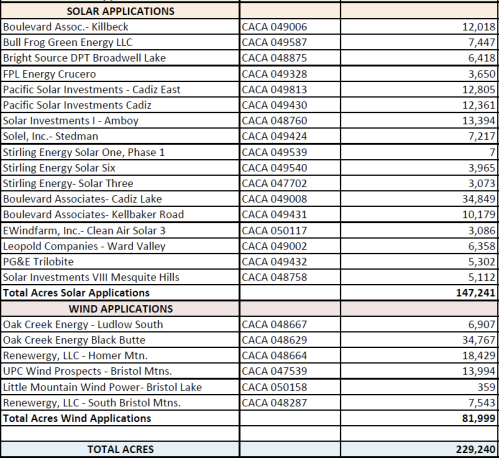
On the firing line are 17 massive solar power plants and six wind farms planned for federal land — land that would be designated a national monument under legislation Feinstein intends to introduce. The solar projects in question would be built by a range of companies, from startups BrightSource Energy and Stirling Energy Systems to corporate heavyweights Goldman Sachs (GS) and FPL (FPL), according to federal documents. (For the complete list, see below.)

The companies are among scores that have filed lease claims on a million acres of acres of desert dirt controlled by the U.S. Bureau of Land Management. California utilities PG&E (PCG) and Southern California Edison (EIX) have signed long-term power purchase agreements for some of the projects now in jeopardy and are counting on the electricity they would produce to meet state-mandated renewable energy targets. PG&E itself has filed a solar power plant land claim in the proposed national monument.

The area of the desert in dispute is some 600,000 acres formerly owned by Catellus, the real estate arm of the Union Pacific Railroad, and donated to the federal government a decade ago by the Wildlands Conservancy, a Southern California environmental group. About 210,000 of those acres are managed by the U.S. Bureau of Land Management, which opened part of the land to renewable energy projects.

“Many of the sites now being considered for leases are completely inappropriate and will lead to the wholesale destruction of some of the most pristine areas in the desert,” Feinstein wrote in a letter to Interior Secretary Ken Salazar released last week, notifying him that she will introduce legislation to designate the former Catellus lands a national monument. “Beyond protecting national parks and wilderness from development, the conservation of these lands has helped to ensure the sustainability of the entire desert ecosystem by preserving the vital wildlife corridors.”

The Catellus land controlled by the BLM forms something of a golden triangle between the Joshua Tree National Park and the Mojave National Preserve in Southern California and are particularly coveted for renewable energy development because of its proximity to transmission lines.

Alan Stein, a deputy district manager for the BLM in California, told Green Wombat that the solar and wind lease claims are in areas that are not designated as wilderness or critical habitat for protected species like the desert tortoise. “This is public domain land, ” he says.

Tortoises, however, are found across the Mojave, and battles over Big Solar’s impact on endangered wildlife are quietly brewing in several solar power plant licensing cases now being reviewed by the California Energy Commission.  Environmentalists find themselves walking a thin green line, trying to balance their interest in promoting carbon-free energy with protecting fragile desert landscapes and a host of threatened animals and plants.

Take BrightSource Energy’s Ivanpah 400-megawatt solar power plant complex on the California-Nevada border. The three solar power plants to be built by the Oakland-based company will supply electricity to PG&E and Southern California Edison. But the project will also destroy some 4,000 acres of desert tortoise habitat and at least 25 tortoises will have to be relocated – a somewhat risky proposition as previous efforts in other cases have resulted in the deaths of the animals.

On Wednesday, the California Energy Commission granted two national environmental groups – the Defenders of Wildlife and the Sierra Club – the right to intervene in the Ivanpah case. “Defenders strongly supports … the development of renewable energy in California,” Kim Delfino, California program director for Defenders of Wildlife, wrote to the energy commission in a Jan. 23 letter.  “Defenders has several serious concerns about the potential impacts of this project on a number of rare, declining and listed species and on their associated desert habitat and waters.”

Natural Resources Defense Council attorney Johanna Wald wrote a letter with the Wilderness Society expressing concern over the impact of Ivanpah project on the desert tortoise but also made a strong statement of support for renewable energy development. “Our public lands harbor substantial wind, solar, and geothermal resources,” wrote Wald, who serves on a state task force to identify appropriate areas for renewable energy development. “Developing some of these resources will be important to creating a sustainable energy economy and combating climate change.”

The big national enviro groups are working with the government and power plant developers to create zones in the Mojave where renewable energy projects would be permitted while setting aside other areas that are prime habitat and wildlife corridors. A similar effort is underway on the federal level to analyze the desert-wide impact of renewable energy development.

Local environmental organizations, however, have split with the Big Green groups over developing the desert and other rural areas. In San Luis Obispo County,  Ausra, SunPower (SPWRA) and First Solar’s (FSLR) plans to build three huge solar farms within miles of each other has prompted some local residents worried about the impact on wildlife to organize in opposition to the projects.

And some small Mojave Desert green groups pledge to go to court to stop big solar projects. “We don’t want to see the Endangered Species Act gutted for the sake of mega solar projects,” veteran grass roots activist Phil Klasky told Green Wombat last year for a story on the solar land rush in the Mojave. “I can say the smaller environmental organizations I’m involved with are planning to challenge these projects.”

It would be unwise to underestimate Klasky. In the 1990s, he helped lead a long-running  and successful campaign to scuttle the construction of a low-level radioactive waste dump in tortoise territory in the Mojave’s Ward Valley – now a prime solar spot.

Still, while California’s senior senator’s move in the Mojave may exacerbate rifts in the environmental movement over renewable energy, it also could galvanize efforts to resolve critter conflicts in a comprehensive way. Otherwise, environmentalists of varying hues may find themselves fighting each other rather than global warming.

Update: I just had a conversation with BrightSource spokesman Keely Wachs, who takes issue with my characterization that the Ivanpah project will “destroy” desert tortoise habitat. He points out that the company is taking care to minimize the impact of the power plant on the surrounding desert and that wildlife may still occupy the site. It would be more accurate to say that the project will remove desert tortoise habitat from active use during Ivanpah’s construction and operation.

(Below is a list of solar and wind projects that fall within the proposed Mojave national monument. Note: Solar Investments is a subsidiary of Goldman Sachs and Boulevard Associates is a subsidiary of FPL.)

source:  BLM
blm-nm2

Read Full Post »

solyndra-rooftop-2

photo: Solyndra

It’s been a good news, bad news Friday for the solar industry. Silicon Valley startup Solyndra received a half billion-dollar loan guarantee from the U.S. Department of Energy to build a solar module factory while further up Interstate 880 OptiSolar moved to shut down its manufacturing operations.

OptiSolar too had asked for a federal loan guarantee to complete work on its Sacramento thin-film solar cell plant but a decision on the $300 million application couldn’t come soon enough to save the startup. “We continued to be unable to find a buyer for the technology and manufacuring business, and the board of directors decided that we needed to limit ongoing operational expense,” wrote OptiSolar spokesman Alan Bernheimer in an e-mail.

First reported by the San Francisco Chronicle’s David Baker, OptiSolar will shut down factories in Sacramento and Hayward, Calif., and lay off 200 workers.  Earlier this month, OptiSolar sold its pipeline of solar power plants – including a 550-megawatt solar farm that will supply electricity to PG&E (PCG) – to rival First Solar  in a $400 million stock deal. At the time, OptiSolar said it intended to focus on manufacturing solar modules.

The news was definitely brighter Friday for Solyndra, which emerged from stealth mode last September with $600 million in funding and $1.2 billion in orders for its solar panels composed of cylindrical tubes imprinted with solar cells. Conventional rooftop solar panels must be tilted to absorb direct sunlight as they aren’t efficient at producing electricity from diffuse light. But the round Solyndra module collects sunlight from all angles, including rays reflected from rooftops. That allows the modules, 40 to a panel,  to sit flat and packed tightly together on commercial rooftops, maximizing the amount of space for power production.

The $535 million federal loan guarantee will allow the Fremont, Calif.-based company to build a second factory, which is expected to create 3,000 construction jobs and more than 1,000 other jobs once the plant is in operation. The factory will be able to produce 500 megawatts’ worth of solar panels a year.

“The DOE Loan Guarantee Program funding will enable Solyndra to achieve the economies of scale needed to deliver solar electricity at prices that are competitive with utility rates,” Solyndra CEO Chris Gronet said in a statement. “This expansion is really about creating new jobs while meaningfully impacting global warming.”

Friday’s grant makes good on Secretary of Energy Steven Chu’s pledge to speed up processing of renewable energy loan guarantee applications. The department had come under fire during the previous administration for taking years to dole out grants and loan guarantees for electric car and green energy projects.

Meanwhile, First Solar (FSLR) announced on Friday that it had manufactured 1 gigawatt of thin-film solar cells since beginning commercial production in 2002. It took the Tempe, Ariz., company six years to hit 500 megawatts and only eight months to produce the second 500 megawatts. First Solar’s annual production capacity will reach 1 gigawatt by year’s end, according to the company.

Read Full Post »

tendril-iphone-appHere’s an iPhone app that really could help save the planet while saving stressed consumers’ money: Boulder, Colo.-based startup Tendril this week unveiled a mobile software program that lets people monitor and control their home’s energy use while on the go.

Say you’re sitting in the unemployment office listening to some bureaucrat drone on, so you pull out your iPhone to update your Facebook status and then check on whether that next unemployment check will cover the utility bill. When Tendril tells you that your electricity consumption is spiking and so will your estimated monthly bill, you remember you left the air conditioner set on Arctic. Flick your finger and shut that energy hog down.

That scenario won’t become common for awhile it as relies on a widespread rollout of smart utility meters that will bring the interactive smart grid and real-time electricity pricing into the home. That is happening, albeit very slowly (though the pace is expected to accelerate with billions in the stimulus package being poured into smart grid-related projects. The ability to remote-control your appliance, however, is some years away).

For instance, Tendril, is rolling out a home energy management system for Texas utility Reliant Energy (RRI) that allows customers to monitor and control their electricity use through a video display that sits in the living room. When Green Wombat visited Reliant’s smart house project in Houston last September, the utility’s tech guys showed me their own home-brewed iPhone app.

As anyone with an iPhone knows, Apple’s (AAPL) app store makes it ridiculously easy to turn the gadget into Dr. Who’s sonic screwdriver – a gizmo that does everything but put out the trash and feed your pet bunny. But earth2tech’s Katie Fehrenbacher questions how widespread Tendril’s app would be used given the difficulty in putting any third-party software program on a BlackBerry or other smartphone. But that’s changing by dint of Apple’s growing share of the smartphone market and the advent of the app-friendly Google (GOOG) phone.

Green Wombat is most intrigued by the potential of such apps as the Tendril Mobile Vantage to tap into people’s inherent competitiveness, keeping-up-with-Jones mentality and, in the Facebook era, compulsion to share, share, share. The data generated by smart meters and home energy management systems like Tendril’s will let consumers compare their energy use – and thus contribution to global warming – with their neighbors and friends.

In fact, Tendril is planning to add a carbon footprint feature to its mobile app. Funnel that data into a Facebook newsfeed and let the peer-to-peer pressure go to work to see who can claim Twittering rights to a low-impact lifestyle.

Read Full Post »

clintonbill1Another reason Green Wombat will be spending Earth Day in Southern California this year: Former President Bill Clinton will deliver the keynote speech at Fortune Magazine’s Brainstorm Green conference on April 22.

Clinton will be joining a gathering of business and environmental leaders, including Ford (F) executive chairman Bill Ford, PG&E (PCG) chief executive Peter Darbee, SunPower (SPWRA) CEO Tom Werner and executives from Fortune 500 companies like IBM (IBM),  Wal-Mart (WMT) and General Electric (GE). On the green side of the aisle, execs from the Natural Resources Defense Council, Environmental Defense Fund and Greenpeace will be attending the confab in Laguna Niguel.  Former California State Treasurer Phil Angelides, now chairman of the Apollo Alliance, and green jobs guru Van Jones will also be present.

We now end the shameless self-promotion and return to our regular Green Wombat programming.

Read Full Post »

esolar-smart-scalable-solar

photo: eSolar

California startup eSolar said on Tuesday that it has licensed its solar power technology for the construction of up to 1 gigawatt of solar farms in India over the next decade.

The deal with Indian conglomerate ACME Group marks India’s first move into large-scale solar power and is the biggest announced foray of a United States solar power plant company overseas. The agreement calls for ACME, based in the northern Indian state of Haryana, to invest $30 million in eSolar, which will also earn fees for each of its 46-megawatt modular solar thermal power plants that are built.

A gigawatt, or 1,000 megawatts, of solar energy produces enough electricity to keep the lights on in about 750,000 energy-hogging U.S. homes. Presumably, many more homes and businesses can be powered by a gigawatt in India, where electricity shortages are common and the country relies on greenhouse-gas emitting diesel generators.

“We’re exclusively selling to ACME in India and they’re exclusively using us,” eSolar CEO Bill Gross told Green Wombat. “We’d like to do something like this in Spain, in Australia and the Middle East.”

It’s the second big deal for Pasadena-based eSolar in a week. Last Monday, the company inked an agreement to license its technology to U.S. coal-fired utility NRG (NRG) for the development of up to 500 megawatts of solar power plants in California and the Southwest for Southern California Edison (EIX) and other utilities. Meanwhile, the financial crisis is forcing the consolidation of the solar industry, with Monday’s dual deals — First Solar (FSLR) acquired the solar power plant assets of Silicon Valley OptiSolar while Spanish solar developer Fotowatio bought financier MMA Renewable Ventures’ solar portfolio.

eSolar claims it can generate electricity at lower prices than natural gas-fired power plants by mass-producing mirrors called heliostats that concentrate sunlight on a water-filled receiver atop a tower to create steam that drives a turbine. The heliostats are much smaller than those made by competitors, use far less steel and can be quickly and cheaply installed in the field because they’re controlled by sophisticated software, according to Gross.

That allows eSolar to pack more mirrors into the solar field to create relatively compact power plants that can be located near urban centers rather than in the desert. ACME, which makes everything from telecommunications equipment and refrigeration systems to fuel cells, will begin construction of the first solar farm later this year.

ACME will hire contractors to build the solar power plants while eSolar will provide the heliostat fields, power towers and software systems. ACME so far has signed power purchase agreements with Indian utilities for 250 megawatts, according to eSolar.

“The eSolar system addresses obstacles that have previously plagued solar installations and presents a viable, cost-effective alternative that can scale quickly to meet India’s growing energy needs,” ACME CEO Manoj Upadhyay said in a statement.

Read Full Post »

denverairport-110

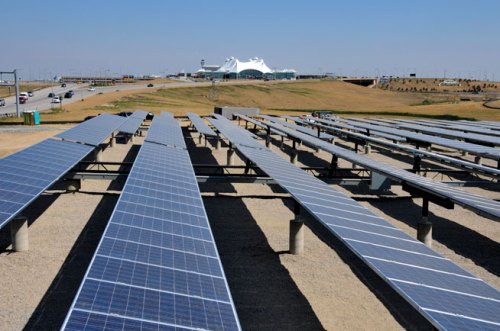
photo: WorldWater & Solar Technologies

The consolidation of the solar industry got underway Monday with the acquisition of San Francisco-based green energy financier MMA Renewable Ventures by Spanish solar developer Fotowatio.

The Madrid-based company will purchase most of MMA Renewable’s solar assets – including the world largest photovoltaic power plant and its pipeline of projects – making it one of the biggest solar developers in the United States.

The financial terms of the deal were not disclosed.

MMA Renewable CEO Matt Cheney told Green Wombat that he’ll continue as CEO of what will be called, for now, Renewable Ventures and that his staff will be joining him. MMA Renewable Ventures was a subsidiary of Municipal Mortgage & Equity, which has been hit hard by the financial crisis.

Fotowatio, on the other hand, scored $350 million in funding last July from General Electric (GE) and Grupo Corporativo Landon. “You’re taking a very robust player in the European market see how much opportunity and potential there is in the U.S. market,” says Cheney. “It’ll produce one of the biggest, if not the biggest, independent solar power producers. It’s the story of consolidation.”

MMA Renewable Ventures raises funds to invest in big commercial solar arrays and photovoltaic power plant projects. The company finances the construction of solar systems by companies like SunPower (SPWRA) and retains ownership of the arrays, selling the electricity under long-term power purchase agreements.

Last year MMA Renewable and Chinese solar giant Suntech (STP) created a joint venture called Gemini Solar to build large-scale photovoltaic power plants.  Cheney said Gemini will continue under Fotowatio.

When the deal closes, Fotowatio will gain 35 megawatts of solar projects in the U.S. with another 400 megawatts under development.

Cheney says the Fotowatio acquisition is a sign of the times as the global economic crisis and falling prices for solar cells disrupts the renewable energy market. “There’s a shakeout in the marketplace and there’s opportunities for consolidation.”

Read Full Post »

three_in_row_hi_medium

San Francisco on Friday made a bid to rule the waves, filing an application to build a 30-megawatt wave energy farm off its coast in a move to sink a Seattle company’s claim on a nearby patch of ocean.

The company, Grays Harbor Ocean Energy, has filed applications with the Federal Energy Regulatory Commission, or FERC, for wave projects to be built from New Jersey to Hawaii. Wave energy technology remains in its infancy but there’s been something of a land – or sea – rush to secure rights to the most promising ocean sites to produce clean green electricity.

Last October, Grays Harbor filed for a preliminary permit to test technology for a 100-megawatt wave park to be floated 20 to 25 miles off the San Francisco coast.  Grays’ San Francisco Ocean Energy Project “may also generate power from wind turbines” placed on the wave-energy converters, according to the company’s application.

So far the project has generated heated opposition from a coalition of environmental groups, surfers and commercial fishing organizations that have intervened in the case.  They argue that the wave farm’s location in federally protected marine sanctuaries near the Farallon Islands could harm endangered whales, turtles and seabirds as well as interfere with surfers, sailors and pose a navigation hazard for oil tankers and other ships.

“Wave energy projects raise many potential environmental concerns, including elevated hydrocarbon concentrations, electromagnetic field effects, interruption of migratory patterns, toxic releases from leaks or spills, impacts to sensitive spawning areas,” wrote the coalition, which includes the Natural Resources Defense Council, in a Jan. 26 letter to FERC.

The next day, the city of San Francisco moved to intervene in the Grays case, saying it would file a competing application. On Friday, the city did so, asking federal regulators to give priority to its Oceanside Wave Energy Project, arguing there’s only room for one wave farm off the San Francisco coast.

The city’s project would be located eight miles offshore, outside the marine sanctuaries. As San Francisco Mayor Gavin Newsom – a Democratic gubernatorial candidate for 2010 – blogged about the municipal wave farm on Friday, the city filed an affidavit from its consultant stating that the Grays project would “impact the nature, quality and direction of the waves” to be used by the Oceanside wave energy plant.

It’s not the first time that San Francisco has tried to scuttle other wave projects. In June 2007, the city unsuccessfully petitioned FERC to deny utility PG&E’s (PCG) application for wave farms hundreds of miles up the coast from San Francisco, contending companies were trying to lock up choice sites.

Despite the rush to file claims, there’s no guarantee that any wave farm will be built. The preliminary permit that San Francisco has applied for would give it the ability to conduct a feasibility study and test wave energy technology with first rights to secure a license build a full-scale wave energy plant.

Although a range of wave technologies are being developed, they generally involve devices that float or are anchored to the seabed that that transform the motion of waves into mechanical energy which drives an electricty generating turbine. The electricity is transmitted through undersea cables to an onshore substation.

In its application, San Francisco said it was considering a number of technologies but anticipates floating between ten and 30 1-megawatt wave energy converters.  The city estimates it would spend between $1 million and $3 million on the feasibility study over the next three years.

San Francisco’s green scheme isn’t the only headache for Grays. Like the company’s other proposed wave energy projects, the San Francisco wave farm would sit on the outer continental shelf. The U.S. Department of the Interior’s Minerals Management Service claims jurisdiction over projects on the outer continental shelf and a fight has broken out between the agency and FERC over who gets to issue permits for OCS wave projects. On Jan. 26, the agency filed a challenge to FERC’s right to license eight of Grays wave farms that would also feature wind turbines.

Wrote Interior Department attorneys: “Some believe the preliminary permit application is part of an attempt to stake a claim to certain areas through the FERC process with the objective of siting wind energy projects, over which FERC does not claim jurisdiction, or then, according to press accounts, selling those rights.”

image: Pelamis Wave Power

Read Full Post »

esolar-field_wide_2b
photo: eSolar

SAN FRANCISCO — “It’s all about the software,” says eSolar CEO Bill Gross.

The tech entrepreneur and founder of startup incubator Idealab is explaining how eSolar’s solar power plants can produce carbon-free electricity cheaper than planet-warming natural gas. At the Cleantech Forum in San Francisco, Gross flashes a photo of eSolar’s demonstration solar farm outside the Southern California town of Lancaster, where 24,000 mirrors called heliostats surround two 150-foot towers.  The heliostats concentrate sunlight on a tower containing water-filled boilers and the resulting heat creates steam that drives an electricity-generating turbine. Rivals like BrightSource Energy use similar “power tower” technology but according to Gross, eSolar’s mirror-controlling software and modular plant design will allow it to produce cheaper solar electricity.

For instance, Gross says competitors use large, slightly curved mirrors to focus sunlight. That require big and expensive steel frames to hold the glass in place.  eSolar’s solution: make small flat mirrors the size of an LCD television screen that clamp on to a  5 x 12-inch frame and then use software and Big Iron computing to position the mirrors to create a parabola out of the entire heliostat field.

“We use Moore’s law rather than more steel,” quipped Gross, referring to Intel co-founder Gordon Moore’s maxim that computing power doubles every two years.

The heliostats roll off an assembly line in China with the wiring and sun-tracking motors built in. “The only tool required to install mirrors in the field is a hand wrench,” Gross says. “There’s  no welding in field, you just install the mirrors on the base. We’ve taken all the labor in the field and moved it to an automated factory.”

The heliostats also do not have to be precisely placed in the solar field, which saves time. “The rows can be wavy as the software will correct for it,” Gross notes. “We don’t need to do extensive surveys to design the field; we just need to leave enough space between mirrors.”

The bottom line: The five-megawatt Palmdale project was built in less than six months. “We think we can finish plants before other people start,” Gross told Green Wombat.

Gross says eSolar has also signed a 92-megawatt deal with a New Mexico utility, which he declined to identify until the agreement is announced. He said his Pasadena, Calif.-based company will also soon unveil a contract to build 500 megawatt’s worth of solar farms in Asia. So far, eSolar has spent $30 million acquiring land – mainly privately owned agricultural property – for solar power plants, according to Gross. He told Cleantech Forum participants that eSolar expects internal rates of return for its partners of between 11% and 14% for U.S. power plants and returns of 20% to 30% for overseas projects.

Also saving time and money are the power towers, which are made from two sections of a windmill tower. At 150 feet they’re half the size of competitors’ towers – again, less steel is needed. The lower height and the software systems that allow more mirrors to be crammed into smaller spaces means that eSolar’s power plants can be placed closer to urban areas where transmission lines are available.

Also unique is the boiler that sits atop the tower. Gross gave Green Wombat a close-up look the proprietary technology. About the size of a cargo shipping container, the “cavity receiver” has openings on either side. The heliostats focus sunlight into the interior of the boiler, which is lined with water-filled pipes.

“The benefit is that the light comes in and even if some light is reflected it can have multiple bounces and still hit the pipes,” Gross says. “We can get all the light inside the cavity all because of the software that controls the mirrors.”

Whether Google (GOOG)-backed eSolar’s plants produce electricity at the low rates Gross is claiming won’t be known until they start coming online. But utilities are betting that this solar software works. Southern California Edision (EIX) last year signed a 20-year-contract with eSolar for 245 megawatts of electricity while coal-dependent NRG Energy (NRG) this week agreed to invest $10 million in eSolar in exchange for the right to develop up to 500 megawatts using the company’s technology. (Southern California Edison is betting even bigger on BrightSource Energy’s power tower technology – two weeks ago the utility signed a 1,300 megawatt power purchase agreement with the Oakland startup – also backed by Google – the world’s largest solar deal to date.)

Read Full Post »

« Newer Posts - Older Posts »

Design a site like this with WordPress.com
Get started