Feeds:
Posts
Comments

Archive for the ‘BrightSource Energy’ Category

brightsource_energy.jpgCalifornia utility PG&E on Tuesday announced contracts to buy up to 900 megawatts of electricity generated by solar power plants to be built in the Mojave Desert by BrightSource Energy. It’s one of the biggest solar deals to date — enough to power some 600,000 homes — and is another sign that that the shift from fossil fuels to carbon-free energy is well underway, at least in California.

But is it too late? PG&E (PCG) first announced it was negotiating a power purchase agreement with BrightSource, then called Luz II, on Aug. 10, 2006. Around that time, the United States’ leading climate scientist, NASA’s James Hansen, warned that the world had only a decade to take drastic action to cut carbon emissions and avert future catastrophe from global warming.

It took nearly two years alone to just hammer out the PG&E-BrightSource deal and the world now has eight years left to radically ramp up alternative energy sources. By the time the first BrightSource 100-megawatt solar power plant (image above) goes online it will be 2011 and the last one will begin generating electricity for PG&E just as the climate change alarm clock goes off. If you believe Hansen, hitting the snooze button will not be an option.

Of course, there’s no guarantee the BrightSource plants will actually be built — it will take billions to construct them and the investment climate is not exactly sunny these days, clouded by Wall Street’s meltdown and the looming expiration of a crucial solar investment tax credit. (Personally, Green Wombat is betting BrightSource pulls it off — though April Fool’s Day probably was not the best date to unveil such a deal. The Oakland, Calif.-based company was founded by solar pioneer Arnold Goldman, its CEO, John Woolard, hails from Silicon Valley and the startup is backed by Morgan Stanley (MS) and some savvy venture capitalists. )

Given the moral and regulatory imperative — California utilities must obtain 20 percent of their electricity from renewable sources by 2010 and a third by 2020 — why is large-scale solar proceeding at the pace of a Mojave Desert tortoise? (Almost three years ago, for instance, Southern California Edison (EIX) and San Diego Gas & Electric (SRE) unveiled agreements with Phoenix’s Stiring Energy Systems to buy up to 1,750 megawatts of solar electricity. Ground has yet to be broken on any of the planned power plants.)

Partly it’s because the years-long negotiations between utilities and solar power plant companies is something of a black box. Details of these power purchase agreements are kept confidential but are estimated to be worth billions — if a recent $4 billion dealstruck by utility Arizona Public Service with solar power plant builder Abengoa Solar is any indication. Regulated utilities are by their nature big and bureaucratic and can be expected to be extra-cautious when they’re placing bets on untried solar technology from companies like BrightSource and Ausra.

“Transactions of this magnitude require a fair amount of time to negotiate and due diligence must also be performed,” PG&E spokeswoman Jennifer Zerwer told Green Wombat in an e-mail. “The original [BrightSource agreement] announced in August 2006 was for 500 megawatts; the final agreement expanded on the original . . . and culminated in the execution of five separate power purchase agreements for up to 900 MW.”

Another factor is a regulatory structure that is an artifact of the fossil fuel age. California requires extensive environmental review of new power plant projects — be they clean and green or down and dirty — a process that can take a 18 months or more. And the best solar sites often are on federal land in the Mojave — securing a lease for that land is another 18-month-long process.

Still, one looks to history. When the United States entered World War II, it retooled its factories in a matter of months to produce planes and tanks. Climate change is an amorphous but no less dangerous threat and speeding up the regulatory timetable will be crucial in the fight against global warming.

The clock, after all, is ticking.

Read Full Post »

torresol2.gif

Abu Dhabi is not content to just sell you the oil that fuels your SUV; now its going to sell you sunshine to keep your lights on and power your electric car when the internal combustion engine goes the way of the buggy whip. Masdar, the oil-rich emirate’s $15 billion renewable energy venture, and Spanish technology company Sener on Wednesday announced a joint venture called Torresol Energy to build large-scale solar power plants in Australia, Europe, the Middle East, North Africa and the United States.

Torresol initially will invest $1.2 billion in three solar power plants to be built in Spain but the company is targeting the global “sunbelt” for future expansion. Masdar will take a 60 percent ownership stake in Torresol with Sener holding a 40 percent stake. A Torresol spokesman declined to reveal the dollar amount of the investment. A prime market for Torresol will be the U.S. desert Southwest, where companies like Ausra, BrightSource Energy, Solel and Abengoa Solar are competing for contracts with utilities PG&E (PCG), Arizona Public Service (PNW) and Southern California Edison (EIX). Torresol potentially could shake up that market, given its very deep pockets and ability to independently finance billion-dollar solar power plants.

The venture is just the latest move by Abu Dhabi to control what Masdar CEO Sultan Ahmed Al Jaber described to Green Wombat recently as “the whole value chain” of renewable energy, from research and development to manufacturing silicon for solar cells to the large-scale deployment of green technology.

The irony is too rich to leave unsaid: A leading oil producer invests billions in carbon-free energy while a leading consumer of fossil fuels – the United States – continues to subsidize Big Oil while while offering only tepid support for green technology. It is inevitable that climate change will foster the rise of renewable energy – the only question is which countries and companies will profit from the new energy economics. It is entirely possible that the U.S. will trade energy dependence of one kind – on Middle East oil – for another – on Middle East and European solar technology – in the era of global warming. It’s no coincidence that most of the solar energy companies with contracts to build utility-scale power plants in California and the Southwest have overseas roots – Ausra hails from Australia, BrightSource was founded by American-Israeli pioneer Arnold Goldman, Solel is based in Israel and Abengoa is headquartered in Spain.

Torresol plans to build solar power plants using a technology it calls a Central Tower Receiver system. It’s similar to technology used by competitors like BrightSource in that fields of mirrors called heliostats focus the sun’s rays on tower that contains a receiver. In this case the receiver is filled with salt which when heated vaporizes water to create steam that drives an electricity-generating turbine. The company says it intends to have 500 megawatts of solar electricity online by 2012.

Read Full Post »

img_2914.jpg

Israeli solar power plant developer Solel announced Monday it has scored $105 million in funding from London-based investment firm Ecofin — yet another sign that the market for large-scale solar energy projects is reaching critical mass.

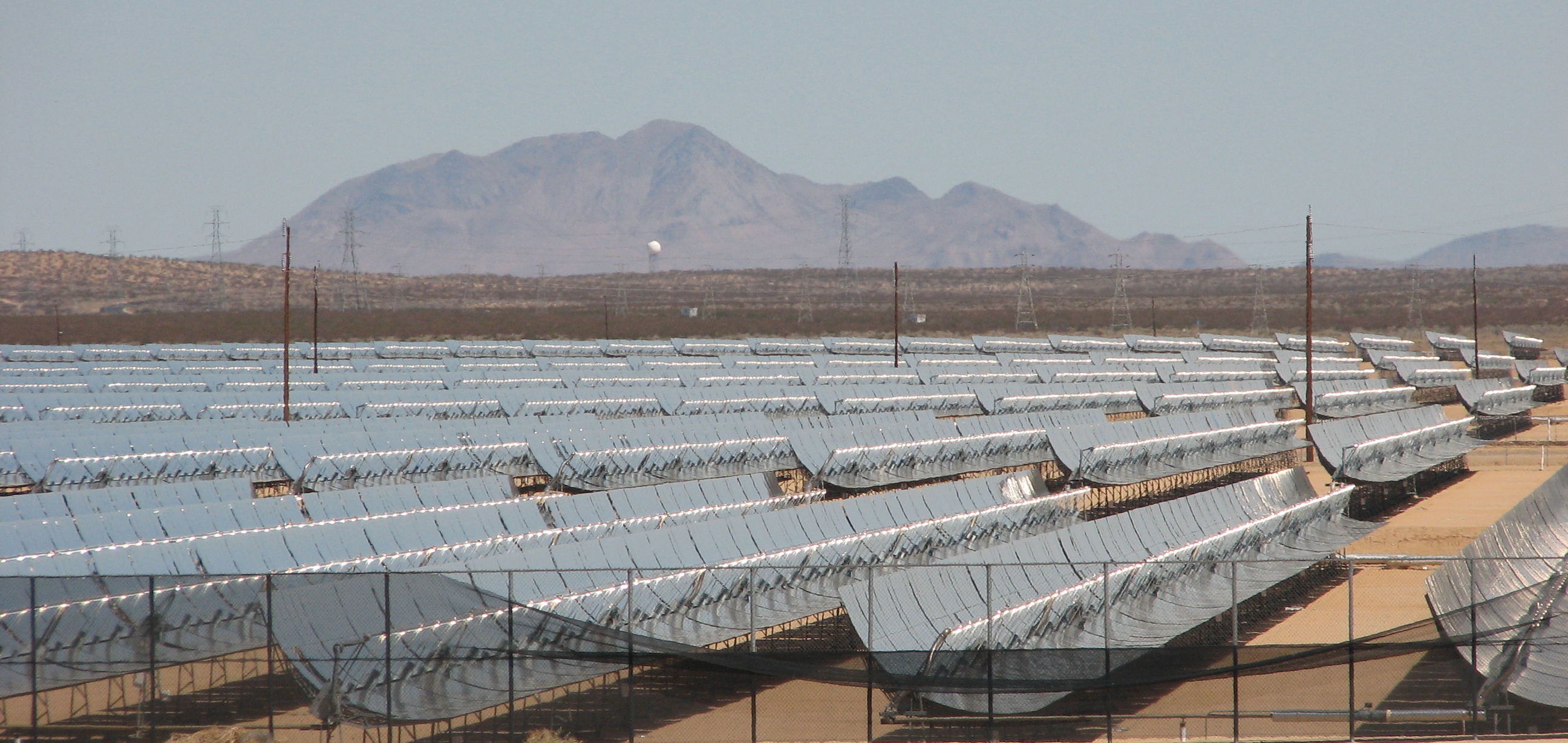
Solel last July signed the world’s largest solar power deal when it agreed to supply California utility PG&E (PCG) with 553 megawatts of green electricity to be produced by a massive solar thermal power plant to be built in the Mojave Desert. The company’s solar trough technology is also used in nine solar power plants (photo above) that were built in the Southern California desert in the 1980s. (In a solar trough power plant, long rows of parabolic mirrors focus the sun’s rays on tubes of liquid suspended over the arrays to create steam that drives an electricity-generating turbine.)

Raising $105 million is impressive and it’s certainly a big number. But given that a 500-megawatt solar power plant can easily cost $1 billion or more to build, it’s a relative drop in the bucket. However, it will allow Solel to move forward with the project and line up project financing for the PG&E plant while it negotiates more deals with other utilities — it won’t say which, but likely candidates are Southern California Edison (EIX) and San Diego Gas & Electric (SRE).

Competitors BrightSource Energy and Ausra have solar power plant applications before the California Energy Commission and have signed or are negotiating power purchase agreements with PG&E.

“Everyone is realizing that the market is there for thousands of megawatts of peaking power,” Solel CEO Avi Brenmiller recently told Green Wombat. “As time goes by we see energy prices rising and utilities are focusing their efforts to get solar thermal power because this is the right solution in the southwest United States.”

The Ecofin investment in Solel is notable also given the uncertainty surrounding solar power at the moment due to Congress’ failure to extend the solar investment tax credit in the recently enacted energy bill. The 30 percent credit is considered crucial to help solar energy companies secure financing for power plants and achieve economies of scale. The tax credit expires at the end of 2008 but solar energy proponents and their allies on Wall Street say they’re confident that Congress will take up legislation this session to extend it for as long as eight years.

Read Full Post »

brightsource-ivanpah.png

When President Bush signed the energy bill into law last month, much was made of the legislation’s mandate that automakers dramatically boost the fuel efficiency of their fleets. Less noticed was that the bill dropped a provision that would have extended the solar investment tax credit — a measure viewed as essential to transforming solar energy from a niche business into a multi billion-dollar industry that can generate gigawatts of greenhouse gas-free electricity.

The timing couldn’t be worse. With the current solar credit set to sunset, as it were, at the end of 2008, Big Solar is at at a tipping point: Utilities and renewable energy companies are in the midst of negotiating massive megawatt power purchase deals whose financing depends on the 30 percent investment tax credit, or ITC.

“I think there is a major concern that this will stall all the beneficiaries of the ITC,” said Joshua Bar-Lev, vice president for regulatory affairs for solar power plant developer BrightSource Energy. The Oakland, Calif.-based startup is negotiating a 500-megawatt agreement with California utility PG&E and is proceeding with plans to build a 400-megawatt solar thermal power station on the Nevada border (artist rendering above).

Solar energy companies, utilities like PG&E (PCG) and Edison International (EIX) as well as financiers such as Morgan Stanley (MS) and GE Energy Financial Services (GE), had pushed for an eight-year extension of the investment tax credit to give Big Solar projects enough time to get off the ground and start to achieve economies of scale. The provision also would have allowed utilities to claim the credit for solar projects they build. The measure drew support from both sides of the aisle in Congress but died — by one vote in the Senate — when Bush threatened to veto the energy bill because the solar tax credit would be financed by repealing previous tax breaks given to Big Oil.

“The Congressional leadership is very strong in their support of the ITC; they will put this on the table In 2008,” said Chris O’Brien, a Sharp Solar executive and chairman of the Solar Energy Industries Association, in an e-mail. “The solar industry will continue to contact legislators in key states.”

House Speaker Nancy Pelosi and the Democratic leadership in the Senate have pledged to re-introduce renewable energy tax credit legislation this session. “Speaker Pelosi has said repeatedly that she hopes to address that this year,” Drew Hammill, a spokesman for Pelosi, told Green Wombat. “We’re just getting started but there’s bipartisan support for the tax credit.”

Publicly, at least, no one in the solar industry will say that the uncertainty over the tax credit is affecting planned projects. “Our expectation is that there will be another tax bill that will address this issue,” said Kevin Walsh, managing director of the renewable energy group at GE Energy Financial Services. “We’re working on a number of [solar thermal] deals but it’s too early to disclose them.”

In recent months, PG&E has signed deals for more than a gigawatt of electricity — enough to light more than 750,000 homes — with solar power plant developers. Such power purchase agreements can take more than a year to hammer out and the permitting and construction of a solar power station can take another three to five years.

“We’re continuing to move forward with negotiations and with contracts that have already been signed, but certainly the absence of the ITC could potentially impact future projects,” said PG&E spokesman Keely Wachs. “Without the credit, it does increase the cost of that energy and of course it also sends a very clear market signal as to our country’s energy priorities.”

Silicon Valley solar startup Ausra is building a 177-megawatt solar power plant on the Central California coast to supply electricity to PG&E and is pursuing deals with Florida’s FPL (FPL) and other utilities.

“Just like any business, the solar industry prefers a predictable system for the future,” wrote Holly Gordon, Ausra’s director of regulatory and legislative affairs, in an e-mail. “It will be more difficult to plan for our projects while the situation remains uncertain. While we are currently seeing excellent demand for solar energy at market prices, we need a long term extension of the renewable energy tax credits to ensure market stability and investor confidence as the market continues to grow.”

Read Full Post »

« Newer Posts

Design a site like this with WordPress.com
Get started