Feeds:
Posts
Comments

Archive for the ‘alternative energy’ Category

photo: Solyndra

In The New York Times on Friday, I follow up my story in Thursday’s paper on mortgage giants Fannie Mae and Freddie Mac paralyzing PACE programs that allow homeowners to install solar arrays and make energy efficiency upgrades through an annual assessment on their property taxes:

In an article in The Times on Thursday, I explained how Fannie Mae and Freddie Mac, the government-chartered mortgage giants, have derailed an innovate financing program that lets homeowners pay for expensive solar panels and energy efficiency upgrades over time through an annual surcharge on their property tax bills.

The program is called Property Assessed Clean Energy, or PACE, and it has been authorized by 22 states since 2008. The energy improvement assessments are secured by a lien on the home, but the agencies, which hold more than half of mortgages in the United States, recently sent letters to lenders warning them that such liens could not take priority over a mortgage. Fannie and Freddie worry that if a homeowner defaults, taxpayers will be left in the lurch, as property taxes generally are paid before mortgages are.

Putting aside whether such liens are any different from the property tax assessments commonly used to finance municipal improvements, how big a potential liability would Fannie and Freddie face?

Not very big, according to an analysis by the California attorney general’s office.

You can read the rest of the story here.

Read Full Post »

image: California Energy Commission

In The New York Times on Friday, I write about another setback in California’s scramble to meet its renewable energy targets:

The developer of a hybrid biomass solar power plant to be built in California has abruptly canceled the project, underscoring the challenges the state faces in meeting its ambitious renewable energy goals.

Martifer Renewables, a Portuguese company, had signed a 20-year power purchase agreement with the California utility PG&E for 106.8 megawatts. The power was to be generated from a pair of power plants called San Joaquin Solar 1 and 2 that would be built on 640 acres of agricultural land in Fresno County. The facility would produce electricity from a solar field by day and burn biomass collected from area farms by night. But 18 months into an extensive licensing process and after recently depositing $250,000 for a transmission study, Martifer notified the California Energy Commission last month that it was withdrawing its license application.

The developer’s representatives did not return a request for comment. But in a June 17 letter to the energy commission, Miguel Lobo, a Martifer executive, wrote, “We were not able at this time to resolve some of our issues regarding project economics and biomass supply amongst other things.”

Although local residents and regulators had raised issues about the proposed solar farm’s water consumption and other impacts, it was the project’s plan to operate around the clock by burning biomass that proved problematic, according to energy commission records.

You can read the rest of the story here.

Read Full Post »

This post first appeared on Grist.

Green tech is back in the green.

Global venture capital investment in green technology companies reached $4.04 billion in the first half of 2010, exceeding – slightly — the record set in the boom year of 2008, according to a preliminary report released Thursday by the Cleantech Group and Deloitte.

Venture investment in the second quarter rose to $2.02 billion, up 43 percent from the year-ago quarter. Investments in the first half of the year spiked 65 percent from the same period in 2009.

“There’s been a very clear resurgence in solar activity and that is largely responsible for the strong quarter,” Richard Youngman, the Cleantech Group’s head of global research, said on a conference call Thursday.

Solar captured $811 million, or about 40 percent, of green technology investment in the second quarter, according to the Cleantech Group, a San Francisco-based consulting and research firm. It defines the global market as consisting of North America, China, India, Israel and Europe.

Solyndra, a Silicon Valley thin-film solar panel maker, scored a $175 million investment while solar power plant builder BrightSource Energy took in $150 million.

It’s no coincidence that both companies have been the beneficiaries of the Obama administration’s push for renewable energy. Solyndra received a $535 million loan guarantee to build a new factory in the San Francisco Bay Area (which the president visited in May) and BrightSource was granted a $1.37 billion loan guarantee to get its first solar thermal power plant online.

Despite the recession, corporate America poured a record $5.1 billion into green tech companies in the first half of 2010, a 325 percent increase from a year ago.

“The significant strengthening of corporate and utility investment into the cleantech sector, relative to 2009, is very encouraging, given the key role they will play in enabling broader adoption of clean technologies at scale,” Scott Smith, partner, Deloitte’s U.S. clean tech leader in the United States, said in a statement.

Youngman warned not to read too much into the success this week of Tesla Motor’s initial public offering. Though the Silicon Valley electric carmaker’s share price accelerated some 40.5 percent on opening day, he pointed out that high-profile IPOs from Solyndra and Goldwind, a Chinese wind turbine maker, were pulled recently.

In fact, head east if you want to get in on a booming IPO market –12 of the 19 green tech offerings in the second quarter came from Chinese companies and raised $1.73 billion, or 75 percent of the total IPO take, according to the Cleantech Group.

The flip side, of course, is that the anemic IPO market in the United States also is driving venture capital investment as green tech firms are forced to raise private money.

Read Full Post »

photo: Sonoma County

In Thursday’s New York Times, I write about how government-chartered mortgage giants Fannie Mae and Freddie Mac are derailing an innovative program called Property Assessed Clean Energy. PACE programs finance the installation of solar panels and energy efficiency upgrades and let homeowners repay the loans through a 20-year surcharge on their property tax bills.

SAN FRANCISCO — The Obama administration is devoting $150 million in stimulus money for programs that help homeowners install solar panels and other energy improvements, which they pay for over time on their property tax bills.

At the same time, the two government-chartered agencies that buy and resell most home mortgages are threatening to derail the effort by warning that they might not accept loans for homes that take advantage of the special financing.

The mixed messages have alarmed state officials and prompted many local governments to freeze their programs, which have been hailed as an innovative way to help homeowners afford the retrofitting of a house with solar panels, which can cost $30,000 or more before incentives.

“The thing that is maddening is that this is having a real-life impact with companies laying off people and homeowners in limbo as all these projects are stalled,” said Clifford Rechtschaffen, a special assistant attorney general in California.

Under the financing programs, a local government borrows money through bonds or other means, and then uses it to make loans to homeowners to cover the upfront costs of solar installations or other energy improvements. Each owner repays the loan over 20 years through a special property tax assessment, which stays with the home even if it is sold.

The technique, known as Property Assessed Clean Energy, or PACE, was pioneered by Berkeley, Calif., in 2008, and 22 states have authorized such programs, which are intended to make it easier and cheaper for homeowners to invest in energy efficiency. So far, only a few thousand people have used them.

But the Energy Department wants to promote the programs — and give an economic boost to companies that install energy systems — through the $150 million in stimulus funds, which are intended to help communities cover setup and administrative costs.

Fannie Mae and Freddie Mac, the government entities that guarantee more than half of the residential mortgages in the United States, have different priorities. They are worried that taxpayers will end up as losers if a homeowner defaults on a mortgage on a home that uses such creative financing. Typically, property taxes must be paid first from any proceeds on a foreclosed home.

In letters sent to mortgage lenders on May 5, Fannie Mae and Freddie Mac stated that energy-efficiency liens could not take priority over a mortgage. “The purpose of this industry letter is to remind seller/servicers that an energy-related lien may not be senior to any mortgage delivered to Freddie Mac,” wrote Patricia J. McClung, a Freddie Mac executive.

However, the agencies did not offer guidance to mortgage lenders on how to handle properties that carry the energy liens. Backers of the programs fear that mortgage lenders, who depend on Fannie and Freddie to buy their home loans, will now start demanding that the entire lien be paid off before issuing a new loan.

That is what happened to Deke DeKay of Healdsburg, Calif., when he sold a house in nearby Geyserville in May. Mr. DeKay, who had purchased the foreclosed home as an investment, put in new insulation and heating and cooling systems, financed by $11,000 from Sonoma County’s program.

“We thought this would be an interesting way of upgrading the home’s energy efficiency without adding to the purchase price,” Mr. DeKay said. “Then right before the close of escrow, the bank discovered this stuff Fannie Mae and Freddie Mae put out and refused to approve the loan without the assessment being paid off first.”

Now Mr. DeKay is worried about his own home, which carries a $25,500 lien for a five-kilowatt solar array installed last year. “If we ever want to refinance the house, it will be impossible for us to do that,” he said.

You can read the rest of the story here.

Read Full Post »

photo: SunRun

In The New York Times on Tuesday, I write about SunRun, a San Francisco solar leasing company that has scored a whopping $55 million round of equity funding:

SunRun, a San Francisco start-up that leases rooftop solar arrays to homeowners, said Tuesday it had raised $55 million from investors.

The equity investment led by Sequoia Capital, a prominent Silicon Valley venture firm, is one of the largest made in a solar leasing firm and a sign that companies are poised for a major expansion beyond the industry’s core market in California.

The investment follows a $100 million tax equity fund PG&E Corporation, the utility holding company, created last week to finance residential solar installations for SunRun customers. PG&E Corporation in January formed a $60 million financing pool for SolarCity, a Silicon Valley competitor to SunRun. SolarCity is also tapping $190 million in tax equity funds created over the past year for the company by U.S. Bancorp.

“If the $55 million is going to actual corporate expansion, it is one of the largest corporate fund-raisings we’ve seen for that purpose in this space,” said Nathaniel Bullard, a solar analyst with Bloomberg New Energy Finance. “It speaks to the opportunity outside of California, in the Southwest and the Northeast.”

The investment is nearly double the $30 million SunRun had previously raised from Sequoia Capital, Accel Partners and Foundation Capital.

“We’re seeing early signs of an inflection point in the market where the cost of offering a solar solution is becoming cheaper than utility pricing,” said Warren Hogarth, a partner at Sequoia Capital, an early investor in Apple, Google and Yahoo. “We’re moving from people buying solar because it’s a nice thing to do to buying solar because it makes economic sense.”

You can read the rest of the story here.

Read Full Post »

This post first appeared on Grist.

I usually don’t write about companies’ funding announcements, unless the amount of money raised is particularly eye-popping. But when Recurve announced Wednesday that it had scored $8 million in its latest round of fund-raising, what caught my attention was who decided to invest in the San Francisco energy retrofit startup.

Along with the venture capital firms re-upping their investments — RockPort Capital Partners and Shasta Ventures — was a new investor, Lowe’s.

That the home improvement giant — $47 billion in sales, 1,700 stores — would invest in a relatively small “green energy remodeling” outfit is a sign that it sees potential in energy efficiency, at least enough to dip its corporate toe in the market.

The investment comes as companies like Recurve push Congress to pass legislation that would establish a $6 billion energy retrofit program called Home Star.

“Lowe’s 60-year history in the home improvement industry will be valuable in shaping Recurve’s growth,” said Pratap Mukherjee, Recurve’s chief executive.

Formerly called Sustainable Spaces, Recurve takes a Silicon Valley approach to energy retrofits. While the startup performs energy audits and dispatches crews to upgrade homes’ systems, it has also has developed software to automate the whole retrofit process for other green building companies in an industry dominated by mom-and-pop shops.

The software, delivered over the Internet, lets retrofitters enter data on a home’s energy profile in a laptop or handheld device during an audit, run electricity consumption simulations, calculate estimates and equipment needed for a retrofit, and generate reports for customers on the spot.

Contractors, of course, then can head down to their neighborhood Lowe’s to buy ducts, insulation, and other materials needed for a retrofit job. Which, in the end, may be one return on Lowe’s investment in Recurve.

Read Full Post »

photo: Todd Woody

This post first appeared on Grist.

The California Assembly has passed legislation that takes the first step to requiring that a percentage of electricity generated in the state be stored.

Electricity, of course, is the ultimate perishable commodity. If the bill is approved by the California Senate and signed by Gov. Arnold Schwarzenegger, it would apparently be the first time a state will move toward mandating that electricity generated by wind farms, solar power plants, and other intermittent sources be stored for use during peak demand.

That’s key if California is to meet its ambitious mandates to obtain 33 percent of its electricity from renewable sources by 2020.

“Electric energy storage is an emerging industry that offers the possibility to solve a number of major obstacles to the achievement of a sustainable electricity future,” according to an analysis of the legislation prepared by the California Public Utilities Commission in May. “It can effectively address problems such as the integration of intermittent renewables.”

Sponsored by Assembly member Nancy Skinner, a Berkeley Democrat, the bill has been watered down to make it palatable to the state’s utilities and regulators. It originally required the state’s utilities to obtain energy storage systems capable of providing at least 2.25 percent of average peak electrical demand by 2014. By 2020 the target would rise to at least 5 percent.

The latest version of the bill now wending its way through the state Senate requires the California Public Utilities Commission to open proceedings on energy storage and by October 2013 to adopt an initial target — if appropriate — for utilities to meet by the end of 2015.

California Attorney General Jerry Brown, the Democratic candidate for governor, is sponsoring the legislation, which is backed, not surprisingly, by the renewable energy industry and venture capitalists.

“It’s part of our bigger effort to deal with climate change,” Cliff Rechtschaffen, Special Assistant Attorney General, told me. “When we looked at how to develop renewables, the technology is here but stalled by lack of regulatory focus.”

Utilities spend billions of dollars building so-called peaker plants that operate just hours a year to supply electricity and avoid blackouts when demand spikes — say, on a hot day when everyone cranks up their air conditioners.

Such costs — and greenhouse gas emissions — could be cut or reduced if electricity stored from wind farms or solar power plants could be dispatched when demand rises.

A report prepared for the California Energy Commission and released this month concluded that adding gigawatts of wind and solar energy to the grid to meet renewable energy mandates would require “major alterations to system operations.”

Without storage, more natural gas power plants or hydroelectric facilities would need to be built to smooth out grid operations as increasing amounts of solar and wind energy comes online, according to the report prepared by Kema, an energy consulting firm.

“Storage can be up to two to three times as effective as adding a combustion turbine to the system,” the report stated.

The cost and feasibility of such storage systems is another matter, as it remains a nascent industry.

Most efforts focus on using batteries or mechanical systems like flywheels to store electricity. California utility PG&E has launched a pilot project to store electricity in the form of compressed air. Some developers of solar power plants intend to use molten salt to capture heat that can be released and used to drive an electricity-generating turbine after the soon goes down.

“This bill moves storage to the top of the regulatory agenda where it belongs,” says Rechtschaffe

Read Full Post »
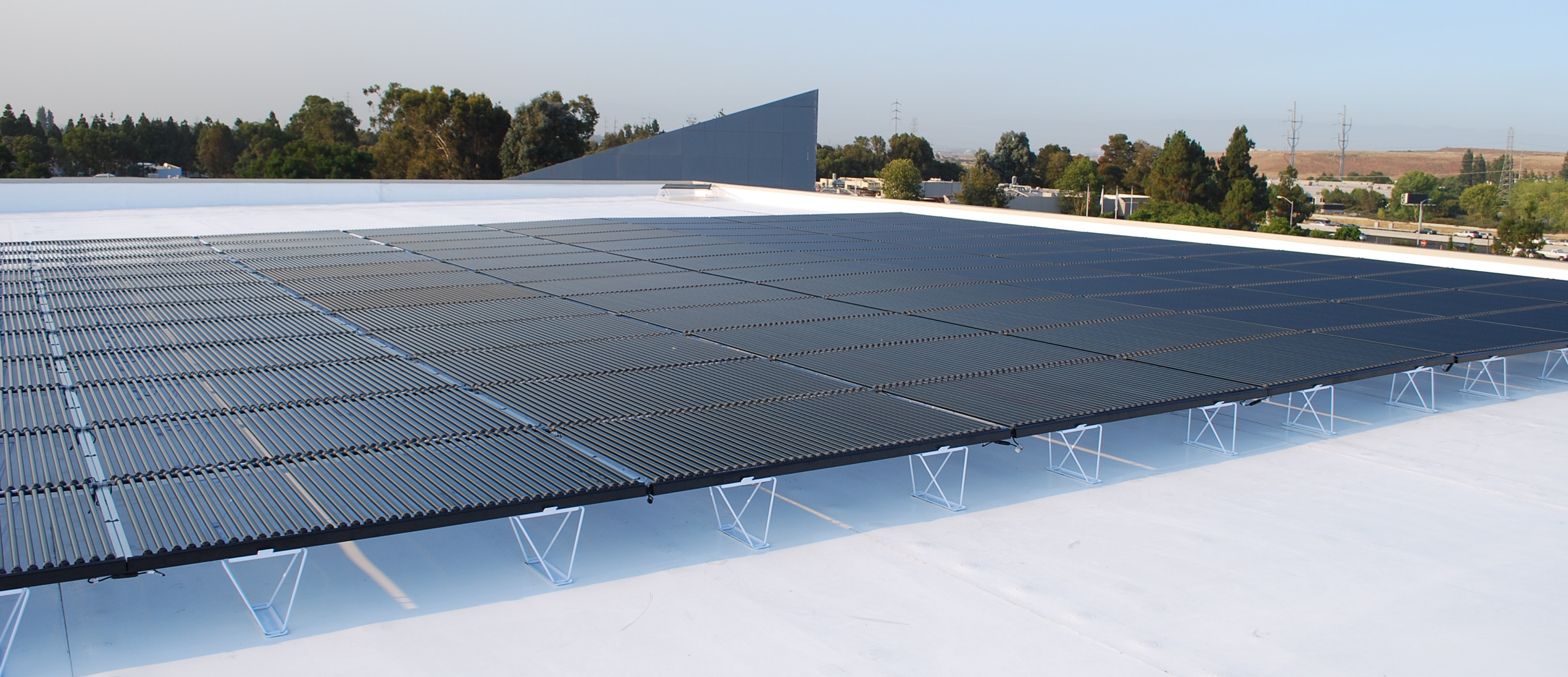
photo: eSolar

This post first appeared on Grist.

Amid all the hope and hype about the nascent solar boom under way in California, there’s long been an elephant in the room – transmission. Billions and billions of dollars must be spent to build and upgrade transmission lines to connect dozens of proposed solar power plants to the grid.

Now that elephant has rolled over and squashed one project’s use of innovative solar technology. Last year, California utility PG&E signed a deal with NRG Energy, a New Jersey-based electricity provider, to buy power from a 92-megawatt solar farm called the Alpine SunTower to be built near the desert town of Lancaster, northeast of Los Angeles.

The power plant would deploy solar thermal technology developed by eSolar, a Pasadena startup founded by serial technology entrepreneur Bill Gross. NRG and eSolar earlier had inked a partnership to build 500 megawatts’ worth of solar farms. In January, eSolar reached an agreement with a Chinese company to supply technology for solar farms that would generate a massive 2,000 megawatts of electricity.

PG&E, however, submitted a letter recently to the California Public Utilities Commission  asking approval for a re-negotiated deal with NRG that has resulted in a downsizing of the Alpine SunTower project to 66 megawatts. And instead of deploying eSolar’s fields of mirrors that focus the sun on a water-filled boiler that sits atop a tower to create steam to drive a turbine, the power plant will generate electricity from photovoltaic panels like those found on residential rooftops.

The utility gave no reason for the technology switch. “NRG has not finalized the exact type of panels or the manufacturer of the panels,” a PG&E executive wrote in the letter. “Solar PV panels have been used in installations throughout the world, in both small and utility scale applications.”

However, when I contacted eSolar about the change, I received a joint statement from the company and NRG:

“NRG is returning the project to its originally proposed size to match the transmission capacity available to the project at this time,” it said. “Maintaining the project as previously announced would require waiting for additional interconnection studies and potential transmission upgrades that would delay the project delivery date.”

While solar panels are not as efficient as eSolar’s solar thermal technology in generating electricity, they are modular – meaning you can just keeping adding them to produce a desired amount of power or to match the transmission capacity in an area. ESolar’s power plants, on the other hand, are designed to be built in 46-megawatt units so there’s far less flexibility in scaling them up or down.

It’s too early to say whether this portends other switches from solar thermal to photovoltaic technology, especially as solar cell prices fall and California utilities scramble to meet a mandate requiring they obtain 20 percent of their electricity from renewable sources by the end of this year and 33 percent by 2020.

But the elephant is getting restless.

Read Full Post »

photo: Todd Woody

In The New York Times on Thursday, I write about the solar industry’s dismay over the rent and other fees the United States government will charge developers to build big solar power plants on federal land in the desert Southwest:

The nation’s biggest landlord, the United States government, has set the rent it will charge developers who build solar power plants on federal land, and some prospective tenants are not happy.

Solar developers will actually pay two fees – the lease for the land along with what the Bureau of Land Management calls a “megawatt capacity fee” based on how much electricity a project generates.

“Since we don’t have authority to collect royalties for wind and solar projects, we had to come up with a methodology to convert that electrical generation into an upfront rent payment,” Ray Brady, manager of the bureau’s renewable energy team, said in an interview.

But potential developers see a disparity. “The proposed B.L.M. rental fees are in many cases two times higher than market rates for private land,” Monique Hanis, a spokeswoman for the Solar Energy Industries Association, said in an e-mail message. “The B.L.M. must collect ‘fair market value’ from developers, but this seems to go beyond that threshold.”

That methodology is a work in progress as the agency tries to adapt decades-old formulas designed for oil and gas leasing and mineral extraction to renewable energy production.

Some 23 million acres of federal property are suitable for large-scale solar development, according to the bureau, and the agency has received more than 200 lease applications from developers who covet hot and sunny desert real estate in the Southwest.

Solar farms typically require vast swaths of land, meaning the lease fees can be considerable depending on a project’s location and local property values. The Bureau of Land Management’s solar rents range from $15.70 an acre in Hidalgo County, N.M., to $313.88 an acre in Riverside County, Calif.

For instance, BrightSource Energy will pay the government about $427,000 a year in rent for its 3,400-acre Ivanpah Solar Electric Generating System in San Bernardino, Calif., now undergoing licensing. The company, based in Oakland, Calif., will also pay an annual megawatt capacity fee of $2.6 million for the 392-megawatt solar thermal power plant. Fees over the 25-year life of the contracts that BrightSource has signed with California utilities would total about $76 million.

In neighboring Riverside County, First Solar, a solar module maker and developer based in Tempe, Ariz., plans to build a 550-megawatt photovoltaic farm on 4,410 acres of federal land. Lease and capacity fees for the Desert Sunlight project will total about $4.3 million a year.

The agency is charging different capacity fees for different solar technologies. Photovoltaic power plants, which deploy solar panels like those found on residential rooftops, are assessed $5,256 a megawatt.

Developers of more efficient solar thermal power plant, which uses mirrors to heat liquids to generate steam that drives a turbine, pay $6,570 a megawatt. The same rate is charged for concentrating photovoltaic farms that use mirrors to focus the sun on a highly efficient solar cell.

If either technology uses energy storage systems to produce electricity when the sun doesn’t shine, the fee jumps to $7,884 a megawatt. The fees will be phased in over the first five years of a power plant’s operation.

Some developers and environmentalists argue that such a fee structure penalizes technologies that are more efficient and thus use less land.

“This is an unfortunate way of emphasizing one technology over another,” said Bobby McEnaney, a land program expert at the Natural Resources Defense Council.

You can read the rest of the story here.

Read Full Post »

photo: Skyline Solar

This post first appeared on Grist.

Grist’s David Roberts sent out a Tweet to his Tweeps today asking which city has installed the most solar. I’ve got an answer for you, David: Nipton, California.

The desert micropolis – population 38 – announced Thursday that it had installed a solar array that will provide 85 percent of its electricity. (The population of the outpost on the edge of Mojave National Preserve spikes to 250 or so during tourist season.)

The solar system is ground-mounted rather than on rooftops and only generates 82 kilowatts. But what is notable is the technology developed by Skyline Solar, a Silicon Valley startup I first wrote about for Grist last year.

The company’s power plants resemble solar thermal parabolic trough installation that deploy long rows of mirrors to heat tubes of liquid suspended over the arrays to create steam that drives an electricity-generating turbine.

Skyline’s system is purely solid state, however. Each 120-foot-long trough concentrates the sun on photovoltaic modules attached to the edges of the arrays. That boosts the solar cell’s electricity production as does a tracking mechanism that allows the arrays to follow the sun throughout the day.

Such concentrating photovoltaic systems – which Skyline calls “high gain solar “ – have been a niche market due to their relatively high costs. But as solar cell prices decline and solar thermal projects get bogged down in environmental disputes, they have become increasingly attractive as they can be built near utility substations and plugged directly into the grid without the need to build expensive new transmission systems.

Skyline has pushed to lower costs by using common materials – glass, steel – and designing the arrays so their components can be mass-produced by automotive manufacturers. The company last year struck a deal with the Michigan subsidiary of Canadian auto manufacturing giant Magna International to make components for its HGS 1000 solar system.

In other news on the solar frontier Thursday, Silicon Valley startup MiaSolé said the National Renewable Energy Laboratory had confirmed that the company’s copper indium gallium selenide solar cells have 13.8 percent efficiency in production. Such thin-film cells typically have a lower efficiency than standard polysilicon solar cells but are cheaper to manufacture. But with an efficiency approaching 14 percent, MiaSolé could give some standard module makes a run for their money.

Read Full Post »

« Newer Posts - Older Posts »

Design a site like this with WordPress.com
Get started