Feeds:
Posts
Comments

Archive for the ‘alternative energy’ Category

photo: Todd Woody

I wrote this story for Grist, where it first appeared.

The anemic economic recovery may have hit the dog days of summer with consumer spending and factory orders slowing, but the new energy economy continues to surge, according to a report released Tuesday by Ernst & Young.

Venture capital (VC) investment in renewable energy, electric cars, energy efficiency, and other green technology jumped to $1.5 billion in the United States in the second quarter of 2010, a nearly 64 percent spike over the second quarter of last year. Green tech investment now has returned to the record levels of the third quarter of 2008, before the global economic collapse shut down the VC’s ATM.

So where’s the money going? Between March and June, at least, investors hitched a ride with startups developing electric cars and the infrastructure to support them. Better Place, the Palo Alto company building electric vehicle charging networks around the world, snagged $350 million. Fisker Automotive, a Southern California startup building a sexy and pricy plug-in hybrid sports sedan called the Karma, scored $35 million, according to the report.

Solar remains a hot opportunity for venture capitalists, with nearly $439 million invested in the second quarter, a 183 percent increase from the year-ago quarter.

It’s no coincidence that the beneficiaries of investors’ largesse are also those startups that received federal loan guarantees to build big solar power plants. (Raising additional capital usually is a requirement for obtaining such federal loan guarantees.)

BrightSource Energy, for instance, secured a $1.37 billion loan guarantee from the U.S. Department of Energy to build its first solar power plant, now undergoing licensing in California. It then quickly raised $180 million from investors.

VCs also continue to pour cash — nearly $200 million in the second quarter — into energy efficiency startups, which tend to be far less capital-intensive than renewable energy companies.

So it’s a good time to go pitch that great green tech idea you’ve been kicking around, right?

Not necessarily. Ernst & Young notes that nearly 59 percent of investment in the second quarter went to so-called later-stage startups that are well on their way to rolling out products.

In other words, venture capitalists seem to be more interested in priming the pipeline for initial public offerings or acquisitions that will produce a big pay day than in financing what green tech investor Vinod Khosla calls “science experiments.”


Read Full Post »

Image: Google

I wrote this story for Grist, where it first appeared.

Google is officially in the green energy business. The search giant announced on Tuesday that its Google Energy subsidiary signed a 20-year power purchase agreement with NextEra Energy. Google will begin buying 114 megawatts of electricity from an Iowa wind farm on July 30.

Google, of course, cannot directly use the clean green energy generated by the wind farm; that power goes into the local grid. So Google Energy will sell the power on the regional spot market, where utilities and electricity retailers go to buy power when demand spikes and they have a shortfall. Google will use the revenue from spot market sales to buy renewable energy certificates (RECs) which will offset its greenhouse gas emissions.

Many companies buy RECs in an attempt to be carbon neutral, obtaining them from third-party brokers. But by purchasing RECs directly tied to the renewable energy it is also buying, Google is getting a bigger bang for its buck.

“By contracting to purchase so much energy for so long, we’re giving the developer of the wind farm financial certainty to build additional clean energy projects,” Urs Hoelzle, Google’s senior vice president for operations, wrote on a blog post Tuesday.

“The inability of renewable energy developers to obtain financing has been a significant inhibitor to the expansion of renewable energy,” he added. “We’ve been excited about this deal because taking 114 megawatts of wind power off the market for so long means producers have the incentive and means to build more renewable energy capacity for other customers.”

In a statement on its site, Google also noted that its motivations for signing long-term renewable energy contracts are not entirely altruistic.

“Through the long term purchase of renewable energy at a predetermined price, we’re partially protecting ourselves against future increases in power prices,” the company stated. “This is a case where buying green makes business sense.”

It remains to be seen how big a green power purchaser Google will become. (The company has also invested directly in a wind project built by NextEra Energy, the biggest American wind power producer.)

But Dan Reicher, Google.org director of climate change and energy programs, told me earlier this year that finding clean ways of powering Google’s massive data centers led in part to the establishment of Google Energy.

“This interest in procuring green electrons is part of what’s driven Google Energy,” he said.

Read Full Post »

Image: Solexant

I wrote this post for Grist, where it first appeared.

Back in the 1980s and ’90s, the region surrounding Portland was dubbed the Silicon Forest for the cluster of computer chip companies that had flocked to Oregon to set up shop.

Now those old-growth tech companies are giving way to a new generation of solar startups that are sprouting up around Portland’s green metropolis, sometimes in old semiconductor factories that have been revamped to produce photovoltaic modules.

Germany’s SolarWorld built the United States’ largest solar module plant in the Portland suburb of Hillsboro in 2008, and on Tuesday Silicon Valley company, Solexant, announced it will open its first commercial factory in the area.

The facility will be Oregon’s first thin-film solar module plant. As the name implies, thin-film solar cells are essentially printed on flexible metal or other materials. Although such technology is less efficient at converting sunlight into electricity than standard crystalline silicon cells made by companies like SolarWorld, thin-film solar’s great promise is that solar cells can be made cheaper, which will lower the cost of photovoltaic power.

Solexant describes itself as a third-generation thin-film solar company. It has revealed few details about its technology other than it has developed a “nanocrystal ink” to make higher efficiency solar cells at a lower cost than its competitors. The technology was first developed at the Lawrence Berkeley National Lab in California.

Investors clearly think the San Jose startup is on to something. Last month, the company raised a $41.5 million round of funding.

To lure Solexant north, Oregon has offered the company a $25 million loan and an $18.75 million tax credit to help build a factory in Gresham, east of Portland. The plant will produce 100 megawatts’ worth of solar modules a year and employ up to 200 people, according to Solexant. (The company currently operates a two-megawatt pilot production line in San Jose.) In exchange for the tax credit, Solexant has agreed that 97 of the new plant’s 200 jobs will go to county residents.

“We are pleased to welcome Solexant to Oregon, North America’s leading solar manufacturing center,” Gov. Ted Kulongoski said in a statement. “This investment will mean jobs immediately for Oregonians with the promise of more in the future. In addition, this company brings a new technological facet to Oregon’s already booming solar manufacturing base and will help us continue to be a global leader in solar manufacturing.”

Read Full Post »

In The New York Times on Wednesday, I wrote that California Attorney General Jerry Brown has filed a lawsuit against Fannie Mae and Freddie Mac over the mortgage giants’ quashing of the PACE solar loan program:

The California attorney general’s office on Wednesday sued Fannie Mae and Freddie Mac over actions by the mortgage finance companies that have derailed a popular financing program that allows homeowners to pay for energy efficiency improvements through a surcharge on their property taxes.

This month, the Federal Housing Finance Agency, which oversees Fannie and Freddie, issued guidelines to lenders that restricted the ability of homeowners to participate in the financing programs, called Property Assessed Clean Energy, or PACE. Twenty-two states have authorized the programs, which have drawn $150 million in stimulus funding support from the Obama administration.

When a city or state pays for energy efficiency upgrades through the program, a lien is placed on the home. The liens, like other property tax assessments, take priority over the mortgage if the homeowner defaults. The housing agency instructed lenders that they could not accept such PACE liens.

In recent months, some banks have declined to refinance mortgages for homes that carry the liens.

In the lawsuit, filed in United States District Court in Oakland, Calif., Jerry Brown, the California attorney general and Democratic candidate for governor, asked that the court declare that participation in PACE programs does not violate the standards of Fannie and Freddie, which are government chartered. The suit also asks that an injunction be issued to prevent them from taking action against homeowners whose properties have PACE liens.

The Federal Housing Finance Agency was also named as a defendant.

The suit alleges that the housing agency’s actions violated California law, which authorizes PACE programs, and are “severely hampering California’s efforts to assist thousands of California homeowners to reduce their energy and water use, help drive the state’s green economy, and create significant numbers of skilled, stable and well-paying jobs.”

“The actions of these government-sponsored, shareholder-owned private corporations have placed California’s PACE programs – and the hundreds of millions of dollars in federal stimulus money supporting them – at immediate risk while benefiting their own pecuniary interests,” the suit states.

You can read the rest of the story here.

Read Full Post »

In The New York Times on Wednesday, I write about the return of J.R. Ewing, the oil tycoon villain of the “Dallas” television show. Except this time, he’s pushing solar energy:

J.R. Ewing returns to the small screen on Tuesday, and the boys down at the Cattleman’s Club just might need a double bourbon when they hear what he has to say.

Larry Hagman, the actor who played the scheming Texas oilman on the long-running television show “Dallas,” is reprising his role as J.R. in an advertising campaign to promote solar energy and SolarWorld, a German photovoltaic module maker.

“In the past it was always about the oil,” Mr. Hagman says in a TV commercial that is being unveiled Tuesday at the Intersolar conference in San Francisco.

“The oil was flowing and so was the money. Too dirty, I quit it years ago,” he growls as he saunters past a portrait of a grinning J.R. in younger days and a wide-screen television showing images of an offshore oil rig and blackened waters.

Doffing a 10-gallon hat, he heads outside into the sunshine and gazes at a solar array on the roof of the house. “But I’m still in the energy business. There’s always a better alternative.”

“Shine, baby shine,” he says with his trademark J.R. cackle.

In real life, Mr. Hagman, 78, lives on an estate in the Southern California town of Ojai where he installed a massive 94-kilowatt solar system, thought to be the world’s largest residential array, several years ago.

You can read the rest of the story here.

Read Full Post »

I wrote this post for Grist, where it first appeared.

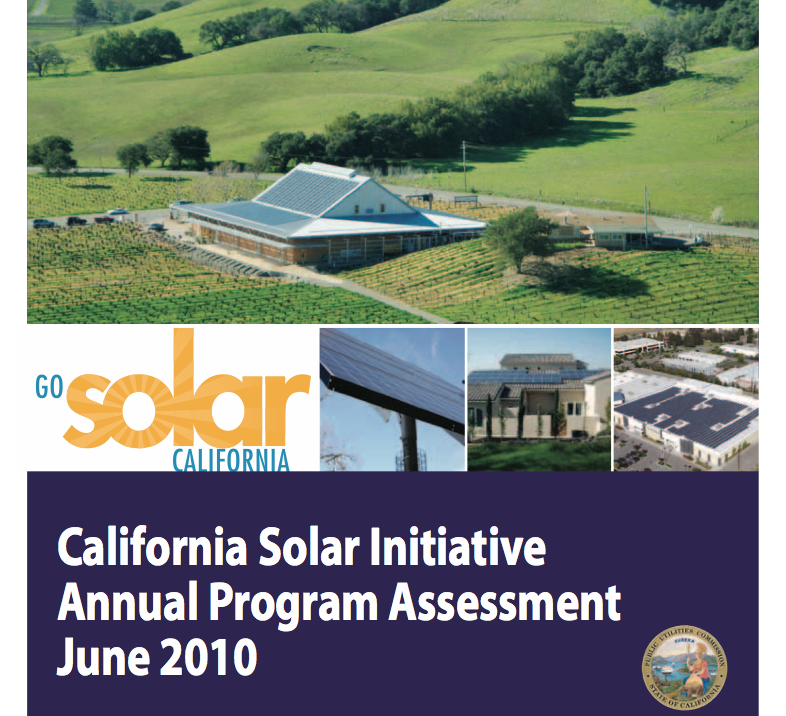
As the Great Recession drags on in California — unemployment rate: 12.4 percent, state government in a state of collapse — the solar boom continues.

The Golden State’s decade-long program to install 3,000 megawatts of photovoltaic arrays on residential and commercial rooftops kicked off in 2007, not too long before the global economic collapse began.

Only three years in, the program — known as the California Solar Initiative — has achieved 42 percent of its 1,750 megawatt target in markets served by the state’s three, big investor-owned utilities, according to a report released Friday by the California Public Utilities Commission. Completed projects account for 20 percent of that 42 percent figure, while another 22 percent are pending installations. (In 2009, the solar program eliminated 180,136 tons of carbon, the equivalent of taking 31,000 cars off the road.)

Demand for solar is accelerating even as the housing market remains in the doldrums. Applications for the solar rebate program hit a high of 134 megawatts in April, and in the first six months of 2010 a total of nearly 300 megawatts’ worth of projects were received.

“The monthly demand for new applications has been well over 1,000 applications per month for the past year,” the report stated.

And Californians’ appetite for solar has grown even as the rebate for new photovoltaic systems has declined, as it is designed to do over the life of the program.

State and federal tax incentives have cut the cost of a solar array roughly in half. And last year’s global glut of photovoltaic modules and the influx of Chinese solar companies into the U.S. market has led to drops in the price of solar panels. (Installation costs still account for about half the price of a solar array.) Overall, the cost of solar systems smaller than 10 kilowatts has dropped by 15 percent between 2007 and 2010 while the price of bigger arrays has fallen 10 percent, according to a report released Friday by the California Public Utilities Commission. (In general, a 10-kilowatt solar array could power a large home or commercial building.)

But one of the biggest factors persuading Californians to go solar appears to be the increasing availability of solar leases. These financial arrangements allow homeowners to have a system installed at little or no upfront cost in exchange for a monthly fee.

Companies such as SolarCity, Sungevity, and SunRun offer solar leases and retain ownership of the rooftop arrays. In 2009, such ownership of solar systems enrolled in the state program jumped 155 percent. Forty percent of the megawatts now generated through the program are owned by leasing companies or other third parties.

Fueling that trend has been the hundreds of millions of dollars that financial giants such as U.S. Bancorp have poured into solar financing funds for SolarCity, Sungevity, and SunRun. So far this year, PG&E Corporation, the parent company of California utility PG&E, has created funds totaling $160 million to finance solar leases for SolarCity and SunRun customers.

Read Full Post »

photo: PG&E

I wrote this post for Grist, where it first appeared.

Amid the hullabaloo over government-chartered mortgage giants derailing the green financing program known as Property Assessed Clean Energy, or PACE, the march toward distributed generation of renewable energy — that is, generating electricity from decentralized sources such as rooftop solar panels or backyard wind turbinescontinues.

Case in point: The Sacramento Municipal Utility District (SMUD) announced Wednesday that it had awarded contracts to San Francisco’s Recurrent Energy to install 60 megawatts’ worth of solar panels in the region surrounding California’s state capital.

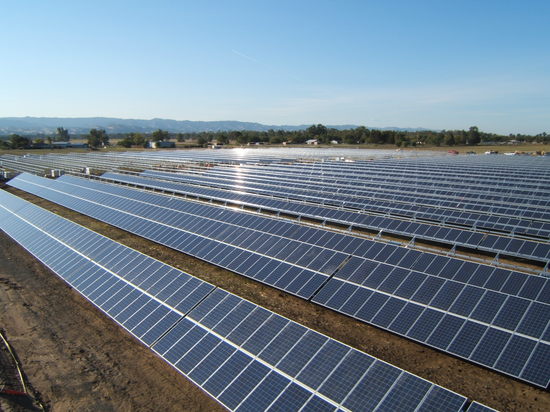
Rather than construct a central solar power station, Recurrent will scatter a dozen five-megawatt installations around two cities in Sacramento County. Each installation will be located near an existing substation, which means that the solar arrays can be plugged directly into the grid without requiring any expensive transmission upgrades.

As I wrote earlier this year in Grist, when SMUD put 100 megawatts of renewable energy contracts out for bid, the allocation sold out within a week. The utility is paying the solar developers a standard premium for their photovoltaic energy — called a feed-in-tariff. But according to calculations done by Vote Solar, a San Francisco non-profit that promotes solar energy, SMUD will pay no more for this clean green solar electricity than it does for fossil-generated power at peak demand times. A 40-percent plunge in solar module costs over the past year has made solar photovoltaic energy increasingly competitive with natural gas, the main fossil fuel used in California to generate electricity.

California’s two big investor-owned utilities, PG&E and Southern California Edison, have launched similar distributed generation programs, which will bring 1,000 megawatts of photovoltaic installations online over the next five years. At peak oputput, that’s the equivalent of a nuclear power plant.

Two weeks ago, PG&E cut the ribbon on the first project to come online as part of its 500-megawatt distributed generation initiative. The two-megawatt Vaca-Dixon Solar Station is built near a utility substation 50 miles north of San Francisco.

It took just nine months to install the fields of solar panels for the Vaca-Dixon station — that’s light speed in a state where the first new big solar thermal power plant in 20 years, BrightSource Energy’s Ivanpah project, has been undergoing licensing for nearly three years.

Solar thermal power plants generate electricity by using mirrors to focus the sun on a liquid-filled boiler. The process creates create steam that drives a conventional turbine which can generate hundreds of megawatts of electricity. Solar thermal projects, by nature, are large centralized facilities, the clean and green versions of a big fossil-fuel power plant.

Photovoltaic farms, on the other hand, generate electricity when sunshine strikes semiconducting materials in a solar cell. If you want to produce more power, you just keep adding solar panels.

While BrightSource hopes to secure a license for its solar thermal project soon, the developer of a hybrid biomass solar trough power plant to be built in California’s Central Valley pulled the plug on the project last month, after spending 18 months and untold millions of dollars in the licensing process before the California Energy Commission.

PG&E has been depending on both those solar thermal projects to supply electricity to help it meet its renewable energy mandates. No wonder then, the utility’s growing enthusiasm for solar panel power. Photovoltaic farms do not have to be approved by California Energy Commission and can be built on already degraded land or close to cities.

And as I reported last month, the developer of another project being built to generate electricity for PG&E, the Alpine SunTower, decided to drop solar thermal technology made by its partner, eSolar, in favor of photovoltaic panels. The official explanation for the switch was that project was being downsized due to transmission constraints and solar panels proved a better fit.

But one has to wonder if economics as much as energy was behind the change. If so, deals like the one SMUD struck could be a recurrent theme.

Read Full Post »

photo: Sungevity

I wrote this post for Grist, where it first appeared.

On Tuesday, the Federal Housing Finance Agency effectively shut down an innovative green financing program called Property Assessed Clean Energy, or PACE, by restricting the ability of homeowners to take out loans to install solar panels and make other energy efficiency improvements.

Now the United States Treasury Department has piled on. A new Treasury directive tells the nation’s banks how to enforce the FHFA rules. The move could pose new problems for homeowners who have PACE loans, and complicate efforts to get the program back on track.

Homeowners repay PACE loans through an annual assessment on their property taxes. On Tuesday, the Treasury Department told banks that if a homeowner has a home equity line of credit, the amount of money available should be lowered to account for the loan liability. The Treasury also said homeowners could be required to put their PACE payments in an escrow account.

After Fannie Mae and Freddie Mac, the government chartered mortgage finance giants, raised concerns about PACE in May, some lenders declined to refinance mortgages that carried PACE liens.

Owners of commercial properties who hold PACE loans may need to put up additional collateral to back up the loan, according to the Treasury Department letter.

Cisco DeVries, president of Renewable Funding, an Oakland, Calif., company that designs and administers PACE programs for local governments, said he wants to make sure PACE loans for commercial owners won’t be curtailed.

“We believe PACE commercial can go ahead as it has always required lender consent when a commercial mortgage is in place,” he wrote in an email. “We just want to make sure we don’t run into an unexpected problem as we move forward.”

Some municipalities sell bonds to finance energy-efficiency loans for homeowners. But they may find that harder to do under the Treasury Department directive, which warned banks to move cautiously when underwriting such bonds.

I reported in the The New York Times on Tuesday that the Federal Housing Finance Agency had rejected the Obama administration’s offer of a two-year guarantee against any PACE-related mortgage losses Fannie or Freddie might suffer.

Now in a move that PACE proponents say adds insult to injury, the Treasury Department is advising banks to get local governments to insure them against any losses from the program if homeowners default on their mortgages.

Among those not amused by the FHFA action was California Gov. Arnold Schwarzenegger.

“The FHFA’s bureaucratic breakdown threatens one of California’s most promising new engines of job creation in this struggling economy,” Schwarzenegger said in a statement. “FHFA’s action threatens thousands of new sustainable jobs in California, especially in the hard-hit construction industry, while denying homeowners the opportunity to reduce monthly energy costs and add equity to their homes.”

Read Full Post »

In The New York Times on Tuesday, I write about the latest developments in the Fannie Mae/Freddie Mac – PACE solar loan saga:

The federal agency that oversees two government-chartered mortgage finance companies imposed new restrictions Tuesday on homeowners’ ability to take advantage of a program that allows them to repay the cost of installing solar panels and other energy improvements through an annual surcharge on their property taxes.

The new guidelines could also make it more difficult for homeowners to obtain mortgages even if they don’t participate in the programs, called Property Assessed Clean Energy, or PACE, but happen to live in an area where they are offered.

“For all intents and purposes, until cooler heads prevail or Congress acts, it’s very difficult to envision PACE going forward,” said Cisco DeVries, president of Renewable Funding, a company in Oakland, Calif., that creates and administers the programs for local governments.

In issuing the guidance to Fannie Mae and Freddie Mac, which buy and resell most mortgages, the Federal Housing Finance Agency was critical of the energy efficiency programs that have been authorized by 22 states and that have drawn $150 million in stimulus funding support from the Obama administration.

When a municipality pays for energy efficiency upgrades through the program, a lien is placed on the home. The liens, like other property tax assessments, take priority over the mortgage if the homeowner defaults.

But the housing agency on Tuesday characterized PACE liens as different from other special assessments that cities routinely use to finance sewers, sidewalks and other civic improvements.

“They present significant risk to lenders and secondary market entities, may alter valuations for mortgage-backed securities and are not essential for successful programs to spur energy conservation,” the agency wrote.

The Federal Housing Finance Agency said efforts were continuing to develop underwriting standards for energy efficiency programs.

“However, first liens that disrupt a fragile housing finance market and longstanding lending priorities, the absence of robust underwriting standards to protect homeowners and the lack of energy retrofit standards to assist homeowners, appraisers, inspectors and lenders determine the value of retrofit products combine to raise safety and soundness concerns,” the agency stated.

You can read the rest of the story here.

Read Full Post »

In Sunday’s New York Times, I have an update on the controversy surrounding Fannie Mae and Freddie Mac’s blocking of the PACE solar loan program:

Two government-chartered mortgage finance companies are unlikely to accept loans on homes that are part of a special program that lets homeowners repay the cost of energy improvements through a surcharge on their property tax bills, according to Energy Department officials.

The Obama administration has allocated $150 million in stimulus money to support the financing technique, called Property Assessed Clean Energy, or PACE, and 22 states have authorized such programs. In a separate stimulus effort, President Obama on Saturday announced nearly $2 billion in loan guarantees for solar energy production.

Through the PACE program, loans to install solar panels and make other energy improvements would be repaid through 20-year special assessments on property tax bills and secured through a lien.

On May 5, Fannie Mae and Freddie Mac, which buy and resell most home mortgages, notified lenders that such liens could not take priority over a mortgage but did not offer guidance on how to handle such loans. The uncertainty has frozen many PACE programs and led some energy companies to furlough workers.

On Friday, Cathy Zoi, an assistant secretary at the Energy Department, called officials in Boulder County, Colo., to inform them that the administration had been unable to persuade the Federal Housing Finance Agency, which oversees Fannie Mae and Freddie Mac, to accept mortgages with PACE liens.

The liens, like other property tax assessments, would be paid first if a homeowner defaults.

“She said in light of the circumstances we should look at other ways of financing energy efficiency with the stimulus money,” said Ben Pearlman, a commissioner in Boulder County.

“We’re very concerned,” Mr. Pearlman said. “It’s a powerful program and a powerful idea. We need to find an easy way for people to make those investments.”

Those homeowners who already carry energy liens on their property may find it difficult to refinance their mortgages. In Sonoma County, Calif., some lenders have declined to issue new loans for homes with such liens unless the assessment is paid off.

Ms. Zoi also called Cisco DeVries, president of Renewable Funding, a company in Oakland, Calif., that devises and administers PACE programs for local governments. “She indicated that the agencies had decided not to accept the liens and the administration needed to begin contingency planning on what to do with stimulus funding allocated for PACE,” Mr. DeVries said.

Dan Leistikow, the Energy Department’s director for public affairs, confirmed the calls. “We expect to get more written guidance from the regulators this week,” he said on Saturday.

You can read the rest of the story here.

Read Full Post »

« Newer Posts - Older Posts »

Design a site like this with WordPress.com
Get started