Feeds:
Posts
Comments

Archive for the ‘alternative energy’ Category

photo: Todd Woody

I wrote this story for Grist, where it first appeared.

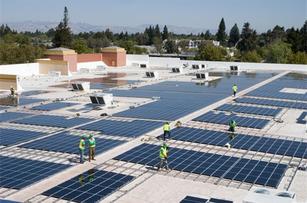
While efforts to pass federal climate change legislation have stalled and a fight rages in California to overturn its global warming law at the ballot box, Golden State regulators have been licensing massive desert solar power plant projects at a breakneck pace in recent weeks.

On Wednesday, for instance, the California Energy Commissioned approved two solar projects that would generate nearly 1,000 megawatts of electricity, the 250-megawatt Genesis Solar Energy Project and the 709-megawatt Imperial Valley Solar Project.

Since Aug. 25, the energy commission has licensed six solar thermal power plants that would cover some 39 square miles of desert land and generate 2,829 megawatts. That’s nearly six times as much solar capacity that was installed in the United States last year, mostly from rooftop solar panels.

“Consider how important it is that California move aggressively toward renewables and how important these pioneering projects are,” said Jeffrey Byron, a member of the California Energy Commission, said at a hearing Wednesday.

Regulators and developers are racing to put shovels to ground before the end of the year when federal incentives for large renewable energy projects expire, which could threaten the financial viability of some of the solar projects.

The Genesis project, to be built by Florida-based energy giant NextEra Energy Resources (formerly called FPL), will build long rows of parabolic troughs in the Riverside County desert that will focus sun on liquid-filled tubes suspended over the mirrors to create steam that will drive an electricity-generating turbine. It’s an older solar technology that was first deployed in the 1980s in California.

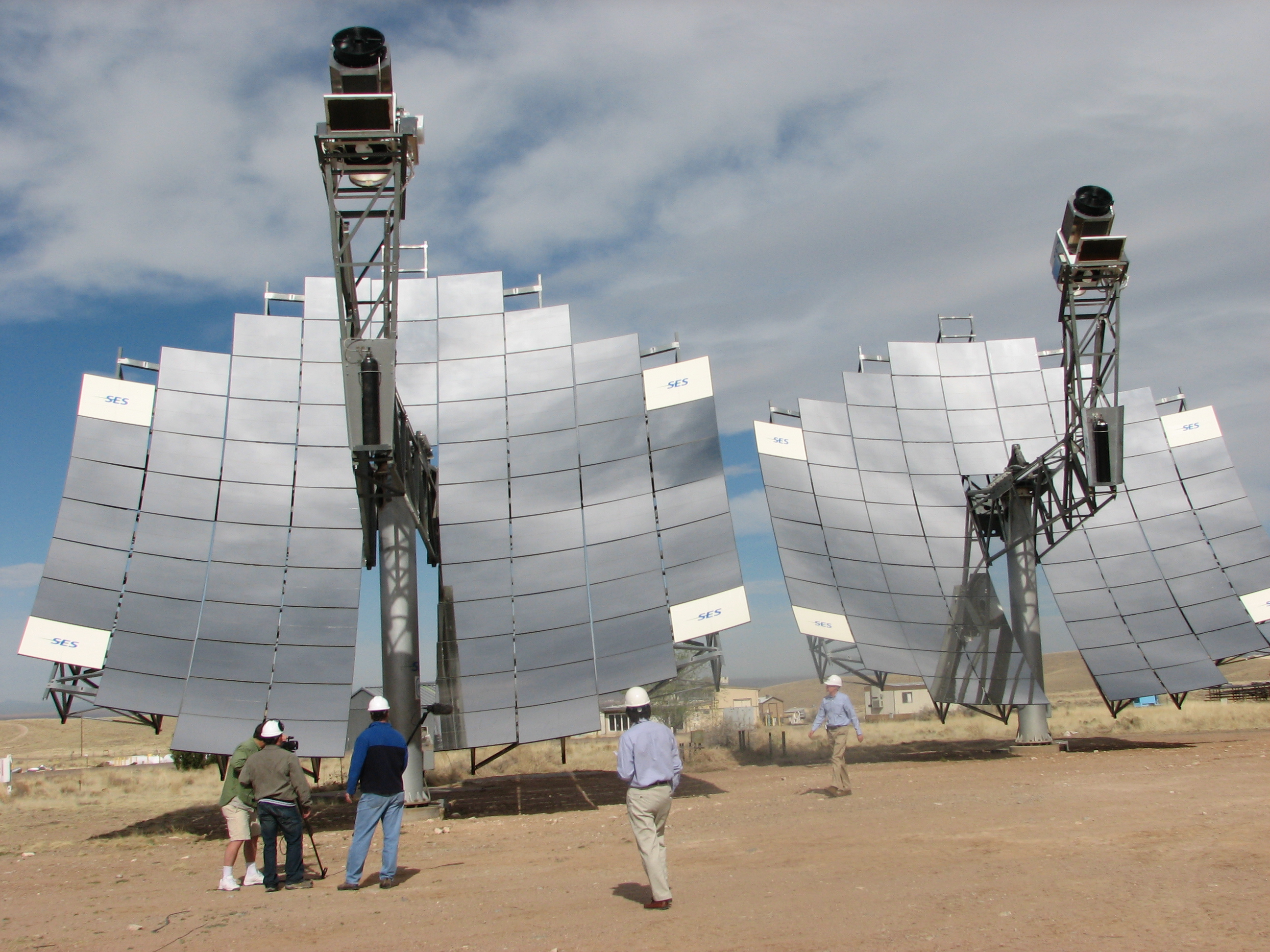
Tessera Solar’s  Imperial Valley project, on the other hand, will be the first big test of Stirling dish technology. Resembling a giant mirrored satellite receiver, the 38-foot-high, 40-foot-wide, solar dish focuses the sun’s rays on a Stirling engine, heating hydrogen gas to drive pistons that generate 25-kilowatts of electricity. Some 29,000 of Tessera’s Suncatchers will be installed on more 6,400 acres of desert land near the Mexican border about 100 miles east of San Diego.

Meanwhile, California Gov. Arnold Schwarzenegger this week signed into law what is thought to be the nation’s first energy storage legislation. The bill, AB 2514 could result in regulations requiring the state’s utilities to store a certain percentage of electricity generated in energy storage systems such as batteries, compressed air or flywheels.

Energy storage is considered crucial for the mass deployment of solar power plants, wind farms and other sources of intermittent renewable energy, as well to build out the smart grid.

Read Full Post »

photo: Edelman

In The New York Times on Tuesday, I write about Adobe Systems putting a dozen Bloom Energy fuel cells on the roof of a parking garage at its downtown San Jose headquarters, the largest such installation in the United States:

To green up its operations, Adobe Systems, the maker of the ubiquitous Flash media player, has done everything from installing waterless urinals to building a wind farm at its downtown San Jose, Calif., headquarters.

Now the company has put a dozen 100-kilowatt Bloom Energy fuel cells on top of a parking garage that will supply nearly a third of the three-tower complex’s electricity.

It will be the nation’s largest installation of Bloom Energy Servers, a cutting-edge solid oxide fuel cell that has been bought by Google, eBay and other big corporations.

Bloom Energy, a long-secretive Sunnyvale, Calif., start-up that has raised $400 million from some of Silicon Valley’s leading venture capitalists, unveiled the energy servers to great fanfare at a February event attended by Gov. Arnold Schwarzenegger of California; Gen. Colin L. Powell, the former secretary of state; and a host of technology chiefs.

Fuel cells convert hydrogen, natural gas or another fuel into electricity through an electrochemical process and then provide electricity directly to a building without the need for new transmission lines. Depending on the type of fuel used, Bloom claims its devices can sharply cut or eliminate greenhouse gas emissions.

Randy Knox, Adobe’s senior director for global workplace solutions, said the company aimed to obtain half of its electricity from renewable sources. But Adobe was stymied by the fact its operations are located in urban skyscrapers rather than on a sprawling corporate campus.

“We just don’t have space on our tower rooftops for large solar arrays,” said Mr. Knox.

Earlier this year Adobe did install 20 1.2-kilowatt vertical wind turbines made by Windspire Energy on a sixth-floor plaza that connects two of its buildings. But the urban wind farm, which looks more like a modern art exhibit than a power plant, generates only enough electricity to power about 10 average homes –- when the wind is blowing.

A dozen Bloom Energy Servers, however, produce 1,200 kilowatts of power around the clock and fit comfortably on the roof of Adobe’s parking garage. Visible from neighboring towers and the 101 freeway, the polished metal cubes’ green-chic look owes more to Apple’s tech aesthetic than to old-school industrial design.

You can read the rest of the story here.

Read Full Post »

graphic: Grist

I wrote this story for Grist, where it first appeared.

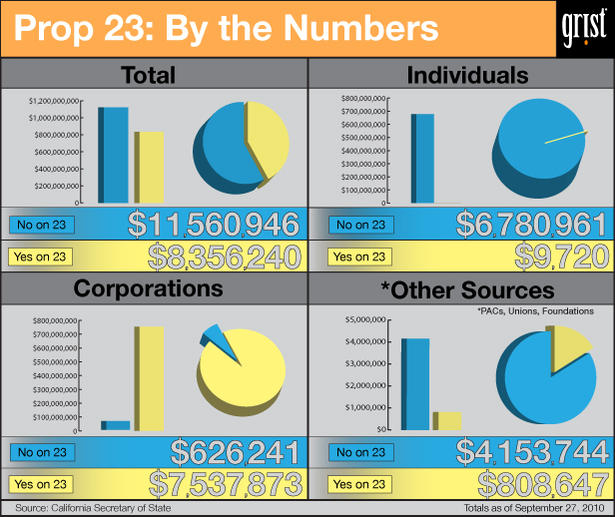
As predicted, the big money has started to pour into the battle over Proposition 23, the California ballot measure that would suspend the state’s global warming law.

But not from where you’d expect. The six-figure donations filling campaign coffers is not coming from the Texas oil companies and petrochemical giants backing Prop 23 but from a coalition of environmentalists, venture capitalists, green tech companies, and environmental justice activists who are working to defeat the measure.

Over the past two weeks, the No on 23 forces have collected more than $1.8 million in contributions while the Yes campaign has taken in only $6,500, according to California Secretary of State records.

The windfall for opponents comes as a Field Poll released Sunday shows Prop 23 losing 45 percent to 34 percent with a large number of voters — 21 percent — still undecided. Meanwhile, a poll from the Los Angeles Times/University of Southern California has Prop 23 winning by a slight margin, 40 percent to 38 percent.

I’ll take a closer look at those poll numbers later but first let’s see who’s putting up the green to keep California green.

Environmental justice groups have jumped into the fight in a significant way this month. SCOPE (Strategic Concepts in Organizing and Policy Education), a Los Angeles-based group that formed in the wake of the 1992 Rodney King riots, has contributed $300,000 in recent weeks. SCOPE is funded by various foundations, including the Ford Foundation and James Irvine Foundation. The organization promotes green jobs and other economic development programs for disadvantaged areas of Los Angeles.

Another Los Angeles organization, listed in financial disclosure filings only as A.L.L.E.R.T., donated $150,000 to another No on Prop 23 group called the California Alliance Action Fund: A Committee Sponsored by Social Justice Organizations.

Then there’s Californians for Clean Energy and Jobs, a Sacramento-based organization that says its “sponsored by environmental organizations and business.” It gave $100,000 to a No on Prop 23 campaign committee that’s backed by the Ella Baker Center for Human Rights, the Oakland, Calif., organization founded by Van Jones.

Meanwhile, individuals continue to write checks. San Francisco investor Robert Fisher, former chair of The Gap clothing empire, contributed another half million dollars on Thursday, bringing his total donations to $1 million.

Steve Westly, the former eBay executive and California state controller who now runs an investment group, donated $10,000; Southern California businessperson, Claire Perry, made her second $250,000 contribution.

A couple of well-heeled New Yorkers also got into the act: Daniel Tishman of Tishman Construction and Garrett Moran of private equity giant The Blackstone group, each donated $25,000 on Friday.

The solar industry, whose prosperity in the United States has been driven in large part by California mandates and incentives for renewable energy, has begun to step up to the plate.

Recurrent Energy, which last week agreed to be acquired by the Japanese conglomerate Sharp, donated $50,000, as did First Solar, the Tempe, Ariz., thin-film solar giant whose early investors include the Walton family. Thomas Werner, chief executive of Silicon Valley’s SunPower, one of the largest American solar panel makers and developers, gave $25,000 on Sept. 18. Another Silicon Valley solar startup, Solaria, put in $5,000.

The Field Poll released this weekend indicates that the broad-based alliance against Prop 23 appears to be keeping proponents of the ballot measure from gaining ground. The only demographic groups that favor Prop 23 are Republicans (47 percent to 33 percent), Latino voters (41 percent to 38 percent), and less educated voters (37 percent to 34 percent for those with a high school education or less; 39 percent to 37 percent for those with some college education).

Geographically, all areas of California, including the conservative Central Valley, oppose Prop 23 by varying margins, according to the poll.

Over the past few weeks, the editorial boards of California’s major newspapers have come out against Prop 23. And Meg Whitman, the Republican candidate for governor, has said she’ll voted against the measure, though she supports suspending the global warming law for one year.

But with just six weeks to go until Election Day, Prop 23 opponents still expect to see a gusher of oil money flowing into the Yes campaign from fossil fuel interests.

Read Full Post »

photo: GE

I wrote this story for Grist, where it first appeared.

General Electric on Wednesday gave a jump-start to Better Place, the Silicon Valley startup developing an electric car infrastructure in several countries.

Better Place plans to deploy a network of urban charging posts and swapping stations where drivers can exchange depleted company-owned batteries for fresh ones when they need to make trips that exceed their car’s range. GE has agreed to help finance up to 10,000 of those batteries in Better Place’s first two markets: Denmark and Israel. That’s no small matter, given that Better Place faces huge capital outlays for battery purchases.

The global conglomerate will also make its WattStation, a sleek electric car charging post that it unveiled in July in San Francisco, compatible with Better Place’s network.

In addition, GE and Better Place will collaborate on an effort to persuade companies to electrify their vehicle fleets and plug into the electric car charging networks that Better Place plans to build in the San Francisco Bay Area; Ontario, Canada; Australia; and Europe.

It’s not the first time GE has dabbled in the nascent electric car industry. In 2008, the company invested $4 million in Think, the Norwegian electric carmaker.

In yet another deal involving a multinational conglomerate and a California startup, Sharp late Tuesday said it had acquired Recurrent Energy, a San Francisco-based solar developer, for $305 million in cash.

While most people may associate Sharp with televisions and other consumer electronics, the Japanese company is also one of the world’s biggest solar panel makers. Recurrent builds small-scale photovoltaic power plants. It has signed contracts for projects that would generate 330 megawatts, and has another nearly another 1,700 megawatts’ worth of deals in development.

During a conference call on Wednesday, Recurrent’s chief executive, Arno Harris, said Recurrent would retain its name and become a division of Sharp and that he and his team would remain in place.

While the buyout is another sign of the consolidating solar industry, it also indicates that big solar panel makers like Sharp feel pressure from the fast rise of low-cost Chinese manufacturers to diversify their business.

Acquiring Recurrent gives Sharp another source of revenue but it won’t necessarily provide a market for Sharp’s own solar panels. In a telling provision of the acquisition, Harris said Recurrent won’t be compelled to buy Sharp solar panels and can keep its current suppliers. Those include Yingli Green Energy, a Chinese company that captured a third of the California market last year thanks in large part to a big deal with Recurrent.

Read Full Post »

photo: Walmart

I wrote this story for Grist, where it first appeared.

When Walmart announced on Monday that it would install 15 megawatts’ worth of solar arrays on as many as 30 of its stores in California and Arizona, it set out to shape the solar market in more ways than one.

The reason? The world’s biggest retailer specified that many of the new solar installations should use thin-film photovoltaic panels. Thin-film solar cells are printed or deposited on glass or flexible materials. And although they are less efficient at converting sunlight into electricity, they can be produced at a lower cost than traditional crystalline silicon solar cells.

Thin-film solar currently accounts for just about 20 percent of the solar market. The most technologically advanced versions have had a difficult time grabbing market share due to competition with low-cost Chinese crystalline silicon manufacturers and a recession that has dried up investor funding.

Enter Walmart.

“By leveraging our global scale to become a more efficient company, we are able to lower our expenses and help develop markets for new technologies,” Kim Saylors Laster, Walmart’s vice president of energy, said in a statement. “Developing and incorporating new renewable energy sources, like thin film, reduces energy price risk and aligns very well with our commitment to solving business challenges through technology.”

Walmart signed a deal with SolarCity, a leading Silicon Valley solar installer, to manage the project. SolarCity will install and own the photovoltaic arrays on Walmart stores and sell the electricity to the retailer.

SolarCity’s chief executive, Lyndon Rive, told me Monday that the company will install thin-film solar arrays made by First Solar and Miasolé.

First Solar, which makes an older variant of the technology called cadmium telluride, is the world’s biggest thin-film manufacturer and Walton family members were early investors in the Tempe, Ariz., company. First Solar is also an investor in SolarCity, which already uses its photovoltaic panels.

Miasolé, a Silicon Valley startup, is one of a number of companies that has developed a type of thin-film solar cell called copper indium gallium selenide, or CIGS, that offers the promise of higher efficiencies and lower costs.

“Walmart wanted to see thin-film be adopted and made that a requirement in the bidding process,” says Rive.

He noted that the retailer did not dictate the percentage of stores that should receive thin-film solar arrays but expects the technology will account for the majority of installations over the next year.

“There’s no hard and fast number but they’d like us to do as much as possible,” said Rive.

Another twist in the Walmart deal is that the company collaborated with the Environmental Defense Fund (EDF) to develop the criteria used to select SolarCity. (EDF, which maintains an office near Walmart’s headquarters in Bentonville, Ark., has long worked with the retailer on sustainability initiatives.)

The goal, Walmart said in a statement, “was to identify the most innovative solar technologies that would create benefits on three fronts — to the environment, technology, and financial viability.”

The bigger ambition, though, is to shape the solar market, as Walmart acknowledged.

“The company’s large scale on-site installation of CIGS could help further the development of this technology and bring it to market quicker, while use of cadmium telluride thin film could help make the case for other businesses to adopt the technology for on-site commercial use.”

Read Full Post »

photo: California Energy Commission

In Friday’s New York Times, I wrote about California regulators’ licensing of a 1,000-megawatt solar thermal power plant, which would be the world’s largest solar energy complex:

California regulators have licensed what is for the moment the world’s largest solar thermal power plant, a 1,000-megawatt complex called the Blythe Solar Power Project to be built in the Mojave Desert.

By contrast, a total of 481 megawatts of new solar capacity was installed in the United States last year, mostly from thousands of rooftop solar arrays, according to the Solar Energy Industries Association, a trade group.

“Given the challenge of climate change at this time, it is very important to reduce fossil fuel use by moving forward with the largest solar project in California,” Robert Weisenmiller, a member of the California Energy Commission, said at a hearing Wednesday in Sacramento after a unanimous vote to approve the Blythe project.

“We’re taking a major step toward reducing the threat of future climate change impacts on the state, and at the same time the other real challenge for the state is the economy,” he added, referring to 604 construction jobs and 221 permanent jobs that the Blythe project would create in an area of California where the unemployment rate was 15 percent this summer.

After years of environmental reviews, the California Energy Commission has in the past three weeks licensed solar thermal farms that would generate 1,500 megawatts of electricity when completed.

A commission spokeswoman said the commissioners anticipated making licensing decisions by the end of 2010 on additional solar projects that would produce another 2,829 megawatts. At peak output, those solar farms would generate the equivalent electricity produced by several large nuclear power plants.

Developers are racing to start construction before federal tax incentives for big renewable energy projects expire at year’s end.

If all the projects are built, they would create 8,000 construction jobs and 1,000 permanent jobs, according to the energy commission.

At peak operation, the Blythe solar complex would supply enough electricity for 800,000 homes. The multibillion-dollar project will be built in four 250-megawatt phases.

It is notable for being the first big solar project to be licensed that would be built on federal land. The United States Bureau of Land Management is expected to decide by the end of October whether to approve the Blythe complex.

The project will be constructed by Solar Millennium, a German developer, and will cover 9.3 square miles in Riverside County in Southern California with long rows of parabolic troughs. The solar reflectors focus the sun on liquid-filled tubes suspended over the mirrors to create steam that drives an electricity-generating turbine housed in a central power block.

You can read the rest of the story here.

Read Full Post »

I wrote this story for Grist, where it first appeared.

The campaign against Proposition 23, the California ballot initiative that would suspend the state’s global warming law, took in more than a half million dollars in contributions this week. Meanwhile, fundraising by the oil companies backing the measure was so lackluster it prompted a plea for help from the petrochemical industry.

“A defeat for Proposition 23 in California could energize environmental fanatics around the country and in Washington to match California’s destructive policies with their own versions of AB32,” wrote Charles T. Drevna, president of the National Petrochemical & Refiners Association, in an email first reported by The New York Times. “We’ve raised about $6 million so far, but unfortunately in California’s expensive media market this is not enough to win the fight against environmental zealots led by Gov. Arnold Schwarzenegger, who seems hell-bent on becoming the real-life Terminator of our industry.”

“I am pleading with each you,” Drevna continued, “for our nation’s best interest and for your company’s own self-interest, please contact me and tell me how much you can contribute to this critical effort as soon as possible. Nov. 2 is drawing near.”

The Texas oil companies backing the initiative made news recently when they secured a $1 million donation from the billionaire Koch brothers, who bankroll various right-wing causes. But the only sizeable donation to the Yes on 23 campaign this week came from Tower Energy Group, a Southern California-based petroleum wholesaler, which contributed $100,000 on Monday. Meanwhile, according to campaign finance records, the anti-Prop 23 forces have been having a pretty good few weeks.

On Monday, Susan Packard Orr, yet another daughter of David Packard, the late co-founder of Hewlett-Packard, contributed $250,000 to the No campaign. She joins her two sisters who have given a total of $201,895 to the effort to defeat Prop 23.

On Wednesday, William Patterson of SPO Partners, a Marin County, Calif., private investment firm, also gave $250,000. The California chapter of the Audubon Society stepped up with a $100,000 donation last week. Earlier in the month, Environment California, a non-profit, made a $100,000 contribution.

Another non-profit, the San Francisco-based Tides Foundation, put in $40,000 while a high-profile San Francisco real estate magnate, Douglas Shorenstein, contributed $25,000.

The big Silicon Valley venture capitalists, who vociferously oppose a ballot initiative that could derail the billions of dollars they’ve invested in green technology startups, have largely remained no-shows on the No on 23 donor roll. Though Tom Baruch, founder of CMEA Capital, did give $25,000 on Wednesday, and John Doerr, a leading green tech investor with Kleiner Perkins Caufield & Byers, is a notable exception with his $500,000 investment to defeat Prop 23.

If Silicon Valley’s venture capitalists decide to open their checkbooks, game on.

Read Full Post »

Photo: WorldWater & Solar Technologies

I wrote this story for Grist, where it first appeared.

Carbon neutral jumbo jets may be a long way off but some airports are making strides in cutting their greenhouse gas emissions.

Denver International, for instance, announced Tuesday that it will install a 4.4-megawatt solar array, more than doubling the 2 megawatts’ worth of photovoltaic panels the airport built in 2008. Earlier this year, Denver signed a deal for a third array, which will generate an additional 1.6 megawatts of electricity.

Yingli Green Energy is providing the 19,000 panels for the 4.4-megawatt project. A Yingli spokesperson told me that altogether, the photovoltaic arrays will supply on average about 6 percent of the airport’s electricity demand. But on days when the sunshine is intense, the solar farm would generate enough electricity to meet nearly a third of Denver International’s electricity needs.

When completed in 2011, the 4.4-megawatt installation will be Colorado’s largest commercial solar project. But what’s really notable is the photovoltaic module maker supplying the solar panels, Yingli.

The Chinese company only entered the United States in 2009 and by that year’s end had captured nearly a third of the California solar market, the bright star of the U.S. solar system. Low-cost Chinese solar companies now supply almost half the California market, according to Bloomberg New Energy Finance, a consulting and research firm.

The Denver deal is another sign that Yingli and other Chinese solar panel makers are shaking up the U.S. market as they move beyond their California base.

In other news, another relatively little-known Chinese firm, Solarfun, said Monday it struck a deal to supply 9.5 megawatts’ worth of solar modules to Martifer Solar, the U.S. subsidiary of a Portuguese renewable energy company, which will install them at projects in California and Colorado.

“Solarfun is focused on the U.S. market as one of our primary growth drivers going forward and we expect Martifer to be a key partner as we continue to build market presence and share,” Bruce Ludemann, the vice president and general manager of Solarfun’s North American operations, said in a statement.

Such success may cause consternation in the executive suites of rivals from Bonn to Silicon Valley, where low-cost Chinese manufacturing is forcing competitors to become even more efficient and maintain their technological edge.

But in the end, the China’s ability to secure such large deals shows that the solar market truly is taking off.

Read Full Post »

I wrote this story for Grist, where it first appeared.

The same day this week that The New York Times published an extensive report by correspondent Keith Bradsher on China’s massive subsidies for renewable energy companies, Ernst & Young released a study showing that, not surprisingly, China has overtaken the United States as the most attractive place for green tech investment.

“China’s steady rise to pole position has been underpinned by strong and consistent government support for renewable energy,” Ben Warren, Ernst & Young’s environment and energy infrastructure advisory leader, said in a statement. “This, together with substantial commitment from industry and the sheer scale of its natural resources, means that its position as top spot for renewable energy investment is well merited.”

Some of that government support may violate World Trade Organization rules. On Thursday, an American union, the United Steelworkers, filed an unfair trade complaint against China with the Office of the United States Trade Representative.

But the Ernst & Young report points to failures on the part of the U.S. government to take action that would attract green investors.

For one thing, Congress has so far failed to establish a national Renewable Energy Standard that would require the country’s utilities to obtain a certain percentage of electricity from non-carbon-emitting sources.

Also, a federal tax subsidy program that is spurring construction of big solar power plants expires at the end of the year and legislation to extend the incentives is languishing in Congress.

“Although the United States remains a highly attractive location for investors in renewable energy, it is clear that recent events have eased momentum,” said Warren. “The U.S. market continues to have significant potential but requires consistent legislative support to provide investors with the long-term confidence they need.”

China, in contrast, “aims to reach an installed capacity of 300GW [gigawatts] of hydro, 70GW of nuclear, 100GW of wind, and 20GW of solar capacity by 2020,” according to the Ernst & Young study.

Reports by the U.S. Energy Information Agency provide a glimpse of the green imbalance of trade between the two countries. The figures from 2008 — apparently the latest available from the government — show that fewer than 1 percent of U.S.-made solar modules were shipped to China while nearly 23 percent of Chinese-made photovoltaic modules were exported to the U.S.

Since then, Chinese imports have risen dramatically. At the end of 2009, for instance, Chinese firms supplied about half the California solar market alone, according to Bloomberg New Energy Finance, a consulting firm.

What China is not exporting, of course, is green jobs.

Read Full Post »

I wrote this story for Grist, where it first appeared.

Talk about sporting greens: On Wednesday, all of the United States’ professional sports leagues said they would distribute a guide on how to switch to renewable energy and urge their teams to solarize their stadiums.

The guide was prepared by the Natural Resources Defense Council (NRDC) and the Bonneville Environmental Foundation and marks a new alliance between environmentalists and the nation’s baseball, football, hockey, and soccer teams.

“It’s not a league mandate, it’s not a requirement for stadiums and arenas to install solar panels, but it indicates an important cultural shift recognized by professional sports that all arenas and stadiums in the country should at least consider and evaluate the opportunity that solar power might provide,” Allen Hershkowitz, a senior scientist with the NRDC, said during a conference call Wednesday.

“Frankly, sports matter. Sports matter a lot,” he added. “Sports is one of the most iconic and influential sectors of our society and frankly we need to have a cultural shift as well as a technical and economic shift if we’re going to advance and move to sustainability.”

In other words, if Jill Six-Pack sees that the Yankees have gone solar she might consider doing the same.

“We really have the ability to shift the dial,” said Darryl Benge, the assistant general manager of Qwest Field in Seattle, home to the Seahawks and Sounders. “We basically bring together small cities on game day.”

Representatives from the National Basketball Association, the National Hockey League, and other stadiums said that economics as well as the environment were pushing them to go green.

Benge noted that Qwest Field’s electricity rates had jumped 18 percent this year, which played a part in the stadium’s decision to solicit bids to install a 600-kilowatt solar array.

In Los Angeles, the Staples Center flipped the switch on a 345.6-kilowatt photovoltaic system that has so far saved $100,000 in electricity costs, according to Lee Zeidman, executive vice president for operations for the facility.

The Staples Center has gone beyond solar to install waterless urinals that save seven million gallons of water annually, and switched to non-toxic cleaning products.

Other teams have tackled the waste issue. Scott Jenkins, the vice president of ballpark operations for the Seattle Mariners, said the team has saved $1 million over three years by recycling 80 percent of the waste generated at games.

Gary Betteman, commissioner of the National Hockey League, said 30,000 shopping bags were replaced with reusable totes during the Stanley Cup, and he noted that several NHL venues have installed solar panels.

Stadium managers acknowledged that sports’ biggest carbon footprint comes from fans driving to and from games. The challenge, they said, will be to get more fans to take public transportation as well as to build arenas in urban areas with accessible mass transit.

For his part, Hershkowitz said he was astounded that it has taken the environmental movement 40 years to forge a strong alliance with professional sports.

“If you want to change the world you don’t emphasize how different you are from everybody else,” he said. “You focus on your similarities.”

Read Full Post »

« Newer Posts - Older Posts »

Design a site like this with WordPress.com
Get started