Feeds:
Posts
Comments

Archive for the ‘alternative energy’ Category

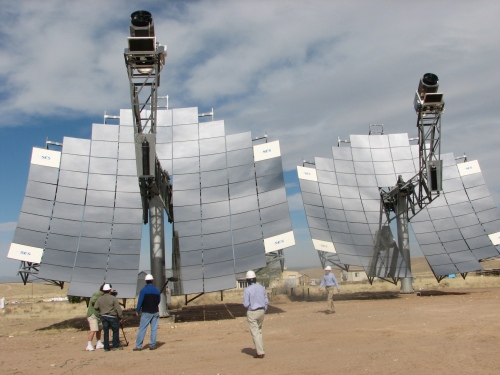
img_1216_1photo: Todd Woody

The numbers are in, and as expected 2008 set a record year for the worldwide wind industry as new wind farms generating a total of 27,000 megawatts of greenhouse gas-free electricity came online, according to the Global Wind Energy Council.

The quick-click headline was that the United States overtook the world’s green superpower, Germany, by installing 8,358 megawatts in 2008  – a 50% jump from the previous year and enough wind energy to power two million American homes. But the big story this year will be China’s rapid emergence as the next global wind power.

China last year doubled its wind energy capacity – for the fourth straight year – adding 6,300 megawatts of new electricity generation for a  total capacity of 12,210 megawatts.  A third of the world’s new wind capacity last year was installed in Asia, with China  accounting for 73% of that power. China reached its 2010 target of generating 5,000 megawatts of wind-powered electricity in 2007 and is expected to hit its 2030 goal of 30,000 megawatts years early.

“In 2009, new installed capacity is expected to nearly double again, which will be one third or more of the world’s total new installed capacity for the year,” Li Junfeng, Secretary General of the Chinese Renewable Energy Industry Association, said in a statement.

Of course, 30,000 megawatts of wind is but a flicker in a country with more than 300,000 megawatts of coal-fired energy online but it’s huge by world standards and has spawned both a burgeoning domestic wind industry and growing investment by overseas companies. Denmark’s Vestas, the world’s largest turbine maker,  will open its fifth factory in China this year and it received orders for another 200 megawatts’ worth of turbines at the end of 2008. General Electric (GE), one of only two U.S. turbine makers, also operates a factory in China and in January the company announced a joint venture with China’s A-Power Energy Generation to make turbine gearboxes. In a separate deal with A-Power, GE will supply the company with 900 turbine gearboxes starting next year.

As the financial crisis slows growth in the U.S. and Europe, India is another potential wind power. It ended 2008 with 9,645 megawatts of wind energy and added more capacity that year – 1,800 megawatts – than former world leaders Germany and Spain. Indian turbine maker Suzlon also has been moving onto European turf, relocating its international headquarters to Denmark and acquiring German turbine manufacturer REPower.

Installed global wind capacity now stands at 120.8 gigawatts with the 2008 turbine market worth $47.5 billion, according to the Global Wind Energy Council.

Read Full Post »

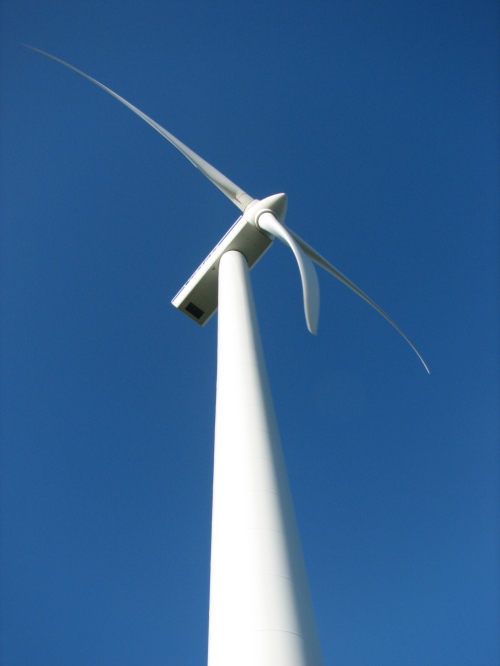
img_1219

photo: Todd Woody

When Green Wombat offered up as a “talking point” the observation that the wind industry now employs more people than coal mining, the post set off some vociferous chatter in the blogosphere, fueled in part by my inadvertent error of referring to the “coal industry” in a subsequent reference rather than “coal mining.”

Eoin O’Carroll at the The Christian Science Monitor‘s Bright Green Blog called the comparison between 85,000 wind industry jobs and 81,000 coal mining jobs “bogus,” citing sources pegging direct industry-wide employment in coal at 136,000 to 174,000. Other commentators pointed out that wind power currently provides only about 1-2% of the United States’ electricity while coal supplies around 49%, according to the U.S. Department of Energy.

Fair enough. But let’s add some context. As Salon‘s Andrew Leonard pointed out, “The key takeaway shouldn’t be employment, but growth rates.” Employment in the wind industry grew 70% between 2007 and 2008 as a result of a 50% jump in the amount of installed wind capacity in the United States last year. And this number bears repeating: 42% of all new U.S. electricity generation in 2008 came from wind farms, the equivalent of building 14 600-megawatt coal-fired power plants  – without the environmental devastation that comes from strip-mining and releasing tons of carbon dioxide into the atmosphere. That extraordinary growth in wind power was, until the recession hit, reviving abandoned factories in the industrial Midwest as European turbine makers and their suppliers set up shop close to what has become the world’s largest wind market.

While wind produces a tiny percentage of the country’s total electricity today, the U.S. does not have a national power grid and energy generation varies widely by state. (For instance, in-state coal-fired power plants supplied 86% of Ohio’s electricity in 2006, according to the Energy Department, but only 1.1% of California’s – though the Golden State obtains about 20% of its electricity from out-of-state coal plants, a practice being phased out by its global warming law).

In Texas, wind accounts for 4.9% of the state’s electricity generation, according to the state grid operator.  Last week, Texas regulators announced they would invest $5 billion to expand transmission lines to bring wind power from remote west Texas wind farms to big cities like Dallas and Houston. That $5 billion, no doubt, will also generate quite a few green jobs and trigger even more wind development once the credit crunch eases.

Jon Wellinghoff, the new acting chairman of the Federal Energy Regulatory Commission, has identified the Great Plains – dubbed the Saudi Arabia of wind – as the prime candidate for a massive power grid project to connect the region’s wind farms to metropolitan regions currently dependent on coal-fired power. Again, such an initiative would generate thousands of jobs. (A 2008 Department of Energy report found that if such transmission hurdles were overcome the nation could obtain as much as 20% of its electricity from wind farms.)

Obviously, coal is not going away any time soon. (And those wind turbines are made of steel, after all.) But with the Obama administration willing to spend billions on a smart power grid to expand green energy production and half the states mandating renewable energy targets – not to mention a looming national cap-and-trade system that would assign a price to the environmental cost of coal-fired electricity – it seems clear which industry will be generating the jobs of the future.

Read Full Post »

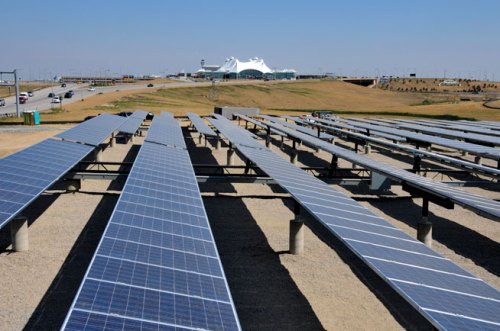
denverairport-110

photo: WorldWater & Solar Technologies

As the financial crisis short-circuits the ambitions of green tech companies, solar financier MMA Renewable Ventures is pushing ahead with raising its fifth fund. Meanwhile, its solar power plant joint venture with Chinese solar cell maker Suntech – Gemini Solar Development – has been selected by utility Austin Energy to build a 30-megawatt solar farm in Texas.

The San Francisco-based firm just completed its $200 million Solar Fund III, which invested in 20.6 megawatts of photovoltaic solar arrays for companies like Macy’s, the Gap, Lowe’s and utility FPL (FPL) as well as the Denver International Airport. MMA Renewable (MMAB.PK) provides the financing for the installation of large commercial solar arrays on big box stores and other locations while retaining ownership of the systems. The electricity produced is sold to the building owner under a long-term contract.

“The good news is that we can raise another fund in a tough market,” MMA Renewable Ventures CEO Matt Cheney told Green Wombat, adding that the company aims to raise $200 million or more for Solar Fund V.

That doesn’t mean it’ll be easy. Many of the Wall Street banks that invested in big solar systems are no more and demand for the tax credits generated by the projects has fallen faster than the Dow Jones as most companies aren’t piling up much tax liability these days.

“The ones that are left are being very picky and asking a lot,” says Cheney, adding that banks and other investors are demanding higher returns on their investments. Still, he notes, past MMA Renewable investors like Wells Fargo (WFC) remain relatively healthy. “If you look at every country in Europe and the U.S., there are good examples of financing institutions that were less impacted by the financial crisis, which is a deep one,” he says.

One possible source of new tax-equity investment may come from well-capitalized utilities that, thanks to a change to the tax laws Congress made last October, can now claim tax credits for solar projects. PG&E (PCG) CEO Peter Darbee, for instance, has said his utility plans to invest in solar power plants.

A new and potentially bigger worry is whether MMA Renewable customers – big box retailers and the like – will be survive the financial crisis. MMA Renewable’s business is built on long-term power purchase contracts – as long as 20 years – that provide a predictable and steady revenue stream to investors.

“Would you buy a corporate bond from a large U.S. company that went out 20 years today?” Cheney asks. “You would most likely tell me that’s a long time. You don’t know if you want to take that risk beyond five or ten years. That’s the equation that’s present in the marketplace today.”

In California, at least, demand for solar has remained strong: This week state regulators reported that installed solar systems more than doubled in 2008 from the previous year.

One bright spot may be the market for smaller-scale photovoltaic power plants and MMA Renewable’s Gemini joint venture with Suntech (STP).  The Austin Energy project still must be approved by the city of Austin, but Cheney says Gemini is in the midst of negotiations with other utilities as well.

When SunPower (SPWRA) reported record fourth-quarter earnings Thursday, CEO Tom Werner said the Silicon Valley solar cell maker was shifting resources to its power plant building business in 2009 and had 1,000 megawatts of projects on the drawing boards.

There was just one catch:  money. “We have a strong pipeline of projects fully permitted, or with permits in process, that will be buildable,” Werner said, ” when financing becomes available.”

Read Full Post »

csi-report

The other day I ran into Danny Kennedy, president of solar installation company Sungevity, on the playground as we were picking up our kids at Malcolm X Elementary (we live in Berkeley). I had spent the week chronicling layoffs at various solar and wind companies so it was with a bit of trepidation that Green Wombat asked Danny how business was going at at Sungevity.  “Great,” he replied as I quizzed him about the impact of the recession. “We’re as busy as ever.”

Apparently so. A report released Wednesday by the California Public Utilities Commission shows that residential and commercial rooftop solar installations in the Golden State more than doubled in 2008 from the previous year to 158 megawatts. What’s more, a record-breaking number of applications to participate in California’s $3 billion solar rebate program were filed in December as the drumbeat of bad economic news grew deafening and the state’s unemployment rate hit 9%.

Are Californians being crazily contrarian? While one would think that a $30,000 solar array would be one of those luxuries most people would put on the back burner in bad times, there are some solid economic reasons for the surge. First, rebates for solar systems under the California Solar Initiative get less lucrative in 2009 as incentives fall as the amount of installed solar rises.  Then in October Congress lifted the $2,000 cap on the federal tax credit on solar arrays, allowing homeowners and businesses to take a 30% tax credit on systems installed after Dec. 31.  Add in the state rebate and the cost of a solar system in California suddenly fell by half.

“The surge in applications occurring in the fourth quarter of 2008 is particularly noteworthy given the slowdown in the economy that occurred during the same time period,” the report’s authors noted. “In addition to environmental benefits such as cutting greenhouse gas emissions and other pollutants, it appears that solar energy is benefiting California by serving as an economic bright spot in the economy.”

And therein lies some lessons as the U.S. Congress debates how to promote green jobs. Two years into the California Solar Initiative, the taxpayers’ investment of $775 million in solar rebates has yielded $5 billion in private investment in solar projects and rapidly expanded the state’s renewable energy industry, according to the report. That’s helped create strong solar companies like solar cell maker SunPower (SPWRA) and markets for thin-film solar companies such as First Solar (FSLR). The decade-long program is on track to achieve its target of 3,000 megawatts of rooftop solar and in the first two years of the program more solar has been installed in California than in the previous 25 years.

While California regulators expect the pace to continue in 2009, the big unknown is how many homeowners and business owners will drop out of the program and cancel their applications if the economy continues to deteriorate rapidly this year. The current dropout rate is 15%, according to the report.

“We are hopeful that many of those pending projects will move forward,” Molly Tirpak Sterkel, who oversees the California Solar Initiative for the utilities commission, told Green Wombat. “We’re also cognizant of the economy and economic forces that may pose a threat to those installations.”

Demand for solar is far stronger in Northern California than in sunny SoCal. Northern California utility PG&E’s (PCG) customers have installed more than twice the megawatts of solar than Southern California Edison (EIX) customers. And the report notes that while applications for commercial arrays in PG&E’s territory rose 71% between April and December 2008, they fell 23% in Southern California Edison’s area. San Diego Gas & Electric (SRE), which covers a much smaller service area, saw applications triple for residential solar arrays.

Sterkel says it is unclear why Northern Californians are going solar at a much faster rate than their southern counterpart, but it may be due to differences in electricity pricing and more mature solar markets in regions like the San Francisco Bay Area. “There’s just that many more solar companies with experience, installations and sales channels, ” she says.

Solar panels seem to be sprouting from Bay Area rooftops like California poppies after a late winter rain. In Berkeley, the city has launched a program that pays for residential and business solar arrays upfront and let owners pay the cost back over 20 years through an annual assessment on their property taxes.

Which also may explain why I seem to be seeing more of those Sungevity signs around town.

Read Full Post »

bio_wellinghoff_j_high

photo: FERC

The Federal Energy Regulatory Commission, or FERC, is one of those acronym agencies that regulates a key aspect of the United States economy – the electricity grid – but tends to operate under the radar.

Not any more. With President Barack Obama’s appointment of FERC Comissioner and renewable energy advocate Jon Wellinghoff as the agency’s acting chairman, FERC will play a key role in the administration’s efforts to digitize the nation’s aging analog power grid to promote solar and wind energy while creating green jobs. The largest chunk of the stimulus package devoted to renewable energy – some $54 billion – has been set aside for modernizing the grid.

At a Nov. 18 briefing on Capitol Hill, Wellinghoff showed that he’s been thinking extensively about how to upgrade the grid to connect renewable energy produced in remote areas to population centers on the coasts. “In the whole Midwest of this country there are virtually no high- voltage transmission lines,” he said, displaying Google’s  (GOOG) proposal to wean the U.S. from fossil fuels by 2030.  “If you overlay where the wind is, all the wind is in the middle of this country – all those areas where we do not have sufficient transmission. Hopefully we can get the structure to put renewables on the grid and improve the grid to make it a smart system that can ultimately deliver these resources in an efficient way.”

Wellinghoff in a December interview with EnergyWashington.com advocated reviving domestic manufacturing of big transformers – now made overseas – to support the expansion of high-voltage power lines across the U.S.

On Monday, Wellinghoff called for electric cars to be integrated into the electric grid, according to a report by Dow Jones. He said FERC could structure rates to pay car owners for returning electricity to the grid from their vehicle batteries to help balance the power supply as more solar, wind and other intermittent sources of energy come online.

At the November briefing, Wellinghoff called electric cars part of “the glue” that will hold a green grid together and said the federal government should consider giving automakers like General Moters (GM) and Ford (F) incentives to produce plug-in hybrids.

“To modernize the grid, we need to define our goals and define a national tranmission planning process,” he said. “Let’s do it. We just need to get it done.”

Read Full Post »

first-solar-11

With Big Solar thermal power plants bogged down in bureaucracy and facing environmental and financial hurdles, utilities are turning to smaller-scale thin-film solar stations that can be built in a matter of months.

In late December, PG&E (PCG), for instance, signed a 20-year contract for electricity generated  from a 10-megawatt thin-film solar power plant in Nevada owned by energy giant Sempra (SRE) that was officially dedicated on Thursday. The solar farm was built by First Solar (FSLR) in a scant six months. Meanwhile, the utility’s nearly two gigawatts worth of deals with solar thermal power companies won’t start producing power for another two years at the earliest. (Southern California Edison (EIX) and San Diego Gas & Electric signed agreements with solar dish developer Stirling Energy Systems for 1.75 gigawatts in 2005 and those projects are just now beginning to move through the regulatory approval process.) And the financial crisis has made it more difficult for solar thermal developers to obtain the billions of dollars needed to finance the construction of a massive megawatt power plant.

Solar thermal power plants typically use miles of mirrors to heat a fluid to create steam which drives an electricity-generating turbine. Photovoltaic (or PV) solar farms essentially take solar panels similar to those found on residential rooftops and mount them on the ground in huge arrays. (Thin-film solar panels are made by depositing layers of photovoltaic materials on glass or flexible materials.)

“In terms of construction, photovoltaic tends to have a much faster development and construction track,” Roy Kuga, PG&E’s vice president for energy supply, told Green Wombat. “There is a segment of mid-sized projects – in the two to 20 megawatt size – where PV shows a distinct advantage in that market. There’s a huge potential for the PV market to expand.”

That’s good news for companies like First Solar – the Tempe, Ariz.-based company backed by the Walton family that is often called the Google of solar for its stock price and market prowess – and SunPower (SPWRA), the Silicon Valley solar cell maker that’s moved into the power plant-building business.

The speed at which the Sempra-First Solar project went online owes much to the fact that it was built on the site of an existing fossil fuel power plant. “It was already permitted for power generation, transmission existed and it did not have to go through the laborious California permitting process,” says Reese Tisdale, a solar analyst with Emerging Energy Research. “As such, First Solar was able to essentially plug and play.”

Nathaniel Bullard, a solar analyst with New Energy Finance, says he expects utilities increasingly to bet on smaller-scale photovoltaic farms to help meet state mandates to obtain a growing percentage of their electricity from renewable sources. Just this week, PG&E CEO Peter Darbee said his utility plans to invest in solar power plant projects rather than just buy the power they produce.

“I think a utility could easily integrate, technically and financially, 100 megawatts of PV,” Bullard says.  If something is falling behind on your big solar thermal projects, you can plug in PV. I think you’ll see more of this with California utilities and I expect to see it more in Florida and North Carolina. It’s a great runaround to issues of siting and transmission.”

That’s because in California photovoltaic power plants do not need approval from the California Energy Commission. And smaller-scale plants take up far less land and can be built close to existing transmission lines. Most large solar thermal power plants typically are planned for the Mojave Desert and require the construction of expensive power lines to connect them to the grid.

The modular nature of PV solar farms means they can begin generating electricity as each segment is completed while a solar thermal plant only goes online once the entire project is finished.

“Certainly there is a sweet spot in which the project is large enough to gain advantages of scale,” says Tisdale. “Also, these small-to-mid-size systems can be spread about a transmission network, instead of at one site.”

Read Full Post »

img_1223

photo: Todd Woody

As President Barack Obama embraced renewable energy in his inaugural speech Tuesday, Clipper Windpower laid off 90 employees – about 11% of its workforce – as the global financial crisis throws a spanner in the once-booming wind industry.

The Carpinteria, Calif.-based turbine maker has seen business slow as customers delay existing orders and put off new ones because they cannot obtain financing for wind farms, Clipper CEO Doug Pertz told Green Wombat.

“In the short-term, the impact to Clipper is a reduction in 2009 turbine production,” he said. “We know that 2009 will be a challenging year, however, remain optimistic that this economic situation is temporary.  We trust that the new Obama administration will, in the not-too-distant future, enact policy to enable better financing options for wind energy projects and aggressively promote the growth of renewable energy development.”

Clipper is one of only two U.S.-owned turbine makers – the other being General Electric (GE) – in an industry dominated by European manufacturers and wind farm developers.

Like their counterparts in the solar industry – which also has been shedding workers in recent weeks – wind companies depend on tax incentives to lure investors. But with traditional investment banks all but extinct on Wall Street and other investors hoarding their cash, there’s been little appetite of late for investing in so-called tax equity partnerships to provide funding for massive wind farms or solar power plants.

Pertz said Clipper’s production is down 20% from the 750 megawatts worth of turbines it manufactured in 2008 and that he expects double-digit declines for 2009. “Customers with large balance sheets are being much more conservative and smaller independent wind developers are seeing that it is much more difficult to obtain tax-equity financing,” he noted.

Wind and solar industry lobbyists are pushing Congress to make the investment tax credit and the production tax credit refundable so those companies that don’t have tax liabilities can trade the credits for cash that can be used to finance renewable energy projects.

Founded in 2001 by wind industry veteran James Dehlsen – his first wind company is now owned by GE –  Clipper makes a 2.5-megawatt turbine called the Liberty at its Cedar Rapids, Iowa, factory that powers wind farms built by FPL (FPL) and BP (BP). Other customers include Queen Elizabeth II, who bought the prototype of a 10-megawatt offshore turbine being developed by Clipper in the U.K.

One bright spot for the wind industry, said Pertz, is an expected move by well-capitalized utilities to take ownership stakes in wind farms if a national standard is enacted requiring them to obtain a certain percentage of their electricity from renewable sources.

Read Full Post »

stirling-dishes

photo: Todd Woody

Fifty-four billion dollars is nothing to sneeze at, of course. That’s the amount in the $825 billion economic stimulus package –  introduced by House Democrats Thursday – set aside for renewable energy, electric car batteries, energy efficiency and other green projects.

It’s a start, but that’s less than 7% of the entire stimulus package (or, about enough to pay for the Iraq war for five months, or somewhat more than what the federal government is spending to bail out Bank of America). The lion’s share of the cash is devoted to smart grid technology and transmission lines, with a second big chunk going toward energy efficiency retrofits of public housing and weatherization of low-income homes.

That’s good news for a host of startups developing smart grid technology. But the the bill does not address the most pressing issue facing renewable energy companies today: the credit crunch has dried up financing just as billions are needed to fund factories and the construction of solar power plants and wind farms that will be connected to smart grids and new transmission lines. In recent weeks, layoffs have hit the solar industry. OptiSolar – a Bay Area thin-film solar startup that’s building a 550-megawatt photovoltaic power plant to supply electricity to utility PG&E (PCG) – reported to have furloughed half its workforce. And according to The Oregonian newspaper,  SpectraWatt, a solar cell maker spun off from chip giant Intel (INTC) last year, has shelved plans for a factory in Hillsboro, Ore.  Friday morning, Kate Galbraith at The New York Times’ Green Inc. blog reported that layoffs have now hit the wind industry.

The retrenchment comes as utilities are counting on solar power plants and wind farms to come online in the next two years to help them meet mandates to obtain a growing percentage of the electricity they sell from renewable sources. In California, for instance, PG&E, Southern California Edison (EIX) and San Diego Gas & Electric (SRE) have signed more than four gigawatts’ worth of contracts for electricity to be produced by large-scale solar power stations that will cost billions to build.

Solar startups rely on a provision that allows them to take a 30% tax credit on the cost of building a power plant. Now most of these companies are startups and have no way to use those tax credits as they’re not profitable. Instead, a solar company must essentially trade the tax credits to a firm that can use them in exchange for cash to finance construction. But investors in these deals have all but disappeared as the financial crisis takes its toll. Which is why solar and wind lobbyists are pushing Congress to make the tax credits “refundable” – meaning those companies that don’t have tax liabilities can trade the credits for cash that can be used to finance power plants. “Due to the recession, projects are now being put on hold, factories are closing and workers face potential layoffs unless Congress refines the tax credits now so they work as originally intended,” said Solar Energy Industries Association CEO Rhone Resch in a statement.

The stimulus package unveiled Thursday undoubtedly will be subject to change, but as written it will boost efforts to modernize and digitize the United States’ aging analog power grid. The bill includes:

  • $11 billion for smart grid research and development, pilot projects and the construction of new transmission lines to connect green energy power plants to the power grid. The government will fund 50% of the cost of utilities’ smart grid investments.
  • $8 billion in loan guarantees for renewable energy transmission projects.
  • $6.9 billion in grants to state and local governments for energy efficiency and carbon reduction programs.
  • $6.7 billion for renovation of federal buildings, of which $6 billion must be used for energy efficiency retrofits.
  • $6.2 billion for home weatherization programs for low-income families.
  • $2.5 billion for energy efficiency retrofits of public housing.
  • $2.4 billion for carbon sequestration – so-called clean coal – demonstration projects.
  • $2 billion for energy efficiency and renewable energy research (which includes $800 million for biomass and $400 million for geothermal research).
  • $2 billion in loan guarantees and grants for advanced vehicle battery research.

The smart grid billions will be a boon to companies like Silver Spring Networks, Gridpoint and eMeter that develop software to allow utilities to monitor and manage electricity use in real-time and provide that data to their customers.  “We think 2009 is going to be a good year for us,” eMeter president Larsh M. Johnson told Green Wombat last month. “We’ve seen continued demand from utilities for our services.”

But the billions for the smart grid can be considered a down payment: According to an estimate by research firm New Energy Finance, the price tag for modernizing the power grid over the next 15 years will be $450 billion.

Read Full Post »

b_342

photo: Better Place

Electric cars, eh?

Silicon Valley startup Better Place on Thursday unveiled a deal with the government of Ontario – the Michigan of Canada – to build an electric car charging network in the automaking province. The announcement comes on the heels of agreements Better Place — the electric car infrastructure company founded by former software executive Shai Agassi — has made with governments in Australia, California, Denmark, Hawaii, Israel and Japan.  Better Place is working with the Canadian arm of Sydney-based infrastructure finance giant Macquarie to develop the Ontario electric car network.

“We need to be where the puck is going and in this case bring the puck to Ontario,” said Ontario minister of international trade Pupatello at a press conference in Toronto Thursday morning.

The Canadian deal comes amid turmoil in the nascent electric car industry. While EV companies like Think and Tesla struggle to survive the credit crisis, the big automakers – Ford (F), General Motors (GM), Toyota (TM), Honda (HMC) and Chrysler – have announced they’re accelerating plans to build electric cars and, in GM’s case, a battery-making factory.

On Thursday, the premier of Ontario, Dalton McGuinty, said his government will conduct a study on how to expedite the introduction of electric cars in the province. When the study is released in May, Better Place will detail its plan and investment timeline for building the network of charging posts and battery-swapping stations.

Better Place, said McGuinty,  “is a model with the power to reshape our province. It’s going to create new green jobs, it’s going to make life more convenient for car drivers of the future and it’s going to signal to the world that Ontario is electric-car friendly and will make it a more attractive place to build electric cars.”

Agassi has now committed to raising billions in capital to simultaneously build charging networks in five far-flung countries over the next three years. When Green Wombat talked to Agassi in November after he signed a deal to build a $1 billion San Francisco Bay Area charging network, he insisted the financial crisis would not hamper efforts to raise funding.

Under Better Place’s system, consumers will buy the electric cars while Better Place will own the batteries, charging subscribers to its network a fee per-mile (or kilometer) driven. Renault-Nissan is supplying electric cars for Better Place’s other networks. An electric Nissan SUV – emblazoned with little wind turbines – was parked at the press conference but company spokeswoman Julie Mullins said an electric car supplier had not yet been selected for Ontario. “Ultimately, we expect a wide range of vehicle makes and models to be available to drivers,” she wrote in an e-mail. “We are currently in talks with several car companies.”

Ontario-based Bullfrog Power will provide renewable energy – 80% hydro, 20% wind – for the Better Place network. “We’re going to create a virtual oil field across the province,” said Agassi.

Read Full Post »

Amid the daily drumbeat of mass layoffs, here’s some sunny news: Solar startup Suniva cut the ribbon Thursday on a photovoltaic cell factory outside Atlanta.

As solar factories go, Suniva’s plant – the first such facility in the Southeast – is relatively small, making 32 megawatts of solar cells annually until  production is fully ramped up to 175 megawatts in 2010. But the factory will create 100 green collar jobs and it follows the opening of  SolarWorld’s new solar cell fab outside Portland, Ore., that will  produce 500 megawatts’ worth of solar cells, and thin-film solar startup HelioVolt’s factory in Austin. Meanwhile, Solyndra, a Silicon Valley thin-film solar startup, is expanding its production facilities while Bay Area rival OptiSolar is building a Sacramento factory that will employ 1,000 workers to produce solar cells for the power plant the company is building for utility PG&E (PCG). (Leading thin-film solar company First Solar (FSLR) operates a factory in Ohio as well as plants in Malaysia.) But Chinese solar giant Suntech (STP) last week said it has put plans for U.S. factories on hold due to the credit crunch.

The Suniva grand opening comes on a good news-bad news day for the solar industry. On one hand, President-elect Barack Obama is expected to nominate alternative energy proponent and Nobel laureate Steven Chu, director of the Lawrence Berkeley National Laboratory, as Secretary of Energy. But the solar industry faces a tough year ahead. On Thursday, research firm New Energy Finance, echoing other analysts, predicted prices for polysilicon – the base material of conventional solar cells – would fall 30% in 2009. That’s bad news for conventional solar cell makers like SunPower (SPWRA) and Suntech if they’ve locked in silicon supplies at higher prices but provides an opening for further growth for thin-film solar companies that make solar cells that use little or no polysilicon.

“We expect to see significant drops in the price of modules next year,” wrote New Energy Finance CEO Michael Liebreich.  “Any manufacturer who does not have access to cheap silicon and who has not focused on manufacturing costs is going to be in trouble. The big shake-out is about to begin. The next two years will change the economics of PV electricity out of recognition.”

Read Full Post »

« Newer Posts - Older Posts »

Design a site like this with WordPress.com
Get started