Feeds:
Posts
Comments

Posts Tagged ‘solar energy’

In another sign that the financial crisis is not slowing the solar industry, Suntech, the giant Chinese solar module maker, made a big move into the United States market on Thursday. The company announced a joint venure with green energy financier MMA Renewable Ventures to build solar power plants and said it would acquire California-based solar installer EI Solutions.

Founded in 2001, Suntech (STP) recently overtook its Japanese and German rivals to become the world’s largest solar cell producer. The company has focused on the lucrative European market and only opened a U.S. outpost, in San Francisco, last year.  The joint venture with MMA Renewable Ventures (MMA) – called Gemini Solar – will build photovoltaic power plants bigger than 10 megawatts.

Most solar panels are produced for commercial and residential rooftops, but in recent months utilities have been signing deals for massive megawatt photovoltaic power plants. Silicon Valley’s SunPower (SPWRA) is building a 250-megawatt PV power station for PG&E (PCG) while Bay Area startup OptiSolar inked a contract with the San Francisco-based utility for a 550-megawatt thin-film solar power plant. First Solar (FSLR), a Tempe, Ariz.-based thin-film company, has contracts with Southern California Edision (EIX) and Sempre to build smaller-scale solar power plants.

Suntech’s purchase of EI Solutions gives it entree into the growing market for commercial rooftop solar systems. EI has installed large solar arrays for Google, Disney, Sony and other corporations.

“Suntech views the long-term prospects for the U.S. solar market as excellent and growing,” said Suntech CEO  Zhengrong Shi in a statement.

Other overseas investors seem to share that sentiment, credit crunch or not.  On Wednesday, Canadian, Australian and British investors lead a $60.6 million round of funding for Silicon Valley solar power plant builder Ausra. “So far the equity market for renewable energy has not been affected by the financial crisis,” Ausra CEO Bob Fishman told Green Wombat.

The solar industry got more good news Wednesday night when the U.S. Senate passed a bailout bill that included extensions of crucial renewable energy investment and production tax credits that were set to expire at the end of the year.

Read Full Post »

photo: Southern California Edison

When Southern California Edison unveiled plans to install 250 megawatts’ worth of solar panels on warehouse roofs back in March, it was hailed as a ground-breaking move. In one fell swoop, the giant utility would cut the cost of photovoltaic power, expand the solar market and kick-start efforts to transform untold acres of sun-baked commercial roof space into mini-power plants.

There’s just one problem: the solar industry is fighting the billion-dollar plan. In briefs filed with the California Public Utilities Commission, solar companies, industry trade groups and consumer advocates argue that allowing a utility to own and operate such massive green megawattage will crowd out competitors who can’t hope to compete with a project financed by Edison’s ratepayers.  (In California, shareholders of investor-owned utilities are guaranteed a rate of return for approved projects, while utility customers bear a portion of the costs in the form of higher rates.)

The five-year plan “would establish SCE as the monopoly developer of commercial-scale distributed solar in its service territory,” wrote Arno Harris, CEO of Recurrent Energy, a San Francisco company that sells solar electricity to commercial customers. “This would irreparably impair the development of a competitive solar industry.”

Southern California Edison (EIX) is the first utility in the United States to propose such a “distributed generation” scheme and the dispute is being watched closely as a test case for the viability of producing renewable electicity from hundreds of millions of square feet of commercial rooftops. Such systems can be plugged directly into existing transmission lines and tend to generate the most solar power when electricity demand spikes – typically on summer afternoons when people crank their air conditioners. Having such green energy on tap would save utilities from having to build expensive and planet-warming fossil fuel-powered “peaker plants” that sit idle except when demand suddenly rises.

Even critics hail Edison’s move as “bold” and “visionary” and no one disputes that in California the development of big rooftop solar has lagged. For instance, the state’s $3.3 billion “million solar roofs” initiative is designed to put smaller-scale solar panels on homes and businesses and provides generous rebates for systems under 1 megawatt. At the other end of the scale, the state’s big utilities have been signing contracts to buy electricity from solar thermal power plants to be built in the desert. Left out of the subsidy game are incentives for the 1-to-2 megawatt arrays well-suited for commercial buildings.

Southern California Edison says it’s filling that gap and will energize the solar industry, not crush it. The utility plans to lease 65 million square feet of commercial rooftop space in the “Inland Empire” region of Southern California for solar arrays that would generate enough electricity to power 162,000 homes.

“SCE’s financial stability and business reputation will increase the probability that 250 MW of solar PV systems will be available to meet the state’s solar rooftop goals over the next five years,” the utility’s attorneys wrote in a brief filed with the utilities commission, which must approve the program. “In so doing, a solar PV program can improve efficiencies … to reduce costs and jump start the competitiveness of solar PV for widespread application on California roofs.”

There’s no doubt the program will be a boon for solar module makers. For instance, thin-film solar cell company First Solar (FSLR) is supplying 33,000 panels for the program’s first project, a 600,000-square-foot roof array in the inland city of Fontana. However, Southern California Edison intends to contract for union labor to install the solar systems and tap its own capital and a rate hike to finance the project. That won’t leave many opportunities for solar installers and financiers like SunPower (SPWR), SunEdison and MMA Renewable Ventures (MMA).

“Even though this program is kind of taking bread out of our own mouth, the demand for solar will keep going up,” says Mark McLanahan, senior vice president of corporate development at MMA Renewable Ventures, a San Francisco firm that finances commercial solar arrays.

“What they have announced is extremely visionary,” McLanahan tells Green Wombat. “It’s game changing and opens up whole new realms of what solar can do. That’s exciting.”  On the other hand, he says, “It’s certainly possible that a young, growing industry that is pretty fragmented could be hurt by this rather than helped.”

A solution advanced by some solar industry critics is for Southern California Edison to open up the entire program to competitive bidding, not just the procurement of solar panels. The utility vehemently opposes the idea, arguing it would work against the economies of scale it says it can bring to the program.

Whether regulators will approve Southern California Edison’s request for a rate hike to pay for the initiative – and at electricity rates that are significantly higher than those set for other solar programs – remains to be seen. The commission’s own ratepayer advocate has questioned whether utility customers will get their money’s worth.

The utilities commission is unlikely to issue a final decision until next year. In the meantime, you can bet the state’s other big utilities – PG&E (PCG) and San Diego Gas & Electric (SRE) – and solar companies will be watching to see whether the sky’s the limit for big rooftop solar or whether a ceiling is about to be placed on the industry’s ambitions.

Read Full Post »

The idea that green is the new tech was brought home this week in San Francisco when one of the chip industry’s biggest trade shows, SEMICON West, was held in conjunction with a huge solar trade show, Intersolar North America. The geeks and the eco-freaks together under one roof.

Not surprising, really. It has been oft-observed that much of the solar cell industry today is essentially an offshoot of the chip biz; both use  the same basic building blocks – silicon – and common manufacturing processes. Cypress Semiconductor saw that early on and has profited greatly from an acquisition that has eclipsed its chip business, solar module maker SunPower (SPWR).

Almost two years ago, Applied Materials (AMAT), the world’s biggest manufacturer of the machines that make computer chips, jumped into the solar business. It reconfigured  equipment used to produce flat-screen televisions and displays to print thin-film solar cells on the same plates. (Thin-film technologies vary, but essentially solar cells are printed or layered on sheets of glass or flexible materials.)

Applied has sold $3 billion worth of contracts for a dozen solar-cell factories that will be able to crank out 1.5 gigawatts’ worth of modules a year by the end of 2010, said Applied chief technology officer Mark Pinto at a lunch Green Wombat attended on Wednesday at Intersolar. To get an idea of just how hot solar is, consider this: Pinto estimates that in just two years solar will bring in 20 to 30 percent of Applied’s revenues.

“Energy generation has been void of technological development for 50 years and that makes it ripe for change,” said Applied CEO Mike Splinter. “It’s all about engineering and the environment.”

For photovolatics, it’s all about getting the costs per watt down to compete against fossil fuels. Part of that involves improving the efficiency of solar cells, but it’s just as much about reducing manufacturing and installation costs.

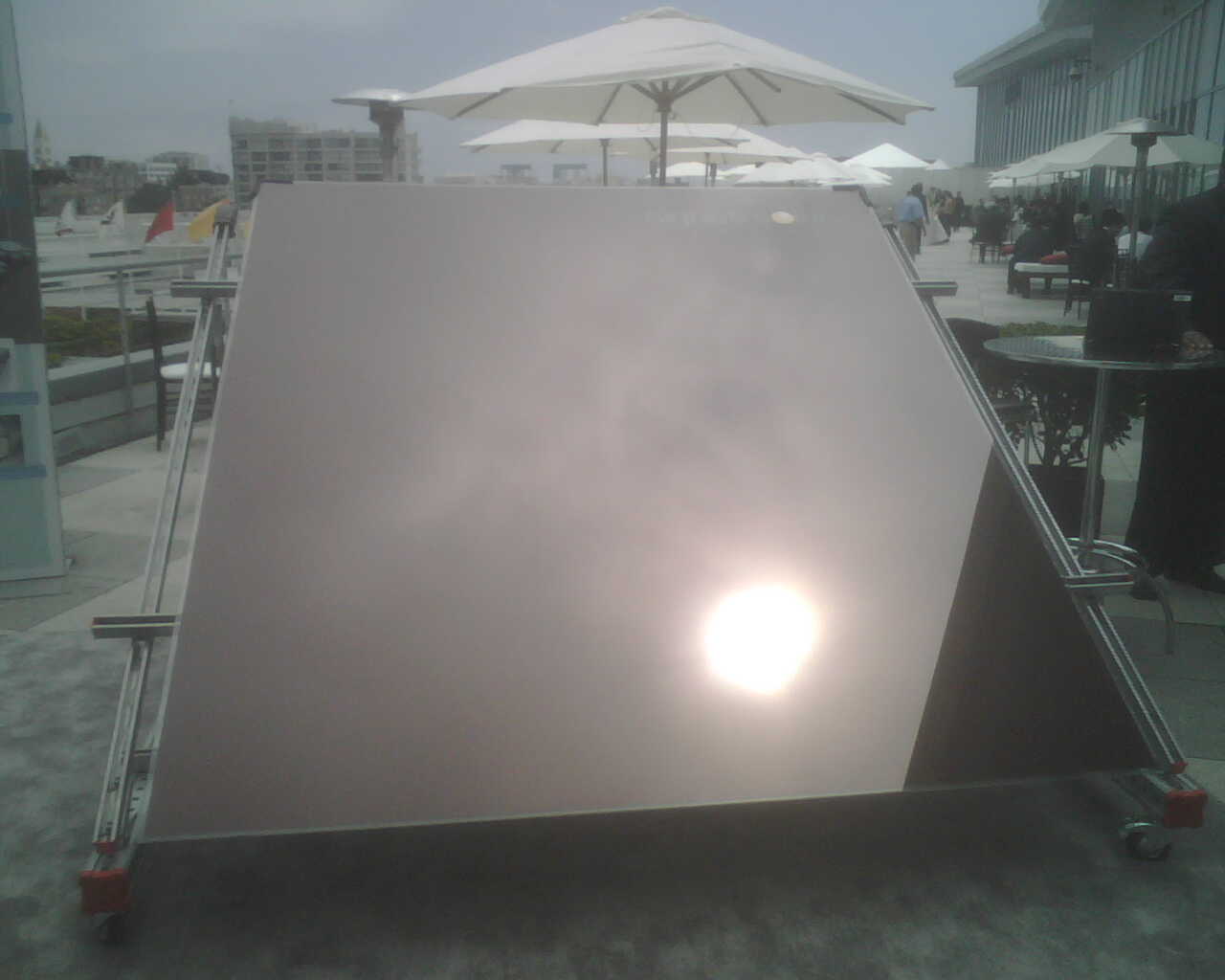
To that end, Applied was showing off its latest product (or to be exact, the product made by its machines): Out on a deck at the Metreon center across from the San Francisco convention hall sat a supersized thin-film solar panel measuring 5.7 square meters (7.2 feet by 7.5 feet) that is but an inch or so thick. The panels, which produce about 500 watts each, are designed for solar farms. The large size means that a 10-megawatt solar power plant would require 20,000 Applied panels versus 150,000 conventional-sized panels, cutting overall costs by 17 percent, the company claims. Installation costs fall dramatically as the panels attach to mounting racks with just two screws and plug into the circuit with two wires.

“We think the cost to produce and install is less than the average cost of electricity in California,” said Pinto.

Thin-film panels like the one in the photo above cost less to make than conventional bulky solar modules, but they are much less efficient at converting sunlight into electricity  – around 6 percent versus 20 percent. However, they tend to work well in diffuse sunlight – i.e. foggy San Francisco – and can be integrated into building facades. The panels could also be made semi-transparent and transformed into electricity-generating windows for skycrapers.

Don’t expect Applied’s booming solar business to translate into a lot of green collar jobs in the United States. So far, it has not sold one solar cell factory here. Europe’s solar tax incentives have made it the market for Applied, with Asia set to become another big play in the coming the years. At home, meanwhile, the looming expiration of a crucial investment tax credit for renewable energy is discouraging expansion of the solar economy.

That doesn’t mean that demand has slowed. Southern California Edison (EIX), for instance, this year announced plans to install 250-megawatts of solar arrays on warehouse rooftops in the Southland. (This week it awarded the project’s first contract to thin-film company First Solar (FSLR) to build a 2-megawatt array in the sun-baked city of Fontana.)

But given that there’s only one thin-film factory currently in commercial operation in the United States – First Solar’s – the panels for Edison’s project and others will be coming from overseas. It makes no economic or environmental sense, of course, to ship huge pieces of glass across the ocean to California. (CORRECTION: As a couple of readers have pointed out, Energy Conversion Devices of Michigan operates a thin-film factory in the U.S.) But as Splinter put it about the lack of a coherent U.S. renewable energy policy and the investment tax credit mess, “This is the biggest miss in a long, long time.”

Read Full Post »

In a sign that solar industry and its political allies are starting to flex some real power, the federal government reversed course Wednesday and announced it would continue to accept new applications to build solar power plants on government land while developing an environmental policy for assessing the projects.

Green Wombat had been off the grid on holiday the past week and so was surprised to log back on to find the mainstream media and blogosphere ablaze over the Bush administration’s supposed move last month to halt big solar power plant projects in California’s Mojave Desert and elsewhere.

“Citing Need for Assessments, U.S. Freezes Solar Energy Projects,” read the headline on The New York Times story about the Bureau of Land Management’s decision to temporarily stop accepting new applications for solar power plants until it studies the environmental impact of industrializing the desert. “How to strangle an industry,” proclaimed Grist, a respected green policy blog about the move. Solar executives and politicians meanwhile slammed the BLM and predicted dark days for renewable energy. “This could completely stunt the growth of the industry,” the Times quoted Ausra exec Holly Gordon.

Problem is, those stories were dead wrong: The feds did not freeze a single solar power plant project currently under review. What was left unsaid, or just briefly mentioned, was the fact that the BLM is continuing to process the 125 solar power plant proposals already in the hopper. Those lease applications cover nearly a million acres for solar power plants that would produce 60 gigawatts of electricity if all are built, which they won’t be. Those projects alone will keep companies like Ausra, BrightSource Energy, FPL (FPL) and PG&E (PCG) busy for years to come, moratorium or not.

“We don’t even like to call it a moratorium,” says Alan Stein, a deputy district manager for the BLM in California. Stein called me on my mobile just as I was about to step into a kayak at Elkhorn Slough near Big Sur. I had spent several months talking to Stein and other BLM officials while criss-crossing the Mojave with solar energy executives for a forthcoming Fortune story and he seemed taken aback by the tone of the media coverage.

But the higher-ups in Washington got the message. “We heard the concerns expressed during the scoping period about waiting to consider new applications, and we are taking action,” said BLM Director James Caswell in a statement. “By continuing to accept and process new applications for solar energy projects, we will aggressively help meet growing interest in renewable energy sources while ensuring environmental protections.”

The head of the solar industry’s trade group, the Solar Energy Industries Association, declared victory. But SEIA president Rhone Resch complained in a statement that, “BLM has only resolved half the problem. They have yet to approve a single solar energy project. Expediting the permitting process is the next step in developing solar energy projects on federal lands.”

He’s right that the process – which is intertwined with California’s extensive environmental review of projects in that part of the Mojave – takes far too long. But developing a desert-wide environmental policy is absolutely essential for huge power plants that in total would cover hundreds of square miles of a fragile landscape home to protected wildlife and rare plants. Otherwise, watch each individual project get bogged down in endless environmental challenges.

What really threatens the nascent solar industry right now is not the BLM. Rather it’s the imminent expiration of the 30 percent investment tax credit that all these solar energy startups and their investors – which include companies such as Google (GOOG) and Morgan Stanley (MS) – are depending on make Big Solar economically viable. Congress has failed several times in recent months to extend the tax credit, which expires at the end of the year. If only solar energy execs and their supporters in Washington could exert the same influence on recalcitrant Republicans as they have on the BLM.

Read Full Post »

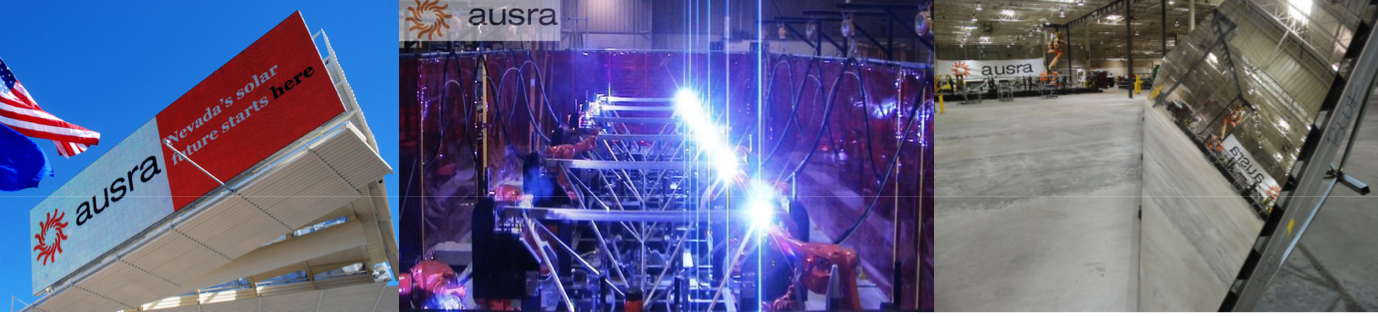
LAS VEGAS – Hard by the Las Vegas airport, the industrial infrastructure of the solar economy is rising in a former furniture factory. Phalanxes of orange robots swivel and dip as they practice assembling components for solar power plants to be built by Silicon Valley startup Ausra.

It’s North America’s first solar power plant factory and it went online Monday when Ausra CEO Robert Fishman and U.S. Senate majority leader Harry Reid, D-Nevada, flipped the switch to start the production line. Ausra’s automated 130,000-square-foot factory is key to the Palo Alto company’s aim of cutting manufacturing costs to make solar energy competitive with fossil fuels.

A large robot picks up 78-square-foot pieces of glass and places them on a conveyor belt so a machine can apply strips of adhesive. Other robots transfer the glass to another line where a dozen bots weld together 53-foot-long steel frames. The completed solar arrays will be trucked to California where Ausra is building a 177-megawatt solar power station for utility PG&E (PCG) on 640 acres of agricultural land in San Luis Obispo County. (To see a video of the robots in action, click here.)

The arrays focus sunlight on water-filled tubes to create steam to drive a turbine. Ausra manufacturing exec David McKay points to where standard-issue boiler pipe will be fed into a machine and treated with a proprietary coating that transforms it into a solar receiver. At peak production the plant will churn out more than 700 megawatts’ worth of equipment year to keep 1,400 solar power plant construction workers employed. “We can produce a lot faster than what we can install,” says McKay.

However, the future of those jobs – and billions in future investments in renewable energy – hangs on whether Congress extends a crucial investment tax credit that the solar industry and utilities are relying on to make large-scale solar power plants competitive with the carbon-spewing variety. The investment tax credit expires at the end of the year and several attempts to pass legislation extending the ITC have failed despite support on both sides of the aisle.

Green Wombat met with the chairman of the Solar Energy Industries Association, Chris O’Brien, last week when he was in San Francisco to get an update on the ITC’s chances. “It’s an election year and it has become part of the political stalemate,” says O’Brien, who heads North America market development and government relations for Swiss-based solar cell equipment maker Oerlikon Solar. “I don’t see an imminent breakthrough.”

The pending demise of the tax credit is “having a significant effect on the development of new business,” according to O’Brien. Solar energy executives, of course, are reluctant to admit that deals are getting dashed, but there’s no doubt the loss of a 30 percent tax credit gives financiers and utilities pause when considering whether to green-light solar power plants that can cost a billion or two to construct.

O’Brien thinks the best-case scenario for the long-term extension of the ITC will come after the presidential election during the lame-duck session of Congress. Otherwise, he says, don’t expect action until around September 2009.

In the meantime, Ausra will keep its robots busy cranking out components for its first California power plant, which is scheduled to start producing green electricity in 2010.

Read Full Post »

When Intel announced this week that it was spinning off a stealth in-house startup called SpectraWatt to develop solar cells, it appeared the chip giant was just the latest old-line Silicon Valley tech firm bitten by the green bug.

After all, crosstown chipmaker Cypress Semiconductor jumped into the solar game back in 2004 when it acquired SunPower (SPWR), now a leading manufacturer of solar cells and panels and an installer of large-scale solar arrays. Then the world’s biggest chip-equipment maker, Applied Materials (AMAT), retooled machines that make flat-screen video displays to produce thin-film solar panels. And just this month, Hewlett-Packard (HPQ) unveiled a deal to license solar technology to a solar cell startup while IBM (IBM) announced it would develop thin-film solar.

But it’s not just now jumping on the enviro-biz bandwagon – Intel’s solar efforts have been quietly under development since 2004. That’s when Andrew Wilson, an 11-year Intel (INTC) veteran, was chatting with a colleague while waiting for a conference call to begin. “We were shooting the breeze and I mentioned that I had replaced all the light bulbs in my house with compact fluorescent lights and my utility bill had come down by a third,” says Wilson, SpectraWatt’s CEO. “And he said, `Hey, did you know that solar cells are made of silicon?’ ”

“We started talking about what a business plan would look like, because if something is made out of silicon then Intel should be taking advantage of that market,” Wilson told Fortune. A year later, Wilson and his colleagues had developed a marketing plan and secured funding from Intel’s new-business incubator to develop a business strategy and hone its technology. (It’s no coincidence that the nascent solar industry is populated by computer industry veterans from companies that put the silicon in Silicon Valley.)

When it comes to cutting-edge solar technology, silicon-based cells are considered a bit old-school. Silicon is currently in short supply and the resulting high prices have led venture capitalists to invest hundreds of millions of dollars in thin-film solar startups that promise to dramatically lower the cost of solar by printing or otherwise applying non-silicon solar cells to glass or flexible materials that can be integrated into walls, windows and other building materials. While thin-film solar is less efficient at converting sunlight into electricity, the expectation is that it can be produced much more cheaply than conventional cells.

But thin-film solar is still largely an early-stage technology and silicon-based cells will continue to be the big market for the near-future. So the question is, how does Intel compete with established players like SunPower, China’s Suntech (STP) and Germany’s Q-Cells as solar cells become a commodity? Intel controls some 80 to 90 percent of the worldwide chip market but it’s unlikely that it – or any other player – will replicate that experience in solar cells.

Wilson’s view is that it’s early days for the solar market and that SpectraWatt’s ace in the hole is Intel’s global manufacturing experience and history of technological innovation. “The solar industry today looks like the microelectronics industry in the late ‘70s – there’s very few standards and no one is manufacturing at scale,” says Wilson. “It’s all about manufacturing processes and material sciences that will lead to fundamental breakthroughs. The product is vastly simpler than a microprocessor but the fundamental nature of a solar cell isn’t all that different. When you think of what it takes to manufacture globally and manage supply chains, that’s Intel’s core competence.”

There certainly is room for more players, given that solar was a $30 billion market in 2007 and is expected to continue to grow at a clip of 30 to 40 percent in the coming years.

Wilson says SpectraWatt has secured silicon supplies and is developing technology that will give it a competitive edge. He’s keeping mum about the details of that technology for now. “We do believe we will have a technological advantage when we get what we’re doing in the lab to manufacturing,” Wilson says.

The company is set to begin building its manufacturing facility in Oregon later this year, with production to begin in mid-2009.

SpectraWatt launches with a $50 million investment lead by Intel Capital, the company’s investing arm. Other investors include Goldman Sachs (GS), PCG Clean Energy and Technology Fund, and German solar giant Solon. (As Green Wombat has written, Solon has invested in an array of solar startups in the United States, including Sungevity and thin-film solar company Global Solar.)

Read Full Post »

eSolar, the solar energy startup founded by Idealab’s Bill Gross and backed by Google, has signed a 20-year contract to supply utility Southern California Edison with 245 megawatts of green electricity.

The solar power plant will be built in 35-megawatt modules, with the first phase set to go online in 2011. As Green Wombat reported in April, eSolar scored $130 million in funding from Google.org, Google’s (GOOG) philanthropic arm, and other investors to develop solar thermal technology that Gross claims will produce electricity as cheaply as coal-fired power plants.

Like Ausra and BrightSource Energy – which have deals with PG&E (PCG) – eSolar will use fields of mirrors to heat water to create steam that drives electricity-generating turbines. Gross says that eSolar’s software allows the company to individually control smaller sun-tracking mirrors – called heliostats – which can be cheaply manufactured and which are more efficient and take up less land than conventional mirrors. According to Gross, that means eSolar can build modular power plants near urban areas and transmission lines rather than out in the desert, lowering costs.

eSolar’s cost claims got Southern California Edison’s (EIX) attention. “It was a competitively priced proposal,” Stuart Hemphill, the utility’s VP for renewable and alternative power, told Fortune. “We found the eSolar team very competent, motivated and willing to do a deal.”

“When it comes down to different solar technologies, competitive pricing is going to be an important part of the equation,” he adds. “They do offer a unique solution.”

eSolar is keeping mum about the exact location of the power plant, only saying it will be in the Antelope Valley region of Southern California.

One potential hitch: Getting eSolar’s electricity to Southern California Edison will depend on the construction of a major new transmission line. That line, the Tehachapi Renewable Transmission Project, has been partially approved to date.

With the eSolar deal, the utility is hedging its bets. Back in 2005, Southern California Edison signed a highly publicized deal with Phoenix’s Stirling Energy Systems to buy up to 850 megawatts of solar electricity from massive solar power plants to be built in the Mojave Desert. (Around the same time, San Diego Gas & Electric (SRE) signed a power purchase agreement with Stirling for up to 900 megawatts. ) Stirling is still perfecting its technology and has yet to file a license application for its first plant. But the company received a $100 million investment earlier this year and Hemphill says Stirling is moving forward.

“We expect that Stirling will meet its contractural obligations,” he says. “Solar thermal is definitely an emerging industry. It’s too early to tell which technologies will be the winners over the long run. It’s a time to be having a portfolio of different technologies so we can figure that out.”

Read Full Post »

NEW YORK – T. Boone Pickens dropped by Fortune’s offices last Thursday, and not surprisingly the billionaire oilman had oil on his mind as gas prices hit yet another new high.

“The only way you’re going to kill demand is with price increases,” Pickens, 80, told a group of editors and writers. “But demand is not as easy to kill as you think.”

The legendary Dallas wildcatter and corporate dealmaker believes the world is approaching “peak oil” – meaning we’ve pumped out more oil than remains in the ground – and he’s looking beyond the petroleum age by placing some big bets on wind. His $12 billion Pampa Wind Project in Texas will generate enough electricity to power some 1.3 million homes when completed in 2014. (Last week Pickens’ Mesa Power placed an order for 667 turbines with General Electric (GE) for the project’s $2 billion first phase.)

For Pickens, wind is key to weaning the U.S. from the petrol pump. “The only transportation fuel we have in the U.S. to replace oil is natural gas,” he said.

Here’s how it would work, according to Pickens. Replace the natural gas power plants that generate about a quarter of the electricity in the United States with wind farms. Use the freed-up natural gas to power cars, trucks and other vehicles. “We could reduce oil imports by 38 percent,” Pickens declared.

The U.S Department of Energy earlier this month released a report estimating that wind power could supply up to 20 percent of the nation’s electricity by 2030. Huge hurdles stand in the way of achieving that target, such as the need for a massive upgrade to the transmission system and the fact that the wind blows intermittently. And natural gas-powered cars won’t be as clean as, say, electric vehicles powered from solar.

Wind isn’t the only green energy source on Pickens’ horizon. I ask him about large-scale solar and he pulls out a map illustrating the best spots for solar power plants in the U.S. “I like it,” he says. “We’re looking at all renewable energy.”

As he put it earlier in the conversation, “I’ve been too early on a lot of things, but now I have enough money to be as early as I want.”

Read Full Post »

“Years ago we came to the conclusion that global warming was a problem, it was an urgent problem and the need for action is now. The problem appears to be worse and more imminent today, and the need to take action sooner and take more significant action is greater than ever before” — PG&E Chairman and CEO Peter Darbee

The head of one of the nation’s largest utilities seemed to be channeling Al Gore on Tuesday when he met with a half-dozen environmental business writers, including Green Wombat, in the PG&E (PCG) boardroom in downtown San Francisco. While a lot of top executives talk green these days, for Darbee green has become the business model, one that represents the future of the utility industry in a carbon-constrained age.

As Katherine Ellison wrote in a feature story on PG&E that appeared in the final issue of Business 2.0 magazine last September, California’s large utilities — including Southern California Edison (EIX) and San Diego Gas & Electric (SRE) — are uniquely positioned to make the transition to renewable energy and profit from green power.

First of all, they have no choice. State regulators have mandated that California’s investor-owned utilities obtain 20 percent of their electricity from renewable sources by 2010 with a 33 percent target by 2020. Regulators have also prohibited the utilities from signing long-term contracts for dirty power – i.e. with the out-of-state coal-fired plants that currently supply 20 percent of California’s electricity. Second, PG&E and other California utilities profit when they sells less energy and thus emit fewer greenhouse gases. That’s because California regulators “decouple” utility profits from sales, setting their rate of return based on things like how well they encourage energy efficiency or promote green power.

Still, few utility CEOs have made green a corporate crusade like Darbee has since taking the top job in 2005. And the idea of a staid regulated monopoly embracing technological change and collaborating with the likes of Google (GOOG) and electric car company Tesla Motors on green tech initiatives still seems strange, if not slightly suspicious, to some Northern Californians, especially in left-leaning San Francisco where PG&E-bashing is local sport.

In a wide-ranging conversation, Darbee, 54, sketched sketched a future where being a successful utility is less about building big centralized power plants that sit idle until demand spikes and more about data management – tapping diverse sources of energy — from solar, wind and waves to electric cars — and balancing supply and demand through a smart grid that monitors everything from your home appliances to where you plugged in your car. “I love change, I love innovation,” says Darbee, who came to PG&E after a career in telecommunications and investment banking.

Renewable energy

“On renewable energy what we’ve seen is the market is thin,” says Darbee. “Demand just from ourselves is greater than supply in terms of reliable, well-funded companies that can provide the service.”

PG&E so far has signed power purchase agreements with three solar startups — Ausra, BrightSource Energy and Solel — for up to 1.6 gigawatts of electricity to be produced by massive solar power plants. Each company is deploying a different solar thermal technology and uncertainty over whether the billion-dollar solar power stations will ultimately be built has prompted PG&E to consider jumping into the Big Solar game itself.

“We’re looking hard at the question of whether we can get into the business ourselves in order to do solar and other forms of renewables on a larger scale,” Darbee says. “Let’s take some of the work that’s been done around solar thermal and see if we can partner with one of the vendors and own larger solar installations on a farm rather than on a rooftop.”

“I like the idea of bringing the balance sheet of a utility, $35 billion in assets, to bear on this problem,” he adds.

It’s an approach taken by the renewable energy arm of Florida-based utility FPL (FPL), which has applied to build a 250-megawatt solar power plant on the edge of the Mojave Desert in California.

For now, PG&E is placing its biggest green bets on solar and wind. The utility has also signed a 2-megawatt deal with Finavera Renewables for a pilot wave energy project off the Northern California coast. Given the power unleashed by the ocean 24/7, wave energy holds great promise, Darbee noted, but the technology is in its infancy. “How does this technology hold up against the tremendous power of the of the Pacific Ocean?”

Electric cars

Darbee is an auto enthusiast and is especially enthusiastic about electric vehicles and their potential to change the business models of both the utility and car industries. (At Fortune’s recent Brainstorm Green conference, Darbee took Think Global’s all-electric Think City coupe for a spin and participated in panels on solar energy and the electric car.)

California utilities look at electric cars and plug-in hybrids as mobile generators whose batteries can be tapped to supply electricity during peak demand to avoid firing up expensive and carbon-spewing power plants. If thousands of electric cars are charged at night they also offer a possible solution to the conundrum of wind power in California, where the breeze blows most strongly in the late evenings when electricity demand falls, leaving electrons twisting in the wind as it were.

“If these cars are plugged in we would be able to shift the load from wind at night to using wind energy during the day through batteries in the car,” Darbee says.

The car owner, in other words, uses wind power to “fill up” at night and then plugs back into the grid during the day at work so PG&E can tap the battery when temperatures rise and everyone cranks up their air conditioners.

Darbee envisions an electricity auction market emerging when demand spikes. “You might plug your car in and say, ‘I’m available and I’m watching the market and you bid me on the spot-market and I’ll punch in I’m ready to sell at 17 cents a kilowatt-hour,” he says. “PG&E would take all the information into its computers and then as temperatures come up there would be a type of Dutch auction and we start to draw upon the power that is most economical.”

That presents a tremendous data management challenge, of course, as every car would need a unique ID so it can be tracked and the driver appropriately charged or credited wherever the vehicle is plugged in. Which is one reason PG&E is working with Google on vehicle-to-grid technology.

“One of the beneficiaries of really having substantial numbers of plug-in hybrid cars is that the cost for electric utility users could go down,” says Darbee. “We have a lot of plants out there standing by for much of the year, sort of like the Maytag repairman, waiting to be called on for those super peak days. And so it’s a large investment of fixed capital not being utilized.” In other words, more electric and plug-in cars on the road mean fewer fossil-fuel peaking power plants would need to be built. (And to answer a question that always comes up, studies show that California currently has electric generating capacity to charge millions of electric cars.)

Nuclear power

Nuclear power is one of the hotter hot-button issues in the global warming debate. Left for dead following the Three Mile Island and Chernobyl disasters, the nuclear power industry got a new lease on life as proponents pushed its ability to produce huge amounts of carbon-free electricity.

“The most pressing problem that we have in the United States and across the globe is global warming and I think for the United States as a whole, nuclear needs to be on the table to be evaluated,” says Darbee.

That’s unlikely to happen, however in California. The state in the late 1970s banned new nuclear power plant construction until a solution to the disposal of radioactive waste is found. PG&E operates the Diablo Canyon nuclear plant, a project that was mired in controversy for years in the ’70s as the anti-nuke movement protested its location near several earthquake faults.

“It’s a treasure for the state of California – It’s producing electricity at about 4 cents a kilowatt hour,” Darbee says of Diablo Canyon. “I have concerns about the lack of consensus in California around nuclear and therefore even if the California Energy Commission said, `Okay, we feel nuclear should play a role,’ I’m not sure we ought to move ahead. I’d rather push on energy efficiency and renewables in California.”

The utility industry

No surprise that Darbee’s peers among coal-dependent utilities haven’t quite embraced the green way. “I spent Saturday in Chicago meeting with utility executives from around the country and we’re trying to see if we can come to consensus on this very issue,” he says diplomatically. “There’s a genuine concern on the part of the industry about this issue but there are undoubtedly different views about how to proceed and what time frames to proceed on.”

For Darbee one of the keys to reducing utility carbon emissions is not so much green technology as green policy that replicates the California approach of decoupling utility profits from sales. “If you’re a utility CEO you’ve got to deliver earnings per share and you’ve got to grow them,” he says. “But if selling less energy is contradictory to that you’re not going to get a lot of performance on energy efficiency out of utilities.”

“This is a war,” Darbee adds, “In fact, some people describe [global warming] as the greatest challenge mankind has ever faced — therefore what we ought to do is look at what are the most cost-effective solutions.”

Read Full Post »
PASADENA, Calif. — Solar power plant builder eSolar has raised $130 million from Google’s philanthropic arm, Google.org, and other investors.

That was the headline news that eSolar chairman and Idealab founder Bill Gross slipped to Green Wombat during dinner Sunday night as Fortune’s Brainstorm Green conference kicked off in Pasadena. The other investors include Idealab and Oak Investment Partners. Big numbers grab attention but the far more interesting angle is the technology that eSolar is developing. If it lives up to its claims, eSolar could help break the logjam that has put Big Solar on the slow track in California.

“We just completed tests at our test site this week and we will be able to produce electricity that is competitive with coal,” said an animated Gross Sunday evening.

That is the Holy Grail of renewable energy and the charge set out by Google (GOOG) founders Sergey Brin and Larry Page when they launched their green power initiative, RE<C (Renewable Energy less than Coal), in November. Google.org subsequently invested $10 million in Pasadena-based eSolar. (eSolar did not say how much of the $130 million Google.org ponied up in the latest round.)

eSolar has been operating in stealth mode but Gross shared details of the company’s technology and how it intends to produce greenhouse gas-free electricity so cheaply — a claim sure to be met with some skepticism by competitors like Ausra, BrightSource Energy and Solel.

At first glance, there doesn’t seem much radically different about an eSolar solar thermal power plant — it’ll use fields of mirrors to focus the sun’s rays on a tower containing a water-filled boiler. The resulting heat will create steam that will drive an electricity-generating turbine.

The tipping-point innovation, according to Gross, is the mirrors and the software that controls them as well as the modular design of the power plants.

While Oakland, Calif.-based BrightSource is developing a similar system, Gross says eSolar is able to use smaller mirrors — called heliostats — that can be cheaply mass produced from off-the-shelf glass like that used in bathroom mirrors. Proprietary software developed by eSolar controls each sun-tracking mirror, increasing their efficiency to produce more electricity. “It’s all about the software,” Gross said.

Smaller more powerful solar fields means that eSolar can build power plants on far less land than competitors for less money, according to Gross. For instance, a 500-megawatt solar power plant can cost more than $1 billion to build and requires thousands of acres of land — which is why most will built in remote deserts. But eSolar plans to build modular, 33-megawatt power plants that can be constructed on a couple hundred acres and plugged into existing transmission lines near urban areas.

“We’ve already bought up rights to enough land to produce more than a gigawatt of electricity,” said Gross, showing Green Wombat a map of California polk-a-dotted with the locations of potential eSolar power plants. A gigawatt can power about 750,000 homes.

The small size of each power plant has another benefit — solar thermal power stations under 50 megawatts do not have to be licensed by the California Energy Commission. That means eSolar can cut at least a year or two off the process of getting a solar power plant online.

That will certainly be attractive to the Golden State’s big utilities — PG&E (PCG), Southern California Edison (EIX) and San Diego Gas & Electric (SRE) — which face a mandate to obtain 20 percent of their electricity from renewable sources by 2010 and 33 percent by 2020.

Although all those utilities have signed massive megawatt deals with solar energy companies, no plant has been yet built.

Gross says that while eSolar has been talking to the utilities it’s not going to wait to have a power purchase agreement in hand before building its first plant.

“Sergey said to go for it and we are.”

Read Full Post »

« Newer Posts

Design a site like this with WordPress.com
Get started