Feeds:
Posts
Comments

Posts Tagged ‘solar energy’

AV Solar Ranch

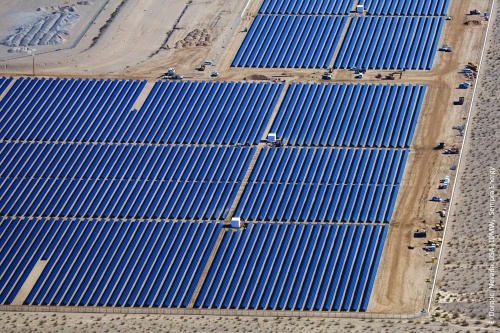
California utility PG&E on Friday announced a contract to buy 230 megawatts of electricity from a photovoltaic solar farm to be built by San Francisco-based NextLight Renewable Power.

NextLight — backed by private equity firm Energy Capital Partners — will build the AV Solar Ranch on agricultural land in Los Angeles County’s Antelope Valley.  PG&E (PCG) says the solar power plant will begin producing electricity in 2011. When fully built out by 2013, it will generate enough power for 90,000 homes, according to the utility.

Since the project will deploy solar panels rather than solar thermal technology that uses mirrors to heat liquids to drive a turbine, it does not need to go through the laborious California Energy Commission permitting process.

NextLight apparently also plans to build solar thermal farms — the company has filed lease claims on some 20,000 acres of Mojave Desert land owned by the U.S. Bureau of Land Management for two 500-megawatt solar trough power plants.

Friday’s agreement follows PG&E’s deal in May with BrightSource Energy to buy 1,300 megawatts of solar electricity to be produced by seven solar power plants.

Read Full Post »

solara

photo: BrightSource Energy

California utility PG&E on Wednesday expanded an agreement with BrightSource Energy to buy 1,310 megawatts of carbon-free electricity to be generated by seven giant solar power plant projects – the world’s biggest solar deal to date. Coming on top of a 1,300 megawatt agreement with Southern California Edison in February, the Google-backed, Oakland, Calif.-based  startup says it now holds more than 40% of the Big Solar contracts in the United States.

PG&E had previously signed a power purchase agreement with BrightSource in April 2008 for 500 megawatts with an option to buy another 400 megawatts. The new 1,310-megawatt deal will supply enough electricity to power about 530,000 homes in California.

Those are impressive numbers, but not an electron of electricity has been produced yet. BrightSource now faces the challenge of licensing, financing billions of dollars in construction costs and then building nearly a dozen large-scale solar power plants to meet a 2016 deadline for the Southern California Edison (EIX) contract and a 2017 completion date for PG&E (PCG).  (The big wild card is whether transmission lines will be available to connect the power plants to the grid.) The first PG&E project is set to go online in 2012 with the first SoCal Edison solar farm to begin generating electricity the next year. Those first two power plants are part of a 400-megawatt complex BrightSource is planning for the Ivanpah Valley on the California-Nevada border.

“The biggest part of our strategy is to ramp up slowly and methodically,” BrightSource CEO John Woolard told Green Wombat. “We’re very, very careful about how we sequence the projects.”

To give you an idea of how arduous the licensing process is in California, consider that BrightSource filed its application to build Ivanpah with the California Energy Commission on Aug. 31, 2007 — the state’s first large-scale solar power plant application in two decades. But the energy commission currently estimates that it won’t sign off on the license until around 2010, more than six months’ behind schedule as a multitude of state and federal agencies and green groups weigh in on the project’s environmental impact. The clock is ticking as BrightSource needs to start shoveling dirt on the construction site by the end of 2010 to qualify for federal loan guarantees that are part of the Obama stimulus package.

BrightSource may also build solar power plants in Nevada and Arizona, where licensing is easier, to supply electricity to PG&E and Southern California Edison. Woolard says the company controls enough land for nine gigawatts’ worth of solar farms.

While BrightSource’s technology is untested on a large scale, the company has built a six-megawatt demonstration plant in Israel, where its technology development arm is headquartered. BrightSource deploys arrays of mirrors called heliostats that concentrate sunlight on a water-filled boiler that sits atop a tower. The intense heat vaporizes the water to create high-pressure steam that drives a standard electricity-generating turbine.

Woolard says an independent engineering firm, R.W. Beck, has validated the technology at the Negev Desert demo plant. That no doubt helped persuade PG&E, which has sent executives to Israel to inspect the project, to supersize its contract. (And while BrightSource represents the biggest solar deal PG&E has signed, it’s probably far more likely to be fulfilled than the utility’s agreement in April to buy electricity from a space-based solar farm to be built by Southern California startup Solaren.)

“What it came down to is that they saw us delivering,” Woolard says. “Our plant in Israel performed above expectations. The fact that we have a solar plant producing the highest quality, highest temperature, highest pressure steam anywhere in the world is the most important thing.”

The company’s pedigree also provides a certain amount of corporate comfort. BrightSource was founded by American-Israeli solar pioneer Arnold Goldman, whose Luz International built nine large-scale solar trough power plants in the Mojave Desert in the 1980s that continue to generate electricity for Southern California Edison. BrightSource has also raised more than $160 million from a blue-chip group of investors that includes Google (GOOG), Morgan Stanley (MS) and VantagePoint Venture Partners as well as a clutch of oil giants – Chevron (CVX), BP (BP) and Norway’s StatoilHydro.

Read Full Post »

First Solar Electric, 701 El Dorado Valley Dr., Boulder City, NV

photo: First Solar

Sempra Generation on Wednesday said it has signed a deal for the United States’ largest photovoltaic power plant, a 48-megawatt solar farm to be built by First Solar in Nevada.

The thin-film solar power station will add on to a 10-megawatt solar farm built by First Solar (FSLR) last year adjacent to a Sempra  natural-gas fired power plant in Boulder City, Nev., outside of Las Vegas. Sempra Generation CEO Michael Allman told Green Wombat that Wednesday’s deal is part of a strategy to bring 500 megawatts of solar electricity online.

“The initial focus is on projects that are next to natural gas fired plants in the desert Southwest,” said Allman, whose company is a division of San Diego-based power giant Sempra Energy (SRE).

By building solar farms on the site of existing fossil fuel plants, Sempra can plug them in to the existing power grid, cutting costs for land, permits and electricity transmission. The 10-megawatt solar plant in Boulder City went online six months after ground was broken. Allman said Sempra also owns land next to its Mesquite natural gas power plant outside of Phoenix suitable for solar development.

“Those two power plants provide us with a substantial competitive advantage in both timing and cost,” said Allman. “These two initial projects will be the lowest cost energy delivered out of a solar project anywhere in the world.”

He declined to say what that cost is but an executive with PG&E (PCG), which is buying the electricity from the 10-megawatt Boulder City solar farm, previously told Green Wombat that the California utility was “very happy” with the rate it negotiated.

Allman said Sempra owns more than 4,000 acres in Arizona that could generate 300 megawatts of solar electricity. The company has also filed lease claims on 11,000 acres of desert land owned by the U.S. Bureau of Land Management in California’s Imperial Valley. But Allman said Sempra’s preference is to acquire private land to avoid the years-long BLM permitting process. The company will consider a range of solar technologies, including solar thermal, for future solar projects.

The 48-megawatt deal announced Wednesday is contingent upon Sempra signing a power purchase agreement with a utility.

Read Full Post »

picture-2

California utility PG&E has signed a deal for the world’s first space-based solar power plant, to be built by a secretive Southern California startup staffed by veterans of the U.S. Air Force, Boeing and Lockheed Martin.

In papers filed Friday with the California Public Utilities Commission, San Francisco-based PG&E asked for approval of a 15-year, 200-megawatt contract with Solaren, a Manhattan Beach, Calif.-based company that plans to put satellites in geosynchronous orbit by 2016 to collect solar energy. The sunlight would then be transmitted to a ground station in Fresno, Calif., in the form of radio frequency waves and converted into electricity to be distributed into the power grid. Since the sun shines 24/7 in space, a Solaren solar farm could theoretically supply “baseload” green electricity to coal-dependent regions without access to abundant sources of renewable energy.

While PG&E won’t spend any money until Solaren beams down electricity, it’s uncertain whether regulators will be willing to count a contract for such unproven, bleeding-edge technology toward the utility’s state-mandated obligation to obtain 20% of its power from renewable sources by 2010 and 33% by 2020. After all, the utilities commission last year rejected PG&E’s contract with a wave energy firm on the grounds that the technology was too early stage. PG&E’s discussion of the Solaren project’s viability was filed under a request for confidentiality.

“Solaren is using an innovative space-based solar technology, which, if successful, would represent a break-through in the renewable power industry,” Brian Cherry, PG&E’s vice present of regulatory relations, wrote in the utility’s 24-page application. “While emerging technologies like space solar face considerable hurdles under a traditional viability analysis, PG&E believes that potential, significant benefits to its customers from a successful space solar installation outweigh the challenges associated with a new and unproven technology.”

Space-based solar has long been a dream and numerous studies have been conducted on its potential viability. In the documents filed with the utilities commission, PG&E (PCG) asserted that the biggest technological obstacle is building satellites that can collect megawatts’ worth of sunlight rather than transmitting the energy miles to a ground station.

“The engineering challenge of building a Space Solar Power Plant is not the energy conversion process itself, but the need to engineer and build MW-class SSP satellites, which are much larger than current kW-class communications satellites,” Cherry wrote. “Solaren’s patented SSP Plant design employs the SSP concept described above to deliver renewable electricity to PG&E.”

Solaren’s website offers a single page that contains no information on the company other than the slogan, “Energy for Tomorrow with Technology of Today.”

In its filing, PG&E said that, “Solaren was founded in 2001 to develop, engineer, test, construct, and operate space solar generating stations. Solaren has informed PG&E that its team is comprised of experienced satellite engineers and space scientists with 20 to 45 years of experience in the leading edge space industry and come from various aerospace organizations that include the U.S. Air Force, Hughes Aircraft Company, Boeing (BA), and Lockheed Martin (LMT).

Not all the hurdles to space-based solar are likely to be technological. While there are no desert tortoises in space or other protected wildlife that live on earth-bound sites for big solar power plants, any orbiting solar farm will have to pass muster with a long list of state, federal and international government agencies. Among them, the U.S. Department of Defense, NASA and the United Nations, according to PG&E.

Read Full Post »

cstste_eldorado_13850021

photo: First Solar

The arid Southwest has no shortage of sun but has been rather slow to embrace Big Solar power plants, at least compared to California, where more than a half-dozen massive megawatt solar farms are being licensed.

That appears to be changing. On Tuesday, First Solar said it will give New Mexico its first big solar power plant, a 30 megawatt photovoltaic farm that will generate electricity from the company’s thin-film panels. Once the plant is built in Colfax County in northeastern New Mexico, First Solar will sell the electricity it generates to the Tri-State Generation and Transmission Association under a 25-year power purchase agreement. Tri-State is an electric cooperative.

The deal continues First Solar’s (FSLR) move into the power plant business. Earlier this month, the Tempe, Ariz.-based company acquired OptiSolar’s 1.85 gigawatt project portfolio – including a 550-megawatt photovolatic power plant for California utility PG&E (PCG) – in a $400 million stock transaction.

First Solar has also signed contracts for smaller-scale solar farms with Southern California Edison (EIX) and Sempre (SRE).

Read Full Post »

solyndra-rooftop-2

photo: Solyndra

It’s been a good news, bad news Friday for the solar industry. Silicon Valley startup Solyndra received a half billion-dollar loan guarantee from the U.S. Department of Energy to build a solar module factory while further up Interstate 880 OptiSolar moved to shut down its manufacturing operations.

OptiSolar too had asked for a federal loan guarantee to complete work on its Sacramento thin-film solar cell plant but a decision on the $300 million application couldn’t come soon enough to save the startup. “We continued to be unable to find a buyer for the technology and manufacuring business, and the board of directors decided that we needed to limit ongoing operational expense,” wrote OptiSolar spokesman Alan Bernheimer in an e-mail.

First reported by the San Francisco Chronicle’s David Baker, OptiSolar will shut down factories in Sacramento and Hayward, Calif., and lay off 200 workers.  Earlier this month, OptiSolar sold its pipeline of solar power plants – including a 550-megawatt solar farm that will supply electricity to PG&E (PCG) – to rival First Solar  in a $400 million stock deal. At the time, OptiSolar said it intended to focus on manufacturing solar modules.

The news was definitely brighter Friday for Solyndra, which emerged from stealth mode last September with $600 million in funding and $1.2 billion in orders for its solar panels composed of cylindrical tubes imprinted with solar cells. Conventional rooftop solar panels must be tilted to absorb direct sunlight as they aren’t efficient at producing electricity from diffuse light. But the round Solyndra module collects sunlight from all angles, including rays reflected from rooftops. That allows the modules, 40 to a panel,  to sit flat and packed tightly together on commercial rooftops, maximizing the amount of space for power production.

The $535 million federal loan guarantee will allow the Fremont, Calif.-based company to build a second factory, which is expected to create 3,000 construction jobs and more than 1,000 other jobs once the plant is in operation. The factory will be able to produce 500 megawatts’ worth of solar panels a year.

“The DOE Loan Guarantee Program funding will enable Solyndra to achieve the economies of scale needed to deliver solar electricity at prices that are competitive with utility rates,” Solyndra CEO Chris Gronet said in a statement. “This expansion is really about creating new jobs while meaningfully impacting global warming.”

Friday’s grant makes good on Secretary of Energy Steven Chu’s pledge to speed up processing of renewable energy loan guarantee applications. The department had come under fire during the previous administration for taking years to dole out grants and loan guarantees for electric car and green energy projects.

Meanwhile, First Solar (FSLR) announced on Friday that it had manufactured 1 gigawatt of thin-film solar cells since beginning commercial production in 2002. It took the Tempe, Ariz., company six years to hit 500 megawatts and only eight months to produce the second 500 megawatts. First Solar’s annual production capacity will reach 1 gigawatt by year’s end, according to the company.

Read Full Post »

clean-edge-report

Worldwide revenues from the solar photovoltaic, wind and biofuels industries jumped 53% in 2008 to $116 billion and is on track to grow to $325 billion by 2018, according to a report released Tuesday by West Coast market research firm Clean Edge.

Last year’s boom, however, is unlikely to be repeated in 2009, given the global financial crisis. Signs of the slowdown were apparent last year as new global investment in green energy grew by a paltry 4.7% to $155 billion, compared to a 60% rise between 2006 and 2007. In the United States, however, venture capital investments in green tech grew 22% last year to $3.3 billion, representing 12% of all VC investments, according to figures compiled by research firm New Energy Finance.

“2009 is a year to get through,” said report author Ron Pernick during a conference call.

Of course, growth projections for renewable energy are inherently speculative. Green energy investment is strongly dependent on government policy and what the Obama administration gives today in the form of billions in subsidies and incentives a successor can take away. And then there are calamities like the extent of the meltdown of the global economy that few foresaw even a year ago.

The wind industry accounted for a third of renewable energy revenues in 2008, becoming a $50 billion business. Clean Edge projects that employment in the wind and solar industries will grow from a combined 600,000 jobs in 2008 to 2.7 million by 2018.

“As the market transitions to low-carbon fuel and electricity sources, conservation and efficiency efforts, and the deployment of a smart, 21st century grid, we believe clean energy offers one of the greatest opportunities for both local and global economies to compete and thrive,” wrote Pernick and co-authors Joel Makower and Clint Wilder.

They identified as growth areas smart grid technologies, energy storage for wind and solar farms, the Eastern Eureopean market,  power grid infrastructure and micro power grids that provide electricity to self-contained facilities or areas.

Read Full Post »

esolar-smart-scalable-solar

photo: eSolar

California startup eSolar said on Tuesday that it has licensed its solar power technology for the construction of up to 1 gigawatt of solar farms in India over the next decade.

The deal with Indian conglomerate ACME Group marks India’s first move into large-scale solar power and is the biggest announced foray of a United States solar power plant company overseas. The agreement calls for ACME, based in the northern Indian state of Haryana, to invest $30 million in eSolar, which will also earn fees for each of its 46-megawatt modular solar thermal power plants that are built.

A gigawatt, or 1,000 megawatts, of solar energy produces enough electricity to keep the lights on in about 750,000 energy-hogging U.S. homes. Presumably, many more homes and businesses can be powered by a gigawatt in India, where electricity shortages are common and the country relies on greenhouse-gas emitting diesel generators.

“We’re exclusively selling to ACME in India and they’re exclusively using us,” eSolar CEO Bill Gross told Green Wombat. “We’d like to do something like this in Spain, in Australia and the Middle East.”

It’s the second big deal for Pasadena-based eSolar in a week. Last Monday, the company inked an agreement to license its technology to U.S. coal-fired utility NRG (NRG) for the development of up to 500 megawatts of solar power plants in California and the Southwest for Southern California Edison (EIX) and other utilities. Meanwhile, the financial crisis is forcing the consolidation of the solar industry, with Monday’s dual deals — First Solar (FSLR) acquired the solar power plant assets of Silicon Valley OptiSolar while Spanish solar developer Fotowatio bought financier MMA Renewable Ventures’ solar portfolio.

eSolar claims it can generate electricity at lower prices than natural gas-fired power plants by mass-producing mirrors called heliostats that concentrate sunlight on a water-filled receiver atop a tower to create steam that drives a turbine. The heliostats are much smaller than those made by competitors, use far less steel and can be quickly and cheaply installed in the field because they’re controlled by sophisticated software, according to Gross.

That allows eSolar to pack more mirrors into the solar field to create relatively compact power plants that can be located near urban centers rather than in the desert. ACME, which makes everything from telecommunications equipment and refrigeration systems to fuel cells, will begin construction of the first solar farm later this year.

ACME will hire contractors to build the solar power plants while eSolar will provide the heliostat fields, power towers and software systems. ACME so far has signed power purchase agreements with Indian utilities for 250 megawatts, according to eSolar.

“The eSolar system addresses obstacles that have previously plagued solar installations and presents a viable, cost-effective alternative that can scale quickly to meet India’s growing energy needs,” ACME CEO Manoj Upadhyay said in a statement.

Read Full Post »

denverairport-110

photo: WorldWater & Solar Technologies

The consolidation of the solar industry got underway Monday with the acquisition of San Francisco-based green energy financier MMA Renewable Ventures by Spanish solar developer Fotowatio.

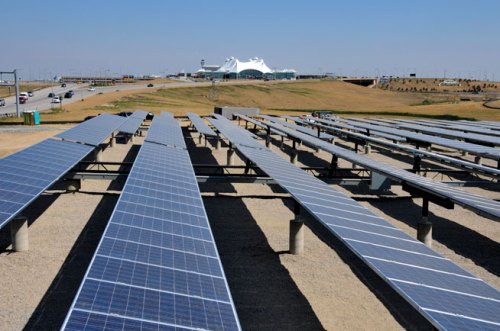
The Madrid-based company will purchase most of MMA Renewable’s solar assets – including the world largest photovoltaic power plant and its pipeline of projects – making it one of the biggest solar developers in the United States.

The financial terms of the deal were not disclosed.

MMA Renewable CEO Matt Cheney told Green Wombat that he’ll continue as CEO of what will be called, for now, Renewable Ventures and that his staff will be joining him. MMA Renewable Ventures was a subsidiary of Municipal Mortgage & Equity, which has been hit hard by the financial crisis.

Fotowatio, on the other hand, scored $350 million in funding last July from General Electric (GE) and Grupo Corporativo Landon. “You’re taking a very robust player in the European market see how much opportunity and potential there is in the U.S. market,” says Cheney. “It’ll produce one of the biggest, if not the biggest, independent solar power producers. It’s the story of consolidation.”

MMA Renewable Ventures raises funds to invest in big commercial solar arrays and photovoltaic power plant projects. The company finances the construction of solar systems by companies like SunPower (SPWRA) and retains ownership of the arrays, selling the electricity under long-term power purchase agreements.

Last year MMA Renewable and Chinese solar giant Suntech (STP) created a joint venture called Gemini Solar to build large-scale photovoltaic power plants.  Cheney said Gemini will continue under Fotowatio.

When the deal closes, Fotowatio will gain 35 megawatts of solar projects in the U.S. with another 400 megawatts under development.

Cheney says the Fotowatio acquisition is a sign of the times as the global economic crisis and falling prices for solar cells disrupts the renewable energy market. “There’s a shakeout in the marketplace and there’s opportunities for consolidation.”

Read Full Post »

esolar-field_wide_2b
photo: eSolar

SAN FRANCISCO — “It’s all about the software,” says eSolar CEO Bill Gross.

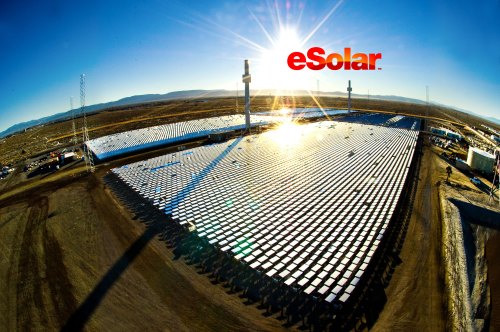
The tech entrepreneur and founder of startup incubator Idealab is explaining how eSolar’s solar power plants can produce carbon-free electricity cheaper than planet-warming natural gas. At the Cleantech Forum in San Francisco, Gross flashes a photo of eSolar’s demonstration solar farm outside the Southern California town of Lancaster, where 24,000 mirrors called heliostats surround two 150-foot towers.  The heliostats concentrate sunlight on a tower containing water-filled boilers and the resulting heat creates steam that drives an electricity-generating turbine. Rivals like BrightSource Energy use similar “power tower” technology but according to Gross, eSolar’s mirror-controlling software and modular plant design will allow it to produce cheaper solar electricity.

For instance, Gross says competitors use large, slightly curved mirrors to focus sunlight. That require big and expensive steel frames to hold the glass in place.  eSolar’s solution: make small flat mirrors the size of an LCD television screen that clamp on to a  5 x 12-inch frame and then use software and Big Iron computing to position the mirrors to create a parabola out of the entire heliostat field.

“We use Moore’s law rather than more steel,” quipped Gross, referring to Intel co-founder Gordon Moore’s maxim that computing power doubles every two years.

The heliostats roll off an assembly line in China with the wiring and sun-tracking motors built in. “The only tool required to install mirrors in the field is a hand wrench,” Gross says. “There’s  no welding in field, you just install the mirrors on the base. We’ve taken all the labor in the field and moved it to an automated factory.”

The heliostats also do not have to be precisely placed in the solar field, which saves time. “The rows can be wavy as the software will correct for it,” Gross notes. “We don’t need to do extensive surveys to design the field; we just need to leave enough space between mirrors.”

The bottom line: The five-megawatt Palmdale project was built in less than six months. “We think we can finish plants before other people start,” Gross told Green Wombat.

Gross says eSolar has also signed a 92-megawatt deal with a New Mexico utility, which he declined to identify until the agreement is announced. He said his Pasadena, Calif.-based company will also soon unveil a contract to build 500 megawatt’s worth of solar farms in Asia. So far, eSolar has spent $30 million acquiring land – mainly privately owned agricultural property – for solar power plants, according to Gross. He told Cleantech Forum participants that eSolar expects internal rates of return for its partners of between 11% and 14% for U.S. power plants and returns of 20% to 30% for overseas projects.

Also saving time and money are the power towers, which are made from two sections of a windmill tower. At 150 feet they’re half the size of competitors’ towers – again, less steel is needed. The lower height and the software systems that allow more mirrors to be crammed into smaller spaces means that eSolar’s power plants can be placed closer to urban areas where transmission lines are available.

Also unique is the boiler that sits atop the tower. Gross gave Green Wombat a close-up look the proprietary technology. About the size of a cargo shipping container, the “cavity receiver” has openings on either side. The heliostats focus sunlight into the interior of the boiler, which is lined with water-filled pipes.

“The benefit is that the light comes in and even if some light is reflected it can have multiple bounces and still hit the pipes,” Gross says. “We can get all the light inside the cavity all because of the software that controls the mirrors.”

Whether Google (GOOG)-backed eSolar’s plants produce electricity at the low rates Gross is claiming won’t be known until they start coming online. But utilities are betting that this solar software works. Southern California Edision (EIX) last year signed a 20-year-contract with eSolar for 245 megawatts of electricity while coal-dependent NRG Energy (NRG) this week agreed to invest $10 million in eSolar in exchange for the right to develop up to 500 megawatts using the company’s technology. (Southern California Edison is betting even bigger on BrightSource Energy’s power tower technology – two weeks ago the utility signed a 1,300 megawatt power purchase agreement with the Oakland startup – also backed by Google – the world’s largest solar deal to date.)

Read Full Post »

« Newer Posts - Older Posts »

Design a site like this with WordPress.com
Get started