Feeds:
Posts
Comments

Posts Tagged ‘First Solar’

The looming expiration of a crucial renewable energy investment tax credit doesn’t seem to have spooked investors. Silicon Valley thin-film solar startup Nanosolar said Wednesday that it has secured another $300 million in funding and is jumping into the Big Solar game as well.

Writing on the Nanosolar blog,  CEO Martin Roscheisen said that the latest financing round – the company’s funding now totals half a billion dollars –  comes from oldline utility AES (AES), French utility giant EDF and the Carlyle Group, among other investors. Nanosolar, which prints solar cells on flexible materials, will supply solar panels to the newly formed AES Solar, which will build medium-scale – up to 50 megawatts – photovoltaic power plants.

The Nanosolar news is just the latest of a spate of deals to take solar panels off rooftops and plant them on the ground to generate massive megawattage. Two weeks ago, thin-film solar startup Optisolar won a contract from utility PG&E (PCG) for a 550-megawatt PV solar power plant while SunPower (SPWR) will build a 250-megawatt photovoltaic solar farm for the utility. Leading  thin-film company First Solar (FSLR), meanwhile, has inked deals over the past few months to build smaller-scale PV power plants for Southern California Edison (EIX) and Sempre (SRE). And thin-film solar company Energy Conversion Devices is assembling a 12-megawatt array for a General Motors plant in Spain.

Read Full Post »

photos: Energy Conversion Devices

As Detroit automakers shutter SUV and truck factories, the decades-long de-industrialization of the Midwest continues apace. But amid the idled assembly lines, a new wave of manufacturing has taken root as solar energy companies set up shop in the heartland.

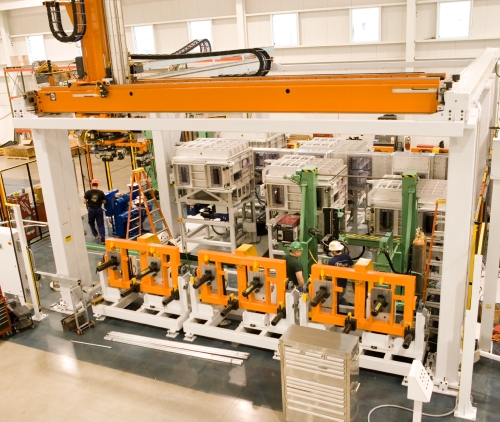
Just in the past week, First Solar (FSLR) announced an expansion of its Ohio plant that makes thin-film solar panels. German company Flabeg will break ground on a factory outside Pittsburgh that will manufacture parabolic solar mirrors for large-scale solar power plants planned for the Southwest. Thin-film solar company Energy Conversion Devices (ENER), meanwhile, operates three factories in Michigan and is currently doubling the production capacity of one of its plants.

In fact, nearly all the United States’ current solar manufacturing capacity is in the Midwest, save for Silicon Valley company Ausra’s factory in Las Vegas. (Thin-film startup Nanosolar is building a factory in San Jose, Calif.)

“Our processes really require high productivity, so what makes it competitive here in the Midwest is that we have a great labor force that is eager to work and well-trained already,” ECD chief executive Mark Morelli told Green Wombat on Monday.

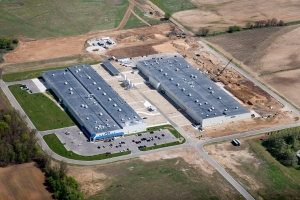
For instance, when appliance maker Electrolux shut down its Greenville, Mich., factory it left 2,700 workers unemployed in the same town where ECD is expanding its thin-film factory (see photos). The company also has recruited top executives from the ever-shrinking auto industry.

“We do a test of the available labor pool and hire the cream of the crop,” Morelli says.

Just as important are a plethora of state tax breaks and grants to retrain industrial workers for the green tech economy.

Although 70 percent of ECD’s flexible solar laminate panels are sold to European customers, Morelli anticipates the U.S. market will take off, with domestic manufacturers garnering a competitive advantage.

That all depends on whether Congress extends a crucial investment tax credit that expires this year and the policies of the next administration in Washington. Even so, demand for solar cells is expected to spike, especially given the recent unveiling of Big Solar projects by California utilities. Southern California Edison (EIX), for instance, is installing 250-megawatts’ worth of solar panels on commercial rooftops while PG&E (PCG) this month announced contracts to buy 800 megawatts of electricity from two photovoltaic power plants, including 500-megawatt thin-film solar farm being built by OptiSolar.

“As utilities begin to embrace distributed power generation, these type of things play into our natural advantage,” says Morelli, referring to his company’s lightweight solar panels that are especially suited for large rooftop arrays.

Of course, a handful of solar factories are not going to revive the Midwest’s industrial fortunes. (First Solar, for instance, operates factories in Germany and Malaysia, and Morelli doesn’t rule out locating manufacturing overseas.) But imagine a national policy that promotes the wide adoption of solar and the expansion of manufacturing in the rustbelt states becomes increasingly attractive. Shipping solar panels and mirror arrays from halfway around the world starts to make much less environmental and financial sense.

ECD’s proximity to the auto industry has already paid off. After installing solar arrays on two of General Motors (GM)’s California facilities, it won a contract in July to build a 12-megawatt rooftop array – the world’s largest by orders of magnitude – at a GM assembly plant in Spain.

Read Full Post »

Thin is in when it comes to solar power plants.

First Solar, the Walton family-backed (WMT) maker of thin-film photovoltaic modules, on Thursday announced its second solar power plant. The latest project is a 10-megawatt photovoltaic power station to be built for Sempra Generation (SRE) in Nevada. Two weeks ago, California regulators approved a 7.5-megawatt – expandable to 21 megawatts – First Solar (FSLR) power plant to be constructed in the Mojave to generate electricity for utility Southern California Edison (EIX). Thin-film solar technology layers solar cells on plates of glass or flexible materials, a process that lowers production costs with the trade-off being lower efficiency at converting sunlight into electricity.

What’s notable about the Nevada First Solar project is that it will be constructed adjacent to a Sempra natural gas-fired power plant near Boulder City, Nev. That will allow the solar station to share transmission lines and other infrastructure and minimize land use. Those are no small considerations these days as the solar land rush continues in the Mojave and environmentalists grow uneasy over the impact of industrializing the desert.

Tempe, Ariz.-based First Solar has already broken ground on the project with completion expected by the end of the year. That’s record time, given that solar thermal power plants – which tend to be larger by orders of magnitude – can take years to receive regulatory approval and build. Also of note: The solar modules for the project will be manufactured at First Solar’s Ohio factory, one of only two commercially operating  thin-film manufacturing facilities in the United States. (The other is Energy Conversion Devices’ thin-film factory in Michigan.)

Sempra Generation, a division of utility giant Sempra, will own and operate the First Solar plant, which will supply electricity to Nevada and California.

Read Full Post »

When it comes to solar companies, First Solar is the Google of renewable energy. The Tempe, Ariz.-based solar cell maker backed by the Wal-Mart (WMT)’s Walton family has seen its stock skyrocket over the past year, hitting a high of $317 on May 14. (It was trading at $275 Friday.) Now First Solar, which makes “thin film” solar modules, is getting into the utility business, winning approval Thursday from California regulators to build the state’s first thin-film photovoltaic solar power plant. The 7.5 megawatt project – expandable to 21 megawatts – will sell electricity to Southern California Edison (EIX) under a 20-year contract.

While First Solar (FSLR) supplies solar modules to power plant builders in Europe, this is apparently the first time it has acted as a utility-scale solar developer itself. First Solar tends to keep quiet about its projects and did not return a request for comment. But a troll through the public records reveals some details of what is called the FSE Blythe project. The solar farm will be built in the Mojave Desert town of Blythe by a First Solar subsidiary, First Solar Electric. The company paid $350,000 in January for 120 acres of agricultural land in Blythe, providing a tidy profit for the seller, which had purchased the property for $60,000 in June 1999.

Approval of the contract by the California Public Utilities Commission Thursday came on the same day that SunPower (SPWR) announced a deal to build two photovoltaic power plants – a 25-megawatt one and a 10-megawatt version – in Florida for utility Florida Power & Light (FPL). PV plants are essentially supersized versions of rooftop solar panel systems found on homes and businesses. Thin-film solar prints solar cells on flexible material or glass and typically uses little or no expensive (and in short supply) polysilicon, the key material of conventional solar cells.

Most large-scale solar power plants being developed in the United States use solar thermal technology that relies on huge arrays of mirrors to heat liquids to create steam that drives electricity-generating turbines. In fact, there is a solar land rush underway in the desert Southwest as solar developers, investment banks like Goldman Sachs (GS), utilities and speculators of every stripe scramble to lock up hundreds of thousands of acres of federal land for solar power plants. (See Green Wombat’s feature story on the solar land rush in the July 21 issue of Fortune.)

PV power plants, on the other hand, have not been cost-competitive with solar thermal and have been most popular in countries like Germany, Spain and Portugal, where generous subsidies guarantee solar developers a high rate for the electricity they produce. The situation in the U.S. seems to be changing, though, judging by the deals utilties are striking with companies like First Solar and SunPower. Meanwhile, thin-film startup OptiSolar is moving to build a gigantic 550-megawatt thin-film solar power plant on California’s central coast but has yet to sign a power purchase agreement with a utility.

Read Full Post »

In the world’s single-largest investment in solar technology, the oil-rich emirate of Abu Dhabi announced Wednesday it will spend $2 billion to jumpstart a home-grown photovoltaics industry. The cash will fund what is undoubtedly the planet’s best-financed startup, Masdar PV, which will build manufacturing facilities in Germany and Abu Dhabi to produce thin-film solar modules that can be used in rooftop solar systems or solar power plants.

Masdar PV is the latest project of the Masdar Initiative, Abu Dhabi’s $15 billion renewable energy venture designed to transform the emirate into a green technology powerhouse. Masdar is best known for its plans to build Masdar City, a “zero-carbon, zero-waste” urban center.

Thin-film solar cells are essentially “printed” on glass or flexible metals, allowing them to be integrated into building materials like roofs and walls. Though thin-film solar is less efficient at converting light into electricity, it uses a fraction of the expensive silicon needed by conventional bulky solar modules and can be produced much more cheaply – provided economies of scale are achieved.

Thus Masdar PV’s big solar bet. “You have to be working at scale to drive costs out of the system,” Steve Geiger, Masdar’s director of special projects, told Fortune in a phone call from Abu Dhabi. “We have to do it at scale and we have to do it in volume in multiple markets.”

One of those markets is the United States, where Masdar PV could give established players like First Solar (FSLR) and startups such as Nanosolar, Heliovolts and Global Solar some formidable competition.

The gamble Masdar PV is taking is that it’s investing billions in an older but proven thin-film technology that may well be left in the dust by more exotic, cheaper and efficient technologies under development by a host of startups.

Masdar PV aims to have a gigawatt of annual production capacity in place by 2014. To get there, Geiger says the company has hired a management team that includes former top executives from First Solar and other thin-film industry veterans.

A leading solar technology company that Geiger declined to identify will provide the manufacturing equipment for Masdar PV’s factories. Judging from his description, the likely supplier is Applied Materials (AMAT), the world’s biggest computer-chip equipment maker that has a burgeoning business building the machines that make thin-film solar cells of the type that Masdar PV will produce.

“We usually partner with large companies that have managerial skills, technology and market access, but we were very fortune that we picked up a top management team and thought it was strong enough to do as a 100% Abu Dhabi Masdar company,” says Geiger, who will oversee Masdar’s thin-film solar venture.

Masdar PV’s first plant is scheduled to go online in Germany toward the end of 2009 with the second to begin production in Abu Dhabi by mid-2010. “Very clearly we need to look at expansion beyond those two physical facilities,” Geiger says. “We really have to look at America and the Asian markets as well.

Thin-film is just one of three solar strategies that Masdar is pursuing by funneling petrodollars into green energy startups. In March, Masdar unveiled Torresol Energy, a joint venture with a Spanish company that will build large-scale solar thermal power plants to supply electricity to utilities. Masdar has also made investments in other solar thermal companies as well as thin-film startups pursuing different technologies. Finally, Masdar wants to produce polysilicon, the basic material of conventional solar cells.

As Masdar chief Sultan Ahmed Al Jaber recently told Green Wombat, “We want to cover the whole value chain – from research to labs to manufacturing to the deployment of technologies.”

Geiger uses an analogy for Masdar’s green energy ambitions that may be more familiar to petroleum-dependent Americans – and should serve as a wake-up call to get serious about carbon-free energy. “The model might be the vertically integrated oil industry,” he says. “It clearly makes sense to have a consolidated power provider.”

Read Full Post »

« Newer Posts

Design a site like this with WordPress.com
Get started