Feeds:
Posts
Comments

photo: Ford

I wrote this story for Grist, where it first appeared.

Bummed that you don’t live in one of the select cities that will be the first to get the electric Nissan Leaf or the Chevrolet Volt next month? Or you do live in one of those early-adopter municipalities and want an electric ride but don’t like either car?

Well, if you’re willing to wait another year, the electric Ford Focus will be rolling into town. Twenty towns, to be exact. Ford on Monday announced that in late 2011, a battery-powered version of its compact car will be sold in — drum roll, please — Atlanta, Austin, and Boston as well as Houston, Chicago, and New York.

Denver, Detroit, and Orlando will get the Focus along with Raleigh and Durham, N.C. and Richmond, Va., and Washington, D.C. Out West, Los Angeles, San Diego, Phoenix, and Tucson are on the list.

Then there are the usual suspects: San Francisco, Seattle, and Portland.

“Markets were chosen based on several criteria, including commuting patterns, existing hybrid purchase trends, utility company collaboration and local government commitment to electrification,” Ford said in a statement.

“Ford wants to build on this enthusiasm by making our first all electric passenger vehicle available in as many pilot markets as possible,” Mark Fields, Ford’s president of the Americas, said in a statement.

“This is the first step in rolling out the Focus Electric. As the country continues to build up its electric vehicle infrastructure and demand for the Focus Electric grows, Ford will continue to evaluate additional markets and consider making this vehicle available in more cities across the country.”

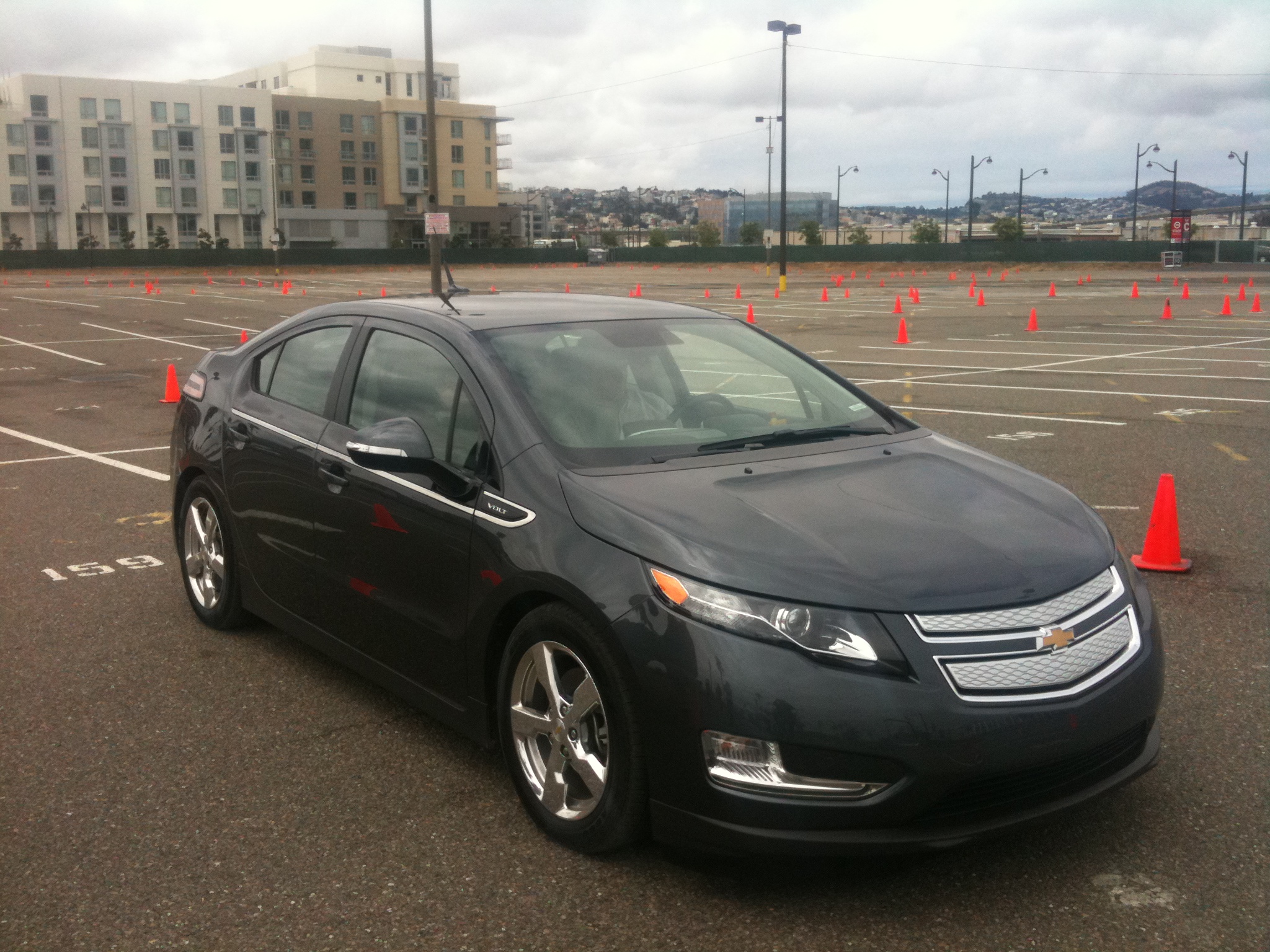
The electric version of its existing Focus will be powered by a lithium ion battery that will give the car an estimated range of 100 miles. That’s the same range that Nissan is advertising for the Leaf. The Chevrolet Volt will travel about 40 miles on a charge before a small gasoline engine kicks in to generate electricity.

photo: Todd Woody

I wrote this story for Grist, where it first appeared.

With the first mass-produced electric cars set to hit American streets next month, there’s been a lot of to-ing and fro-ing in the media about whether consumers will actually buy the vehicles once they’re in showrooms.

But as General Electric made clear this week, some big corporations are certainly in the market for battery-powered rides, and that alone could help spur the market.

GE announced that it would buy 25,000 electric cars between now and 2015, including 12,000 Chevrolet Volts. (Which will help General Motors pay back that taxpayer-financed bailout.)

Now, 25,000 cars might not sound like all that much. But it’s the largest corporate buy of electric vehicles to date. And if GE’s move inspires other multinationals to follow suit and electrify their fleets, the numbers could really start to add up. Just imagine if the Fortune 500 made a similar commitment — 12.5 million electric cars would be on the road in a few years.

(GE chief executive Jeff Immelt just needs to start bragging about how big his electric fleet is at cocktail parties; before you know it, the CEO next door will be putting in an even larger order for EVs.)

As Immelt has made clear on more than one occasion, this is all about business.

“We basically touch every part of the infrastructure,” he said in a video press release. “From the smart grid, to our WattStation, to electrical distribution products, to everywhere in between.

“We’ve always believed clean energy is about commercialization. It’s not a novelty,” Immelt continued. “Broad-based commitments and broad-based strategies are what’s going to make clean energy a reality.”

GE unveiled the WattStation, its electric charging station for the street and garage, this past summer, and in September inked a deal with Better Place to deploy the iPodish charger in the Silicon Valley startup’s electric infrastructure network.

I wrote this story for Grist, where it first appeared.

Environmental enforcement? Yes, there’s an app for that too.

As California’s permanent budget crisis results in continuing cutbacks to environmental agencies, IBM has rolled out Creek Watch, an iPhone app that lets the State Water Resources Control Board crowdsource the condition of the Golden State’s waterways.

Here’s how it works: You’re out for a jog, or a hike, or just walking the dog. When you cross a creek, stream, or other body of water, you pull out your iPhone and fire up the Creek Watch app.

The app asks you to take a picture of the creek and then click on tabs that note the water level (dry, some, full), flow rate (still, slow, fast), and the amount of trash (none, some, a lot). Other screens define those terms and show photos as examples. For instance, “a lot” of trash is 10 or more pieces of debris. There’s also a place for citizen scientists to jot down additional observations.

The app uses the iPhone’s GPS chip to pinpoint the creek’s location, and the photos and information are uploaded to the Creek Watch database, which can be tapped by state water officials.

“Creek Watch lets the average citizen contribute to the health of their water supply — without PhDs, chemistry kits, and a lot of time,” Christine Robson of IBM’s Almaden Research Center in San Jose said in a statement.

“With more than 700 miles of creeks in Santa Clara County alone, we need innovative technologies like this one to empower the community to help us continuously improve our water quality and the ecosystem,” noted Carol Boland, a watershed biologist for the city of San Jose.

So far, the reviews of the app by citizen water monitors have been positive.

“I’ll be able to report trash in the creek behind my house, with location and photos automatically,” wrote one person on the Creek Watch app review page. “I hope the water district is watching.”

photo: Todd Woody

I wrote this story for Grist, where it first appeared.

When experts try to describe the smart grid, their favorite analogy is the internet.

Just as the internet enabled interactive, two-way communication, the smart grid, we’re told, will deploy sensors and software to digitize a century-old analog electricity distribution system, transforming it into one capable of integrating renewable energy and decentralizing power production.

But while the benefits of the internet are manifest — YouTube, Facebook, Grist! — what will the smart grid do for you and me?

For most people, the most familiar part of the smart grid is the smart meter, those wireless digital devices being installed in homes by the millions so that residents can monitor electricity use in real time rather than through a monthly utility bill that arrives long after the power has been consumed.

Smart meters have been controversial in Northern California, where a number of communities have moved to ban the devices over fears about the potential health effects from their emission of electromagnetic frequencies. (Mobile phones, televisions, and other electronic devices also emit electromagnetic frequencies, and so far there has been no scientific evidence to support the health claims about smart meters.)

A sunnier view of the smart meter as a gateway to a new energy future emerges in Los Angeles, where utility Southern California Edison has built a model home with smart grid technology embedded in everything from the dishwasher to the thermostat.

“It’s much easier to show than tell,” says Mindy McDonald, a Southern California Edison project manager. She is standing outside the “Smart Energy Experience” home that’s been constructed inside the utility’s Customer Technology Application Center, just off the 210 freeway in the inland suburb of Irwindale. “Grappling with the smart grid, it’s much easier to just walk people through,” says McDonald.

The idea is to show people how smart grid technology can cut their electricity bills, reduce the need to build additional fossil fuel plants, and therefore cut greenhouse gas emissions.

A Coda electric car is parked in the stylish suburban ranch’s garage. Solar panels, a solar hot water system, and a wind turbine sit on the roof. LEDs provide the home’s lighting, and every appliance contains communication chips, allowing them to “talk” to each other and to the utility through the smart meter attached to the front of the house.

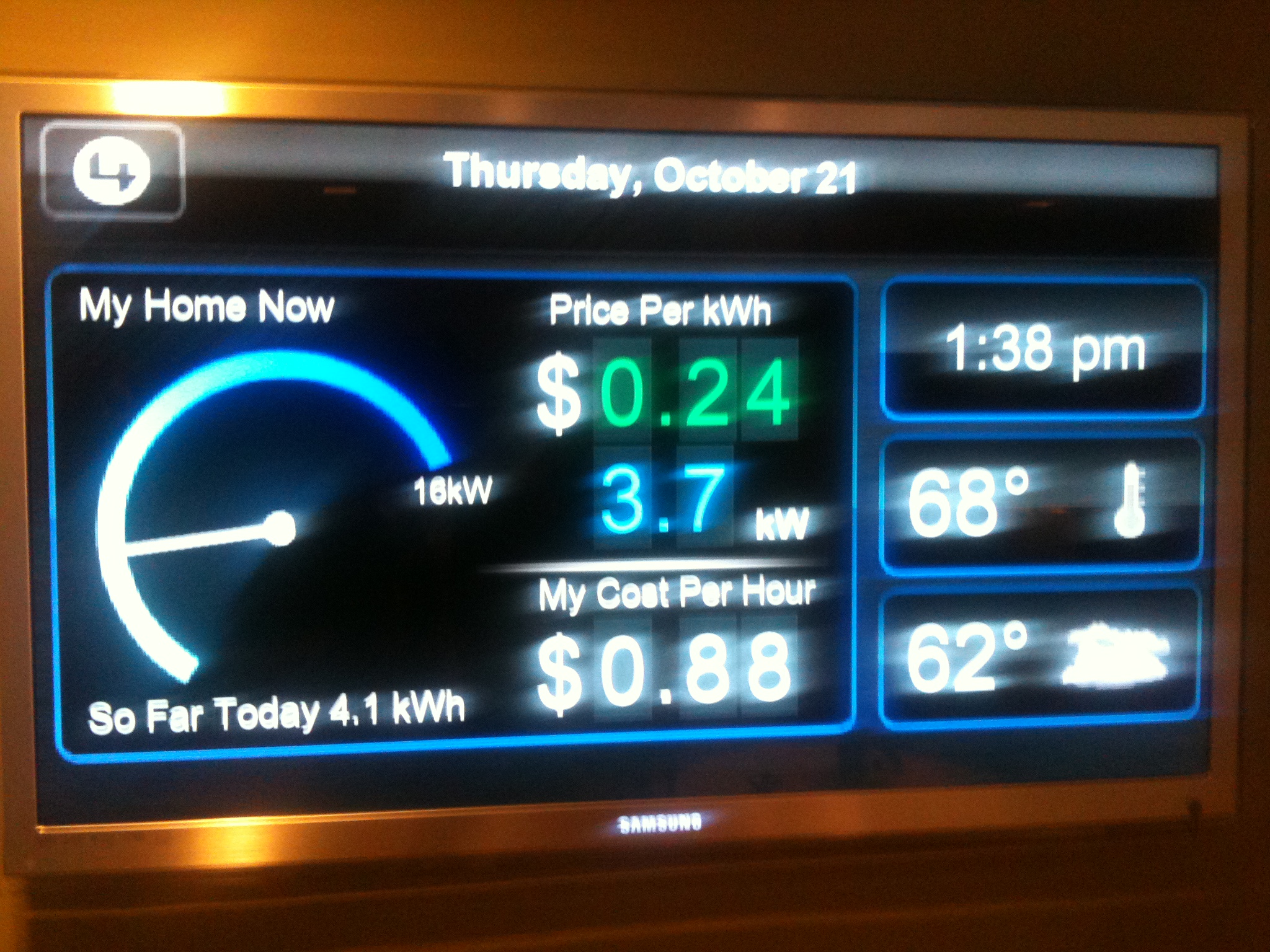
A video screen in the living room displays the home’s energy management system, and a large flat screen in the kitchen tracks the amount of electricity being consumed and its cost.

When McDonald turns on the washing machine and the air conditioner and then plugs in the car, an “energy speedometer” on the screen shows the cost of electricity rapidly accelerating from 11 cents an hour to $2.81. The display also tells the homeowner how much electricity has been consumed so far in the day and the price per kilowatt-hour.

“It’s really has an impact when you can see how much it’s costing and they realize that maybe they should turn something off,” McDonald says. “Most people don’t pay any attention to what electricity costs until they get their bill and it’s too late to do anything about it.”

The utility so far has installed smart meters in about a fifth of the 4.9 million households and businesses it serves. Beginning in January, those customers can set a monthly electricity budget and receive a text alert, email, or phone call when they’re on track to exceed their limit, according to McDonald.

Another upcoming program, called Save Power Days, will let customers sign up to have their electricity consumption automatically curtailed when demand — and prices — spike, say on a hot summer afternoon. In return, they could save up to $200 a year on their bills.

“Your meter would receive a notification and send it to your programmable communicating thermostat, and it would automatically raise or lower the home’s temperature,” says McDonald. “If you have energy management system, you could set it up any way you want.”

She touches the iPad that controls the house to show how a smart house would react. When the meter signals the energy management system, it adjusts the thermostats, turns off the air conditioner, and switches on ceiling fans. Window blinds lower to block sunlight and keep the house cooler while the lights are dimmed.

“It’s all automatic,” notes McDonald. “If you are home and you don’t want to participate, you can opt out by turning up thermostat temperature, or just push ‘opt out’ on the screen.”

Theodore F. Craver, Jr., chief executive of Edison International, the utility’s parent company, said in an interview that these technologies will change people’s relationship with the energy system.

“Most people think it’s out of sight, out of mind — as long as the light switch goes on and an appliance can be plugged in, that’s it,” he says. “Now the customer will interact with the grid instead of just being passive.”

The question is just how successful utilities will be at persuading people to become active participants in managing their energy consumption.

“Too many of them are saying just giving people more and better information about electricity use, for example, is automatically a huge environmental plus,” Ralph Cavanagh, the co-director of energy programs for the Natural Resources Defense Council, said at the E2 Environmental Entrepreneurs recent conference.

“I’m all for better information but the average electric bill in the average U.S. household is $3 a day,” he continued. “If all you’re talking about is giving people more and better information about their $3 a day, at some point many of them are going to conclude that they have more important things to do with their time.”

Said Jesse Berst, president of the Center for Smart Energy, a research and consulting firm in Redmond, Wash.: “I think it’s a lot easier to teach devices to be smart about energy than to teach people to be smart about energy. I don’t see people clustered around the warmth of the home energy management console.”

They might well start paying more attention when utilities begin introducing what is called “time of day” pricing. Since the smart grid lets utilities monitor electricity consumption in real time, they can start charging consumers higher prices when demand spikes and thus the cost of power rises.

In other words, if you set your air conditioner at arctic temperatures when all your neighbors are cranking up their units on a sweltering day, you’ll pay the price. The flip side is that your smart meter could tell your smart washing machine and dishwasher to delay switching on until power prices drop in the evening.

The smart grid offers Joe and Josephine Ratepayer other benefits as well. For instance, if a storm knocks out a power line, all the 1,500 homes on a typical Southern California Edison circuit served by that line will lose electricity. The utility usually doesn’t find out about such outages until customers call to complain. It can be hours before a repair crew can be dispatched and the problem located and fixed.

As part of its smart grid program, Southern California Edison will be installing sensors on the top of power poles to monitor the circuit. If a line goes down, sensors will reroute power to minimize the number of homes affected by a blackout. The sensors will also notify the utility of the problem and its location and the system will automatically dispatch a repair crew.

That means fewer people sitting in the dark.

Edison International’s Craver says that a grid with this kind of smarts could make a huge difference. “There’s such a high potential for change, and a perhaps pretty radical difference that will start to be created where the grid has a two-way communications capability, and some level of intelligence actually built into the system.”

photo: Todd Woody

I wrote this story for Grist, where it first appeared.

If you want a birds-eye view of the future of power, scramble up to the roof of a 562,089-square-foot warehouse in Ontario, a city that sits in the smoggy heart of Southern California’s Inland Empire east of Los Angeles.

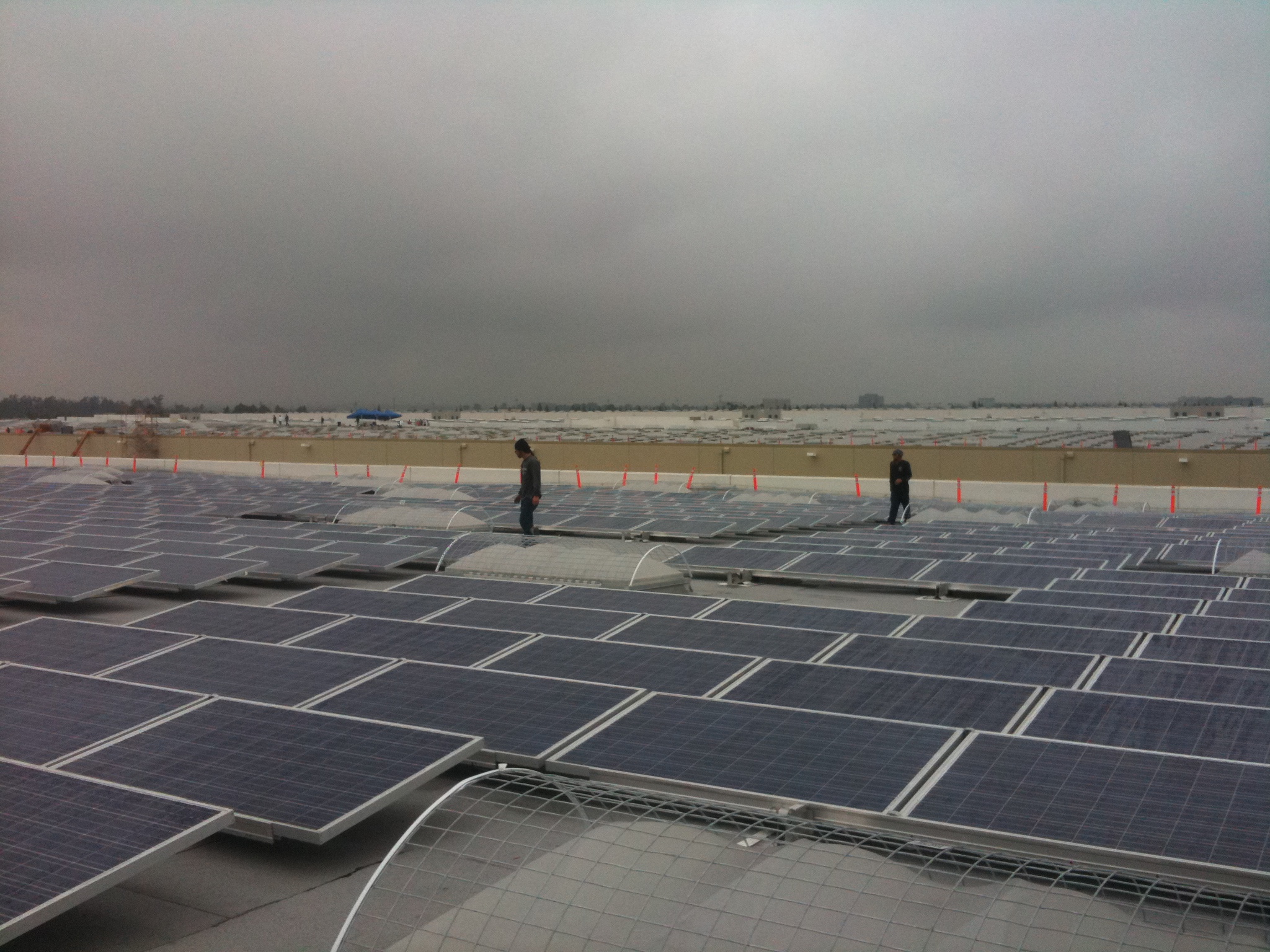
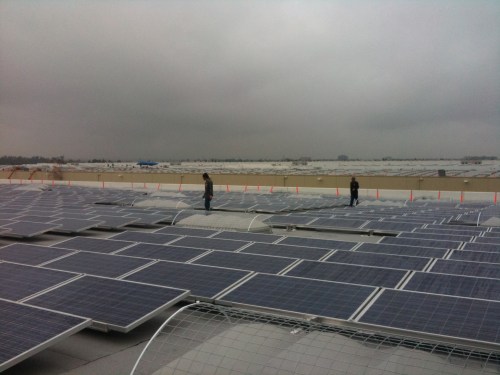
On a roof the size of several football fields, workers are busy installing 11,591 solar panels that will generate 2.55 megawatts of electricity. Across the street is another massive warehouse blanketed in photovoltaic panels. Beyond that lie two more warehouses with solar arrays under construction.

Warehouses themselves use relatively little electricity, so owners lease their roofs to utility Southern California Edison, which own the solar arrays and feeds the power they produce into the grid. Over the next five years, the utility will install 250 megawatts worth of photovoltaic panels on big commercial rooftops and buy an additional 250 megawatts from solar developers that will build and operate warehouse arrays. At peak output, those solar arrays will generate as much electricity as a mid-sized fossil-fuel power plant.

“In the Inland Empire you’ve got big buildings and good sun,” Rudy Perez, manager of the utility’s solar rooftop program, said as we stood on the top of the warehouse where solar panels covered the roof as far as the eye could see.

He noted that the number of applications from solar developers to connect rooftop photovoltaic projects to the grid has tripled in the past six months alone.

“It’s one thing when you have one building in an area with a big solar array, another when you have five,” said Perez. “As you get into the higher and higher numbers, that’s where you really need smart grid technology.”

That’s because the rise of renewable energy and electric cars will vastly complicate how the power grid operates.

“We could literally have more change in the system in the next 10 years than we’ve had in the last 100 years,” Theodore F. Craver, Jr., chief executive of the utility’s parent company, Edison International, said in an interview after meeting with executives from French utility giant EDF. The French had come to Los Angeles to learn about Southern California Edison’s smart grid efforts.

In the current, mostly analog grid, the distribution of electricity is fairly straightforward. A utility or another company builds a fossil-fuel-powered plant and flips the switch. For the next 30 years or more, electricity flows into high-voltage transmission lines hour after hour, day after day.

The transmission lines carry the electricity to a distribution system where transformers “step down” the power to a lower voltage and then send it to homes and businesses. And though technological improvements have been made over the decades to the grid, it remains essentially a one-way system. And while storms and accidents can bring down power lines and blackouts can occur when demand soars on a hot day and electricity generation can’t keep up, power flows 24/7 from a natural gas or coal-fired plant.

Now consider the challenges posed by intermittent sources of electricity like solar and wind, not to mention the prospect of thousands of cars plugging into the grid at once to recharge their batteries.

“A rolling cloud can cut electrical output by 80 percent in a just few seconds,” says Perez. “That’s one reason why we have to be smart about where we put [solar].”

And why it’s necessary to build a digitalized grid that deploys software, sensors, and other hardware to monitor and manage electricity distribution and troubleshoot problems.

Instead of relying on dozens of big power plants, the smart grid of the future will increasingly tap thousands or millions of individual rooftop power plants and wind turbines. It will need to collect information about their electricity output and balance the flow of electricity throughout the grid — to ensure that a neighborhood doesn’t go dark because a large cloud is hovering over the solar array atop the local Costco.

“As we start to replace more of the generation with different technologies, we are altering the physics of the system,” said Pedro Pizarro, Southern California Edison’s executive vice president of power operations.

This drizzly October morning is a case in point. A ceiling of gray clouds hangs over the four Ontario warehouses that altogether would be generating some 7.59 megawatts if the sun were shining at peak intensity. So the smart grid also needs to be able to forecast the weather and know, say, that for the next few days electricity production is going to fall in one area while it might rise another, sun-splashed one.

“There’s new technologies that allow for much precise control of the grid,” Perez said. “One of the concerns would be that the intermittency of one of these buildings causes problem for our customers.”

Down the coast at the University of California, San Diego (UCSD), researchers have built what looks like a mirrored hemispherical bowl that scans the skies and snaps two photos a minute to predict when clouds will form over the campus’ one-megawatt worth of solar panels that are installed at seven locations.

“We do a 3-D characterization of all clouds on the horizon every 30 seconds,” Byron Washom, director of strategic energy initiatives at UCSD, said at a solar conference in October. “And then in the next second we note its vector, its speed, its height, its opacity and we characterize it.”

“So we actually begin to forecast what type of cloud is going to intersect where the sun is,” added Washom. “We know where it is at all times in the sky [in relation to] each individual panel on campus.”

He said the scientists’ goal is to be able to use the machines, which cost $12,000 apiece and have a range of one kilometer (0.62 miles), to do hourly forecasts with 90 percent accuracy.

“So a capital investment of less than $1 million could bring this to the Southern California rooftop market if we crack the science,” said Washom, referring to the concentration of warehouses in places such as Ontario.

Another smart grid strategy is to store energy generated by solar arrays in batteries and feed power to the grid when renewable energy production falls or demand spikes.

Washom showed a picture of a device that looks like the back end of a DVD player. The Sanyo lithium ion battery can store 1.5-kilowatt hours of electricity. UCSD plans to stack them like servers in a data center so it can store 1.5 megawatts of electricity produced by campus solar arrays.

In the San Francisco Bay Area, SolarCity, a solar panel installer, and electric carmaker Tesla Motors have received a $1.8 million state grant for a pilot project that will put lithium ion car batteries in half a dozen homes with rooftop solar arrays.

The Sacramento Municipal Utility District (SMUD), meanwhile, plans to install lithium ion batteries in 15 residences as part of its smart solar homes program. The utility will also put two 500-kilowatt batteries near substations to test energy storage on a larger scale.

Such systems are expensive but if the price eventually falls, utilities would be able to use them to release power to the grid when, say, a one of Washom’s cloud-forecasting devices predicts electricity production will fall off. (SMUD also will deploy 70 solar stations to help it forecast weather conditions that could affect electricity production, according to Mark Rawson, the utility’s project manager for advanced, renewable and distributed generation.)

So will the smart grid and increasing production of rooftop solar and other renewable energy spell the end of big centralized power stations and the multibillion-dollar transmission infrastructure? Will the future bring some sort of Ecotopian nirvana where power is put in the hands of the people (or at least on their rooftops)?

Not anytime soon, according to Pizarro of Southern California Edison, barring technological breakthroughs that dramatically reduce the cost of photovoltaic power.

“Right now solar is increasing but it’s not overwhelming the system,” says Pizarro, noting that rooftop photovoltaics remain a tiny percentage of the overall power supply even in places like California, where utilities must obtain a third of their electricity from renewable sources by 2020.

Still, renewable energy “has the potential to reduce the generation from central stations,” Pizarro said. “It’s a question of how much and how soon.”

The other wild card is the price of oil and natural gas, notes Craver, Edison’s chief executive. When the cost of natural gas — the dominant energy source in California — rises, renewable energy becomes more attractive. When natural gas prices plunge, as they have over the past couple of years, installing solar becomes far more expensive in relative terms.

At last month’s solar conference, SMUD’s Rawson said his utility currently relies on photovoltaics, or PV, for less than one percent of its electricity generation. But that will likely change dramatically in the years ahead, he says, as the smart grid evolves to handle the widespread distribution of solar power.

“We’re trying to change PV from something that is tolerated by the utility to something that is controlled by the utility,” he said.

I wrote this story for Grist, where it first appeared.

This week’s election once again showed California as a true-blue state, with Democrats taking the governorship and other top offices in a landslide (though the race for state attorney general remains too close to call). But truth be told, California is a true blue beach state, with the heavily populated, mostly Democratic coast bordering a vast inland red sea.

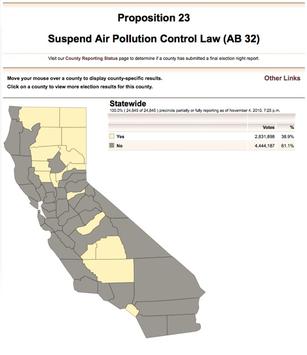
Still, it when came to the overwhelming defeat of Proposition 23 — the ballot measure that would have suspended California’s landmark global warming law — California was a remarkably green state, from Malibu to the Sierra Nevada, from remote Del Norte County on the Oregon border to San Diego.

County-by-county election results from the California Secretary of State’s office show a rout of the Texas oil companies bankrolled Prop 23 not only in places like San Francisco (where No forces took 82 percent of the vote) and Los Angeles (with a 67.6 percent No vote) but in conservative, Tea Partying strongholds.

For instance, while the inland Southern California counties of Riverside and San Bernardino went for Meg Whitman, the Republican candidate for governor, over Democrat Jerry Brown, they voted No on 23.

In fact, except for a handful of sparsely populated counties in the far north and center of the state (along with such outliers as Orange County), most of California’s conservative heartland voted to preserve the climate change law that requires greenhouse gas emissions to be cut to 1990 levels by 2020.

Even in San Diego County, heavily populated and heavily Republican, 55.8 percent of voters cast ballots against Prop 23.

The fact that the No campaign raised three times as much cash as the Texas oil companies and assembled a broad-based, bipartisan coalition of environmentalists, unions, venture capitalists, hedge fund managers, big corporations, and environmental justice activists certainly was key to the election.

And the No forces’ message that Prop 23 would kill green jobs seemed to resonate in counties like Riverside and San Bernardino, where the unemployment rate has hit 15 percent this year.

Those counties also happen to be home to a large number of planned renewable energy projects. In the weeks leading up to Election Day, state and federal regulators approved big solar power plants that officials estimate will create more than 8,000 jobs in a region where the housing collapse has devastated the building industry.

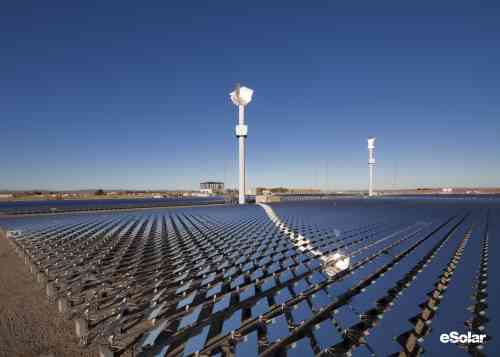
Two weeks before the election, I was out in the Mojave Desert as construction began on BrightSource Energy’s 370-megawatt Ivanpah solar thermal power plant. Over the next three years, Ivanpah will employ 1,000 workers.

One of them, Basilio Yniguez, a 36-year-old father of seven from San Bernardino County, told me he had been out of work for a year.

“Thanks to the green thing going up, I’m working,” he said.

And given that 61.1 percent of California voters voted against Prop 23, that green jobs message apparently worked as well.

photo: eSolar

I wrote this story for Sustainable Industries, where it first appeared.

The landslide defeat Tuesday of Proposition 23, the California ballot measure that would have suspended the state’s landmark global warming law, was not enough to stop Proposition 26, another initiative that could complicate efforts to launch a cap-and-trade market in the Golden State.

Prop 26, which like Prop 23 was backed by the oil industry, will reclassify some environmental fees as taxes that will require a two-thirds vote of the state Legislature to impose. Some environmentalists and green business owners fear that would hinder the implementation of California’s global warming law, known as AB 32.

But on Wednesday, a top California official said that since Prop 26 applies only to laws enacted after Jan. 1, it should not affect AB 32, which was signed into law by Gov. Arnold Schwarzenegger in 2006.

“We do not believe our efforts will be derailed as a result of Proposition 26 passing,” Mary Nichols, chair of the California Air Resources Board, the agency charged with implementing AB 32, said during a conference call with reporters on Wednesday. “It’s full speed ahead.”

“There is a scoping plan already in the process of being implemented,” she said.

AB 32 requires California to cut greenhouse gas emissions to 1990 levels by 2020. Last Friday, the Air Resources Board released its proposed plan to create a cap-and-trade market that would impose emissions limits on some industrial sectors beginning in 2012.

Questions  — and possible legal battles — remain, however, about how Prop 26 would affect any future fees imposed on polluters as a result of AB 32.

“Many, many programs will be affected,” said Annie Notthoff, California political director for the Natural Resources Defense Council, referring to Prop 26’s impact on other environmental efforts. “But the broad objectives of AB 32 are not affected at all.”

You can read the rest of the story here.

photo: Todd Woody

I wrote this story for Grist, where it first appeared.

When you mix red and blue in a state like California, you get green.

Tuesday’s landslide defeat of Proposition 23 — the ballot measure bankrolled by Texas oil companies Tesoro and Valero that would have suspended the state’s landmark global-warming law — marked the emergence of a bipartisan, enviro-business coalition that spanned the demographic divide.

With nearly all ballots counted Wednesday morning, 61.3 percent of voters rejected Prop 23 in the nation’s first statewide plebiscite on a climate-change law.

Equally important, voters swept into California’s top offices a slate of environmentalists led by Gov.-elect Jerry Brown of Oakland. In what amounts to a takeover of Sacramento by Bay Area deep green Democrats, San Francisco Mayor Gavin Newsom was elected lieutenant governor and Kamala Harris, San Francisco’s district attorney, looks like she will become the attorney general if her narrow lead holds. Both Brown and U.S. Sen. Barbara Boxer decisively dispatched Republican candidates who opposed or would undermine the global-warming law, known as AB 32.

Brown, of course, set California down the green path in the 1970s during his first term as governor. He pushed renewable energy projects, energy efficiency, and other policies that would set the stage for the state’s green tech boom and that would be embraced by a successor (and now a predecessor), Gov. Arnold Schwarzenegger (R).

And the passage of Proposition 25, which allows the state legislature to pass a budget with a simple majority rather than a two-thirds vote, should ease the way for the passage of a green agenda.

But voters also threw a spanner in the works on Tuesday when they passed oil industry–backed Proposition 26, which will reclassify certain environmental fees as taxes and require a two-thirds vote of the legislature to impose them. It remains unclear how exactly that will hinder the implementation of AB 32.

The question now is whether Tuesday’s election is another example of California exceptionalism or a template for other states (given that chances for congressional action on climate change seem slim to none).

And so does this new green alliance — of big environmental groups, Silicon Valley venture capitalists and tech giants, hedge-fund managers, old economy businesses, and environmental-justice activists — continue or wither now that the threat to AB 32 has passed?

Clearly, many in the No on 23 coalition see the defeat of the ballot measure as the beginning, not the end, of a much larger campaign.

“Great campaigns are ones that win the victory you want but also build power for the long haul,” Danny Kennedy, cofounder of Oakland solar company Sungevity and a former Greenpeace activist, said at a Prop 23 fundraiser in September that brought together hedge-fund titans and venture capitalists with environmental-justice advocates. “And this is one of those,” he told the crowd. “This is a really fun opportunity because we’re going to beat those boys back to Texas where they came from and we’re going to build this beautiful thing we see in the seed of this group in this room.”

Bob Epstein, a founder of E2 Environmental Entrepreneurs, said at the group’s conference in San Francisco last week, “if we want to build this into a national movement, state by state, the messaging is critical.”

“Every campaign has three items: It has a victim, it has a villain, and it has an opportunity,” said Epstein. “The No side says, ‘Stop the dirty energy proposal brought to you by two Texas oil companies.’ It’s all emotional. The reason? It will make the air dirtier, it’ll harm our clean energy jobs, and it’ll keep us on fossil fuels. The victim: Anyone who breathes air near a refinery. The villain: In this case, Valero volunteered.”

On the Natural Resources Defense Council blog, Annie Notthoff, the group’s California political director, analyzed the election. “We have pitched a very large tent, and we accommodate people of all political points of view,” she wrote. “But we agree on a couple of things, and those transcend all our differences: We need to get people working, and we need to develop new sources of clean, domestic energy that support the economy and improve public health. Until we do that, everything else is a sideshow.”

photo: White House

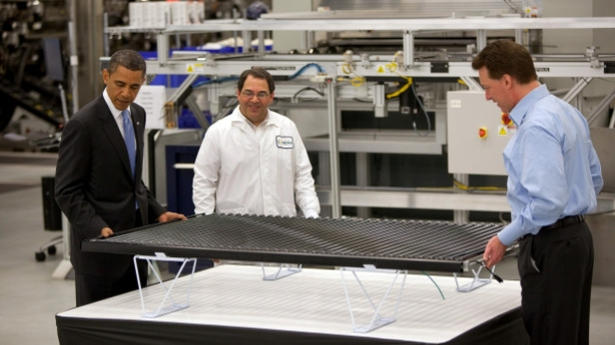
In Wednesday’s New York Times, I have an exlusive about Silicon Valley solar startup Solyndra’s move to shutter a factory and lay off workers just weeks after it opened a state-of the art plant built with a half-billion-dollar federal loan guarantee:

SAN FRANCISCO — Solyndra, a Silicon Valley solar-panel maker that won half a billion dollars in federal aid to build a state-of-the-art robotic factory, plans to announce on Wednesday that it will shut down an older plant and lay off workers.

The cost-cutting move, which will reduce the company’s previously announced production capacity, is a sign of the notable shift in the prospects for cutting-edge American solar companies, which now face intense price competition from Chinese manufacturers that use more established photovoltaic technologies.

Just seven weeks ago, Solyndra opened Fab 2, a $733 million factory in Fremont, Calif., to make its high-tech solar panels. The new plant was supposed to be the first phase of a rapid expansion of the company.

Instead, Solyndra has decided to shutter the old plant and postpone plans to expand Fab 2, which was built with a $535 million federal loan guarantee.

“Fab 2 is much more efficient and cost-effective than our existing facility,” Brian Harrison, Solyndra’s chief executive, said in an interview. “We’re adjusting our plans to be more in line with where the market is and where our business is at the moment.”

When Solyndra filed for an initial public stock offering in December, it estimated it would have a total production capacity of 610 megawatts by 2013 if its two plants were fully built out. The company now expects it have capacity of 285 to 300 megawatts by 2013.

Solyndra abandoned plans for the stock offering in June, citing market conditions.

The company is the most prominent of a wave of Silicon Valley solar start-ups that hoped to transform the economics of the industry. Gov. Arnold Schwarzenegger of California and Energy Secretary Steven Chu helped break ground on Fab 2 last year, and President Obama made an appearance at the unfinished factory in May to extol Solyndra’s innovative technology.

Mr. Harrison noted that the market had undergone a significant shift since Solyndra filed for the stock offering, with solar module prices plummeting as low-cost Chinese manufacturers like Suntech and Yingli ramped up production.

You can read the rest of the story here.

I wrote this story for Grist, where it first appeared.

As voters head to the polls Tuesday, opponents of Proposition 23, the California ballot measure that would suspend the state’s global warming law, are hoping the San Francisco Giants’ win over the Texas Rangers augurs well for the outcome of the election.

The latest polls show Prop 23, which is backed by Texas oil companies and the petrochemical industry, heading to defeat, though a large number of voters remained undecided.

(The No on 23 campaign ran a full-page ad in the sports section of the San Francisco Chronicle during the World Series urging fans to defeat Texas at the polls and the baseball park.)

The lack of enthusiasm for Prop 23 could be seen in the final fundraising disclosures filed with the California Secretary of State’s office.

As the election ends, the No on 23 forces have raised $31.3 million to the Yes effort’s $10.7 million. In the final week of the campaign, the Yes campaign raised only $6,000, including a $5,000 donation from NACS, previously known as the National Association of Convenience Stores.

Prop 23 opponents continued to rake in the cash right up to Election Day, with more than $766,000 filling coffers in the final week of the campaign. Among the big contributors in the last week was the California Democratic Party, which gave $224,534. Sempra Energy, which owns one of the state’s largest utilities, San Diego Gas & Electric, made another $25,000 contribution.

That fundraising prowess is in part a reflection of the broad-based coalition the No on 23 campaign put together. Among those making common cause to preserve California’s climate change law are national environmental groups, Silicon Valley venture capitalists and tech giants, hedge fund managers, old economy businesses, and environmental justice activists.

The global warming law, known as AB 32, requires California to cut greenhouse gas emissions to 1990 levels by 2020. Prop 23 would suspend the law until the state unemployment rate — currently 12.4 percent — falls to 5.5 percent for four consecutive quarters, something that has happened only three times in the past four decades.

Design a site like this with WordPress.com
Get started