Feeds:
Posts
Comments

Fortune associate editor Julie Schlosser reports from Fortune’s Brainstorm Green conference:

PASADENA, Calif — Consumers are feeling the pressure to go green. And it’s hard to ignore. Drinking bottled water is a definite no no. Flying across the country? Buy offsets. The consumer is being bombarded with green marketing and advertising and the result might not be what you expected. All this green guilt and messaging just might be making consumers more skeptical about the growing assortment of green products.

When polled, most consumers overwhelmingly say they want to buy green, according to Joel Makower, head of Greener World Media and author of The Green Consumer. But they aren’t actually doing it. According to the research, Makower says, “If it is green, consumers assume it isn’t good.” And that means, in many cases, green products are entering the marketplace with a deficit.

That was part of the discussion at Monday afternoon’s panel, “The Green Consumer: Myth or reality?” Andrew Shapiro, founder and CEO of GreenOrder, a strategic consulting firm that works with big brands such as GE (GE), GM (GM), Starwood (HOT) and Office Depot (ODP), moderated the panel that included Stonyfield Farm founder Gary Hirschberg, Elizabeth Lowery of GM, and Makower.

Hirschberg, the CE-Yo (yes, you read that correctly) of Stonyfield Farm, the world’s largest organic yogurt company, has a fun story to tell. He took organic yogurt into the mainstream long before organics were cool, and he has built a $300 million-per-year business along the way. He has also managed to incorporate green principles throughout the product’s life cycle. “But we don’t even use the word green when we describe what we do,” he pointed out.

Still, he argues, there is obviously a green consumer. “But we think they are more focused on quality.” And the quality does something that millions of dollars in advertising can’t. It creates loyalty, says Hirschberg. “And if loyalty comes from an emotional place, authenticity is the key to creating it.”

What consumers are showing us is that if your company has a high “talk-to-do ratio” when it comes to going or being green, you’ll lose the consumer’s trust immediately. By adopting a sense of humility and focusing on communicating honestly with your consumers, Hirschberg argues, companies can build loyalty.

So how does a company build such a relationship with their customer? By offering them a premium product and one that isn’t just greener, but tastes better, lasts longer, or is more aesthetically pleasing. And as the economy continues to slow, the best way to get a consumer to go green is to give them the goods for less.

Fortune editor-at-large David Whitford reports this week from Fortune’s Brainstorm Green conference:

PASADENA, Calif — Climate-change legislation is coming, that’s the first point to emerge Monday from two panels at Fortune’s Brainstorm: Green conference — one that looked at politics and policy, the other at the costs, risks and opportunities that await us all in a carbon-constrained America. But new regulations may not be coming as fast as we think, that was one surprise. And by itself, legislation won’t be enough.

None of the experts who spoke could imagine a bill of any kind being signed into law within the next year at the earliest. Most stretched the timetable to as far as 2011. There are lots of reasons for that, but here’s what it comes down to, says California Attorney General (and former governor) Jerry Brown: “The threat [of global warming] is more obscure to the average person, and the costs [of legislation] are very real.” That clash, he says, “will make significant climate change legislation rather difficult.”

A lot revolves around coal. It doesn’t matter how some House Democrats may feel about the need for prompt action to stave off global warming. As long as they represent coal districts (as 27 of them do), they’ll have a hard time passing a law that hurts their constituents’ pocketbooks. The challenge lies in devising legislation that’s tough enough to do the job, says Fortune’s Marc Gunther, but not so tough that it has no chance of ever being approved.

Fred Krupp, who leads the Environmental Defense Fund, was hopeful nonetheless. He sees an “enormous upwelling of pressure” within the business community that will make a cap-and-trade system for reducing carbon emissions a reality in the next 18-24 months. “America has to get on with this,” he said, and not just in the policy arena.

Want to be the next Bill Gates or Warren Buffett? Krupp asked. Enormous rewards await those who can devise ways to suck carbon out of smokestacks, or even out of the air. “If we use the profit motive,” Krupp said, “and only if we use the profit motive, we will solve this.”

PASADENA, Calif. — Norwegian electric carmaker Think Global is bringing its zippy urban runabout to the United States.

On Monday at Fortune’s Brainstorm Green conference, Think launched its North American operation with Silicon Valley venture capitalist heavyweight Kleiner Perkins Caufield & Byers and Boston’s Rockport Capital Partners as lead investors.

Think North America will sell the Think City, its two-seater battery-powered car, as well as a forthcoming five-seater called the Think Ox.

“We thought this would be a wonderful vehicle to bring to the U.S.,” said Kleiner partner Ray Lane. He’ll serve as chairman of Think North America, which will be a 50-50 joint venture between Think and Kleiner/Rockport. They declined to put a price tag on the investment but Lane said “we’ll invest what it takes.”

The Think City began rolling off the production line in Norway earlier this year and Think already has announced it will sell the car in France, the U.K. and Scandinavia. With its current battery, the City can go about 110 miles on a charge at a top speed of around 62 miles an hour. Lane said Think North America aims to sell the car in the U.S. market for less than a Toyota (TM) Prius, which retails for around $25,000. Batteries being developed by Think’s partners A123Systems in collaboration with General Electric (GE) will boost the range and top speed, Willums has noted.

“This is not just a one-off kind of deal,” says Rockport’s Wilber James, who is serving as Think North America’s president while a CEO search is underway. “Being venture capitalists, we’re on the cutting edge in battery technology. We’re not just passive investors; we’re very active in this company.”

Think CEO Jan Olaf-Willums, who appeared on stage with Lane and James, said he hopes to sell a few thousand cars next year — starting in California — and then ramp up to 30,000 cars. “We can put assembly plants anywhere in six months,” said Willums, referring to Think’s $10 million modular factories.

James and Lane seemed taken with the little electric. “I had the privilege of sitting in back of the City while Ray Lane drove the car with Jan-Olaf through the streets of Geneva,” said James. “It’s a fun car to drive.”

Green Wombat can confirm that. I drove a Think City last year when I visited Willums in Norway for a story I wrote for Business 2.0 magazine. The stylish two-seater with the roof-to-bumper glass hatch accelerates like a sports cars, thanks to the instant transmission of power from the electric motor to the wheels.

Willums brought two Thinks – one a sporty orange convertible, the other a black coupe — to Pasadena. “That will be a big seller in Los Angeles,” Lane told Green Wombat as a crowd gathered around the cabriolet in the Southern California sunshine outside the Langham hotel in Pasadena.

Since I drove the City last, it’s been been upgraded with an interactive, Internet-enabled touchscreen. The City will sync with your home computer, download your schedule, your shopping list and monitor your battery usage and driving habits, according to Dipender Saluja, whose Silicon Valley startup, Automatik, is developed the the technology to create what Willums calls a “computer on wheels.” The onboard system is designed to communicate with a smart utility grid so that the owner can be charged or credited for the electricity consumed or returned back to the grid from the car’s battery.

On Monday, I got behind the wheel of the Think City that sported a large sunroof and took a quick spin around the hotel grounds with Willums. Version 2.0 of the car was a more refined iteration of the pre-production car I drove last year in Norway but still a blast to drive.

Lane and Willums said Think will begin by selling a few thousand cars to corporate fleets. He also said Think North America is in discussions with utilities like PG&E (PCG).

PASADENA, Calif. — Solar power plant builder eSolar has raised $130 million from Google’s philanthropic arm, Google.org, and other investors.

That was the headline news that eSolar chairman and Idealab founder Bill Gross slipped to Green Wombat during dinner Sunday night as Fortune’s Brainstorm Green conference kicked off in Pasadena. The other investors include Idealab and Oak Investment Partners. Big numbers grab attention but the far more interesting angle is the technology that eSolar is developing. If it lives up to its claims, eSolar could help break the logjam that has put Big Solar on the slow track in California.

“We just completed tests at our test site this week and we will be able to produce electricity that is competitive with coal,” said an animated Gross Sunday evening.

That is the Holy Grail of renewable energy and the charge set out by Google (GOOG) founders Sergey Brin and Larry Page when they launched their green power initiative, RE<C (Renewable Energy less than Coal), in November. Google.org subsequently invested $10 million in Pasadena-based eSolar. (eSolar did not say how much of the $130 million Google.org ponied up in the latest round.)

eSolar has been operating in stealth mode but Gross shared details of the company’s technology and how it intends to produce greenhouse gas-free electricity so cheaply — a claim sure to be met with some skepticism by competitors like Ausra, BrightSource Energy and Solel.

At first glance, there doesn’t seem much radically different about an eSolar solar thermal power plant — it’ll use fields of mirrors to focus the sun’s rays on a tower containing a water-filled boiler. The resulting heat will create steam that will drive an electricity-generating turbine.

The tipping-point innovation, according to Gross, is the mirrors and the software that controls them as well as the modular design of the power plants.

While Oakland, Calif.-based BrightSource is developing a similar system, Gross says eSolar is able to use smaller mirrors — called heliostats — that can be cheaply mass produced from off-the-shelf glass like that used in bathroom mirrors. Proprietary software developed by eSolar controls each sun-tracking mirror, increasing their efficiency to produce more electricity. “It’s all about the software,” Gross said.

Smaller more powerful solar fields means that eSolar can build power plants on far less land than competitors for less money, according to Gross. For instance, a 500-megawatt solar power plant can cost more than $1 billion to build and requires thousands of acres of land — which is why most will built in remote deserts. But eSolar plans to build modular, 33-megawatt power plants that can be constructed on a couple hundred acres and plugged into existing transmission lines near urban areas.

“We’ve already bought up rights to enough land to produce more than a gigawatt of electricity,” said Gross, showing Green Wombat a map of California polk-a-dotted with the locations of potential eSolar power plants. A gigawatt can power about 750,000 homes.

The small size of each power plant has another benefit — solar thermal power stations under 50 megawatts do not have to be licensed by the California Energy Commission. That means eSolar can cut at least a year or two off the process of getting a solar power plant online.

That will certainly be attractive to the Golden State’s big utilities — PG&E (PCG), Southern California Edison (EIX) and San Diego Gas & Electric (SRE) — which face a mandate to obtain 20 percent of their electricity from renewable sources by 2010 and 33 percent by 2020.

Although all those utilities have signed massive megawatt deals with solar energy companies, no plant has been yet built.

Gross says that while eSolar has been talking to the utilities it’s not going to wait to have a power purchase agreement in hand before building its first plant.

“Sergey said to go for it and we are.”

For longtime Australian Greenpeace activist Danny Kennedy, one of the environmental group’s more memorable moves was when the Sydney crew climbed the roof of the prime minister’s home and installed solar panels to protest the government’s preference for Big Coal over renewable energy. (Note: Do not try this on the White House.)

These days, there’s a new, greener PM in power and Kennedy is in California, running a solar startup that aims to minimize the time spent on rooftops by doing for the solar business what Dell did for personal computers: Digitizing the entire enterprise to cut costs and create a mass market.

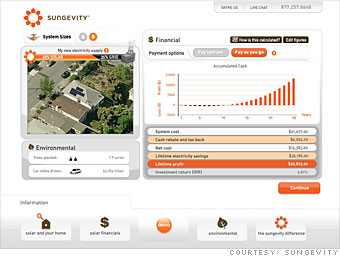
Putting photovoltaic panels on residential rooftops remains largely a labor-­intensive cottage business, often involving multiple visits to a client’s home to make the sales pitch, measure the roof, and design a custom system. Sungevity, which officially launches Tuesday on Earth Day, takes all that online.

Enter your address on its website, and satellite-imaging software zooms in on your home, and Sungevity’s proprietary algorithm calculates the roof’s dimensions — the pitch and azimuth — selects appropriately sized solar arrays, and shows what they will look like installed — while computing your return on investment. Once the order is placed, one of five off-the-­shelf prepackaged solar arrays is shipped to the customer’s door, and an installation crew is dispatched. A database tracks local building and permit requirements, sending the necessary forms to the homeowner for their signature while beaming local regulations governing solar arrays to the installation crew.

“This changes the game,” says Kennedy, 37, who co-founded Sungevity last year after leaving Greenpeace and relocating from Sydney to Berkeley. (Full disclosure: Kennedy’s kids and Green Wombat’s son attend the same elementary school.)

Kennedy and his partners have raised $2.7 million from investors that include German solar giant Solon and actress Cate Blanchett. “Our technology allows us to size up an entire city remotely and work out what the solar potential of the roof space is,” adds Kennedy, who will be speaking at Fortune’s Brainstorm Green conference on Monday. “This is the real secret sauce, the thing that rocks the house.”

Says Joe Kastner, an executive with solar financier MMA (MMA) Renewable Ventures: “If you do a lot of site visits, that can end up being a big portion of the cost. Anything that can make these projects more efficient and cut the costs on the front end is good.” He adds that Sungevity may appeal to potential customers accustomed to managing their lives online and who are loathe to hang out at home waiting for solar sales or service people to show up. “I would be interested in doing as much as possible over the Internet,” Kastner says. “There’s definitely a market for it.”

Rather than employ its own installers, Sungevity will work with unions to train electricians and other contractors so that it can tap pools of green-­collar workers in local markets. “That’s probably long-term what’s most needed to achieve a million solar roofs,” says Kennedy, referring to California’s solar target. “[Solar panel] supply is not the big constraint. The real issue is labor — it’s the limiting factor in the growth of the industry.”

At the company’s Berkeley offices down the street from Chez Panisse, Kennedy and Andrew Birch, a board member and solar economics expert, run through a live demo of the Sungevity system. In about 15 minutes, a spokesmodel had walked a potential customer through the sales pitch and ordering process while on the backend a consultant is sizing up the roof with the software tools. Within a day or so an e-mail will be sent to the customer with different solar array options and the relative return on investment. “With a traditional solar installer, that would have been about a two week process,” says Kennedy.

Whether this all works so smoothly once volumes of real-life orders start coming over the transom remains to be seen, of course. And the limits of the system become apparent when Birch types in my Berkeley address and the picture shows a large Japanese maple overhanging my house, which would have ruled out a solar array except the tree had been removed a year and a half earlier. Kennedy acknowledges that leafy cities like Berkeley with its mishmash of architectural styles and every-which-way rooflines are problematic. Instead, Sungevity’s target market is middle-American suburbia, with its vast tracts of cookie-­cutter houses.

That’s just fine with potential rival SolarCity, the Foster City, Calif., solar installer backed by PayPal co-founder and Tesla Motors chairman Elon Musk. “Their technology works very well for track homes — that’s maybe 2% of our business,” says SolarCity CEO Lyndon Rive. “Our market is more retrofit homes, existing homes in well-established areas that are looking to go solar.”

“I like it when companies like Sungevity get into the market,” he adds. “They’re forcing innovation and the most important thing is the widespread adoption of solar.”

Sungevity’s launch comes as utilities like Southern California Edison (EIX) and PG&E (PCG) and tech giants like Google (GOOG) are pushing for a mass expansion of solar energy.

Nat Kreamer, president of San Francisco-based solar installer Sun Run, says Sungevity’s move to digitize the solar business is valuable but it will have to focus on the installation process to really get costs down. “Once you figure out how to size up someone’s system, the challenge is the speed you can get it built,” he says.

Installation costs account for roughly half of a solar system’s cost and solar installers like Akeena Solar have developed modular arrays containing wiring and other components to minimize the time spent on installation.

Sungevity will not focus on zeroing out customers’ electricity bills, but like Sun Run, will push the “hybrid home” – selling smaller, cheaper solar systems that will cover that portion of a home’s electricity use that is the most expensive to buy from a utility.

For instance, after rebates, a standardized Sungevity solar array for a four-bedroom home in Northern California will cost about $21,000 and deliver an estimated return on investment of 13% over the system’s 25-year life.

“We’re selling this as an economic asset,” says Kennedy, “not just as a way to go green.”

brightsource_energy.jpgCalifornia utility PG&E on Tuesday announced contracts to buy up to 900 megawatts of electricity generated by solar power plants to be built in the Mojave Desert by BrightSource Energy. It’s one of the biggest solar deals to date — enough to power some 600,000 homes — and is another sign that that the shift from fossil fuels to carbon-free energy is well underway, at least in California.

But is it too late? PG&E (PCG) first announced it was negotiating a power purchase agreement with BrightSource, then called Luz II, on Aug. 10, 2006. Around that time, the United States’ leading climate scientist, NASA’s James Hansen, warned that the world had only a decade to take drastic action to cut carbon emissions and avert future catastrophe from global warming.

It took nearly two years alone to just hammer out the PG&E-BrightSource deal and the world now has eight years left to radically ramp up alternative energy sources. By the time the first BrightSource 100-megawatt solar power plant (image above) goes online it will be 2011 and the last one will begin generating electricity for PG&E just as the climate change alarm clock goes off. If you believe Hansen, hitting the snooze button will not be an option.

Of course, there’s no guarantee the BrightSource plants will actually be built — it will take billions to construct them and the investment climate is not exactly sunny these days, clouded by Wall Street’s meltdown and the looming expiration of a crucial solar investment tax credit. (Personally, Green Wombat is betting BrightSource pulls it off — though April Fool’s Day probably was not the best date to unveil such a deal. The Oakland, Calif.-based company was founded by solar pioneer Arnold Goldman, its CEO, John Woolard, hails from Silicon Valley and the startup is backed by Morgan Stanley (MS) and some savvy venture capitalists. )

Given the moral and regulatory imperative — California utilities must obtain 20 percent of their electricity from renewable sources by 2010 and a third by 2020 — why is large-scale solar proceeding at the pace of a Mojave Desert tortoise? (Almost three years ago, for instance, Southern California Edison (EIX) and San Diego Gas & Electric (SRE) unveiled agreements with Phoenix’s Stiring Energy Systems to buy up to 1,750 megawatts of solar electricity. Ground has yet to be broken on any of the planned power plants.)

Partly it’s because the years-long negotiations between utilities and solar power plant companies is something of a black box. Details of these power purchase agreements are kept confidential but are estimated to be worth billions — if a recent $4 billion dealstruck by utility Arizona Public Service with solar power plant builder Abengoa Solar is any indication. Regulated utilities are by their nature big and bureaucratic and can be expected to be extra-cautious when they’re placing bets on untried solar technology from companies like BrightSource and Ausra.

“Transactions of this magnitude require a fair amount of time to negotiate and due diligence must also be performed,” PG&E spokeswoman Jennifer Zerwer told Green Wombat in an e-mail. “The original [BrightSource agreement] announced in August 2006 was for 500 megawatts; the final agreement expanded on the original . . . and culminated in the execution of five separate power purchase agreements for up to 900 MW.”

Another factor is a regulatory structure that is an artifact of the fossil fuel age. California requires extensive environmental review of new power plant projects — be they clean and green or down and dirty — a process that can take a 18 months or more. And the best solar sites often are on federal land in the Mojave — securing a lease for that land is another 18-month-long process.

Still, one looks to history. When the United States entered World War II, it retooled its factories in a matter of months to produce planes and tanks. Climate change is an amorphous but no less dangerous threat and speeding up the regulatory timetable will be crucial in the fight against global warming.

The clock, after all, is ticking.

img_2698.jpg

Southern California Edison plans to install 250 megawatts’ worth of solar panels on commercial rooftops, generating enough electricity to power 162,000 homes.

It’s a potentially game-changing move, one that could lower the cost of solar cells as manufacturers ramp up production to meet the utility’s schedule of installing a megawatt-a-week of arrays until it reaches the 250-megawatt target. That alone is more than United States’ entire production of solar cells in 2006 and will generate as much electricity as a small coal-fired power plant, albeit with no greenhouse gas emissions. “This project will turn two square miles of unused commercial rooftops into advanced solar generating stations,” said John Bryson, CEO of the utility’s parent company, Edison International (EIX), in a statement Wednesday night.

The $875 million initiative also marks the first big foray into so-called distributed energy by a major utility. Instead of building a centralized power station and the expensive transmission system needed to transmit electricity to the power grid, Edison will connect clusters of solar arrays into existing neighborhood circuits. A significant hurdle for the massive megawatt solar power plants planned for California’s Mojave Desert is the need in some cases to build multi billion-dollar transmission systems through environmentally sensitive lands to bring the electricity to coastal metropolises.

Solar arrays of course only generate electricity when the sun is shining, but they produce the most power during the hottest part of the day when Southern Californians crank up their air conditioners. The arrays could help spare Edison from having to fire up a fossil-fuel power plant when demand peaks.

Edison spokesman Gil Alexander told Green Wombat that the utility expects the project’s scale to allow arrays to be placed on roofs at half the cost of a typical installation. Edison’s ambitions could prove a boon for solar cell makers like SunPower (SPWR) and Suntech (STP) as well as solar installation companies such as Akeena (AKNS). One unknown is whether the demand created by Edison will drive up costs in the short term, given ongoing shortages of polysilicon, the base material of solar cells. The Edison project could also help jump-start the market for thin-film solar panels, which typically use far less silicon than conventional solar cells.

Alexander says Edison is already negotiating with solar panel makers and installers. Needless to say, the project will up local hiring of green collar workers.

Here’s how the solar roofs initiative will work: Edison will lease 65 million square feet of warehouse rooftop space from building owners. (The target area is the fast-growing “Inland Empire” of Riverside and San Bernardino counties.) The utility will contract for the installation of the arrays and will retain ownership of the solar systems. California regulators appear inclined to approve the project, which will be financed by a hike in utility rates.

“This will be a utility-scale solar power plant, if one thinks of the 100 or so buildings on which the two square miles of solar panels will be installed,” Alexander wrote in an e-mail. “One advantage of this project is that we will tap unused rooftop real estate directly in areas we serve where demand is growing rather than securing a major plat of land in a remote area and then building transmission lines to bring the power to those areas of rising demand.”

Anyone who has driven through Los Angeles can attest to the endless acres of big-box stores, warehouses and strip malls and thus the potential to generate green power from sun-baked suburban sprawl.

Edison’s solar roof ramp up is likely to put pressure on California’s other big utilities, PG&E (PCG) and San Diego Gas & Electric (SRE), to follow suit. Like Edison, they face a state mandate to obtain 20 percent of their electricity from renewable sources by 2010 and 33 percent by 2020. California’s global warming law requires the state’s greenhouse gas emissions to be rolled back to 1990 levels by 2020.

The Governator himself gave a not-so-subtle nudge to Edison’s competitors. “These are the kinds of big ideas we need to meet California’s long-term energy and climate change goals,” said Gov. Arnold Schwarzenegger in a statement. “I urge others to follow in their footsteps. If commercial buildings statewide partnered with utilities to put this solar technology on their rooftops, it would set off a huge wave of renewable energy growth.”

beacon-solar-energy-project.jpg

Utility giant FPL has filed plans with California regulators to build a $1 billion, 250-megawatt solar power plant in the Mojave Desert. The move marks the first time that a major player — in this case a Fortune 500 company — has jumped into the nascent Big Solar market.

Juno Beach, Fla.-based FPL’s renewable energy arm, FPL (FPL) Energy, will operate the Beacon Solar Energy Project, which will connect to the transmission system operated by Los Angeles’ municipal utility, the Los Angeles Department of Water and Power. FPL Energy spokesman Steve Stengel declined to say whether the company had struck a deal with LADWP to buy the electricity produced by the Beacon project. “We are currently in discussions with a potential customer on a power purchase agreement for this project,” he wrote in an e-mail. “However, due to confidentiality considerations, I cannot elaborate at this time.”

California law requires the state’s investor-owned utilities — PG&E (PCG), Southern California Edison (EIX) and San Diego Gas & Electric (SRE) — to obtain 20 percent of their electricity from renewable sources by 2010 and 33 percent by 2020. But public utilities like LADWP only have to set green energy targets, 13 percent by 2010 and 20 percent by 2017 in Los Angeles’ case. Under California’s global warming law, the state’s greenhouse gas emissions must be reduced to 1990 levels by 2020.

Those renewable energy mandates have been driving the market for large-scale solar power plants, but so far California’s Big Three utilities have placed their bets on startups like Ausra, BrightSource Energy and Stirling Energy Systems.

FPL Energy, however, is no stranger to the California solar market. It currently operates seven of nine “solar trough” power plants that were built by Israeli solar pioneer Luz International in the 1980s and early ’90s in the Mojave at Kramer Junction and Harper Dry Lake.

The plants use long rows of parabolic mirrors to focus the sun’s rays on tubes of synthetic oil suspended above the arrays. The hot oil is used to create steam which drives electricity-generating turbines. The company’s new power plant (artist rendering above) will built on 2,012 acres of former farmland near California City and will also use solar trough technology.

FPL tends to be tight-lipped about its plans but in a recent interview with Green Wombat, FPL Energy senior vice president Michael O’Sullivan acknowledged the company is bidding on contracts with utilities throughout the Southwest. “We do not develop through the issuance of press releases,” he says, “and there’s a lot of thinly capitalized solar developers trying to get attention by running around the Southwest announcing projects.” Unlike competitors developing new solar technology, FPL is sticking with the tried and true. “One reason we’re focused on solar trough technology like we have out at Kramer is that it’s a proven, financeable technology,” O’Sullivan says.

In a letter accompanying the Beacon Solar application to the California Energy Commission, O’Sullivan estimated the project would create 1,000 jobs during the two-year construction phase and 66 permanent positions once it goes online in 2011.

Greed is green

virgin-galactic-spaceshiptwo-feather-1.jpgIt is an article of faith these days that any company worth its public relations budget must proclaim loudly and frequently its good green intentions. So it was rather refreshing to hear one of Richard Branson’s top lieutenants – Will Whitehorn, chief of Virgin Galactic – cast his company’s enviro-friendly initiatives as strictly business.

“We’re not doing this to be environmentally kosher,” declares Whitehorn, referring to Virgin’s efforts to develop greenhouse-gas free biofuels for its jets and forthcoming spaceship, “we’re doing this to ensure our company’s survival.”

The occasion for Whitehorn’s remarks was one of those “green salons” that have become popular in San Francisco of late. You know, gather a group of so-called thought-leaders – executives, environmentalists, venture capitalists, journalists – in a chi-chi restaurant and let the ideas and sauvignon blanc flow. Easy enough to skewer, particularly when the well-compensated are dining on ahi tuna skewers, but you never know where the conversation will go, and in this case it strayed interestingly off-topic. The subject du jour was a white paper on corporate greenwashing from Bite Communications, the public relations firm that organized the recent lunch. Among those on hand were Whitehorn and execs from Chinese solar panel maker Suntech (STP), fuel-cell maker Bloom Energy, utility PG&E (PCG), and VantagePoint Venture Partners, investor in electric car startup Tesla Motors and solar power plant builder BrightSource Energy.

Whitehorn held center court, tracing Virgin’s trip down the green path a decade ago when the company forecast a dramatic rise in oil prices and tried to gauge the impact on its airline and new railway business. As a result, he says, Virgin spent big bucks on energy-efficient locomotives to hedge against future fuel cost spikes.

“This is not really a question of being green,” says Whitehorn, who expresses annoyance that Branson’s pledge last year to invest $3 billion in biofuels research and development was portrayed in the media as a charitable deed. “We’re doing this to make money and we’re creating a more sustainable economy in the process.”

“We’ve got to get away from this idea of doing these things as good works,” he adds. “We’re doing what we’re doing to create a profitable business for the future.”

It’s a meme increasingly being advanced by some environmentalists, most notably by the black sheep of the movement, Ted Nordhaus and Michael Shellenberger, whose 2004 essay, “The Death of Environmentalism” riled the green elite. The Berkeley duo’s new book, Break Through: From the Death of Environmentalism to the Politics of Possibility, calls for reframing global warming from a doom-and-gloom scenario to an opportunity for unbridled economic prosperity by investing in green technologies. Their central argument: only when people and societies achieve a certain level of material wellbeing do they have the luxury of supporting environmental preservation. In other words, greed is green.

Whitehorn also took aim at companies that proclaim themselves carbon neutral, scorning the notion that corporate greenhouse gas emissions can be offset by merely buying carbon credits. “We’re not going to be carbon neutral – it’s impossible,” he says of Virgin. “You need to get out and do something other than buy someone else’s carbon problem.”

Still, Kristina Skierka, director of Bite’s clean-tech practice, wanted to know just how green Virgin Galactic can be, given its business model of ferrying the rich into outer space for a couple of hundred grand a pop. “If we use biofuels we will get the emissions down to near zero,” Whitehorn claims. “This is about a new type of launch system; the carbon impacts will be negligible.

He says space tourism is just the launching pad, as it were, for a host of space-based ventures. “If you look at space as an industrial place to conduct human activities, it has huge advantages.”

Virgin’s next frontier is the deep blue sea. According to Whitehorn, the company recently created a skunk works to develop a “radical” new submarine technology for a startup to be called, what else, Virgin Oceanic.

torresol2.gif

Abu Dhabi is not content to just sell you the oil that fuels your SUV; now its going to sell you sunshine to keep your lights on and power your electric car when the internal combustion engine goes the way of the buggy whip. Masdar, the oil-rich emirate’s $15 billion renewable energy venture, and Spanish technology company Sener on Wednesday announced a joint venture called Torresol Energy to build large-scale solar power plants in Australia, Europe, the Middle East, North Africa and the United States.

Torresol initially will invest $1.2 billion in three solar power plants to be built in Spain but the company is targeting the global “sunbelt” for future expansion. Masdar will take a 60 percent ownership stake in Torresol with Sener holding a 40 percent stake. A Torresol spokesman declined to reveal the dollar amount of the investment. A prime market for Torresol will be the U.S. desert Southwest, where companies like Ausra, BrightSource Energy, Solel and Abengoa Solar are competing for contracts with utilities PG&E (PCG), Arizona Public Service (PNW) and Southern California Edison (EIX). Torresol potentially could shake up that market, given its very deep pockets and ability to independently finance billion-dollar solar power plants.

The venture is just the latest move by Abu Dhabi to control what Masdar CEO Sultan Ahmed Al Jaber described to Green Wombat recently as “the whole value chain” of renewable energy, from research and development to manufacturing silicon for solar cells to the large-scale deployment of green technology.

The irony is too rich to leave unsaid: A leading oil producer invests billions in carbon-free energy while a leading consumer of fossil fuels – the United States – continues to subsidize Big Oil while while offering only tepid support for green technology. It is inevitable that climate change will foster the rise of renewable energy – the only question is which countries and companies will profit from the new energy economics. It is entirely possible that the U.S. will trade energy dependence of one kind – on Middle East oil – for another – on Middle East and European solar technology – in the era of global warming. It’s no coincidence that most of the solar energy companies with contracts to build utility-scale power plants in California and the Southwest have overseas roots – Ausra hails from Australia, BrightSource was founded by American-Israeli pioneer Arnold Goldman, Solel is based in Israel and Abengoa is headquartered in Spain.

Torresol plans to build solar power plants using a technology it calls a Central Tower Receiver system. It’s similar to technology used by competitors like BrightSource in that fields of mirrors called heliostats focus the sun’s rays on tower that contains a receiver. In this case the receiver is filled with salt which when heated vaporizes water to create steam that drives an electricity-generating turbine. The company says it intends to have 500 megawatts of solar electricity online by 2012.

Design a site like this with WordPress.com
Get started