Feeds:
Posts
Comments

SAN FRANCISCO – Google and General Electric said Wednesday that they will collaborate on developing geothermal power as well as technology to enable plug-in vehicles to return electricity to the grid.

During Google’s (GOOG) annual Zeitgeist conference at its Silicon Valley headquarters, Google CEO Eric Schmidt and GE (GE) chief Jeff Immelt said the two giants also would team up to push for policy changes in Washington to develop smart electricity grids to allow the widespread deployment of renewable energy.

“There’s two fundamental things that have to be done, and which we’re working with Google on,” said Immelt before an audience that included former Vice President Al Gore. “One, there has to be more capacity. The second thing is there has to be a smart grid to allow it to operate more effectively. That’s primarily software. We make the hardware.”

Schmidt quizzed Immelt about the impact of the Wall Street meltdown on green energy. “Will the craziness of last week screw some of this stuff up?” asked Schmidt. “Are we going to get set back for years because of all the shenanigans in the financial industry?”

“People should be concerned but not panicked,” replied Immelt. “The federal government is doing the right thing.”

Gore was not so sanguine, noting that Congress has failed repeatedly to extend crucial investment tax credits for renewable energy. “While Congress is voting on oil drilling and leasing oil shale – which is a move that would be game over for the climate crisis – they’re preparing to filibuster over renewable energy tax credits,” he said.

Google and GE are among scores of Fortune 500 companies that have lobbied Congress to extend the investment tax credit and the production tax credit, which is particularly important to the wind industry. ”

“I’m a lifelong Republican and I believe in free markets but over time we worship false idols,” says Immelt. “Sometimes we think the free market is whatever the price of oil is today. In the end, clean energy is both a technology and a public policy.”

He noted that because the production tax credit allowed the wind industry to scale up, wind-generated electricity now costs about six-to-seven cents a kilowatt hour, down from 15 cents 15 years ago.

“We bought Enron’s wind business for a few million dollars and now it’s worth $7 to 8 billion,” Immelt said. “I’ve made some bad decisions but that wasn’t one of them.”

Google in August invested nearly $11 million in geothermal companies developing so-called enhanced geothermal systems technology to allow the earth’s heat to be tapped nearly anywhere and turned into electricity. On Wednesday, Google and GE said they will work on technology to transform geothermal into a large-scale source of green electricity.

In a statement, the two companies said they will also “explore enabling technologies including software, controls and services that help utilities enhance grid stability and integrate plug-in vehicles and renewable energy into the grid.”

Image: Google

BERKELEY, Calif. – The Berkeley City Council Tuesday night gave final approval for the nation’s first municipal program to finance solar arrays for homes and businesses.

The city’s Sustainable Energy Financing District could accelerate the adoption of rooftop solar by overcoming one of the biggest obstacles to homegrown green energy: the $20,000 to $30,000 upfront costs and long payback time for a typical solar system.

Here’s how the program will work: Berkeley will seek bond financing up to $80 million for the solar program – enough to install solar arrays on 4,000 homes and pay for some energy efficiency improvements. For those who sign up, Berkeley will pay for the solar arrays and add a surcharge to the homeowners’ tax bill for 20 years. When the house is sold, the surcharge rolls over to the new owner.

According to city staff, a typical solar array will cost $28,077 – you won’t find many McMansions in this city by the bay) – and after state rebates, $22,569 will need to be financed at an estimated interest rate of 6.75%. Berkeley is counting on obtaining a favorable interest rate given that the debt will be secured by property tax revenue. (And to answer the inevitable question, the foreclosure rate in Berkeley is low and property values have been relatively stable. How the meltdown on Wall Street will affect the program is another matter.)

For a typical solar system, the homeowner will be assessed an extra $182 a month on her property tax bill. To put that in perspective, the property tax bill on a $800,000 house – your basic middle-class home here if it was bought within the past three years – runs about $900 a month.

Electric bills are relatively low in Berkeley due to the temperate climate – Green Wombat’s was $15 in August. The real benefit of the program may come if it is used for solar hot water systems and expanded to pay for energy efficiency measures, such as installing new windows and insulation in Berkeley’s housing stock, most of which dates from the early 20th century.

The remaining hurdle is for the city to secure financing at a favorable rate. Once that is obatined, the program. which has won the support of local utility giant PG&E (PCG), should also be boon for solar panel makers and installers like SunPower (SPWR), SunTech (STP), Akeena (AKNS) and Sungevity.

The solar program is designed to help Berkeley meet a voter-approved mandate to cut its greenhouse gas emissions 80 percent by 2050.

Illustration: Genomatica

Outside of ExxonMobil (XOM), petrochemical companies would seem to be the least likely to join the sustainability movement sweeping corporations worldwide. After all, how do you green an industry predicated on petroleum as a key ingredient?

The answer, according to San Diego startup Genomatica, is to replace hydrocarbons with carbohydrates. The company is announcing Tuesday that it has bioengineered a microorganism that ingests sugar and water to produce a chemical called 1,4‐butanediol. Commonly known as BDO, the chemical is a raw material found in everything from golf balls to skateboard wheels to spandex. Although Genomatica is planning a pipeline of bioengineered chemicals, BDO alone is a $4 billion business.

“By using carbohydrates versus hydrocarbons, we can produce BDO with less energy and that translates into a smaller carbon footprint,” Genomatica CEO Christopher Gann told Green Wombat.

So far, Genomatica – founded in 2000 and backed by marquee Silicon Valley venture capital firms Mohr Davidow Ventures and Draper Fisher Jurvetson – has only produced batches of BDO in the laboratory. But Gann,  a veteran of Dow Chemical (DOW), and company president Christophe Schilling claim that by the middle of 2009 they will be able to make bioengineered BDO cheaper than the petroleum-based chemical.

“This is a disruptive technology,” Gann says.

If Genomatica lives up to its claims of success in the lab, the technology indeed could potentially turn the petrochemical industry on its head.

First, anything that removes petroleum from a manufacturing process is going to get noticed. (While transportation accounts 70% of the 20.7 million barrels of oil consumed in the United States daily, a significant portion is used for chemicals  – up to 25% in the gulf states home to the nation’s petrochemical industry, according to the U.S. Energy Information Administration.)

Second, Genomatica’s microorganism leaves behind none of the nasty byproducts of petrochemical production, avoiding the health risks and costs of containing, storing and cleaning up toxic waste.

Lastly, Gann and Schilling say Genomatica’s technology frees BDO production from vast and accident-prone petrochemical complexes. “Since the raw materials are sugar and water, we can locate next to where there’s sugar and water or locate next to where the product can be consumed,” says Gann.

The startup was spun out of the University of California at San Diego, where Schilling and his mentor, Professor Bernhard Palsson, developed a technology platform to design virtual microorganisms. Schilling compares the process to the way airliners are designed entirely on computers.

“It allows us to model and simulate how microorganisms would survive and grow,” he says. “We can now go ahead and figure out the best way to engineer the organism to perform a particular task. We use off-the-shelf technologies and some proprietary ones to produce the organisms.”

Genomatica, which has raised $20 million from the Silicon Valley VCs as well as some Icelandic angel investors, will make money by licensing its technology to chemical companies. Gann and Schilling declined to identify other chemicals in their product pipeline but said they were related to the class of petrochemicals known as “cracker-plus-one.”

Green Wombat often highlights high tech when it comes to tackling global warming and energy independence. But a new study from the University of California’s Lawrence Berkeley National Laboratory shows that simply installing white roofs on homes and commercial buildings – to reflect the sun’s rays rather than absorb them – can reduce air-conditioning costs by 20% and could save $1 billion a year in energy outlays in the United States.

Switch to cool sidewalks and roads and the savings rise to $2 billion annually, according to the study by scientists Hashem Akbari and Surabi Menon and California Energy Commissioner Art Rosenfeld to be published in the journal Climate Change.

The scientists calculated that a global white roofs and roads effort would offset 44 billion metric tons of greenhouse gas emissions, or more than a year’s worth of carbon, and help stablize future C02 emission increases.

“The 44 Gt CO2-equivalent offset potential for cool roofs and cool pavements would counteract
the effect of the growth in CO2-equivalent emission rates for 11 years,” according to the authors.

Such emission reductions, of course, can be securitized into tradable carbon credits, which the study estimates would be worth $1.1 trillion. Regulated carbon market exist in places like Europe but securities based on cool roofs have not yet been created.

A global cool roofs agreement could avoid the pitfalls of Kyoto-style accords, the scientists note.  “Installing cool roofs and cool pavements in cities worldwide does not need delicate negotiations between nations in terms of curbing each country’s CO2 emission rates.”

It’s one of those low-tech, commonsense solutions to both energy use and global warming – one used for thousands of years in the regions like the Mediterranean; those picturesque villages overlooking the sea are white-washed for a reason.

In California, commercial buildings with flat roofs have been required to cool it since 2005. But one of the biggest hurdles in the U.S. to doing the white thing may be homeowner associations that dictate everything from the color of your mailbox to where you place your rubbish bin. The vast majority of homes in California either have standard black shingle roofs or Spanish-style red tiles. A proposal to paint those roofs white will likely incite architectural outrage.

But there’s another, albeit much more expensive solution, to hot roofs: Cover them with solar panels.

photo: California Energy Commission

The looming expiration of a crucial renewable energy investment tax credit doesn’t seem to have spooked investors. Silicon Valley thin-film solar startup Nanosolar said Wednesday that it has secured another $300 million in funding and is jumping into the Big Solar game as well.

Writing on the Nanosolar blog,  CEO Martin Roscheisen said that the latest financing round – the company’s funding now totals half a billion dollars –  comes from oldline utility AES (AES), French utility giant EDF and the Carlyle Group, among other investors. Nanosolar, which prints solar cells on flexible materials, will supply solar panels to the newly formed AES Solar, which will build medium-scale – up to 50 megawatts – photovoltaic power plants.

The Nanosolar news is just the latest of a spate of deals to take solar panels off rooftops and plant them on the ground to generate massive megawattage. Two weeks ago, thin-film solar startup Optisolar won a contract from utility PG&E (PCG) for a 550-megawatt PV solar power plant while SunPower (SPWR) will build a 250-megawatt photovoltaic solar farm for the utility. Leading  thin-film company First Solar (FSLR), meanwhile, has inked deals over the past few months to build smaller-scale PV power plants for Southern California Edison (EIX) and Sempre (SRE). And thin-film solar company Energy Conversion Devices is assembling a 12-megawatt array for a General Motors plant in Spain.

Louisiana goes nuclear

In another sign of a nuclear revival, Louisiana Governor Bobby Jindal on Tuesday announced a deal with The Shaw Group and Westinghouse for the nation’s first factory to build nuclear power plant components.

Louisiana tossed in tax breaks and other incentives worth $248 million over the next decade to lure the project to the Port of Lake Charles. The assembly plant will be a joint venture between engineering and construction firm Shaw (SGR) and Westinghouse, the nuclear plant builder now owned by Toshiba. The two companies are constructing four nuclear power stations in China and say they’re looking at 14 power plants in the United States.  There hasn’t been a new nuke plant licensed in the U.S. in more than three decades.

“The agreement to fabricate modules for the AP1000 nuclear power plant in Louisiana again proves that the nuclear renaissance is now a reality,” said Westinghouse executive Dan Lipman in statement.

Of the many hurdles to reviving the U.S. nuclear industry – the unresolved waste disposal issue, huge capital costs, environmental opposition –  the withering away of the infrastructure to produce power plant components has been one that has received relatively little attention.

photos: Energy Conversion Devices

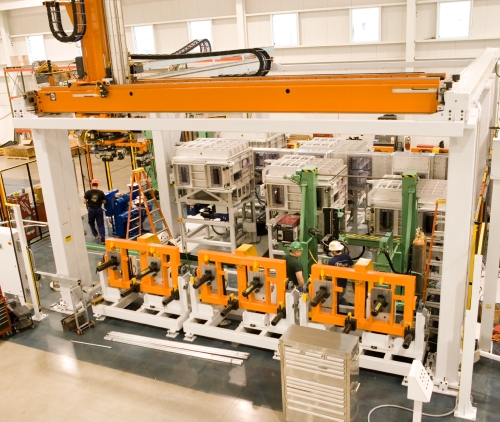
As Detroit automakers shutter SUV and truck factories, the decades-long de-industrialization of the Midwest continues apace. But amid the idled assembly lines, a new wave of manufacturing has taken root as solar energy companies set up shop in the heartland.

Just in the past week, First Solar (FSLR) announced an expansion of its Ohio plant that makes thin-film solar panels. German company Flabeg will break ground on a factory outside Pittsburgh that will manufacture parabolic solar mirrors for large-scale solar power plants planned for the Southwest. Thin-film solar company Energy Conversion Devices (ENER), meanwhile, operates three factories in Michigan and is currently doubling the production capacity of one of its plants.

In fact, nearly all the United States’ current solar manufacturing capacity is in the Midwest, save for Silicon Valley company Ausra’s factory in Las Vegas. (Thin-film startup Nanosolar is building a factory in San Jose, Calif.)

“Our processes really require high productivity, so what makes it competitive here in the Midwest is that we have a great labor force that is eager to work and well-trained already,” ECD chief executive Mark Morelli told Green Wombat on Monday.


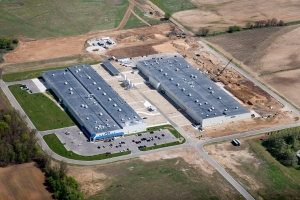
For instance, when appliance maker Electrolux shut down its Greenville, Mich., factory it left 2,700 workers unemployed in the same town where ECD is expanding its thin-film factory (see photos). The company also has recruited top executives from the ever-shrinking auto industry.

“We do a test of the available labor pool and hire the cream of the crop,” Morelli says.

Just as important are a plethora of state tax breaks and grants to retrain industrial workers for the green tech economy.

Although 70 percent of ECD’s flexible solar laminate panels are sold to European customers, Morelli anticipates the U.S. market will take off, with domestic manufacturers garnering a competitive advantage.

That all depends on whether Congress extends a crucial investment tax credit that expires this year and the policies of the next administration in Washington. Even so, demand for solar cells is expected to spike, especially given the recent unveiling of Big Solar projects by California utilities. Southern California Edison (EIX), for instance, is installing 250-megawatts’ worth of solar panels on commercial rooftops while PG&E (PCG) this month announced contracts to buy 800 megawatts of electricity from two photovoltaic power plants, including 500-megawatt thin-film solar farm being built by OptiSolar.

“As utilities begin to embrace distributed power generation, these type of things play into our natural advantage,” says Morelli, referring to his company’s lightweight solar panels that are especially suited for large rooftop arrays.

Of course, a handful of solar factories are not going to revive the Midwest’s industrial fortunes. (First Solar, for instance, operates factories in Germany and Malaysia, and Morelli doesn’t rule out locating manufacturing overseas.) But imagine a national policy that promotes the wide adoption of solar and the expansion of manufacturing in the rustbelt states becomes increasingly attractive. Shipping solar panels and mirror arrays from halfway around the world starts to make much less environmental and financial sense.

ECD’s proximity to the auto industry has already paid off. After installing solar arrays on two of General Motors (GM)’s California facilities, it won a contract in July to build a 12-megawatt rooftop array – the world’s largest by orders of magnitude – at a GM assembly plant in Spain.

Google on Tuesday took the drilling debate in a different direction – announcing that Google.org is investing nearly $11 million in technology to expand the nation’s geothermal reserves. That’s more than the U.S. government is spending on geothermal projects this year.

Traditional geothermal power plants, like those built by Calpine (CPN) in Northern California, sit atop reserves of naturally occurring steam or hot water that can be tapped to drive electricity-generating turbines. So-called Enhanced Geothermal Systems, or EGS,  hope to tap geothermal energy in any location by drilling deep underground to fracture “hot rocks” and then pump them with water to create steam that can be used in a power plant. The great potential, of course, would be to liberate the Midwest and South from their dependence on coal-fired power plants.

“While the U.S. debates drilling in the ocean for oil, we are focused on drilling for renewable energy – and lots of it – right beneath our feet,” Google.org said in a statement, citing a Massachusetts Institute of Technology study that estimates the accessible heat below the U.S. represents more than 2,500 times the nation’s annual energy consumption. (A Google.org video on geothermal is above.)

Google.org (GOOG), the search giant’s philanthropic arm,  will invest $6.25 million into AltaRock Energy, a Sausalito, startup, developing EGS technology. The investment is part of $26.25 million round of funding AltaRock revealed on Tuesday. Other investors include marquee green-tech venture capitalists Khosla Ventures and Kleiner Perkins Caufield & Byers.

Potter Drilling, a Redwood City, Calif., company developing hard-rock drilling technology to be used for geothermal, scored $4 million from Google.org. Other investors include MIT.

Google.org is granting the Southern Methodist University Geothermal Laboratory $489,521 to map North America’s geothermal reserves.

The geothermal funding is the latest investment in renewable energy by Google. It has invested in solar power plant companies BrightSource Energy and eSolar as well as in high-altitude wind company Makani and various ventures related to plug-in hybrid electric cars.

T. Boone Pickens and Texas may be the kings of Big Wind but California is catching up, buying gigawatts of green electricity from turbines planted on the windswept flatlands of … Oregon.

On Monday, Southern California Edison became the latest Golden State utility to look north, announcing a 20-year contract to buy a whopping 909 megawatts from Caithness Energy’s Shepherd’s Flat project. The 303-turbine wind farm will span two Oregon counties and 30 square miles when it goes online between 2011 and 2012. PG&E (PCG), meanwhile, signed a deal in July for 240 megawatts of wind power from Horizon Wind Energy’s turbine ranch in the same area. That’s on top of 85 megawatts it agreed to buy last year from PPM Energy (now called Iberdrola Renewables) in a neighboring county that’s part of a turbine tier of counties on Oregon’s northern border.  Earlier this month the Los Angeles Department of Water and Power approved a 72-megawatt contract with Willow Creek Energy for wind power from the same area in Oregon.

So why ship electricity a thousand miles down the West Coast when California already plans to add gigawatts of in-state wind energy?  In a word, transmission.

“The beauty of this particular project is that it is already fully permitted and has transmission already available,”  Stuart Hemphill, Southern California Edison’s (EIX) vice president for renewable and alternative power, told Green Wombat.

“Oregon has a terrific wind resource,” he adds. “It far exceeds that in California.”

In December 2006 the utility signed an agreement to purchase 1,500 megawatts from a giant wind farm to be built by a subsidiary of Australia’s Allco Financial Group in Southern California’s Tehachapi region. But the project is dependent on the construction of new transmission lines – often an environmentally contentious and drawn-out process in California.

“It is expected to go online in 2010,” says Hemphill of the wind farm. “We’re just getting the transmission project up and running. The first three segments have been approved and we’re doing the building now.”

With California’s investor-owned utilities facing a 2010 deadline to obtain 20% of their electricity from renewable sources, expect the Oregon green rush to continue.

Oilman turned wind wildcatter T. Boone Pickens met with presumptive Republican presidential nominee  John McCain Friday morning to pump his Pickens Plan to wean the United States from imported oil by shifting electricity production to wind farms and using natural gas to fuel cars and trucks. On Sunday, he’ll hook up with Democrat Barack Obama.

The McCain meeting was “good…very relaxed,” Pickens said Friday during a conference call with Senate Majority Leader Harry Reid to promote next week’s National Clean Energy Summit in Las Vegas. “It was a free flowing discussion. I presented the Pickens Plan to him, and he asked a lot of questions about it. He feels like I’m an energy expert, and he wanted information.”

Pickens began a campaign in July to foster a bipartisan approach to reducing the U.S.’s dependence on imported oil, declaring the “the United States is the Saudi Arabia of wind power.” Pickens is building the nation’s largest wind farm in Texas, and he has an interest in a natural gas transportation company.

Though Nevada Democrat Reid remarked, “Who would have thought that T. Boone Pickens and Sen. Harry Reid would have been in same boat pulling the oars same way,” Pickens made clear he’s no latter-day Al Gore.

“I’d open it all up to drilling – OCS, ANWAR,” he said, referring to the outer continental shelf and the Alaskan National Wildlife Refuge – the third rail of environmental politics.

“The one place I differ with Senator McCain is that I said if you’re going to open the OCS, throw in ANWAR too,” Pickens added.

Gore and other greens have questioned the viability and environmental impact of using natural gas for transportation. Pickens, on the other hand, said he isn’t opposed to electric cars. But, he added, “We can’t make a big cut [in oil imports] in ten years without using natural gas as a transportation fuel.  Use it for trucks and let them do what they want with cars.”

For Reid’s part, he said offshore drilling was still on the table, but he’s pushing for Congress to extend the renewable energy investment tax credit that expires at the end of the year. Scores of wind and solar projects – like the massive photovoltaic power plants that California utility PG&E (PCG) unveiled Thursday with SunPower (SPWR) and OptiSolar – are contingent upon Congress renewing the 30% tax credit.

“We have people standing by willing to invest billions of dollars in renewable energy,” Reid said. “The future is not in a commodity that was discovered in the 18th century. The future is sun, wind, geothermal.”

Design a site like this with WordPress.com
Get started