Feeds:
Posts
Comments

photos: SolarWorld

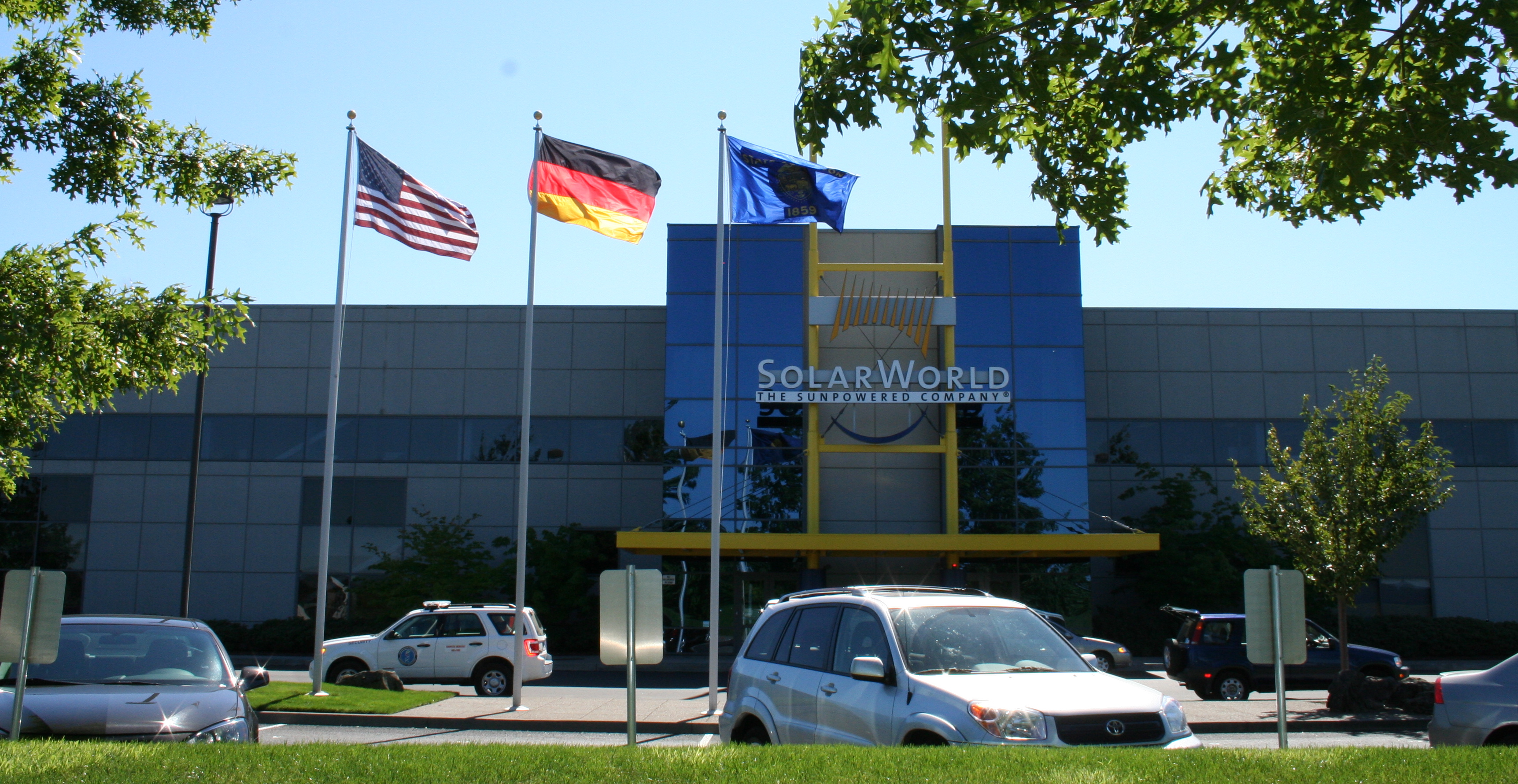
HILLSBORO, Ore. – A solar cell factory has sprouted in Oregon’s Silicon Forest amid the region’s old-growth semiconductor plants. And who is providing these well-paid, high-tech green jobs, investing in America rather than fleeing to Asia to set up shop? The Germans.

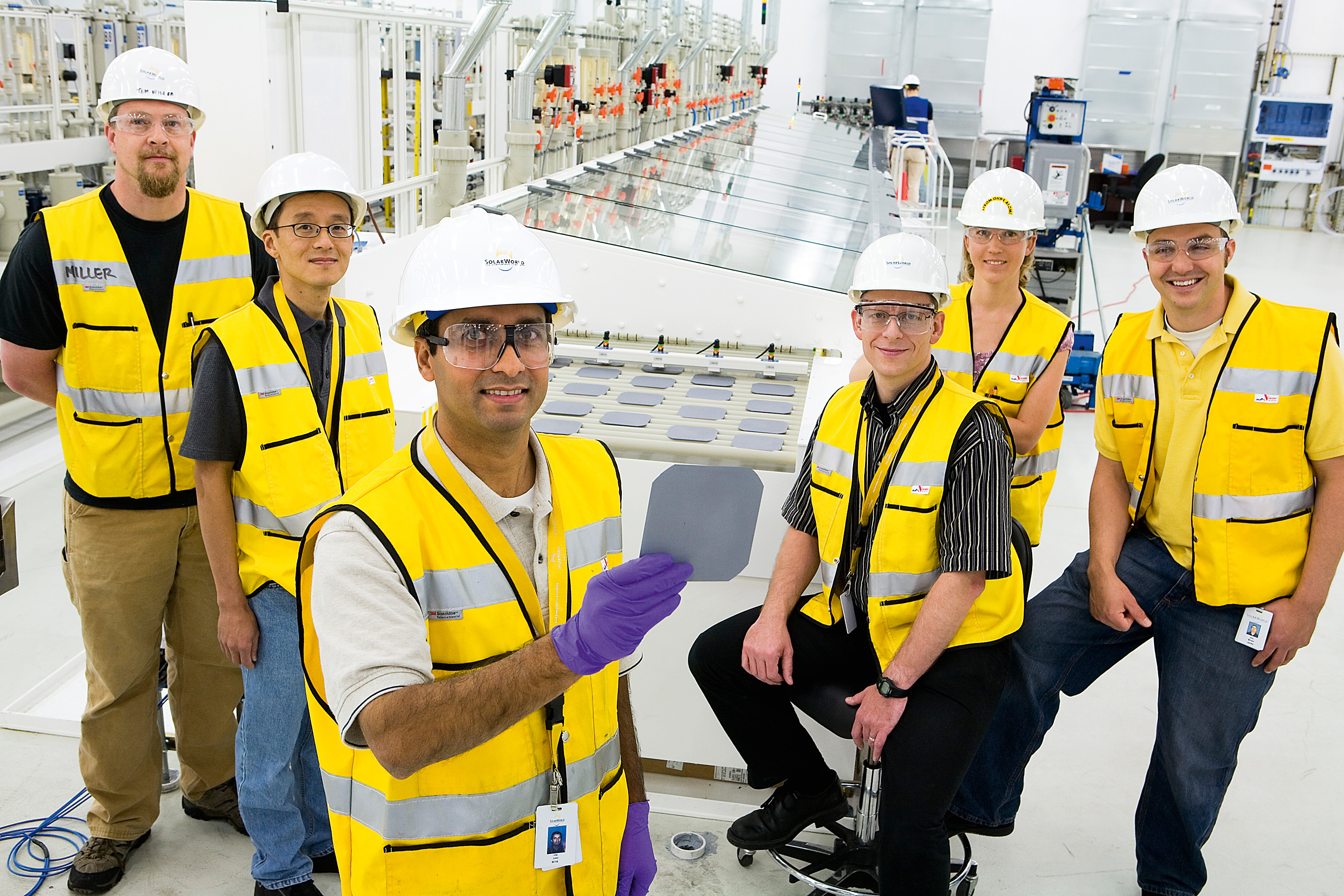
Bonn-based SolarWorld AG on Friday officially flips the switch on the United States’ largest solar cell plant. (See the Fortune video here.) The company, the world’s fifth largest solar cell manufacturer, has recycled a former Komatsu factory built to produce silicon wafers for the chip industry  Last week, SolarWorld America president Boris Klebensberger gave Green Wombat a sneak peak at the new Hillsboro plant and talked about why a German company, whose domestic solar market is the planet’s largest, is pursuing a made-in-America strategy. (SolarWorld’s German rival Solon AG, meanwhile, on Friday opened a smaller solar module plant in Tucson, Ariz.)

“I know a lot of people will say, ‘You idiot, Boris. You can’t manufacture in the U.S.,’ ” says Klebensberger, 39, who sports a hoop earring and has a penchant for saying what’s on his mind.
That has been the conventional wisdom. While thin-film solar companies like First Solar (FSLR), Solyndra and Energy Conversion Devices (ENER) have built factories in the U.S., traditional silicon-based module makers such as SunPower (SPWRA) have outsourced production overseas.

But SolarWorld is counting on its expertise in manufacturing in high-cost Germany and its new American branding to give it a competitive advantage. “Made in America is a very big selling point,” says SolarWorld marketing director Anne Schneider. “Customers like that.”

Like other solar cell makers, SolarWorld is trying to build a brand around an increasingly commoditized product. “Even in a commodity business this is a brand,” says Klebensberger. “If you have to choose between two products that are technologically the same,  you’ll probably choose the one made in the U.S.”

SolarWorld jumped into the U.S. market in 2006 when it acquired Royal Dutch Shell’s solar cell factory in Camarillo, Calif., and a silicon ingot plant in Vancouver, Wash. “This was an opportunity for SolarWorld to establish itself in the U.S. market very quickly and get an employee base,” says Klebensberger, who also serves as COO of SolarWorld’s global operations.

The company was founded in 1998 by, as Klebensberger puts it, “five crazy guys who people thought were on drugs” when they said they were going into the solar business. (Klebensberger was employee No. 7.) But Germany’s lucrative incentives for renewable energy quickly turned the nation into a solar powerhouse and SolarWorld went public in 1999. Revenues – $931 million last year – have been growing around 30%-40% annually and the company has a market cap of $3.1 billion.

SolarWorld saw a potentially huge opportunity in the U.S. but the Shell plant was relatively small – producing 80 megawatts of solar cells annually – so Klebensberger went shopping for a new factory. He ruled out California – too expensive – before settling on Hillsboro, 20 miles west of Portland.

The cost of living was reasonable – at least compared to California – and Oregon is on the forefront of promoting sustainability and the green economy. And just as importantly, Intel (INTC) and other chip companies had opened semiconductor factories, or fabs, in the area in the 1980s and ’90s. “A lot of our workforce came from established chip companies or those that closed their fabs,” says Klebensberger, sipping tea from a coffee cup emblazoned with “Got Silicon?”

“The manufacturing and product is different but the raw starting material is the same and there’s a lot of similarity in the equipment,” adds Gordon Bisner, vice president of operations and a chip industry veteran. “There’s a lot of the same skill sets from a maintenance and engineering standpoint and understanding the basic manufacturing principles and what it takes to manufacture a product successfully in the United States.”

Klebensberger’s team found an old Komatsu silicon wafer fab that had stood empty for years. They bought the 480,000-square foot building for $40 million last year and began retrofitting it. “We needed a quick ramp-up,” says Klebensberger. “This business is all about speed.”

The retrofit took about 15 months – though the minimalist gray industrial decor of the Komatsu era remains. When fully built out in a couple of years, the plant will produce 500 megawatts’ worth of solar cells annually and employ 1,400 workers. In the meantime, the target is 100 megawatts by the end of 2008, and 250 megawatts in 2009.

In one corner of the building, a room of steel vats cook up polysilicon, producing eight-foot-long silicon ingots in the shape of giant silver pencils. Those ingots are taken to another room where wiresaw machines slice them into wafers. The wafers then travel down a conveyor belt where robots wash them and scan for imperfections.

“What’s critical here is the equipment,” says Bisner over the hum of the machines. “Our competitive advantage is how we use the equipment, how can we get every little bit of photovoltaic cell out of the end of the line. It takes equipment, it takes technology and it takes people too.”

In an adjoining room, the wafers are imprinted with contacts and transformed into photovoltaic cells. Depending on customer demand, SolarWorld will sell both silicon wafers and finished cells. The company currently gets 10% to 15% of its revenues from the U.S.

SolarWorld isn’t the only solar company wanting a made-in-America label. Sanyo this week announced it will build a solar cell factory in Salem, south of Portland. And Chinese solar giant Suntech (STP) earlier this month acquired a California-based solar installer and announced a joint venture with San Francisco-based MMA Renewable Ventures (MMA) to build solar power plants. Suntech chief strategy officer Steven Chan told Green Wombat this week that Suntech will likely open factories in the U.S. within a couple years.

Says Klebensberger, “We provide green jobs. We’re not just talking about it, we’re doing it.”
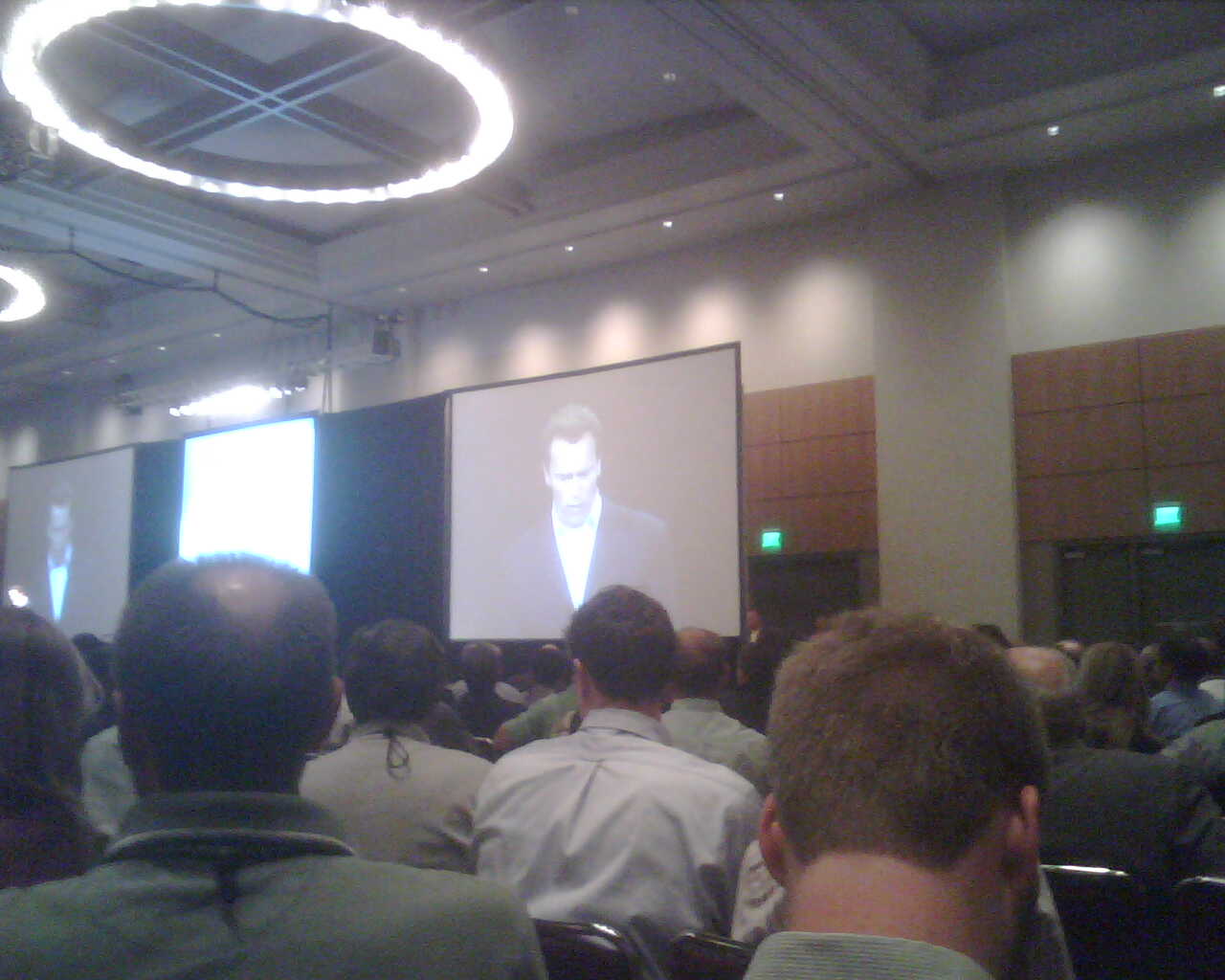
SAN DIEGO – California Governor Arnold Schwarzenegger made a surprise appearance at the solar industry’s annual confab Monday night, warning not to use the financial crisis as an excuse to abandon the fight against global warming.

“We should not give in to those who say environmental goals should take a back seat until the economy improves,” said Schwarzenegger, kicking off the Solar Power International conference. “That’s short-sighted thinking. Tough economic times mean we need more solar, more green jobs.”

The governator’s championing of solar energy through California’s million solar roofs initiative and its landmark global warming law has made Schwarzenegger something of a patron saint of the solar industry, and the audience was on its feet cheering the perma-tanned politician.

The solar power conference is a barometer of the industry’s growth. When Schwarzenegger last appeared at the conference in 2006, 6,000 attendees crammed the San Jose Convention center. This week an estimated 20,000 people have descended upon San Diego for the event. (For techies, think of it as the Consumer Electronics Show and Macworld rolled into one.)

The crowd was in a festive mood. Solar stocks were up dramatically Monday with the bounce back on Wall Street – First Solar (FSLR) spiked nearly 23% and Suntech (STP) rose 21% as was SunPower (SPWRA). And ten days ago Congress slipped into the financial bailout package an eight-year extension of a crucial 30% solar investment tax credit, lifted a $2,000 tax credit limit for homeowners who install solar arrays and allowed utilities to claim the investment tax credit for solar installations. “Imagine it took a financial rescue plan to get a tax credit for solar,” Schwarzenegger remarked.

The Republican governor used the occasion to champion California, as he is his wont, giving kudos to Southern California Edison (EIX) for the utility’s plans to install 250-megawatts’ worth of solar panels on warehouse roofs. “I can envision going up in a helicopter and up and down California and see no more warehouses without solar panels.”

“Solar is the future, it cannot be stopped,” he added.

Photos: Solyndra

SAN FRANCISCO – The chatter of the Financial District types who lunch at One Market is a bit deafening, so I’m sure I’ve misheard when Solyndra CEO Chris Gronet tells me how much funding his stealth solar startup has raised. “You said $60 million, right?” I ask.

“$600 million,” he replies.

That pile of cash from investors ranging from Silicon Valley venture capitalists to Richard Branson to the Walton family wasn’t the only big number Solyndra revealed to Green Wombat in anticipation of the solar panel manufacturer’s public debut Tuesday after operating undercover for more than three years. “We have $1.2 billion in orders under contract,” says Kelly Truman, the Fremont, Calif.-based company’s vice president for marketing and business development.

The stealth startup is a Silicon Valley archetype, along with the baby-faced Web 2.0 mogul and the millionaire stock-option secretary. But perhaps no company in recent memory has managed to hire more than 500 people and build a state-of-the-art thin-film solar factory – in plain view of one of the Valley’s busiest freeways – without attracting much attention beyond a few enterprising green business blogs.

Thin-film solar has been something of a Holy Grail in Silicon Valley, with high-profile startups like Nanosolar – with nearly $500 million in funding itself – all vying to be first to market with copper indium gallium selenide solar cells. CIGS cells can essentially be printed on flexible materials or glass without using expensive silicon. While such solar cells are less efficient at converting sunlight into electricity, production costs are expected to be significantly lower than making traditional silicon-based modules. (Thin-film companies like First Solar (FSLR) – also backed by the Waltons – use an older technology.)

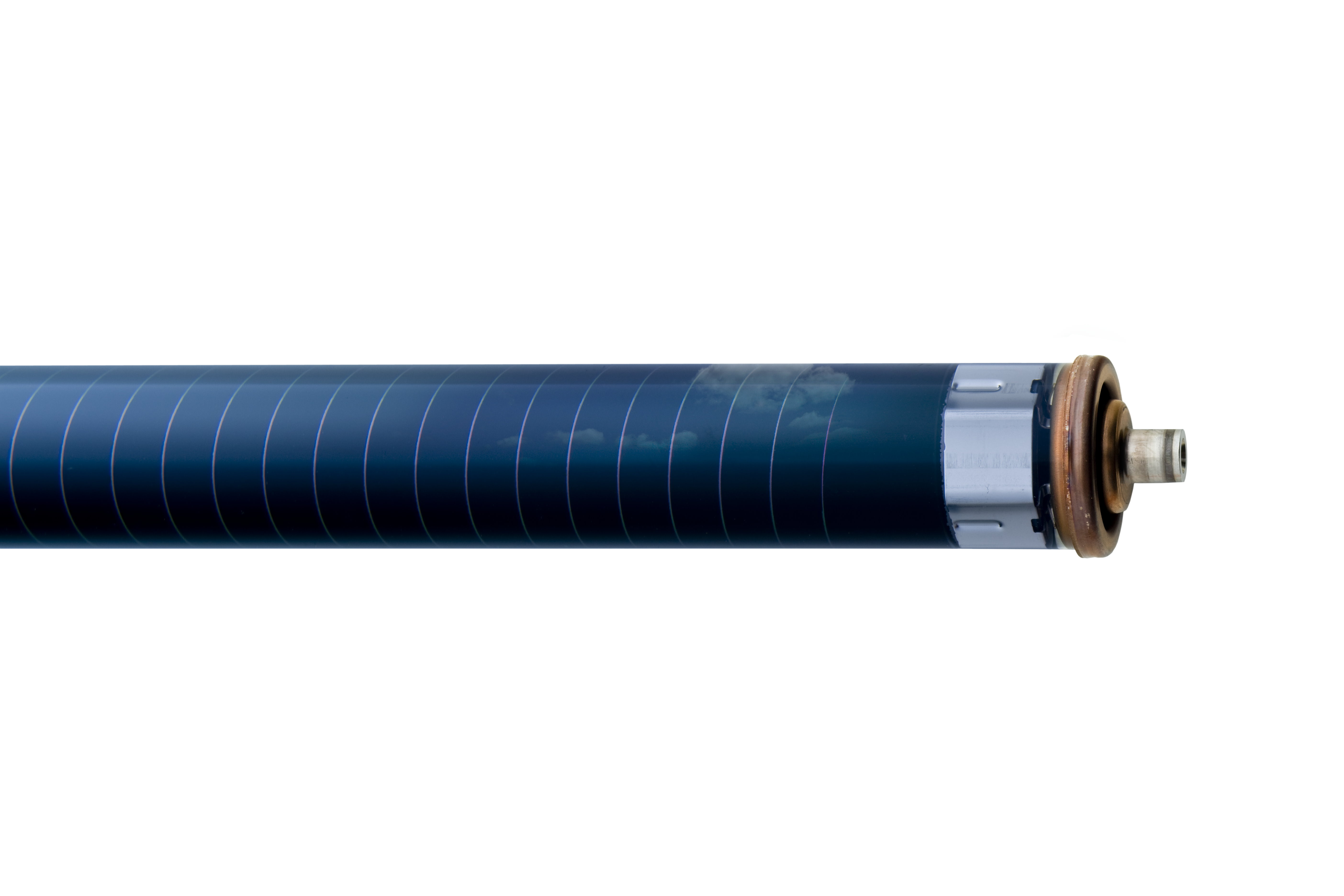
Yet Solyndra bursts onto the scene with a factory operating 24/7 and a billion-dollar book of business. The reason for Solyndra’s secrecy – and success with investors and customers – is sitting in a bazooka-sized cylinder propped up beside Truman at the restaurant. He pulls out a long, black glass tube that is darkened by a coating of solar cells.

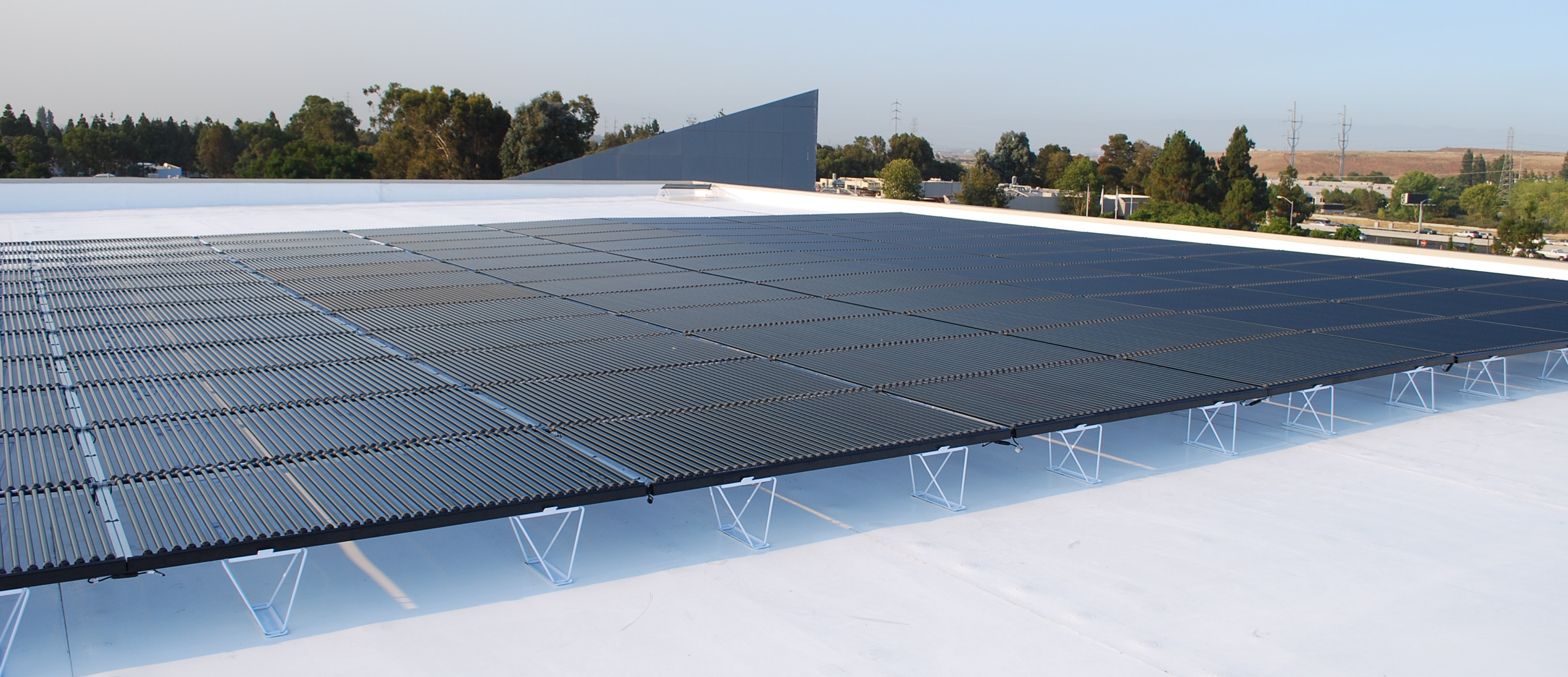
The cylindrical shape is the key, according to CEO Gronet. Conventional rooftop solar panels must be tilted to absorb direct sunlight as they aren’t efficient at producing electricity from diffuse light. But the round Solyndra module collects sunlight from all angles, including rays reflected from rooftops. That allows the modules, 40 to a panel,  to sit flat and packed tightly together on commercial rooftops, maximizing the amount of space for power production.

“We can cover twice as much roofspace as conventional solar panels and they can be installed in one-third the time,” says Gronet, a boyish 46-year-old who holds a Stanford Ph.D. in semiconductor processing and was an 11-year veteran of chip equipment maker Applied Materials (AMAT) before he started Solyndra in May 2005.

And because air flows through the panels they stay cooler and don’t need to be attached to the roof to withstand strong winds. That means installers simply clip on mounting stands and then snap the panels together like Legos.

“For flat commercial rooftops this is game-changing technology,” said Manfred Bachler, chief technical officer at European solar installation giant Phoenix Solar, in a statement.

Solyndra’s target is the 30 billion square feet of flat roofspace found on big box stores and other buildings in the U.S., according to Navigant Consulting – a potential $650 billion solar market.  The emerging business model is for a solar developer to finance, install and operate a commercial solar array and then sell the electricity to the rooftop owner. Solyndra’s business is to supply the solar panels to the installers, a market crowded with competitors like SunPower (SPWRA) and Suntech (STP).

A good chunk of the $600 million the company has raised has gone toward building its 300,000-square-foot solar fab. A video Gronet and Truman played for me shows a highly automated factory, with robotic assembly lines and robot carts moving the solar modules through the production process.

The fab – which can produce 110 megawatts’ worth of solar cells a year – already is shipping panels to big customers like Solar Power in the U.S. and Germany’s Phoenix Solar – three-quarters of its $1.2 billion in orders are destined for European companies. Solyndra is in the process of obtaining permits for a second 420-megawatt fab in Fremont; upon its completion, Solyndra would become one of the biggest solar cell manufacturers in North America. (Gronet says a third fab will be built in Europe, Asia or the Middle East.)

That has helped Solyndra attract a long list of investors, from Silicon Valley VCs like CMEA and US Venture Partners to Madrone Capital – the Walton family’s (WMT) private equity fund – and Masdar, the Abu Dhabi company whose mission is to transform the oil-rich emirate into a green tech powerhouse. Another high-profile investor is Richard Branson’s Virgin Green Fund.

“We looked at 117 solar companies and have made two investments, including Solyndra,” says Anup Jacob, a partner at Virgin Green Fund and a Solyndra board member. “Dr. Chris Gronet and his team came out of Applied Materials and really took the best and brightest of Silicon Valley. They’re great scientists and operations people.”

Jacob told Green Wombat that Virgin hired Stanford scientists to evaluate Solyndra’s technology and engineering firms to vet its solar factory. “Because we’re late-stage investors, we were able to look at all their major competitors,” he says. “There’s a number of well-heeled solar companies that have said they are going to do a lot of things but haven’t delivered.”

Virgin concluded that Solyndra could make good on its promise to make solar competitive with traditional sources of electricity. “As a rooftop owner, all you care about is how much electricity you can get from your rooftop at the cheapest price possible,” he says.

One challenge, he adds, was keeping mum about Solyndra. “I gotta tell you that Richard Branson is a guy who loves to talk about what’s he’s doing and it was real effort to honor Solyndra’s wishes to keep quiet.”

Illustration: Principle Power

A Seattle-based renewable energy startup, Principle Power, has signed an agreement to build a deep-sea, 150-megawatt wind farm to be constructed on floating platforms off the Oregon coast.

The deal with the Tillamook Intergovernmental Development Agency – which includes the local utility for a coastal county west of Portland – is very early stage but foreshadows two technological trends in the wind industry: massive megawatt turbines placed on deep-ocean platforms.

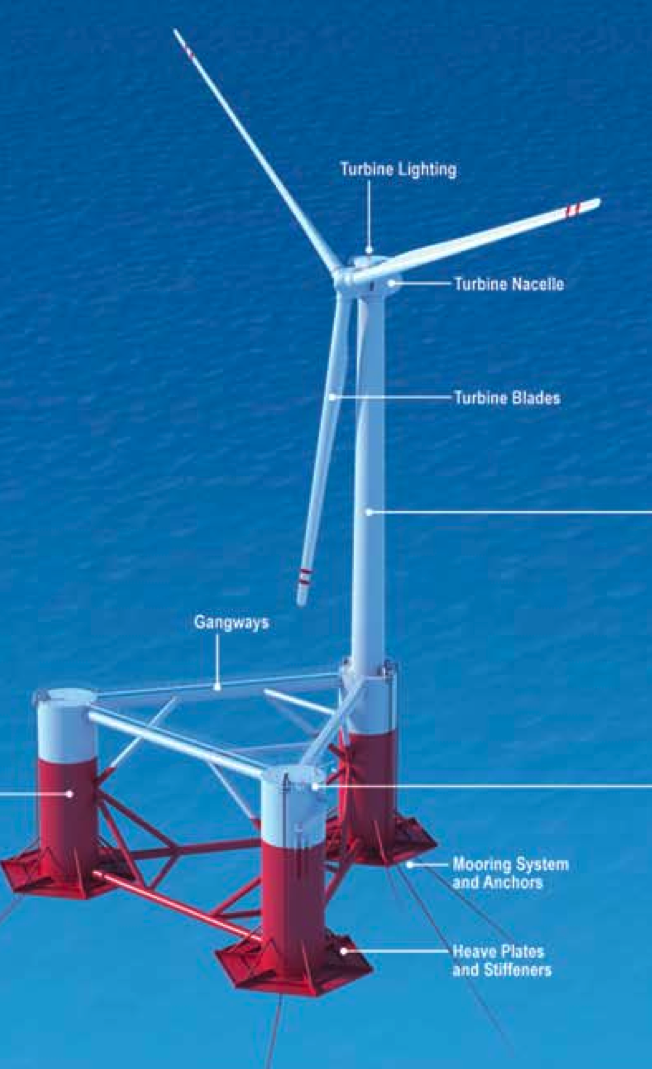
Principle Power co-founder Jon Bonanno tells Green Wombat that each floating platform – called a WindFloat – will feature a 5-megawatt turbine. By contrast, the biggest biggest land-based turbines are typically 2.5 megawatts, while General Electric (GE) makes a 3.6-megawatt turbine designed for offshore use.

Bigger turbines offer better economies of scale (important given the steep cost of developing offshore wind farms), and since a deep-ocean wind turbine is not visible from the coast, they avoid the not-in-my-backyard fights that dog near-shore projects. (Clipper Windpower of Carpinteria, Calif., is developing a ten-megawatt monster for England’s Crown Estate, while European wind companies like Enercon has been testing turbines in the six megawatt range.)

“It’s becoming an increasingly important component of the mix in Europe,” says Ethan Zindler, head of North American research for New Energy Finance, a London-based firm. “I think a lot of it is conceptual at this point. There’s still a lot of barriers in turbine design and transport.”

Beyond the technological challenges of supersizing a turbine, there’s the issue of how to get a 300-foot-tall windmill out to sea without breaking the bank. Various wind companies are tackling the problem but Principle Power’s solution is to license the WindFloat technology from a Berkeley, Calif.-based startup called Marine Innovation & Technology. The company’s founders, who previously worked on offshore platforms for the oil industry, designed the WindFloat to be semi-submersible. “The design and size of the WindFloat enables the overall structure to be assembled onshore and towed to its final location, significantly reducing construction costs,” according to Principle Power.

“The WindFloat has undergone concept development validation through numerical modeling, third party engineering verification and extensive wave tank testing,” Bonanno said in an e-mail, noting that he expects a full-scale prototype to be built within a year.

Depending on the permitting process and Principle’s ability to obtain project financing, Bonanno anticipates the wind farm to be up and operating between 2013 and 2015.  Early estimates peg the cost of the wind farm at about $375 million.

Pat Ashby, the general manager of the 19,000-customer Tillamook People’s Utility District, says his utility has a capacity of 50 megawatts so it would most likely serve as an interconnection point to transmit electricity from the wind farm to the regional power grid. “Our substations are all along the coast,” he says. “There’s only a dozen miles or less to get to a substation.”

According to Ashby, the cost of laying a transmission line is about $1 million a mile. On the other hand, if the wind farm is too close to shore, residents will likely get riled up about the impact on their views. “We’ve already had an organized group come forward to express their concerns,” he says.

Bonanno notes that if the wind farm was placed five miles off the coast, the turbines would appear to be the size of a thumb from the shore; at ten miles they would not be visible.

photo: eSolar

After months of failed attempts in Congress to extend crucial renewable energy tax credits, the end-game came with lightning speed Friday afternoon: The House of Representatives passed the green incentives attached to the financial bailout package approved by the Senate Wednesday night and President Bush promptly signed the legislation into law.

There were goodies for wind, geothermal and alternative fuels, but the big winner by far was the solar industry.

“It feels like we should be popping the champagne,” said a Silicon Valley solar exec Green Wombat met for lunch minutes after Bush put pen to paper.

That it took the biggest financial crisis since the Great Depression to save billions of dollars of renewable projects in the pipeline for the sake of political expediency does not bode well for a national alternative energy policy. But the bottom line is that the legislation passed Friday sets the stage for a potential solar boom.

  • The 30% solar investment tax credit has been extended to 2016, giving solar startups, utilities and financiers the certainty they need for the years’ long slog it takes to get large-scale power plants and other projects online. The extension is particularly important to those Big Solar projects that need to arrange project financing in the next year or so.
  • The $2,000 tax credit limit for residential solar systems has been lifted, meaning that homeowners can get a 30% tax credit on the solar panels they install after Dec. 31. That will save a bundle – especially for those who live in states with generous state rebates – and goose demand for solar panel makers and installers like SunPower (SPWRA) and First Solar (FSLR). (If you buy a $24,000 3-kilowatt solar array in California – big enough to power the average home –  you can claim a $7,200 federal tax credit. Add in the state solar rebate and the cost of the system is cut in half.)
  • Utilities like PG&E (PCG), Southern California Edison (EIX) and FPL (FPL) can now themselves claim the 30% investment tax credit for large-scale solar power projects. That should encourage those well-capitalized utilities to build their own solar power plants rather than just sign power purchase agreements with startups like Ausra and BrightSource Energy.

“The brakes are off,” says Danny Kennedy, co-founder of Sungevity, a Berkeley, Calif., solar installer that uses imaging technology to remotely size and design solar arrays. “In just six months since our launch we’ve sold about a hundred systems. With an uncapped tax credit for homeowners going solar, we expect business to boom.”

While elated sound bites from solar executives have been flooding the inbox all afternoon – along with invites to celebratory after-work drinks – solar stocks took a drubbing (along with the rest of the still-spooked market) after initially soaring on the news.

SunPower ended the trading day down 5% while First Solar shares dropped 8%. The bright spot was China’s Suntech (STP), which on Thursday announced a joint venture with financier MMA Renewable Ventures to build solar power plants as well as the acquisition of California-based solar panel installer EI Solutions.

Congress didn’t treat the wind industry so generously. The production tax credit for generating renewable energy was extended by just one year, guaranteeing the industry’s will continue to live year by year (at least through 2009). But given that 30% of all new power generation built in the United States in 2007 was wind, and that the amount of wind power installed by the end of 2008 is expected to rise 60% over the record set last year, the wind biz should do just fine.

But Congress did give a break to those who buy small-scale wind turbines. Systems under 100 kilowatts qualify for a 30% tax credit up to $4,000. Homeowners get a $1,000 tax credit for each kilowatt of wind they install, though the credit is capped at $4,000.

“This is a huge breakthrough for small wind,” says Scott Weinbrandt, president of Helix Wind, a San Diego-based manufacturer of 2-and-4-kilowatt turbines.

In another sign that the financial crisis is not slowing the solar industry, Suntech, the giant Chinese solar module maker, made a big move into the United States market on Thursday. The company announced a joint venure with green energy financier MMA Renewable Ventures to build solar power plants and said it would acquire California-based solar installer EI Solutions.

Founded in 2001, Suntech (STP) recently overtook its Japanese and German rivals to become the world’s largest solar cell producer. The company has focused on the lucrative European market and only opened a U.S. outpost, in San Francisco, last year.  The joint venture with MMA Renewable Ventures (MMA) – called Gemini Solar – will build photovoltaic power plants bigger than 10 megawatts.

Most solar panels are produced for commercial and residential rooftops, but in recent months utilities have been signing deals for massive megawatt photovoltaic power plants. Silicon Valley’s SunPower (SPWRA) is building a 250-megawatt PV power station for PG&E (PCG) while Bay Area startup OptiSolar inked a contract with the San Francisco-based utility for a 550-megawatt thin-film solar power plant. First Solar (FSLR), a Tempe, Ariz.-based thin-film company, has contracts with Southern California Edision (EIX) and Sempre to build smaller-scale solar power plants.

Suntech’s purchase of EI Solutions gives it entree into the growing market for commercial rooftop solar systems. EI has installed large solar arrays for Google, Disney, Sony and other corporations.

“Suntech views the long-term prospects for the U.S. solar market as excellent and growing,” said Suntech CEO  Zhengrong Shi in a statement.

Other overseas investors seem to share that sentiment, credit crunch or not.  On Wednesday, Canadian, Australian and British investors lead a $60.6 million round of funding for Silicon Valley solar power plant builder Ausra. “So far the equity market for renewable energy has not been affected by the financial crisis,” Ausra CEO Bob Fishman told Green Wombat.

The solar industry got more good news Wednesday night when the U.S. Senate passed a bailout bill that included extensions of crucial renewable energy investment and production tax credits that were set to expire at the end of the year.

A green credit crunch?

photo: eSolar

If Wall Street’s implosion can feel remote on the West Coast, where green tech startups largely rely on Silicon Valley venture capital, there may be no escaping the fallout from the credit crunch.

Still, even those renewable energy companies tapping East Coast cash have powered ahead amid the chaos on the Street. Take SolarReserve, a Santa Monica, Calif.-based solar power plant developer. A day after Lehman Brothers filed for bankruptcy last week, the stealth startup announced a $140 million round of funding from investors that included Citigroup (C) and Credit Suisse (CS).

Lehman does hold small stakes in wind turbine maker Clipper Windpower of Carpinteria, Calif., and Ormat Technologies, a Reno, Nev., geothermal developer. “Lehman’s exit from wind is not good news, but it’s not the end of the world,” says Ethan Zindler, head of North American research for New Energy Finance, a London-based research firm. And while Lehman holds stock lent to it from solar cell companies like SunPower (SPWR) and Evergreen Solar – potentially diluting their earnings per share if the stock is not returned – Lehman is not a big player in solar.

That’s not the case with Goldman Sachs (GS) and Morgan Stanley (MS). Both are major solar and wind investors and both were forced this week to reorganize themselves into bank holding companies to stave off shotgun marriages with other institutions. Spokespeople for Goldman and Morgan Stanley told Green Wombat that the firms’ transformation into more conventional commercial banks – at least a two-year process- will not change their green investing strategies.

But if there appears to be little immediate collateral damage from the financial crisis for green tech startups, there are longer-term consequences. Solar power plants, wind farms and other large-scale renewable energy projects require billions of dollars in bank financing.

“Credit is just going to get more expensive,” says Zindler. “We’ve already seen some pull-back for some big solar and wind deals. Bigger developers who have solid balance sheets will be OK but the smaller guys could be in trouble.”

Says Bill Gross, chairman of solar power plant developer eSolar: “I think if you’re going to get project financing, you’re just going to have to show higher returns to get people to take the money out of the mattress.”

But Gross, the founder of Pasadena, Calif.-based startup incubator Idealab, argues that given soaring electricity demand and fossil fuel prices, large-scale renewable energy projects will be an attractive investment, paricularly since utilities typically sign 20-year contracts for the power they produce. eSolar, which is backed by Google and other investors, has a long-term contract to supply Southern California Edison with 245 megawatts of green electricity. Gross says eSolar has a pipeline of other projects and interest in the company remains high, particularly overseas.

“If you can make projects that can compete with fossil fuels on a parity basis, those projects are going to be financed,” he says, “because they’re safe returns for 20 years and I think money is going to flow to them.”

Rob Lamkin, CEO of solar power plant startup Cool Earth, echoed that sentiment. “The credit crisis does give me pause,” says Lamkin, whose Livermore, Calif.-company has raised $21 million in venture funding and is developing “solar balloons” that use air pressure to concentrate sunlight on solar cells. “But the energy problem is so big that I don’t see problems raising project financing.”

The key for developers of utility-scale projects – particularly solar power plants – will be keeping their costs under control; not an easy thing when deploying new technologies amid a commodities boom.

Dita Bronicki, CEO of geothermal power plant developer Ormat Technologies (ORA), does not anticipate trouble obtaining project financing. “I think the cost of money is going to go up, but a company like Ormat with an operating fleet and operating cash flow will not be as affected,” Bronicki says. “Small companies will find that lenders will be more picky in what they will invest.”

Green entrepreneurs tend to be an optimistic bunch, so it’s not surprising they still think the future looks bright. But they had reason to be sunny this week – amid Wall Street’s meltdown, the U.S. Senate on Tuesday passed, at long last,  extensions of crucial renewable energy investment tax credits and other goodies to goose green tech, such as a tax credit worth up to $7,500 for buyers of plug-in electric cars. The Senate action now must be reconciled with similar legislation in the House of Representatives.

Solar projects, for instance, would qualify for a 30% investment tax credit through 2016.

“That is one thing that will help project finance,” says Gross. “So many people are sitting on the sidelines right now and if the investment tax credit passes that will help get these projects financed.”

After a year of stalemate that threatened to strangle the nascent United States solar industry, the U.S. Senate on Tuesday passed energy legislation that extends a key investment tax credit until 2016.

The 30% solar tax credit was part of a package of green energy incentives that includes a one-year extension of the production tax credit crucial to the wind industry and a $2,500-$7,500 tax credit for people who buy plug-in electric vehicles. (That should make General Motors (GM) happy as it prepares to roll out its ever-increasingly expensive Volt plug-in electric hybrid.)

Homeowners also won an extension of a tax credit for installing solar panels and the $2,000 cap on such systems was lifted. Put in a small wind turbine or a geothermal heat pump and you can claim up to a $4,000 and $2,000 tax credit, respectively.

The big winner was the solar industry. Congress’ failure to extend the investment tax credit threatened to scuttle scores of multibillion-dollar solar power plants in the pipeline and undermine mandates that utilities like PG&E (PCG) and Southern California Edison (EIX) obtain a growing percentage of their electricity from renewable sources.

The legislation now returns to the House of Representatives, which earlier passed a similar version of the Senate bill.

Green Wombat’s story on the Royal Turbine is in the latest issue of Fortune and available online here and below.

Her majesty’s big, honkin’ windmill

The Queen of England is buying the world’s largest wind turbine, which towers over Big Ben and will light up thousands of British homes.

By Todd Woody, senior editor

(Fortune Magazine) — It’s been a century or so since Britain ruled the waves, but Queen Elizabeth II will soon reign over the wind. Earlier this year the Crown Estate, which manages royal property worth $14 billion and controls the seas up to 14 miles off the British coast, agreed to purchase – for an undisclosed sum – the world’s largest wind turbine.

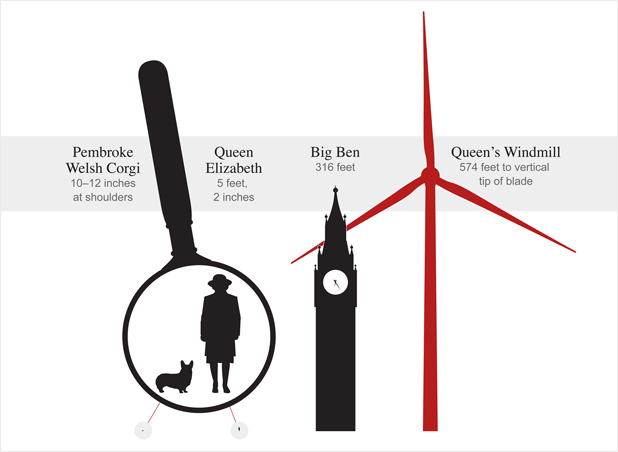
It’s a 7.5-megawatt monster to be built by Clipper Windpower of Carpinteria, Calif. Now the Royal Turbine is getting even bigger: Clipper has revealed to Fortune that Her Majesty’s windmill has been supersized to ten megawatts, producing five times the power generated by typical big turbines currently in commercial operation. The giant’s wingspan stretches the length of two soccer fields. At 574 feet, the turbine soars over Big Ben and roughly equals 111 Queen Elizabeths (the actual queen) plus one corgi stacked on top of one another.

The Queen’s turbine will displace two million barrels of oil as well as 724,000 tons of CO2 over its lifetime. This prototype will be the flagship for Clipper’s Britannia Project, an effort to create a new generation of massive-megawatt turbines to be placed on deep-sea floating platforms. When the windmill goes online in 2012 somewhere off the British coast, it could power 3,700 average homes.

Rule, Britannia, indeed.

photo: Todd Woody

Green Wombat’s story in the new issue of Fortune magazine on the solar power plant-fueled boom in demand for wildlife biologists is now online here. The photo above of the blunt-nosed leopard lizard was taken at a state reserve in San Luis Obispo County.

Or you can read the story below.

The hottest tech job in America

Giant solar plants are being built where dozens of protected species live. That’s good news for wildlife biologists.

By Todd Woody, senior editor

(Fortune Magazine) — It looks like a scene from an old episode of The X-Files: As a red-tailed hawk circles overhead and a wild pronghorn sheep grazes in the distance, a dozen people in dark sunglasses move methodically through a vast field of golden barley, eyes fixed to the ground, GPS devices in hand. They’re searching for bodies.

In this case, however, the bodies belong to the endangered blunt-nosed leopard lizard, and the crew moving through the knee-high grain are wildlife biologists hired by Ausra, a Silicon Valley startup that’s building a solar power plant for utility PG&E on this square mile of central California ranchland.

With scores of solar power stations planned for sites in the Southwest, demand for wildlife biologists is hot. They’re needed to look for lizards and other threatened fauna and flora, to draw up habitat-protection plans, and to comply with endangered-species laws to ensure that a desert tortoise or a kit fox won’t be inadvertently squashed by a solar array.

That has engineering giants like URS (URS, Fortune 500) in San Francisco and CH2MHill of Englewood, Colo., scrambling to hire biologists to serve their burgeoning roster of solar clients. “It’s a good time to be a biologist – it’s never been busier in my 15 years in the business,” says Angela Leiba, a senior project manager for URS, which is staffing the $550 million Ausra project. URS has brought onboard 40 biologists since 2007 to keep up with the solar boom. Salaries in the industry, which typically start around $30,000 and run up to about $120,000, have spiked 15% to 20% over the past year.

The work is labor-intensive. “It can take a 30- to 50-person team several weeks to complete just one wildlife survey,” says CH2MHill VP David Stein.

The economics of Big Solar ensure that wildlife biology will be a growth field for years to come. For one thing, there’s the mind-boggling scale of solar power plants. Adjacent to the Ausra project in San Luis Obispo County, for instance, OptiSolar of Hayward, Calif., is building a solar farm for PG&E that will cover 9 1/2 square miles with solar panels. Nearby, SunPower of San Jose will do the same on 3.4 square miles. Every acre must be scoured for signs of “species of special concern” during each phase of each project.

That adds up to a lot of bodies on the ground. URS, for instance, has dispatched 75 biologists to Southern California where Stirling Energy Systems of Phoenix is planting 12,000 solar dishes in the desert. “The biologists are critical to move these projects forward,” notes Stirling COO Bruce Osborn. For one project Stirling had to pay for two years’ worth of wildlife surveys before satisfying regulators.

Just about every solar site is classified as potential habitat for a host of protected species whose homes could be destroyed by a gargantuan power station. (Developers of California solar power plants, for example, have been ordered to capture and move desert tortoises out of harm’s way.) The only way to determine if a site is crawling with critters is to conduct surveys.

While that means a lot of jobs for wildlife biologists, it’s not all red-tailed hawks and pronghorn sheep for these nature boys and girls. The work can get a bit Groundhog Dayish, say, after spending 1,400 hours plodding through the same barley field in 90-degree heat in search of the same blunt-nosed leopard lizard. No wonder then when URS crew boss Theresa Miller asks for volunteers to reconnoiter a decrepit farmhouse for some protected bats on the Ausra site, hands shoot up like schoolchildren offered the chance to take the attendance to the principal’s office.

PG&E (PCG, Fortune 500) renewable-energy executive Hal La Flash worries that universities aren’t cranking out enough workers of all stripes for the green economy. “It could really slow down some of these big solar projects,” he says. Osborn can vouch for that: Biological work on the Stirling project has ground to a halt at times while the company waits for its consultants to finish up surveys on competitors’ sites.

For the young graduate, veteran biologist Thomas Egan wants to say just three words to you: Mohave ground squirrel. The rare desert dweller is so elusive that the only way to detect it on a solar site is to set traps and bag it. “There’s a limited number of people authorized to do trapping for Mohave ground squirrels,” says Egan, a senior ecologist with AMEC Earth & Environmental. “If you can work with the Mohave ground squirrel, demand is intense.”

Design a site like this with WordPress.com
Get started