September 21, 2009 by Todd Woody

photo: eSolar
In Sunday’s Los Angeles Times, I write about how the rise of green technology is changing the way Silicon Valley venture capitalists do business:
Silicon Valley venture capitalists have always been about inventing the future — taking a wild idea, nurturing it with cash and creativity and giving birth to new products, companies and industries we once couldn’t imagine and now can’t conceive of living without: the Web, Google, the iPhone, Twitter.
But as green technology becomes the latest tech wave to break from the nation’s entrepreneurial epicenter, it’s now all about companies reinventing the past. Solar power companies, electric car start-ups and algae biofuel ventures aim to remake century-old trillion-dollar industries on a global scale.
Venture capitalists poured $4 billion into green-tech start-ups in 2008 — nearly 40% of all tech investments in the U.S., according to a survey by PricewaterhouseCoopers. Green-tech investment plunged in the first half of 2009 to $513 million as the recession dragged on, but there are signs of a rebound: Silicon Valley’s Khosla Ventures announced this month that it had raised $1.1 billion — the biggest first-time fund in a decade — that would be largely devoted to investing in green-tech start-ups, many in Southern California.
But green-tech companies face unique challenges, including global markets, tough technological hurdles and a future shaped by government incentives and regulatory policy. Those challenges are changing the game on Sand Hill Road.
“If you’re starting a Web 2.0 company, your basic needs are personnel and servers — there is no physical product, no manufacturing capacity, no inventory, no steel in the ground,” VantagePoint’s Salzman said, referring to software-based companies that provide services over the Internet.
Green-tech start-ups, he said, often need big money and investors steeped in big science and big government.
You can read the rest of the story here.
Posted in alternative energy, BrightSource Energy, energy, energy efficiency, enviro capitalism, enviro startups, environment, global warming, green chemicals, green financing, green policy, Nanosolar, renewable energy, solar energy, solar power plants, Solyndra, Tesla Motors, the green economy | Tagged Alan Salzman Mohr Davidow Ventures, green technology, Khosla Ventures, Marianne Wu, Silicon valley, VantagePoint Venture Capital, venture capitalists, Vinod Khosla | Leave a Comment »
September 16, 2009 by Todd Woody

photo: Mission Motors
Would you pay $68,995 for an electric motorcycle that goes 150 mph and 150 miles on a charge? Mission Motors, a San Francisco startup, is betting well-heeled techies and gearheads will pony up for the thrill of instantaneous acceleration offered by an electric superbike. The company’s prototype, the Mission One, earlier this month set a world speed record for electric motorcycles. As I write in The New York Times today:
Mission Motors, an electric motorcycle startup based in San Francisco, said Tuesday that its prototype vehicle had set a world speed record for battery-powered bikes of 150.059 miles per hour at the Bonneville Speedway in Utah.
That was the average speed achieved during two, mile-long trials but the motorcycle, called the Mission One, hit 161 m.p.h. on the Bonneville Salt Flats during one run on Sept 1.
Speed matters for what amounts to the Tesla Roadster of electric motorcycles.
“Our focus is on the market that is most motivated by performance,” said Forrest North, the co-founder and chief executive of Mission Motors and a former battery engineer at the high-end electric car maker, Tesla. Mr. North is bringing a bit of that company’s strategy to Mission Motors: Build a stylish high-tech, high-priced electric vehicle for enthusiasts, and then move down the market with less expensive models.
You can read the rest of the story here.
Posted in electric cars, enviro startups, environment, green cars | Tagged Bonneville Speedway, electric motorcycle, Mission Motors, Mission One | 2 Comments »
September 15, 2009 by Todd Woody

photo: Better Place
In today’s New York Times, I write about Better Place’s unveiling of its software platform for managing tens of thousands of electric cars on the road and the grid. Software as much as hardware will be key to making electric cars a mass market phenomenon:
Electric cars may be all about hardware – batteries, drivetrains, charging stations — but companies like Better Place are depending on software to give a niche product mass-market appeal.
At the Frankfurt Motor Show on Tuesday, Better Place, which builds electric vehicle charging networks, is expected to take the wraps off a software platform that tells drivers when and where to charge their batteries, while giving utilities the ability to manage the impact of tens of thousands of vehicles tapping into the power grid.
The company, based in Palo Alto, Calif., has signed deals to roll out networks of charging spots and battery switching stations in Australia, Denmark, California, Canada and Hawaii and Israel.
Better Place will own the car batteries and drivers will buy “miles” (or kilometers) on a subscription plan much like they purchase mobile phone minutes. That means Better Place must track the location and capacity of thousands of batteries at any given moment to properly bill customers and ensure that fresh batteries and charging posts are available when needed.
You can read the rest of the story here.
Posted in Better Place, electric cars, green cars | Tagged Better Place, electric car charging network, electric cars, Renault | Leave a Comment »
September 10, 2009 by Todd Woody

Photo: Todd Woody
In my Green State column for Grist on Thursday, I write about Wheego, an Atlanta startup that will soon begin selling an electric microcar called the Whip.
I took the Whip for a spin around San Francisco with Wheego chief executive Mike McQuary riding shotgun but what really grabbed my attention was the fact that the chassis and body are made in China. While U.S. automakers take halting steps toward weaning themselves from the internal combustion engine, the Chinese are positioning themselves to make the great leap forward into the electric age. As I write on Grist:
A traffic jam is developing on the electric highway.
A decade after General Motors killed the electric car, big automakers and startups are revving up to put battery-powered vehicles on the road over the next couple of years. One of the latest entrants is Wheego, an Atlanta company that is about to launch the Whip—a tiny low-speed “neighborhood electric vehicle” that will be upgraded in 2010 to a full-speed, highway-ready car.
Wheego chief executive Mike McQuary brought a Whip to San Francisco last week, and I took the car for a spin around the city. (More on that in a bit.)
You see quite a few neighborhood electrics across the Bay in Berkeley where I live. Their top speed is around 25 miles per hour and many look like glorified golf carts or cast-offs from an East Bloc auto factory, circa 1984. And at the risk of stereotyping, most seem to be driven by the proverbial little old leftist lady in tennis shoes who glides down the hill for the weekly nuclear disarmament rally outside the Cal campus (circa 1984).
The Wheego Whip, on the other hand, looks like a “real” car (PDF brochure). Somewhat similar in appearance to the Smart fortwo or Think City EV, it’s a two-seater microcar sporting all the mod cons—power windows, Bluetooth stereo, iPod/iPhone jack, air conditioning.
Like Coda Automotive’s forthcoming electric sedan, the Whip’s body and chassis are Chinese made—another sign that China is emerging as a player in the nascent electric car industry—while the battery comes from Canada and the motor from Wisconsin (U-S-A! U-S-A!). The Whip will be assembled in California in the Los Angeles exurb of Ontario. Other electric startups are following a similar business plan, making the old Detroit automotive model increasingly look as viable as a Hummer.
You can read the rest of the column here.
Posted in electric cars, green cars | Tagged China, electric cars, Mike McQuary, Wheego, Wheego Whip | Leave a Comment »
September 9, 2009 by Todd Woody
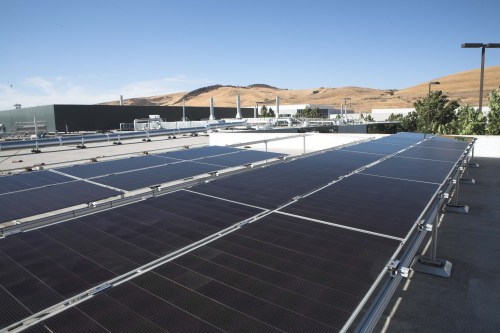
photo: Nanosolar
A day after First Solar made waves with its agreement with the Chinese government to build a 2,000-megawatt solar farm in Mongolia, Silicon Valley startup Nanosolar took the wraps off its much-hyped thin-film photovoltaic technology and announced it has booked $4.1 billion in orders from solar developers. As I write in today’s New York Times:
Since its founding in 2002, Nanosolar has raised a lot of money – half a billion dollars to date – and made a lot of noise about upending the solar industry, but the Silicon Valley start-up has been a bit vague on specifics about why it’s the next big green thing.
On Wednesday, Nanosolar pulled back the curtain on its thin-film photovoltaic cell technology — which it claims is more efficient and less expensive than that of industry leader First Solar — and announced that it has secured $4.1 billion in orders for its solar panels.
Martin Roscheisen, Nanosolar’s chief executive, said customers include solar power plant developers like NextLight, AES Solar and Beck Energy of Germany.
The typical Nanosolar farm will be between 2 and 20 megawatts in size, Mr. Roscheisen said in an e-mail message from Germany, where he was attending the opening of Nanosolar’s new factory near Berlin. “This is a sweet spot in terms of ease of permitting and distributed deployment without having to tax the transmission infrastructure.”
You can read the rest of the story here.
Posted in alternative energy, First Solar, green startups, Nanosolar, solar energy, solar power plants | Tagged First Solar, Martin Roscheisen, Nanosolar, solar cells, thin-film | Leave a Comment »
September 9, 2009 by Todd Woody

Photo: BrightSource Energy
In another sign that old-line corporate giants see solar power as big business, engineering and construction giant Bechtel has signed a deal with BrightSource Energy to build the solar developer’s first solar power plant, a 440-megawatt project in Southern California on the Nevada border. As I write in Wednesday’s New York Times:
Bechtel, the global engineering and construction giant, has jumped into the solar power plant business in a deal with a developer to build a 440-megawatt energy complex in California.
The agreement, being announced Wednesday, calls for Bechtel’s development and finance arm, Bechtel Enterprises, to take an equity stake in the solar project known as the Ivanpah Solar Electricity Generating System. The collection of three solar power stations will deliver electricity to Pacific Gas & Electric and Southern California Edison.
Bechtel is teaming up with BrightSource Energy, a start-up company based in Oakland, Calif.
Ivanpah is the first large-scale solar power plant to undergo regulatory review in the United States in nearly two decades, and the selection of Bechtel as BrightSource’s engineering, procurement and construction contractor is considered a significant step in obtaining financing needed to build the project.
You can read the rest of the story here.
Posted in alternative energy, BrightSource Energy, PG&E, solar energy, solar power plants, Southern California Edison | Tagged Bechtel, BrightSource Energy, Ivanpah, solar energy, solar power, solar power plants | Leave a Comment »
September 9, 2009 by Todd Woody

Photo: First Solar
First Solar became the first U.S. solar company to break into the Chinese market on Tuesday and it did do in a big way when it signed an agreement to build a two-gigawatt thin-film solar power plant in Inner Mongolia. As I write in The New York Times:
Chinese government officials signed an agreement on Tuesday with First Solar, an American solar developer, for a 2,000-megawatt photovoltaic farm to be built in the Mongolian desert.
Set for completion in 2019, the First Solar project represents the world’s biggest photovoltaic power plant project to date, and is part of an 11,950-megawatt renewable-energy park planned for Ordos City in Inner Mongolia.
The memorandum of understanding between Chinese officials and First Solar, the world’s largest photovoltaic cell manufacturer, would open a potentially vast solar market in China and follows the Chinese government’s recent moves to accelerate development of renewable energy.
You can read the rest of the story here.
Posted in alternative energy, First Solar, renewable energy, solar energy, solar power plants | Tagged China, First Solar, Mike Ahearn, Ordos, solar power plants, thin-film solar | Leave a Comment »
September 1, 2009 by Todd Woody

photo: Ausra
In Wednesday’s Los Angeles Times, I write about green tech guru Vinod Khosla’s new $1.1 billion venture funds — the biggest first-time fund since the halcyon days of the dot-com era a decade ago and and a strong signal that investors see a bright future in clean and green technologies. CalPERS, the United States’ biggest pension fund, is the major backer of the new Khosla Ventures’ funds:
In a sign that green technology investing is bouncing back, Silicon Valley venture capital firm Khosla Ventures said Tuesday that it had raised $1.1 billion to spur development of renewable energy and other clean technologies.
It is the biggest first-time fund in a decade and comes as venture capital investment in green technology is just beginning to recover from a precipitous fall prompted by the global economic collapse last fall.
In the first half of the year, investments in green tech plunged to $513 million from $2 billion in the first six months of 2008, according to a survey by PricewaterhouseCoopers.
But Vinod Khosla, founder of Khosla Ventures in Menlo Park, Calif., and a leading green tech guru, has managed to raise an $800-million fund to invest in early and mid-stage clean energy and information technology companies as well as a $275-million fund to finance what he called high-risk “science experiments” that may exist only in a university laboratory.
You can read the rest of the story here.
Posted in alternative energy, biofuels, energy, energy efficiency, enviro capitalism, enviro startups, environment, green financing, green startups, green tech | Tagged CalPERS, clean tech, Cleantech Group, green tech investing, Khosla Ventures, PricewaterhouseCoopers, Vinod Khosla | 1 Comment »
August 28, 2009 by Todd Woody
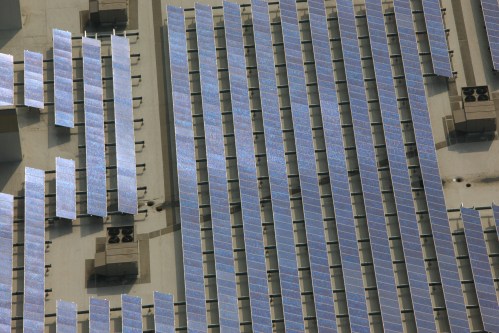
photo: Southern California Edison
It hasn’t received much media attention, but the California Public Utilities Commission has just proposed instituting a first-of-its-kind reverse auction market to spur renewable energy development — mainly solar photovoltaic. As I write today in The New York Times:
California regulators are taking an eBay approach to ramping-up renewable energy in the Golden State.
In what might be a world first, the California Public Utilities Commission on Thursday proposed letting developers bid on contracts to install green energy projects. A solar company that offers to sell electricity to one of California’s three big utilities at a rate lower than its competitors would win a particular power purchase agreement.
This “reverse auction market” feed-in tariff is designed to avoid the pitfalls the have plagued efforts in Europe to encourage development of renewable energy by paying artificially high rates for electricity produced by solar power plants or rooftop photovoltaic projects.
You can read the rest of the story here:
Posted in alternative energy, energy, environment, green policy, PG&E, Recurrent Energy, renewable energy, solar energy, solar power plants, Southern California Edison, SunPower | Tagged California Public Utilities Commission, CPUC, photovoltaics, Recurrent Energy, reverse auction market, solar energy, SunPower, Suntech | 3 Comments »
August 28, 2009 by Todd Woody

Photo: Creative Water Solutions
In today’s New York Times’ Green Inc. blog, I write about a literally green pool cleaner that could upend a $3 billion industry:
As its license plates proclaim, Minnesota is the Land of 10,000 Lakes.
Now a Minneapolis-area company says it has figured out the secret to the state’s famously crystalline watering holes: moss.
Specifically, species of sphagnum moss that the startup, Creative Water Solutions, envisions will keep tens of thousands of swimming pools clean while drastically reducing the use of chlorine and other harsh chemicals.
The patented treatment system, which the company has sold for backyard swimming pools since 2007, underwent its first large-scale commercial test this summer at a public aquatic complex in St. Paul.
“I think this is going to have a dramatic effect and change the whole aquatic industry,” said Thomas Schaffer, a 35-year pool industry veteran hired by the City of St. Paul to monitor the moss treatment of an Olympic-size pool and a smaller children’s pool. “We saw a one-third decline in chlorine demand for the water immediately. We’re now using two-thirds less chlorine.”
You can read the rest of the story here.
Posted in green startups, green tech | Tagged Creative Water Solutions, sphagnum moss, swimming pools, water treatment | 1 Comment »
« Newer Posts - Older Posts »
 Green Wombat