February 3, 2010 by Todd Woody
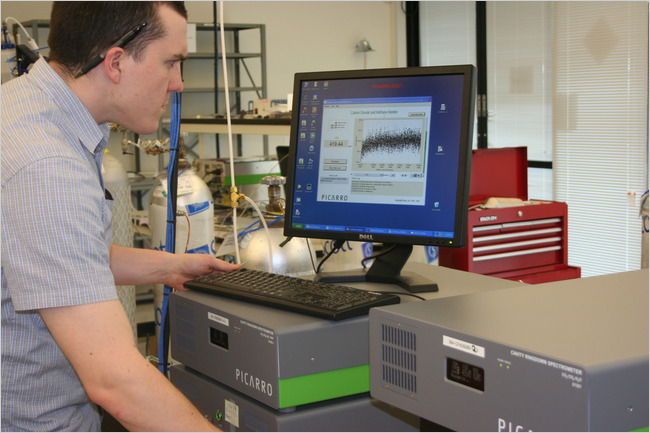
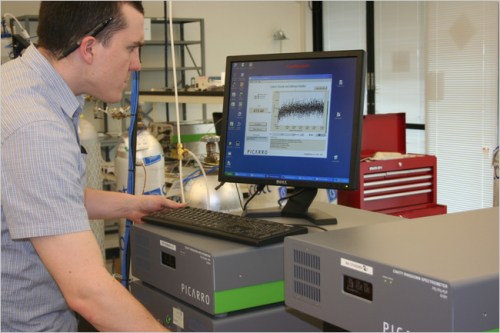 photo: Picarro
I follow up my story in Wednesday’s New York Times about California’s move to build the first statewide greenhouse gas monitoring network with a look at why such programs may be necessary to prevent a meltdown in the carbon markets:
In Wednesday’s New York Times, I write about California’s move to set up what is believed to be the world’s first statewide greenhouse gas monitoring network.
The Silicon Valley company Picarro manufacturers greenhouse gas measurement devices.
The first objective of the network, which will place analyzers around the state to measure methane in the atmosphere, will be to determine if actual emissions match estimates.
The California Air Resources Board assembles those estimates, called inventories, from computer models that rely on data such as how many grams of methane is burned per gallon of gasoline multiplied by the number of gallons sold in the state.
Such models, which follow protocols established by the United Nation’s Intergovernmental Panel on Climate Change, are used worldwide. And while monitoring stations scattered around the world measure average global greenhouse gas concentrations, they don’t identify how much methane is being released in, say, California’s Central Valley, where methane emissions from livestock are assumed to be plentiful.
The recent Copenhagen climate change talks faltered in part over the issue of how to verify emissions. And the integrity of emissions trading schemes will depend on ensuring that companies don’t game the market by deliberately or inadvertently under-reporting how much carbon they’re putting into the atmosphere.
“If the markets are not matching reality, we will find out at some point and the markets will then adjust with a huge shock,” said Pieter Tans, a senior scientist with the National Oceanic and Atmospheric Administration’s Earth System Research Laboratory in Colorado.
You can read the rest of the story here.
Posted in carbon trading, environment, global warming, green policy | Tagged California, cap-and-trade, carbon markets, greenhouse gas monitoring networks, Picarro | 2 Comments »
February 3, 2010 by Todd Woody
 photo: Picarro
In The New York Times on Wednesday, I write about California’s move to deploy the world’s first statewide greenhouse gas monitoring network:
SAN FRANCISCO — California is preparing to introduce the first statewide system of monitoring devices to detect global-warming emissions, installing them on towers throughout the state.
The monitoring network, which is expected to grow, will initially focus on pinpointing the sources and concentrations of methane, a potent contributor to climate change. The California plan is an early example of the kind of system that may be needed in many places as countries develop plans to limit their emissions of greenhouse gases.
“This is the first time that this is being done anywhere in the world that we know of,” said Jorn Dinh Herner, a scientist with the California Air Resources Board.
While monitoring stations around the globe already detect carbon dioxide, methane and other greenhouse gases, they are deliberately placed in remote locations and are generally intended to measure average global concentrations of greenhouse gases rather than local emissions.
The California network, by contrast, is meant to help the state find specific sources of emissions, as well as to verify the state’s overall compliance with a plan it adopted to limit greenhouse gases.
The air resources board has bought seven portable analyzers made by Picarro, a company in Silicon Valley that also supplies the machines to the federal government and academic scientists.
By this summer, the analyzers will be deployed on towers in the San Joaquin and Sacramento Valleys, home to large agricultural operations and oil fields, and on Mount Wilson, outside Los Angeles. Data will also be collected from Picarro machines maintained by the Lawrence Berkeley National Laboratory on the coast and from several monitoring stations operated by other agencies.
You can read the rest of the story here.
Posted in climate change, global warming, green policy | Tagged AB32, Calfornia, climate change, global warming, greenhouse gas monitoring network, methane | Leave a Comment »
February 1, 2010 by Todd Woody
 Photo: Flickr via Pink Sherbet Photography
In my latest Green State column in Grist, I write about the need to roll out a smart water grid as drought and water shortages take their toll:
The other day I came home to find a colorful flyer on my front door proclaiming, “Your meter just got smarter.”
While I was out and about in Berkeley, a worker from my utility, PG&E, slipped in the side gate and gave my old gas and electric meter a digital upgrade. So-called smart meters allow the two-way transmission of electricity data and will eventually let me monitor and alter my energy consumption in near real-time. I’ll be able to fire up an app on my iPhone and see, for instance, a spike in watts because my son has left the lights on in his room and a laptop plugged in.
Now I only learn of my electricity use when I get my monthly utility bill, long after all that carbon has escaped into the atmosphere. The situation is even worse when it comes to water consumption; my bill and details of my water use arrive every other month.
“When you tell people what total bucket of water they used in the past 60 days, the barn door is open and the animals are long gone,” says Richard Harris, water conservation manager for the East Bay Municipal Utility District, my local water agency.
EBMUD is currently testing smart water meters in 30 households and plans to expand the pilot program to 4,000 homes and businesses later this year.
“It’ll give us better knowledge of where our water is going,” says Harris. “We also thought if we’re going to ask people to use water more efficiently, especially when we’re coming out of a drought and have imposed water restrictions, customers need to have an idea of what their current use is.”
EBMUD’s smart meters take readings every hour and participants in the pilot program will be able to go online to check their consumption and set up an email alert if their water use rises above a certain level. The agency also plans to offer a social networking feature to allow people to compare their water consumption with other households in the area. Nothing like a little peer pressure to get you to turn off the tap.
Given that many states expect to face water shortages in the coming years, one would think we’d be seeing a roll out of smart water meters akin to the national effort being made to smarten up the power grid.
The payoff could be enormous. Water agencies and consumers would be able to detect leaking pipes and toilets in real-time and fix the problem before the water literally goes down the drain.
You can read the rest of the column here.
Posted in green tech, smart grid, water, water tech | Tagged East Bay Municipal Utility District, IBM, Oracle, smart water grids, smart water meters | Leave a Comment »
February 1, 2010 by Todd Woody
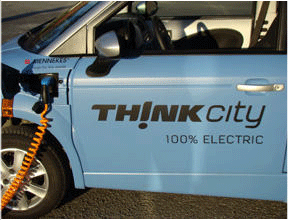
The ability to fast-charge electric cars is seen as key to the adoption of battery-powered vehicles. But as I wrote in The New York Times on Thursday, utilities are worried such devices will overload the grid:
Think, the Norwegian electric automaker, announced a deal this week with a California company, AeroVironment, a maker of electric vehicle charging stations, to introduce fast-charging stations that can charge its battery-powered City car to 80 percent capacity in as little as 15 minutes.
A conventional charger can take eight or more hours to charge an electric car, depending on the battery.
“The development and deployment of very-fast-charge stations will help speed the electrification of automobiles in the United States and globally,” Richard Canny, Think’s chief executive, said in a statement.
But utilities — concerned that fast-chargers could overload the electricity grid — are more cautious.
Think and AeroVironment did not reveal the voltage of their fast-charger but such devices — known in the industry as “Level 3” chargers — generally average around 440 volts. Most household appliances run on 110 volts.
“It is premature to evaluate the feasibility or safety of Level 3 fast-charging equipment,” wrote Christopher Warner, a lawyer for the utility Pacific Gas and Electric, in a brief filed with the California Public Utilities Commission in October. “Such charging may require large investments in infrastructure and load management constraints in order to prevent ‘mini-peaks’ and localized impacts on grid reliability.”
You can read the rest of the story here.
Posted in Better Place, electric cars, enviro startups, environment, green cars, green policy, PG&E, San Diego Gas & Electric | Tagged Better Place, California, Coulomb Technologies, electric car infrastructure, electric cars, fast-charging, utilities | Leave a Comment »
February 1, 2010 by Todd Woody

photo: Better Place
In The New York Times on Friday, I wrote about the latest developments in California’s efforts to write the rules of the road for an electric car infrastructure:
California officials have indicated they are not inclined to regulate electric car infrastructure companies that plan to sell electricity to drivers through networks of charging stations.
Whether to treat such companies as quasi-utilities has been a contentious issue. The state’s three big utilities have split on the topic, while battery charging start-ups like Better Place and Coulomb Technologies have warned that regulation could stifle innovation and scare off investors.
Now the president of the California Public Utilities Commission, Michael R. Peevey, has signaled he is siding with the companies as the commission moves to put electric car regulations in place.
“Facilities that are solely used to provide electricity as a transportation fuel do not constitute ‘electric plant,’” wrote Mr. Peevey in a recent ruling. “As such, the commission would not have regulatory authority regarding the price that an electric vehicle charging facility operator charges for charging services or other aspects of the operation of such facilities.”
That is not likely to be the final word on the subject. Mr. Peevey, who is overseeing the electric car rule-making process, invited utilities, automakers and charging station companies to file briefs on his proposed interpretation of the law.
With several mass-market electric cars set to hit showrooms by the end of the year, the utilities commission is moving unusually swiftly to resolve a variety of outstanding issues. In his ruling, Mr. Peevey set an April deadline to issue a preliminary decision on the most of them.
You can read the rest of the story here.
Posted in Better Place, electric cars, green cars, green policy | Tagged Better Place, Coulomb Technologies, electric car charging, electric car infrastructure, electric cars | Leave a Comment »
January 28, 2010 by Todd Woody
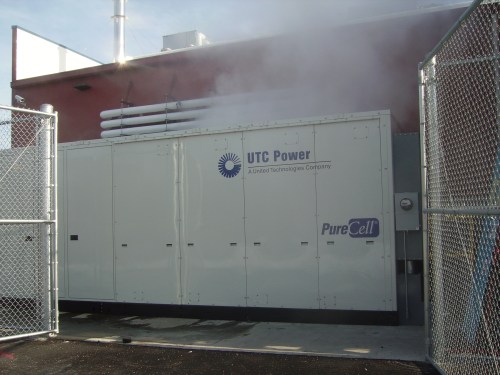
Photo: Golub Corporation
In The New York Times on Wednesday, I write about a New York grocery store chain that has installed a low-emission fuel cell to power one of its supermarkets:
A supermarket in Albany is among the first grocery stores in the country to install a fuel cell to supply cleaner, greener electricity along with heat and hot water.
Fuel cells reform natural gas to produce hydrogen that’s combined with oxygen to generate electricity, heat and water. The process produces a fraction of the carbon dioxide and other pollutants emitted by power plants.
The Price Chopper store in Albany, owned by the Golub Corporation, is using a 400-kilowatt PureCell fuel cell made by U.T.C. Power, a division of United Technologies.
The fuel cell provides most of the electricity for the 69,000-square-foot supermarket, and in the event of a blackout it can operate off the grid to keep the lights on.
Benny Smith, vice president of facilities for Golub, said the company began investigating fuel cells in 2007 when electricity prices spiked in the Northeast, where it operates 120 Price Chopper stores.
“You have to plan your own destiny,” said Mr. Smith. “After meeting with the U.T.C. folks, we decided to go with a fuel cell since a combined heat and power system is more efficient and had a positive cash flow.”
A major consideration, according to Mr. Smith, was the availability of financial incentives from the New York State Energy Research Development Authority. He said the agency gave U.T.C. an $800,000 grant, which the company factored into a lease agreement with Golub.
The fuel cell, which feeds electricity into the power grid, began operating last month. During the winter, it supplies about 90 percent of the store’s electricity and heats the facility. “We’re producing at a much more effective cost due to the combined heat and power,” said Mr. Smith.
You can read the rest of the story here.
Posted in alternative energy, energy | Tagged combined heat and power, fuel cells, Golub Corporation, Price Chopper | Leave a Comment »
January 21, 2010 by Todd Woody
In The New York Times on Thursday, I write about how California regulators are helping revive a once-thriving solar hot water market:
California regulators on Thursday approved a $350 million program to subsidize the installation of solar water heaters to reduce greenhouse gas emissions.
The program will allocate $250 million for the replacement of hot water heaters fueled by natural gas and $100.8 million for those powered by electricity.
Solar hot water systems typically consist of a storage tank and a rooftop array that collects heat from the sun to warm the water.
Customers of California’s three big investor-owned utilities will receive rebates of up to $1,500, or about 30 percent of the cost of replacing a residential natural-gas hot water heater with a solar system. Owners of multi-family commercial buildings are eligible for up to $500,000 in incentives.
The California Public Utilities Commission reserved 60 percent of the funds to install solar hot water systems on those buildings, with the balance going to single-family homes.
Homeowners with electric hot water heaters can receive up to $1,010 to install a solar hot water system and owners of commercial buildings will get up to $250,000. Only about 10 percent of hot water systems in California are electric, according to the utilities commission.
The program’s goal is to replace 585 therms of natural gas -– the equivalent of installing 200,000 solar hot water systems — and 150 megawatts of electricity by 2017. Incentives decrease over the eight-year life of the program.
“Today’s decision will increase consumer confidence and understanding of solar water heating technology and its benefits,” Michael R. Peevey, president of the utilities commission, said in a statement.
You can read the story of the story here.
Posted in alternative energy, energy, environment, global warming, solar energy | Tagged California, solar hot water | Leave a Comment »
January 15, 2010 by Todd Woody
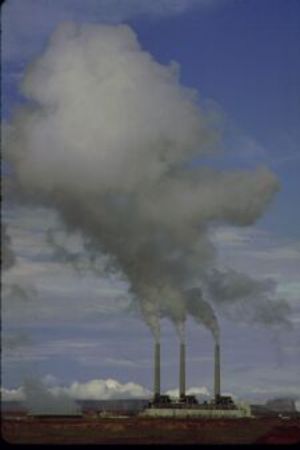 Could we really be as dependent on fossil fuels in 2034 as we are today? In The New York TImes on Friday, I write about a projection from energy consultants Black & Veatch that sees fossil fuels continuing to play a dominant role in the United States a quarter century from now:
A quarter century from now the United States’ reliance on fossil fuels will have declined only marginally, according to a projection from Black & Veatch, the engineering and energy consulting firm.
In 2034, a mix of coal, natural gas and other fossil fuels will supply 68 percent of the nation’s energy needs, compared to 76 percent today. The share of energy production from renewable sources, including solar and wind, in 2034 will rise to 13 percent from 5 percent. Nuclear power will supply only 2 percent more electricity than it does in 2010, the firm said.
Those numbers were part of a presentation that Black & Veatch made to utility executives and other clients in Sacramento this week and which Mark Griffith, a managing director at the company, shared with The Times.
“We’re not assuming that greenhouse gas legislation leads to a immediate shutdown of all coal plants, nor does it lead to going directly to natural gas or renewables,” said Mr. Griffith.
However, Mr. Griffith acknowledged that a number of factors remain in flux that could change those dynamics, including the final shape of a cap-and-trade system – if one is implemented – and whether the United States imposes a requirement that all states obtain a percentage of their electricity from renewable sources.
You can read the rest of the story here.
Posted in alternative energy, energy, environment, green policy, nuclear energy, solar energy, wind power | Tagged Black & Veatch, energy, fossil fuels, renewable energy | 1 Comment »
January 15, 2010 by Todd Woody
In The New York Times on Friday, I write about why business software giant Oracle sees big business in promoting smart water meters:
With many states projecting that they’ll face water shortages in the coming years, smart water meters that provide real-time data on water use can help conserve dwindling supplies.
Traditionally, consumers receive monthly or quarterly water bills, long after the resource has disappeared down the drain. If a smart meter could give real-time information on water use through an in-home video display, the hope is that consumers will curb their consumption when they see, for example, just how many gallons that long shower squanders.
Water districts, on the other hand, can tap such information to detect leaks and other problems and quickly make repairs.
And yet, 64 percent of 300 water districts surveyed in Canada and the United States have no current plans to roll out a smart meter program, according to a study by Oracle, the business software giant.
And why is Oracle interested in smart water meters? The company already sells software systems and services to water districts as well as to electric and gas utilities and sees a large potential market in smart water meters.
(An Oracle rival, IBM, has also targeted water has a money-maker, and it has been developing sensor networks for water agencies.)
“There’s a belief today that water is becoming a critical issue for the nation,” said Guerry Waters, vice president for industry strategy at Oracle Utilities. “It’s a growing issue we’re going to have to deal with, not unlike the issues driving the electric industry.”
But Oracle’s own survey indicates the challenges of both rolling out smart water meters and making a business of them.
You can read the rest of the story here.
Posted in environment, IBM, water | Tagged IBM, Oracle, smart water meters, water shortages | 1 Comment »
January 14, 2010 by Todd Woody

In The New York Times on Thursday, I write about a report from Bloomberg New Energy Finance that shows China has become the dominant solar module supplier in the huge California market:
China’s rise as a major solar module maker has been meteoric, but perhaps nowhere has its ascension been faster than in California, the United States’ largest solar market.
The Chinese company Yingli Solar has captured 27 percent of California’s solar market, according to a preliminary report.
Over the last three years, China’s share of the California market, in terms of supplied megawatts, has risen to 46 percent, from 2 percent, according to a preliminary report by Bloomberg New Energy Finance, a research and consulting firm.
At the same time, the share supplied in California by American companies has declined to 16 percent, from 43 percent.
“The ascendancy of Chinese manufacturers would be noteworthy regardless of market conditions, but is particularly telling in a time when purse-strings are still tight,” the report said.
At the beginning of 2009, Chinese solar companies supplied 21 percent of the market; by year’s end their stake had more than doubled.
You can read the rest of the story here.
Posted in alternative energy, energy, environment, renewable energy, solar energy, Suntech | Tagged California, China, market share, solar market, solar modules, Suntech, Yingli | 1 Comment »
« Newer Posts - Older Posts »




 Green Wombat