Feeds:
Posts
Comments

Photo: Lori Eanes.

In a piece I wrote for Yale Environment 360, I interview the new executive director of the Sierra Club, Michael Brune, about what’s next for the green movement in the wake of the defeat of federal climate change legislation:

In March, Michael Brune took over as executive director of the Sierra Club, the oldest and largest environmental organization in the United States. The Sierra Club doesn’t change leaders often — he’s only the sixth executive director in its 118-year history — and in selecting Brune, the group’s board chose to go with a young outsider with a track record of campaigning in the streets and confronting corporations to effect environmental change.

Brune, 38, previously ran the Rainforest Action Network, a San Francisco-based group whose slogan is “Environmentalism with Teeth.” With a small staff and modest budget, Rainforest Action has extracted agreements from companies such as Home Depot and Citigroup to abandon environmentally destructive practices.

In moving four blocks from Rainforest Action’s offices to the Sierra Club’s national headquarters, Brune — who started his environmental career as a Greenpeace campaigner — is now leading an organization with 1.3 million members and 400 chapters.

His ascension to one of the top jobs in American environmentalism comes at a turning point for the green movement. The decade’s best shot at imposing a national cap on greenhouse gas emissions has failed in the U.S. Senate, despite years of effort by groups such as the Environmental Defense Fund and the Natural Resources Defense Council to forge a coalition with Fortune 500 companies to pass climate change legislation.

“I think we need to a do a very honest and candid reflection on why various iterations of cap and trade legislation have failed,” says Brune, whose soft-spoken manner belies a reputation as a hard-nosed negotiator. “Millions of people have written e-mails, called their senators, demonstrated in the streets, taken actions in a variety of different ways, and still we can’t even get 50 votes, much less 60” in the Senate.

In an interview with Yale Environment 360, Brune sat down in his office at Sierra Club headquarters with writer Todd Woody to talk about the future of the environmental movement, his plans for the Sierra Club, and the next front in what author author Eric Pooley calls the “climate war.”

Yale Environment 360: With the failure of climate legislation, where does the environmental movement go from here?

Michael Brune: The first thing we need to do is a good assessment of what went wrong. We should not try to do the same thing and expect a different result. We need to rethink what the best way is to build momentum to fight climate change. Just as it was clear that one single bill wasn’t going to stop climate change, it’s also clear that there are many different avenues that we can take.

e360: What would be some of those avenues?

Brune: I think clearly right now focusing on administrative actions, regulatory actions, and perhaps more narrow but stronger legislation that would focus on reducing oil consumption and increasing the inventory of clean energy that is available. There’s a lot that can happen through the EPA [Environmental Protection Agency] to protect the public health that Eight years from now we could have a third of the coal fleet replaced with clean energy.” will accelerate a transition away from dirty coal-fired power plants.

The Sierra Club over the past three or four years has been focused on stopping new coal-fired power plants from being built, arguably one of the most effective things we’ve ever done. Along with a broad coalition of grassroots groups, we’ve been able to stop about 131 new coal plants from being built.

That work is going to be evolving over the next several years to not only focus on stopping new plants but on retiring the biggest, oldest coal plants and replacing them with clean energy. So by supporting the EPA’s efforts to protect public health and tighten the controls on particulate matter and air toxins like mercury — there’s a whole series of regulations that are coming down the pike — we feel like we can achieve dramatic reductions and significantly decarbonize the power sector. We feel eight years from now we could have a third of the coal fleet be retired and replaced with clean energy.

You can read the rest of the interview here.

photo: Todd Woody

In Wednesday’s New York Times, I write about a growing movement to repurpose farmland and toxic waste sites for big renewable energy projects:

LEMOORE, Calif. — Thousands of acres of farmland here in the San Joaquin Valley have been removed from agricultural production, largely because the once fertile land is contaminated by salt buildup from years of irrigation.

But large swaths of those dry fields could have a valuable new use in their future — making electricity.

Farmers and officials at Westlands Water District, a public agency that supplies water to farms in the valley, have agreed to provide land for what would be one of the world’s largest solar energy complexes, to be built on 30,000 acres.

At peak output, the proposed Westlands Solar Park would generate as much electricity as several big nuclear power plants.

Unlike some renewable energy projects blocked by objections that they would despoil the landscape, this one has the support of environmentalists.

The San Joaquin initiative is in the vanguard of a new approach to locating renewable energy projects: putting them on polluted or previously used land. The Westlands project has won the backing of groups that have opposed building big solar projects in the Mojave Desert and have fought Westlands for decades over the district’s water use. Landowners and regulators are on board, too.

“It’s about as perfect a place as you’re going to find in the state of California for a solar project like this,” said Carl Zichella, who until late July was the Sierra Club’s Western renewable programs director. “There’s virtually zero wildlife impact here because the land has been farmed continuously for such a long time and you have proximity to transmission, infrastructure and markets.”

Recycling contaminated or otherwise disturbed land into green energy projects could help avoid disputes when developers seek to build sprawling arrays of solar collectors and wind turbines in pristine areas, where they can affect wildlife and water supplies.

The United States Environmental Protection Agency and the National Renewable Energy Laboratory, for instance, are evaluating a dozen landfills and toxic waste sites for wind farms or solar power plants. In Arizona, the Bureau of Land Management has begun a program to repurpose landfills and abandoned mines for renewable energy.

In Southern California, the Los Angeles Department of Water and Power has proposed building a 5,000-megawatt solar array complex, part of which would cover portions of the dry bed of Owens Lake, which was drained when the city began diverting water from the Owens Valley in 1913. Having already spent more than $500 million to control the intense dust storms that sweep off the lake, the agency hopes solar panels can hold down the dust while generating clean electricity for the utility. A small pilot project will help determine if solar panels can withstand high winds and dust.

“Nothing about this is simple, but it’s worth doing,” Austin Beutner, the department’s interim general manager, said of the pilot program.

All of the projects are in early stages of development, and many obstacles remain. But the support they’ve garnered from landowners, regulators and environmentalists has attracted the interest of big solar developers such as SunPower and First Solar as well as utilities under pressure to meet aggressive renewable energy mandates.

Those targets have become harder to reach as the sunniest undeveloped land is put off limits.

Last December, Senator Dianne Feinstein, Democrat of California, introduced legislation to protect nearly a million acres of the Mojave Desert from renewable energy development.

But the senator’s bill also includes tax incentives for developers who build renewable energy projects on disturbed lands.

For Westlands farmers, the promise of the solar project is not clean electricity, but the additional water allocations they will get if some land is no longer used for farming.

“Westlands’ water supply has been chronically short over the past 18 years, so one of the things we’ve tried to do to balance supply and demand is to take land out of production,” said Thomas W. Birmingham, general manager of the water district, which acquired 100,000 acres and removed the land from most agricultural production. “The conversion of district-owned lands into areas that can generate electricity will help to reduce the cost of providing water to our farmers.”

You can read the rest of the story here:

photo: Better Place

I wrote this story for Grist, where it first appeared.

In a few months, you’ll be able to buy a Nissan Leaf or Chevrolet Volt if you live in places like San Francisco. But where are you going to plug in your electric car?

When I took a spin in the Leaf last week in San Jose, one of the car’s features was a large touch screen that displayed a map locating nearby charging stations – all two of them.

On Wednesday, the Bay Area Air Quality Management District moved to fill out that map, voting to allocate $5 million to subsidize the installation of 3,000 home charging stations, 2,000 public charging stations and 50 fast-chargers near highways. (Fast chargers can top off an electric car battery in a matter of minutes rather than hours.)

The district regulates air pollution in the nine-county San Francisco Bay Area and it has taken a keen interest in electric cars for good reason.

Transportation is responsible for more than half of the region’s air pollution and replacing carbon-spewing cars with emission-free ones will go a long way to improving public health and keeping the area in compliance with state and federal air quality standards.

“The past several years have seen exciting progress in the development of electric vehicle technology,” Jack P. Broadbent, the air district’s chief executive, said in a statement. “Creating a useful charging network will make it easier for Bay Area residents to spare the air every day by going electric.”

The details of how the $5 million will be distributed remain to be worked out, Ralph Borrmann, an air district spokesman, said in an email.

“The funding mechanism may be a combination of a traditional grant program with a voucher component,” he said. “So for example, a resident may purchase a charging system from a dealer who provides an incentive voucher which will be paid for through the air district.”

Borrmann said the air district won’t own the public charging network, targeted for employer and public parking lots.

It remains to be seen just how much of a charge the air district will actually get for its $5 million, given that installation of a single home charging station alone can cost more than $2,000. But the move to support electric cars underscores the fact that greening transportation isn’t just good for the environment, it’s good for human health.

I wrote this story for Grist, where it first appeared.

The Gulf oil spill disaster is usually tied to Americans’ insatiable appetite for gasoline to fuel an unsustainable lifestyle.

And while transportation accounts for most of the United States’ petroleum consumption, there are still more than 14 million homes that rely on some type of oil for heating. Retrofitting those houses to run on cleaner fuel and increase their energy efficiency could save as much oil as would be spilled in two Deepwater Horizon disasters a month, according to a report from the Natural Resources Defense Council and the Institute for Market Transformation, a non-profit focused on green building.

“Retrofitting our oil-heated homes and commercial buildings to 50 percent savings would save 2 billion barrels of oil by 2030, practically offsetting the amount of oil we could get by drilling in the Outer Continental Shelf,”  the report states. “In addition, home retrofits could save more than double the amount of natural gas that we could produce by drilling the Outer Continental Shelf.”

NRDC points out that the $20 billion BP has set aside for the Gulf cleanup could finance energy efficiency retrofits for every home in Louisiana and Mississippi, cutting homeowners utility bills by 25 percent. The nearly $4 billion BP has spent so far on the cleanup could pay for retrofitting 650,000 homes.

“That could have been spent on U.S.-made insulation, air conditioners, furnaces, water heaters, and other products, as well as the labor to install them,” the report states. “Of course, oil savings from building efficiency pale in comparison to the savings potential of more efficient vehicles, better urban planning, and increasing transportation options, but the magnitude of the savings potential of the building sector illustrates just how short-sighted our focus on drilling has become.”

And while building energy efficiency improvements aren’t cheap, those investments will continue to pay dividends for decades in the form of lower energy bills and reduced demand for fossil fuels.

photo: Todd Woody

I wrote this story for Grist, where it first appeared.

The anemic economic recovery may have hit the dog days of summer with consumer spending and factory orders slowing, but the new energy economy continues to surge, according to a report released Tuesday by Ernst & Young.

Venture capital (VC) investment in renewable energy, electric cars, energy efficiency, and other green technology jumped to $1.5 billion in the United States in the second quarter of 2010, a nearly 64 percent spike over the second quarter of last year. Green tech investment now has returned to the record levels of the third quarter of 2008, before the global economic collapse shut down the VC’s ATM.

So where’s the money going? Between March and June, at least, investors hitched a ride with startups developing electric cars and the infrastructure to support them. Better Place, the Palo Alto company building electric vehicle charging networks around the world, snagged $350 million. Fisker Automotive, a Southern California startup building a sexy and pricy plug-in hybrid sports sedan called the Karma, scored $35 million, according to the report.

Solar remains a hot opportunity for venture capitalists, with nearly $439 million invested in the second quarter, a 183 percent increase from the year-ago quarter.

It’s no coincidence that the beneficiaries of investors’ largesse are also those startups that received federal loan guarantees to build big solar power plants. (Raising additional capital usually is a requirement for obtaining such federal loan guarantees.)

BrightSource Energy, for instance, secured a $1.37 billion loan guarantee from the U.S. Department of Energy to build its first solar power plant, now undergoing licensing in California. It then quickly raised $180 million from investors.

VCs also continue to pour cash — nearly $200 million in the second quarter — into energy efficiency startups, which tend to be far less capital-intensive than renewable energy companies.

So it’s a good time to go pitch that great green tech idea you’ve been kicking around, right?

Not necessarily. Ernst & Young notes that nearly 59 percent of investment in the second quarter went to so-called later-stage startups that are well on their way to rolling out products.

In other words, venture capitalists seem to be more interested in priming the pipeline for initial public offerings or acquisitions that will produce a big pay day than in financing what green tech investor Vinod Khosla calls “science experiments.”

photo: Todd Woody

I wrote this story for Grist, where it first appeared.

Judging by the comments on my previous post comparing the Chevrolet Volt plug-in hybrid and Nissan Leaf electric car, more than a few readers are suffering sticker shock at the price of greening their rides.

Now there’s another option for those wanting to take the occasional trip down the electric highway without forking over $41,000 for a Volt or $32,780 for a Leaf (before a $7,500 federal tax incentive).

This week, rental car giant Enterprise Holdings announced it had placed an order for 500 Leafs that will be available in early 2011 at Enterprise Rent-a-Car locations in Phoenix and Tucson, Ariz.; Knoxville and Nashville, Tenn.; San Diego; Los Angeles; Portland, Ore.; and Seattle. (Not coincidentally, those cities are also where Nissan will first roll out the Leaf later this year and where a Department of Energy-funded network of charging stations will be built.)

“There is a lot of conversation and buzz about the electric car and we would like to offer it to our customer base as it comes commercially and economically viable,” Lee Broughton, Enterprise Holdings’ director of sustainability, told me.

Enterprise Holdings also owns Alamo and National Car Rental, but decided to place the Leafs with Enterprise Rent-a-Car as its locations are concentrated in neighborhoods.

“We’re uniquely placed to offer exposure of the electric vehicle to customers,” says Broughton. “When you think about the daily urban commuter, electric cars are in the sweet spot.”

He says Enterprise, which currently offers nearly 7,000 hybrid cars for rent, is also talking to other electric carmakers.

The company has not set a price for renting a Leaf, but Broughton noted that Enterprise’s hybrid fleet commands a slight premium.

“There is a sticker price difference for a vehicle of a similar size simply because of the technology and the infrastructure to support it,” he notes of the Leaf.

Enterprise will qualify for the $7,500 federal tax incentive for each Leaf as well as any available local and state rebates.

Adding cars like the Leaf and the Volt to rental fleets could be an effective way to expose people to electric cars and expand the market. They would also seem ideal for urban car-sharing services like Zipcar, which offer hipsters cool rides like the Mini Cooper and the Prius.

But when I talked to top executives at Zipcar and its competitors earlier this year, I found their enthusiasm tempered by the costs of the first mass-market electric cars and plug-in hybrids and worries about whether a sufficient number of charging stations will be available for their customers.

That could well change over the next year as electric cars begin to proliferate and curious consumers decide the best way to go electric is to do a time-share.

I wrote this story for Grist, where it first appeared.

Are you a Volt kind of gal or a Leaf guy?

With General Motors and Nissan revving up to put the first mass-produced electric cars in showrooms in a few months, the shape of the nascent market is starting to emerge as the engineers complete their work and the marketers begin theirs.

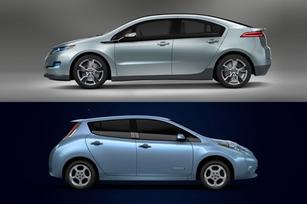
The cars, the Chevrolet Volt and the Nissan Leaf, take two different technological roads to sustainable transportation, and their differing appeal was on display Monday when I spent the afternoon at the Plug-In 2010 conference in San Jose. (Even the cars’ names telegraph their shades of green.)

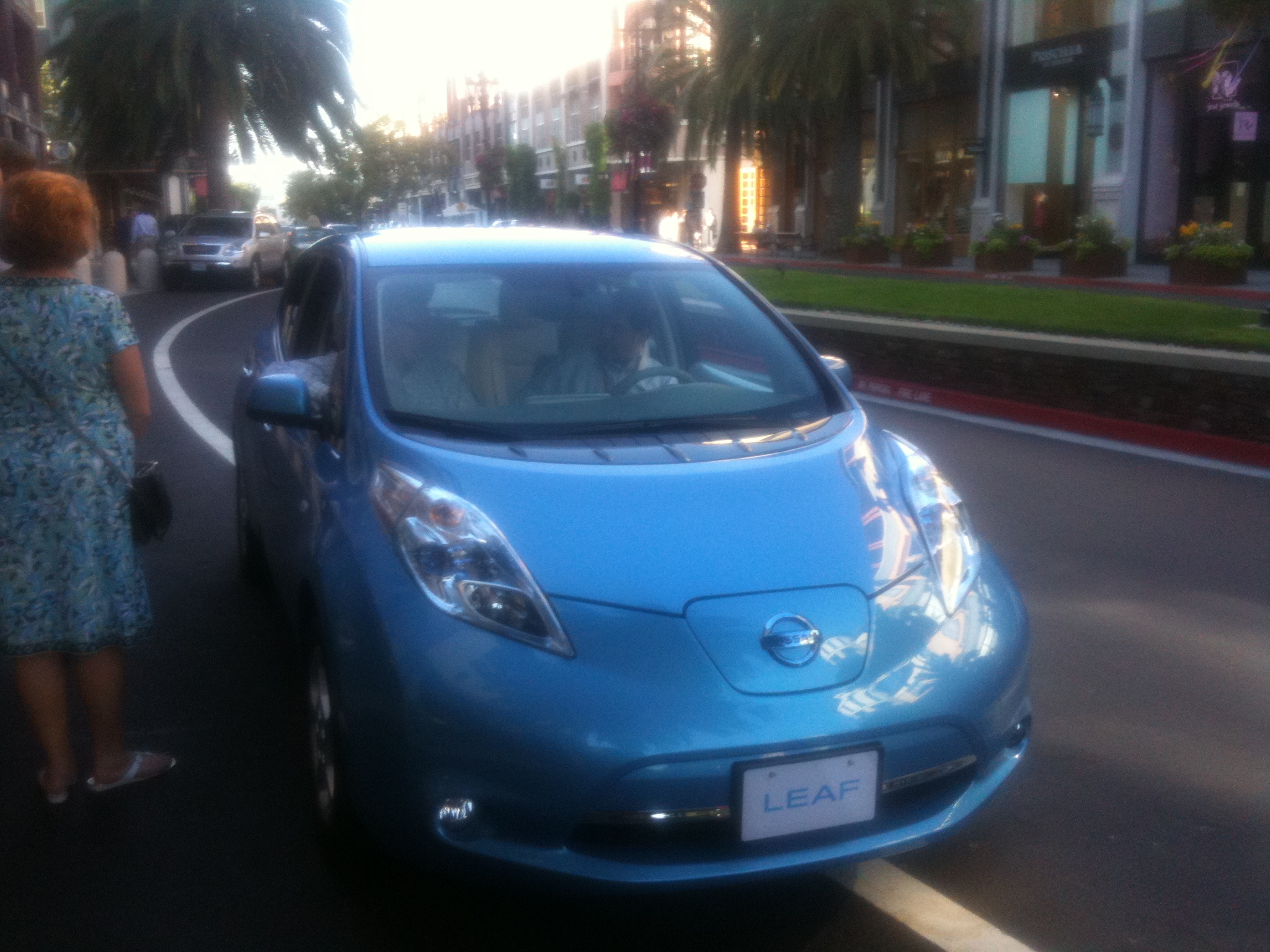
First I took a test drive of a metallic blue Leaf parked outside the Hotel Valencia in San Jose’s upscale Santana Row shopping district. Like the Toyota Prius, the five-seater Leaf has a distinctive shape that lets your neighbors know you’ve gone green — that and the logo emblazoned on the side that screams “zero emission” in big letters.

Nissan clearly is targeting the Prius set. Inside, the Leaf features a clean minimalist interior with just enough high-tech touches to let you know you that this is not your grandma’s Sentra. Move the big and round blue LED-illuminated knob in the center console to the left and down and the Leaf is in gear. (Press the button on the top of the knob to put the Leaf in park.)

Like every other electric vehicle I’ve driven, the Leaf accelerates quickly as power is instantaneously transferred to the wheels, albeit not as silently as other EVs. Nissan has implanted speakers under the wheel wells that broadcast a low sound somewhat like a starship going into warp to warn unsuspecting pedestrians that a car is coming.

Touch a button on the big dashboard screen and the Leaf tells you how many miles you can travel on the battery’s remaining charge and displays a map showing just how far you can go in any direction. Another button displays the location of charging stations — which are very few and far between in San Jose at the moment.

Other than the iPhone-like features, the Leaf drives and handle like any other compact car. Which is the point, after all, for automakers seeking to make electric cars as common as the Honda Civic.

Still, Nissan is clearly targeting the enviro crowd that made the Prius a hit and broke down barriers for electric cars.

“Basically everything you see here is made out of recycled water bottles, right down to the floor mats,” the Nissan representative riding shotgun points out about the interior.

If that doesn’t provide enough green cred at the neighborhood cocktail party, there’s the optional solar panel that does double duty as a spoiler. (“Ninety-nine percent bragging rights, one percent function,” concedes the Nissan rep.)

But what about the Volt?

That same evening, I attended a dinner where GM executives at long last revealed the sticker price of the Volt: $41,000, versus $32,780 for the Leaf, before a $7,500 federal tax credit.

Although GM calls the Volt an “extended range electric vehicle,” it is in fact a serial hybrid that will travel 40 emission-free miles on a charge from its lithium ion battery pack. When the battery runs down, a small gasoline engine kicks in to power a generator that delivers electricity to the car’s motor. That lets the Volt go 340 miles, dispelling range anxiety. (Nissan says the Leaf can travel up to 100 miles on a charge.)

“This car is designed for the majority of Americans,” Joel Ewanick, GM’s vice president for North America marketing, said at the dinner. “This is a car that the average person can drive on a daily basis. It’s not something that’s a unique little niche vehicle.”

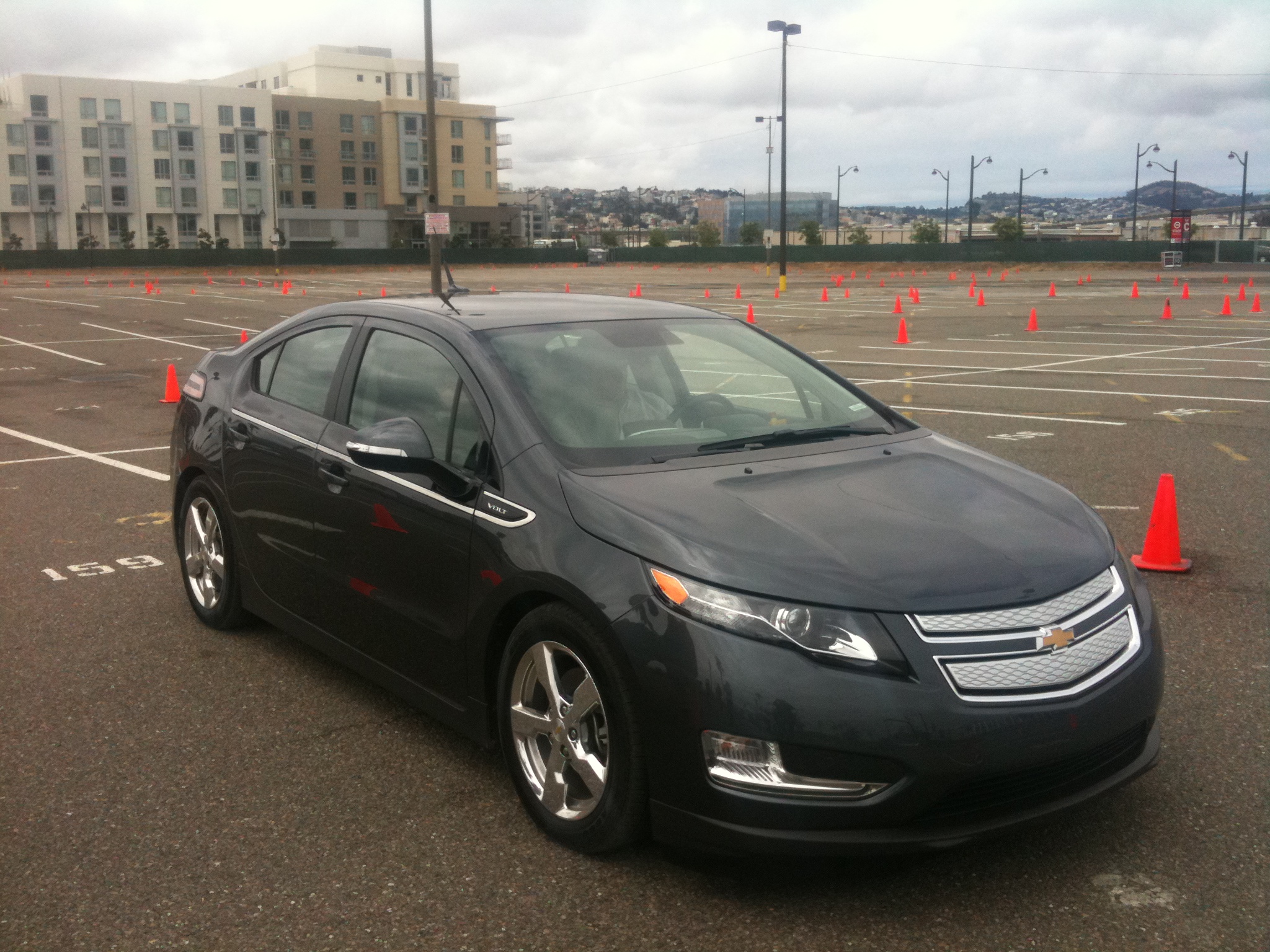
The Volt has an aggressive muscular stance and an interior choc-a-block with buttons and ports (plus a 32-gig hard drive for your music collection) that should appeal to the Camaro crowd as well as greenies. (It’s also fun to drive, as I found out when I took the Volt for a spin a couple of months ago.)

So, which to choose?

The reality is that both types of cars are needed to accelerate the transition away from gasoline-powered vehicles, and both vehicles present conundrums to potential buyers.

As I tooled around in the Leaf, I realized that if I had driven the car down to San Jose from Berkeley, I wouldn’t have enough juice to make a return trip. On the other hand, if I had taken the Volt, I would have been burning carbon for more than half the trip.

Clearly, the electric-car market will need both the Volt and the Leaf in the coming years.

And a lot of fast-charging stations.

photo: Todd Woody

In The New York Times on Tuesday, I write that General Motors has finally unveiled the retail price for the Chevrolet Volt plug-in electric hybrid:

General Motors began taking orders for the long-awaited Chevrolet Volt on Tuesday, pricing the plug-in hybrid car at $41,000.

A federal tax credit can reduce the net cost of the Volt to $33,500, and a 36-month lease will be available for $350 a month with $2,500 due at the signing.

Production of the Volt will begin in September, and the car will initially be sold in California, New York, Michigan, Connecticut, Texas, New Jersey and the nation’s capital, G.M. said.

The car’s suggested starting price is $8,220 higher than that of the all-electric Nissan Leaf, which will also go on sale this year.

With the Volt ready for the assembly line, executives began a full-court press to persuade consumers that the car’s cutting-edge technology and features are worth a BMW price tag.

“It’s a real car — it just happens to be electric,” Joel Ewanick, G.M.’s vice president for North America marketing, said at a dinner Monday night at the Plug-In 2010 conference in San Jose, Calif. “This car is designed for the majority of Americans. This is a car that the average person can drive on a daily basis. It’s not something that’s a unique little niche vehicle.”

“The marketing challenge is communicating how different this is than what they’re used to,” he added.

The Volt’s lithium-ion battery pack gives the car an emissions-free range of 40 miles. When the battery is depleted, a small gasoline engine kicks in to run a generator that supplies electricity to the motor, extending the Volt’s range by 300 miles.

Mr. Ewanick said that a Volt driven 15,000 miles a year would use 550 fewer gallons of gasoline than a comparable gas-only car.

G.M. executives, however, insist on calling the Volt an “extended range electric vehicle,” underscoring the balancing act between promoting its green credibility and its utility as competitors roll out all-electric cars.

You can read the rest of the story here.

I wrote this story for Grist, where it first appeared.

As global warming accelerates, the world will become not only hotter, flatter, and more crowded but also thirsty, according to a new study that finds 70 percent of counties in the United States may face climate change-related risks to their water supplies by 2050.

One-third of U.S. counties may find themselves at “high or extreme risk,” according to the report prepared for the Natural Resources Defense Council by Tetra Tech, a California environmental consulting firm.

“It appears highly likely that climate change could have major impacts on the available precipitation and the sustainability of water withdrawals in future years under the business-as-usual scenario,” the study’s authors conclude. “This calculation indicates the increase in risk that affected counties face that water demand will outstrip supplies, if no other remedial actions are taken. To be clear, it is not intended as a prediction that water shortages will occur, but rather where they are more likely to occur.”

Those conclusions are based on climate modeling, predicted precipitation, historical drinking water consumption as well as water use by industry and for electrical generation.

It’s no surprise that states in the hot and dry West faces the highest risk of water shortages. Arizona, California, Nevada, and Texas top the list, though the study also finds that part of Florida could find itself tapped out.

“As a result, the pressure on public officials and water users to creatively manage demand and supply — through greater efficiency and realignment among competing uses, and by water recycling and creation of new supplies through treatment — will be greatest in these regions,” the report states. “The majority of the Midwest and Southern regions are considered to be at moderate risk, whereas the Northeast and some regions in the Northwest are at low risk of impacts.”

The forecast relies on the continuation of business as usual — i.e. the nation does not change its water-wasting ways — and also on federal government data that predicts the U.S. will continue to use thirsty fossil-fuel power plants to generate electricity.

That should whet some appetites for renewable energy sources that use less water and for investment in new water technologies.

photo: U.S. Fish and Wildlife Service

On Thursday, Yale Environment 360 published a story I wrote about a growing fight over using the U.S. Endangered Species Act to protect wildlife at risk of extinction from climate change:

While a high-profile battle raged over listing the polar bear as a threatened species due to melting Arctic sea ice, U.S. environmentalists were quietly building a case to protect a critter closer to home, one whose existence also seems gravely threatened by a warming world.

A pocket-sized member of the rabbit family with a distinctive squeak and large ears that frame dark eyes and a button nose, the American pika lives on rocky slopes high in alpine mountain ranges from the Sierra Nevada to the Rockies. Sporting a thick gray-brown coat, the pika does not hibernate and so maintains a high internal temperature to survive frigid winters. Because it can’t turn off its heater, the animal can die in the summer if its body temperature increases by as little as 3 degrees Celsius (5.4 F).

As temperatures have risen across the American West, scientists who study the pika have discovered that it is disappearing from lower elevations. In the Sierra Nevada, for instance, biologists at the University of California, Berkeley, found that the pika had moved upslope 500 feet to cooler climes over the past 90 years. Another study determined that nine of 25 pika populations in the Great Basin of Nevada and Utah have vanished over the past century, with surviving pikas migrating up 900 feet. Eventually, the tiny mammal will reach the mountaintop and the end of the line, with nowhere left to go if temperatures continue to climb, according to numerous biologists.

The pika has become an indicator species in more ways than one. It is in the vanguard of a growing number of animals and plants that U.S. environmental groups have petitioned to protect as the Endangered Species Act becomes the latest battleground over global warming.

The effort to put a furry face on the abstract phenomenon of climate change is bringing to a head a simmering issue: As scientific evidence accumulates about global warming’s impact on wildlife, how effective can the Endangered Species Act be in cushioning the blow of climate change on various species? But beyond this issue, an even thornier question looms: Can conservation groups use the act to force the U.S. government to use the legislation’s powerful provisions to mandate greenhouse gas reductions to protect wildlife and their habitat?

You can read the rest of the story here.

Design a site like this with WordPress.com
Get started