Feeds:
Posts
Comments

Photo: Todd Woody

I wrote this story for Grist, where it first appeared.

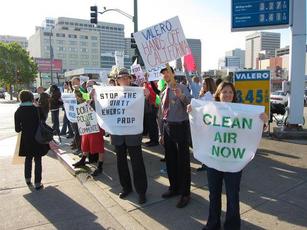
With the campaign season revving up, even more money is starting to flow into the campaign to defeat Proposition 23.

Prop 23 is the California ballot initiative that would suspend the state’s landmark climate change law. Its opponents had been relying mostly on the largesse of a California coalition of environmental groups and Silicon Valley’s venture capitalists and tech elite to finance their No on 23 campaign. But now No forces are tapping out-of-state donors.

On Thursday, they got $250,000 from New York investor Nicolas Berggruen. Berggruen is head of Berggruen Holdings, which has made investments in wind energy projects.

Also last week, Nancy Burnett of Lummi Island, Wash., deposited $100,000 in the anti-Prop 23 coffers. Burnett is a daughter of David Packard, co-founder of Silicon Valley tech giant Hewlett-Packard, and a supporter of Democratic candidates.

And this week, David Bonderman, a Texas investor with TPG Capital, donated $7,500.

Closer to home, Warren Hellman, the wealthy San Francisco investor, banjo player, and blue-grass aficionado, wrote a $75,000 check to the No campaign. The campaign’s supporters are fighting to preserve California’s Global Warming Solutions Act, popularly known as Assembly Bill 32. AB 32 requires the state to reduce greenhouse gas emissions to 1990 levels by 2020 and allows the creation of a cap-and-trade market to meet that mandate.

The bulk of the money financing the pro-Prop 23 campaign has come from two Texas-based oil companies, Tesoro and Valero, and other out-of-state fossil fuel interests. The most recent big donation came earlier this month when Valero gave $3 million to the effort.

Both sides expect the campaign spending to peak somewhere north of $100 million by the time Election Day rolls around in November, with huge amounts of cash rolling in when the traditional election season kicks off after Labor Day.

One person watching the Prop 23 battle closely is Lawrence Goldenhersh, chief executive of Enviance, a California firm that sells environmental compliance software and services — including those that track greenhouse gas emissions — to big industrial companies.

“If AB 32 is sustained by the voters of California, you will have the largest plebiscite in the history of the climate change debate cast by voters in the world’s seventh largest economy,” Goldenhersh told me Tuesday. “If AB 32 survives and Jerry Brown gets elected governor I think you’ll have cap-and-trade nationally by 2013.”

Enviance has clients on both sides of the Prop 23 fight — including Valero — and thus is not taking a position on the ballot measure, according to Goldenhersh. Still, he calls the election the “Normandy invasion of climate change.”

“If Prop 23 passes and AB 32 is suspended or killed then I think there will not be a lot of drive and political appetite to take on a piece of grand climate legislation in Congress,” he says. “People will say, ‘if it’s too expensive for California then it’s too expensive for a little state.’ “
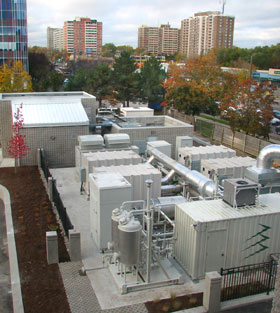
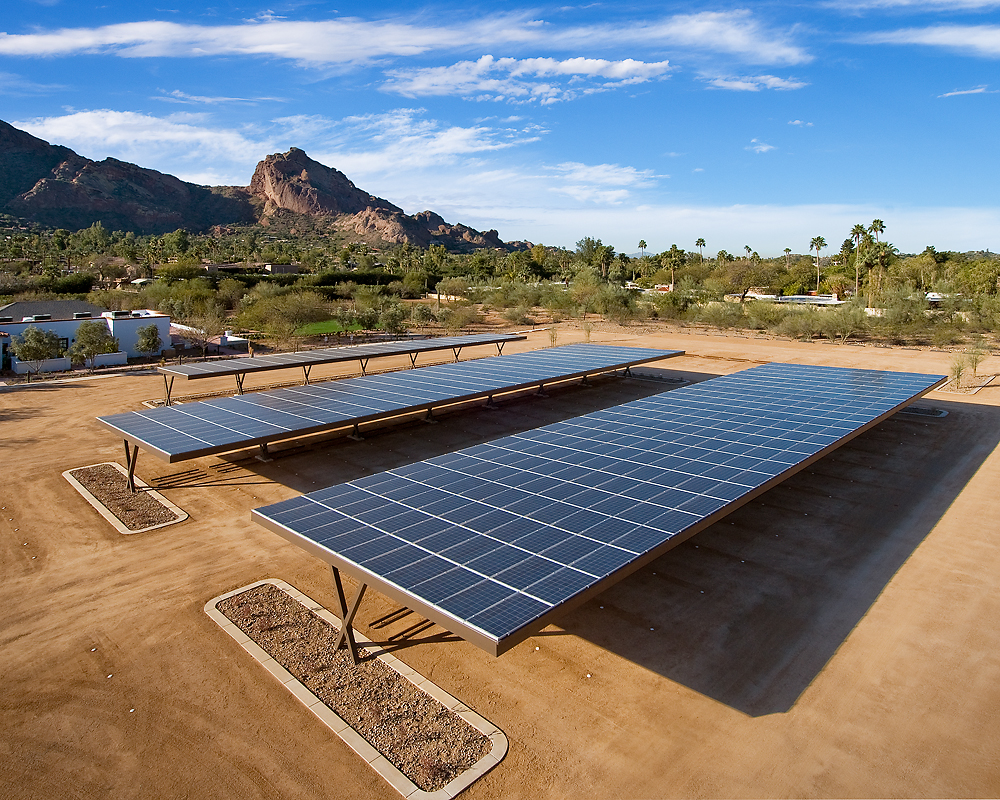
photo: FuelCell Energy

I wrote this story for Grist, where it first appeared.

It’s been a crappy week — and I mean that in a good way.

On Wednesday, I wrote about the California egg farm that bought a 1.4-megawatt fuel cell powered by biogas produced from chicken poo. (Forget free-range eggs; carbon-free could become all the rage with fashion-forward foodies.)

Now the company that makes the fuel generator, FuelCell Energy, said it has signed a deal to provide two 300-kilowatt fuel cells to a Southern California water district that will install the devices in wastewater treatment plants. These fuel cells will also be powered by biogas derived from wastewater — i.e. what swirls down your toilet.

You get the picture.

An anaerobic digester at the Perris Valley Regional Water Reclamation Facility in Riverside County will remove methane, a potent greenhouse gas, from the, er, “biosolids,” which will provide the fuel for the fuel cells.

Heat produced by the fuel cells will be used to help power the digester, creating what engineers call a closed-loop system. That will take pressure off the power grid and help California utilities meet a mandate to obtain a third of their electricity from renewable sources by 2020.

“We installed our first fuel cell power plant about two years ago and have been very pleased with the reliability of the system,” Ron Sullivan, president of the board of the Eastern Municipal Water District, said in a statement. “We operate around the clock and value the energy security that an on-site fuel cell provides, which is about 40 percent of our total electrical demand at that plant.”

Gordie Hanrahan, a spokesperson for FuelCell Energy, said he could not comment on the costs of the Riverside County fuel cells. But he noted that a 600-kilowatt system installed for a farm customer in California last year cost $9.5 million and had a projected annual energy savings of $700,000. When various incentives and other savings are taken into account, the payback time is estimated to be six years.

A big benefit of fuel cells in smoggy Southern California is that besides emitting virtually no carbon dioxide they also produce nearly zero nitrogen oxide, sulfur dioxide, and particulate matter — all of which are strictly regulated by the state and pose a health hazard.

“The ultra-clean power generation by the fuel cell power plant was an important aspect of our purchasing decision,” noted Sullivan.

Priming the pump was a $2.7 million grant that the state of California awarded to the water district for the purchase of the fuel cells.

Now that’s money that won’t go down the drain.

photo: REC Solar

I wrote this story for Grist, where it first appeared.

Every time I fly over Phoenix, Las Vegas, or some other sprawling sun-scorched Southwest city, two thoughts come to mind: Who had the bright idea of putting black shingles on all those desert subdivisions, and why aren’t those roofs covered in solar panels?

Apparently the administrators at the Southern Arizona VA Health Care System in Tucson had the same idea. This week REC Solar, a California company, announced a deal to install a 2.9-megawatt photovoltaic array on the hospital’s carports. That’s in addition to the 302-kilowatt system ground-mounted system REC Solar currently is building for the veteran’s hospital.

At 2.9 megawatts, the new parking lot installation will apparently be the nation’s largest solar carport complex and will supply a big chunk of the 900,000-square foot facility’s electricity demand. (At peak output, an array of that size would be able to supply electricity to roughly 3,000 average-sized homes, provided their owners didn’t run the air conditioning 24/7.)

The solar panels generate electricity while the carports will help to keep the vehicles underneath cooler. Three years ago, Google put solar panels on carports at its sprawling Silicon Valley headquarters and then installed electric car charging stations in the parking spaces. A San Diego company called Envision Solar builds “solar groves” — tree-like carports with solar panel canopies — in parking lots for companies such as Dell.

While the Arizona deal highlights the opportunity to generate clean electricity from parking lots — those vast wastelands that symbolize the nation’s oil addiction — it also underscores the government’s role in driving demand and creating a market for green technology.

While the Obama administration has doled out billions of dollars in stimulus money for renewable energy projects, it has also directed federal agencies to practice what it preaches. That means increasing the energy efficiency of the government’s own huge real estate holdings, replacing federal automotive fleets with cars that run on alternative fuels, and generating electricity from renewable energy.

As I wrote earlier this week, the United States military has become one of the biggest green forces. The Navy, for instance, is aiming to cut its dependence on fossil fuels in half by 2020 by converting ships to run on electric hybrid propulsion systems, fueling fighter jets with biofuels, and installing everything from smart meters to solar arrays at all naval bases.

In other words, there’s a lot of government carports out there ready to go solar.

I wrote this story for Grist, where it first appeared.

When Bloom Energy unveiled its long-awaited fuel cell earlier this year to much media attention and announced it had installed the 100-kilowatt devices at Google, eBay, and other Fortune 500 companies, there was sniping in some quarters about greenwashing as the Bloom Energy Servers ran on natural gas.

But generators can also use biogas and on Tuesday a Bloom competitor, FuelCell Energy, announced the sale of a 1.4-megawatt chicken poo-powered fuel cell to an egg farm in California’s Central Valley.

Olivera Egg Ranch will install an anaerobic digester that will strip methane, a potent greenhouse gas, from untold pounds of poultry poo that usually are stored in a waste lagoon. Instead of escaping into the atmosphere and contributing to global warming, the methane will power the fuel cell, which will generate enough electricity to supply the ranch’s entire operations.

In a double play for the environment and the ranch owner’s pocketbook, the heat that is a byproduct of the fuel cell’s operation will be used by the anaerobic digester, forgoing the need for a combustion-based boiler. In other words, Olivera’s eggs — it packs 14 million cartoons annually — will be produced with virtually greenhouse-gas free electricity.

Most California farming operations that have recently deployed anaerobic digesters — usually to process cow manure — connect them to pipes that ship the methane gas to a distant utility power plant where it is used as fuel.

Fuel cells take distributed energy to the countryside, generating electricity onsite and thus avoiding the need for transmission infrastructure as well as the greenhouse gas emissions of a central natural gas-fired power plant.

“My waste disposal costs will decrease as will my power bill as the poultry operation will continually generate the fuel needed to create electricity, reducing the amount of electricity needed from the electrical grid,” ranch owner Ed Olivera, said in a statement.

photo: NRDC

I wrote this story for Grist, where it first appeared.

The climate war has shifted to California.

Proposition 23, an initiative that would suspend Assembly Bill 32 (AB 32), the state’s landmark global warming law, provides the first ballot box test for climate change legislation — and for the prospects of reviving a national cap-and-trade bill.

So far, much of the media attention has focused on Prop 23’s funding. It’s being underwritten by the Texas oil companies Tesoro and Valero along with other mostly out-of-state petrochemical and fossil fuel interests. Prop 23 supporters have contributed more than $6.5 million to the campaign.

But a review of opposition fundraising — for the No on 23 campaign — offers a revealing look at what amounts to a fight for the future, a struggle between the industrial behemoths of the old fossil fuel economy and a startup coalition of environmental groups, Silicon Valley technology companies, financiers, and old-line corporations looking to profit from decarbonizing California.

“The choice that is before California is between the new clean economy versus the dirty old economy,” says Annie Notthoff, California advocacy director for the Natural Resources Defense Council. “The Silicon Valley folks who are willing to invest in the new clean energy economy with their dollars are tangible evidence that this is an economic issue as well as an environmental one.”

The NRDC has emerged as one of the key fundraisers, funneling more than a million dollars to the No on 23 campaign to date. Big green groups such as NRDC and the Environmental Defense Fund took the lead on forging alliances with Fortune 500 companies in the unsuccessful effort to pass national climate change legislation. In contrast, the heavy hitters in California’s Prop 23 battle are green tech entrepreneurs and venture capitalists, who have traditionally shied away from electoral politics.

The last stand for climate change has brought John Doerr, a leading green tech investor with Kleiner Perkins Caufield & Byers, to the table. Doerr has given $500,000 to defeat Prop 23. And he’s not alone.

Wendy Schmidt, founder the 11th Hour Project, a Silicon Valley environmental grant-making nonprofit (and wife of Google chief executive Eric Schmidt), donated $500,000 to NRDC’s No Prop 23 Committee. (Disclosure: The Schmidt Family Foundation is a financial supporter of Grist’s, and Wendy Schmidt is a member of the Grist Board.)

Google itself hasn’t contributed to the No campaign, but last week the search giant’s green energy chief, Bill Weihl, assured a gathering at the company’s Silicon Valley headquarters that, “We’re strongly behind the No on 23 campaign” and the global warming law, known as AB 32.

When asked about Google’s potential financial support for the No campaign, company spokesperson Parag Chokshi said, “Google has been a very strong supporter of AB 32 and wants it to be implemented. We’ll continue to monitor the situation as we move forward.”

To date, the heaviest hitter on Team No is Thomas Steyer, the press-shy founder of San Francisco hedge fund Farallon Capital Management. Steyer, a big donor to Democratic candidates, has pledged $5 million and stepped forward to co-chair the No on 23 Committee with George Schulz, the Republican former secretary of state.

“I personally come at this issue as a businessperson who cares about the economic future of California as well as the environmental and security issues here,” Steyer said on a conference call late last month. “The right way to frame this is that we have a fairly stark choice to either move forward or turn back the clock.”

“We have 12,000 companies in California working on clean energy already,” he added. “It’s going to be one of the dominant spaces in the world and for us to excel and lead in this area we need a consistent regulatory framework for investment.”

Yet another mainstream investor is Robert Fisher, former chair of The Gap, the San Francisco-based clothing empire. Like Schmidt, Fisher has put up a half million dollars for the NRDC fund. And Southern California investor Anne Getty Earhart, an heir to the Getty oil fortune, donated $250,000 directly to the No campaign.

“What makes this unusual is that this is not your classic tree-huggers-versus-big business battle,” says Steve Maviglio, a longtime California Democratic operative and the chief spokesperson for the No on Prop 23 campaign. “Environmentalists, dyed-in-the-wool businessmen, tech companies — they have all been very active in fundraising, active on the lecture circuit and before editorial boards.”

You can read the rest of the story here.

photo: U.S. Navy

In The New York Times on Tuesday, I write about Navy Secretary Ray Mabus’ plans to green the Navy and Marine Corps and help build a market for new technologies:

Want to stimulate demand for renewable energy? Send in the Marines.

That was Navy Secretary Ray Mabus’s message on Monday when he outlined plans to slash the Navy and Marine Corps’ dependence on fossil fuels during an appearance on Monday evening at San Francisco’s Commonwealth Club.

“We use in the Navy and Marine Corps almost 1 percent of the energy that America uses,” Mr. Mabus said. “If we can get energy from different places and from different sources, you can flip the line from ‘Field of Dreams’ — If the Navy comes, they will build it. If we provide the market, then I think you’ll begin to see the infrastructure being built.”

“Within 10 years, the United States Navy will get one half of all its energy needs, both afloat and onshore, from non-fossil fuel sources,” he added. “America and the Navy rely too much on fossil fuels. It makes the military, in this case our Navy and Marine Corps, far too vulnerable to some sort of disruption.”

Reaching those renewable energy goals will be a gargantuan challenge. The Navy operates 290 ships, 3,700 aircraft, 50,000 non-combat vehicles and owns 75,200 buildings on 3.3 million acres of land.

Last year the Navy launched its first electric hybrid ship, the Makin Island, an amphibious assault vessel that some have dubbed the Prius of the seas. On its maiden voyage from a shipyard in Pascagoula, Miss., to its home base in San Diego, the Makin Island saved $2 million in fuel costs, Mr. Mabus said.

“In terms of our fleet, we have most of ships we’re going to have in 2020 so we know what we have to do to change that,” he said in a conversation with Greg Dalton, a Commonwealth Club executive. “We can do things like retrofit ships with hybrid drives. Mainly it’s changing the fuels.”

Two days after the Deepwater Horizon oil rig exploded in the Gulf of Mexico in April, a Navy pilot flew an F/A-18 Hornet fighter jet powered by a biofuel blend made from the seeds of camelina sativa, an inedible plant.

You can read the rest of the story here.

I wrote this story for Grist, where it first appeared.

At an event at Google last week, green tech investor Vinod Khosla noted that solar companies are building factories in California even though it would be cheaper to manufacture photovoltaic panels in China.

“The markets are here, the innovators are here, the ecosystem is here,” he said, noting that the state’s global warming law, known as Assembly Bill 32, or AB 32, had created a predictable regulatory climate, spurring investment in California.

Adding another data point to Khosla’s argument, AQT Solar, a Sunnyvale, Calif., startup, announced Thursday that it had officially flipped the switch on its first factory – in the heart of Silicon Valley.

The company’s trajectory is classic Silicon Valley and illustrates Khosla’s thesis of why California has become an epicenter of green technology innovation.

AQT was founded in 2007 by veterans of the Valley’s old-line tech industry who saw a way to repurpose existing technology to make cheaper and more efficient thin-film solar cells at a time when photovoltaic module prices were plummeting and competitors with high capital costs were being squeezed. (Thin-film solar cells are made by depositing semiconducting materials on glass or flexible materials, a process which allows them to be essentially printed on long rolls of metal.)

The startup managed to get to the production phase on $15 million raised from investors — a pittance for a solar cell manufacturer — and on Thursday the company also announced its first customer, the developer Sol Pacifico, which will install AQT solar cells at a luxury resort to be built in Baja Mexico.

The factory will initially be able to produce 15 megawatts’ worth of solar cells a year.

AQT has been able to recycle Silicon Valley’s old computer chip company infrastructure as well as tap its intellectual and financial capital.

“We found a building that was an old semiconductor plant that fit our needs perfectly,” says Michael Bartholomeusz, AQT’s chief executive. “In next six months, we’ll be expanding our Sunnyvale facility and hiring 40 more people. We’ll have a second manufacturing site next year.”

That’s not a huge number of jobs, of course, but inevitably some of those employees will capitalize on their experience at AQT and start their own companies, continuing Silicon Valley’s endless cycle of innovation.

Khosla’s point was that that feedback loop could be short-circuited if voters in November pass Proposition 23, a California ballot initiative that would suspend the state’s global warming law and with it the certainty businesses that rely on to make investment decisions.

“More of the startups in Silicon Valley are setting up factories here rather than in China, and that’s because there’s a market here,” he said. “That will change” if Proposition 23 passes.

photo: Todd Woody

I wrote this story for Grist, where it first appeared.

With months to go before the first mass production electric cars hit American streets, the $41,000 question (before rebates and tax incentives) is whether drivers will buy them en masse.

Which is why you should keep your eye on Berkeley, Calif. While I would hardly hold out my hometown as an avatar of mainstream American values, on the environmental front it’s often been in the vanguard of things to come, like curbside recycling.

Take hybrid cars. When I was reporting a story earlier this year on the San Francisco Bay Area as the launch pad for mass-market electric cars, Andrew Tang, an executive with PG&E, told me that the utility was closely watching local sales of the Toyota Prius as a proxy for likely purchases of electric cars. Studying Prius distribution helped PG&E create a heat map of neighborhoods where the electricity demand might spike.

In Berkeley, he said, one out of every five cars sold for the past four years has been a Prius. Made sense to me. Priuses seem as common as Obama bumper stickers and are just part of the visual landscape, like Alice Waters. But it wasn’t until my friend Mike and his son Bryce were visiting from Texas recently that the hybridization of Berkeley really became apparent to me.

We were at REI picking up some gear for a camping trip when Bryce remarked that he had counted eight Priuses in the store’s rather small parking lot. On the 2.8-mile drive home we decided to see how many Priuses we could spot along the road into the Berkeley Hills.

We counted 34, including four on my block.

A few weeks later I played the Prius game on the way down the hill to the Berkeley Bowl to pick up some groceries. I counted 25 Priuses, two Honda Insight hybrids, an old Toyota RAV4 electric and one gunmetal gray Tesla Roadster.

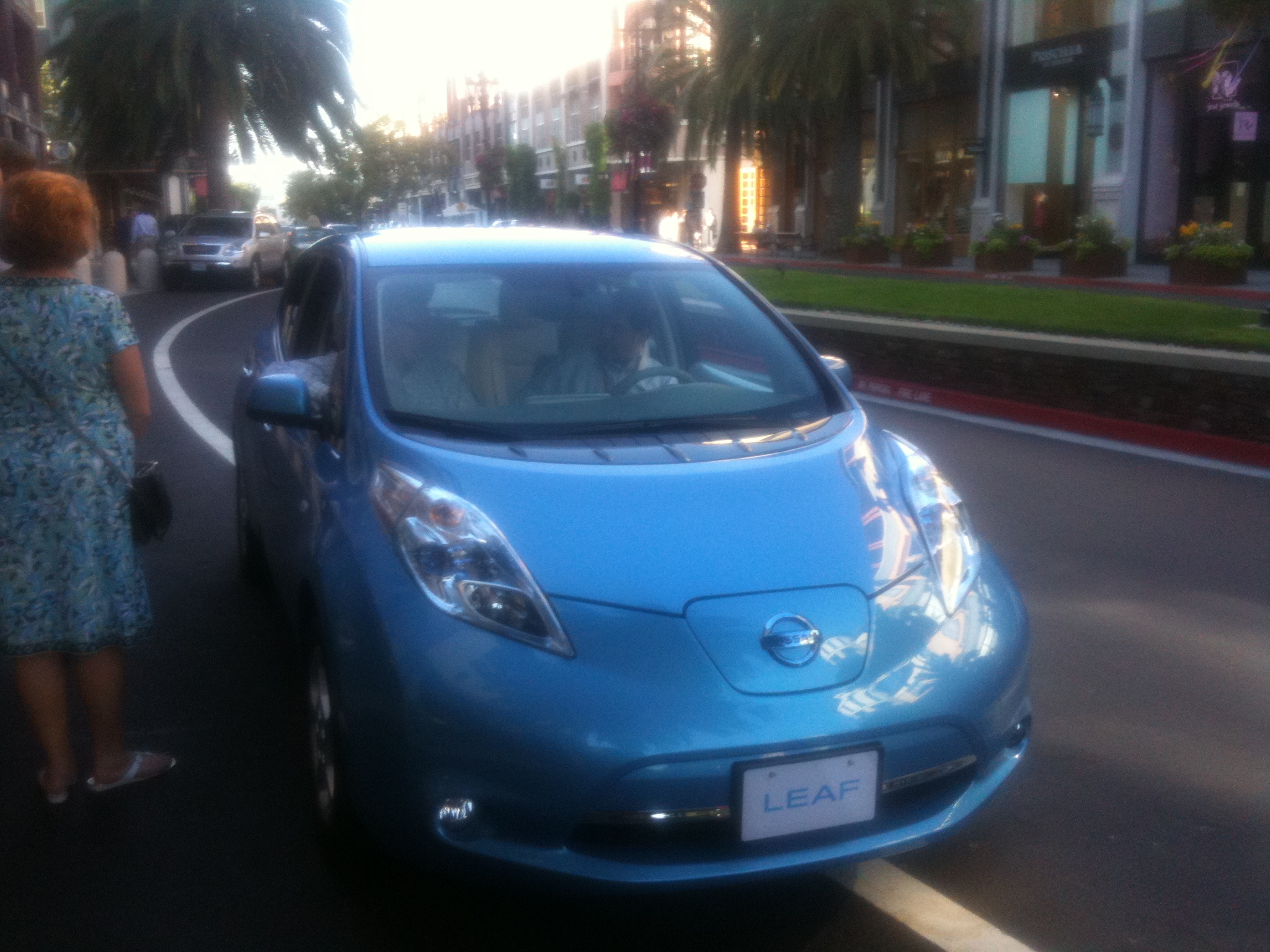
So will Toyota’s hegemony stand once Nissan’s battery-powered Leaf blows into town? No doubt, many will trade in their Prius to go electric. The Leaf sports a distinctive look that, like the Prius, screams green to your neighbors. (And keeping up with the Joneses is just a part of Berkeley’s cultural fabric.)

The Chevrolet Volt may be a harder sell, given it is an electric hybrid and boasts a muscular all-American look that you don’t see too often on the streets here.

But every Prius owner won’t have to switch to electric in order to have an impact. Seeing a Leaf or Volt in the neighbor’s driveway or in the REI parking lot will make an electric car less a curiosity and more just another automotive option when trading in that ’95 Volvo station wagon.

photo: eSolar

I wrote this story for Grist, where it first appeared.

As the traditional Labor Day kickoff to the fall election campaign approaches, the battle is intensifying over Proposition 23, the California ballot initiative that would effectively repeal the state’s landmark climate change law.

And thus the title of a gathering Tuesday at Google’s Silicon Valley headquarters: “Electric Bills & Oil Spills: Will California Continue to be a Clean Energy Leader?”

The not-so-subtle subtext: Not if Prop 23 passes.

“We’re strongly behind the No on 23 campaign,” Bill Weihl, Google’s green energy czar (yes, that’s his title), said as he kicked off the event in a company café packed with Bay Area green A-listers.

Not surprisingly, the panel focused less on the environmental consequences of Prop 23 than on the potential for the ballot initiative to derail California’s green tech revolution.

“Proposition 23 will kill markets and the single largest source of job growth in California in the last two years,” declared Vinod Khosla, a leading green tech investor, referring to the clean energy economy. “Not only that, it’ll kill investment in the long term for creating the next 10 Googles.”

Chipped in Weihl: “For California, we can either lead in this and invest in it and participate in this huge growth sector or cede that to China, India, and other places. It would be crazy for us to sit back and let others take that opportunity.”

Underwritten by Texas oil companies Tesoro and Valero and other out-of-state fossil fuel corporations, Prop 23 would suspend California’s global warming law — popularly known as AB 32, as in Assembly Bill 32 — until the unemployment rate drops to 5.5 percent for four consecutive quarters. (In other words, never.) AB 32 requires California to reduce greenhouse gas emissions to 1990 levels by 2020, which most likely would be accomplished through a cap-and-trade market.

Khosla and Weihl were joined on a panel by Mary Nichols, head of the California Air Resources Board, the agency charged with implementing AB 32; and Tom Bottorff, an executive with the utility PG&E.

“If you listen to the arguments of the proponents of Prop 23, their vision of California is a World War II or 1950s vision,” said Nichols, who before her appointment by Gov. Arnold Schwarzenegger was a longtime activist with the Natural Resources Defense Council. “They want to go back to a time when rubber factories and building of aircraft and automobiles were the main businesses of California.”

As the fight over Prop 23 heats up, expect to see a lot more of such talk from a place where the future is the main export.

photo: Todd Woody

In a followup to my story in Wednesday’s New York Times about recycling farmland and toxic waste sites for renewable energy projects, I take a deeper dive into why some farmers in the California’s San Joaquin Valley want to stop raising crops and start growing electrons:

In an article in The New York Times on Wednesday, I wrote about an ambitious plan to build one of the world’s largest solar energy complexes on 30,000 acres of farmland in the San Joaquin Valley of California.

Elsewhere, big renewable energy projects have encountered opposition from farmers, ranchers and environmentalists who worry about the impact of solar power plants on agriculture, wildlife and scarce water supplies.

But farmers in the San Joaquin Valley’s Westlands Water District are embracing solar power as a solution to their water woes. And environmental groups are backing the project as a way to avoid fights over building solar power plants in pristine desert areas.

In the 1960s, the west side of the San Joaquin Valley was transformed from a desert to one of the nation’s most productive agricultural centers thanks to a huge irrigation project that transports water from Northern California and distributes it to 600,000 acres of farmland through 1,034 miles of underground pipes.

Decades of irrigation and drainage problems led to a buildup of salt in the soil that forced the water district to spend $100 million to acquire and retire 100,000 acres of land from most agricultural production. Drought and environmental disputes over the impact of water diversions on endangered fish, meanwhile, slashed water deliveries to Westlands farmers.

The water district hopes to make money off salt-contaminated land by providing an initial 12,000 acres to Westside Holdings, a firm that has proposed building a 5,000-megawatt photovoltaic power complex called the Westlands Solar Park.

And farmers like Mark Shannon have agreed to lease their parched land to Westside, reluctantly concluding there’s more money to be made by growing electrons than crops.

“Last year, we received only 10 percent of our water supply and we idled 85 percent of this ranch,” said Mr. Shannon of the 5,300-acre property that his family has farmed for three generations. “My dad is 67 and I can’t believe how many times I’ve called him and he’s in tears — he just always figured he’d pass this land on to me.”

Mr. Shannon took me up in a small plane for a bird’s-eye view of the impact of the water crisis on his land, where brown fields surround green patches of almonds and pistachios. Beyond his farm are dry lands that stretch to the horizon, property owned by the Westlands Water District and taken out of irrigated production.

“Last year, we had over 250,000 acres in the district that didn’t get farmed,” said Sarah Woolf, a Westlands spokeswoman. “Then you have drainage issues coupled with the long-term reliability of the water supply.”

Desperate farmers have been spending millions of dollars drilling hundreds of deep groundwater wells, which in turn has caused subsidence problems.

In other parts of California, the prospect of covering square miles of farmland with solar panels has stirred outrage among some rural residents. But Mr. Shannon and Westlands officials don’t expect any significant opposition in the San Joaquin Valley.

The reason: if farmers such convert their land to solar farms, their water allocations will be redistributed to their neighbors.

You can read the rest of the story here.

Design a site like this with WordPress.com
Get started