Feeds:
Posts
Comments

Archive for the ‘wind power’ Category

cemex-eurus-wind-farm1

photo: CEMEX

The cement industry’s contribution to global warming is pretty concrete – it’s responsible for 5% of greenhouse gas emissions, fueled by demand from the rapidly industrializing economies of China and India.

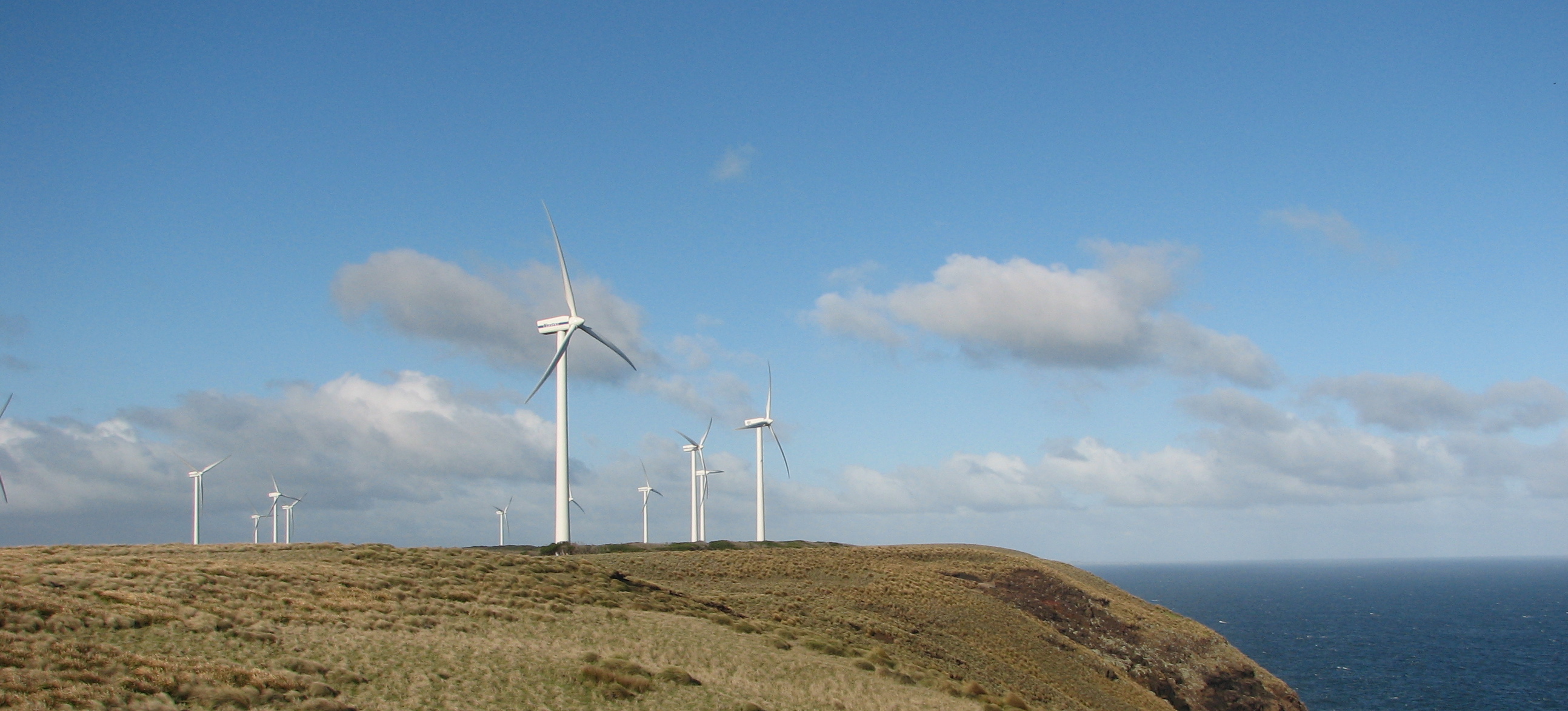
Now CEMEX, the Mexican building materials giant, has taken steps to green up its operation. Not by changing the way it makes cement but how it powers the process. Late last week, Mexican President Felipe Calderón inaugurated the first phase of what will be a $550 million, 250-megawatt Oaxaca wind farm – Latin America’s largest – that will generate the equivalent of a quarter of the electricity CEMEX consumes in Mexico.

The EURUS wind farm is a joint development between CEMEX (CX) and Acciona, the Spanish renewable energy powerhouse. The first 25 turbines will go online by March and the final phase will be completed by the end of 2009. A CEMEX spokesman said Acciona will retain ownership of the wind farm and sell the electricity to CEMEX under a 20-year contract.  The electricity from EURUS will go into the power grid and CEMEX will receive “electricity credits” for the power produced.

Mexico has become the next frontier for the wind industry. The same day Calderón presided over the opening of EURUS he also dedicated a nearby 80-megawatt wind farm built by Spanish company Iberdrola Renewables.

Read Full Post »

img_1223

photo: Todd Woody

As President Barack Obama embraced renewable energy in his inaugural speech Tuesday, Clipper Windpower laid off 90 employees – about 11% of its workforce – as the global financial crisis throws a spanner in the once-booming wind industry.

The Carpinteria, Calif.-based turbine maker has seen business slow as customers delay existing orders and put off new ones because they cannot obtain financing for wind farms, Clipper CEO Doug Pertz told Green Wombat.

“In the short-term, the impact to Clipper is a reduction in 2009 turbine production,” he said. “We know that 2009 will be a challenging year, however, remain optimistic that this economic situation is temporary.  We trust that the new Obama administration will, in the not-too-distant future, enact policy to enable better financing options for wind energy projects and aggressively promote the growth of renewable energy development.”

Clipper is one of only two U.S.-owned turbine makers – the other being General Electric (GE) – in an industry dominated by European manufacturers and wind farm developers.

Like their counterparts in the solar industry – which also has been shedding workers in recent weeks – wind companies depend on tax incentives to lure investors. But with traditional investment banks all but extinct on Wall Street and other investors hoarding their cash, there’s been little appetite of late for investing in so-called tax equity partnerships to provide funding for massive wind farms or solar power plants.

Pertz said Clipper’s production is down 20% from the 750 megawatts worth of turbines it manufactured in 2008 and that he expects double-digit declines for 2009. “Customers with large balance sheets are being much more conservative and smaller independent wind developers are seeing that it is much more difficult to obtain tax-equity financing,” he noted.

Wind and solar industry lobbyists are pushing Congress to make the investment tax credit and the production tax credit refundable so those companies that don’t have tax liabilities can trade the credits for cash that can be used to finance renewable energy projects.

Founded in 2001 by wind industry veteran James Dehlsen – his first wind company is now owned by GE –  Clipper makes a 2.5-megawatt turbine called the Liberty at its Cedar Rapids, Iowa, factory that powers wind farms built by FPL (FPL) and BP (BP). Other customers include Queen Elizabeth II, who bought the prototype of a 10-megawatt offshore turbine being developed by Clipper in the U.K.

One bright spot for the wind industry, said Pertz, is an expected move by well-capitalized utilities to take ownership stakes in wind farms if a national standard is enacted requiring them to obtain a certain percentage of their electricity from renewable sources.

Read Full Post »

deutsche-bank-green-bankPresident-elect Barack Obama may dismiss notions of a New New Deal to stave off a Great Depression 2.0, but signs of a Rooseveltian shift in thinking abound.

Case in point: This week, Deutsche Bank called for the establishment of a “national infrastructure bank” to create “green” jobs, fight global warming and ensure U.S.  energy independence by investing in an array of projects – from energy efficiency to upgrading the Eisenhower-era power grid to large-scale renewable energy power plants.

The idea of a national infrastructure bank is not new – versions have been proposed by Obama and Senators Chris Dodd (D-Conn.) and Chuck Hagel (R-Neb.) to finance the repair of the nation’s crumbling highways, water systems and cities. Deutsche’s twist is to give such an institution a green mission.

“We believe this confluence opens up an historic opportunity for a new U.S. administration and Congress to take a global leadership position on the issue of the environment and energy security, while addressing current financial problems,”  wrote Deutsche Bank’s Climate Change Investment Research team in its report.

“We’re calling for the national infrastructure bank to go green because in the long run it will save us money and create more jobs,” Deutsche senior investment analyst Bruce Kahn told Green Wombat.

He says Deutsche Bank is not putting a dollar figure on the capitalization of such bank, but the report notes others have suggested a $100 billion investment would generate two million green jobs.

Deutsche Bank (DB) recommends a green infrastructure bank focus on energy efficiency, the transmission grid, renewable energy and public transportation. The green bank would dispense federal funding, make grants to states and cities, issue loans to governments and companies, underwrite public and private bonds, and provide tax credits for public and private projects.

In Deutsche Bank’s analysis, the biggest bang for the buck would come from a massive retrofit program to increase the energy efficiency of the nation’s commercial buildings and make sure the 1.8 million new homes constructed every year are green. Buildings consume as much as 50% of the electricity generated in urban areas and emit about 20% of the country’s greenhouse gases. The work of installing energy-efficient heating, lighting and air conditioning systems is labor intensive and would spike demand for green building materials.

Upgrading and digitizing the power grid to create a “transmission super highway” to bring solar and wind energy from the deserts and Great Plains to the cities could generate as many as 500,000 jobs, according to an estimate by the American Wind Energy Association. The price tag to modernize the grid: $450 billion over the next 15 years by New Energy Finance’s estimate.

One area given short shrift by the Deutsche report is how a green infrastructure bank would support large-scale renewable energy power plants. Wind farms and solar power stations typically require billions of dollars in financing to get built and rely on investors buying the tax credits the projects generate. Those investors have been in short supply thanks to the credit crunch and the collapse of the Wall Street banks that often put up the cash for such deals.

“Everyone’s lost money, there’s no tax equity to be had,”  says Kahn. “But we expect that tax credit equity investors will return to the market, not next month, but in the next couple of years.” Kahn says an infrastructure bank could support green energy power plant projects through loans and loan guarantees.

A green bank would also be good business for Deutsche Bank.

“We have large number of investments at stake, current investments in all these sectors,” says Kahn. “It provides an investment opportunity as this infrastructure bank would not be able to exist all on its own. It would need private capital to invest alongside it.”

Read Full Post »

photo: Todd Woody

CEDAR RAPIDS, Iowa – For the past four years, the global wind industry has grown at a Google-like 30% clip as wind farm developers and turbine makers met demand for the one renewable energy source that has become competitive with fossil fuels. In the United States alone, new wind capacity will have jumped 50% in 2008.

Now the credit crunch is taking its toll – at least when it comes to forecasts for the industry’s prospects in 2009. Over the past week, analysts and industry insiders have ratcheted back growth predictions due to uncertainty over whether developers will be able to secure financing for the ever-bigger wind farms on the drawing boards.

“There is little visibility into the project finance market over the next 18 months,” wrote HSBC analysts Robert Clover, Charanjit Singh and James Magness in a report issued last week. “Thus far, company management in the wind sector continues to say that it is not experiencing a slowdown in growth, although developers say that finance is more expensive than it was. We do not believe that the long-term growth story has been undermined, but expect a period of reduced growth.”

The HSBC analysts predict the industry won’t grow at all next year. Meanwhile, the American Wind Energy Association, a Washington, D.C., trade group, also expects a slowdown in 2009.

“Clearly the market’s perception of growth for the wind industry has declined dramatically, but against a backdrop of virtually no industry data points,” the HSBC analysts acknowledged.

Ah, there’s the rub. Aside from the fear of the future that threatens to paralyze just about every industry, absent a complete collapse of capitalism the wind industry would seem poised to continue its run, albeit at a slower pace. (The nascent Big Solar business, in contrast, finds itself in a more precarious situation.)

In the U.S., state mandates that require utilities to obtain a growing percentage of electricity from renewable sources will drive growth for years into the future. That’s the reason you’re seeing plans for gigawatt-sized wind farms like the 4-gigawatt one T. Boone Pickens is building in Texas. As analysts were souring on the industry’s prospects last week, oil giant BP’s (BP) wind subsidiary finalized a deal with California turbine maker Clipper Windpower to build a five-gigawatt project – the world’s largest, sorry T. Boone – in South Dakota. (Of course, that’s little comfort to investors who have seen wind stocks take big hits in recent weeks. Nor is it good news for two U.S. startups that have filed for IPOs –  First Wind and Noble Environmental.)

The wind developers and turbine makers Green Wombat has talked to in recent weeks for an upcoming Fortune magazine story say the long-term impact of the financial crisis remains unknown at this point. A large pipeline of orders for windmills – Danish turbine king Vestas’ orders spiked 52% from the first quarter to the second, according to HSBC – suggests that growth will continue unless wind farm developers start canceling projects – something that hasn’t happened to date.

The wombat happened to be at Clipper’s Cedar Rapids, Iowa, turbine factory on Tuesday and put the question to Bob Gates, the Carpinteria, Calif.-based company’s vice president of operations. Clipper is only one of two U.S. turbine makers, the other being General Electric (GE). (GE acquired its turbine operations from a bankrupt Enron, which itself had bought the business in 1997 from Clipper’s founder.)

“I think growth will be flat next year and that may continue to 2010 and then go back up,” said Gates as workers assembed gigantic drive trains for Clipper’s 2.5-megawatt Liberty turbine. “You have to put in your order for some components a year in advance, so if demand drops in 2009 you’ll have fewer turbines to bring to market in 2010.”

Read Full Post »

Illustration: Principle Power

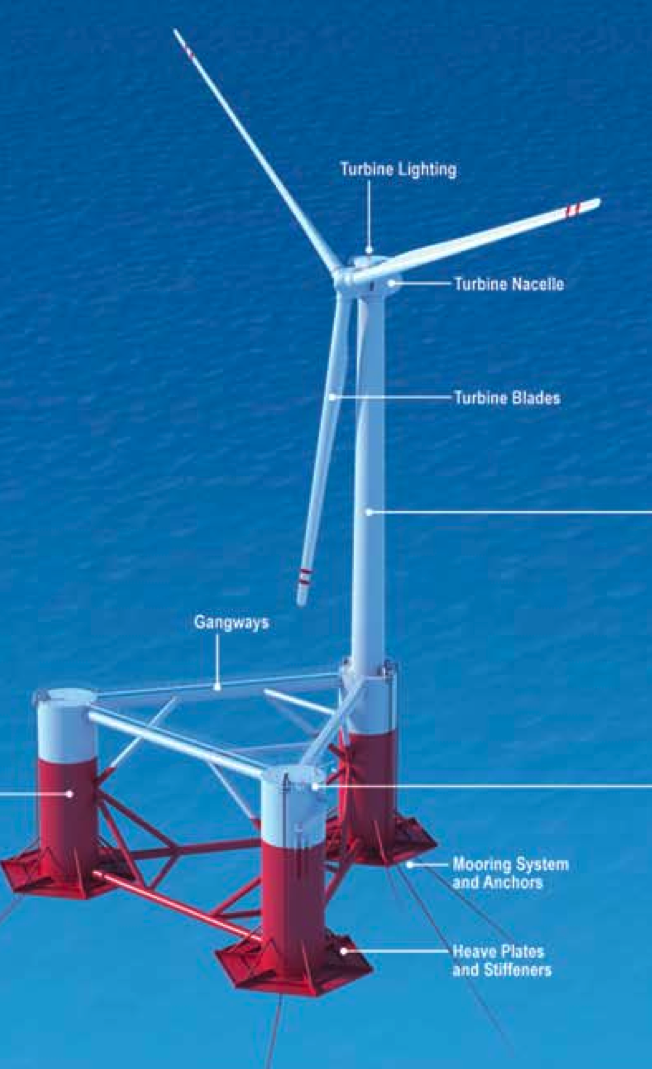
A Seattle-based renewable energy startup, Principle Power, has signed an agreement to build a deep-sea, 150-megawatt wind farm to be constructed on floating platforms off the Oregon coast.

The deal with the Tillamook Intergovernmental Development Agency – which includes the local utility for a coastal county west of Portland – is very early stage but foreshadows two technological trends in the wind industry: massive megawatt turbines placed on deep-ocean platforms.

Principle Power co-founder Jon Bonanno tells Green Wombat that each floating platform – called a WindFloat – will feature a 5-megawatt turbine. By contrast, the biggest biggest land-based turbines are typically 2.5 megawatts, while General Electric (GE) makes a 3.6-megawatt turbine designed for offshore use.

Bigger turbines offer better economies of scale (important given the steep cost of developing offshore wind farms), and since a deep-ocean wind turbine is not visible from the coast, they avoid the not-in-my-backyard fights that dog near-shore projects. (Clipper Windpower of Carpinteria, Calif., is developing a ten-megawatt monster for England’s Crown Estate, while European wind companies like Enercon has been testing turbines in the six megawatt range.)

“It’s becoming an increasingly important component of the mix in Europe,” says Ethan Zindler, head of North American research for New Energy Finance, a London-based firm. “I think a lot of it is conceptual at this point. There’s still a lot of barriers in turbine design and transport.”

Beyond the technological challenges of supersizing a turbine, there’s the issue of how to get a 300-foot-tall windmill out to sea without breaking the bank. Various wind companies are tackling the problem but Principle Power’s solution is to license the WindFloat technology from a Berkeley, Calif.-based startup called Marine Innovation & Technology. The company’s founders, who previously worked on offshore platforms for the oil industry, designed the WindFloat to be semi-submersible. “The design and size of the WindFloat enables the overall structure to be assembled onshore and towed to its final location, significantly reducing construction costs,” according to Principle Power.

“The WindFloat has undergone concept development validation through numerical modeling, third party engineering verification and extensive wave tank testing,” Bonanno said in an e-mail, noting that he expects a full-scale prototype to be built within a year.

Depending on the permitting process and Principle’s ability to obtain project financing, Bonanno anticipates the wind farm to be up and operating between 2013 and 2015.  Early estimates peg the cost of the wind farm at about $375 million.

Pat Ashby, the general manager of the 19,000-customer Tillamook People’s Utility District, says his utility has a capacity of 50 megawatts so it would most likely serve as an interconnection point to transmit electricity from the wind farm to the regional power grid. “Our substations are all along the coast,” he says. “There’s only a dozen miles or less to get to a substation.”

According to Ashby, the cost of laying a transmission line is about $1 million a mile. On the other hand, if the wind farm is too close to shore, residents will likely get riled up about the impact on their views. “We’ve already had an organized group come forward to express their concerns,” he says.

Bonanno notes that if the wind farm was placed five miles off the coast, the turbines would appear to be the size of a thumb from the shore; at ten miles they would not be visible.

Read Full Post »

photo: eSolar

After months of failed attempts in Congress to extend crucial renewable energy tax credits, the end-game came with lightning speed Friday afternoon: The House of Representatives passed the green incentives attached to the financial bailout package approved by the Senate Wednesday night and President Bush promptly signed the legislation into law.

There were goodies for wind, geothermal and alternative fuels, but the big winner by far was the solar industry.

“It feels like we should be popping the champagne,” said a Silicon Valley solar exec Green Wombat met for lunch minutes after Bush put pen to paper.

That it took the biggest financial crisis since the Great Depression to save billions of dollars of renewable projects in the pipeline for the sake of political expediency does not bode well for a national alternative energy policy. But the bottom line is that the legislation passed Friday sets the stage for a potential solar boom.

  • The 30% solar investment tax credit has been extended to 2016, giving solar startups, utilities and financiers the certainty they need for the years’ long slog it takes to get large-scale power plants and other projects online. The extension is particularly important to those Big Solar projects that need to arrange project financing in the next year or so.
  • The $2,000 tax credit limit for residential solar systems has been lifted, meaning that homeowners can get a 30% tax credit on the solar panels they install after Dec. 31. That will save a bundle – especially for those who live in states with generous state rebates – and goose demand for solar panel makers and installers like SunPower (SPWRA) and First Solar (FSLR). (If you buy a $24,000 3-kilowatt solar array in California – big enough to power the average home –  you can claim a $7,200 federal tax credit. Add in the state solar rebate and the cost of the system is cut in half.)
  • Utilities like PG&E (PCG), Southern California Edison (EIX) and FPL (FPL) can now themselves claim the 30% investment tax credit for large-scale solar power projects. That should encourage those well-capitalized utilities to build their own solar power plants rather than just sign power purchase agreements with startups like Ausra and BrightSource Energy.

“The brakes are off,” says Danny Kennedy, co-founder of Sungevity, a Berkeley, Calif., solar installer that uses imaging technology to remotely size and design solar arrays. “In just six months since our launch we’ve sold about a hundred systems. With an uncapped tax credit for homeowners going solar, we expect business to boom.”

While elated sound bites from solar executives have been flooding the inbox all afternoon – along with invites to celebratory after-work drinks – solar stocks took a drubbing (along with the rest of the still-spooked market) after initially soaring on the news.

SunPower ended the trading day down 5% while First Solar shares dropped 8%. The bright spot was China’s Suntech (STP), which on Thursday announced a joint venture with financier MMA Renewable Ventures to build solar power plants as well as the acquisition of California-based solar panel installer EI Solutions.

Congress didn’t treat the wind industry so generously. The production tax credit for generating renewable energy was extended by just one year, guaranteeing the industry’s will continue to live year by year (at least through 2009). But given that 30% of all new power generation built in the United States in 2007 was wind, and that the amount of wind power installed by the end of 2008 is expected to rise 60% over the record set last year, the wind biz should do just fine.

But Congress did give a break to those who buy small-scale wind turbines. Systems under 100 kilowatts qualify for a 30% tax credit up to $4,000. Homeowners get a $1,000 tax credit for each kilowatt of wind they install, though the credit is capped at $4,000.

“This is a huge breakthrough for small wind,” says Scott Weinbrandt, president of Helix Wind, a San Diego-based manufacturer of 2-and-4-kilowatt turbines.

Read Full Post »

photo: eSolar

If Wall Street’s implosion can feel remote on the West Coast, where green tech startups largely rely on Silicon Valley venture capital, there may be no escaping the fallout from the credit crunch.

Still, even those renewable energy companies tapping East Coast cash have powered ahead amid the chaos on the Street. Take SolarReserve, a Santa Monica, Calif.-based solar power plant developer. A day after Lehman Brothers filed for bankruptcy last week, the stealth startup announced a $140 million round of funding from investors that included Citigroup (C) and Credit Suisse (CS).

Lehman does hold small stakes in wind turbine maker Clipper Windpower of Carpinteria, Calif., and Ormat Technologies, a Reno, Nev., geothermal developer. “Lehman’s exit from wind is not good news, but it’s not the end of the world,” says Ethan Zindler, head of North American research for New Energy Finance, a London-based research firm. And while Lehman holds stock lent to it from solar cell companies like SunPower (SPWR) and Evergreen Solar – potentially diluting their earnings per share if the stock is not returned – Lehman is not a big player in solar.

That’s not the case with Goldman Sachs (GS) and Morgan Stanley (MS). Both are major solar and wind investors and both were forced this week to reorganize themselves into bank holding companies to stave off shotgun marriages with other institutions. Spokespeople for Goldman and Morgan Stanley told Green Wombat that the firms’ transformation into more conventional commercial banks – at least a two-year process- will not change their green investing strategies.

But if there appears to be little immediate collateral damage from the financial crisis for green tech startups, there are longer-term consequences. Solar power plants, wind farms and other large-scale renewable energy projects require billions of dollars in bank financing.

“Credit is just going to get more expensive,” says Zindler. “We’ve already seen some pull-back for some big solar and wind deals. Bigger developers who have solid balance sheets will be OK but the smaller guys could be in trouble.”

Says Bill Gross, chairman of solar power plant developer eSolar: “I think if you’re going to get project financing, you’re just going to have to show higher returns to get people to take the money out of the mattress.”

But Gross, the founder of Pasadena, Calif.-based startup incubator Idealab, argues that given soaring electricity demand and fossil fuel prices, large-scale renewable energy projects will be an attractive investment, paricularly since utilities typically sign 20-year contracts for the power they produce. eSolar, which is backed by Google and other investors, has a long-term contract to supply Southern California Edison with 245 megawatts of green electricity. Gross says eSolar has a pipeline of other projects and interest in the company remains high, particularly overseas.

“If you can make projects that can compete with fossil fuels on a parity basis, those projects are going to be financed,” he says, “because they’re safe returns for 20 years and I think money is going to flow to them.”

Rob Lamkin, CEO of solar power plant startup Cool Earth, echoed that sentiment. “The credit crisis does give me pause,” says Lamkin, whose Livermore, Calif.-company has raised $21 million in venture funding and is developing “solar balloons” that use air pressure to concentrate sunlight on solar cells. “But the energy problem is so big that I don’t see problems raising project financing.”

The key for developers of utility-scale projects – particularly solar power plants – will be keeping their costs under control; not an easy thing when deploying new technologies amid a commodities boom.

Dita Bronicki, CEO of geothermal power plant developer Ormat Technologies (ORA), does not anticipate trouble obtaining project financing. “I think the cost of money is going to go up, but a company like Ormat with an operating fleet and operating cash flow will not be as affected,” Bronicki says. “Small companies will find that lenders will be more picky in what they will invest.”

Green entrepreneurs tend to be an optimistic bunch, so it’s not surprising they still think the future looks bright. But they had reason to be sunny this week – amid Wall Street’s meltdown, the U.S. Senate on Tuesday passed, at long last,  extensions of crucial renewable energy investment tax credits and other goodies to goose green tech, such as a tax credit worth up to $7,500 for buyers of plug-in electric cars. The Senate action now must be reconciled with similar legislation in the House of Representatives.

Solar projects, for instance, would qualify for a 30% investment tax credit through 2016.

“That is one thing that will help project finance,” says Gross. “So many people are sitting on the sidelines right now and if the investment tax credit passes that will help get these projects financed.”

Read Full Post »
After a year of stalemate that threatened to strangle the nascent United States solar industry, the U.S. Senate on Tuesday passed energy legislation that extends a key investment tax credit until 2016.

The 30% solar tax credit was part of a package of green energy incentives that includes a one-year extension of the production tax credit crucial to the wind industry and a $2,500-$7,500 tax credit for people who buy plug-in electric vehicles. (That should make General Motors (GM) happy as it prepares to roll out its ever-increasingly expensive Volt plug-in electric hybrid.)

Homeowners also won an extension of a tax credit for installing solar panels and the $2,000 cap on such systems was lifted. Put in a small wind turbine or a geothermal heat pump and you can claim up to a $4,000 and $2,000 tax credit, respectively.

The big winner was the solar industry. Congress’ failure to extend the investment tax credit threatened to scuttle scores of multibillion-dollar solar power plants in the pipeline and undermine mandates that utilities like PG&E (PCG) and Southern California Edison (EIX) obtain a growing percentage of their electricity from renewable sources.

The legislation now returns to the House of Representatives, which earlier passed a similar version of the Senate bill.

Read Full Post »

Green Wombat’s story on the Royal Turbine is in the latest issue of Fortune and available online here and below.

Her majesty’s big, honkin’ windmill

The Queen of England is buying the world’s largest wind turbine, which towers over Big Ben and will light up thousands of British homes.

By Todd Woody, senior editor

(Fortune Magazine) — It’s been a century or so since Britain ruled the waves, but Queen Elizabeth II will soon reign over the wind. Earlier this year the Crown Estate, which manages royal property worth $14 billion and controls the seas up to 14 miles off the British coast, agreed to purchase – for an undisclosed sum – the world’s largest wind turbine.

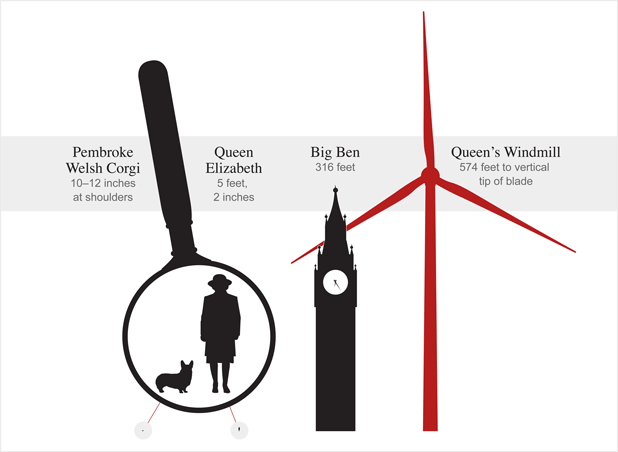
It’s a 7.5-megawatt monster to be built by Clipper Windpower of Carpinteria, Calif. Now the Royal Turbine is getting even bigger: Clipper has revealed to Fortune that Her Majesty’s windmill has been supersized to ten megawatts, producing five times the power generated by typical big turbines currently in commercial operation. The giant’s wingspan stretches the length of two soccer fields. At 574 feet, the turbine soars over Big Ben and roughly equals 111 Queen Elizabeths (the actual queen) plus one corgi stacked on top of one another.

The Queen’s turbine will displace two million barrels of oil as well as 724,000 tons of CO2 over its lifetime. This prototype will be the flagship for Clipper’s Britannia Project, an effort to create a new generation of massive-megawatt turbines to be placed on deep-sea floating platforms. When the windmill goes online in 2012 somewhere off the British coast, it could power 3,700 average homes.

Rule, Britannia, indeed.

Read Full Post »

SAN FRANCISCO – Google and General Electric said Wednesday that they will collaborate on developing geothermal power as well as technology to enable plug-in vehicles to return electricity to the grid.

During Google’s (GOOG) annual Zeitgeist conference at its Silicon Valley headquarters, Google CEO Eric Schmidt and GE (GE) chief Jeff Immelt said the two giants also would team up to push for policy changes in Washington to develop smart electricity grids to allow the widespread deployment of renewable energy.

“There’s two fundamental things that have to be done, and which we’re working with Google on,” said Immelt before an audience that included former Vice President Al Gore. “One, there has to be more capacity. The second thing is there has to be a smart grid to allow it to operate more effectively. That’s primarily software. We make the hardware.”

Schmidt quizzed Immelt about the impact of the Wall Street meltdown on green energy. “Will the craziness of last week screw some of this stuff up?” asked Schmidt. “Are we going to get set back for years because of all the shenanigans in the financial industry?”

“People should be concerned but not panicked,” replied Immelt. “The federal government is doing the right thing.”

Gore was not so sanguine, noting that Congress has failed repeatedly to extend crucial investment tax credits for renewable energy. “While Congress is voting on oil drilling and leasing oil shale – which is a move that would be game over for the climate crisis – they’re preparing to filibuster over renewable energy tax credits,” he said.

Google and GE are among scores of Fortune 500 companies that have lobbied Congress to extend the investment tax credit and the production tax credit, which is particularly important to the wind industry. ”

“I’m a lifelong Republican and I believe in free markets but over time we worship false idols,” says Immelt. “Sometimes we think the free market is whatever the price of oil is today. In the end, clean energy is both a technology and a public policy.”

He noted that because the production tax credit allowed the wind industry to scale up, wind-generated electricity now costs about six-to-seven cents a kilowatt hour, down from 15 cents 15 years ago.

“We bought Enron’s wind business for a few million dollars and now it’s worth $7 to 8 billion,” Immelt said. “I’ve made some bad decisions but that wasn’t one of them.”

Google in August invested nearly $11 million in geothermal companies developing so-called enhanced geothermal systems technology to allow the earth’s heat to be tapped nearly anywhere and turned into electricity. On Wednesday, Google and GE said they will work on technology to transform geothermal into a large-scale source of green electricity.

In a statement, the two companies said they will also “explore enabling technologies including software, controls and services that help utilities enhance grid stability and integrate plug-in vehicles and renewable energy into the grid.”

Image: Google

Read Full Post »

« Newer Posts - Older Posts »

Design a site like this with WordPress.com
Get started