Feeds:
Posts
Comments

Archive for the ‘Southern California Edison’ Category

photo: Think Global

Norwegian electric carmaker Think Global, once owned by Ford, has tapped Ford executive Richard Canny as its new president and chief operating officer. Canny previously served as president of Ford South America, president of Ford Argentina and managing director of Ford Malaysia.

Think also announced Tuesday that it has hired a veteran of Volvo and Saab, Mikael Ekholm, as executive vice president for engineering and manufacturing. The appointment of the Australian-born Canny comes as the Oslo company ramps up production of the City, it’s Internet-enabled, battery-powered urban runabout.

Green Wombat chatted with Think CEO Jan-Olaf Willums via e-mail Tuesday about the rollout of the City in Europe, its next model – an electric crossover SUV –  and the company’s plans for the United States market. (At Fortune’s Brainstorm Green conference in April, Willums announced the formation of Think North America with marquee venture capital firms Kleiner Perkins Caufield & Byers and Rockport Capital Partners. Other investors in Think include General Electric (GE) )

“The factory completed its planned build of 100 cars for the local market prior to the Norwegian summer shutdown,” says Willums, a longtime entrepreneur and sustainability expert who made his fortune as a co-founder of Norweigan solar company REC Solar. “Of course, like any new vehicle launch we are having occasional new issues arise and teething problems to overcome.”

The cars are now on Oslo roads racking up high mileage under real-world conditions, he adds.

(You can still spot the previous generation of the City, built under Ford (F) ownership, tooling around Oslo, as I did when I visited in 2007 for a story I did on Think.)

Willums says Think will boost production in the second half of the year to support sales in Norway and elswhere in Scandinavia. “During 2009, we are planning a roll out to a number of other European markets with our plans for the major cities (Paris, Amsterdam, Nice, Zurich, Basel) being the priority,” he says. The order of the rollout, he notes, will depend in part on where the government and private sector incentives for electric vehicles are strongest.

To that end, Willums says that the timing of the City’s debut in the United States will be determined in part by state incentives and the policy of the incoming administration in Washington.

Think is in a race to get its cars on the road as the big automakers accelerate their plans for plug-in hybrids and all-electric cars for the mass market. General Motors (GM) is hurrying to bring its Chevy Volt plug-in electric hybrid to showrooms while Toyota (TM) is working on a plug-in version of the Prius. Mitsubishi will supply its i MiEV electric car to California utilities PG&E (PCG) and Southern California Edison (EIX) for fleet testing.

Meanwhile, work continues on the Think Ox, the company’s planned five-seater crossover model. Think showed off a concept version of the electric car at the Geneva auto show earlier this year. The addition of Canny, Willums says, should help the company “grow and mature to a larger scale electric car producer.”

Along with gearing up production of the City, Think has been energizing its marketing efforts, judging by the slick promotional video it created for the Ox below. (For a higher-def version, go here.)

Read Full Post »

photo: Southern California Edison

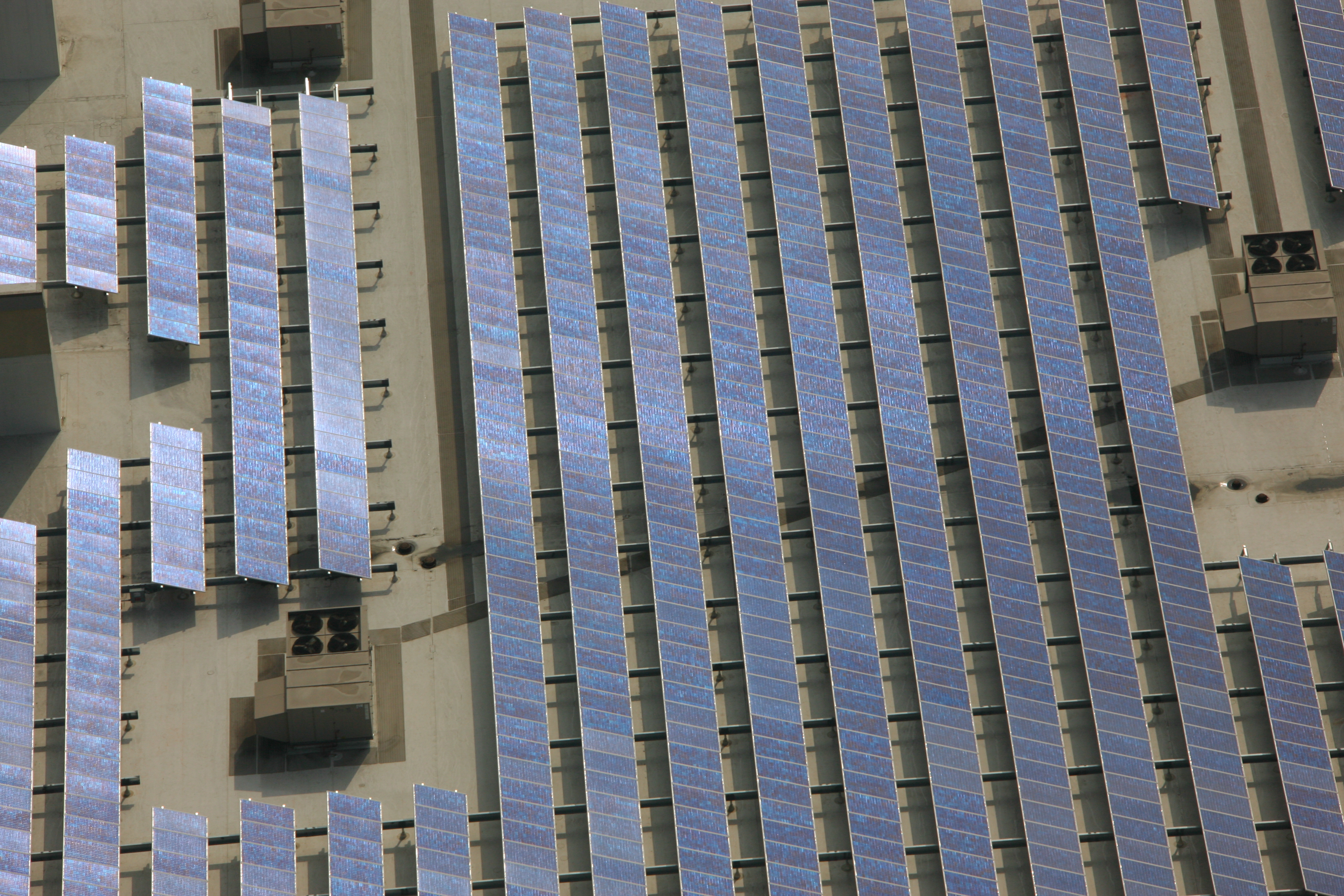
When Southern California Edison unveiled plans to install 250 megawatts’ worth of solar panels on warehouse roofs back in March, it was hailed as a ground-breaking move. In one fell swoop, the giant utility would cut the cost of photovoltaic power, expand the solar market and kick-start efforts to transform untold acres of sun-baked commercial roof space into mini-power plants.

There’s just one problem: the solar industry is fighting the billion-dollar plan. In briefs filed with the California Public Utilities Commission, solar companies, industry trade groups and consumer advocates argue that allowing a utility to own and operate such massive green megawattage will crowd out competitors who can’t hope to compete with a project financed by Edison’s ratepayers.  (In California, shareholders of investor-owned utilities are guaranteed a rate of return for approved projects, while utility customers bear a portion of the costs in the form of higher rates.)

The five-year plan “would establish SCE as the monopoly developer of commercial-scale distributed solar in its service territory,” wrote Arno Harris, CEO of Recurrent Energy, a San Francisco company that sells solar electricity to commercial customers. “This would irreparably impair the development of a competitive solar industry.”

Southern California Edison (EIX) is the first utility in the United States to propose such a “distributed generation” scheme and the dispute is being watched closely as a test case for the viability of producing renewable electicity from hundreds of millions of square feet of commercial rooftops. Such systems can be plugged directly into existing transmission lines and tend to generate the most solar power when electricity demand spikes – typically on summer afternoons when people crank their air conditioners. Having such green energy on tap would save utilities from having to build expensive and planet-warming fossil fuel-powered “peaker plants” that sit idle except when demand suddenly rises.

Even critics hail Edison’s move as “bold” and “visionary” and no one disputes that in California the development of big rooftop solar has lagged. For instance, the state’s $3.3 billion “million solar roofs” initiative is designed to put smaller-scale solar panels on homes and businesses and provides generous rebates for systems under 1 megawatt. At the other end of the scale, the state’s big utilities have been signing contracts to buy electricity from solar thermal power plants to be built in the desert. Left out of the subsidy game are incentives for the 1-to-2 megawatt arrays well-suited for commercial buildings.

Southern California Edison says it’s filling that gap and will energize the solar industry, not crush it. The utility plans to lease 65 million square feet of commercial rooftop space in the “Inland Empire” region of Southern California for solar arrays that would generate enough electricity to power 162,000 homes.

“SCE’s financial stability and business reputation will increase the probability that 250 MW of solar PV systems will be available to meet the state’s solar rooftop goals over the next five years,” the utility’s attorneys wrote in a brief filed with the utilities commission, which must approve the program. “In so doing, a solar PV program can improve efficiencies … to reduce costs and jump start the competitiveness of solar PV for widespread application on California roofs.”

There’s no doubt the program will be a boon for solar module makers. For instance, thin-film solar cell company First Solar (FSLR) is supplying 33,000 panels for the program’s first project, a 600,000-square-foot roof array in the inland city of Fontana. However, Southern California Edison intends to contract for union labor to install the solar systems and tap its own capital and a rate hike to finance the project. That won’t leave many opportunities for solar installers and financiers like SunPower (SPWR), SunEdison and MMA Renewable Ventures (MMA).

“Even though this program is kind of taking bread out of our own mouth, the demand for solar will keep going up,” says Mark McLanahan, senior vice president of corporate development at MMA Renewable Ventures, a San Francisco firm that finances commercial solar arrays.

“What they have announced is extremely visionary,” McLanahan tells Green Wombat. “It’s game changing and opens up whole new realms of what solar can do. That’s exciting.”  On the other hand, he says, “It’s certainly possible that a young, growing industry that is pretty fragmented could be hurt by this rather than helped.”

A solution advanced by some solar industry critics is for Southern California Edison to open up the entire program to competitive bidding, not just the procurement of solar panels. The utility vehemently opposes the idea, arguing it would work against the economies of scale it says it can bring to the program.

Whether regulators will approve Southern California Edison’s request for a rate hike to pay for the initiative – and at electricity rates that are significantly higher than those set for other solar programs – remains to be seen. The commission’s own ratepayer advocate has questioned whether utility customers will get their money’s worth.

The utilities commission is unlikely to issue a final decision until next year. In the meantime, you can bet the state’s other big utilities – PG&E (PCG) and San Diego Gas & Electric (SRE) – and solar companies will be watching to see whether the sky’s the limit for big rooftop solar or whether a ceiling is about to be placed on the industry’s ambitions.

Read Full Post »

Thin is in when it comes to solar power plants.

First Solar, the Walton family-backed (WMT) maker of thin-film photovoltaic modules, on Thursday announced its second solar power plant. The latest project is a 10-megawatt photovoltaic power station to be built for Sempra Generation (SRE) in Nevada. Two weeks ago, California regulators approved a 7.5-megawatt – expandable to 21 megawatts – First Solar (FSLR) power plant to be constructed in the Mojave to generate electricity for utility Southern California Edison (EIX). Thin-film solar technology layers solar cells on plates of glass or flexible materials, a process that lowers production costs with the trade-off being lower efficiency at converting sunlight into electricity.

What’s notable about the Nevada First Solar project is that it will be constructed adjacent to a Sempra natural gas-fired power plant near Boulder City, Nev. That will allow the solar station to share transmission lines and other infrastructure and minimize land use. Those are no small considerations these days as the solar land rush continues in the Mojave and environmentalists grow uneasy over the impact of industrializing the desert.

Tempe, Ariz.-based First Solar has already broken ground on the project with completion expected by the end of the year. That’s record time, given that solar thermal power plants – which tend to be larger by orders of magnitude – can take years to receive regulatory approval and build. Also of note: The solar modules for the project will be manufactured at First Solar’s Ohio factory, one of only two commercially operating  thin-film manufacturing facilities in the United States. (The other is Energy Conversion Devices’ thin-film factory in Michigan.)

Sempra Generation, a division of utility giant Sempra, will own and operate the First Solar plant, which will supply electricity to Nevada and California.

Read Full Post »

When it comes to solar companies, First Solar is the Google of renewable energy. The Tempe, Ariz.-based solar cell maker backed by the Wal-Mart (WMT)’s Walton family has seen its stock skyrocket over the past year, hitting a high of $317 on May 14. (It was trading at $275 Friday.) Now First Solar, which makes “thin film” solar modules, is getting into the utility business, winning approval Thursday from California regulators to build the state’s first thin-film photovoltaic solar power plant. The 7.5 megawatt project – expandable to 21 megawatts – will sell electricity to Southern California Edison (EIX) under a 20-year contract.

While First Solar (FSLR) supplies solar modules to power plant builders in Europe, this is apparently the first time it has acted as a utility-scale solar developer itself. First Solar tends to keep quiet about its projects and did not return a request for comment. But a troll through the public records reveals some details of what is called the FSE Blythe project. The solar farm will be built in the Mojave Desert town of Blythe by a First Solar subsidiary, First Solar Electric. The company paid $350,000 in January for 120 acres of agricultural land in Blythe, providing a tidy profit for the seller, which had purchased the property for $60,000 in June 1999.

Approval of the contract by the California Public Utilities Commission Thursday came on the same day that SunPower (SPWR) announced a deal to build two photovoltaic power plants – a 25-megawatt one and a 10-megawatt version – in Florida for utility Florida Power & Light (FPL). PV plants are essentially supersized versions of rooftop solar panel systems found on homes and businesses. Thin-film solar prints solar cells on flexible material or glass and typically uses little or no expensive (and in short supply) polysilicon, the key material of conventional solar cells.

Most large-scale solar power plants being developed in the United States use solar thermal technology that relies on huge arrays of mirrors to heat liquids to create steam that drives electricity-generating turbines. In fact, there is a solar land rush underway in the desert Southwest as solar developers, investment banks like Goldman Sachs (GS), utilities and speculators of every stripe scramble to lock up hundreds of thousands of acres of federal land for solar power plants. (See Green Wombat’s feature story on the solar land rush in the July 21 issue of Fortune.)

PV power plants, on the other hand, have not been cost-competitive with solar thermal and have been most popular in countries like Germany, Spain and Portugal, where generous subsidies guarantee solar developers a high rate for the electricity they produce. The situation in the U.S. seems to be changing, though, judging by the deals utilties are striking with companies like First Solar and SunPower. Meanwhile, thin-film startup OptiSolar is moving to build a gigantic 550-megawatt thin-film solar power plant on California’s central coast but has yet to sign a power purchase agreement with a utility.

Read Full Post »

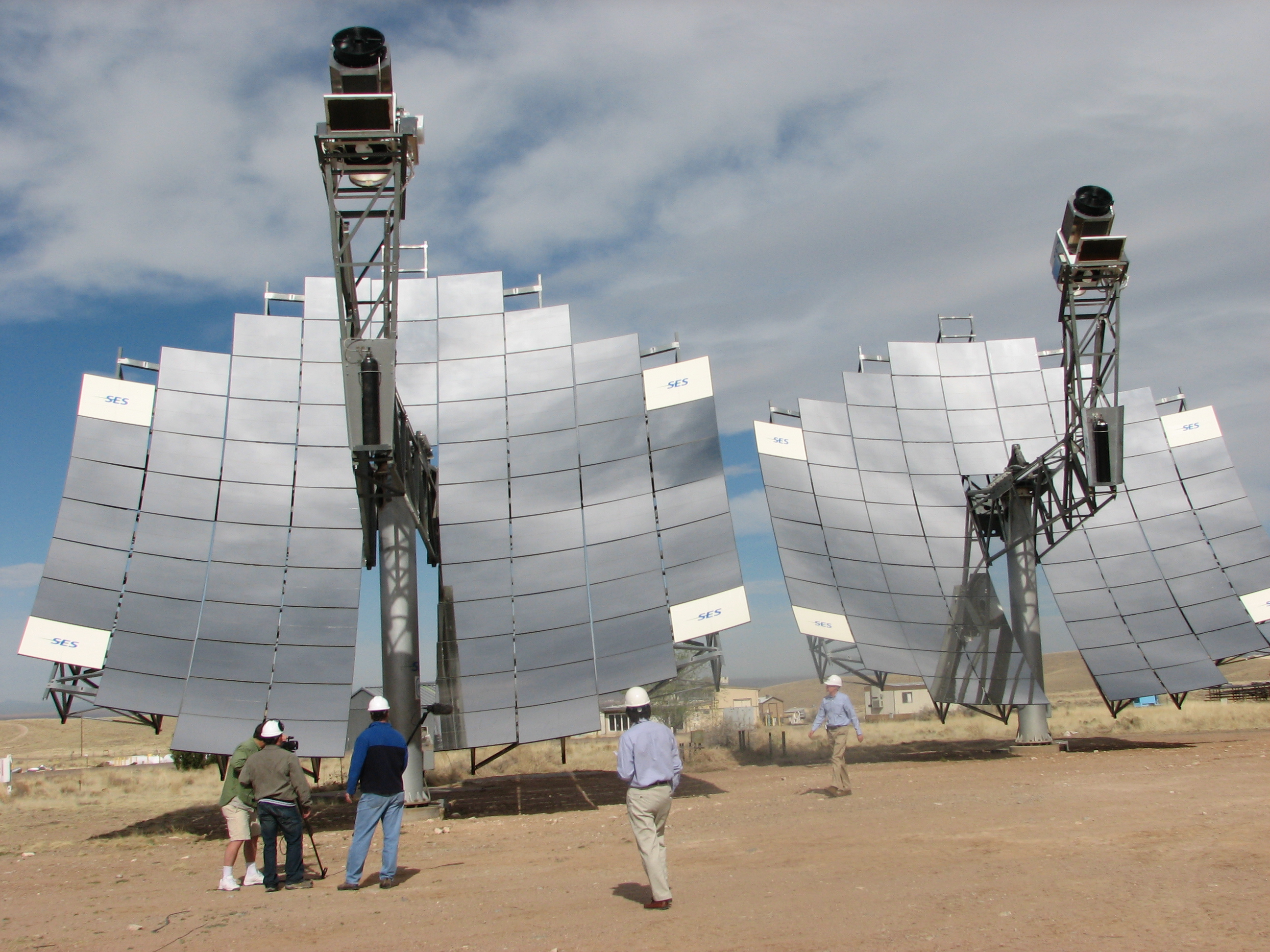
Nearly three years ago, two Southern California utilities caused a stir when they announced deals to buy up to 1.75 gigawatts of electricity from massive solar farms to be built by Stirling Energy Systems of Phoenix. The company had developed a Stirling solar dish – a 38-foot-high, 40-foot-wide mirrored structure that looks like a big shiny satellite receiver. The dish focuses the sun’s rays on a Stirling engine, heating hydrogen gas to drive pistons that generate electricity.

Plans called for as many as 70,000 solar dishes to carpet the desert. For Southern California Edison (EIX) and San Diego Gas & Electric (SRE) – both facing a state mandate to obtain 20 percent of their electricity from renewable sources by 2010 – it was a big gamble. As the years ticked by and Stirling tinkered with its technology, competitors like Ausra, BrightSource Energy and Solel came out of stealth mode and stole the limelight, signing deals with PG&E (PCG) and filing applications with California regulators to build solar power plants. By the time I visited Stirling’s test site in New Mexico in March 2007 for a Business 2.0 feature story, industry insiders were telling me – privately, of course – that Stirling would never make it; Stirling dishes were just too complex and too expensive to compete against more traditional solar technologies.

That may or may not end up being true, but Stirling has moved to silence the naysayers by filing a license application with the California Energy Commission for its first solar power plant – the world’s largest – a 30,000-dish, 750-megawatt project to be built 100 miles east of San Diego on 6,100 acres of federal land controlled by the U.S. Bureau of Land Management. (A energy commission licence application – an extremely detailed and expensive document; Stirling’s runs 2,600 pages – is considered a sign that a project has the wherewithal to move forward.)

The first phase of the SES Solar Two project will consist of 12,000 SunCatcher dishes generating 300 megawatts for San Diego Gas & Electric. While the Stirling solar dish is more complex and contains more moving parts than other solar thermal technologies – which use mirrors to heat liquids to generate steam to drive a standard electricity-generating turbine – or photovoltaic panels like those found on rooftops, it also offers some distinct advantages. For one thing, it’s the most efficient solar thermal technology, converting sunlight into electricity at a 31.25% rate.  Each 25-kilowatt dish is in fact a self-contained mini-power plant that can start generating electricity – and cash – as soon as it is installed. Stirling will build 1.5-megawatt clusters of 60 dishes that will begin paying for themselves as each pod goes online. A conventional solar thermal power plant, of course, must be completely built out – which can take a year or two depending on size – before generating electricity.

The 750-megawatt Stirling project will also use relatively little water – no small matter in the desert – compared to other solar thermal plants. According to Stirling, SES Solar Two will consume 33 acre-feet of water – to wash the dishs’ mirrors – which is equivalent to the annual water use of 33 Southern California households. In contrast, a solar power plant to be built by BrightSource Energy that is nearly half the size is projected to use 100 acre-feet of water annually while a 177-megawatt Ausra plant would use 22 acre-feet, according to the companies’ license applications.

Still, there’s some big hurdles for Stirling to overcome. While it did score a whopping $100 million in funding in April from Irish renewable energy company NTR, the company will need billions in project financing to build Solar Two. And the project’s second 450-megawatt phase is dependent on the utility completing a controversial new transmission line through the desert called the Sunrise Powerlink. Depending on how fast the project is approved, construction is expected to begin in 2009 and last more than three years.

The other big unknown is what environmental opposition may develop. Within 10 miles of the SES Solar Two site are proposals to build solar power plants on an additional 51,457 acres of BLM land. Then there are the wildlife issues. Several California-listed “species of special concern” have been found on the Stirling site, including the burrowing owl, flat-tailed horned lizard and the California horned lark.

Regardless it’s a big step forward for Stirling. As California Governor Arnold Schwarzenegger said in a statement, “This groundbreaking solar energy project is a perfect example of the clean renewable energy California can and will generate to meet our long-term energy and climate change goals.”

Read Full Post »

eSolar, the solar energy startup founded by Idealab’s Bill Gross and backed by Google, has signed a 20-year contract to supply utility Southern California Edison with 245 megawatts of green electricity.

The solar power plant will be built in 35-megawatt modules, with the first phase set to go online in 2011. As Green Wombat reported in April, eSolar scored $130 million in funding from Google.org, Google’s (GOOG) philanthropic arm, and other investors to develop solar thermal technology that Gross claims will produce electricity as cheaply as coal-fired power plants.

Like Ausra and BrightSource Energy – which have deals with PG&E (PCG) – eSolar will use fields of mirrors to heat water to create steam that drives electricity-generating turbines. Gross says that eSolar’s software allows the company to individually control smaller sun-tracking mirrors – called heliostats – which can be cheaply manufactured and which are more efficient and take up less land than conventional mirrors. According to Gross, that means eSolar can build modular power plants near urban areas and transmission lines rather than out in the desert, lowering costs.

eSolar’s cost claims got Southern California Edison’s (EIX) attention. “It was a competitively priced proposal,” Stuart Hemphill, the utility’s VP for renewable and alternative power, told Fortune. “We found the eSolar team very competent, motivated and willing to do a deal.”

“When it comes down to different solar technologies, competitive pricing is going to be an important part of the equation,” he adds. “They do offer a unique solution.”

eSolar is keeping mum about the exact location of the power plant, only saying it will be in the Antelope Valley region of Southern California.

One potential hitch: Getting eSolar’s electricity to Southern California Edison will depend on the construction of a major new transmission line. That line, the Tehachapi Renewable Transmission Project, has been partially approved to date.

With the eSolar deal, the utility is hedging its bets. Back in 2005, Southern California Edison signed a highly publicized deal with Phoenix’s Stirling Energy Systems to buy up to 850 megawatts of solar electricity from massive solar power plants to be built in the Mojave Desert. (Around the same time, San Diego Gas & Electric (SRE) signed a power purchase agreement with Stirling for up to 900 megawatts. ) Stirling is still perfecting its technology and has yet to file a license application for its first plant. But the company received a $100 million investment earlier this year and Hemphill says Stirling is moving forward.

“We expect that Stirling will meet its contractural obligations,” he says. “Solar thermal is definitely an emerging industry. It’s too early to tell which technologies will be the winners over the long run. It’s a time to be having a portfolio of different technologies so we can figure that out.”

Read Full Post »

“Years ago we came to the conclusion that global warming was a problem, it was an urgent problem and the need for action is now. The problem appears to be worse and more imminent today, and the need to take action sooner and take more significant action is greater than ever before” — PG&E Chairman and CEO Peter Darbee

The head of one of the nation’s largest utilities seemed to be channeling Al Gore on Tuesday when he met with a half-dozen environmental business writers, including Green Wombat, in the PG&E (PCG) boardroom in downtown San Francisco. While a lot of top executives talk green these days, for Darbee green has become the business model, one that represents the future of the utility industry in a carbon-constrained age.

As Katherine Ellison wrote in a feature story on PG&E that appeared in the final issue of Business 2.0 magazine last September, California’s large utilities — including Southern California Edison (EIX) and San Diego Gas & Electric (SRE) — are uniquely positioned to make the transition to renewable energy and profit from green power.

First of all, they have no choice. State regulators have mandated that California’s investor-owned utilities obtain 20 percent of their electricity from renewable sources by 2010 with a 33 percent target by 2020. Regulators have also prohibited the utilities from signing long-term contracts for dirty power – i.e. with the out-of-state coal-fired plants that currently supply 20 percent of California’s electricity. Second, PG&E and other California utilities profit when they sells less energy and thus emit fewer greenhouse gases. That’s because California regulators “decouple” utility profits from sales, setting their rate of return based on things like how well they encourage energy efficiency or promote green power.

Still, few utility CEOs have made green a corporate crusade like Darbee has since taking the top job in 2005. And the idea of a staid regulated monopoly embracing technological change and collaborating with the likes of Google (GOOG) and electric car company Tesla Motors on green tech initiatives still seems strange, if not slightly suspicious, to some Northern Californians, especially in left-leaning San Francisco where PG&E-bashing is local sport.

In a wide-ranging conversation, Darbee, 54, sketched sketched a future where being a successful utility is less about building big centralized power plants that sit idle until demand spikes and more about data management – tapping diverse sources of energy — from solar, wind and waves to electric cars — and balancing supply and demand through a smart grid that monitors everything from your home appliances to where you plugged in your car. “I love change, I love innovation,” says Darbee, who came to PG&E after a career in telecommunications and investment banking.

Renewable energy

“On renewable energy what we’ve seen is the market is thin,” says Darbee. “Demand just from ourselves is greater than supply in terms of reliable, well-funded companies that can provide the service.”

PG&E so far has signed power purchase agreements with three solar startups — Ausra, BrightSource Energy and Solel — for up to 1.6 gigawatts of electricity to be produced by massive solar power plants. Each company is deploying a different solar thermal technology and uncertainty over whether the billion-dollar solar power stations will ultimately be built has prompted PG&E to consider jumping into the Big Solar game itself.

“We’re looking hard at the question of whether we can get into the business ourselves in order to do solar and other forms of renewables on a larger scale,” Darbee says. “Let’s take some of the work that’s been done around solar thermal and see if we can partner with one of the vendors and own larger solar installations on a farm rather than on a rooftop.”

“I like the idea of bringing the balance sheet of a utility, $35 billion in assets, to bear on this problem,” he adds.

It’s an approach taken by the renewable energy arm of Florida-based utility FPL (FPL), which has applied to build a 250-megawatt solar power plant on the edge of the Mojave Desert in California.

For now, PG&E is placing its biggest green bets on solar and wind. The utility has also signed a 2-megawatt deal with Finavera Renewables for a pilot wave energy project off the Northern California coast. Given the power unleashed by the ocean 24/7, wave energy holds great promise, Darbee noted, but the technology is in its infancy. “How does this technology hold up against the tremendous power of the of the Pacific Ocean?”

Electric cars

Darbee is an auto enthusiast and is especially enthusiastic about electric vehicles and their potential to change the business models of both the utility and car industries. (At Fortune’s recent Brainstorm Green conference, Darbee took Think Global’s all-electric Think City coupe for a spin and participated in panels on solar energy and the electric car.)

California utilities look at electric cars and plug-in hybrids as mobile generators whose batteries can be tapped to supply electricity during peak demand to avoid firing up expensive and carbon-spewing power plants. If thousands of electric cars are charged at night they also offer a possible solution to the conundrum of wind power in California, where the breeze blows most strongly in the late evenings when electricity demand falls, leaving electrons twisting in the wind as it were.

“If these cars are plugged in we would be able to shift the load from wind at night to using wind energy during the day through batteries in the car,” Darbee says.

The car owner, in other words, uses wind power to “fill up” at night and then plugs back into the grid during the day at work so PG&E can tap the battery when temperatures rise and everyone cranks up their air conditioners.

Darbee envisions an electricity auction market emerging when demand spikes. “You might plug your car in and say, ‘I’m available and I’m watching the market and you bid me on the spot-market and I’ll punch in I’m ready to sell at 17 cents a kilowatt-hour,” he says. “PG&E would take all the information into its computers and then as temperatures come up there would be a type of Dutch auction and we start to draw upon the power that is most economical.”

That presents a tremendous data management challenge, of course, as every car would need a unique ID so it can be tracked and the driver appropriately charged or credited wherever the vehicle is plugged in. Which is one reason PG&E is working with Google on vehicle-to-grid technology.

“One of the beneficiaries of really having substantial numbers of plug-in hybrid cars is that the cost for electric utility users could go down,” says Darbee. “We have a lot of plants out there standing by for much of the year, sort of like the Maytag repairman, waiting to be called on for those super peak days. And so it’s a large investment of fixed capital not being utilized.” In other words, more electric and plug-in cars on the road mean fewer fossil-fuel peaking power plants would need to be built. (And to answer a question that always comes up, studies show that California currently has electric generating capacity to charge millions of electric cars.)

Nuclear power

Nuclear power is one of the hotter hot-button issues in the global warming debate. Left for dead following the Three Mile Island and Chernobyl disasters, the nuclear power industry got a new lease on life as proponents pushed its ability to produce huge amounts of carbon-free electricity.

“The most pressing problem that we have in the United States and across the globe is global warming and I think for the United States as a whole, nuclear needs to be on the table to be evaluated,” says Darbee.

That’s unlikely to happen, however in California. The state in the late 1970s banned new nuclear power plant construction until a solution to the disposal of radioactive waste is found. PG&E operates the Diablo Canyon nuclear plant, a project that was mired in controversy for years in the ’70s as the anti-nuke movement protested its location near several earthquake faults.

“It’s a treasure for the state of California – It’s producing electricity at about 4 cents a kilowatt hour,” Darbee says of Diablo Canyon. “I have concerns about the lack of consensus in California around nuclear and therefore even if the California Energy Commission said, `Okay, we feel nuclear should play a role,’ I’m not sure we ought to move ahead. I’d rather push on energy efficiency and renewables in California.”

The utility industry

No surprise that Darbee’s peers among coal-dependent utilities haven’t quite embraced the green way. “I spent Saturday in Chicago meeting with utility executives from around the country and we’re trying to see if we can come to consensus on this very issue,” he says diplomatically. “There’s a genuine concern on the part of the industry about this issue but there are undoubtedly different views about how to proceed and what time frames to proceed on.”

For Darbee one of the keys to reducing utility carbon emissions is not so much green technology as green policy that replicates the California approach of decoupling utility profits from sales. “If you’re a utility CEO you’ve got to deliver earnings per share and you’ve got to grow them,” he says. “But if selling less energy is contradictory to that you’re not going to get a lot of performance on energy efficiency out of utilities.”

“This is a war,” Darbee adds, “In fact, some people describe [global warming] as the greatest challenge mankind has ever faced — therefore what we ought to do is look at what are the most cost-effective solutions.”

Read Full Post »

img_2698.jpg

Southern California Edison plans to install 250 megawatts’ worth of solar panels on commercial rooftops, generating enough electricity to power 162,000 homes.

It’s a potentially game-changing move, one that could lower the cost of solar cells as manufacturers ramp up production to meet the utility’s schedule of installing a megawatt-a-week of arrays until it reaches the 250-megawatt target. That alone is more than United States’ entire production of solar cells in 2006 and will generate as much electricity as a small coal-fired power plant, albeit with no greenhouse gas emissions. “This project will turn two square miles of unused commercial rooftops into advanced solar generating stations,” said John Bryson, CEO of the utility’s parent company, Edison International (EIX), in a statement Wednesday night.

The $875 million initiative also marks the first big foray into so-called distributed energy by a major utility. Instead of building a centralized power station and the expensive transmission system needed to transmit electricity to the power grid, Edison will connect clusters of solar arrays into existing neighborhood circuits. A significant hurdle for the massive megawatt solar power plants planned for California’s Mojave Desert is the need in some cases to build multi billion-dollar transmission systems through environmentally sensitive lands to bring the electricity to coastal metropolises.

Solar arrays of course only generate electricity when the sun is shining, but they produce the most power during the hottest part of the day when Southern Californians crank up their air conditioners. The arrays could help spare Edison from having to fire up a fossil-fuel power plant when demand peaks.

Edison spokesman Gil Alexander told Green Wombat that the utility expects the project’s scale to allow arrays to be placed on roofs at half the cost of a typical installation. Edison’s ambitions could prove a boon for solar cell makers like SunPower (SPWR) and Suntech (STP) as well as solar installation companies such as Akeena (AKNS). One unknown is whether the demand created by Edison will drive up costs in the short term, given ongoing shortages of polysilicon, the base material of solar cells. The Edison project could also help jump-start the market for thin-film solar panels, which typically use far less silicon than conventional solar cells.

Alexander says Edison is already negotiating with solar panel makers and installers. Needless to say, the project will up local hiring of green collar workers.

Here’s how the solar roofs initiative will work: Edison will lease 65 million square feet of warehouse rooftop space from building owners. (The target area is the fast-growing “Inland Empire” of Riverside and San Bernardino counties.) The utility will contract for the installation of the arrays and will retain ownership of the solar systems. California regulators appear inclined to approve the project, which will be financed by a hike in utility rates.

“This will be a utility-scale solar power plant, if one thinks of the 100 or so buildings on which the two square miles of solar panels will be installed,” Alexander wrote in an e-mail. “One advantage of this project is that we will tap unused rooftop real estate directly in areas we serve where demand is growing rather than securing a major plat of land in a remote area and then building transmission lines to bring the power to those areas of rising demand.”

Anyone who has driven through Los Angeles can attest to the endless acres of big-box stores, warehouses and strip malls and thus the potential to generate green power from sun-baked suburban sprawl.

Edison’s solar roof ramp up is likely to put pressure on California’s other big utilities, PG&E (PCG) and San Diego Gas & Electric (SRE), to follow suit. Like Edison, they face a state mandate to obtain 20 percent of their electricity from renewable sources by 2010 and 33 percent by 2020. California’s global warming law requires the state’s greenhouse gas emissions to be rolled back to 1990 levels by 2020.

The Governator himself gave a not-so-subtle nudge to Edison’s competitors. “These are the kinds of big ideas we need to meet California’s long-term energy and climate change goals,” said Gov. Arnold Schwarzenegger in a statement. “I urge others to follow in their footsteps. If commercial buildings statewide partnered with utilities to put this solar technology on their rooftops, it would set off a huge wave of renewable energy growth.”

Read Full Post »

« Newer Posts

Design a site like this with WordPress.com
Get started