Feeds:
Posts
Comments

Archive for the ‘Southern California Edison’ Category

solara
Images: BrightSource Energy

A ray of sunshine amid the economic gloom: While some solar companies struggle through the downturn, BrightSource Energy on Wednesday morning announced the world’s largest solar energy deal to date – a 20-year contract to supply utility Southern California Edison with 1,300 megawatts of greenhouse gas-free electricity.

That’s more than twice the size of the previous world’s-biggest-solar-deal, a 553-megawatt power purchase agreement in 2007 between California utility PG&E and Israel’s Solel. BrightSource itself last year inked a deal to provide PG&E (PCG) with 500-megawatts of solar electricity with an option for 400 megawatts more.

“This proves the energy industry is recognizing the role solar thermal will play as we de-carbonize our energy supply,”  BrightSource CEO John Woolard said Wednesday at a press conference.  “We believe now more than ever the time is right for large-scale solar thermal.”
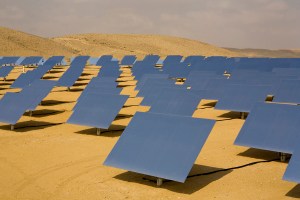
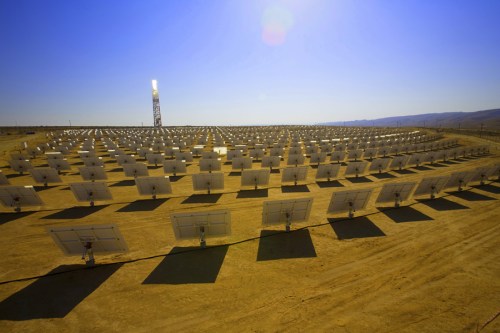
solarhOakland-based BrightSource will build seven solar power plants for Southern California Edison (EIX) using its “power tower” technology. Thousands of sun-tracking mirrors called heliostats focus the sun’s rays on a water-filled boiler that sits atop a tower. The intense heat creates steam which drives a turbine to generate electricity. BrightSource has built a prototype power plant in Israel.

BrightSource has raised more than $160 million from a blue-chip group of investors that includes Google (GOOG), Morgan Stanley (MS) and VantagePoint Venture Partners as well as a clutch of oil giants – Chevron (CVX), BP (BP) and Norway’s StatoilHydro.

If all the solar power plants are built, BrightSource’s deal with Southern California Edison will generate enough electricity to power about 845,000 homes. The agreement is a vote of confidence in the solar industry at a time when the financial crisis has forced BrightSource rivals like OptiSolar to lay off workers while Ausra retools its strategy to focus on supplying solar thermal technology to power plant developers rather than building projects itself.

Given the economic collapse, why are these massive megawatt deals still being done? First, California utilities are under tight deadlines to ratchet up the amount of electricity they obtain from renewable sources – 20% by the end of 2010 and 33% by 2020. Second, it costs nothing to sign a contract – no money has yet changed hands, and won’t unless the plants are built and begin producing electricity.

In fact, not a kilowatt of juice has been generated from the more than 5,000 megawatts of Big Solar contracts signed over the past four years by California’s three investor owned utilities (the third being San Diego Gas & Electric (SRE) ).  Still, a long-term utility contract is key for a startup like BrightSource to obtain the billions in financing required to build large-scale solar power plants. The terms of utility contracts – such as the cost of the solar electricity produced – are closely held secrets but are worth billions, if a 2008 power purchase agreement between Spanish solar company Abengoa and utility Arizona Public Service is any guide.

A significant hurdle for BrightSource – and many other solar developers – is the expansion of the transmission grid to connect remote power plants to cities. BrightSource spokesman Keely Wachs says the company has 4,200 megawatts of solar power plant projects under development.

The Southern California Edison deal is something of a homecoming for American-Israeli solar pioneer Arnold Goldman, BrightSource’s founder and chairman. In the 1980s, during the first solar boom, his Luz International built nine solar power plants in the Mojave. Those plants, most are now operated by FPL (FPL), continue to provide electricity to Edison.

The first BrightSource solar farm for Edison is expected to go online in early 2013. It’s a 100 megawatt power plant part of BrightSource’s Ivanpah complex to be built on federal land on the California-Nevada border in the Mojave Desert. That plant is currently wending its way through a complex state and federal licensing process.

Just how complex was illustrated by a meeting Green Wombat attended Tuesday in Sacramento, where a roomful of state and federal officials spent hours discussing the environmental impact of a 750-megawatt solar power plant to be built by Phoenix’s Stirling Energy Systems for San Diego Gas & Electric that would plant 30,000 solar dishes in the desert. A second Stirling solar farm will be built for Southern California Edision. When the deals were announced in 2005, they were the world’s largest at the time.

PG&E chief executive Peter Darbee recently said his utility will begin directly investing in solar power projects. On Wednesday, Southern California Edison renewable energy executive Stuart Hemphill said Edison would consider requests from solar power developers to take ownership stakes in their projects but prefers to sign power purchase agreements.

“We do see solar as the large untapped resource, particularly in Southern California,” said Hemphill.
Read Full Post »

sunrise_powerlink_031506

Over the weekend The New York Times’ Matthew L. Wald had a sobering story on the not-inconsiderable challenges facing efforts to expand and upgrade the United States’ power grid to tap renewable energy from wind farms and solar power plants. Among them: Opposition to new high-voltage power lines from landowners and environmentalists, a Byzantine permitting process and fights over who pays the costs of transmission projects that span state lines.

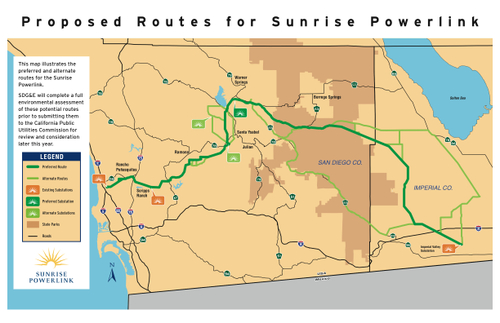
Here in California, the ongoing controversy over the Sunrise Powerlink project is a case study in just how difficult it will be to build the infrastructure to transmit electricity from dozens of solar power plants planned for the Mojave Desert. Among the big companies looking to cash in on the solar land rush: Goldman Sachs (GS), Chevron (CVX) and FPL (FPL)

Utility San Diego Gas & Electric first proposed the $1.3 billion, 150-mile Sunrise Powerlink in 2005 to connect the coastal metropolis with remote solar power stations and wind farms in eastern San Diego County and the Imperial Valley. For instance, SDG&E’s contract to buy up to 900 megawatts of solar electricity from massive solar farms to be built by Stirling Energy Systems is dependent on the construction of the Sunrise Powerlink. Like California’s other big investor-owned utilities – PG&E (PCG) and Southern California Edison (EIX) – SDG&E, a unit of energy giant Sempra (SRE), is racing the clock to meet a state mandate to obtain 20% of its electricity from renewable sources by 2010 and 33% by 2020.

But Sunrise sparked opposition from the get-go as the utility proposed routing part of the transmission project through a pristine wilderness area of the Anza-Borrego Desert State Park.  The prospect of 150-foot-tall transmission towers marching through critical habitat for desert tortoises and other protected wildlife galvanized environmentalists well-versed in the arcane arts of regulatory warfare.

Opponents also painted the project as a Trojan horse to bring in cheap coal-fired power from Mexico. (Wald makes a similar point in his Times‘ piece – the same high-voltage lines designed to transmit green electricity from wind farms can also be used to send cheap carbon-intensive coal-fired electricity across the country.) That argument subsequently lost currency when regulators, citing California’s landmark global warming law, barred utilities from signing long-term contracts for out-of-state coal power.

After more than three years of hearings and procedural skirmishes culminating in an 11,000-page environmental impact report, a PUC administrative law judge last October issued a 265-page decision all but killing the project on environmental grounds. Whether SDG&E thought that green energy and climate change concerns would trump worries over wildlife and wilderness, it was clear that trying to build an industrial project through a state park was a costly mistake.

Then in December, after California Governor Arnold Schwarzenegger signed an executive order to streamline and prioritize the licensing of renewable energy projects, the utilities commission’s board revived Sunrise Powerlink, approving a different route for the transmission lines that avoids Anza-Borrego.

But the fight is far from over. With the cost of the project now approaching $2 billion, late last month the Center for Biological Diversity, a Tucson, Ariz.-based environmental group, filed a suit in the California Supreme Court challenging the utilties commission’s approval of Sunrise Powerlink.

Safe to say, the battle will drag on for some time to come, giving new meaning to the term “stranded assets” for some would-be Big Solar developers.

Read Full Post »

csi-report

The other day I ran into Danny Kennedy, president of solar installation company Sungevity, on the playground as we were picking up our kids at Malcolm X Elementary (we live in Berkeley). I had spent the week chronicling layoffs at various solar and wind companies so it was with a bit of trepidation that Green Wombat asked Danny how business was going at at Sungevity.  “Great,” he replied as I quizzed him about the impact of the recession. “We’re as busy as ever.”

Apparently so. A report released Wednesday by the California Public Utilities Commission shows that residential and commercial rooftop solar installations in the Golden State more than doubled in 2008 from the previous year to 158 megawatts. What’s more, a record-breaking number of applications to participate in California’s $3 billion solar rebate program were filed in December as the drumbeat of bad economic news grew deafening and the state’s unemployment rate hit 9%.

Are Californians being crazily contrarian? While one would think that a $30,000 solar array would be one of those luxuries most people would put on the back burner in bad times, there are some solid economic reasons for the surge. First, rebates for solar systems under the California Solar Initiative get less lucrative in 2009 as incentives fall as the amount of installed solar rises.  Then in October Congress lifted the $2,000 cap on the federal tax credit on solar arrays, allowing homeowners and businesses to take a 30% tax credit on systems installed after Dec. 31.  Add in the state rebate and the cost of a solar system in California suddenly fell by half.

“The surge in applications occurring in the fourth quarter of 2008 is particularly noteworthy given the slowdown in the economy that occurred during the same time period,” the report’s authors noted. “In addition to environmental benefits such as cutting greenhouse gas emissions and other pollutants, it appears that solar energy is benefiting California by serving as an economic bright spot in the economy.”

And therein lies some lessons as the U.S. Congress debates how to promote green jobs. Two years into the California Solar Initiative, the taxpayers’ investment of $775 million in solar rebates has yielded $5 billion in private investment in solar projects and rapidly expanded the state’s renewable energy industry, according to the report. That’s helped create strong solar companies like solar cell maker SunPower (SPWRA) and markets for thin-film solar companies such as First Solar (FSLR). The decade-long program is on track to achieve its target of 3,000 megawatts of rooftop solar and in the first two years of the program more solar has been installed in California than in the previous 25 years.

While California regulators expect the pace to continue in 2009, the big unknown is how many homeowners and business owners will drop out of the program and cancel their applications if the economy continues to deteriorate rapidly this year. The current dropout rate is 15%, according to the report.

“We are hopeful that many of those pending projects will move forward,” Molly Tirpak Sterkel, who oversees the California Solar Initiative for the utilities commission, told Green Wombat. “We’re also cognizant of the economy and economic forces that may pose a threat to those installations.”

Demand for solar is far stronger in Northern California than in sunny SoCal. Northern California utility PG&E’s (PCG) customers have installed more than twice the megawatts of solar than Southern California Edison (EIX) customers. And the report notes that while applications for commercial arrays in PG&E’s territory rose 71% between April and December 2008, they fell 23% in Southern California Edison’s area. San Diego Gas & Electric (SRE), which covers a much smaller service area, saw applications triple for residential solar arrays.

Sterkel says it is unclear why Northern Californians are going solar at a much faster rate than their southern counterpart, but it may be due to differences in electricity pricing and more mature solar markets in regions like the San Francisco Bay Area. “There’s just that many more solar companies with experience, installations and sales channels, ” she says.

Solar panels seem to be sprouting from Bay Area rooftops like California poppies after a late winter rain. In Berkeley, the city has launched a program that pays for residential and business solar arrays upfront and let owners pay the cost back over 20 years through an annual assessment on their property taxes.

Which also may explain why I seem to be seeing more of those Sungevity signs around town.

Read Full Post »

first-solar-11

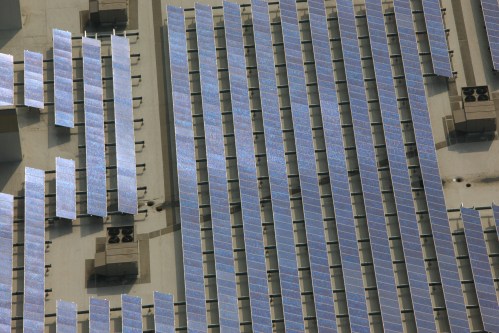
With Big Solar thermal power plants bogged down in bureaucracy and facing environmental and financial hurdles, utilities are turning to smaller-scale thin-film solar stations that can be built in a matter of months.

In late December, PG&E (PCG), for instance, signed a 20-year contract for electricity generated  from a 10-megawatt thin-film solar power plant in Nevada owned by energy giant Sempra (SRE) that was officially dedicated on Thursday. The solar farm was built by First Solar (FSLR) in a scant six months. Meanwhile, the utility’s nearly two gigawatts worth of deals with solar thermal power companies won’t start producing power for another two years at the earliest. (Southern California Edison (EIX) and San Diego Gas & Electric signed agreements with solar dish developer Stirling Energy Systems for 1.75 gigawatts in 2005 and those projects are just now beginning to move through the regulatory approval process.) And the financial crisis has made it more difficult for solar thermal developers to obtain the billions of dollars needed to finance the construction of a massive megawatt power plant.

Solar thermal power plants typically use miles of mirrors to heat a fluid to create steam which drives an electricity-generating turbine. Photovoltaic (or PV) solar farms essentially take solar panels similar to those found on residential rooftops and mount them on the ground in huge arrays. (Thin-film solar panels are made by depositing layers of photovoltaic materials on glass or flexible materials.)

“In terms of construction, photovoltaic tends to have a much faster development and construction track,” Roy Kuga, PG&E’s vice president for energy supply, told Green Wombat. “There is a segment of mid-sized projects – in the two to 20 megawatt size – where PV shows a distinct advantage in that market. There’s a huge potential for the PV market to expand.”

That’s good news for companies like First Solar – the Tempe, Ariz.-based company backed by the Walton family that is often called the Google of solar for its stock price and market prowess – and SunPower (SPWRA), the Silicon Valley solar cell maker that’s moved into the power plant-building business.

The speed at which the Sempra-First Solar project went online owes much to the fact that it was built on the site of an existing fossil fuel power plant. “It was already permitted for power generation, transmission existed and it did not have to go through the laborious California permitting process,” says Reese Tisdale, a solar analyst with Emerging Energy Research. “As such, First Solar was able to essentially plug and play.”

Nathaniel Bullard, a solar analyst with New Energy Finance, says he expects utilities increasingly to bet on smaller-scale photovoltaic farms to help meet state mandates to obtain a growing percentage of their electricity from renewable sources. Just this week, PG&E CEO Peter Darbee said his utility plans to invest in solar power plant projects rather than just buy the power they produce.

“I think a utility could easily integrate, technically and financially, 100 megawatts of PV,” Bullard says.  If something is falling behind on your big solar thermal projects, you can plug in PV. I think you’ll see more of this with California utilities and I expect to see it more in Florida and North Carolina. It’s a great runaround to issues of siting and transmission.”

That’s because in California photovoltaic power plants do not need approval from the California Energy Commission. And smaller-scale plants take up far less land and can be built close to existing transmission lines. Most large solar thermal power plants typically are planned for the Mojave Desert and require the construction of expensive power lines to connect them to the grid.

The modular nature of PV solar farms means they can begin generating electricity as each segment is completed while a solar thermal plant only goes online once the entire project is finished.

“Certainly there is a sweet spot in which the project is large enough to gain advantages of scale,” says Tisdale. “Also, these small-to-mid-size systems can be spread about a transmission network, instead of at one site.”

Read Full Post »

solarcells

photo: Southern California Edison

While demand for solar panels is expected to continue to grow by double-digits in the years ahead, 2009 could be a make-or-break year for some companies, according to an analysis from HSBC Global Research.

After grappling with a shortage of polysilicon – the base material of conventional solar cells – for the past couple years, the industry now faces falling prices. The spot market for polysilicon has plummeted 35% since October, writes HSBC alternative energy analyst Christine Wang, who predicts prices will fall 30% next year.

That’s bad news for solar module makers who locked in long-term contracts at higher prices – which looked like a smart move when polysilicon was in short supply and prices rising rapidly. “The winners will likely be the companies with competitive cost structures, scale, good product  quality, strong balance sheets, and strong customer relationships,” according to Wang. “We believe that new entrants and small players will suffer the most as they lack brand recognition.”

The culprits are the usual suspects – the global financial crisis as well as some cutbacks in subsidies from countries like Spain. Solar cell companies that have rapidly ramped up production over the past two years now may be saddled with too many high-priced products.

Wang downgraded Chinese solar giant Suntech (STP) and set a price target of $4.50 – down sharply from HSBC’s earlier target of $55. Suntech was trading at near $10 Monday afternoon but still nearly 90% off its 2008 high.  (SunPower (SPWRA), First Solar (FSLR) and other solar cell makers have also seen their share prices nose-dive.) “High portion of polysilicon based on contract prices will hurt Suntech,” writes Wang, who estimated that 80% of Suntech’s polysilicon supply is locked into contracts “on less favorable fixed prices.”

Falling panel prices is good news for solar system installers like Sungevity and Akeena Solar (AKNS) and their residential and commercial customers. When Green Wombat ran into Akeena CEO Barry Cinnamon in San Francisco at the announcement of Better Place’s Bay Area electric car project, he said he was in no rush to enter into long-term contracts with solar cell suppliers as he expects prices will continue to fall in 2009.

Still, not all the news is gloomy for the industry. Wang expects that the financial crisis won’t derail government support for solar, given climate change pressures and state mandates to increase the use of renewable energy. The move by utilities like PG&E (PCG) and Southern California Edison (EIX) to sign long-term contracts for electricity from photovoltaic power plants will also keep demand high in coming years.

Wang projects solar cell demand will grow 45% between 2008 and 2012. “Developed countries are increasingly focused on environmental protection and curtailing the causes of climate change, and we do not believe this trend will shift just because of a (hopefully) short-term financial crisis,” she wrote.

Read Full Post »

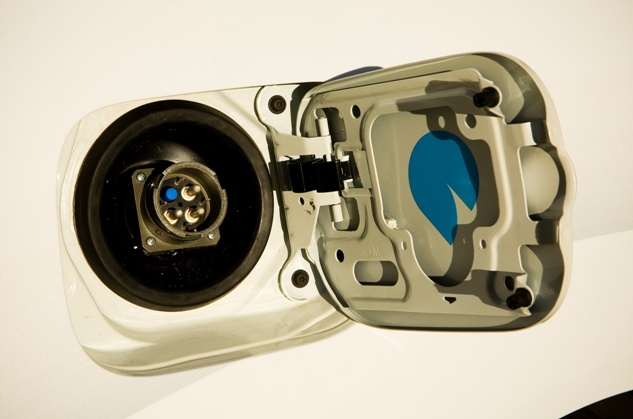
betterplaceplugElectric cars are as good for the economy as the environment and could put $80 billion in consumers’ pockets by 2030, according to a new study from the University of California.

Not surprisingly, the oil industry would take a $175 billion hit under the scenario sketched by UC Berkeley’s Global Venture Lab, while a booming battery business would gain $130 billion as the internal combustion engine sputters out. “There will also be significant changes in the balance of payments among nations as petroleum imports decline,” the authors wrote. “We find the net imports of the U.S. will decline by $20 billion.”

The report makes several assumptions to arrive at its optimistic conclusions: The Cal researchers are counting on 39% of cars on the road to be electric by 2030 and powered by electricity generated from renewable sources like wind and solar.

Electric car owners would save an estimated $7,203 in operating costs, mainly because with no engines to maintain, battery-powered vehicles rarely see the inside of mechanic’s garage.

Left unexplored in the report was the impact of electric cars on the United States auto industry. If General Motors (GM), Ford (F) and Chrysler survive – and that’s a big if these days – they stand to benefit assuming they retool for the electric age and produce cars consumers want to buy before rivals like Toyota (TM), Honda (HMC) and Renault-Nissan beat them to the punch. But their dealer networks are sure to suffer once their lucrative repair and maintenance business evaporates.

Another winner in the electric car economy will be solar and wind companies and utilities, particularly those like PG&E (PCG) and Southern California Edison (EIX) that are making multi billion-dollar investments in renewable energy.

One of the biggest assumption the Cal report makes involves the rise of a U.S. battery industry. “We don’t have a battery industry today,” said Shai Agassi, CEO of electric car infrastructure startup Better Place, on Friday at a panel Green Wombat moderated for the University of California’s Global Technology Leaders Conference. “Either we make them here or they’re going to be made in China.”

Agassi and the mayors of San Francisco, San Jose and Oakland on Friday announced that Better Place would build a $1 billion network of charging stations throughout the Bay Area. Renault-Nissan has agreen to provide Better Place with the hundreds of thousands of electric cars it’ll need to put on the road make its business model profitable.

photo: Better Place

Read Full Post »

schwarzenegger-optisolarjpeg
photo: California Governor’s Office

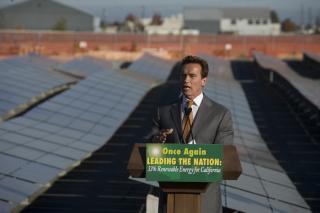
California Governor Arnold Schwarzenegger on Monday terminated talk that the recession will crimp California’s fight against global warming when he ordered every utility in the state to obtain a third of its electricity from renewable sources by 2020. And in a move that will shake up the land rush to build solar power plants in the desert, Schwarzenegger signed an executive order to streamline and prioritize the licensing of such projects.

“One of the great things about California, of course, is that we always push the envelope,” said Schwarzenegger at startup OptiSolar’s solar cell factory in Sacramento, surrounded by a triptych of solar panels, utility executives and environmentalists. “That is why today I’m proposing that we set our sights even higher. This will be the most aggressive target in the nation.”

California currently requires the state’s Big Three investor-owned utilities – PG&E (PCG), Southern California Edison (EIX) and San Diego Gas & Electric (SRE) – to secure 20% of their electricity from green energy sources like wind, solar and geothermal by 2010. Monday’s move turns what had been a 33% renewables goal into a mandate and extends responsibility for meeting it to every electricity retailer in California.

Utilities, however, have struggled to reach even the 20% target as renewable energy projects become bogged down in California’s extensive environmental review and licensing process that involves a host of state and federal agencies.

Many proposed massive megawatt solar power plants will be built on environmentally sensitive land in the Mojave and Colorado deserts in California, threatening to trigger years-long battles over endangered species and water.

Take, for instance, the Ivanpah Solar Electric Generating System, 400-megawatt solar thermal power plant  to be built by Bay Area startup BrightSource Energy on U.S. Bureau of Land Management property. BrightSource, which has a 20-year contract to sell the power plant’s electricity to PG&E, is dealing with the California Energy Commission, the California Department of Fish and Game, the BLM and the U.S. Fish and Wildlife Service as well as the agencies that control access to the transmission grid.

Then there’s environmental fights over extending power lines to connect such projects to coastal metropolises. Late last month, state regulators rejected San Diego Gas & Electric’s plan to build $1.3 billion transmission line called the Sunrise Powerlink due to the environmental impact of routing it through sensitive desert lands.  A final decision on the project to bring green energy from the Imperial Valley to coastal metropolises will be made next month.

Schwarzenegger’s executive order requires various state agencies to collaborate to create a one-stop shopping permit process to cut in half the time it takes to license a renewable energy project – which now can be a two-year slog. The U.S. Fish and Wildlife Service and BLM also agreed to participate in a Renewable Energy Action Team to expedite the licensing of solar power plants and other green energy projects.

“We will streamline the permitting process and the siting of new plants and transmission lines,” Schwarzenegger said. “We will complete the environmental work up front, dramatically reducing the time and the uncertainty normally associated with any of those projects.”

By March 1, the action team will identify and prioritize those areas of the desert that should be developed first for renewable energy projects based on environmental impacts and access to transmission. The group will also work with another task force that is identifying where power lines should be extended into the desert.

That will affect the fortunes of dozens of solar startups, financiers and speculators — everyone from Goldman Sachs (GS) to Chevron (CVX) — that have filed lease claims on nearly a million areas of desert land that the BLM is opening up for solar power plants. Those with land claims in areas at the top of the list for renewable energy development will find it easier to obtain financing – currently in short supply – to build billion-dollar projects. Those at the bottom of the list may rue the six-figure application fees they paid to stake claims on thousands of acres of desert land.

Behind the optimistic talk and smiles at Monday’s press conference, utility execs and environmentalists who praised the governor’s latest green initiative also signaled that political fights over how to achieve the state’ ambitious renewable energy goals are not over.

“Transmission is absolutely critical to get those renewables from the Imperial Valley,” San Diego Gas & Electric CEO Deborah Reed told the audience. “Assuming a positive decision on Sunrise Powerlink next month, we’ll get to 33% by 2020.”

But when the Nature Conservancy’s Rebecca Shaw took the microphone, she offered a cautionary note. “In our urgency to create a more sustainable future, we must be careful not to destroy the very environment that we are trying to protect,” said Shaw, associate state director for the environmental group.

California’s aggressive renewable energy policies already have had one desired consequence: spurring the creation of green collar jobs. OptiSolar, which earlier this year signed a long-term contract to supply PG&E with 550 megawatts of electricity from a massive photovoltaic solar farm, employs 500 people at its Bay Area headquarters and factory. CEO Randy Goldstein said his company will hire another 1,000 for its new Sacramento factory.

Read Full Post »

cool-earth-solar-balloon1

Image: Cool Earth

LIVERMORE, Calif. – It sounds like something out of one of those do-it-your-self magazines: Stitch together two buck’s worth of thin-film plastic – the stuff potato chip bags are made of – stick in a photovoltaic cell, inflate with air and, voilà, you’ve got yourself a “solar balloon” that will generate a kilowatt of electricity. String together 10,000 balloons and you’ve got a solar power plant that can power a town.

California startup Cool Earth Solar believes this high-low tech approach is what will make its solar power plants competitive with fossil fuels. Green Wombat visited Cool Earth’s Livermore headquarters recently for a Fortune Magazine story and got a look at the technology.  “We wanted to do solar in a very different way,” says Cool Earth CEO Rob Lamkin.

Different it is. We’re standing in Cool Earth’s back shop in front of an eight-foot-high solar balloon. Two pounds of plastic are pumped with a third of a pound of air per square inch to make the balloon taut. The curved top two-thirds of the balloon is transparent and the bottom is made of the silvery reflective plastic you’d find lining a bag of junk food. A steel strut inside will hold a tiny but highly efficient solar cell, which is the most high-tech component of the balloon.

Here’s the ingenious part of the technology, developed by scientists at Caltech: Instead of using expensive optics to concentrate sunlight on the solar cell, Cool Earth manipulates the air pressure inside the balloon to change the shape of the mirrored surface so that it focuses the maximum amount of sunlight on the solar cell, boosting electricity generation 300 to 400 times.

By replacing expensive materials like steel with cheap-as-chips plastic and air, Cool Earth aims to dramatically lower the price of solar electricity. “We strongly believe it’s all about cost,” says Lamkin, “not how clever the technology is or if it is 1% more efficient.”  For instance, the amount of aluminum in a can of Coke would provide enough reflective material for 750 balloons, he notes.

The company, founded in 2007, has raised $21 million so far. It plans to build solar power stations in the 10-megawatt to 30-megawatt range. Two to six balloons will be suspended on wood poles and anchored with cables about 10 feet off the ground. That means the earth won’t have to be graded, reducing the environmental impact of Cool Earth’s power plants – a growing issue given that most solar thermal power stations will be built in the desert, home to a plethora of protected wildlife. The relatively compact size of Cool Earth’s power stations also means they can be located close to existing transmission lines.

A prototype power plant is being built in a field across the street from Cool Earth’s offices and Lamkin says a 1.5 megawatt plant will be constructed early next year in the Central Valley town of Tracy. The electricity probably will be sold to utility PG&E (PCG) under a state renewable energy program.

Unlike big solar thermal plants, photovoltaic power stations do not need to obtain a license from the California Energy Commission, which can be an expensive two-year ordeal. Lamkin estimates that a Cool Earth power plant can be up and running in six months, which should appeal to utilities like PG&E, Southern California Edison (EIX) and San Diego Gas & Electric (SRE), which are under the gun to meet state mandates to obtain 20% of their electricity from renewable sources by 2010.

Now Cool Earth just needs to make the technology work in the field. It has yet to produce electricity from its balloons, as the solar cells are still being produced. Also unknown is how the balloons will operate in real-world conditions. Lamkin says they can withstand 125-mile-an-hour winds. They have a lifespan of just five years, but Cool Earth expects to replace the balloons every year, given their low cost.

“Our major structural element is air, which so far is free,” Lamkin says. “And the sun isn’t taxed either.”

Yet.

Read Full Post »

The risky nature of Big Solar projects has been driven home with California regulators’ move to kill a controversial $1.3 billion transmission line that would have connected massive solar power stations in the desert to coastal cities.

“These projects are unlikely to proceed,” wrote Jean Vieth, an administrative law judge with the California Public Utilities Commission, in a ruling rejecting San Diego Gas & Electric’s Sunrise Powerlink transmission line.

Phoenix-based Stirling Energy Systems in 2005 scored a contract to provide SDG&E (SRE) with up to 900 megawatts of electricity to be generated by as many as 36,000 solar dishes. A few months later, the utility filed an application to build the Sunrise Powerlink, a new transmission line to connect the Stirling power plants and other renewable energy projects to the coast.

But the utility’s proposal to build 150-foot-high transmission towers right through wilderness areas of Anza-Borrego State Park, home to a host of protected species, triggered a long-running fight with green groups that generated an 11,000-page environmental impact report. On Halloween, Vieth issued a ruling that found that despite state mandates to cut greenhouse gas emissions, the environmental impact of the transmission project was frightening.

“The potentially high economic costs to ratepayers and the potential implications for our [greenhouse gas] policy objectives do not justify the severe environmental damage that any of the transmission proposals would cause,” concluded Vieth in a 265-page decision.

The battle isn’t over — the public utilities commission will vote in December whether to accept the judge’s ruling. They will also consider an alternative decision issued by a commissioner assigned to review the case. That decision would let SDG&E build a transmission line along a different route under certain conditions.

But the case highlights the conflicting environmental values that will dog solar power projects. In other words, just what trade-offs are we willing to make to secure a planet-friendly source of energy? In this case, the judge ruled that to avoid the environmental damage of a massive new transmission line, the preferred alternative is to build more fossil-fuel plants close to San Diego along with a smaller-scale solar power station and a huge increase in rooftop solar arrays. The judge acknowledged that such an alternative “would cause substantially more GHG emissions than the proposed project and other transmission proposals.”

The judge’s second preferred alternative was to build only renewable-energy projects near San Diego that would not require big new transmission lines. Some Sunrise Powerlink opponents argue that San Diego has enough roof space to generative massive amounts of electricity from photovoltaic solar panels. (The cost of such an undertaking was left unsaid.)

Public Utilities Commissioner Dian Grueneich’s alternative decision would allow San Diego Gas & Electric to build Sunrise Powerlink along a more environmentally-benign route if the utility could prove that most of the transmission line would carry renewable energy so as to offset the 100,000 tons of greenhouse gases emitted during its construction. “Reliance on a single 900-megawatt contract (the Stirling Energy Systems contract) is too risky,” she wrote.

So where does this leave Stirling? COO Bruce Osborn didn’t immediately respond to a request for comment. But earlier this year, he told Green Wombat that even if Sunrise Powerlink was killed, there’s enough existing transmission capacity to carry electricity from the power plant’s first 300-megawatt phase. Stirling also has a 20-year contract to supply up to 850 megawatts of electricity to utility Southern California Edison (EIX), a deal not contingent on Sunrise Powerlink.

Read Full Post »

The economy may be all trick and no treat, but you wouldn’t know it from First Solar, one of the few public solar cell makers and thus a bellwether for the industry. This week the Tempe, Ariz.-based company reported solid third-quarter earnings and unveiled two deals that mark a big expansion in the U.S. market.

It agreed to supply solar installer SolarCity with 100 megawatts of thin-film modules and made a $25 million investment in the Silicon Valley startup – which represents a 10% stake, valuing SolarCity at $250 million. The other deal didn’t get much attention – it was buried in the earnings report – but is significant nonetheless. First Solar (FSLR) will team up with utility giant Edison International (EIX)‘s power plant subsidiary, Edison Mission Energy, to develop large-scale solar power stations. (First Solar just completed a 2.4 megawatt project for Southern California Edison as part of the utility’s 250-megawatt commercial rooftop initiative and will finish by year’s end a 12-megawatt solar power plant in Nevada for Sempra (SRE).)

“By combining Mission’s extensive track record of power project development with First Solar’s low-cost systems and construction capability, we believe we’ve created a powerful engine for future growth in the U.S. utilities segment,” First Solar CEO Mike Ahearn said during the company’s earnings call Wednesday, according to a transcript published by the Seeking Alpha business blog.

But it was Ahearn’s comments on the European market – 85% of First Solar’s business is in Germany, for instance – that is of most interest to investors.

While he predicts the European market will remain strong – First Solar expects its 2009 net sales to range from $2 billion to $2.1 billion, up from $1.22 to $1.24 for 2008 – he did note some red flags, particularly for utility-scale solar power stations.

“Our review indicates that solar projects lending outside of Germany has essentially stopped for the time being,” Ahearn said. “Today, we have identified potential financial risk in our customer base that represent approximately 15% to 20% of our planned sales in Europe in 2009.”

“We believe most of our European customers outside of Germany have sufficient balance sheet strength to bridge any near-term projects delays,” he added.

During the Solar Power International conference in San Diego this month, there was much buzz that solar companies that had ramped up their production capacity over the past couple of years would be hit by an oversupply of solar modules just as customers get crunched by the credit crisis.

But Ahearn told analysts on Wednesday that First Solar’s thin-film modules – which are made by depositing solar cells on plates of glass and use minimal amounts of expensive silicon – would continue to sell for less than conventional cells and thus remain attractive to customers. “We therefore assume that any price competition is unlikely to have a sustained impact on First Solar,”  he said.

Despite First Solar’s moves into the U.S. market, Ahearn acknowledged the immediate future is uncertain. While Congress extended a key investment tax credit for eight years as part of the financial bailout package, investors have lost their appetite for tax equity partnerships that would buy those credits from solar companies in exchange for financing the construction of power plants.

“In the short-term, our review indicates that the traditional investors in tax equity – financial institutions – have largely stopped participating,” Ahearn said. “We assume some of these investors will return to the market in 2009, but the timing and future cost of this funding is difficult to predict. The possibility of more expensive tax equity and its impact on solar electricity prices for both new and pending projects remains a major uncertainty going into 2009.”

Read Full Post »

« Newer Posts - Older Posts »

Design a site like this with WordPress.com
Get started