Feeds:
Posts
Comments

Archive for the ‘solar power plants’ Category

Thin is in when it comes to solar power plants.

First Solar, the Walton family-backed (WMT) maker of thin-film photovoltaic modules, on Thursday announced its second solar power plant. The latest project is a 10-megawatt photovoltaic power station to be built for Sempra Generation (SRE) in Nevada. Two weeks ago, California regulators approved a 7.5-megawatt – expandable to 21 megawatts – First Solar (FSLR) power plant to be constructed in the Mojave to generate electricity for utility Southern California Edison (EIX). Thin-film solar technology layers solar cells on plates of glass or flexible materials, a process that lowers production costs with the trade-off being lower efficiency at converting sunlight into electricity.

What’s notable about the Nevada First Solar project is that it will be constructed adjacent to a Sempra natural gas-fired power plant near Boulder City, Nev. That will allow the solar station to share transmission lines and other infrastructure and minimize land use. Those are no small considerations these days as the solar land rush continues in the Mojave and environmentalists grow uneasy over the impact of industrializing the desert.

Tempe, Ariz.-based First Solar has already broken ground on the project with completion expected by the end of the year. That’s record time, given that solar thermal power plants – which tend to be larger by orders of magnitude – can take years to receive regulatory approval and build. Also of note: The solar modules for the project will be manufactured at First Solar’s Ohio factory, one of only two commercially operating  thin-film manufacturing facilities in the United States. (The other is Energy Conversion Devices’ thin-film factory in Michigan.)

Sempra Generation, a division of utility giant Sempra, will own and operate the First Solar plant, which will supply electricity to Nevada and California.

Read Full Post »

HALF MOON BAY, Calif. – Green Wombat has been at Fortune’s Brainstorm Tech conference the past few days, the highlight of which for me was leading a session on energy with Vint Cerf. Known as the “father of the Internet” for his role in co-creating its underlying technology, Cerf is now a Google (GOOG) vice president and its chief Internet evangelist.

The idea: Brainstorm with 40 high-powered participants – everyone from Idealab’s Bill Gross (chairman of solar power plant company eSolar) to Stan Williams of Hewlett-Packard’s (HPQ) Quantum Systems Labs to venture capitalist Richard Wong of Accel Partners. The task we set out: Devise solutions to Al Gore’s challenge last week for the United States to obtain 100% of its electricity from renewable energy by 2018. Piece of cake.

Sorry, Al, we didn’t come up with a 12-step plan to kick America’s addiction to the black stuff – oil and coal. But the wide-ranging discussion underscored the complexity of the challenge and the fact that a solar-power-plant and wind-farm building boom is but one part of the big fix.

First, said one participant, we must create the “energy Internet.” In other words, a smart transmission grid that can get electricity generated from desert solar power stations and High Plains wind farms to other regions of the country as well as manage “distributed energy” from such things as rooftop solar panels. Another technological challenge that must be overcome: energy storage to capture electricity produced by solar and wind power stations for use when the sun isn’t shining and the wind isn’t blowing.

For many in the room, just as critical is the need to reduce energy demand, increase public awareness and devise the right economic incentives to promote green power and lower electricity consumption. As more than a few participants noted, Americans use more than twice as much electricity per capita as Europeans.

Gross suggests establishing a floor on electricity prices – say 10 cents/kilowatt hour – to allow renewable energy companies to get up and running and achieve economies of scale to compete against coal and natural gas.

Given the techie crowd –  Silicon Valley is just over the hill from Half Moon Bay – some of the more interesting ideas were about how to use software and Web  2.0 tools to change consumer behavior and awareness about energy consumption. For the home there needs to be an energy meter that provides constant feedback on the electricity usage – and the charges incurred –  of individual appliances and gadgets, like that laptop you left plugged in. Your mobile GPS-enabled phone could monitor your driving habits, suggesting ways to consolidate trips, report your fuel efficiency and ping you about your home energy use. Another idea;  Embed carbon footprint data in individual products, so that consumers can scan them with their phones when making purchasing decisions.

(Another provocative idea that Cerf discussed with me before the session: How to re-architect the suburbs when the aging baby boom generation begins to abandon their McMansions in search of housing and a lifestyle less isolated and closer to shops and services.)

Beyond technological innovation, the overriding sentiment was that the president and Congress must show leadership in establishing a national renewable energy policy that commits the resources and sense of urgency of a 21st century Manhattan project.

Coincidentally, the day before the session I moderated a panel at Google on renewable energy sponsored by the California Clean Tech Open, a contest that provides seed capital and services to incubate green startups with promising business plans. This year’s finalists, announced Tuesday, include several companies developing software and services to monitor and cut home and business energy consumption. Judging by the overflow crowd – some 350 people with a line out the door – there’s no shortage of talent in the Valley interested in green tech.

Among those present was Bob Cart, CEO of San Francisco-based Green Volts, which is developing concentrating photovoltaic power plants. Green Volts was a 2006 Clean Tech Open winner and Cart told Green Wombat that less than two years later the company is breaking ground this week on its first power plant, which will generate two megawatts of electricity for utility PG&E (PCG).

Green tech innovation can come from some improbable places. Rock star and home-brew technologist Neil Young closed out Brainstorm Tech on Wednesday by taking the stage for an interview with Time Inc. editor-in-chief John Huey.  Young has been working with a far-flung group of technologists and auto enthusiasts to convert a 1959 Lincoln Continental Mark IV into a 100-mpg, Internet-enabled bio-electric-hybrid. He told Huey the Continental is just one of several green car projects he has under way.

“We have an onboard fuel creation device on an Envoy in Adelaide, Australia,” Young said. That prompted Cerf to ask from the audience, “You mentioned onboard fuel production. This car doesn’t happen to run on piss, does it?”  Young laughed, “It could.”

The songwriter and political provocateur said he was focusing on land yachts  – the Continental stretches to 19.5 feet.  “Americans, a lot of them are big, and they like big cars and long highways.”

Read Full Post »

The idea that green is the new tech was brought home this week in San Francisco when one of the chip industry’s biggest trade shows, SEMICON West, was held in conjunction with a huge solar trade show, Intersolar North America. The geeks and the eco-freaks together under one roof.

Not surprising, really. It has been oft-observed that much of the solar cell industry today is essentially an offshoot of the chip biz; both use  the same basic building blocks – silicon – and common manufacturing processes. Cypress Semiconductor saw that early on and has profited greatly from an acquisition that has eclipsed its chip business, solar module maker SunPower (SPWR).

Almost two years ago, Applied Materials (AMAT), the world’s biggest manufacturer of the machines that make computer chips, jumped into the solar business. It reconfigured  equipment used to produce flat-screen televisions and displays to print thin-film solar cells on the same plates. (Thin-film technologies vary, but essentially solar cells are printed or layered on sheets of glass or flexible materials.)

Applied has sold $3 billion worth of contracts for a dozen solar-cell factories that will be able to crank out 1.5 gigawatts’ worth of modules a year by the end of 2010, said Applied chief technology officer Mark Pinto at a lunch Green Wombat attended on Wednesday at Intersolar. To get an idea of just how hot solar is, consider this: Pinto estimates that in just two years solar will bring in 20 to 30 percent of Applied’s revenues.

“Energy generation has been void of technological development for 50 years and that makes it ripe for change,” said Applied CEO Mike Splinter. “It’s all about engineering and the environment.”

For photovolatics, it’s all about getting the costs per watt down to compete against fossil fuels. Part of that involves improving the efficiency of solar cells, but it’s just as much about reducing manufacturing and installation costs.

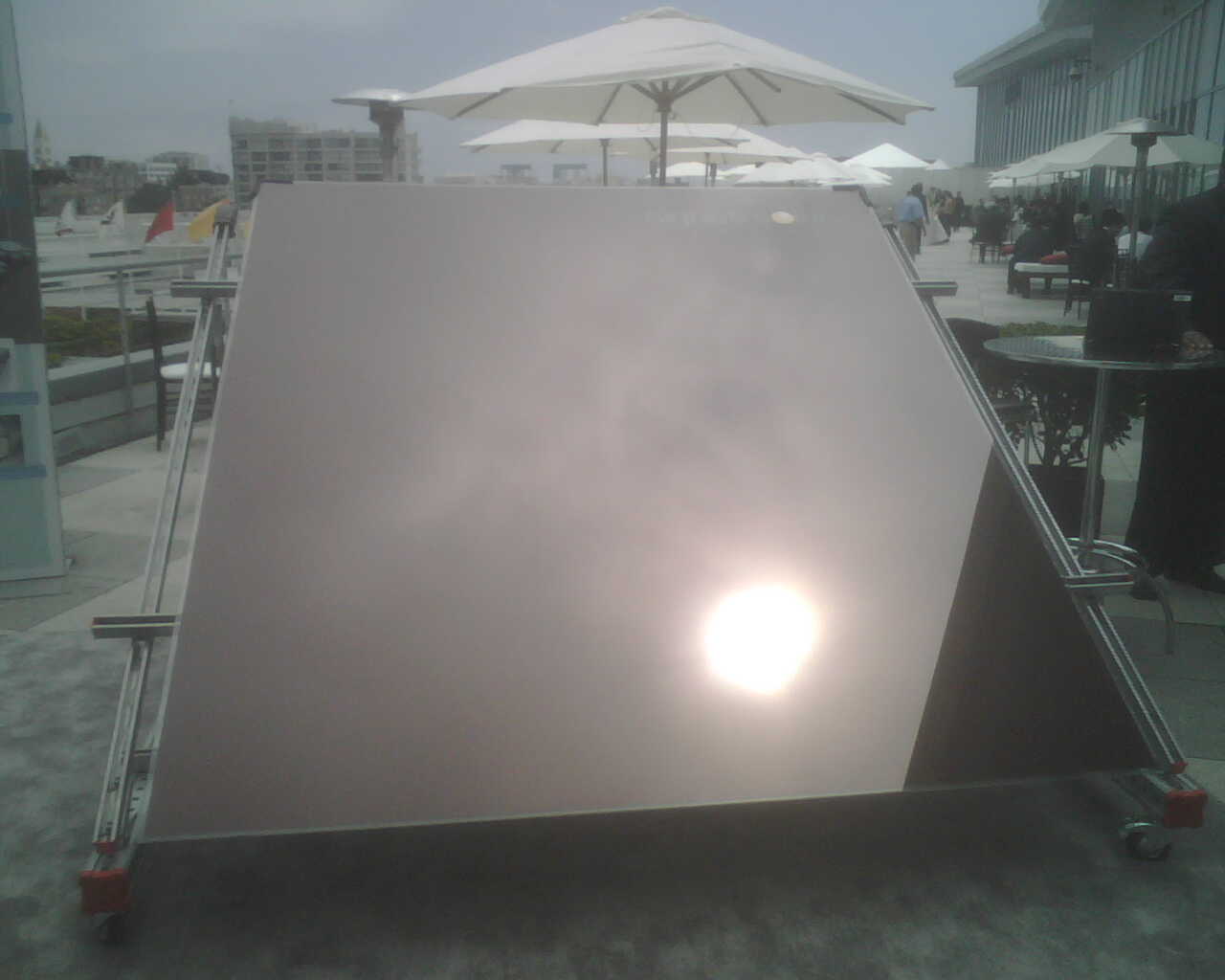
To that end, Applied was showing off its latest product (or to be exact, the product made by its machines): Out on a deck at the Metreon center across from the San Francisco convention hall sat a supersized thin-film solar panel measuring 5.7 square meters (7.2 feet by 7.5 feet) that is but an inch or so thick. The panels, which produce about 500 watts each, are designed for solar farms. The large size means that a 10-megawatt solar power plant would require 20,000 Applied panels versus 150,000 conventional-sized panels, cutting overall costs by 17 percent, the company claims. Installation costs fall dramatically as the panels attach to mounting racks with just two screws and plug into the circuit with two wires.

“We think the cost to produce and install is less than the average cost of electricity in California,” said Pinto.

Thin-film panels like the one in the photo above cost less to make than conventional bulky solar modules, but they are much less efficient at converting sunlight into electricity  – around 6 percent versus 20 percent. However, they tend to work well in diffuse sunlight – i.e. foggy San Francisco – and can be integrated into building facades. The panels could also be made semi-transparent and transformed into electricity-generating windows for skycrapers.

Don’t expect Applied’s booming solar business to translate into a lot of green collar jobs in the United States. So far, it has not sold one solar cell factory here. Europe’s solar tax incentives have made it the market for Applied, with Asia set to become another big play in the coming the years. At home, meanwhile, the looming expiration of a crucial investment tax credit for renewable energy is discouraging expansion of the solar economy.

That doesn’t mean that demand has slowed. Southern California Edison (EIX), for instance, this year announced plans to install 250-megawatts of solar arrays on warehouse rooftops in the Southland. (This week it awarded the project’s first contract to thin-film company First Solar (FSLR) to build a 2-megawatt array in the sun-baked city of Fontana.)

But given that there’s only one thin-film factory currently in commercial operation in the United States – First Solar’s – the panels for Edison’s project and others will be coming from overseas. It makes no economic or environmental sense, of course, to ship huge pieces of glass across the ocean to California. (CORRECTION: As a couple of readers have pointed out, Energy Conversion Devices of Michigan operates a thin-film factory in the U.S.) But as Splinter put it about the lack of a coherent U.S. renewable energy policy and the investment tax credit mess, “This is the biggest miss in a long, long time.”

Read Full Post »

For those readers who missed Green Wombat’s feature story on the solar land rush in the July 21 issue of Fortune – available here at Fortune.com – I reprint below.

The Southwest desert’s real estate boom

From California to Arizona, demand for sites for solar power projects has ignited a land grab.

By Todd Woody, senior editor

(Fortune Magazine) — Doug Buchanan grins with relief when he sees the carcasses. He has just driven up a steep dirt road onto a vast, sunbaked mesa overlooking the Mojave Desert in western Nevada. There, a few feet from the trail, lie the corpses of two steers. A raven perches on one, the only object more than three feet above the ground on this pancake-flat plateau. Cattle, dead or alive, qualify as good news in Buchanan’s line of work. If cattle are present, that means grazing is permitted, and that in turn means that this land is most likely not protected habitat for the desert tortoise.

Buchanan, 53, is scouting sites for a solar power company called BrightSource Energy, an Oakland-based startup backed by Google and Morgan Stanley. The blunt, fifth-generation Californian, who used to survey the same area for natural-gas power sites, knows that the presence of an endangered species such as the tortoise could derail BrightSource’s plans to build a multibillion-dollar solar energy plant on the mesa.

BrightSource badly wants these 20 square miles of federal land on what is called Mormon Mesa. The company was in such a hurry to stake its claim with the U.S. Bureau of Land Management that it applied for a lease sight unseen. That’s an expensive gamble for a startup, given that application fees alone run in the six figures. “I usually like to go out and kick the tires before filing a claim,” Buchanan says, “but there’s a lot of competitive pressure these days to move fast.”

That’s putting it mildly. A solar land rush is rolling across the desert Southwest. Goldman Sachs, utilities PG&E and FPL, Silicon Valley startups, Israeli and German solar firms, Chevron, speculators – all are scrambling to lock up hundreds of thousands of acres of long-worthless land now coveted as sites for solar power plants.

The race has barely begun – finished plants are years away – but it’s blazing fastest in the Mojave, where the federal government controls immense stretches of some of the world’s best solar real estate right next to the nation’s biggest electricity markets. Just 20 months ago only five applications for solar sites had been filed with the BLM in the California Mojave. Today 104 claims have been received for nearly a million acres of land, representing a theoretical 60 gigawatts of electricity. (The entire state of California currently consumes 33 gigawatts annually.)

It’s not just a federal-land grab either. Buyers are also vying for private property. Some are paying upwards of $10,000 an acre for desert dirt that a few years ago would have sold for $500.

No doubt the prospect of potential riches is overheating expectations. But California and surrounding states have mandated massive increases in renewable energy in the next few years. That has led some experts at Emerging Energy Research of Cambridge, Mass., to predict that Big Solar could be a $45 billion market by 2020.

Meanwhile, the land rush is setting the stage for a showdown between solar investors and those who want to protect a fragile environment that is home to the desert tortoise and other rare critters. The Southwest is on the cusp of what could be a green revolution. And the biggest obstacle of all may be … environmentalists.

***

Over the past year a parade of executives bearing land claims have made the trek to a stucco BLM office just off the interstate in the dusty city of Needles, Calif., a 110-mile drive south from Las Vegas. (It’s the town where the late “Peanuts” cartoonist, Charles M. Schulz, briefly lived as a boy; in the comic strip, Snoopy’s brother Spike is a resident.) The Bush administration has instructed the BLM to facilitate renewable-energy projects (along with nonrenewable ones). But Sterling White, the BLM’s earnest Needles field manager, is also concerned about what could happen if they transform the Mojave into a collection of giant power stations. “One of our biggest challenges is the cumulative impact of these projects,” he says.

Nearly 80% of the land that White’s office oversees is federally protected wilderness or endangered-species habitat. That leaves about 700,000 acres for solar power plants, only some of which are near transmission lines. Land leases are handed out on a first-come, first-served basis, but White is also supposed to weed out speculators from genuine solar developers based on loose criteria such as who is negotiating with utilities and who is applying for state power licenses. White has yet to approve a single lease, but he has summarily rejected four because they lie in protected-species habitat.

***

Solar prospectors tend to be as secretive about their land as forty-niners were about the veins of gold they discovered. Most bids are placed by limited-liability corporations with opaque names that conceal their ownership. And no one has been as quick to move into the Mojave – or as tightlipped about it – as Solar Investments.

That entity, it turns out, is Goldman Sachs’s solar subsidiary. The investment bank’s designs on the desert are a topic of intense interest and speculation. Goldman declined to comment. But here’s what we know:

Solar Investments filed its first land claim in December 2006 and within a month had applied for more than 125,000 acres for power plants that would produce ten gigawatts of electricity. Many of the sites lie close to the transmission lines that connect the desert to coastal cities. (Goldman has also staked claims on 40,000 acres of the Nevada desert.)

Nobody expects Goldman to begin operating solar plants. It will probably either partner with another developer or sell its limited-liability company (and its leases) outright. The firm has been making the rounds of solar developers. “The conversation’s been pretty wide-ranging, primarily as an investor interested in financing deals,” says one solar energy executive approached by Goldman. “But there’s clearly an element of interest in our technology.” Goldman has requested permission to install meteorological equipment on its sites and is evaluating “competing technologies, including solar dish systems, power towers, and large-scale photovoltaic arrays,” according to a letter Goldman sent to the BLM in August 2007.

Competitors are lining up behind Goldman, staking claims on some of the same sites in hopes the bank will abandon them. PG&E and FPL, for instance, are in the queue after Goldman on one site. Solel, an Israeli solar company that last year scored a contract to deliver 553 megawatts to PG&E, is third in line behind Goldman on another.

“I view Goldman as a very interesting indicator of things to come,” says Brian McDonald, PG&E’s director of renewable-resource development. “They’re usually ahead of the curve – you can extract a huge amount of value if you get in early.” There’s other smart money here too. A Palo Alto startup called Ausra received $40 million from the elite green venture capitalists Vinod Khosla and Kleiner Perkins Caufield & Byers. Ausra has signed a deal with PG&E and announced its intention to construct a gigawatt’s worth of projects a year.

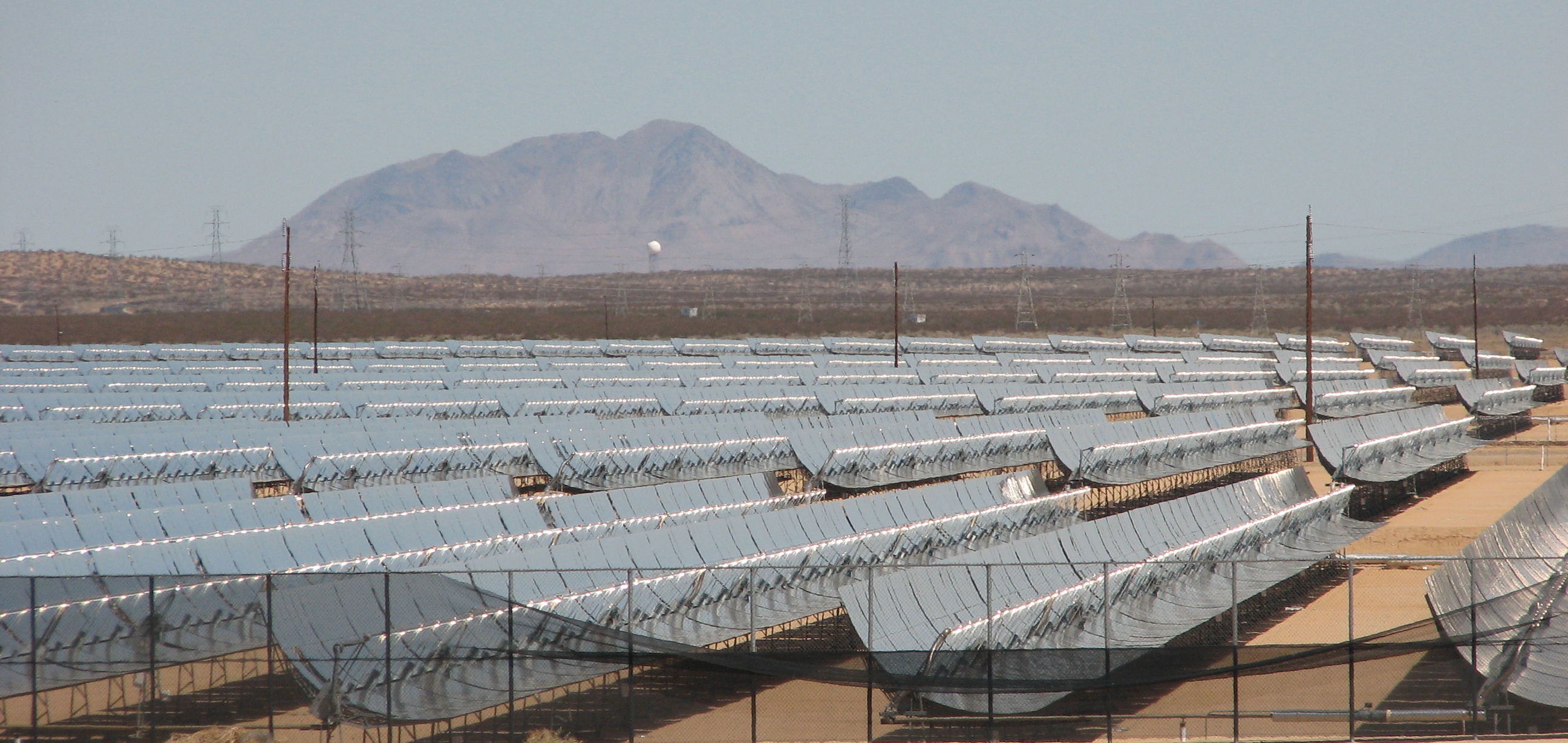
Most of the power production contemplated for the Mojave will rely on solar thermal technology – the common approach in large-scale generation projects – in which arrays of mirrors heat liquids to produce steam that drives electricity-generating turbines. But a secretive Hayward, Calif., startup called OptiSolar has filed claims on 105,300 acres to build nine gigawatts’ worth of photovoltaic power plants, which employ solar panels similar to those found on residential rooftops. (The company also has applied for leases on 21,800 acres in Arizona and Nevada.) To put those ambitions in context, the biggest photovoltaic power plant operating today produces 15 megawatts. Says OptiSolar executive vice president Phil Rettger: “We have a proprietary technology and a business approach that we’re convinced will let us deploy PV at large scale and be competitive with other forms of renewable energy.”

***

With the prime BLM sites quickly being snapped up – recently the agency temporarily stopped accepting new land claims while it develops a desertwide solar policy – competition is growing for private land. Here, too, the emphasis on secrecy borders on the obsessive. A request to view a piece of desert that is up for sale is treated as if I had asked to visit Area 51.

Waiting outside a roadside diner in southwestern Arizona – I’ve promised not to say where – with BrightSource senior vice president Tom Doyle, I expect to see a weather-beaten farmer come chugging up in a battered pickup. Instead, a pale-green Volvo SUV driven by a physician glides into the parking lot. The doctor, who wishes to remain anonymous, acquired the land two years ago as the renewable-energy boom got underway. “We thought we’d put solar on it – that’s the reason we bought it,” the doctor says as we pile into the Volvo and head into the desert to visit the site. After about five miles we turn off the road and come to a stop in a rocky patch of desert framed by low-slung mountains and buttes. Doyle quizzes the physician about water rights, endangered species, and access to transmission lines before moving out of earshot to talk dollars. The whole process takes only about 20 minutes – the two sides ultimately decide not to do a deal – and then Doyle is on to visit the next potential property.

Such is the land frenzy that farmers in Arizona were paid $45 million for 1,920 acres by Spanish solar company Abengoa so that it could build a 280-megawatt power plant; the land had an assessed value of a few hundred thousand dollars. The company also plunked down $30 million for 3,000 acres in the California Mojave that had traded hands for $1.25 million nine years earlier. That prompted developer Scott Martin to put his adjacent 300-acre parcel – land he had bought only a few months earlier for $457,500 – on the market for $3 million. Also for sale: a $15 million, 3,000-acre tract near Palm Springs, which Martin began shopping around to solar executives like Ausra’s Perry Fontana. When I join Fontana to check out the site, a onetime World War II air base outside the Mojave ghost town of Rice, he says, “I probably get three calls a day from brokers or landowners.” As if on cue, his Bluetooth earpiece lights up with a cold call from a broker peddling some land near Needles.

***

Green energy is not about to get a green light from all environmentalists. “We’re going to challenge these big solar projects, and there’s going to be tremendous environmental battles,” says veteran California activist Phil Klasky, a member of several green groups who helped lead a campaign in the 1990s that scuttled a radioactive-waste dump planned in tortoise territory in the Mojave. “Large solar arrays will have an impact on surrounding critical habitat for the desert tortoise and other threatened species. We have to fight global warming, but just because it’s solar doesn’t make it right.”

The developers are worried about resistance. “I remember the spotted owl,” says Fred Morse, a former Department of Energy official who is a senior advisor to Abengoa’s U.S. operations. The widespread logging of ancient forests, home to the northern spotted owl, set off epic environmental fights in the 1980s and ’90s. As Morse puts it, “The Mohave ground squirrel or the desert tortoise – any one of them could become a cause.”

Solar energy companies may make for less tempting targets than timber barons, but development of the desert has never been attempted on such a scale. The result is that some environmentalists find themselves anguished over which side to take. “We’ve had our share of conflicts over endangered species in this state, no doubt about it,” says Kevin Hunting, a biologist and a deputy director of the California Department of Fish and Game, which enforces the state endangered-species laws. “We’re actively looking to strike that critical balance between the state’s renewable-energy goals and conserving species that are vulnerable. It’s challenging.”

California wildlife regulators, for instance, have peppered Ausra with requests for more biological surveys on the site of a 177-megawatt solar power plant to be built in San Luis Obispo County. The feds could also require Ausra to prepare a plan to protect the San Joaquin kit fox, a process that could take years and shred the project’s economic viability.

Worse for developers, state and federal law require wildlife officials to consider the total impact of multiple projects when weighing whether to approve any individual facility. Next door to Ausra’s solar farm, for example, is OptiSolar’s planned 550-megawatt power plant, which would cover 9 1/2 square miles of potential endangered-species habitat with solar panels. Will the regulators approve one? Both? Nobody knows.

In the meantime, the solar land rush is unlikely to cool down. Which is why Morse wants to keep quiet Abengoa’s $30 million real estate deal. The company is applying to build a 250-megawatt solar power plant on the site, and it may be in the market for more land. “We don’t want to publicize that purchase,” he says, “as the speculators will be coming out of the woodwork.”

Read Full Post »

When it comes to solar companies, First Solar is the Google of renewable energy. The Tempe, Ariz.-based solar cell maker backed by the Wal-Mart (WMT)’s Walton family has seen its stock skyrocket over the past year, hitting a high of $317 on May 14. (It was trading at $275 Friday.) Now First Solar, which makes “thin film” solar modules, is getting into the utility business, winning approval Thursday from California regulators to build the state’s first thin-film photovoltaic solar power plant. The 7.5 megawatt project – expandable to 21 megawatts – will sell electricity to Southern California Edison (EIX) under a 20-year contract.

While First Solar (FSLR) supplies solar modules to power plant builders in Europe, this is apparently the first time it has acted as a utility-scale solar developer itself. First Solar tends to keep quiet about its projects and did not return a request for comment. But a troll through the public records reveals some details of what is called the FSE Blythe project. The solar farm will be built in the Mojave Desert town of Blythe by a First Solar subsidiary, First Solar Electric. The company paid $350,000 in January for 120 acres of agricultural land in Blythe, providing a tidy profit for the seller, which had purchased the property for $60,000 in June 1999.

Approval of the contract by the California Public Utilities Commission Thursday came on the same day that SunPower (SPWR) announced a deal to build two photovoltaic power plants – a 25-megawatt one and a 10-megawatt version – in Florida for utility Florida Power & Light (FPL). PV plants are essentially supersized versions of rooftop solar panel systems found on homes and businesses. Thin-film solar prints solar cells on flexible material or glass and typically uses little or no expensive (and in short supply) polysilicon, the key material of conventional solar cells.

Most large-scale solar power plants being developed in the United States use solar thermal technology that relies on huge arrays of mirrors to heat liquids to create steam that drives electricity-generating turbines. In fact, there is a solar land rush underway in the desert Southwest as solar developers, investment banks like Goldman Sachs (GS), utilities and speculators of every stripe scramble to lock up hundreds of thousands of acres of federal land for solar power plants. (See Green Wombat’s feature story on the solar land rush in the July 21 issue of Fortune.)

PV power plants, on the other hand, have not been cost-competitive with solar thermal and have been most popular in countries like Germany, Spain and Portugal, where generous subsidies guarantee solar developers a high rate for the electricity they produce. The situation in the U.S. seems to be changing, though, judging by the deals utilties are striking with companies like First Solar and SunPower. Meanwhile, thin-film startup OptiSolar is moving to build a gigantic 550-megawatt thin-film solar power plant on California’s central coast but has yet to sign a power purchase agreement with a utility.

Read Full Post »

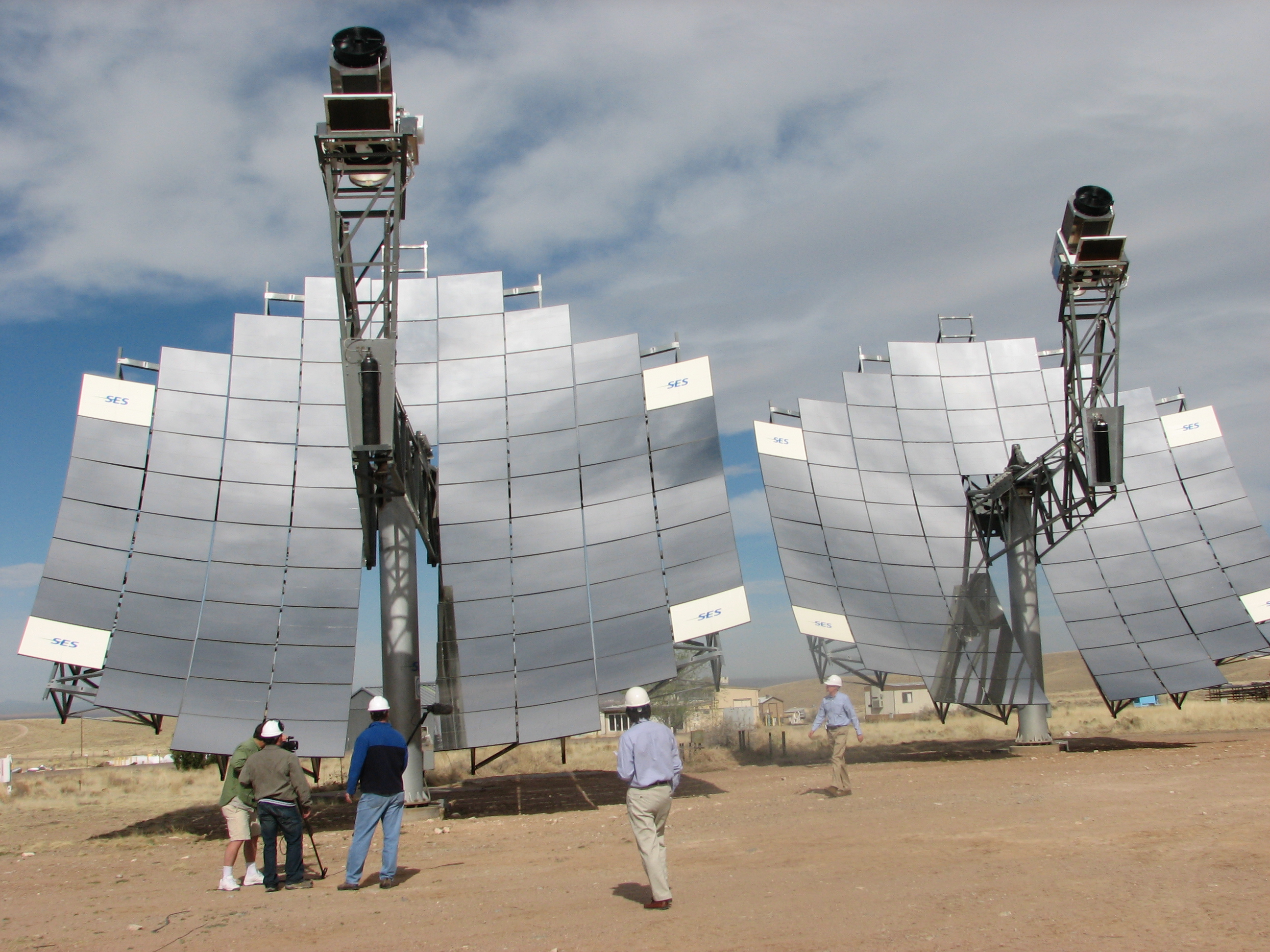
Nearly three years ago, two Southern California utilities caused a stir when they announced deals to buy up to 1.75 gigawatts of electricity from massive solar farms to be built by Stirling Energy Systems of Phoenix. The company had developed a Stirling solar dish – a 38-foot-high, 40-foot-wide mirrored structure that looks like a big shiny satellite receiver. The dish focuses the sun’s rays on a Stirling engine, heating hydrogen gas to drive pistons that generate electricity.

Plans called for as many as 70,000 solar dishes to carpet the desert. For Southern California Edison (EIX) and San Diego Gas & Electric (SRE) – both facing a state mandate to obtain 20 percent of their electricity from renewable sources by 2010 – it was a big gamble. As the years ticked by and Stirling tinkered with its technology, competitors like Ausra, BrightSource Energy and Solel came out of stealth mode and stole the limelight, signing deals with PG&E (PCG) and filing applications with California regulators to build solar power plants. By the time I visited Stirling’s test site in New Mexico in March 2007 for a Business 2.0 feature story, industry insiders were telling me – privately, of course – that Stirling would never make it; Stirling dishes were just too complex and too expensive to compete against more traditional solar technologies.

That may or may not end up being true, but Stirling has moved to silence the naysayers by filing a license application with the California Energy Commission for its first solar power plant – the world’s largest – a 30,000-dish, 750-megawatt project to be built 100 miles east of San Diego on 6,100 acres of federal land controlled by the U.S. Bureau of Land Management. (A energy commission licence application – an extremely detailed and expensive document; Stirling’s runs 2,600 pages – is considered a sign that a project has the wherewithal to move forward.)

The first phase of the SES Solar Two project will consist of 12,000 SunCatcher dishes generating 300 megawatts for San Diego Gas & Electric. While the Stirling solar dish is more complex and contains more moving parts than other solar thermal technologies – which use mirrors to heat liquids to generate steam to drive a standard electricity-generating turbine – or photovoltaic panels like those found on rooftops, it also offers some distinct advantages. For one thing, it’s the most efficient solar thermal technology, converting sunlight into electricity at a 31.25% rate.  Each 25-kilowatt dish is in fact a self-contained mini-power plant that can start generating electricity – and cash – as soon as it is installed. Stirling will build 1.5-megawatt clusters of 60 dishes that will begin paying for themselves as each pod goes online. A conventional solar thermal power plant, of course, must be completely built out – which can take a year or two depending on size – before generating electricity.

The 750-megawatt Stirling project will also use relatively little water – no small matter in the desert – compared to other solar thermal plants. According to Stirling, SES Solar Two will consume 33 acre-feet of water – to wash the dishs’ mirrors – which is equivalent to the annual water use of 33 Southern California households. In contrast, a solar power plant to be built by BrightSource Energy that is nearly half the size is projected to use 100 acre-feet of water annually while a 177-megawatt Ausra plant would use 22 acre-feet, according to the companies’ license applications.

Still, there’s some big hurdles for Stirling to overcome. While it did score a whopping $100 million in funding in April from Irish renewable energy company NTR, the company will need billions in project financing to build Solar Two. And the project’s second 450-megawatt phase is dependent on the utility completing a controversial new transmission line through the desert called the Sunrise Powerlink. Depending on how fast the project is approved, construction is expected to begin in 2009 and last more than three years.

The other big unknown is what environmental opposition may develop. Within 10 miles of the SES Solar Two site are proposals to build solar power plants on an additional 51,457 acres of BLM land. Then there are the wildlife issues. Several California-listed “species of special concern” have been found on the Stirling site, including the burrowing owl, flat-tailed horned lizard and the California horned lark.

Regardless it’s a big step forward for Stirling. As California Governor Arnold Schwarzenegger said in a statement, “This groundbreaking solar energy project is a perfect example of the clean renewable energy California can and will generate to meet our long-term energy and climate change goals.”

Read Full Post »

In a sign that solar industry and its political allies are starting to flex some real power, the federal government reversed course Wednesday and announced it would continue to accept new applications to build solar power plants on government land while developing an environmental policy for assessing the projects.

Green Wombat had been off the grid on holiday the past week and so was surprised to log back on to find the mainstream media and blogosphere ablaze over the Bush administration’s supposed move last month to halt big solar power plant projects in California’s Mojave Desert and elsewhere.

“Citing Need for Assessments, U.S. Freezes Solar Energy Projects,” read the headline on The New York Times story about the Bureau of Land Management’s decision to temporarily stop accepting new applications for solar power plants until it studies the environmental impact of industrializing the desert. “How to strangle an industry,” proclaimed Grist, a respected green policy blog about the move. Solar executives and politicians meanwhile slammed the BLM and predicted dark days for renewable energy. “This could completely stunt the growth of the industry,” the Times quoted Ausra exec Holly Gordon.

Problem is, those stories were dead wrong: The feds did not freeze a single solar power plant project currently under review. What was left unsaid, or just briefly mentioned, was the fact that the BLM is continuing to process the 125 solar power plant proposals already in the hopper. Those lease applications cover nearly a million acres for solar power plants that would produce 60 gigawatts of electricity if all are built, which they won’t be. Those projects alone will keep companies like Ausra, BrightSource Energy, FPL (FPL) and PG&E (PCG) busy for years to come, moratorium or not.

“We don’t even like to call it a moratorium,” says Alan Stein, a deputy district manager for the BLM in California. Stein called me on my mobile just as I was about to step into a kayak at Elkhorn Slough near Big Sur. I had spent several months talking to Stein and other BLM officials while criss-crossing the Mojave with solar energy executives for a forthcoming Fortune story and he seemed taken aback by the tone of the media coverage.

But the higher-ups in Washington got the message. “We heard the concerns expressed during the scoping period about waiting to consider new applications, and we are taking action,” said BLM Director James Caswell in a statement. “By continuing to accept and process new applications for solar energy projects, we will aggressively help meet growing interest in renewable energy sources while ensuring environmental protections.”

The head of the solar industry’s trade group, the Solar Energy Industries Association, declared victory. But SEIA president Rhone Resch complained in a statement that, “BLM has only resolved half the problem. They have yet to approve a single solar energy project. Expediting the permitting process is the next step in developing solar energy projects on federal lands.”

He’s right that the process – which is intertwined with California’s extensive environmental review of projects in that part of the Mojave – takes far too long. But developing a desert-wide environmental policy is absolutely essential for huge power plants that in total would cover hundreds of square miles of a fragile landscape home to protected wildlife and rare plants. Otherwise, watch each individual project get bogged down in endless environmental challenges.

What really threatens the nascent solar industry right now is not the BLM. Rather it’s the imminent expiration of the 30 percent investment tax credit that all these solar energy startups and their investors – which include companies such as Google (GOOG) and Morgan Stanley (MS) – are depending on make Big Solar economically viable. Congress has failed several times in recent months to extend the tax credit, which expires at the end of the year. If only solar energy execs and their supporters in Washington could exert the same influence on recalcitrant Republicans as they have on the BLM.

Read Full Post »

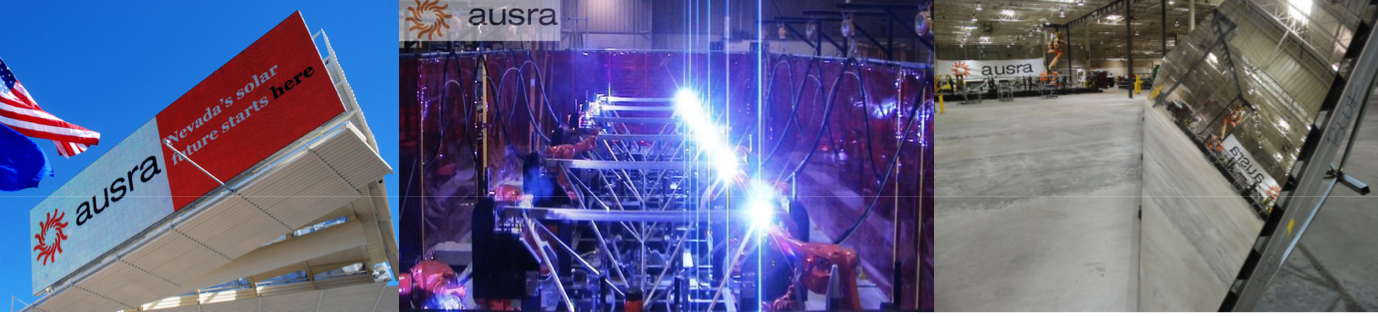
LAS VEGAS – Hard by the Las Vegas airport, the industrial infrastructure of the solar economy is rising in a former furniture factory. Phalanxes of orange robots swivel and dip as they practice assembling components for solar power plants to be built by Silicon Valley startup Ausra.

It’s North America’s first solar power plant factory and it went online Monday when Ausra CEO Robert Fishman and U.S. Senate majority leader Harry Reid, D-Nevada, flipped the switch to start the production line. Ausra’s automated 130,000-square-foot factory is key to the Palo Alto company’s aim of cutting manufacturing costs to make solar energy competitive with fossil fuels.

A large robot picks up 78-square-foot pieces of glass and places them on a conveyor belt so a machine can apply strips of adhesive. Other robots transfer the glass to another line where a dozen bots weld together 53-foot-long steel frames. The completed solar arrays will be trucked to California where Ausra is building a 177-megawatt solar power station for utility PG&E (PCG) on 640 acres of agricultural land in San Luis Obispo County. (To see a video of the robots in action, click here.)

The arrays focus sunlight on water-filled tubes to create steam to drive a turbine. Ausra manufacturing exec David McKay points to where standard-issue boiler pipe will be fed into a machine and treated with a proprietary coating that transforms it into a solar receiver. At peak production the plant will churn out more than 700 megawatts’ worth of equipment year to keep 1,400 solar power plant construction workers employed. “We can produce a lot faster than what we can install,” says McKay.

However, the future of those jobs – and billions in future investments in renewable energy – hangs on whether Congress extends a crucial investment tax credit that the solar industry and utilities are relying on to make large-scale solar power plants competitive with the carbon-spewing variety. The investment tax credit expires at the end of the year and several attempts to pass legislation extending the ITC have failed despite support on both sides of the aisle.

Green Wombat met with the chairman of the Solar Energy Industries Association, Chris O’Brien, last week when he was in San Francisco to get an update on the ITC’s chances. “It’s an election year and it has become part of the political stalemate,” says O’Brien, who heads North America market development and government relations for Swiss-based solar cell equipment maker Oerlikon Solar. “I don’t see an imminent breakthrough.”

The pending demise of the tax credit is “having a significant effect on the development of new business,” according to O’Brien. Solar energy executives, of course, are reluctant to admit that deals are getting dashed, but there’s no doubt the loss of a 30 percent tax credit gives financiers and utilities pause when considering whether to green-light solar power plants that can cost a billion or two to construct.

O’Brien thinks the best-case scenario for the long-term extension of the ITC will come after the presidential election during the lame-duck session of Congress. Otherwise, he says, don’t expect action until around September 2009.

In the meantime, Ausra will keep its robots busy cranking out components for its first California power plant, which is scheduled to start producing green electricity in 2010.

Read Full Post »

In another sign that technological innovation will drive solutions to global warming and the United States’ energy dependence, technology born of Hewlett-Packard’s imaging and printing research will be used to make more efficient and cheaper solar panels. HP is licensing its transparent transistor technology, which will eliminate the need for mechanical trackers to follow the sun, to a Livermore, Calif., startup called Xtreme Energetics

Here’s how it’s supposed to work: XE’s solar panels concentrate sunlight onto highly efficient solar cells that use a fraction of the expensive silicon found in standard solar modules. A layer of HP’s clear transistors will funnel light to the solar cell as the sun moves across the sky.

“Basically, we don’t have any mechanical gears or cogs,” says XE chief executive Colin Williams, a veteran of JPL/Caltech and a former Stanford University professor. “From an outward appearance the panel appears to be fixed, but internally light is being steered to the solar cell through the electronics.”

Doing away with bulky mechanical trackers means that more panels can be packed onto commercial rooftops, allowing energy-hungry facilities like data centers to draw more of their power from the sun. The panels will be transparent and can be colorized to blend in with building facades. Williams says XE will also produce panels for large-scale solar power plants.

That’s the goal, at least. XE, which is currently funded by its founders, is two years away from producing solar panels with HP’s (HPQ) technology and its claim that they will be twice as efficient at half the cost of conventional solar systems has yet to be proven.

For HP, the solar licensing deal is an unanticipated benefit of collaborative research by HP Labs, engineers at its imaging and printing operation in Oregon and researchers at Oregon State University. “They were looking for future ways to display images,” say Joe Beyers, HP’s vice president of intellectual property licensing. “It just turned out that Colin and his team became aware of the work we were doing with Oregon State and started the dialog.”

Beyers says other potential applications for the technology – developed as part of HP’s new approach to commercializing R&D that my colleague Jon Fortt wrote about recently – include video displays for car windshields.

Read Full Post »

eSolar, the solar energy startup founded by Idealab’s Bill Gross and backed by Google, has signed a 20-year contract to supply utility Southern California Edison with 245 megawatts of green electricity.

The solar power plant will be built in 35-megawatt modules, with the first phase set to go online in 2011. As Green Wombat reported in April, eSolar scored $130 million in funding from Google.org, Google’s (GOOG) philanthropic arm, and other investors to develop solar thermal technology that Gross claims will produce electricity as cheaply as coal-fired power plants.

Like Ausra and BrightSource Energy – which have deals with PG&E (PCG) – eSolar will use fields of mirrors to heat water to create steam that drives electricity-generating turbines. Gross says that eSolar’s software allows the company to individually control smaller sun-tracking mirrors – called heliostats – which can be cheaply manufactured and which are more efficient and take up less land than conventional mirrors. According to Gross, that means eSolar can build modular power plants near urban areas and transmission lines rather than out in the desert, lowering costs.

eSolar’s cost claims got Southern California Edison’s (EIX) attention. “It was a competitively priced proposal,” Stuart Hemphill, the utility’s VP for renewable and alternative power, told Fortune. “We found the eSolar team very competent, motivated and willing to do a deal.”

“When it comes down to different solar technologies, competitive pricing is going to be an important part of the equation,” he adds. “They do offer a unique solution.”

eSolar is keeping mum about the exact location of the power plant, only saying it will be in the Antelope Valley region of Southern California.

One potential hitch: Getting eSolar’s electricity to Southern California Edison will depend on the construction of a major new transmission line. That line, the Tehachapi Renewable Transmission Project, has been partially approved to date.

With the eSolar deal, the utility is hedging its bets. Back in 2005, Southern California Edison signed a highly publicized deal with Phoenix’s Stirling Energy Systems to buy up to 850 megawatts of solar electricity from massive solar power plants to be built in the Mojave Desert. (Around the same time, San Diego Gas & Electric (SRE) signed a power purchase agreement with Stirling for up to 900 megawatts. ) Stirling is still perfecting its technology and has yet to file a license application for its first plant. But the company received a $100 million investment earlier this year and Hemphill says Stirling is moving forward.

“We expect that Stirling will meet its contractural obligations,” he says. “Solar thermal is definitely an emerging industry. It’s too early to tell which technologies will be the winners over the long run. It’s a time to be having a portfolio of different technologies so we can figure that out.”

Read Full Post »

« Newer Posts - Older Posts »

Design a site like this with WordPress.com
Get started