Feeds:
Posts
Comments

Archive for the ‘solar energy’ Category

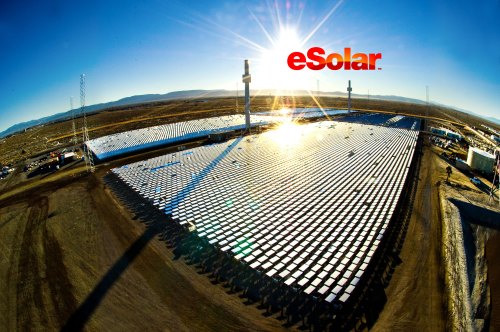
esolar-field_wide_2b
photo: eSolar

SAN FRANCISCO — “It’s all about the software,” says eSolar CEO Bill Gross.

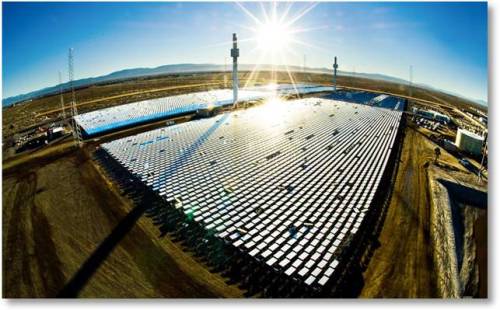
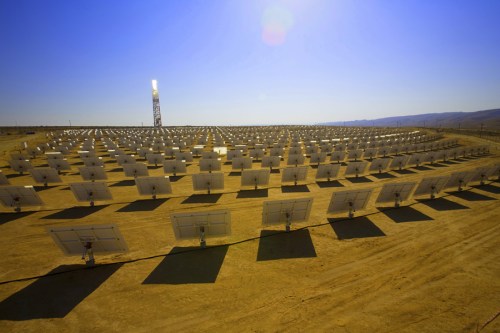
The tech entrepreneur and founder of startup incubator Idealab is explaining how eSolar’s solar power plants can produce carbon-free electricity cheaper than planet-warming natural gas. At the Cleantech Forum in San Francisco, Gross flashes a photo of eSolar’s demonstration solar farm outside the Southern California town of Lancaster, where 24,000 mirrors called heliostats surround two 150-foot towers.  The heliostats concentrate sunlight on a tower containing water-filled boilers and the resulting heat creates steam that drives an electricity-generating turbine. Rivals like BrightSource Energy use similar “power tower” technology but according to Gross, eSolar’s mirror-controlling software and modular plant design will allow it to produce cheaper solar electricity.

For instance, Gross says competitors use large, slightly curved mirrors to focus sunlight. That require big and expensive steel frames to hold the glass in place.  eSolar’s solution: make small flat mirrors the size of an LCD television screen that clamp on to a  5 x 12-inch frame and then use software and Big Iron computing to position the mirrors to create a parabola out of the entire heliostat field.

“We use Moore’s law rather than more steel,” quipped Gross, referring to Intel co-founder Gordon Moore’s maxim that computing power doubles every two years.

The heliostats roll off an assembly line in China with the wiring and sun-tracking motors built in. “The only tool required to install mirrors in the field is a hand wrench,” Gross says. “There’s  no welding in field, you just install the mirrors on the base. We’ve taken all the labor in the field and moved it to an automated factory.”

The heliostats also do not have to be precisely placed in the solar field, which saves time. “The rows can be wavy as the software will correct for it,” Gross notes. “We don’t need to do extensive surveys to design the field; we just need to leave enough space between mirrors.”

The bottom line: The five-megawatt Palmdale project was built in less than six months. “We think we can finish plants before other people start,” Gross told Green Wombat.

Gross says eSolar has also signed a 92-megawatt deal with a New Mexico utility, which he declined to identify until the agreement is announced. He said his Pasadena, Calif.-based company will also soon unveil a contract to build 500 megawatt’s worth of solar farms in Asia. So far, eSolar has spent $30 million acquiring land – mainly privately owned agricultural property – for solar power plants, according to Gross. He told Cleantech Forum participants that eSolar expects internal rates of return for its partners of between 11% and 14% for U.S. power plants and returns of 20% to 30% for overseas projects.

Also saving time and money are the power towers, which are made from two sections of a windmill tower. At 150 feet they’re half the size of competitors’ towers – again, less steel is needed. The lower height and the software systems that allow more mirrors to be crammed into smaller spaces means that eSolar’s power plants can be placed closer to urban areas where transmission lines are available.

Also unique is the boiler that sits atop the tower. Gross gave Green Wombat a close-up look the proprietary technology. About the size of a cargo shipping container, the “cavity receiver” has openings on either side. The heliostats focus sunlight into the interior of the boiler, which is lined with water-filled pipes.

“The benefit is that the light comes in and even if some light is reflected it can have multiple bounces and still hit the pipes,” Gross says. “We can get all the light inside the cavity all because of the software that controls the mirrors.”

Whether Google (GOOG)-backed eSolar’s plants produce electricity at the low rates Gross is claiming won’t be known until they start coming online. But utilities are betting that this solar software works. Southern California Edision (EIX) last year signed a 20-year-contract with eSolar for 245 megawatts of electricity while coal-dependent NRG Energy (NRG) this week agreed to invest $10 million in eSolar in exchange for the right to develop up to 500 megawatts using the company’s technology. (Southern California Edison is betting even bigger on BrightSource Energy’s power tower technology – two weeks ago the utility signed a 1,300 megawatt power purchase agreement with the Oakland startup – also backed by Google – the world’s largest solar deal to date.)

Read Full Post »

optisolar-panels
photo: Optisolar

SAN FRANCISCO — With the financial crisis dimming solar’s prospects to become a significant source of renewable energy, utility giant PG&E on Tuesday said it will spend $1.4 billion over five years to install 250 megawatts’ worth of photovoltaic panels in California while contracting with private developers for another 250 megawatts. PG&E chief executive Peter Darbee said the utility is also prepared to be a “green knight,” rescuing distressed big centralized solar power plant projects by providing financing so they can get built.

“We have contracted for 24% of our energy to be renewable and we’re concerned whether our [developers] will have access to capital,” Darbee said at PG&E’s San Francisco headquarters during a press conference. “We think financing for these projects may be in jeopardy. PG&E is well-positioned with its $35 billion balance sheet to step up and help.”

PG&E’s (PCG) move to take a direct role in obtaining the renewable energy it needs to comply with California’s global warming laws could be big business for solar module panel makers and installers like SunPower (SPWRA), Suntech (STP) and First Solar (FSLR). The action was prompted in part by a change in the tax laws that lets utilities claim a 30% investment tax credit for solar projects.

Fong Wan, PG&E’s vice president for energy procurement, said most of the 500 megawatts of solar panels will be installed on the ground in arrays of between one and 20 megawatts at utility substations or on other PG&E-owned property. (The utility is one of California’s largest landowners.) A small portion may be installed on rooftops, he said.

PG&E said the solar initiative will generate enough electricity to power 150,000 homes and will provide 1.3% of the utility’s electricity supply.

“There’s no or little need for new transmission and these projects can plug directly into the grid,” said Darbee. “Given our size and our credit ratings and our strength, we can move forward where smaller developers may not be able to do so.”

The California Public Utilities Commission must approve PG&E’s solar initiative, which Wan estimated would add about 32 cents to the average monthly utility bill.  An $875 million program unveiled by Southern California Edison (EIX) last year to install 250 megawatts of utility-owned rooftop solar panels has run into opposition from solar companies that argue it is  anti-competitive and from consumer advocates who contend the price is too high. The state’s third big utility, San Diego Gas & Electric (SRE), has also proposed a rooftop solar program.

Wan acknowledged that objections to Edison led PG&E to design its program so that private developers would have a 50% stake in the initiative. PG&E will sign 20-year power purchase agreements for privately owned solar installations.

PG&E will also need regulators’ approval to inject equity financing into companies developing big solar power plants. The utility has signed power purchase agreements for up to 2,400 megawatts of electricity to be produced by solar thermal  and photovoltaic power plants to be built by companies like Ausra, BrightSource Energy, OptiSolar and SunPower.

“We are looking at the least risky and most developed opportunities to see where we can be the most helpful,” Darbee said.

Read Full Post »

image001

photo: eSolar

NRG Energy, one of the United States’ most coal-dependent utilities, on Monday signed a deal with California startup eSolar to develop solar power plants.

The agreement calls for NRG  to invest $10 million in Pasadena-based eSolar for the right to use the startup’s technology to develop and operate three solar power projects in California and the Southwest that would generate 500 megawatts of greenhouse gas-free electricity.  NRG ranks as one of the nation’s dirtiest utilities,  spewing 70 million tons of carbon dioxide annually from its coal-fired power plants, according to a 2007 Fortune Magazine story.  But the Princeton, N.J.-based Fortune 500 company has sought to clean up its ways under CEO David Crane, pursuing carbon-capture technology and moving to build nuclear power plants.

Last year eSolar, founded by Idealab’s Bill Gross and backed by Google, won a 20-year contract to supply utility Southern California Edison (EIX) with 245 megawatts of green electricity annually. Last  April, eSolar scored $130 million in funding from Google.org, Google’s (GOOG) philanthropic arm, and other investors to develop solar thermal technology that Gross claims will produce electricity as cheaply as coal-fired power plants.

Like rivals Ausra and BrightSource Energy – which have deals with utility PG&E (PCG) – eSolar will use fields of mirrors to heat water to create steam that drives electricity-generating turbines. Gross says that eSolar’s software allows the company to individually control smaller sun-tracking mirrors – called heliostats – which can be cheaply manufactured and which are more efficient and take up less land than conventional mirrors. According to Gross, that means eSolar can build modular power plants near urban areas and transmission lines rather than out in the desert, lowering costs.

In October, eSolar’s then-CEO told Green Wombat that the company was more interested in being a solar technology provider than a power plant construction company.

The eSolar deal gives NRG (NRG), which operates coal-fired power plants in Texas and the Northeast, a foothold in the California renewable energy market. The first solar farm will go online in 2011 and NRG will have the right to develop 11 of eSolar’s 46-megawatt modular power plants. eSolar currently is building a five-megawatt demonstration power plant in Lancaster, Calif., that is expected to be completed this year.

“By coupling NRG’s construction capabilities and regional operating expertise with eSolar’s innovative … technology, we can advance NRG’s renewable energy portfolio while helping to accelerate development of these important projects on a commercial scale,” said NRG executive Michael Liebelson in a statement.

During a press conference Monday, Liebelson said NRG would be able to take advantage of the 30% investment tax credit for renewable energy projects and intends to apply for federal loan guarantees for such power plants that were included in the recently enacted stimulus package.

The deal, coming less than two weeks after BrightSource Energy signed a 1,300-megawatt power purchase agreement with Southern California Edison, shows that despite the financial crisis the market for renewable energy is showing renewed signs of life.

Read Full Post »

cpuc-rps-report

California quadrupled the amount of renewable energy it installed in 2008 over the previous year, according to a report released Wednesday by the state’s Public Utilities Commission.

The 500 megawatts of green electricity brought online last year represents 60% of all renewable energy generation built since 2002, when California mandated that the state’s investor-owned utilities obtain 20% of their power from renewable sources by 2010. In November, Governor Arnold Schwarzenegger signed an executive order raising the Renewable Portfolio Standard, or RPS, to 33% by 2020.

“Clearly, 2008 was a turning point for the RPS program and contracted projects are beginning to deliver in large numbers,” the California Public Utilities Commission report stated.

The CPUC in 2008 approved projects that would generate 2,812 megawatts of renewable energy for California’s Big Three utilities – PG&E (PCG), Southern California Edison (EIX) and San Diego Gas & Electric (SRE). Impressive numbers but the utilities have acknowledged they are unlikely to meet their renewable energy targets by the 2010 deadline because it takes years to get solar and wind projects online and some will inevitably fail. For instance, the financial crisis has raised questions about just how many of the Big Solar power plants the utilities are relying on will actually get built, though the $787 billion stimulus packaged signed into law Tuesday by President Barack Obama has brightened the solar industry’s prospects.

California increasingly is depending on solar energy to meet its commitments to reduce greenhouse gas emissions under the state’s landmark 2006 global warming law. According to regulators, utilities received 30% more bids for solar power projects in 2008 than in the previous year while wind farm proposals dropped by half and “very few” geothermal tenders were filed.

The fact that utilities received 24,000 megawatts’ worth of renewable energy bids last year (more than enough, if built, to meet the 33% renewable energy target) speaks to the frothy state of the market. But before solar power plants and other green energy projects can go online they face years-long and often contentious environmental reviews, while a lack of transmission lines to bring all this electricity from the desert to coastal cities remains the green elephant in the room.

Meanwhile, regulators are reviewing a policy change that would seem to undercut the state’s goal of encouraging utilities to generate more renewable energy. On March 12 Feb. 20,the California Public Utilities Commission will consider whether to allow utilities to buy so-called tradable renewable energy credits, or TRECs, from other entities  to meet their green electricity mandates. Such credits are associated with the electricity generated by wind farms, solar power plants and other projects and can be bought and sold. In other words, if a utility finds itself falling short of its renewable energy goals – or just doesn’t want to spend the money procuring green power – it could buy TRECs on the open market.

Green Wombat is awaiting a reply from the utilities commission on whether California utilities could purchase TRECs generated by out-of-state projects – which, of course, would do nothing to reduce the state’s own greenhouse gas emissions.  UPDATE: CPUC spokeswoman Terrie Prosper says that utilities will be able to buy out-of-state TRECs as long as they meet California’s eligibility requirements.

Read Full Post »

topaz-solar-farm-app

In the green stimulus sweepstakes, big potential winners are companies like Silicon Valley startup OptiSolar.

The solar-cell maker came out of nowhere last year to score a deal with utility PG&E to build the world’s largest photovolaic power plant, a 550-megawatt monster that would cover some 9 1/2 square miles on California’s central coast. OptiSolar subsequently began construction of a factory in Sacramento to produce the thousands of thin-film solar panels needed for the project. Then the economy tanked and as financing dried up, OptiSolar laid off half its workforce – some 300 employees – and halted construction of the Sacramento facility.

With a Colorado solar company executive joining President Barack Obama as he signed the $787 billion stimulus legislation into law Tuesday at a solar-powered museum in Denver, OptiSolar and other renewable energy companies stalled by the financial crisis may see their fortunes revive. The package allows builders of big renewable energy projects to apply for a government cash grant to cover 30% of construction costs in lieu of claiming a 30% investment tax credit. A dearth of investors who finance solar power plants and wind farms in exchange for the tax credits has put in jeopardy green energy projects planned for the desert Southwest and the Great Plains. The cash grant would shave about $300 million off the projected $1 billion price tag for OptiSolar’s Topaz Solar Farm.

The stimulus package also includes $2.3 billion to fund a 30% manufacturing tax credit for equipment used to make components for green energy projects, a provision OptiSolar can tap to help finance its solar cell factories. And the company may be able to take advantage of the legislation’s government loan guarantees for large renewable energy projects.

“It will lower the cost of the factory we’re building in Sacramento and make it easier to attract financing,” OptiSolar spokesman Alan Bernheimer told Green Wombat, noting the company’s priority is to complete the facility and begin production of solar panels. “The factory is more than shovel ready – our shovels are hanging on the wall where we put them when we had stop work in November.” (OptiSolar currently manufactures solar modules at its Hayward, Calif., plant.)

Fred Morse, senior adviser to Spanish solar energy giant Abengoa, says the stimulus package puts back on track a $1 billion, 280-megawatt solar thermal power plant the company will build outside Phoenix to produce electricity for utility Arizona Public Service. “With the stimulus bill we’re very confident we’ll be able to finance the project,” says Morse. He says Abengoa expects to use the government loan guarantees to obtain debt financing to fund construction of the project and then apply for the 30% cash refund. “I think the entire industry is very optimistic that these two aspects of the stimulus package, the grants and the temporary loan guarantees, should allow a lot of projects to be built.”

Mark McLanahan, senior vice president of corporate development for MMA Renewable Ventures, agrees. “I expect the government grants to attract new investors,” says McLanahan, whose San Francisco firm finances and owns commercial and utility-scale solar projects.

There are some strings attached, though.

To qualify for the cash grants, developers need to start shoveling dirt by Dec. 31, 2010. That means only a handful of big solar thermal power plants planned for California, for instance, are likely to make it through a complicated two-year licensing process in time to break ground by the deadline. One of those could be the first phase of BrightSource Energy’s 400-megawatt Ivanpah power plant on the California-Nevada border. But BrightSource’s biggest projects, part of a 1,300 megawatt deal signed with Southern California Edison (EIX) last week, won’t start coming online until 2013 at the earliest.

Another Big Solar project, Stirling Energy Systems’ 750-megawatt solar dish farm for San Diego Gas & Electric (SRE), will be racing to meet the 2010 deadline. The project is in the middle of a long environmental review by the California Energy Commission and the U.S. Bureau of Land Management which currently is scheduled to stretch into 2010.

SolarReserve CEO Terry Murphy says his Santa Monica-based startup has a couple of solar power plant projects in the works that should be able to take advantage of the stimulus provisions. “The likelihood of us being able to close on a financial deal has increased,” Murphy says.

Solar analyst Nathan Bullard of research firm New Energy Finance expects the stimulus package to prompt a push for large photovoltaic power projects. That’s because in California such solar farms – which essentially take rooftop solar panels and mount them in huge arrays on the ground – do not need approval from the California Energy Commission and can be built relatively quickly.

That’s good news for companies like thin-film solar cell maker First Solar (FSLR), which builds smaller scale photovoltaic power plants, and SunPower (SPWRA), which has a long-term contract with PG&E (PCG) for the electricity generated from a planned 250-megawatt PV solar farm to be built near OptiSolar’s project.

“It’s great for PV because you can definitely can get construction done by the end of 2010,” says Bullard. “It’s also good news for smaller and mid-sized developers who couldn’t access tax-equity financing.”

The catch, however, is that renewable energy companies still must raise money from investors in a credit-crunched market to cover construction costs, as the government doesn’t pay out the cash until 60 days after a solar power plant or wind farm goes online. And as McLanahan points out, the cost of raising capital from private equity investors is typically higher and will add to the cost of renewable energy projects. Those costs will only rise if the government is late in paying out refunds.

MMA Renewable finances large commercial arrays and solar power plants and then sells the electricity under long-term contracts to customers who host the solar systems. The loan guarantee provision of the stimulus legislation will help secure financing from investors skittish that some of MMA Renewable’s customers may default on their agreements, according to McLanahan.

Says Murphy: “The fact that we’re getting iron into the ground and getting things moving helps us.”

The wind industry also stands to gain from the stimulus package through a three-year extension of the production tax credit for generating renewable electricity as well as the government cash grants and manufacturing tax credit. Despite a record year for wind farm construction in 2008, projects have come to a standstill in recent months as the financial crisis froze development and forced the European-dominated industry to lay off workers.

“I think it’s good down payment on what needs to happen,” says Doug Pertz, CEO of Clipper Windpower, one of two U.S. wind turbine makers. “A lot more needs to be done but I think this will start to bring a lot of people back into the marketplace.”

Read Full Post »

freescale-pwr-conversion_lr1

photo: Freescale

Freescale Semiconductor on Monday is unveiling a new power conversion technology that the chipmaker says will dramatically enhance the efficiency of solar cells and other devices by allowing them to operate at low voltages.

That means a single solar cell attached to a mobile phone or other handheld device could charge the gadget. The bigger potential is to maximize the electricity generated from rooftop solar panels. which typically contain a dozen or more solar cells each. When a cloud or a tree shades part of a solar panel, power output from all the solar cells drops because they are linked together. By integrating Freescale’s power convertersamsung-blue-earth1 into each solar cell, those that aren’t shaded can still produce electricity, according to Arman Naghavi, general manager of Freesale’s Analog, Mixed-Signal & Power Division.
That’s because each solar cell can operate at much lower voltages when Freescale’s (FSL) converter is used. While most electronics need a jolt of 700 millivolts to begin working, Freescale’s technology allows them to operate on as little as 320 millivolts. (See video below.)

Sounds geeky but the consequences could be far-ranging, reducing electricity consumption and opening the door to a new generation of solar-powered devices.  One big hurdle to using solar cells to power everything from laptops to street lights is that it takes too many of them to produce enough power to be practicable. After all, who’s going to carry around a solar panel to charge their MacBook.

Freescale’s technology could change that equation. “For instance, you wouldn’t have to put a battery in a garage door opener – just add a solar strip on the remote control,” Kevin Parmenter, a Freescale applications engineering manager, told Green Wombat. (Samsung last week announced it would start selling a mobile phone (photo above) equipped with a solar panel but it’s unclear just how much talk or texting time it would allow.)

Other uses are more sci-fi: self-powered nanosensors that tap the technology to harvest ambient heat or friction in the environment.

The converter will hit the market in the second half of 2009. Potential customers include solar cell makers like SunPower (SPWRA) and Suntech (STP) as well as biomedical companies and defense contractors. Freescale, headquartered in Austin, Texas, was spun out of Motorola (MOT) in 2004.

“It really helps the entire green movement,” says Naghavi. “We are seeing a tremendous interest from lots of areas historically we have never touched or played in.”


Read Full Post »

solara
Images: BrightSource Energy

A ray of sunshine amid the economic gloom: While some solar companies struggle through the downturn, BrightSource Energy on Wednesday morning announced the world’s largest solar energy deal to date – a 20-year contract to supply utility Southern California Edison with 1,300 megawatts of greenhouse gas-free electricity.

That’s more than twice the size of the previous world’s-biggest-solar-deal, a 553-megawatt power purchase agreement in 2007 between California utility PG&E and Israel’s Solel. BrightSource itself last year inked a deal to provide PG&E (PCG) with 500-megawatts of solar electricity with an option for 400 megawatts more.

“This proves the energy industry is recognizing the role solar thermal will play as we de-carbonize our energy supply,”  BrightSource CEO John Woolard said Wednesday at a press conference.  “We believe now more than ever the time is right for large-scale solar thermal.”

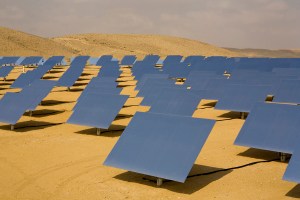
solarhOakland-based BrightSource will build seven solar power plants for Southern California Edison (EIX) using its “power tower” technology. Thousands of sun-tracking mirrors called heliostats focus the sun’s rays on a water-filled boiler that sits atop a tower. The intense heat creates steam which drives a turbine to generate electricity. BrightSource has built a prototype power plant in Israel.
BrightSource has raised more than $160 million from a blue-chip group of investors that includes Google (GOOG), Morgan Stanley (MS) and VantagePoint Venture Partners as well as a clutch of oil giants – Chevron (CVX), BP (BP) and Norway’s StatoilHydro.

If all the solar power plants are built, BrightSource’s deal with Southern California Edison will generate enough electricity to power about 845,000 homes. The agreement is a vote of confidence in the solar industry at a time when the financial crisis has forced BrightSource rivals like OptiSolar to lay off workers while Ausra retools its strategy to focus on supplying solar thermal technology to power plant developers rather than building projects itself.

Given the economic collapse, why are these massive megawatt deals still being done? First, California utilities are under tight deadlines to ratchet up the amount of electricity they obtain from renewable sources – 20% by the end of 2010 and 33% by 2020. Second, it costs nothing to sign a contract – no money has yet changed hands, and won’t unless the plants are built and begin producing electricity.

In fact, not a kilowatt of juice has been generated from the more than 5,000 megawatts of Big Solar contracts signed over the past four years by California’s three investor owned utilities (the third being San Diego Gas & Electric (SRE) ).  Still, a long-term utility contract is key for a startup like BrightSource to obtain the billions in financing required to build large-scale solar power plants. The terms of utility contracts – such as the cost of the solar electricity produced – are closely held secrets but are worth billions, if a 2008 power purchase agreement between Spanish solar company Abengoa and utility Arizona Public Service is any guide.

A significant hurdle for BrightSource – and many other solar developers – is the expansion of the transmission grid to connect remote power plants to cities. BrightSource spokesman Keely Wachs says the company has 4,200 megawatts of solar power plant projects under development.

The Southern California Edison deal is something of a homecoming for American-Israeli solar pioneer Arnold Goldman, BrightSource’s founder and chairman. In the 1980s, during the first solar boom, his Luz International built nine solar power plants in the Mojave. Those plants, most are now operated by FPL (FPL), continue to provide electricity to Edison.

The first BrightSource solar farm for Edison is expected to go online in early 2013. It’s a 100 megawatt power plant part of BrightSource’s Ivanpah complex to be built on federal land on the California-Nevada border in the Mojave Desert. That plant is currently wending its way through a complex state and federal licensing process.

Just how complex was illustrated by a meeting Green Wombat attended Tuesday in Sacramento, where a roomful of state and federal officials spent hours discussing the environmental impact of a 750-megawatt solar power plant to be built by Phoenix’s Stirling Energy Systems for San Diego Gas & Electric that would plant 30,000 solar dishes in the desert. A second Stirling solar farm will be built for Southern California Edision. When the deals were announced in 2005, they were the world’s largest at the time.

PG&E chief executive Peter Darbee recently said his utility will begin directly investing in solar power projects. On Wednesday, Southern California Edison renewable energy executive Stuart Hemphill said Edison would consider requests from solar power developers to take ownership stakes in their projects but prefers to sign power purchase agreements.

“We do see solar as the large untapped resource, particularly in Southern California,” said Hemphill.

Read Full Post »

sunrise_powerlink_031506

Over the weekend The New York Times’ Matthew L. Wald had a sobering story on the not-inconsiderable challenges facing efforts to expand and upgrade the United States’ power grid to tap renewable energy from wind farms and solar power plants. Among them: Opposition to new high-voltage power lines from landowners and environmentalists, a Byzantine permitting process and fights over who pays the costs of transmission projects that span state lines.

Here in California, the ongoing controversy over the Sunrise Powerlink project is a case study in just how difficult it will be to build the infrastructure to transmit electricity from dozens of solar power plants planned for the Mojave Desert. Among the big companies looking to cash in on the solar land rush: Goldman Sachs (GS), Chevron (CVX) and FPL (FPL)

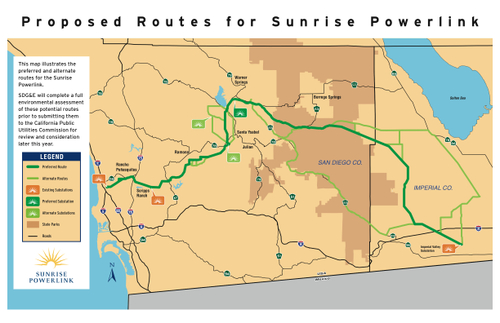
Utility San Diego Gas & Electric first proposed the $1.3 billion, 150-mile Sunrise Powerlink in 2005 to connect the coastal metropolis with remote solar power stations and wind farms in eastern San Diego County and the Imperial Valley. For instance, SDG&E’s contract to buy up to 900 megawatts of solar electricity from massive solar farms to be built by Stirling Energy Systems is dependent on the construction of the Sunrise Powerlink. Like California’s other big investor-owned utilities – PG&E (PCG) and Southern California Edison (EIX) – SDG&E, a unit of energy giant Sempra (SRE), is racing the clock to meet a state mandate to obtain 20% of its electricity from renewable sources by 2010 and 33% by 2020.

But Sunrise sparked opposition from the get-go as the utility proposed routing part of the transmission project through a pristine wilderness area of the Anza-Borrego Desert State Park.  The prospect of 150-foot-tall transmission towers marching through critical habitat for desert tortoises and other protected wildlife galvanized environmentalists well-versed in the arcane arts of regulatory warfare.

Opponents also painted the project as a Trojan horse to bring in cheap coal-fired power from Mexico. (Wald makes a similar point in his Times‘ piece – the same high-voltage lines designed to transmit green electricity from wind farms can also be used to send cheap carbon-intensive coal-fired electricity across the country.) That argument subsequently lost currency when regulators, citing California’s landmark global warming law, barred utilities from signing long-term contracts for out-of-state coal power.

After more than three years of hearings and procedural skirmishes culminating in an 11,000-page environmental impact report, a PUC administrative law judge last October issued a 265-page decision all but killing the project on environmental grounds. Whether SDG&E thought that green energy and climate change concerns would trump worries over wildlife and wilderness, it was clear that trying to build an industrial project through a state park was a costly mistake.

Then in December, after California Governor Arnold Schwarzenegger signed an executive order to streamline and prioritize the licensing of renewable energy projects, the utilities commission’s board revived Sunrise Powerlink, approving a different route for the transmission lines that avoids Anza-Borrego.

But the fight is far from over. With the cost of the project now approaching $2 billion, late last month the Center for Biological Diversity, a Tucson, Ariz.-based environmental group, filed a suit in the California Supreme Court challenging the utilties commission’s approval of Sunrise Powerlink.

Safe to say, the battle will drag on for some time to come, giving new meaning to the term “stranded assets” for some would-be Big Solar developers.

Read Full Post »

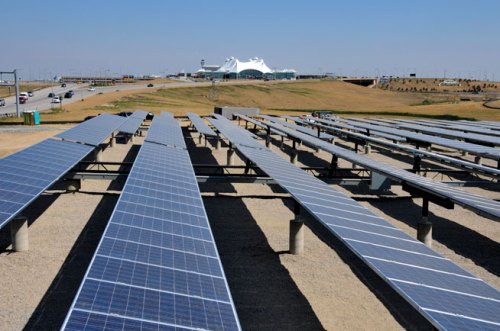
denverairport-110

photo: WorldWater & Solar Technologies

As the financial crisis short-circuits the ambitions of green tech companies, solar financier MMA Renewable Ventures is pushing ahead with raising its fifth fund. Meanwhile, its solar power plant joint venture with Chinese solar cell maker Suntech – Gemini Solar Development – has been selected by utility Austin Energy to build a 30-megawatt solar farm in Texas.

The San Francisco-based firm just completed its $200 million Solar Fund III, which invested in 20.6 megawatts of photovoltaic solar arrays for companies like Macy’s, the Gap, Lowe’s and utility FPL (FPL) as well as the Denver International Airport. MMA Renewable (MMAB.PK) provides the financing for the installation of large commercial solar arrays on big box stores and other locations while retaining ownership of the systems. The electricity produced is sold to the building owner under a long-term contract.

“The good news is that we can raise another fund in a tough market,” MMA Renewable Ventures CEO Matt Cheney told Green Wombat, adding that the company aims to raise $200 million or more for Solar Fund V.

That doesn’t mean it’ll be easy. Many of the Wall Street banks that invested in big solar systems are no more and demand for the tax credits generated by the projects has fallen faster than the Dow Jones as most companies aren’t piling up much tax liability these days.

“The ones that are left are being very picky and asking a lot,” says Cheney, adding that banks and other investors are demanding higher returns on their investments. Still, he notes, past MMA Renewable investors like Wells Fargo (WFC) remain relatively healthy. “If you look at every country in Europe and the U.S., there are good examples of financing institutions that were less impacted by the financial crisis, which is a deep one,” he says.

One possible source of new tax-equity investment may come from well-capitalized utilities that, thanks to a change to the tax laws Congress made last October, can now claim tax credits for solar projects. PG&E (PCG) CEO Peter Darbee, for instance, has said his utility plans to invest in solar power plants.

A new and potentially bigger worry is whether MMA Renewable customers – big box retailers and the like – will be survive the financial crisis. MMA Renewable’s business is built on long-term power purchase contracts – as long as 20 years – that provide a predictable and steady revenue stream to investors.

“Would you buy a corporate bond from a large U.S. company that went out 20 years today?” Cheney asks. “You would most likely tell me that’s a long time. You don’t know if you want to take that risk beyond five or ten years. That’s the equation that’s present in the marketplace today.”

In California, at least, demand for solar has remained strong: This week state regulators reported that installed solar systems more than doubled in 2008 from the previous year.

One bright spot may be the market for smaller-scale photovoltaic power plants and MMA Renewable’s Gemini joint venture with Suntech (STP).  The Austin Energy project still must be approved by the city of Austin, but Cheney says Gemini is in the midst of negotiations with other utilities as well.

When SunPower (SPWRA) reported record fourth-quarter earnings Thursday, CEO Tom Werner said the Silicon Valley solar cell maker was shifting resources to its power plant building business in 2009 and had 1,000 megawatts of projects on the drawing boards.

There was just one catch:  money. “We have a strong pipeline of projects fully permitted, or with permits in process, that will be buildable,” Werner said, ” when financing becomes available.”

Read Full Post »

csi-report

The other day I ran into Danny Kennedy, president of solar installation company Sungevity, on the playground as we were picking up our kids at Malcolm X Elementary (we live in Berkeley). I had spent the week chronicling layoffs at various solar and wind companies so it was with a bit of trepidation that Green Wombat asked Danny how business was going at at Sungevity.  “Great,” he replied as I quizzed him about the impact of the recession. “We’re as busy as ever.”

Apparently so. A report released Wednesday by the California Public Utilities Commission shows that residential and commercial rooftop solar installations in the Golden State more than doubled in 2008 from the previous year to 158 megawatts. What’s more, a record-breaking number of applications to participate in California’s $3 billion solar rebate program were filed in December as the drumbeat of bad economic news grew deafening and the state’s unemployment rate hit 9%.

Are Californians being crazily contrarian? While one would think that a $30,000 solar array would be one of those luxuries most people would put on the back burner in bad times, there are some solid economic reasons for the surge. First, rebates for solar systems under the California Solar Initiative get less lucrative in 2009 as incentives fall as the amount of installed solar rises.  Then in October Congress lifted the $2,000 cap on the federal tax credit on solar arrays, allowing homeowners and businesses to take a 30% tax credit on systems installed after Dec. 31.  Add in the state rebate and the cost of a solar system in California suddenly fell by half.

“The surge in applications occurring in the fourth quarter of 2008 is particularly noteworthy given the slowdown in the economy that occurred during the same time period,” the report’s authors noted. “In addition to environmental benefits such as cutting greenhouse gas emissions and other pollutants, it appears that solar energy is benefiting California by serving as an economic bright spot in the economy.”

And therein lies some lessons as the U.S. Congress debates how to promote green jobs. Two years into the California Solar Initiative, the taxpayers’ investment of $775 million in solar rebates has yielded $5 billion in private investment in solar projects and rapidly expanded the state’s renewable energy industry, according to the report. That’s helped create strong solar companies like solar cell maker SunPower (SPWRA) and markets for thin-film solar companies such as First Solar (FSLR). The decade-long program is on track to achieve its target of 3,000 megawatts of rooftop solar and in the first two years of the program more solar has been installed in California than in the previous 25 years.

While California regulators expect the pace to continue in 2009, the big unknown is how many homeowners and business owners will drop out of the program and cancel their applications if the economy continues to deteriorate rapidly this year. The current dropout rate is 15%, according to the report.

“We are hopeful that many of those pending projects will move forward,” Molly Tirpak Sterkel, who oversees the California Solar Initiative for the utilities commission, told Green Wombat. “We’re also cognizant of the economy and economic forces that may pose a threat to those installations.”

Demand for solar is far stronger in Northern California than in sunny SoCal. Northern California utility PG&E’s (PCG) customers have installed more than twice the megawatts of solar than Southern California Edison (EIX) customers. And the report notes that while applications for commercial arrays in PG&E’s territory rose 71% between April and December 2008, they fell 23% in Southern California Edison’s area. San Diego Gas & Electric (SRE), which covers a much smaller service area, saw applications triple for residential solar arrays.

Sterkel says it is unclear why Northern Californians are going solar at a much faster rate than their southern counterpart, but it may be due to differences in electricity pricing and more mature solar markets in regions like the San Francisco Bay Area. “There’s just that many more solar companies with experience, installations and sales channels, ” she says.

Solar panels seem to be sprouting from Bay Area rooftops like California poppies after a late winter rain. In Berkeley, the city has launched a program that pays for residential and business solar arrays upfront and let owners pay the cost back over 20 years through an annual assessment on their property taxes.

Which also may explain why I seem to be seeing more of those Sungevity signs around town.

Read Full Post »

« Newer Posts - Older Posts »

Design a site like this with WordPress.com
Get started