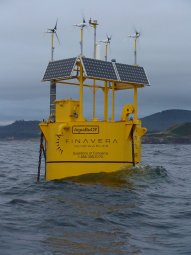
An offshore wave farm will supply Californians with clean green electricity generated by the ocean, under a first-of-its-kind power purchase agreement that utility PG&E will announce Tuesday morning.
The giant San Francisco-based utility has signed a long-term contract to buy 2-megawatts of electricity from Finavera Renewables’ wave-energy power plant, to be built off the Northern California coast. The Vancouver company intends to eventually expand the Humboldt County project into a 100-megawatt “wave park.” It is likely to be the first of a score of floating power stations dotting California’s 1,100-mile coastline in the coming years, judging by the stack of applications for such wave farms on file at the Federal Energy Regulatory Commission.
“This power purchase agreement is extremely significant and reflects the massive potential for wave power as a renewable source of energy in the future,” says PG&E spokesman Keely Wachs. Like the Golden State’s other big investor-owned utilities — Southern California Edison (EIX) and San Diego Gas & Electric (SRE) — PG&E (PCG) must obtain 20 percent of its electricity from renewable sources by 2010 and 33 percent by 2020.
“The California market is huge for wave energy,” Finavera CEO Jason Bak told Fortune’s Green Wombat. “This is the first power purchase agreement with a large utility, and we see this as being one of the key components to commercializing wave energy technology.”
The ocean as potential source of greenhouse gas-free power is tremendous: The energy locked up in the surf rolling toward the California coast is equivalent to some 37 gigawatts — enough to light nearly 30 million homes — according to PG&E. And unlike the sun and wind, waves can generate electricity 24/7. But the technology to tap all that water-borne power and deliver it at competitive prices remains in the start-up phase.
PG&E and Finavera would not disclose the terms of the power purchase agreement. But Bak acknowledged that the key challenge he and other wave-energy companies face is “advancing the technology to the stage where we have a near-commercial technology.”
Finavera plans to deploy strings of connected wave-energy converters that it calls AquaBuoys. As waves roll past an array of AquaBuoys connected to an onshore station by an undersea cable, two-stroke hose pumps convert their energy into pressurized seawater that drives electricity-generating turbines. According to filings Finavera has made with the Federal Energy Regulatory Commission, a fully built-out 100 megawatt Humboldt wave farm would consist of 200 to 300 AquaBuoys floating on a two-square-mile site about two to three miles off the town of Trinidad. The initial phase of the project is expected to go online in 2012 and will use eight AquaBuoys.
While PG&E is merely dipping its corporate toe in the wave-energy waters with a relatively small 2-megawatt power purchase agreement, the deal with Finavera is likely to intensify efforts to stake claims on the best stretches of coast.
PG&E itself earlier this year unveiled its WaveConnect project to build two 40-megawatt wave farms, one off Humboldt and the other off the Mendocino County coast. Chevron (CVX) dived in last July with a plan for a Humboldt wave farm to be built by Scotland’s Ocean Power Delivery — now called Pelamis Wave Power — before abruptly pulling its application a month later.
Over the past two months there’s been a new flurry of applications. New Jersey’s Ocean Power Technologies (OPTT) in November filed for a FERC permit for a 20-megawatt “wave energy park” to be located off the Humboldt coast. And a newcomer to the wave energy business called GreenWave Energy Solutions has filed permit applications for wave farms off Mendocino and the Central Coast town of Moro Bay in San Luis Obispo County. (The Thousand Oaks, Calif., company lists a San Francisco attorney as its president and it was registered by a Southern California developer.)
Before Finavera can begin construction of the Humboldt wave farm, it must first spend two to three years completing environmental impact studies and negotiating with local, state and federal regulators. While obtaining financing for wave-energy projects using untried technology is difficult, Finavera will have one advantage over its competitors: a long-term power purchase agreement with one of the United States’ largest utilities.
“This PPA is a vote of confidence from PG&E that we can get the project done,” says Bak.
 Green Wombat