Feeds:
Posts
Comments

Archive for the ‘PG&E’ Category

betterplaceplug

photo: Better Place

With electric cars months away from hitting the road, the California Public Utilities Commission has begun the complex task of establishing a regulatory framework for the state’s emerging electric vehicle infrastructure. The biggest fight is likely to be over whether to regulate companies like Better Place, which plans to build an electric car charging network in the state. As I write in The New York Times on Monday:

With electric cars set to hit the mass market next year, a skirmish is breaking out in California over who will control the state’s electric vehicle infrastructure.

The California Public Utilities Commission will write the rules of the electric road and is just starting to grapple with the complex regulatory issues surrounding the integration of battery-powered cars into the state’s electrical grid.

One of the biggest questions is whether to regulate Better Place, Coulomb Technologies and other companies that plan to sell electricity to drivers through a network of battery charging stations.

California’s three big investor-owned utilities have split over the issue.

“The commission should establish its authority to regulate third-party providers of electricity for electric vehicles,” Christopher Warner, an attorney for Pacific Gas & Electric, wrote in a filing with the utilities commission. “Managing the increased electricity consumption and load attributable to electric vehicles in order to avoid adverse impacts on the safety and reliability of the electric grid may be one of the most difficult management challenges that electric utilities will face.”

Southern California Edison, meanwhile, urged the commission to move cautiously, calibrating any regulation to the specific business models of the companies.

San Diego Gas & Electric said the commission does not have the right to regulate companies like Better Place.

You can read the rest of the story here.

Read Full Post »

solarh

Photo: BrightSource Energy

In today’s New York Times, I write about how Harvey Whittemore — one of Nevada’s biggest power brokers and a confident of Senate majority leader Harry Reid — has responded to the housing crash by leasing desert land at his mega-home development to BrightSource Energy for a 960-megawatt solar farm complex.

What to do when building a 159,000-home city in the Nevada desert and the housing market collapses?

Go solar.

The Coyote Springs Land Company this week expanded a deal with BrightSource Energy, a solar power developer based in Oakland, Calif., to carve out 12 square miles of it its 43,000-acre mega-development for solar power plants that would generate up to 960 megawatts of electricity.

Harvey Whittemore, Coyote Springs’s chairman, said his plan always was to include some renewable energy in the massive golfing community under development 50 miles northeast of Las Vegas. But, Mr. Whittemore said, he decided to go bigger as the housing market crashed and solar developers like BrightSource began to sign deals with utilities.

“We’ve always said we’ll adjust the land use plan to the market,” said Mr. Whittemore in an interview. “At the end of the day we have approvals for 159,000 units and we looked at what we could do to reduce the number of units while at same time coming up with a functional business plan that takes advantage of private land.”

Private land is in short supply in Nevada, where the federal government owns about 87 percent of the state. That has forced solar developers like BrightSource – which is under the gun to supply 2,610 megawatts to California utilities — to seek leases on desert property managed by the United States Bureau of Land Management, a years-long process involving extensive environmental review.

By dealing with Mr. Whittemore, BrightSource is sidestepping all of that and acquiring an ally who knows how to get things done in the Silver State.

You can read the rest of the story here.

Read Full Post »

solarh
Photo: BrightSource Energy

In another sign that old-line corporate giants see solar power as big business, engineering and construction giant Bechtel has signed a deal with BrightSource Energy to build the solar developer’s first solar power plant, a 440-megawatt project in Southern California on the Nevada border. As I write in Wednesday’s New York Times:

Bechtel, the global engineering and construction giant, has jumped into the solar power plant business in a deal with a developer to build a 440-megawatt energy complex in California.

The agreement, being announced Wednesday, calls for Bechtel’s development and finance arm, Bechtel Enterprises, to take an equity stake in the solar project known as the Ivanpah Solar Electricity Generating System. The collection of three solar power stations will deliver electricity to Pacific Gas & Electric and Southern California Edison.

Bechtel is teaming up with BrightSource Energy, a start-up company based in Oakland, Calif.

Ivanpah is the first large-scale solar power plant to undergo regulatory review in the United States in nearly two decades, and the selection of Bechtel as BrightSource’s engineering, procurement and construction contractor is considered a significant step in obtaining financing needed to build the project.

You can read the rest of the story here.

Read Full Post »

solarcells

photo: Southern California Edison

It hasn’t received much media attention, but the California Public Utilities Commission has just proposed instituting a first-of-its-kind reverse auction market to spur renewable energy development — mainly solar photovoltaic.  As I write today in The New York Times:

California regulators are taking an eBay approach to ramping-up renewable energy in the Golden State.

In what might be a world first, the California Public Utilities Commission on Thursday proposed letting developers bid on contracts to install green energy projects. A solar company that offers to sell electricity to one of California’s three big utilities at a rate lower than its competitors would win a particular power purchase agreement.

This “reverse auction market” feed-in tariff is designed to avoid the pitfalls the have plagued efforts in Europe to encourage development of renewable energy by paying artificially high rates for electricity produced by solar power plants or rooftop photovoltaic projects.

You can read the rest of the story here:

Read Full Post »

solarF

In Monday’s New York Times’ Green Inc. blog, I take a look at two recently approved solar energy contracts in California that offer a rare look at the economics of large-scale solar power plants:

California regulators have approved contracts for more than 8,600 megawatts of renewable energy, to be generated mostly by big solar power plants for the state’s largest utilities. But the details of those deals and the emerging economics of green energy often remain shrouded in secrecy, subject to confidentiality agreements.

That black box cracked open a bit on Thursday, when the California Public Utilities Commission gave the green light to two 25-year power purchase agreements between Pacific Gas & Electric and BrightSource Energy, a solar power plant builder based in Oakland, Calif.

When approving contracts for 310 megawatts of solar electricity, the utilities commission also signed off on an apparently first-of-its-kind technology royalty agreement between BrightSource and PG&E.

You can read the rest of the story here.

Read Full Post »

Stirling SunCatcher

photo: Tessera Solar

When it comes to renewable energy, Texas has been all about Big Wind. But this week the Lone Star State took on its first Big Solar project when San Antonio utility CPS Energy signed a 27-megawatt deal with Tessera Solar.

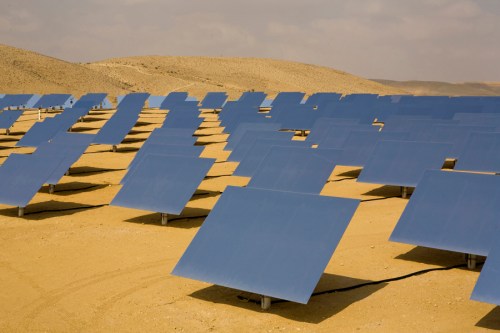
Houston-based Tessera is the solar farm developer for Stirling Energy Systems, which makes a Stirling solar dish. Resembling a giant mirrored satellite receiver, the 25-kilowatt solar dish focuses the sun’s rays on a Stirling engine, heating hydrogen gas to drive pistons that generate electricity. (Last year Irish green energy firm NTR pumped $100 million into Scottsdale, Ariz.-based Stirling Energy Systems and created Tessera to develop solar power plants using the Stirling dish, called the SunCatcher.

Stirling Energy Systems previously signed deals with Southern California Edison (EIX) and San Diego Gas & Electric (SRE) to supply up to 1,750 megawatts of electricity from some 70,000 solar dishes to be planted in the Mojave and Sonoran deserts.

Other solar developers privately have cast doubt on Stirling’s ability to make good on those contracts, arguing the SunCatcher is just too expensive and complex to compete against solar thermal technologies that rely on mirrors to heat liquids to create steam that drives electricity-generating turbines.

But earlier this week, Stirling unveiled the latest generation of the SunCatcher at Sandia National Laboratories in Albuquerque, N.M. The new SunCatcher has shed 5,000 pounds and its Stirling hydrogen engine contains 60% fewer parts than the previous version, according to the company.

The SunCatcher also uses a fraction of the water consumed by competing solar thermal technologies being developed by startups like BrightSource Energy and Ausra — no small deal in the desert. Tessera solar farms also can be built in modules, meaning that when a 1.5 megawatt pod of 60 SunCatchers is installed it can immediately begin generating electricity — and cash.

California utility PG&E also went modular Thursday when it signed a 92-megawatt deal with New Jersey’s NRG (NRG) for electricity to be generated by a Southern California solar power plant using eSolar’s technology. Google-backed (GOOG) eSolar’s builds its solar power tower plants in 46-megawatt modules. The power plants take up much less land than competing solar thermal technologies, thanks to eSolar’s use of sophisticated software to control small mirrors that are packed close together.

NRG earlier this month signed a deal to build a 92-megawatt eSolar-powered solar farm in New Mexico near the Texas border.

eSolar CEO Bill Gross says his solar farms will generate electricity cheaper than natural gas-fired power plants, a claim PG&E (PCG) appears to confirm in its submission of the deal to the regulators. (Thanks to Vote Solar for pointing to the document.)

Read Full Post »

AV Solar Ranch

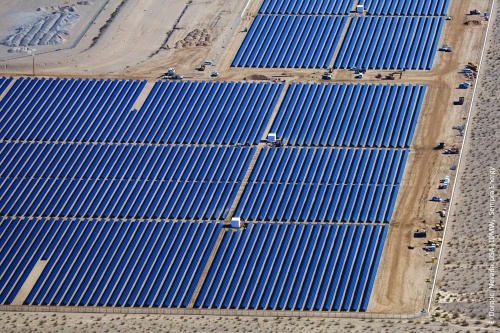
California utility PG&E on Friday announced a contract to buy 230 megawatts of electricity from a photovoltaic solar farm to be built by San Francisco-based NextLight Renewable Power.

NextLight — backed by private equity firm Energy Capital Partners — will build the AV Solar Ranch on agricultural land in Los Angeles County’s Antelope Valley.  PG&E (PCG) says the solar power plant will begin producing electricity in 2011. When fully built out by 2013, it will generate enough power for 90,000 homes, according to the utility.

Since the project will deploy solar panels rather than solar thermal technology that uses mirrors to heat liquids to drive a turbine, it does not need to go through the laborious California Energy Commission permitting process.

NextLight apparently also plans to build solar thermal farms — the company has filed lease claims on some 20,000 acres of Mojave Desert land owned by the U.S. Bureau of Land Management for two 500-megawatt solar trough power plants.

Friday’s agreement follows PG&E’s deal in May with BrightSource Energy to buy 1,300 megawatts of solar electricity to be produced by seven solar power plants.

Read Full Post »

Top 10 solar utilities

A solar industry trade group on Thursday released its list of the Top 10 solar integrated utilities of 2008 and it will come as no surprise that California’s Big Three utilities took the top three spots.

What is news, and a sign that solar’s reach is extending beyond the Golden State, is that six of the Top 10 solar utilities on the Solar Electric Power Association’s list hail from places like New York and New Jersey.

Still, San Francisco-based PG&E (PCG), which claimed the No. 1 slot, alone connected 84.9 megawatts of photovoltaic solar to the grid in 2008, accounting for 44% of all new solar capacity last year. Southern California Edison (EIX) came in second with 32.4 megawatts and San Diego Gas & Electric (SRE) took third place with 16 megawatts.

Xcel Energy (XEL) in Colorado was close behind with 14.2 megawatts. After that the numbers take a dive to the single megawatts. Still, utilities from not-so-sunny places like Portland, Ore.  made the list.

Southern California Edison is No. 1 when it comes to total installed solar to date — 441.4 megawatts — due largely to the 354 megawatts of electricity generated by nine solar thermal power plants built in the 1980s that continue to operate in the Mojave Desert. PG&E came in second with 229.5 megawatts connected to the grid so far.

Those numbers should skyrocket in the coming years as the California utilities have signed contracts for more than 3 gigawatts of electricity to be produced by large solar farms. Utilities like Arizona Public Service (PNW) — No. 5 on the list for 2008 — are also beginning to contract for solar electricity to be produced by massive megawatt solar power plants.

Read Full Post »

solara

photo: BrightSource Energy

California utility PG&E on Wednesday expanded an agreement with BrightSource Energy to buy 1,310 megawatts of carbon-free electricity to be generated by seven giant solar power plant projects – the world’s biggest solar deal to date. Coming on top of a 1,300 megawatt agreement with Southern California Edison in February, the Google-backed, Oakland, Calif.-based  startup says it now holds more than 40% of the Big Solar contracts in the United States.

PG&E had previously signed a power purchase agreement with BrightSource in April 2008 for 500 megawatts with an option to buy another 400 megawatts. The new 1,310-megawatt deal will supply enough electricity to power about 530,000 homes in California.

Those are impressive numbers, but not an electron of electricity has been produced yet. BrightSource now faces the challenge of licensing, financing billions of dollars in construction costs and then building nearly a dozen large-scale solar power plants to meet a 2016 deadline for the Southern California Edison (EIX) contract and a 2017 completion date for PG&E (PCG).  (The big wild card is whether transmission lines will be available to connect the power plants to the grid.) The first PG&E project is set to go online in 2012 with the first SoCal Edison solar farm to begin generating electricity the next year. Those first two power plants are part of a 400-megawatt complex BrightSource is planning for the Ivanpah Valley on the California-Nevada border.

“The biggest part of our strategy is to ramp up slowly and methodically,” BrightSource CEO John Woolard told Green Wombat. “We’re very, very careful about how we sequence the projects.”

To give you an idea of how arduous the licensing process is in California, consider that BrightSource filed its application to build Ivanpah with the California Energy Commission on Aug. 31, 2007 — the state’s first large-scale solar power plant application in two decades. But the energy commission currently estimates that it won’t sign off on the license until around 2010, more than six months’ behind schedule as a multitude of state and federal agencies and green groups weigh in on the project’s environmental impact. The clock is ticking as BrightSource needs to start shoveling dirt on the construction site by the end of 2010 to qualify for federal loan guarantees that are part of the Obama stimulus package.

BrightSource may also build solar power plants in Nevada and Arizona, where licensing is easier, to supply electricity to PG&E and Southern California Edison. Woolard says the company controls enough land for nine gigawatts’ worth of solar farms.

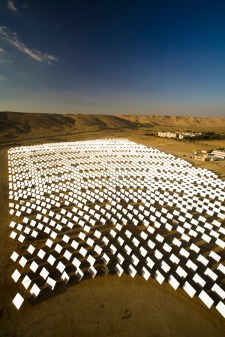
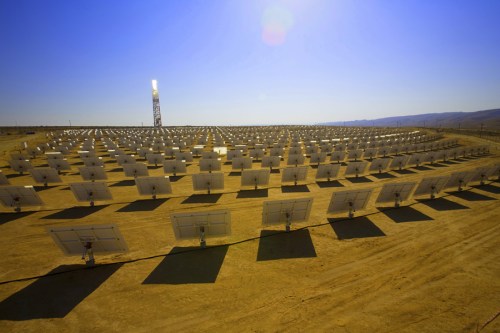
While BrightSource’s technology is untested on a large scale, the company has built a six-megawatt demonstration plant in Israel, where its technology development arm is headquartered. BrightSource deploys arrays of mirrors called heliostats that concentrate sunlight on a water-filled boiler that sits atop a tower. The intense heat vaporizes the water to create high-pressure steam that drives a standard electricity-generating turbine.

Woolard says an independent engineering firm, R.W. Beck, has validated the technology at the Negev Desert demo plant. That no doubt helped persuade PG&E, which has sent executives to Israel to inspect the project, to supersize its contract. (And while BrightSource represents the biggest solar deal PG&E has signed, it’s probably far more likely to be fulfilled than the utility’s agreement in April to buy electricity from a space-based solar farm to be built by Southern California startup Solaren.)

“What it came down to is that they saw us delivering,” Woolard says. “Our plant in Israel performed above expectations. The fact that we have a solar plant producing the highest quality, highest temperature, highest pressure steam anywhere in the world is the most important thing.”

The company’s pedigree also provides a certain amount of corporate comfort. BrightSource was founded by American-Israeli solar pioneer Arnold Goldman, whose Luz International built nine large-scale solar trough power plants in the Mojave Desert in the 1980s that continue to generate electricity for Southern California Edison. BrightSource has also raised more than $160 million from a blue-chip group of investors that includes Google (GOOG), Morgan Stanley (MS) and VantagePoint Venture Partners as well as a clutch of oil giants – Chevron (CVX), BP (BP) and Norway’s StatoilHydro.

Read Full Post »

First Solar Electric, 701 El Dorado Valley Dr., Boulder City, NV

photo: First Solar

Sempra Generation on Wednesday said it has signed a deal for the United States’ largest photovoltaic power plant, a 48-megawatt solar farm to be built by First Solar in Nevada.

The thin-film solar power station will add on to a 10-megawatt solar farm built by First Solar (FSLR) last year adjacent to a Sempra  natural-gas fired power plant in Boulder City, Nev., outside of Las Vegas. Sempra Generation CEO Michael Allman told Green Wombat that Wednesday’s deal is part of a strategy to bring 500 megawatts of solar electricity online.

“The initial focus is on projects that are next to natural gas fired plants in the desert Southwest,” said Allman, whose company is a division of San Diego-based power giant Sempra Energy (SRE).

By building solar farms on the site of existing fossil fuel plants, Sempra can plug them in to the existing power grid, cutting costs for land, permits and electricity transmission. The 10-megawatt solar plant in Boulder City went online six months after ground was broken. Allman said Sempra also owns land next to its Mesquite natural gas power plant outside of Phoenix suitable for solar development.

“Those two power plants provide us with a substantial competitive advantage in both timing and cost,” said Allman. “These two initial projects will be the lowest cost energy delivered out of a solar project anywhere in the world.”

He declined to say what that cost is but an executive with PG&E (PCG), which is buying the electricity from the 10-megawatt Boulder City solar farm, previously told Green Wombat that the California utility was “very happy” with the rate it negotiated.

Allman said Sempra owns more than 4,000 acres in Arizona that could generate 300 megawatts of solar electricity. The company has also filed lease claims on 11,000 acres of desert land owned by the U.S. Bureau of Land Management in California’s Imperial Valley. But Allman said Sempra’s preference is to acquire private land to avoid the years-long BLM permitting process. The company will consider a range of solar technologies, including solar thermal, for future solar projects.

The 48-megawatt deal announced Wednesday is contingent upon Sempra signing a power purchase agreement with a utility.

Read Full Post »

« Newer Posts - Older Posts »

Design a site like this with WordPress.com
Get started