Feeds:
Posts
Comments

Archive for the ‘green tech’ Category

solyndra-rooftop-2

photo: Solyndra

It’s been a good news, bad news Friday for the solar industry. Silicon Valley startup Solyndra received a half billion-dollar loan guarantee from the U.S. Department of Energy to build a solar module factory while further up Interstate 880 OptiSolar moved to shut down its manufacturing operations.

OptiSolar too had asked for a federal loan guarantee to complete work on its Sacramento thin-film solar cell plant but a decision on the $300 million application couldn’t come soon enough to save the startup. “We continued to be unable to find a buyer for the technology and manufacuring business, and the board of directors decided that we needed to limit ongoing operational expense,” wrote OptiSolar spokesman Alan Bernheimer in an e-mail.

First reported by the San Francisco Chronicle’s David Baker, OptiSolar will shut down factories in Sacramento and Hayward, Calif., and lay off 200 workers.  Earlier this month, OptiSolar sold its pipeline of solar power plants – including a 550-megawatt solar farm that will supply electricity to PG&E (PCG) – to rival First Solar  in a $400 million stock deal. At the time, OptiSolar said it intended to focus on manufacturing solar modules.

The news was definitely brighter Friday for Solyndra, which emerged from stealth mode last September with $600 million in funding and $1.2 billion in orders for its solar panels composed of cylindrical tubes imprinted with solar cells. Conventional rooftop solar panels must be tilted to absorb direct sunlight as they aren’t efficient at producing electricity from diffuse light. But the round Solyndra module collects sunlight from all angles, including rays reflected from rooftops. That allows the modules, 40 to a panel,  to sit flat and packed tightly together on commercial rooftops, maximizing the amount of space for power production.

The $535 million federal loan guarantee will allow the Fremont, Calif.-based company to build a second factory, which is expected to create 3,000 construction jobs and more than 1,000 other jobs once the plant is in operation. The factory will be able to produce 500 megawatts’ worth of solar panels a year.

“The DOE Loan Guarantee Program funding will enable Solyndra to achieve the economies of scale needed to deliver solar electricity at prices that are competitive with utility rates,” Solyndra CEO Chris Gronet said in a statement. “This expansion is really about creating new jobs while meaningfully impacting global warming.”

Friday’s grant makes good on Secretary of Energy Steven Chu’s pledge to speed up processing of renewable energy loan guarantee applications. The department had come under fire during the previous administration for taking years to dole out grants and loan guarantees for electric car and green energy projects.

Meanwhile, First Solar (FSLR) announced on Friday that it had manufactured 1 gigawatt of thin-film solar cells since beginning commercial production in 2002. It took the Tempe, Ariz., company six years to hit 500 megawatts and only eight months to produce the second 500 megawatts. First Solar’s annual production capacity will reach 1 gigawatt by year’s end, according to the company.

Read Full Post »

powerstring-picMost people think of National Semiconductor as a chip company. But the Silicon Valley mainstay has been moving into the solar business and on Thursday it scooped up Act Solar, a startup that makes equipment designed to maximize power production from photovoltaic panels.

Act Solar, a three-year-old Santa Clara, Calif.-based company, developed the PowerString, a device that recirculates energy in a rooftop solar array to keep all panels producing electricity in the event that shade, dirt or glitches affecting one solar module don’t impact others. PowerString also allows solar array owners to wirelessly monitor the performance of their systems.

National Semiconductor (NSM) already makes diagnostic and measuring equipment for use in maximizing electricity production from solar panels and will fold Act Solar into that division. “Early field tests and historical modeling have shown that this [Act Solar] solution can cumulatively deliver 40 to 80 percent more power over the operating life of a solar panel installation,” National Semiconductor said in a statement.

Read Full Post »

487207673_hpim1983

photo: IBM

IBM on Friday unveiled a series of  “smart water” services to deploy sensor networks and data-crunching software to help environmental officials better manage an increasingly scarce commodity.

“What we got back from people who monitor water systems is that they had a huge amount of data, that they were often entering the data by hand, and that they didn’t have time to analyze the data,” says Sharon Nunes, vice president for Big Green Innovations at IBM. “What we’re trying to to do is build more intelligence into their water systems.”

Here’s how it works in a nutshell: Sensors are scattered throughout a water district’s infrastructure – from reservoirs to the pipes that deliver H20 to homes – and gather information on water quality, leakage and other conditions. IBM (IBM) software analyzes that data and organizes it on a computer dashboard so water managers can at a glance detect problems and balance supply and demand.

A demonstration of the IBM technology and its reach is underway in Ireland’s Galway Bay. Working with Marine Institute Ireland, IBM’s SmartBay project has equipped several hundred buoys like the one in the photo above with sensors that are networked through wireless links. The sensors measure such things as water temperature, salinity and oxygen content. Nunes said some sensors measure wave height to determine the best locales for wave energy production while another experimental intelligent sensor detects phosphates and then essentially does a science experiment in a box to determine whether the data is of sufficient quality to beam back to the home base.

The project also uses fishermen as “nodes on the network,” allowing them to text-message reports of floating debris on the bay. SmartBay crunches that data and sends back a map showing the likely position of flotsam over the next 24 hours so boats can avoid collisions.

Nunes says all this data – presented on a computer dashboard – allows the Galway harbor master to get a quick snapshot of the the bay’s health and potential navigation hazards so decisions can be made quickly – like whether to close the beaches because of a spike in pollution.

She estimates the potential market for smart water technology to be between $15 billion and $20 billion. The $64,000 question, though, is whether IBM’s likely customers – cash-strapped municipalities and state and local governments – can afford to get smart.

The answer, Nunes says, is that federal stimulus package money is available for water projects while other countries like China have set aside cash – $53 billion in China’s case – for water quality projects.

Read Full Post »

thnk-city-michigan-usa_imagelarge

photo: Think

Norwegian electric car company Think announced Thursday that it will open a factory in the United States in 2010 to produce its City urban runabout.

Think CEO Richard Canny, a former Ford executive, is in Ann Arbor, Mich., this week meeting with officials from eight states vying for the factory. But don’t put in your order just yet – only 2,500 cars will roll off the assembly line the first year and they will be reserved for demonstration projects and fleet sales.

“The U.S. is quickly overtaking Europe as an attractive market for EVs and is an ideal location to engineer and build EVs,” Canny said in a statement. “We see ourselves playing a small but potentially growing role in re-inventing the U.S. auto industry by bringing back new manufacturing jobs to the U.S.”  Think has not yet responded to Green Wombat’s inquiry about which states, other than Michigan, is in talks with the company for the factory.

How Think will finance its North American expansion remains an open question. Just three months ago the company was teetering on the edge of bankruptcy as the global financial crisis cut off capital and forced Think to idle its Norwegian factory and lay off workers. The company obtained $5.7 million interim financing in January and recalled some workers. A report on Treehugger Thursday cited sources that said Think was contemplating relocating to Sweden or the U.K.

Think spokeswoman Katinka Von Der Lippe told Green Wombat on Thursday that the interim financing has been extended but that the company is still seeking a new infusion of capital to resume full production of the City, a two-seater that goes 112 miles on a charge with a top speed of about 62 miles per hour.  Update: Think’s U.S. spokesman, Brendan Prebo, tells Green Wombat that Think will raise most of the new capital from its existing European and U.S. investors, which include General Electric (GE), so it can resume full production of the City in Norway.

The company said that it will apply for a low-interest loan from the U.S. Department of Energy under its Advanced Technology Vehicle Manufacturing program to help pay for the factory. Prebo declined to reveal the size of the DOE loan the company will seek but noted it “will be a substantial investment for Think” but small compared to what some of the big automakers want.

After the first-year startup phase, the U.S. factory will initially employ 300 workers and produce 16,000 cars annually, according to Think. Capacity would eventually be expanded to 60,000 cars and a workforce of 900. A research and development center will employ about 70 people.

But calling a Think facility a factory is somewhat misleading. It’s really an assembly plant and the one Green Wombat visited in 2007 in Aurskog, Norway, was more Ikea than Henry Ford, with plastic-bodied Think City models quietly gliding through clean well-lighted spaces.

The question for Think, Tesla Motors other EV startups is whether they can gain a foothold in the market before the major players big-foot them with their own electric and plug-in electric cars. Ford (F), General Motors (GM), Honda (HMC), Toyota (TM), Renault-Nissan and other global automakers all are accelerating plans to introduce electric vehicles.

Thursday’s announcement follows the formation of Think North America, unveiled in April 2008 at Fortune’s Brainstorm Green conference.  A bicoastal group of venture capital firms – Silicon Valley’s Kleiner Perkins Caufield & Byers and Boston’s Rockport Capital Partners – signed on as lead investors.

Read Full Post »

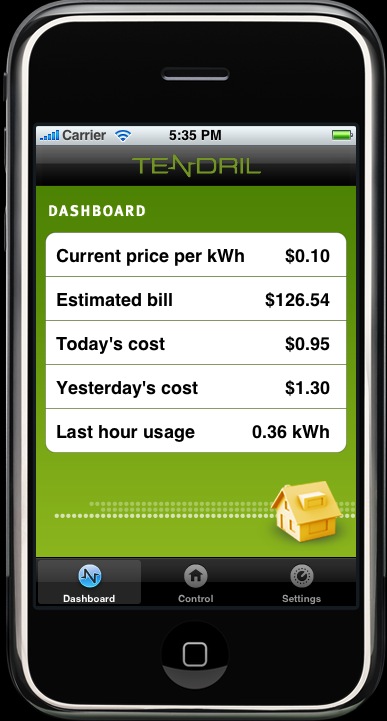
tendril-iphone-appHere’s an iPhone app that really could help save the planet while saving stressed consumers’ money: Boulder, Colo.-based startup Tendril this week unveiled a mobile software program that lets people monitor and control their home’s energy use while on the go.

Say you’re sitting in the unemployment office listening to some bureaucrat drone on, so you pull out your iPhone to update your Facebook status and then check on whether that next unemployment check will cover the utility bill. When Tendril tells you that your electricity consumption is spiking and so will your estimated monthly bill, you remember you left the air conditioner set on Arctic. Flick your finger and shut that energy hog down.

That scenario won’t become common for awhile it as relies on a widespread rollout of smart utility meters that will bring the interactive smart grid and real-time electricity pricing into the home. That is happening, albeit very slowly (though the pace is expected to accelerate with billions in the stimulus package being poured into smart grid-related projects. The ability to remote-control your appliance, however, is some years away).

For instance, Tendril, is rolling out a home energy management system for Texas utility Reliant Energy (RRI) that allows customers to monitor and control their electricity use through a video display that sits in the living room. When Green Wombat visited Reliant’s smart house project in Houston last September, the utility’s tech guys showed me their own home-brewed iPhone app.

As anyone with an iPhone knows, Apple’s (AAPL) app store makes it ridiculously easy to turn the gadget into Dr. Who’s sonic screwdriver – a gizmo that does everything but put out the trash and feed your pet bunny. But earth2tech’s Katie Fehrenbacher questions how widespread Tendril’s app would be used given the difficulty in putting any third-party software program on a BlackBerry or other smartphone. But that’s changing by dint of Apple’s growing share of the smartphone market and the advent of the app-friendly Google (GOOG) phone.

Green Wombat is most intrigued by the potential of such apps as the Tendril Mobile Vantage to tap into people’s inherent competitiveness, keeping-up-with-Jones mentality and, in the Facebook era, compulsion to share, share, share. The data generated by smart meters and home energy management systems like Tendril’s will let consumers compare their energy use – and thus contribution to global warming – with their neighbors and friends.

In fact, Tendril is planning to add a carbon footprint feature to its mobile app. Funnel that data into a Facebook newsfeed and let the peer-to-peer pressure go to work to see who can claim Twittering rights to a low-impact lifestyle.

Read Full Post »

genomatica21

image: Genomatica

Talk about recycling: “Green chemicals” startup Genomatica on Wednesday said it has bioengineered a petroleum-free version of a widely used industrial solvent that can be produced in shuttered ethanol plants.

You’ve most likely never heard of the chemical, methyl ethyl ketone, or MEK, but it is used as a solvent in paint and other coatings. Genomatic says it has bioengineered a microbe that ingests sugar and water and produces MEK without the toxic byproducts and environmental risks that come from making petroleum-based industrial chemicals.

The San Diego company – backed by Silicon Valley venture capital firms Mohr Davidow Ventures and Draper Fisher Jurvetson – last year produced its first green chemical in the lab, 1,4‐butanediol, or BDO, which is a raw material found in everything from skateboard wheels to spandex. Genomatica plans to license its bio-chemicals to industrial producers.

When it came time to develop its next product, Genomatic CEO Christopher Gann says the company targeted a chemical that could be produced by existing industrial plants. “We said is it possible to shorten the development cycle by using existing assets,” Gann, a veteran of a veteran of Dow Chemical (DOW), told Green Wombat. “Can we develop a bioprocess for a chemical that would operate in the same conditions as corn ethanol.”

Why ethanol? The financial crisis has left a couple dozen ethanol plants idle. Gann and Genomatica president Christophe Schilling determined that existing ethanol plans could easily be repurposed to produce MEK. That’s potentially a win-win situation: Capital costs are kept to a minimum as new chemical factories don’t have to be built, while ethanol producers get a new lease on the life of their plants.

The food-versus-fuel controversy that has plagued corn ethanol producers is unlikely to pose a problem for Genomatica as the United States’ annual production of MEK is only about 57 million gallons (not 57,000 gallons as Green Wombat originally reported.), according to Gann. Still, it’s an attractively big market — about $2 billion, Gann estimates.

At least one ethanol producer, DAK Renewable Energy, has expressed interest in modifying some of its plants to make MEK, according to Genomatica.

So far, bio-MEK has only been produced in small batches in Genomatica’s lab. Meanwhile, Gann says the company is about to embark on a fundraising round to finance the construction of a demonstration plant in Southern California to produce BDO.

Read Full Post »

optisolar-panels
photo: Optisolar

SAN FRANCISCO — With the financial crisis dimming solar’s prospects to become a significant source of renewable energy, utility giant PG&E on Tuesday said it will spend $1.4 billion over five years to install 250 megawatts’ worth of photovoltaic panels in California while contracting with private developers for another 250 megawatts. PG&E chief executive Peter Darbee said the utility is also prepared to be a “green knight,” rescuing distressed big centralized solar power plant projects by providing financing so they can get built.

“We have contracted for 24% of our energy to be renewable and we’re concerned whether our [developers] will have access to capital,” Darbee said at PG&E’s San Francisco headquarters during a press conference. “We think financing for these projects may be in jeopardy. PG&E is well-positioned with its $35 billion balance sheet to step up and help.”

PG&E’s (PCG) move to take a direct role in obtaining the renewable energy it needs to comply with California’s global warming laws could be big business for solar module panel makers and installers like SunPower (SPWRA), Suntech (STP) and First Solar (FSLR). The action was prompted in part by a change in the tax laws that lets utilities claim a 30% investment tax credit for solar projects.

Fong Wan, PG&E’s vice president for energy procurement, said most of the 500 megawatts of solar panels will be installed on the ground in arrays of between one and 20 megawatts at utility substations or on other PG&E-owned property. (The utility is one of California’s largest landowners.) A small portion may be installed on rooftops, he said.

PG&E said the solar initiative will generate enough electricity to power 150,000 homes and will provide 1.3% of the utility’s electricity supply.

“There’s no or little need for new transmission and these projects can plug directly into the grid,” said Darbee. “Given our size and our credit ratings and our strength, we can move forward where smaller developers may not be able to do so.”

The California Public Utilities Commission must approve PG&E’s solar initiative, which Wan estimated would add about 32 cents to the average monthly utility bill.  An $875 million program unveiled by Southern California Edison (EIX) last year to install 250 megawatts of utility-owned rooftop solar panels has run into opposition from solar companies that argue it is  anti-competitive and from consumer advocates who contend the price is too high. The state’s third big utility, San Diego Gas & Electric (SRE), has also proposed a rooftop solar program.

Wan acknowledged that objections to Edison led PG&E to design its program so that private developers would have a 50% stake in the initiative. PG&E will sign 20-year power purchase agreements for privately owned solar installations.

PG&E will also need regulators’ approval to inject equity financing into companies developing big solar power plants. The utility has signed power purchase agreements for up to 2,400 megawatts of electricity to be produced by solar thermal  and photovoltaic power plants to be built by companies like Ausra, BrightSource Energy, OptiSolar and SunPower.

“We are looking at the least risky and most developed opportunities to see where we can be the most helpful,” Darbee said.

Read Full Post »

topaz-solar-farm-app

In the green stimulus sweepstakes, big potential winners are companies like Silicon Valley startup OptiSolar.

The solar-cell maker came out of nowhere last year to score a deal with utility PG&E to build the world’s largest photovolaic power plant, a 550-megawatt monster that would cover some 9 1/2 square miles on California’s central coast. OptiSolar subsequently began construction of a factory in Sacramento to produce the thousands of thin-film solar panels needed for the project. Then the economy tanked and as financing dried up, OptiSolar laid off half its workforce – some 300 employees – and halted construction of the Sacramento facility.

With a Colorado solar company executive joining President Barack Obama as he signed the $787 billion stimulus legislation into law Tuesday at a solar-powered museum in Denver, OptiSolar and other renewable energy companies stalled by the financial crisis may see their fortunes revive. The package allows builders of big renewable energy projects to apply for a government cash grant to cover 30% of construction costs in lieu of claiming a 30% investment tax credit. A dearth of investors who finance solar power plants and wind farms in exchange for the tax credits has put in jeopardy green energy projects planned for the desert Southwest and the Great Plains. The cash grant would shave about $300 million off the projected $1 billion price tag for OptiSolar’s Topaz Solar Farm.

The stimulus package also includes $2.3 billion to fund a 30% manufacturing tax credit for equipment used to make components for green energy projects, a provision OptiSolar can tap to help finance its solar cell factories. And the company may be able to take advantage of the legislation’s government loan guarantees for large renewable energy projects.

“It will lower the cost of the factory we’re building in Sacramento and make it easier to attract financing,” OptiSolar spokesman Alan Bernheimer told Green Wombat, noting the company’s priority is to complete the facility and begin production of solar panels. “The factory is more than shovel ready – our shovels are hanging on the wall where we put them when we had stop work in November.” (OptiSolar currently manufactures solar modules at its Hayward, Calif., plant.)

Fred Morse, senior adviser to Spanish solar energy giant Abengoa, says the stimulus package puts back on track a $1 billion, 280-megawatt solar thermal power plant the company will build outside Phoenix to produce electricity for utility Arizona Public Service. “With the stimulus bill we’re very confident we’ll be able to finance the project,” says Morse. He says Abengoa expects to use the government loan guarantees to obtain debt financing to fund construction of the project and then apply for the 30% cash refund. “I think the entire industry is very optimistic that these two aspects of the stimulus package, the grants and the temporary loan guarantees, should allow a lot of projects to be built.”

Mark McLanahan, senior vice president of corporate development for MMA Renewable Ventures, agrees. “I expect the government grants to attract new investors,” says McLanahan, whose San Francisco firm finances and owns commercial and utility-scale solar projects.

There are some strings attached, though.

To qualify for the cash grants, developers need to start shoveling dirt by Dec. 31, 2010. That means only a handful of big solar thermal power plants planned for California, for instance, are likely to make it through a complicated two-year licensing process in time to break ground by the deadline. One of those could be the first phase of BrightSource Energy’s 400-megawatt Ivanpah power plant on the California-Nevada border. But BrightSource’s biggest projects, part of a 1,300 megawatt deal signed with Southern California Edison (EIX) last week, won’t start coming online until 2013 at the earliest.

Another Big Solar project, Stirling Energy Systems’ 750-megawatt solar dish farm for San Diego Gas & Electric (SRE), will be racing to meet the 2010 deadline. The project is in the middle of a long environmental review by the California Energy Commission and the U.S. Bureau of Land Management which currently is scheduled to stretch into 2010.

SolarReserve CEO Terry Murphy says his Santa Monica-based startup has a couple of solar power plant projects in the works that should be able to take advantage of the stimulus provisions. “The likelihood of us being able to close on a financial deal has increased,” Murphy says.

Solar analyst Nathan Bullard of research firm New Energy Finance expects the stimulus package to prompt a push for large photovoltaic power projects. That’s because in California such solar farms – which essentially take rooftop solar panels and mount them in huge arrays on the ground – do not need approval from the California Energy Commission and can be built relatively quickly.

That’s good news for companies like thin-film solar cell maker First Solar (FSLR), which builds smaller scale photovoltaic power plants, and SunPower (SPWRA), which has a long-term contract with PG&E (PCG) for the electricity generated from a planned 250-megawatt PV solar farm to be built near OptiSolar’s project.

“It’s great for PV because you can definitely can get construction done by the end of 2010,” says Bullard. “It’s also good news for smaller and mid-sized developers who couldn’t access tax-equity financing.”

The catch, however, is that renewable energy companies still must raise money from investors in a credit-crunched market to cover construction costs, as the government doesn’t pay out the cash until 60 days after a solar power plant or wind farm goes online. And as McLanahan points out, the cost of raising capital from private equity investors is typically higher and will add to the cost of renewable energy projects. Those costs will only rise if the government is late in paying out refunds.

MMA Renewable finances large commercial arrays and solar power plants and then sells the electricity under long-term contracts to customers who host the solar systems. The loan guarantee provision of the stimulus legislation will help secure financing from investors skittish that some of MMA Renewable’s customers may default on their agreements, according to McLanahan.

Says Murphy: “The fact that we’re getting iron into the ground and getting things moving helps us.”

The wind industry also stands to gain from the stimulus package through a three-year extension of the production tax credit for generating renewable electricity as well as the government cash grants and manufacturing tax credit. Despite a record year for wind farm construction in 2008, projects have come to a standstill in recent months as the financial crisis froze development and forced the European-dominated industry to lay off workers.

“I think it’s good down payment on what needs to happen,” says Doug Pertz, CEO of Clipper Windpower, one of two U.S. wind turbine makers. “A lot more needs to be done but I think this will start to bring a lot of people back into the marketplace.”

Read Full Post »

freescale-pwr-conversion_lr1

photo: Freescale

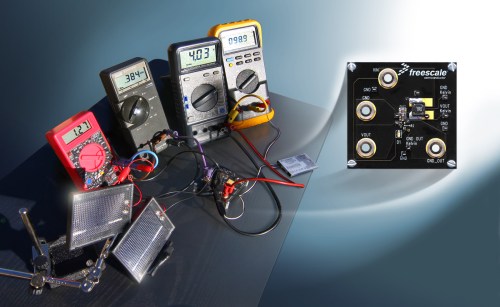
Freescale Semiconductor on Monday is unveiling a new power conversion technology that the chipmaker says will dramatically enhance the efficiency of solar cells and other devices by allowing them to operate at low voltages.

That means a single solar cell attached to a mobile phone or other handheld device could charge the gadget. The bigger potential is to maximize the electricity generated from rooftop solar panels. which typically contain a dozen or more solar cells each. When a cloud or a tree shades part of a solar panel, power output from all the solar cells drops because they are linked together. By integrating Freescale’s power convertersamsung-blue-earth1 into each solar cell, those that aren’t shaded can still produce electricity, according to Arman Naghavi, general manager of Freesale’s Analog, Mixed-Signal & Power Division.

That’s because each solar cell can operate at much lower voltages when Freescale’s (FSL) converter is used. While most electronics need a jolt of 700 millivolts to begin working, Freescale’s technology allows them to operate on as little as 320 millivolts. (See video below.)

Sounds geeky but the consequences could be far-ranging, reducing electricity consumption and opening the door to a new generation of solar-powered devices.  One big hurdle to using solar cells to power everything from laptops to street lights is that it takes too many of them to produce enough power to be practicable. After all, who’s going to carry around a solar panel to charge their MacBook.

Freescale’s technology could change that equation. “For instance, you wouldn’t have to put a battery in a garage door opener – just add a solar strip on the remote control,” Kevin Parmenter, a Freescale applications engineering manager, told Green Wombat. (Samsung last week announced it would start selling a mobile phone (photo above) equipped with a solar panel but it’s unclear just how much talk or texting time it would allow.)

Other uses are more sci-fi: self-powered nanosensors that tap the technology to harvest ambient heat or friction in the environment.

The converter will hit the market in the second half of 2009. Potential customers include solar cell makers like SunPower (SPWRA) and Suntech (STP) as well as biomedical companies and defense contractors. Freescale, headquartered in Austin, Texas, was spun out of Motorola (MOT) in 2004.

“It really helps the entire green movement,” says Naghavi. “We are seeing a tremendous interest from lots of areas historically we have never touched or played in.”


Read Full Post »

scibToshiba and Volkswagen on Thursday unveiled a partnership to develop next-generation battery systems for electric cars.

For the Japanese conglomerate, the VW deal is just its latest green tech move.  Though known in the United States mainly for its laptop computers, Toshiba is the General Electric (GE) of Japan – it makes everything from consumer electronics to medical devices to nuclear power plant components.

In January, Toshiba announced that it was getting into the solar power plant business to build photovoltaic farms for utilities. The company also said it would install carbon-capture technology at a coal-fired power plant in Japan as part of a pilot project.

But its development of advanced battery technology could have the biggest impact.  Toshiba’s Super Charge ion Battery, or SCiB, can charge to 90% capacity in ten minutes, depending on its use, according to the company. Laptop versions of the SCiB can be discharged 6,000 times versus 500 times for a conventional battery. Larger versions of the battery are used to power electric bicycles and industrial equipment like forklifts. The real breakthrough will come if the SCiB can be adapted for electric cars.

“One of our big target markets is the automobile market,” Craig Hershberg, Toshiba’s director of environmental affairs, told Green Wombat. “We’re currently talking to one of the big automakers in the U.S.”

He declined to name the car company but General Motors (GM), Ford (F) and Chrysler have all accelerated electric car programs as have Toyota (TM) and Honda (HMC). Those talks probably will get a boost from the stimulus bill passed this week that gives a $7,500 tax credit to consumers who purchase plug-in electric hybrid vehicles.

The company is building a SCiB factory in Japan and is also exploring the potential of the SCiB to store electricity generated by solar power plants and wind farms.

“Toshiba aims to make SCiB a mainstay of its industrial systems and automotive products businesses worldwide,” the company said in a statement.

Read Full Post »

« Newer Posts - Older Posts »

Design a site like this with WordPress.com
Get started