Feeds:
Posts
Comments

Archive for the ‘green policy’ Category

photo: SolarCity

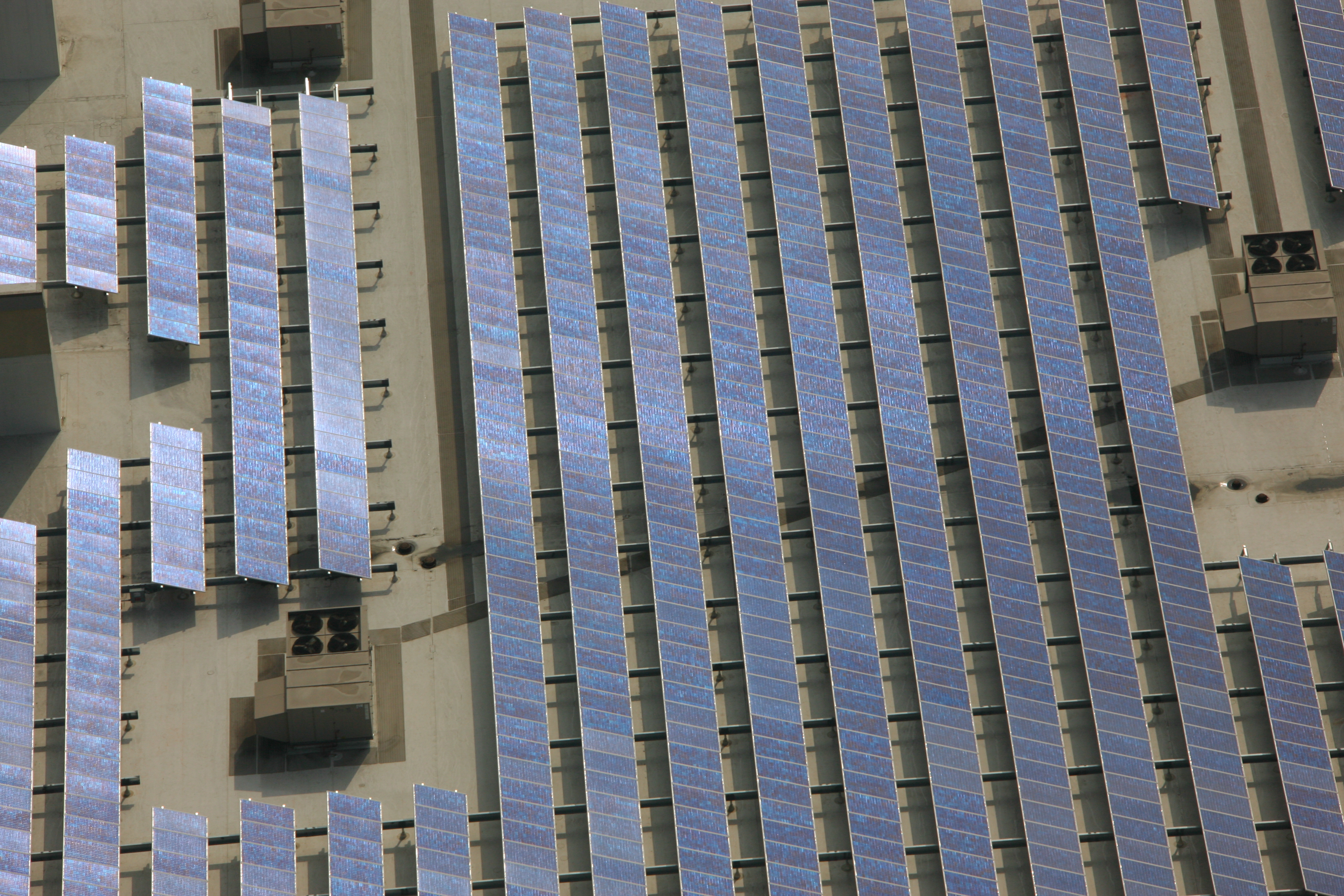
In The New York Times on Monday, I write about a $100 million tax equity fund created by PG&E Corporation to finance residential solar installations:

P.G.&E. Corporation, the California utility holding company, has created a $100 million tax-equity fund to finance residential solar installations by SunRun, a San Francisco start-up that leases photovoltaic arrays to homeowners.

The fund, managed by a P.G.&E. subsidiary, Pacific Energy Capital II, is the largest single solar leasing pool to date, according to the company, and marks the growing interest of utilities in the renewable energy financing business.

“We’re in somewhat of a unique position in that roughly half of the nation’s rooftop solar installations are in our service territory,” Brian Steel, P.G.&E.’s senior director of corporate strategy, said in an interview. “We’re at the proverbial ground zero of these new technologies and so perhaps more than any utility holding company in the country we have a strategic imperative to get ahead of the curve through having a propriety seat at the table with a partner like SunRun.”

The financing, announced Monday, follows P.G.&E.’s creation of a $60 million tax-equity vehicle in January for SolarCity, a Silicon Valley company that also leases solar arrays to homeowners.

The $100 million in financing is expected to fund solar installations for 3,500 homes in Arizona, California, Colorado, Massachusetts and New Jersey.

“That a major energy company like P.G.&E. is coming to the table illustrates that distributed solar is becoming part of the mainstream energy business,” said Edward Fenster, SunRun’s chief executive.

You can read the rest of the story here.

Read Full Post »

photo: Todd Woody

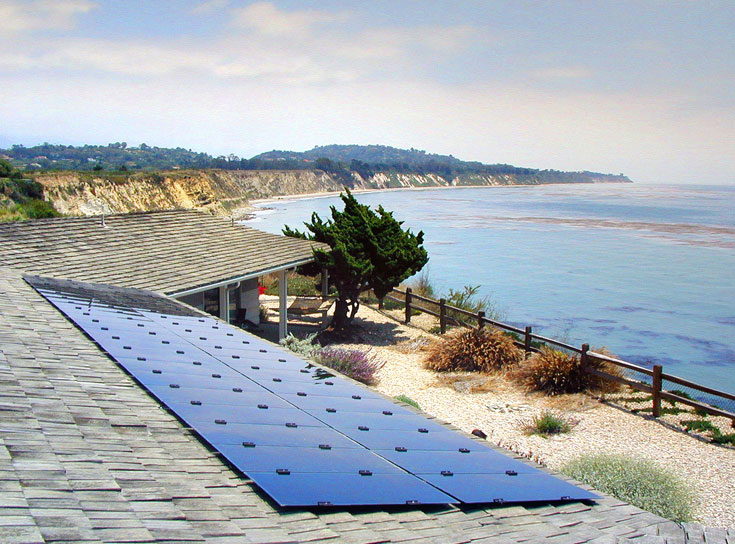
In The New York Times on Thursday, I write about the solar industry’s dismay over the rent and other fees the United States government will charge developers to build big solar power plants on federal land in the desert Southwest:

The nation’s biggest landlord, the United States government, has set the rent it will charge developers who build solar power plants on federal land, and some prospective tenants are not happy.

Solar developers will actually pay two fees – the lease for the land along with what the Bureau of Land Management calls a “megawatt capacity fee” based on how much electricity a project generates.

“Since we don’t have authority to collect royalties for wind and solar projects, we had to come up with a methodology to convert that electrical generation into an upfront rent payment,” Ray Brady, manager of the bureau’s renewable energy team, said in an interview.

But potential developers see a disparity. “The proposed B.L.M. rental fees are in many cases two times higher than market rates for private land,” Monique Hanis, a spokeswoman for the Solar Energy Industries Association, said in an e-mail message. “The B.L.M. must collect ‘fair market value’ from developers, but this seems to go beyond that threshold.”

That methodology is a work in progress as the agency tries to adapt decades-old formulas designed for oil and gas leasing and mineral extraction to renewable energy production.

Some 23 million acres of federal property are suitable for large-scale solar development, according to the bureau, and the agency has received more than 200 lease applications from developers who covet hot and sunny desert real estate in the Southwest.

Solar farms typically require vast swaths of land, meaning the lease fees can be considerable depending on a project’s location and local property values. The Bureau of Land Management’s solar rents range from $15.70 an acre in Hidalgo County, N.M., to $313.88 an acre in Riverside County, Calif.

For instance, BrightSource Energy will pay the government about $427,000 a year in rent for its 3,400-acre Ivanpah Solar Electric Generating System in San Bernardino, Calif., now undergoing licensing. The company, based in Oakland, Calif., will also pay an annual megawatt capacity fee of $2.6 million for the 392-megawatt solar thermal power plant. Fees over the 25-year life of the contracts that BrightSource has signed with California utilities would total about $76 million.

In neighboring Riverside County, First Solar, a solar module maker and developer based in Tempe, Ariz., plans to build a 550-megawatt photovoltaic farm on 4,410 acres of federal land. Lease and capacity fees for the Desert Sunlight project will total about $4.3 million a year.

The agency is charging different capacity fees for different solar technologies. Photovoltaic power plants, which deploy solar panels like those found on residential rooftops, are assessed $5,256 a megawatt.

Developers of more efficient solar thermal power plant, which uses mirrors to heat liquids to generate steam that drives a turbine, pay $6,570 a megawatt. The same rate is charged for concentrating photovoltaic farms that use mirrors to focus the sun on a highly efficient solar cell.

If either technology uses energy storage systems to produce electricity when the sun doesn’t shine, the fee jumps to $7,884 a megawatt. The fees will be phased in over the first five years of a power plant’s operation.

Some developers and environmentalists argue that such a fee structure penalizes technologies that are more efficient and thus use less land.

“This is an unfortunate way of emphasizing one technology over another,” said Bobby McEnaney, a land program expert at the Natural Resources Defense Council.
You can read the rest of the story here.

Read Full Post »

This post first appeared on Grist.

Legislation pending in New York that would require the state to install 5,000 megawatts of solar power by 2025 could generate 22,198 jobs and boost the economy by $20 billion, according to a report released by Vote Solar on Wednesday.

The cost to consumers would be just a 39-cent-a-month hike on their utility bills, the report found.

Vote Solar, a San Francisco non-profit that is backing the bills in the New York legislature along with the Natural Resources Defense Council and other environmental groups, commissioned the study conducted by Crossborder Energy. Described as an independent consultant, Crossborder relied on economic models developed by the National Renewable Energy Laboratory to make its projections.

“We note that in an effort to be conservative in our assumptions, these benefits are calculated without taking into account any potential new manufacturing,” the report stated. “Precedent shows that states that make a clear commitment to clean energy see reciprocal investment on behalf of manufacturing companies. For example, in both Arizona and California, the states’ strong and transparent policies were fundamental to the decisions of two major global solar manufacturers…to locate their first domestic manufacturing operations in those states.”

New York currently has less than 25 megawatts of solar installed. The New York Solar Jobs and Development Act would require the state’s utilities to install enough solar to account for at least 2.5 percent of their electricity sales by 2025. Those targets could be reached through residential and commercial rooftop solar installations or by building solar power plants. Utilities could own and operate their own solar power facilities to meet 25 percent of their mandate.

But the legislation does not specify incentives or other policies to encourage solar installations, which would inevitably affect the cost of the program for developers and consumers.

Read Full Post »

Photo: The White House

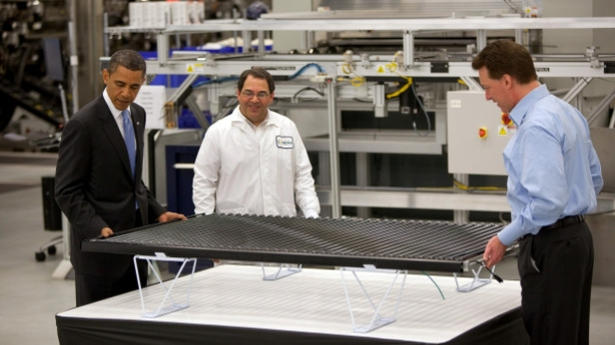
In my new Green State column on Grist, I attend President Obama’s speech at a Silicon Valley solar panel factory:

Silicon Valley in the Internet age has not made for great presidential photo ops. The Valley’s computer-chip factories were off-shored decades ago and (Google excepted) the software giants that supplanted hardware companies just didn’t have the same pizzazz — T-shirted geeks writing code can’t compete with guys and gals in bunny suits tending big futuristic machines.

The rise of green tech has changed all that. The Valley is back in the business of building stuff — solar panels, electric cars, fuel cells, and various energy efficient widgets and gadgets.

And so when President Obama’s helicopter landed Wednesday morning at Solyndra, a solar module maker, a television-ready tableau awaited — a huge American flag hung in an unfinished factory, shiny high-tech thin-film solar panels were on display and workers in hard hats mingled with an audience of some 200 engineers, scientists, venture capitalists, and California’s patron saint of green tech PR events, Governor Arnold Schwarzenegger.

“We’ve got to go back to making things. We’ve got to go back to exports. We’ve got to go back to innovation,” said Obama on Wednesday in Fremont as Solyndra employees snapped photos with their iPhones.

“The true engine of economic growth will always be companies like Solyndra, will always be America’s businesses,” he continued. “But that doesn’t mean the government can just sit on the sidelines.  Government still has the responsibility to help create the conditions in which students can gain an education so they can work at Solyndra, and entrepreneurs can get financing so they can start a company, and new industries can take hold.”

It’s an apt choice of words, for the fortunes of green tech startups like Solyndra have become entwined with the government as the Obama administration attempts to jumpstart a transition to a clean energy economy. The sprawling solar module plant we’re standing in — its construction is employing 3,000 workers — is being financed thanks in large part to a $535 million loan guarantee the Department of Energy granted to Solyndra last year.

You can read the rest of the column here.

Read Full Post »

photo: Todd Woody

Green Wombat has been in transition so I’m a bit behind on posting. In case you missed it, in the Sunday New York Times on May 9, I wrote a profile of David Gelbaum, one of the nation’s biggest — and until now — most reclusive green technology investors and environmental philanthropists:

AMID the $6 million homes perched on a beachfront cliff in this conservative Southern California enclave, the seven-year-old Honda Civic hybrid with the Obama bumper sticker is the giveaway.

It’s not the usual drive of choice for wealthy former hedge fund managers like David Gelbaum. Then again, there’s not much that is business as usual about Mr. Gelbaum, an intensely private person who happens to be one of the nation’s largest — and largely unknown — green technology investors and environmental philanthropists.

Mr. Gelbaum has invested $500 million in clean-tech companies since 2002 through his Quercus Trust, amassing a portfolio of some 40 businesses involved in nearly every aspect of the emerging green economy, be it renewable energy, the smart electric grid, sustainable agriculture, electric cars or biological remediation of oil spills. He has poured almost as much into environmental causes.

“I think his impact on green technology is huge,” says Bill Gross, the serial technology entrepreneur and founder of eSolar, a solar power start-up in which Mr. Gelbaum has invested. “He is supporting bolder and riskier bets, and he’s doing it from a different filter than a traditional venture capitalist, and I think that makes a wider opportunity for success.”

In this economic downturn, many venture capitalists have grown cautious about putting money into what Vinod Khosla, the prominent Silicon Valley green tech investor, calls “science experiments.” But Quercus Trust is still taking chances on blue-sky start-ups pursuing technological breakthroughs.

Working outside the clubby venture capital network, Mr. Gelbaum has, until recently, maintained an obsessively low profile. In Silicon Valley, he remains something of an unknown. Associates say his near-invisibility is owed to a genuine modesty and concerns over the security of his family because of his wealth. Recipients of his philanthropy, for instance, signed confidentiality agreements that forbade mention of his name.

Mr. Gelbaum says he decided to break his long silence upon becoming chief executive in February of Entech Solar, one of his portfolio companies that is publicly traded. “This is what’s best for the company,” he says, pointing out that Entech benefits if he maintains a more public profile.

It is too early to predict whether Mr. Gelbaum’s big green bets will pay off. But he’s been capitalizing on two trends: the rapid decline in the price of photovoltaic power, and a focus on cutting capital costs as solar power competition with China intensifies.

His environmental philanthropy also gives him an influence beyond laboratories and boardrooms. He has given $200 million to the Sierra Club and $250 million to the Wildlands Conservancy, a land trust he co-founded that has acquired and preserved 1,200 square miles of land in California, including more than a half million acres of the Mojave Desert.

You can read the rest of the story here.

Read Full Post »

photo: Todd Woody

In The New York Times on Wednesday, I write about California regulators’ preliminary decision to reject requests by two big utilities to install grid-connected fuel cells:

While Google, Wal-Mart and other corporations have embraced fuel cells, California regulators have turned down requests from the state’s two biggest utilities to install the technology.

In a preliminary decision, an administrative law judge with the California Public Utilities Commission found unwarranted an application from Pacific Gas and Electric and Southern California to spend more than $43 million to install fuel cells that would generate six megawatts of electricity.

The technology transforms hydrogen, natural gas or other fuels into electricity through an electrochemical process, emitting fewer or no pollutants, depending on the type of fuel used.

“It is unreasonable to spend three times the price paid to renewable generation for the proposed Fuel Cell Projects, which are nonrenewable and fueled by natural gas,” wrote the administrative law judge, Dorothy J. Duda, in a proposed ruling issued last week. “In addition, the applications do not satisfactorily address how full ratepayer funding of utility-owned fuel cell generation would enhance private market investment and market transformation of the fuel cell industry.”

You can read the rest of the story here.

Read Full Post »

photo: Todd Woody

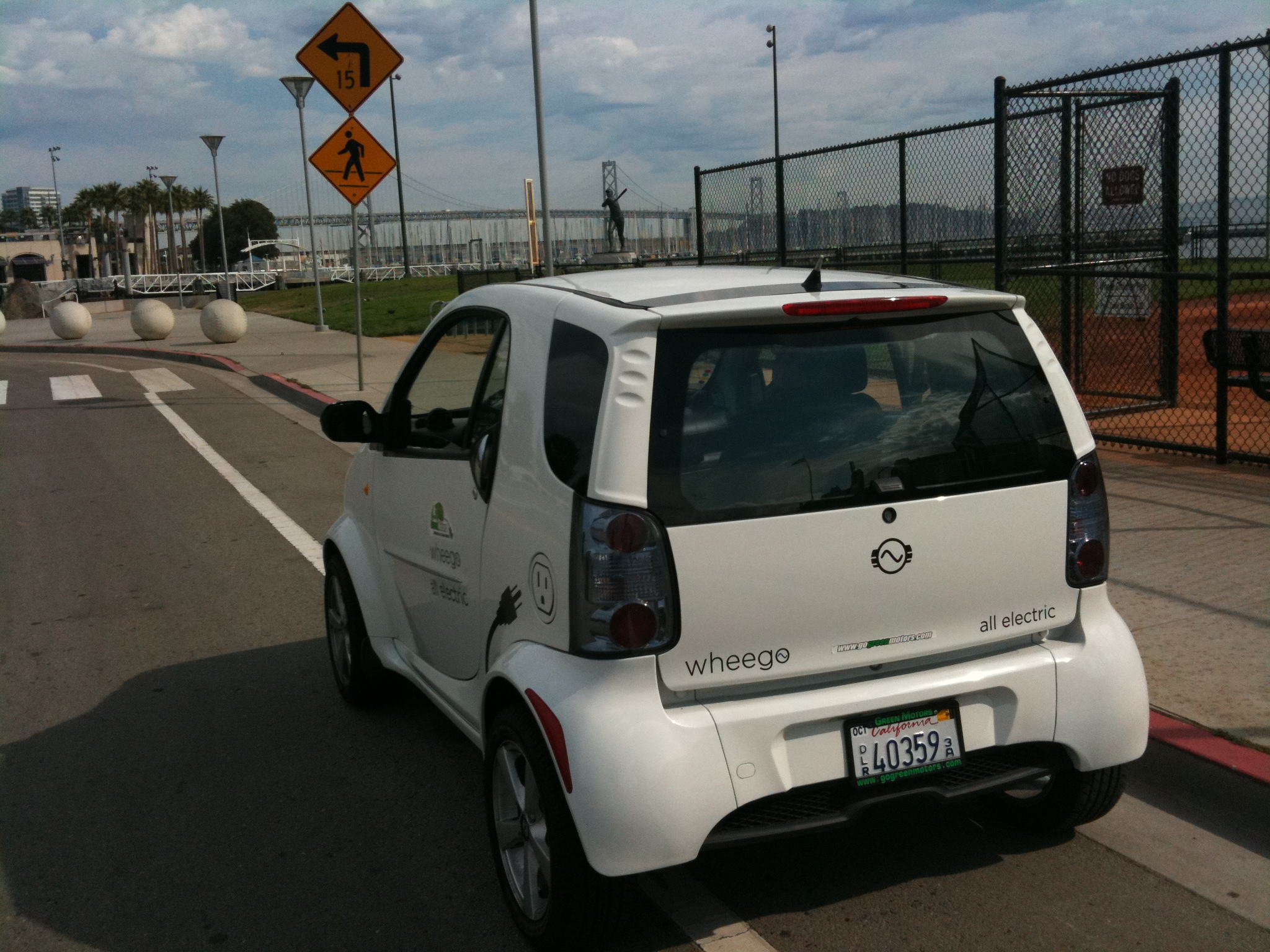
In a story I wrote with Clifford Krauss in Monday’s New York Times, I look at how the San Francisco Bay Area has is scrambling to prepare for the arrival of mass-market electric cars later this year:

SAN FRANCISCO — If electric cars have any future in the United States, this may be the city where they arrive first.

The San Francisco building code will soon be revised to require that new structures be wired for car chargers. Across the street from City Hall, some drivers are already plugging converted hybrids into a row of charging stations.

In nearby Silicon Valley, companies are ordering workplace charging stations in the belief that their employees will be first in line when electric cars begin arriving in showrooms. And at the headquarters of Pacific Gas and Electric, utility executives are preparing “heat maps” of neighborhoods that they fear may overload the power grid in their exuberance for electric cars.

“There is a huge momentum here,” said Andrew Tang, an executive at P.G.& E.

As automakers prepare to introduce the first mass-market electric cars late this year, it is increasingly evident that the cars will get their most serious tryout in just a handful of places. In cities like San Francisco, Portland, Ore., and San Diego, a combination of green consciousness and enthusiasm for new technology seems to be stirring public interest in the cars.

The first wave of electric car buying is expected to begin around December, when Nissan introduces the Leaf, a five-passenger electric car that will have a range of 100 miles on a fully charged battery and be priced for middle-class families.

Several thousand Leafs made in Japan will be delivered to metropolitan areas in California, Arizona, Washington state, Oregon and Tennessee. Around the same time, General Motors will introduce the Chevrolet Volt, a vehicle able to go 40 miles on electricity before its small gasoline engine kicks in.

“This is the game-changer for our industry,” said Carlos Ghosn, Nissan’s president and chief executive. He predicted that 10 percent of the cars sold would be electric vehicles by 2020.

You can read the rest of the story here.

Read Full Post »

photo: Picarro

I follow up my story in Wednesday’s New York Times about California’s move to build the first statewide greenhouse gas monitoring network with a look at why such programs may be necessary to prevent a meltdown in the carbon markets:

In Wednesday’s New York Times, I write about California’s move to set up what is believed to be the world’s first statewide greenhouse gas monitoring network.

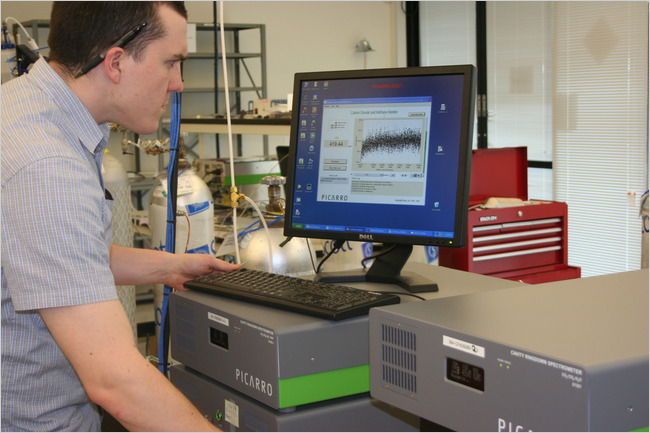
The Silicon Valley company Picarro manufacturers greenhouse gas measurement devices.
The first objective of the network, which will place analyzers around the state to measure methane in the atmosphere, will be to determine if actual emissions match estimates.

The California Air Resources Board assembles those estimates, called inventories, from computer models that rely on data such as how many grams of methane is burned per gallon of gasoline multiplied by the number of gallons sold in the state.

Such models, which follow protocols established by the United Nation’s Intergovernmental Panel on Climate Change, are used worldwide. And while monitoring stations scattered around the world measure average global greenhouse gas concentrations, they don’t identify how much methane is being released in, say, California’s Central Valley, where methane emissions from livestock are assumed to be plentiful.

The recent Copenhagen climate change talks faltered in part over the issue of how to verify emissions. And the integrity of emissions trading schemes will depend on ensuring that companies don’t game the market by deliberately or inadvertently under-reporting how much carbon they’re putting into the atmosphere.

“If the markets are not matching reality, we will find out at some point and the markets will then adjust with a huge shock,” said Pieter Tans, a senior scientist with the National Oceanic and Atmospheric Administration’s Earth System Research Laboratory in Colorado.

You can read the rest of the story here.

Read Full Post »

photo: Picarro

In The New York Times on Wednesday, I write about California’s move to deploy the world’s first statewide greenhouse gas monitoring network:

SAN FRANCISCO — California is preparing to introduce the first statewide system of monitoring devices to detect global-warming emissions, installing them on towers throughout the state.

The monitoring network, which is expected to grow, will initially focus on pinpointing the sources and concentrations of methane, a potent contributor to climate change. The California plan is an early example of the kind of system that may be needed in many places as countries develop plans to limit their emissions of greenhouse gases.

“This is the first time that this is being done anywhere in the world that we know of,” said Jorn Dinh Herner, a scientist with the California Air Resources Board.

While monitoring stations around the globe already detect carbon dioxide, methane and other greenhouse gases, they are deliberately placed in remote locations and are generally intended to measure average global concentrations of greenhouse gases rather than local emissions.

The California network, by contrast, is meant to help the state find specific sources of emissions, as well as to verify the state’s overall compliance with a plan it adopted to limit greenhouse gases.

The air resources board has bought seven portable analyzers made by Picarro, a company in Silicon Valley that also supplies the machines to the federal government and academic scientists.

By this summer, the analyzers will be deployed on towers in the San Joaquin and Sacramento Valleys, home to large agricultural operations and oil fields, and on Mount Wilson, outside Los Angeles. Data will also be collected from Picarro machines maintained by the Lawrence Berkeley National Laboratory on the coast and from several monitoring stations operated by other agencies.

You can read the rest of the story here.

Read Full Post »

The ability to fast-charge electric cars is seen as key to the adoption of battery-powered vehicles. But as I wrote in The New York Times on Thursday, utilities are worried such devices will overload the grid:

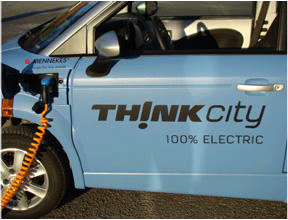
Think, the Norwegian electric automaker, announced a deal this week with a California company, AeroVironment, a maker of electric vehicle charging stations, to introduce fast-charging stations that can charge its battery-powered City car to 80 percent capacity in as little as 15 minutes.

A conventional charger can take eight or more hours to charge an electric car, depending on the battery.

“The development and deployment of very-fast-charge stations will help speed the electrification of automobiles in the United States and globally,” Richard Canny, Think’s chief executive, said in a statement.

But utilities — concerned that fast-chargers could overload the electricity grid — are more cautious.

Think and AeroVironment did not reveal the voltage of their fast-charger but such devices — known in the industry as “Level 3” chargers — generally average around 440 volts. Most household appliances run on 110 volts.

“It is premature to evaluate the feasibility or safety of Level 3 fast-charging equipment,” wrote Christopher Warner, a lawyer for the utility Pacific Gas and Electric, in a brief filed with the California Public Utilities Commission in October. “Such charging may require large investments in infrastructure and load management constraints in order to prevent ‘mini-peaks’ and localized impacts on grid reliability.”

You can read the rest of the story here.

Read Full Post »

« Newer Posts - Older Posts »

Design a site like this with WordPress.com
Get started