Feeds:
Posts
Comments

Archive for the ‘green policy’ Category

I wrote this post for Grist, where it first appeared.

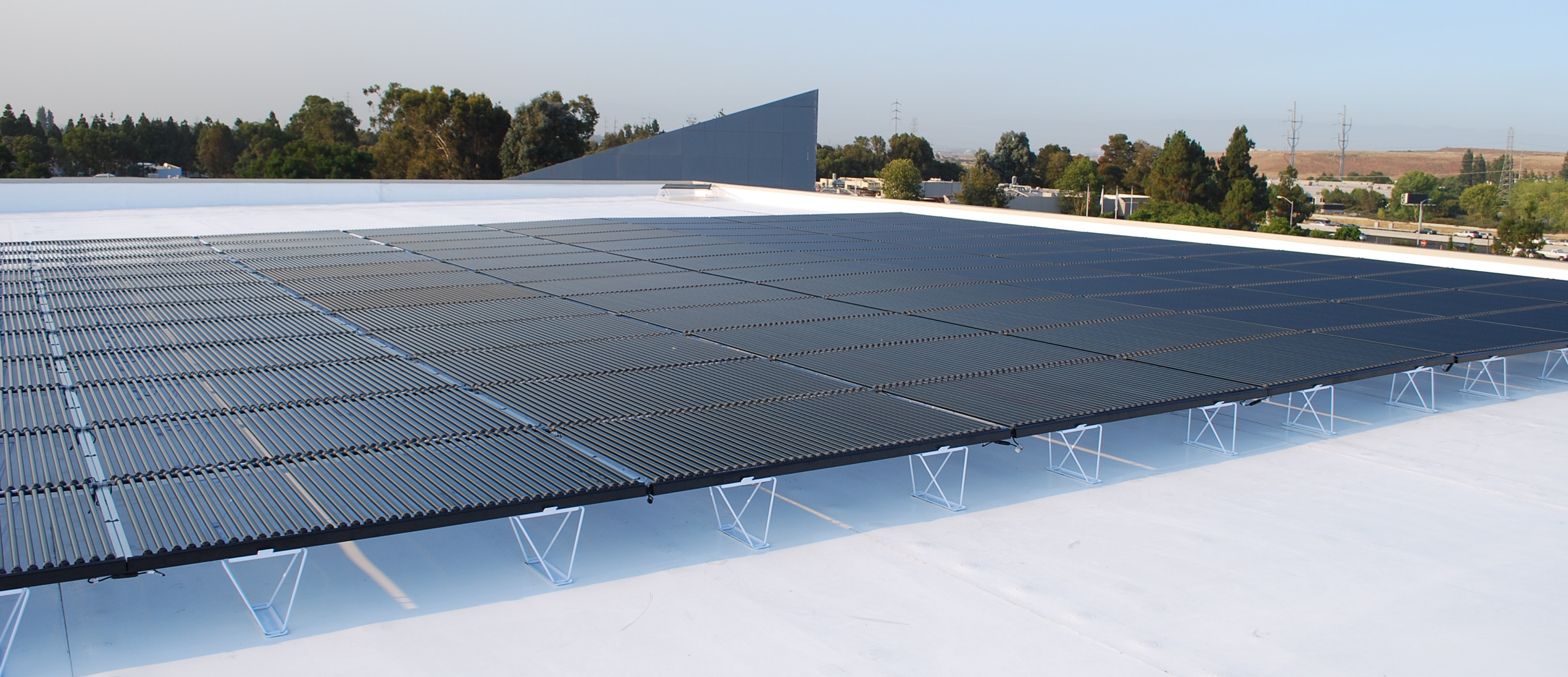
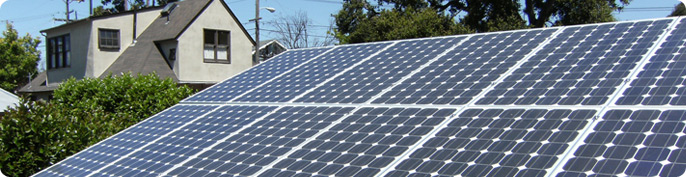
As the Great Recession drags on in California — unemployment rate: 12.4 percent, state government in a state of collapse — the solar boom continues.

The Golden State’s decade-long program to install 3,000 megawatts of photovoltaic arrays on residential and commercial rooftops kicked off in 2007, not too long before the global economic collapse began.

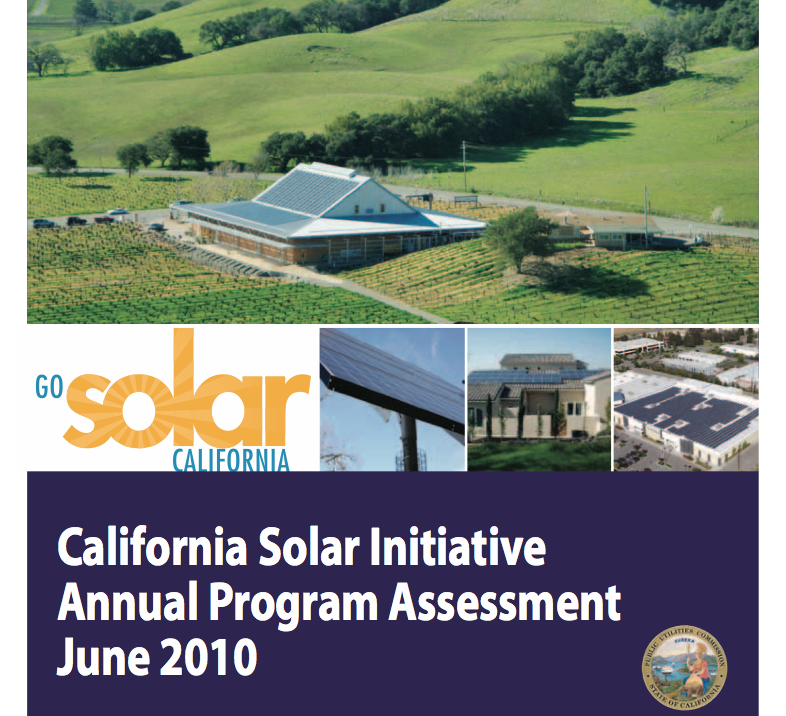
Only three years in, the program — known as the California Solar Initiative — has achieved 42 percent of its 1,750 megawatt target in markets served by the state’s three, big investor-owned utilities, according to a report released Friday by the California Public Utilities Commission. Completed projects account for 20 percent of that 42 percent figure, while another 22 percent are pending installations. (In 2009, the solar program eliminated 180,136 tons of carbon, the equivalent of taking 31,000 cars off the road.)

Demand for solar is accelerating even as the housing market remains in the doldrums. Applications for the solar rebate program hit a high of 134 megawatts in April, and in the first six months of 2010 a total of nearly 300 megawatts’ worth of projects were received.

“The monthly demand for new applications has been well over 1,000 applications per month for the past year,” the report stated.

And Californians’ appetite for solar has grown even as the rebate for new photovoltaic systems has declined, as it is designed to do over the life of the program.

State and federal tax incentives have cut the cost of a solar array roughly in half. And last year’s global glut of photovoltaic modules and the influx of Chinese solar companies into the U.S. market has led to drops in the price of solar panels. (Installation costs still account for about half the price of a solar array.) Overall, the cost of solar systems smaller than 10 kilowatts has dropped by 15 percent between 2007 and 2010 while the price of bigger arrays has fallen 10 percent, according to a report released Friday by the California Public Utilities Commission. (In general, a 10-kilowatt solar array could power a large home or commercial building.)

But one of the biggest factors persuading Californians to go solar appears to be the increasing availability of solar leases. These financial arrangements allow homeowners to have a system installed at little or no upfront cost in exchange for a monthly fee.

Companies such as SolarCity, Sungevity, and SunRun offer solar leases and retain ownership of the rooftop arrays. In 2009, such ownership of solar systems enrolled in the state program jumped 155 percent. Forty percent of the megawatts now generated through the program are owned by leasing companies or other third parties.

Fueling that trend has been the hundreds of millions of dollars that financial giants such as U.S. Bancorp have poured into solar financing funds for SolarCity, Sungevity, and SunRun. So far this year, PG&E Corporation, the parent company of California utility PG&E, has created funds totaling $160 million to finance solar leases for SolarCity and SunRun customers.
Read Full Post »

photo: PG&E

I wrote this post for Grist, where it first appeared.

Amid the hullabaloo over government-chartered mortgage giants derailing the green financing program known as Property Assessed Clean Energy, or PACE, the march toward distributed generation of renewable energy — that is, generating electricity from decentralized sources such as rooftop solar panels or backyard wind turbinescontinues.

Case in point: The Sacramento Municipal Utility District (SMUD) announced Wednesday that it had awarded contracts to San Francisco’s Recurrent Energy to install 60 megawatts’ worth of solar panels in the region surrounding California’s state capital.

Rather than construct a central solar power station, Recurrent will scatter a dozen five-megawatt installations around two cities in Sacramento County. Each installation will be located near an existing substation, which means that the solar arrays can be plugged directly into the grid without requiring any expensive transmission upgrades.

As I wrote earlier this year in Grist, when SMUD put 100 megawatts of renewable energy contracts out for bid, the allocation sold out within a week. The utility is paying the solar developers a standard premium for their photovoltaic energy — called a feed-in-tariff. But according to calculations done by Vote Solar, a San Francisco non-profit that promotes solar energy, SMUD will pay no more for this clean green solar electricity than it does for fossil-generated power at peak demand times. A 40-percent plunge in solar module costs over the past year has made solar photovoltaic energy increasingly competitive with natural gas, the main fossil fuel used in California to generate electricity.

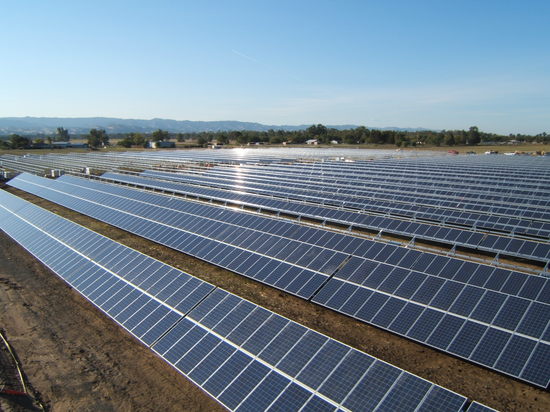
California’s two big investor-owned utilities, PG&E and Southern California Edison, have launched similar distributed generation programs, which will bring 1,000 megawatts of photovoltaic installations online over the next five years. At peak oputput, that’s the equivalent of a nuclear power plant.

Two weeks ago, PG&E cut the ribbon on the first project to come online as part of its 500-megawatt distributed generation initiative. The two-megawatt Vaca-Dixon Solar Station is built near a utility substation 50 miles north of San Francisco.

It took just nine months to install the fields of solar panels for the Vaca-Dixon station — that’s light speed in a state where the first new big solar thermal power plant in 20 years, BrightSource Energy’s Ivanpah project, has been undergoing licensing for nearly three years.

Solar thermal power plants generate electricity by using mirrors to focus the sun on a liquid-filled boiler. The process creates create steam that drives a conventional turbine which can generate hundreds of megawatts of electricity. Solar thermal projects, by nature, are large centralized facilities, the clean and green versions of a big fossil-fuel power plant.

Photovoltaic farms, on the other hand, generate electricity when sunshine strikes semiconducting materials in a solar cell. If you want to produce more power, you just keep adding solar panels.

While BrightSource hopes to secure a license for its solar thermal project soon, the developer of a hybrid biomass solar trough power plant to be built in California’s Central Valley pulled the plug on the project last month, after spending 18 months and untold millions of dollars in the licensing process before the California Energy Commission.

PG&E has been depending on both those solar thermal projects to supply electricity to help it meet its renewable energy mandates. No wonder then, the utility’s growing enthusiasm for solar panel power. Photovoltaic farms do not have to be approved by California Energy Commission and can be built on already degraded land or close to cities.

And as I reported last month, the developer of another project being built to generate electricity for PG&E, the Alpine SunTower, decided to drop solar thermal technology made by its partner, eSolar, in favor of photovoltaic panels. The official explanation for the switch was that project was being downsized due to transmission constraints and solar panels proved a better fit.

But one has to wonder if economics as much as energy was behind the change. If so, deals like the one SMUD struck could be a recurrent theme.

Read Full Post »

photo: Sungevity

I wrote this post for Grist, where it first appeared.

On Tuesday, the Federal Housing Finance Agency effectively shut down an innovative green financing program called Property Assessed Clean Energy, or PACE, by restricting the ability of homeowners to take out loans to install solar panels and make other energy efficiency improvements.

Now the United States Treasury Department has piled on. A new Treasury directive tells the nation’s banks how to enforce the FHFA rules. The move could pose new problems for homeowners who have PACE loans, and complicate efforts to get the program back on track.

Homeowners repay PACE loans through an annual assessment on their property taxes. On Tuesday, the Treasury Department told banks that if a homeowner has a home equity line of credit, the amount of money available should be lowered to account for the loan liability. The Treasury also said homeowners could be required to put their PACE payments in an escrow account.

After Fannie Mae and Freddie Mac, the government chartered mortgage finance giants, raised concerns about PACE in May, some lenders declined to refinance mortgages that carried PACE liens.

Owners of commercial properties who hold PACE loans may need to put up additional collateral to back up the loan, according to the Treasury Department letter.

Cisco DeVries, president of Renewable Funding, an Oakland, Calif., company that designs and administers PACE programs for local governments, said he wants to make sure PACE loans for commercial owners won’t be curtailed.

“We believe PACE commercial can go ahead as it has always required lender consent when a commercial mortgage is in place,” he wrote in an email. “We just want to make sure we don’t run into an unexpected problem as we move forward.”

Some municipalities sell bonds to finance energy-efficiency loans for homeowners. But they may find that harder to do under the Treasury Department directive, which warned banks to move cautiously when underwriting such bonds.

I reported in the The New York Times on Tuesday that the Federal Housing Finance Agency had rejected the Obama administration’s offer of a two-year guarantee against any PACE-related mortgage losses Fannie or Freddie might suffer.

Now in a move that PACE proponents say adds insult to injury, the Treasury Department is advising banks to get local governments to insure them against any losses from the program if homeowners default on their mortgages.

Among those not amused by the FHFA action was California Gov. Arnold Schwarzenegger.

“The FHFA’s bureaucratic breakdown threatens one of California’s most promising new engines of job creation in this struggling economy,” Schwarzenegger said in a statement. “FHFA’s action threatens thousands of new sustainable jobs in California, especially in the hard-hit construction industry, while denying homeowners the opportunity to reduce monthly energy costs and add equity to their homes.”

Read Full Post »

In The New York Times on Tuesday, I write about the latest developments in the Fannie Mae/Freddie Mac – PACE solar loan saga:

The federal agency that oversees two government-chartered mortgage finance companies imposed new restrictions Tuesday on homeowners’ ability to take advantage of a program that allows them to repay the cost of installing solar panels and other energy improvements through an annual surcharge on their property taxes.

The new guidelines could also make it more difficult for homeowners to obtain mortgages even if they don’t participate in the programs, called Property Assessed Clean Energy, or PACE, but happen to live in an area where they are offered.

“For all intents and purposes, until cooler heads prevail or Congress acts, it’s very difficult to envision PACE going forward,” said Cisco DeVries, president of Renewable Funding, a company in Oakland, Calif., that creates and administers the programs for local governments.

In issuing the guidance to Fannie Mae and Freddie Mac, which buy and resell most mortgages, the Federal Housing Finance Agency was critical of the energy efficiency programs that have been authorized by 22 states and that have drawn $150 million in stimulus funding support from the Obama administration.

When a municipality pays for energy efficiency upgrades through the program, a lien is placed on the home. The liens, like other property tax assessments, take priority over the mortgage if the homeowner defaults.

But the housing agency on Tuesday characterized PACE liens as different from other special assessments that cities routinely use to finance sewers, sidewalks and other civic improvements.

“They present significant risk to lenders and secondary market entities, may alter valuations for mortgage-backed securities and are not essential for successful programs to spur energy conservation,” the agency wrote.

The Federal Housing Finance Agency said efforts were continuing to develop underwriting standards for energy efficiency programs.

“However, first liens that disrupt a fragile housing finance market and longstanding lending priorities, the absence of robust underwriting standards to protect homeowners and the lack of energy retrofit standards to assist homeowners, appraisers, inspectors and lenders determine the value of retrofit products combine to raise safety and soundness concerns,” the agency stated.

You can read the rest of the story here.

Read Full Post »

In Sunday’s New York Times, I have an update on the controversy surrounding Fannie Mae and Freddie Mac’s blocking of the PACE solar loan program:

Two government-chartered mortgage finance companies are unlikely to accept loans on homes that are part of a special program that lets homeowners repay the cost of energy improvements through a surcharge on their property tax bills, according to Energy Department officials.

The Obama administration has allocated $150 million in stimulus money to support the financing technique, called Property Assessed Clean Energy, or PACE, and 22 states have authorized such programs. In a separate stimulus effort, President Obama on Saturday announced nearly $2 billion in loan guarantees for solar energy production.

Through the PACE program, loans to install solar panels and make other energy improvements would be repaid through 20-year special assessments on property tax bills and secured through a lien.

On May 5, Fannie Mae and Freddie Mac, which buy and resell most home mortgages, notified lenders that such liens could not take priority over a mortgage but did not offer guidance on how to handle such loans. The uncertainty has frozen many PACE programs and led some energy companies to furlough workers.

On Friday, Cathy Zoi, an assistant secretary at the Energy Department, called officials in Boulder County, Colo., to inform them that the administration had been unable to persuade the Federal Housing Finance Agency, which oversees Fannie Mae and Freddie Mac, to accept mortgages with PACE liens.

The liens, like other property tax assessments, would be paid first if a homeowner defaults.

“She said in light of the circumstances we should look at other ways of financing energy efficiency with the stimulus money,” said Ben Pearlman, a commissioner in Boulder County.

“We’re very concerned,” Mr. Pearlman said. “It’s a powerful program and a powerful idea. We need to find an easy way for people to make those investments.”

Those homeowners who already carry energy liens on their property may find it difficult to refinance their mortgages. In Sonoma County, Calif., some lenders have declined to issue new loans for homes with such liens unless the assessment is paid off.

Ms. Zoi also called Cisco DeVries, president of Renewable Funding, a company in Oakland, Calif., that devises and administers PACE programs for local governments. “She indicated that the agencies had decided not to accept the liens and the administration needed to begin contingency planning on what to do with stimulus funding allocated for PACE,” Mr. DeVries said.

Dan Leistikow, the Energy Department’s director for public affairs, confirmed the calls. “We expect to get more written guidance from the regulators this week,” he said on Saturday.

You can read the rest of the story here.

Read Full Post »

photo: Solyndra

In The New York Times on Friday, I follow up my story in Thursday’s paper on mortgage giants Fannie Mae and Freddie Mac paralyzing PACE programs that allow homeowners to install solar arrays and make energy efficiency upgrades through an annual assessment on their property taxes:

In an article in The Times on Thursday, I explained how Fannie Mae and Freddie Mac, the government-chartered mortgage giants, have derailed an innovate financing program that lets homeowners pay for expensive solar panels and energy efficiency upgrades over time through an annual surcharge on their property tax bills.

The program is called Property Assessed Clean Energy, or PACE, and it has been authorized by 22 states since 2008. The energy improvement assessments are secured by a lien on the home, but the agencies, which hold more than half of mortgages in the United States, recently sent letters to lenders warning them that such liens could not take priority over a mortgage. Fannie and Freddie worry that if a homeowner defaults, taxpayers will be left in the lurch, as property taxes generally are paid before mortgages are.

Putting aside whether such liens are any different from the property tax assessments commonly used to finance municipal improvements, how big a potential liability would Fannie and Freddie face?

Not very big, according to an analysis by the California attorney general’s office.

You can read the rest of the story here.

Read Full Post »

image: California Energy Commission

In The New York Times on Friday, I write about another setback in California’s scramble to meet its renewable energy targets:

The developer of a hybrid biomass solar power plant to be built in California has abruptly canceled the project, underscoring the challenges the state faces in meeting its ambitious renewable energy goals.

Martifer Renewables, a Portuguese company, had signed a 20-year power purchase agreement with the California utility PG&E for 106.8 megawatts. The power was to be generated from a pair of power plants called San Joaquin Solar 1 and 2 that would be built on 640 acres of agricultural land in Fresno County. The facility would produce electricity from a solar field by day and burn biomass collected from area farms by night. But 18 months into an extensive licensing process and after recently depositing $250,000 for a transmission study, Martifer notified the California Energy Commission last month that it was withdrawing its license application.

The developer’s representatives did not return a request for comment. But in a June 17 letter to the energy commission, Miguel Lobo, a Martifer executive, wrote, “We were not able at this time to resolve some of our issues regarding project economics and biomass supply amongst other things.”

Although local residents and regulators had raised issues about the proposed solar farm’s water consumption and other impacts, it was the project’s plan to operate around the clock by burning biomass that proved problematic, according to energy commission records.

You can read the rest of the story here.

Read Full Post »

photo: Sonoma County

In Thursday’s New York Times, I write about how government-chartered mortgage giants Fannie Mae and Freddie Mac are derailing an innovative program called Property Assessed Clean Energy. PACE programs finance the installation of solar panels and energy efficiency upgrades and let homeowners repay the loans through a 20-year surcharge on their property tax bills.

SAN FRANCISCO — The Obama administration is devoting $150 million in stimulus money for programs that help homeowners install solar panels and other energy improvements, which they pay for over time on their property tax bills.

At the same time, the two government-chartered agencies that buy and resell most home mortgages are threatening to derail the effort by warning that they might not accept loans for homes that take advantage of the special financing.

The mixed messages have alarmed state officials and prompted many local governments to freeze their programs, which have been hailed as an innovative way to help homeowners afford the retrofitting of a house with solar panels, which can cost $30,000 or more before incentives.

“The thing that is maddening is that this is having a real-life impact with companies laying off people and homeowners in limbo as all these projects are stalled,” said Clifford Rechtschaffen, a special assistant attorney general in California.

Under the financing programs, a local government borrows money through bonds or other means, and then uses it to make loans to homeowners to cover the upfront costs of solar installations or other energy improvements. Each owner repays the loan over 20 years through a special property tax assessment, which stays with the home even if it is sold.

The technique, known as Property Assessed Clean Energy, or PACE, was pioneered by Berkeley, Calif., in 2008, and 22 states have authorized such programs, which are intended to make it easier and cheaper for homeowners to invest in energy efficiency. So far, only a few thousand people have used them.

But the Energy Department wants to promote the programs — and give an economic boost to companies that install energy systems — through the $150 million in stimulus funds, which are intended to help communities cover setup and administrative costs.

Fannie Mae and Freddie Mac, the government entities that guarantee more than half of the residential mortgages in the United States, have different priorities. They are worried that taxpayers will end up as losers if a homeowner defaults on a mortgage on a home that uses such creative financing. Typically, property taxes must be paid first from any proceeds on a foreclosed home.

In letters sent to mortgage lenders on May 5, Fannie Mae and Freddie Mac stated that energy-efficiency liens could not take priority over a mortgage. “The purpose of this industry letter is to remind seller/servicers that an energy-related lien may not be senior to any mortgage delivered to Freddie Mac,” wrote Patricia J. McClung, a Freddie Mac executive.

However, the agencies did not offer guidance to mortgage lenders on how to handle properties that carry the energy liens. Backers of the programs fear that mortgage lenders, who depend on Fannie and Freddie to buy their home loans, will now start demanding that the entire lien be paid off before issuing a new loan.

That is what happened to Deke DeKay of Healdsburg, Calif., when he sold a house in nearby Geyserville in May. Mr. DeKay, who had purchased the foreclosed home as an investment, put in new insulation and heating and cooling systems, financed by $11,000 from Sonoma County’s program.

“We thought this would be an interesting way of upgrading the home’s energy efficiency without adding to the purchase price,” Mr. DeKay said. “Then right before the close of escrow, the bank discovered this stuff Fannie Mae and Freddie Mae put out and refused to approve the loan without the assessment being paid off first.”

Now Mr. DeKay is worried about his own home, which carries a $25,500 lien for a five-kilowatt solar array installed last year. “If we ever want to refinance the house, it will be impossible for us to do that,” he said.

You can read the rest of the story here.

Read Full Post »

photo: Nissan

This post first appeared on Grist.

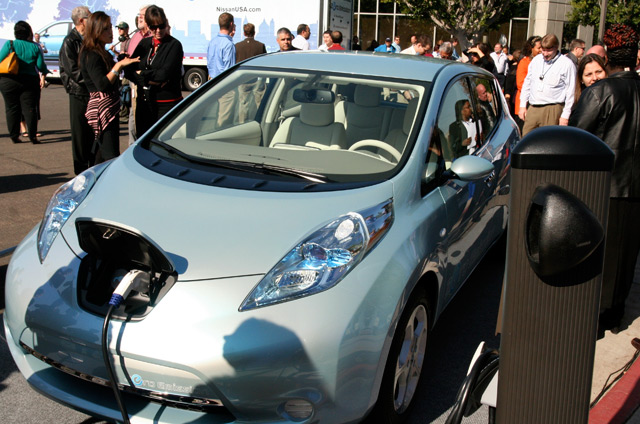
With the first mass-market electric cars set to hit California roads later this year, the state’s utilities have been working to ensure that early adopters – who tend to be clustered in places like Berkeley and Santa Monica – don’t overload neighborhood transformers and trigger local blackouts.

One way to do that is to encourage drivers not to plug in all at the same time, say when they arrive home from work and also crank up the air conditioning, is to set variable electricity rates that reward those who wait to charge until demand falls late at night or the wee hours of the morning.

What is unknown is whether such rates will actually change anyone’s behavior.

We’re about to find out. On Thursday, the California Public Utilities Commission approved a pilot project proposed by San Diego Gas & Electric to set variable rates for electric car charging.

“This information is critically important as we contemplate a future with widespread electric vehicle usage, given the additional electricity demand these vehicles create and the associated impacts on the grid,” Michael Peevey, the utilities commission president, said in a statement.

The project, which kicks off in January, will accompany the roll out of 1,000 Nissan Leaf electric cars in the San Diego area and the installation of home charging stations for each driver. Some 1,500 public charging stations will also be installed as well as 50 fast chargers that allow the cars’ batteries to be topped off in a matter of minutes rather than hours.

The San Diego effort is part of program backed by the United States Department of Energy called the EV Project that will put 5,700 Leafs and 2,600 Chevrolet Volts in garages in five states along with 14,650 charging stations and 310 fast chargers.

Under the plan greenlighted by California regulators on Thursday, San Diego Gas & Electric will bill Nissan Leaf drivers a range of rates, from a low of 7 cents a kilowatt/hour for summer “super off peak” charging to a high of 38 cents a kilowatt/hour during peak summer demand.

So will someone who has forked over $109,000 for a Tesla Roadster care about saving 31 cents a kilowatt hour? Probably not. What about the middle-of-the-road buyer of a $20,000 (after tax incentives) Nissan Leaf?

Maybe. But survey data that a California utility executive recently shared with me was not encouraging. Polling of likely electric car buyers showed that they were not particularly charged up about the prospect of saving money by delaying their EV gratification.

Another solution is smart charging. Drivers plug in when they get home but the charger communicates with the power grid to determine the optimal time to flip the switch.

That requires a smart grid and the California Public Utilities Commission on Thursday also approved a comprehensive plan to digitalize the state’s power system.

Read Full Post »

photo: Todd Woody

This post first appeared on Grist.

The California Assembly has passed legislation that takes the first step to requiring that a percentage of electricity generated in the state be stored.

Electricity, of course, is the ultimate perishable commodity. If the bill is approved by the California Senate and signed by Gov. Arnold Schwarzenegger, it would apparently be the first time a state will move toward mandating that electricity generated by wind farms, solar power plants, and other intermittent sources be stored for use during peak demand.

That’s key if California is to meet its ambitious mandates to obtain 33 percent of its electricity from renewable sources by 2020.

“Electric energy storage is an emerging industry that offers the possibility to solve a number of major obstacles to the achievement of a sustainable electricity future,” according to an analysis of the legislation prepared by the California Public Utilities Commission in May. “It can effectively address problems such as the integration of intermittent renewables.”

Sponsored by Assembly member Nancy Skinner, a Berkeley Democrat, the bill has been watered down to make it palatable to the state’s utilities and regulators. It originally required the state’s utilities to obtain energy storage systems capable of providing at least 2.25 percent of average peak electrical demand by 2014. By 2020 the target would rise to at least 5 percent.

The latest version of the bill now wending its way through the state Senate requires the California Public Utilities Commission to open proceedings on energy storage and by October 2013 to adopt an initial target — if appropriate — for utilities to meet by the end of 2015.

California Attorney General Jerry Brown, the Democratic candidate for governor, is sponsoring the legislation, which is backed, not surprisingly, by the renewable energy industry and venture capitalists.

“It’s part of our bigger effort to deal with climate change,” Cliff Rechtschaffen, Special Assistant Attorney General, told me. “When we looked at how to develop renewables, the technology is here but stalled by lack of regulatory focus.”

Utilities spend billions of dollars building so-called peaker plants that operate just hours a year to supply electricity and avoid blackouts when demand spikes — say, on a hot day when everyone cranks up their air conditioners.

Such costs — and greenhouse gas emissions — could be cut or reduced if electricity stored from wind farms or solar power plants could be dispatched when demand rises.

A report prepared for the California Energy Commission and released this month concluded that adding gigawatts of wind and solar energy to the grid to meet renewable energy mandates would require “major alterations to system operations.”

Without storage, more natural gas power plants or hydroelectric facilities would need to be built to smooth out grid operations as increasing amounts of solar and wind energy comes online, according to the report prepared by Kema, an energy consulting firm.

“Storage can be up to two to three times as effective as adding a combustion turbine to the system,” the report stated.

The cost and feasibility of such storage systems is another matter, as it remains a nascent industry.

Most efforts focus on using batteries or mechanical systems like flywheels to store electricity. California utility PG&E has launched a pilot project to store electricity in the form of compressed air. Some developers of solar power plants intend to use molten salt to capture heat that can be released and used to drive an electricity-generating turbine after the soon goes down.

“This bill moves storage to the top of the regulatory agenda where it belongs,” says Rechtschaffe

Read Full Post »

« Newer Posts - Older Posts »

Design a site like this with WordPress.com
Get started