Feeds:
Posts
Comments

Archive for the ‘green policy’ Category

photo: U.S. Navy

In The New York Times on Tuesday, I write about Navy Secretary Ray Mabus’ plans to green the Navy and Marine Corps and help build a market for new technologies:

Want to stimulate demand for renewable energy? Send in the Marines.

That was Navy Secretary Ray Mabus’s message on Monday when he outlined plans to slash the Navy and Marine Corps’ dependence on fossil fuels during an appearance on Monday evening at San Francisco’s Commonwealth Club.

“We use in the Navy and Marine Corps almost 1 percent of the energy that America uses,” Mr. Mabus said. “If we can get energy from different places and from different sources, you can flip the line from ‘Field of Dreams’ — If the Navy comes, they will build it. If we provide the market, then I think you’ll begin to see the infrastructure being built.”

“Within 10 years, the United States Navy will get one half of all its energy needs, both afloat and onshore, from non-fossil fuel sources,” he added. “America and the Navy rely too much on fossil fuels. It makes the military, in this case our Navy and Marine Corps, far too vulnerable to some sort of disruption.”

Reaching those renewable energy goals will be a gargantuan challenge. The Navy operates 290 ships, 3,700 aircraft, 50,000 non-combat vehicles and owns 75,200 buildings on 3.3 million acres of land.

Last year the Navy launched its first electric hybrid ship, the Makin Island, an amphibious assault vessel that some have dubbed the Prius of the seas. On its maiden voyage from a shipyard in Pascagoula, Miss., to its home base in San Diego, the Makin Island saved $2 million in fuel costs, Mr. Mabus said.

“In terms of our fleet, we have most of ships we’re going to have in 2020 so we know what we have to do to change that,” he said in a conversation with Greg Dalton, a Commonwealth Club executive. “We can do things like retrofit ships with hybrid drives. Mainly it’s changing the fuels.”

Two days after the Deepwater Horizon oil rig exploded in the Gulf of Mexico in April, a Navy pilot flew an F/A-18 Hornet fighter jet powered by a biofuel blend made from the seeds of camelina sativa, an inedible plant.

You can read the rest of the story here.

Read Full Post »

photo: Todd Woody

I wrote this story for Grist, where it first appeared.

With months to go before the first mass production electric cars hit American streets, the $41,000 question (before rebates and tax incentives) is whether drivers will buy them en masse.

Which is why you should keep your eye on Berkeley, Calif. While I would hardly hold out my hometown as an avatar of mainstream American values, on the environmental front it’s often been in the vanguard of things to come, like curbside recycling.

Take hybrid cars. When I was reporting a story earlier this year on the San Francisco Bay Area as the launch pad for mass-market electric cars, Andrew Tang, an executive with PG&E, told me that the utility was closely watching local sales of the Toyota Prius as a proxy for likely purchases of electric cars. Studying Prius distribution helped PG&E create a heat map of neighborhoods where the electricity demand might spike.

In Berkeley, he said, one out of every five cars sold for the past four years has been a Prius. Made sense to me. Priuses seem as common as Obama bumper stickers and are just part of the visual landscape, like Alice Waters. But it wasn’t until my friend Mike and his son Bryce were visiting from Texas recently that the hybridization of Berkeley really became apparent to me.

We were at REI picking up some gear for a camping trip when Bryce remarked that he had counted eight Priuses in the store’s rather small parking lot. On the 2.8-mile drive home we decided to see how many Priuses we could spot along the road into the Berkeley Hills.

We counted 34, including four on my block.

A few weeks later I played the Prius game on the way down the hill to the Berkeley Bowl to pick up some groceries. I counted 25 Priuses, two Honda Insight hybrids, an old Toyota RAV4 electric and one gunmetal gray Tesla Roadster.

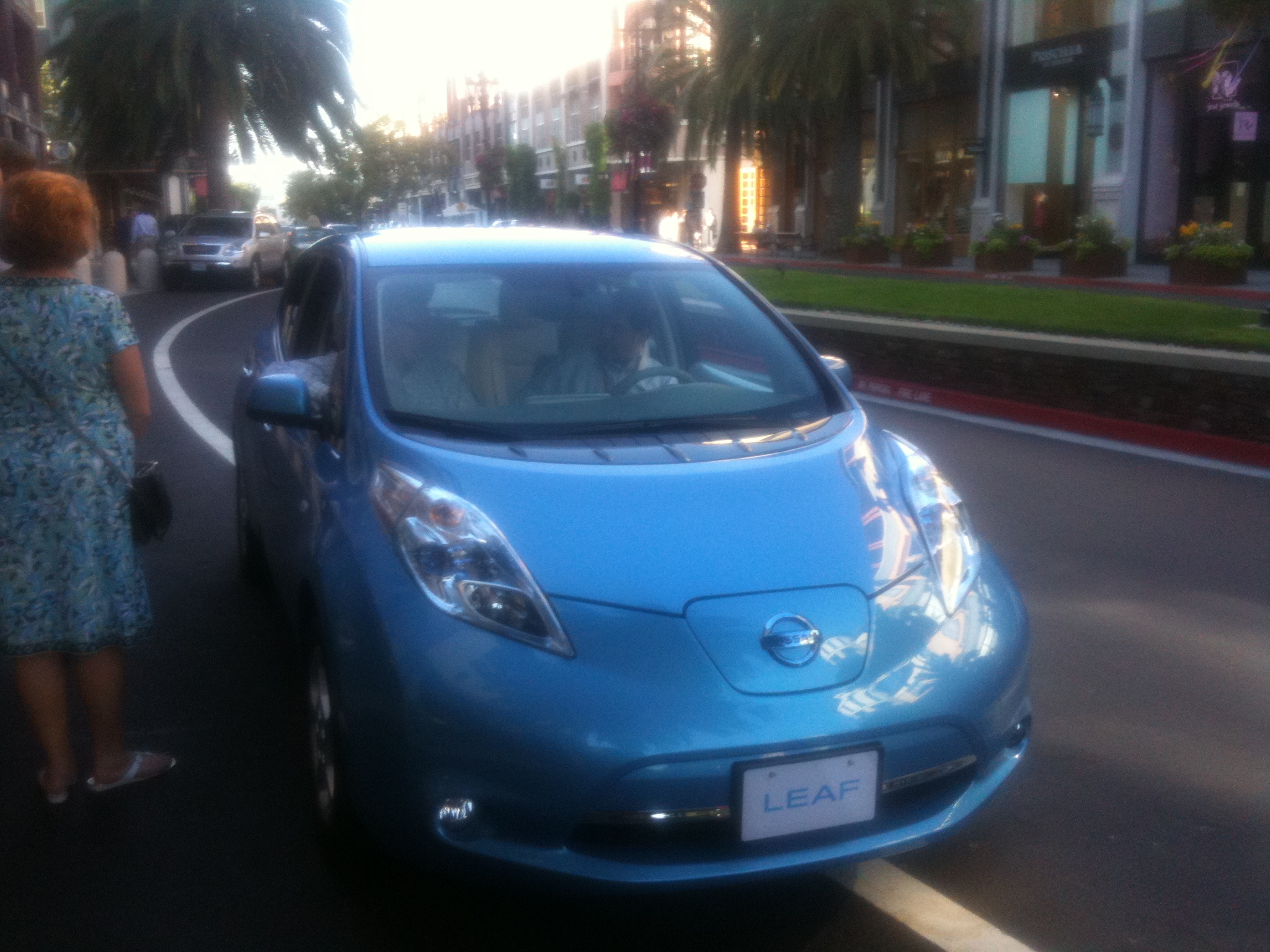
So will Toyota’s hegemony stand once Nissan’s battery-powered Leaf blows into town? No doubt, many will trade in their Prius to go electric. The Leaf sports a distinctive look that, like the Prius, screams green to your neighbors. (And keeping up with the Joneses is just a part of Berkeley’s cultural fabric.)

The Chevrolet Volt may be a harder sell, given it is an electric hybrid and boasts a muscular all-American look that you don’t see too often on the streets here.

But every Prius owner won’t have to switch to electric in order to have an impact. Seeing a Leaf or Volt in the neighbor’s driveway or in the REI parking lot will make an electric car less a curiosity and more just another automotive option when trading in that ’95 Volvo station wagon.

Read Full Post »

photo: eSolar

I wrote this story for Grist, where it first appeared.

As the traditional Labor Day kickoff to the fall election campaign approaches, the battle is intensifying over Proposition 23, the California ballot initiative that would effectively repeal the state’s landmark climate change law.

And thus the title of a gathering Tuesday at Google’s Silicon Valley headquarters: “Electric Bills & Oil Spills: Will California Continue to be a Clean Energy Leader?”

The not-so-subtle subtext: Not if Prop 23 passes.

“We’re strongly behind the No on 23 campaign,” Bill Weihl, Google’s green energy czar (yes, that’s his title), said as he kicked off the event in a company café packed with Bay Area green A-listers.

Not surprisingly, the panel focused less on the environmental consequences of Prop 23 than on the potential for the ballot initiative to derail California’s green tech revolution.

“Proposition 23 will kill markets and the single largest source of job growth in California in the last two years,” declared Vinod Khosla, a leading green tech investor, referring to the clean energy economy. “Not only that, it’ll kill investment in the long term for creating the next 10 Googles.”

Chipped in Weihl: “For California, we can either lead in this and invest in it and participate in this huge growth sector or cede that to China, India, and other places. It would be crazy for us to sit back and let others take that opportunity.”

Underwritten by Texas oil companies Tesoro and Valero and other out-of-state fossil fuel corporations, Prop 23 would suspend California’s global warming law — popularly known as AB 32, as in Assembly Bill 32 — until the unemployment rate drops to 5.5 percent for four consecutive quarters. (In other words, never.) AB 32 requires California to reduce greenhouse gas emissions to 1990 levels by 2020, which most likely would be accomplished through a cap-and-trade market.

Khosla and Weihl were joined on a panel by Mary Nichols, head of the California Air Resources Board, the agency charged with implementing AB 32; and Tom Bottorff, an executive with the utility PG&E.

“If you listen to the arguments of the proponents of Prop 23, their vision of California is a World War II or 1950s vision,” said Nichols, who before her appointment by Gov. Arnold Schwarzenegger was a longtime activist with the Natural Resources Defense Council. “They want to go back to a time when rubber factories and building of aircraft and automobiles were the main businesses of California.”

As the fight over Prop 23 heats up, expect to see a lot more of such talk from a place where the future is the main export.

Read Full Post »

photo: Todd Woody

In a followup to my story in Wednesday’s New York Times about recycling farmland and toxic waste sites for renewable energy projects, I take a deeper dive into why some farmers in the California’s San Joaquin Valley want to stop raising crops and start growing electrons:

In an article in The New York Times on Wednesday, I wrote about an ambitious plan to build one of the world’s largest solar energy complexes on 30,000 acres of farmland in the San Joaquin Valley of California.

Elsewhere, big renewable energy projects have encountered opposition from farmers, ranchers and environmentalists who worry about the impact of solar power plants on agriculture, wildlife and scarce water supplies.

But farmers in the San Joaquin Valley’s Westlands Water District are embracing solar power as a solution to their water woes. And environmental groups are backing the project as a way to avoid fights over building solar power plants in pristine desert areas.

In the 1960s, the west side of the San Joaquin Valley was transformed from a desert to one of the nation’s most productive agricultural centers thanks to a huge irrigation project that transports water from Northern California and distributes it to 600,000 acres of farmland through 1,034 miles of underground pipes.

Decades of irrigation and drainage problems led to a buildup of salt in the soil that forced the water district to spend $100 million to acquire and retire 100,000 acres of land from most agricultural production. Drought and environmental disputes over the impact of water diversions on endangered fish, meanwhile, slashed water deliveries to Westlands farmers.

The water district hopes to make money off salt-contaminated land by providing an initial 12,000 acres to Westside Holdings, a firm that has proposed building a 5,000-megawatt photovoltaic power complex called the Westlands Solar Park.

And farmers like Mark Shannon have agreed to lease their parched land to Westside, reluctantly concluding there’s more money to be made by growing electrons than crops.

“Last year, we received only 10 percent of our water supply and we idled 85 percent of this ranch,” said Mr. Shannon of the 5,300-acre property that his family has farmed for three generations. “My dad is 67 and I can’t believe how many times I’ve called him and he’s in tears — he just always figured he’d pass this land on to me.”

Mr. Shannon took me up in a small plane for a bird’s-eye view of the impact of the water crisis on his land, where brown fields surround green patches of almonds and pistachios. Beyond his farm are dry lands that stretch to the horizon, property owned by the Westlands Water District and taken out of irrigated production.

“Last year, we had over 250,000 acres in the district that didn’t get farmed,” said Sarah Woolf, a Westlands spokeswoman. “Then you have drainage issues coupled with the long-term reliability of the water supply.”

Desperate farmers have been spending millions of dollars drilling hundreds of deep groundwater wells, which in turn has caused subsidence problems.

In other parts of California, the prospect of covering square miles of farmland with solar panels has stirred outrage among some rural residents. But Mr. Shannon and Westlands officials don’t expect any significant opposition in the San Joaquin Valley.

The reason: if farmers such convert their land to solar farms, their water allocations will be redistributed to their neighbors.

You can read the rest of the story here.

Read Full Post »

Photo: Lori Eanes.

In a piece I wrote for Yale Environment 360, I interview the new executive director of the Sierra Club, Michael Brune, about what’s next for the green movement in the wake of the defeat of federal climate change legislation:

In March, Michael Brune took over as executive director of the Sierra Club, the oldest and largest environmental organization in the United States. The Sierra Club doesn’t change leaders often — he’s only the sixth executive director in its 118-year history — and in selecting Brune, the group’s board chose to go with a young outsider with a track record of campaigning in the streets and confronting corporations to effect environmental change.

Brune, 38, previously ran the Rainforest Action Network, a San Francisco-based group whose slogan is “Environmentalism with Teeth.” With a small staff and modest budget, Rainforest Action has extracted agreements from companies such as Home Depot and Citigroup to abandon environmentally destructive practices.

In moving four blocks from Rainforest Action’s offices to the Sierra Club’s national headquarters, Brune — who started his environmental career as a Greenpeace campaigner — is now leading an organization with 1.3 million members and 400 chapters.

His ascension to one of the top jobs in American environmentalism comes at a turning point for the green movement. The decade’s best shot at imposing a national cap on greenhouse gas emissions has failed in the U.S. Senate, despite years of effort by groups such as the Environmental Defense Fund and the Natural Resources Defense Council to forge a coalition with Fortune 500 companies to pass climate change legislation.

“I think we need to a do a very honest and candid reflection on why various iterations of cap and trade legislation have failed,” says Brune, whose soft-spoken manner belies a reputation as a hard-nosed negotiator. “Millions of people have written e-mails, called their senators, demonstrated in the streets, taken actions in a variety of different ways, and still we can’t even get 50 votes, much less 60” in the Senate.

In an interview with Yale Environment 360, Brune sat down in his office at Sierra Club headquarters with writer Todd Woody to talk about the future of the environmental movement, his plans for the Sierra Club, and the next front in what author author Eric Pooley calls the “climate war.”

Yale Environment 360: With the failure of climate legislation, where does the environmental movement go from here?

Michael Brune: The first thing we need to do is a good assessment of what went wrong. We should not try to do the same thing and expect a different result. We need to rethink what the best way is to build momentum to fight climate change. Just as it was clear that one single bill wasn’t going to stop climate change, it’s also clear that there are many different avenues that we can take.

e360: What would be some of those avenues?

Brune: I think clearly right now focusing on administrative actions, regulatory actions, and perhaps more narrow but stronger legislation that would focus on reducing oil consumption and increasing the inventory of clean energy that is available. There’s a lot that can happen through the EPA [Environmental Protection Agency] to protect the public health that Eight years from now we could have a third of the coal fleet replaced with clean energy.” will accelerate a transition away from dirty coal-fired power plants.

The Sierra Club over the past three or four years has been focused on stopping new coal-fired power plants from being built, arguably one of the most effective things we’ve ever done. Along with a broad coalition of grassroots groups, we’ve been able to stop about 131 new coal plants from being built.

That work is going to be evolving over the next several years to not only focus on stopping new plants but on retiring the biggest, oldest coal plants and replacing them with clean energy. So by supporting the EPA’s efforts to protect public health and tighten the controls on particulate matter and air toxins like mercury — there’s a whole series of regulations that are coming down the pike — we feel like we can achieve dramatic reductions and significantly decarbonize the power sector. We feel eight years from now we could have a third of the coal fleet be retired and replaced with clean energy.

You can read the rest of the interview here.

Read Full Post »

photo: Todd Woody

In Wednesday’s New York Times, I write about a growing movement to repurpose farmland and toxic waste sites for big renewable energy projects:

LEMOORE, Calif. — Thousands of acres of farmland here in the San Joaquin Valley have been removed from agricultural production, largely because the once fertile land is contaminated by salt buildup from years of irrigation.

But large swaths of those dry fields could have a valuable new use in their future — making electricity.

Farmers and officials at Westlands Water District, a public agency that supplies water to farms in the valley, have agreed to provide land for what would be one of the world’s largest solar energy complexes, to be built on 30,000 acres.

At peak output, the proposed Westlands Solar Park would generate as much electricity as several big nuclear power plants.

Unlike some renewable energy projects blocked by objections that they would despoil the landscape, this one has the support of environmentalists.

The San Joaquin initiative is in the vanguard of a new approach to locating renewable energy projects: putting them on polluted or previously used land. The Westlands project has won the backing of groups that have opposed building big solar projects in the Mojave Desert and have fought Westlands for decades over the district’s water use. Landowners and regulators are on board, too.

“It’s about as perfect a place as you’re going to find in the state of California for a solar project like this,” said Carl Zichella, who until late July was the Sierra Club’s Western renewable programs director. “There’s virtually zero wildlife impact here because the land has been farmed continuously for such a long time and you have proximity to transmission, infrastructure and markets.”

Recycling contaminated or otherwise disturbed land into green energy projects could help avoid disputes when developers seek to build sprawling arrays of solar collectors and wind turbines in pristine areas, where they can affect wildlife and water supplies.

The United States Environmental Protection Agency and the National Renewable Energy Laboratory, for instance, are evaluating a dozen landfills and toxic waste sites for wind farms or solar power plants. In Arizona, the Bureau of Land Management has begun a program to repurpose landfills and abandoned mines for renewable energy.

In Southern California, the Los Angeles Department of Water and Power has proposed building a 5,000-megawatt solar array complex, part of which would cover portions of the dry bed of Owens Lake, which was drained when the city began diverting water from the Owens Valley in 1913. Having already spent more than $500 million to control the intense dust storms that sweep off the lake, the agency hopes solar panels can hold down the dust while generating clean electricity for the utility. A small pilot project will help determine if solar panels can withstand high winds and dust.

“Nothing about this is simple, but it’s worth doing,” Austin Beutner, the department’s interim general manager, said of the pilot program.

All of the projects are in early stages of development, and many obstacles remain. But the support they’ve garnered from landowners, regulators and environmentalists has attracted the interest of big solar developers such as SunPower and First Solar as well as utilities under pressure to meet aggressive renewable energy mandates.

Those targets have become harder to reach as the sunniest undeveloped land is put off limits.

Last December, Senator Dianne Feinstein, Democrat of California, introduced legislation to protect nearly a million acres of the Mojave Desert from renewable energy development.

But the senator’s bill also includes tax incentives for developers who build renewable energy projects on disturbed lands.

For Westlands farmers, the promise of the solar project is not clean electricity, but the additional water allocations they will get if some land is no longer used for farming.

“Westlands’ water supply has been chronically short over the past 18 years, so one of the things we’ve tried to do to balance supply and demand is to take land out of production,” said Thomas W. Birmingham, general manager of the water district, which acquired 100,000 acres and removed the land from most agricultural production. “The conversion of district-owned lands into areas that can generate electricity will help to reduce the cost of providing water to our farmers.”

You can read the rest of the story here:

Read Full Post »

I wrote this story for Grist, where it first appeared.

The Gulf oil spill disaster is usually tied to Americans’ insatiable appetite for gasoline to fuel an unsustainable lifestyle.

And while transportation accounts for most of the United States’ petroleum consumption, there are still more than 14 million homes that rely on some type of oil for heating. Retrofitting those houses to run on cleaner fuel and increase their energy efficiency could save as much oil as would be spilled in two Deepwater Horizon disasters a month, according to a report from the Natural Resources Defense Council and the Institute for Market Transformation, a non-profit focused on green building.

“Retrofitting our oil-heated homes and commercial buildings to 50 percent savings would save 2 billion barrels of oil by 2030, practically offsetting the amount of oil we could get by drilling in the Outer Continental Shelf,”  the report states. “In addition, home retrofits could save more than double the amount of natural gas that we could produce by drilling the Outer Continental Shelf.”

NRDC points out that the $20 billion BP has set aside for the Gulf cleanup could finance energy efficiency retrofits for every home in Louisiana and Mississippi, cutting homeowners utility bills by 25 percent. The nearly $4 billion BP has spent so far on the cleanup could pay for retrofitting 650,000 homes.

“That could have been spent on U.S.-made insulation, air conditioners, furnaces, water heaters, and other products, as well as the labor to install them,” the report states. “Of course, oil savings from building efficiency pale in comparison to the savings potential of more efficient vehicles, better urban planning, and increasing transportation options, but the magnitude of the savings potential of the building sector illustrates just how short-sighted our focus on drilling has become.”

And while building energy efficiency improvements aren’t cheap, those investments will continue to pay dividends for decades in the form of lower energy bills and reduced demand for fossil fuels.

Read Full Post »

photo: U.S. Fish and Wildlife Service

On Thursday, Yale Environment 360 published a story I wrote about a growing fight over using the U.S. Endangered Species Act to protect wildlife at risk of extinction from climate change:

While a high-profile battle raged over listing the polar bear as a threatened species due to melting Arctic sea ice, U.S. environmentalists were quietly building a case to protect a critter closer to home, one whose existence also seems gravely threatened by a warming world.

A pocket-sized member of the rabbit family with a distinctive squeak and large ears that frame dark eyes and a button nose, the American pika lives on rocky slopes high in alpine mountain ranges from the Sierra Nevada to the Rockies. Sporting a thick gray-brown coat, the pika does not hibernate and so maintains a high internal temperature to survive frigid winters. Because it can’t turn off its heater, the animal can die in the summer if its body temperature increases by as little as 3 degrees Celsius (5.4 F).

As temperatures have risen across the American West, scientists who study the pika have discovered that it is disappearing from lower elevations. In the Sierra Nevada, for instance, biologists at the University of California, Berkeley, found that the pika had moved upslope 500 feet to cooler climes over the past 90 years. Another study determined that nine of 25 pika populations in the Great Basin of Nevada and Utah have vanished over the past century, with surviving pikas migrating up 900 feet. Eventually, the tiny mammal will reach the mountaintop and the end of the line, with nowhere left to go if temperatures continue to climb, according to numerous biologists.

The pika has become an indicator species in more ways than one. It is in the vanguard of a growing number of animals and plants that U.S. environmental groups have petitioned to protect as the Endangered Species Act becomes the latest battleground over global warming.

The effort to put a furry face on the abstract phenomenon of climate change is bringing to a head a simmering issue: As scientific evidence accumulates about global warming’s impact on wildlife, how effective can the Endangered Species Act be in cushioning the blow of climate change on various species? But beyond this issue, an even thornier question looms: Can conservation groups use the act to force the U.S. government to use the legislation’s powerful provisions to mandate greenhouse gas reductions to protect wildlife and their habitat?

You can read the rest of the story here.

Read Full Post »

Image: Solexant

I wrote this post for Grist, where it first appeared.

Back in the 1980s and ’90s, the region surrounding Portland was dubbed the Silicon Forest for the cluster of computer chip companies that had flocked to Oregon to set up shop.

Now those old-growth tech companies are giving way to a new generation of solar startups that are sprouting up around Portland’s green metropolis, sometimes in old semiconductor factories that have been revamped to produce photovoltaic modules.

Germany’s SolarWorld built the United States’ largest solar module plant in the Portland suburb of Hillsboro in 2008, and on Tuesday Silicon Valley company, Solexant, announced it will open its first commercial factory in the area.

The facility will be Oregon’s first thin-film solar module plant. As the name implies, thin-film solar cells are essentially printed on flexible metal or other materials. Although such technology is less efficient at converting sunlight into electricity than standard crystalline silicon cells made by companies like SolarWorld, thin-film solar’s great promise is that solar cells can be made cheaper, which will lower the cost of photovoltaic power.

Solexant describes itself as a third-generation thin-film solar company. It has revealed few details about its technology other than it has developed a “nanocrystal ink” to make higher efficiency solar cells at a lower cost than its competitors. The technology was first developed at the Lawrence Berkeley National Lab in California.

Investors clearly think the San Jose startup is on to something. Last month, the company raised a $41.5 million round of funding.

To lure Solexant north, Oregon has offered the company a $25 million loan and an $18.75 million tax credit to help build a factory in Gresham, east of Portland. The plant will produce 100 megawatts’ worth of solar modules a year and employ up to 200 people, according to Solexant. (The company currently operates a two-megawatt pilot production line in San Jose.) In exchange for the tax credit, Solexant has agreed that 97 of the new plant’s 200 jobs will go to county residents.

“We are pleased to welcome Solexant to Oregon, North America’s leading solar manufacturing center,” Gov. Ted Kulongoski said in a statement. “This investment will mean jobs immediately for Oregonians with the promise of more in the future. In addition, this company brings a new technological facet to Oregon’s already booming solar manufacturing base and will help us continue to be a global leader in solar manufacturing.”

Read Full Post »

In The New York Times on Wednesday, I wrote that California Attorney General Jerry Brown has filed a lawsuit against Fannie Mae and Freddie Mac over the mortgage giants’ quashing of the PACE solar loan program:

The California attorney general’s office on Wednesday sued Fannie Mae and Freddie Mac over actions by the mortgage finance companies that have derailed a popular financing program that allows homeowners to pay for energy efficiency improvements through a surcharge on their property taxes.

This month, the Federal Housing Finance Agency, which oversees Fannie and Freddie, issued guidelines to lenders that restricted the ability of homeowners to participate in the financing programs, called Property Assessed Clean Energy, or PACE. Twenty-two states have authorized the programs, which have drawn $150 million in stimulus funding support from the Obama administration.

When a city or state pays for energy efficiency upgrades through the program, a lien is placed on the home. The liens, like other property tax assessments, take priority over the mortgage if the homeowner defaults. The housing agency instructed lenders that they could not accept such PACE liens.

In recent months, some banks have declined to refinance mortgages for homes that carry the liens.

In the lawsuit, filed in United States District Court in Oakland, Calif., Jerry Brown, the California attorney general and Democratic candidate for governor, asked that the court declare that participation in PACE programs does not violate the standards of Fannie and Freddie, which are government chartered. The suit also asks that an injunction be issued to prevent them from taking action against homeowners whose properties have PACE liens.

The Federal Housing Finance Agency was also named as a defendant.

The suit alleges that the housing agency’s actions violated California law, which authorizes PACE programs, and are “severely hampering California’s efforts to assist thousands of California homeowners to reduce their energy and water use, help drive the state’s green economy, and create significant numbers of skilled, stable and well-paying jobs.”

“The actions of these government-sponsored, shareholder-owned private corporations have placed California’s PACE programs – and the hundreds of millions of dollars in federal stimulus money supporting them – at immediate risk while benefiting their own pecuniary interests,” the suit states.

You can read the rest of the story here.

Read Full Post »

« Newer Posts - Older Posts »

Design a site like this with WordPress.com
Get started