Feeds:
Posts
Comments

Archive for the ‘green policy’ Category

solar-energy-bill-2.pngWith
Congress back in session, renewable energy proponents are girding for a
battle over legislation that could make or break the nascent solar
power industry.

At stake in the energy bill now before Congress is the survival of a
30 percent investment tax credit that make large-scale solar power
plants a viable option for utilities under pressure to cut greenhouse
gas emissions by obtaining more of their electricity from renewable
sources. On the home front, a similar tax credit for residential solar
installations is up for grabs as Congress tries to reconcile House and
Senate versions of the energy legislation.

"There are at least eight or nine well-funded companies that are
actually making great progress in developing large-scale solar,"
says Joshua Bar-Lev, vice president for regulatory affairs for Oakland,
Calif.,-based solar power plant developer BrightSource Energy. "I don’t
know if any of them are going to be able to finance projects and get
the permits they need without these tax credits."

The solar companies and their allies in the utility industry and on
Wall Street had been pressing for an eight-year extension of the
investment tax credit. They also want to abolish a prohibition on
utilities from taking advantage of the incentive if they invest directly in
solar power plants. But since word hit the street that Congressional
leaders were considering stripping out the incentives to speed passage
of the complex legislation — catchall bills that will affect the fate
of nearly every energy-related industry, from Big Oil to biofuels —
solar proponents have been converging on the Capitol in an 11th-hour
lobbying frenzy.

"Things are very uncertain at the moment," says Chris O’Brien, an
executive at solar panel maker Sharp who serves as chairman of the
Solar Energy Industry Association, a trade group. "In recent years,
we’ve seen a very sharp increase in corporate investment, project
investment and financing for solar technology companies and solar
projects. There’s great concern that the U.S. market continue to grow."

Like other renewable energy sectors, solar has lived and died at the
hands of tax incentives. In the 1980s a California tax break encouraged
the construction of the state’s first utility-scale power plants by Luz
International, founded by BrightSource’s chairman. When the incentives
evaporated with the return of cheap energy that decade, the company’s
business disappeared (though those Mojave Desert solar power stations
continue to operate).

Global warming fears, renewable energy mandates imposed on utilities
and a flood of venture capital has revived Big Solar over the past two
years. The industry argues that longer term tax incentives must be put
in place to ensure solar power plant builders have enough time to break
into the electricity market and achieve economies of scale that will
drive down the cost of green energy. This time around, the solar
entrepreneurs have attracted the support of utilities like PG&E
(PCG) and Edison International (EIX) as well as Wall Street titans like
Goldman Sachs (GS) and Morgan Stanley (MS), both of which have invested
in renewable energy companies. (Morgan Stanley, for instance, is
backing BrightSource.)

"We’ve gone to Congress and talked to members about the need for
multi-year commitments so we have certainty," Rick Carter, PG&E’s
director of federal government relations, told Green Wombat. "What
we’ve seen over past couple years is stop-and-go with tax credits. If
you have multi-year leads to build facilities, that doesn’t work."

Take California, for example. Negotiations between a solar energy
company and a utility over a power purchase agreement can last more
than a year and it can take another three or four years to to obtain regulatory approval for a
solar power plant, secure the site and then get the facility built and
operating. PG&E, Southern California Edison and San Diego Gas &
Electric (SRE) all have signed long-term power purchase agreements for
solar power plants that will be financed and built over the next
several years.

Given that the prime solar sites and potential economic payoff for
Big Solar is in the sun-drenched West, companies like BrightSource have
been targeting Congress members from western states. "We want both
representatives and senators to see the benefit of this: price
certainty, jobs, clean energy," says Bar-Lev.

While the situation changes daily, action on the energy legislation is expected sometime in the next two weeks.


Read Full Post »

kevin-rudd.jpgAustralian voters on Saturday tossed out the decade-old government of conservative Prime Minster John Howard, installing Labor Party leader Kevin Rudd (left) as the new PM. Howard was a staunch ally of the Bush administration on climate change, joining it in refusing to ratify the Kyoto Accord despite — or because of — Australia’s status as the planet’s biggest per-capita emitter of greenhouse gases.

Australia is a proverbial canary in the coal mine when it comes to suffering the consequences of climate change, and Saturday’s election may foreshadow how environmental issues will play out elsewhere in the coming years. With the peter-garret-mp.jpgcountry in the grip of the worst drought on record, global warming — and the Howard government’s emu-in-the-sand stance that prompted corporate Australia to push its own climate change agenda — became a hot campaign topic. The Australian Labor Party’s environment spokesman, former Midnight Oil front man Peter Garret (right) — a rock-star-environmentalist-turned-politico — hammered the government at every turn. Meanwhile, Rudd promised to sign Kyoto, up investment in green technology and establish a nationwide carbon trading market to help achieve a 60 percent reduction in greenhouse gas emissions by 2050. Labor also set a target of obtaining 20 percent of this coal-dependent nation’s electricity from renewable sources by 2020.

Just how much Labor’s climate change policies contributed to its landslide victory is up for debate, though such was the voters’ wrath that it appears that even Howard will lose his seat in Parliament, the first sitting prime minister to do so since 1929. But here’s one indicator: The Australian Greens scored 20 percent of the votes in some electorates and will take as many as six seats in the Senate, possibly giving the environmental party the balance of power in the upper house. The Greens also contributed to the Labor landslide because under Australia’s preferential voting system, ballots cast for unsuccessful Green candidates were re-directed to the ALP.

So with a charismatic greenie like Garrett as Australia’s presumptive new environment minister, Australia is set to become the Scandinavia of the South Pacific, right? Not quite. Australia’s current prosperity owes much to the resource boom under way as China buys up just about any mineral that can be dug out of the ground. (See my Fortune colleague Brian O’Keefe’s excellent story on the iron ore gold rush in Western Australia.)

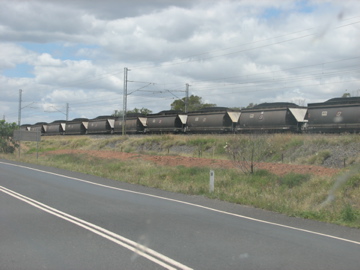
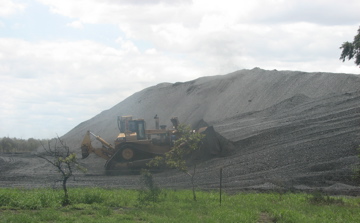
img_3574.jpgGreen Wombat got a first-hand look at the pressures Rudd will face during a visit last month to Queensland, the new PM’s home state. Driving through central Queensland’s coal belt, a never-ending procession of trains piled high with the black stuff flanked the two-lane highway, running 24/7 between the mines and the port, where China-bound coal ships are stacked up by the dozens off shore. Bulldozers scaled mountains of coal sitting on the side of the road, scooping up bucketfuls to be put on a conveyor belt that straddled the highway to connect to a train depot. At the Dingo roadhouse, a big color-coded wall map charts central Queensland’s major coal seams and Shift Miner Magazine is on sale, chronicling the explosion in coal mining that has turned places like Rockhampton into boom towns. Riding in from the Rockhampton airport, a former coal miner-turned-taxi img_3569.jpgdriver tells me she rues passing up the chance a couple years’ back to buy a house for $A10,000 in a nearby mining town; such homes now go for $A300,000. Out on a cattle ranch about 500 kilometers from Rockhampton, a mining company is drilling for gold but rancher John Dennis tells me he hopes they find something else. “Black gold,” he says. “Coal.” (The biggest corporate takeover attempt now under way Down Under is Aussie mining giant BHP Billiton (BHP)’s $150 billion offer for rival Rio Tinto (RTP).)

So no surprise that Rudd wants to spend $A500 million on so-called clean coal technology to capture and store greenhouse gas emissions from coal-fired power plants. While sun-drenched Australia has some of the world’s best solar resource it currently gets about 86 percent of its electricity from coal. In fact, in recent years, Australian solar energy companies like Ausra have relocated to California, frustrated by the government’s lack of support for renewable energy. But with the new Labor government pledging to fund a $A150 million Energy Innovation Fund to stop the brain drain as well as increase the mandatory renewable energy targets, Australia may be the next frontier for green business.

Read Full Post »

Australia’s green election

kevin-rudd.jpgAustralian voters on Saturday tossed out the decade-old government
of conservative Prime Minster John Howard, installing Labor Party
leader Kevin Rudd (left) as the new PM. Howard was a staunch ally of
the Bush administration on climate change, joining it in refusing to
ratify the Kyoto Accord despite — or because of — Australia’s status
as the planet’s biggest per-capita emitter of greenhouse gases.

Australia is a proverbial canary in the coal mine when it comes to
suffering the consequences of climate change, and Saturday’s election
may foreshadow how environmental issues will play out elsewhere in the
coming years. With the peter-garret-mp.jpgcountry
in the grip of the worst drought on record, global warming — and the
Howard government’s emu-in-the-sand stance that prompted corporate
Australia to push its own climate change agenda — became a hot
campaign topic. The Australian Labor Party’s environment spokesman,
former Midnight Oil front man Peter Garret (right) — a
rock-star-environmentalist-turned-politico — hammered the government
at every turn. Meanwhile, Rudd promised to sign Kyoto, up investment in
green technology and establish a nationwide carbon trading market to
help achieve a 60 percent reduction in greenhouse gas emissions by
2050. Labor also set a target of obtaining 20 percent of this
coal-dependent nation’s electricity from renewable sources by 2020.

Just how much Labor’s climate change policies contributed to its
landslide victory is up for debate, though such was the voters’ wrath
that it appears that even Howard will lose his seat in Parliament, the
first sitting prime minister to do so since 1929. But here’s one
indicator: The Greens scored 20 percent of the votes in some
electorates and will take as many as six seats in the Senate, possibly
giving the environmental party the balance of power in the upper house.
The Greens also contributed to the Labor landslide because under
Australia’s preferential voting system, ballots cast for unsuccessful
Green candidates were re-directed to the ALP.

So with a charismatic greenie like Garrett as Australia’s
presumptive new environment minister, Australia is about to become the
Scandinavia of the South Pacific, right? Not quite. Australia’s current
prosperity owes much to the resource boom under way as China buys up
just about any mineral that can be dug out of the ground. (See my
Fortune colleague Brian O’Keefe’s excellent story on the ire ore gold rush in Western Australia.)

img_3574.jpgGreen
Wombat got a first-hand look at the pressures Rudd will face during a
visit last month to Queensland, the new PM’s home state. Driving
through central Queensland’s coal belt, a never-ending procession of
trains piled high with coal flanked the two-lane highway, running 24/7
between the mines and the port, where China-bound coal ships are
stacked up by the dozens off shore. Bulldozers scaled mountains of coal
piled on the side of the road, scooping the sooty stuff up to be put on
a conveyor belt that straddled the highway to connect to a train depot.
At the Dingo roadhouse, a big color-coded wall map charts central
Queensland’s major coal seams and Shift Miner Magazine is on sale,
chronicling the explosion in coal mining that has turned places like
Rockhampton into boom towns. Riding in from the Rockhampton airport, a
former coal miner-turned-taxi img_3569.jpgdriver
tells me she rues passing up the chance a couple years’ back to buy a
house for $A10,000 in a nearby mining town; such homes now go for
$A300,000. Out on a cattle ranch about 500 kilometers from Rockhampton,
a mining company is drilling for gold but rancher John Dennis tells me
he hopes they find something else. "Black gold," he says. "Coal." (The
biggest corporate takeover attempt now under way Down Under is Aussie
mining giant BHP Billiton (BHP)’s $150 billion offer for rival Rio
Tinto (RTP).)

So no surprise that Rudd wants to spend $A500 million on so-called
clean coal technology to capture and store greenhouse gas emissions
from coal-fired power plants. While sun-drenched Australia has some of
the world’s best solar resource it currently gets about 86 percent of
its electricity from coal-fired power plants. In fact, in recent years,
Australian solar energy companies like Ausra
have relocated to California, frustrated by the government’s lack of
support for renewable energy. But with the new Labor government
pledging to fund a $A150 million Energy Innovation Fund to stop the
brain drain as well as increase the mandatory renewable energy targets,
Australia may be the next frontier for green business.

Read Full Post »

Katrina
A coalition of institutional investors and state government officials today petitioned the U.S. Securities and Exchange Commission to require companies to disclose to shareholders the risks global warming poses to their business. "The transition to a carbon constrained economy is underway, and public access to material information concerning the risks and opportunities that companies face, and their means of addressing those risks and opportunities, is vital to investors," stated a letter signed by the nation’s biggest public pension funds, the California treasurer, the New York attorney general and other state government officials, environmental groups and investors that manage more than $1.5 trillion in assets.  "A firm that is or soon will be subject to greenhouse gas regulation under state or federal policies should disclose, in light of its current and projected greenhouse gas emissions, the effects of regulation upon their capital expenditures, earnings and competitive position."

In an accompanying petition, the coalition said public companies should reveal their total greenhouse gas emissions, provide a strategic analysis of the risks and opportunities presented by climate change, assess the physical risks of climate change to their operations, and analysis the regulatory risk posed by government efforts to fight global warming.

"Regulation of greenhouse gas emissions imposes direct costs on major sources of greenhouse gas emissions and indirect costs on the companies that use their products and services," the petition states. "At the same time, these new regulatory developments will offer major opportunities for firms that can reduce emissions, thereby garnering marketable emissions credits or cost advantages over their competition, and for firms offering technologies and services needed to reduce emissions."

The coalition argues that corporate disclosure of climate change risks is spotty at best. It  noted, for instance, that neither oil giant ExxonMobil (XOM) nor insurer Allstate (ALL) mentioned global warming, greenhouse gases or carbon dioxide in their 2006 annual reports.

Read Full Post »

The U.S. Department of Energy has released a report analyzing the impact of proposed legislation from New Mexico Senator Jeff Bingaman that would require utilities to obtain 15 percent of their electricity from renewable sources by 2030. Such a so-called renewable portfolio standard would result in a 6.7 percent decline in greenhouse gas emissions, according to the DOE’s Energy Information Administration. Though CO2 emissions from coal-fired plants would fall, utilities’ overall greenhouse gas emissions would continue to rise. The study does not take into account renewable energy standards already in place in more than half states For instance, California requires that 20 percent of electricity sold by investor-owned utilities must come from renewable sources by 2010, rising to 30 percent by 2030. California will impose statewide limits on greenhouse gas emissions, and five other western states have agreed to do the same. "The implementation of any combination of these policies would be expected to have a significant impact on renewable generation markets," the report’s authors wrote. The study also found:

  • Solar energy would grow to eight percent of renewable energy production, largely because of the generous marketable credits rooftop solar arrays would receive.
  • Biomass energy production would triple.
  • Natural gas and nuclear energy production would decline slightly.
  • Electricity prices would rise .9 percent between 2005 and 2030.

Read Full Post »

Californiavictoria_mou_1Arnold Schwarzenegger is fond of calling California a nation-state and accordingly he practices his own foreign policy, forging an international alliance to combat global warming. On Friday the California governor signed a memorandum of understanding in Los Angeles with Steve Bracks, the premier of the Australian state of Victoria. The two Pacific Rim states agreed to share technology and develop policies to develop international carbon trading markets, reduce greenhouse gas emissions from vehicles, foster clean energy technologies and worth together on energy efficiency standards.  Schwarzenegger has signed a similar accord with U.K. Prime Minister Tony Blair and he has collaborated on green policies with the premier of British Columbia. But the California-Victorian alliance is particularly noteworthy, representing a growing rebellion against national governments perceived as obstructionist on global warming. "This agreement exemplifies the leadership role of sub-national jurisdictions in driving global climate change solutions," the document states. Australia, of course, is the only other major industrialized country to join the United States in refusing to enact the Kyoto Accord. The country of 20 million is heavily dependent on cheap and highly polluting coal and conservative Prime Minister John Howard, a close ally of President George Bush, has doggedly resisted efforts to impose emissions limits. Victoria, Australia’s second-largest state, is governed by the left-leaning Labor Party and is the California of Australia when it comes to promoting clean energy and policies to fight global warming. (Victoria, for instance, is helping fund the world’s largest photovoltaic solar power station.)  Howard is in a tough re-election fight, and as the country suffers through one of its worst droughts on record, climate change has emerged as a major campaign issue. The prime minister is bashed almost daily by the Labor Party environment spokesman, former Midnight Oil frontman Peter Garrett, and now he’s got the Terminator doing photo-ops with the opposition.

Read Full Post »

Light_bulb_ocean
photo originally uploaded by welshkaren

Philips (PHG), one of the world’s leading light bulb makers, wants to flip the switch on incandescent lighting – one of its major product lines. Yesterday the company joined a campaign to push for legislation to phase out by 2016 the use of energy-hogging traditional lighting in favor of more planet-friendly compact fluorescent light bulbs and LEDs. Another unlikely bedfellow in the effort to replace century-old lighting technology is utility giant Duke Energy (DUK). The Lighting Efficiency Coalition – an amalgam of several environmental groups and their corporate allies – supports legislation to promote the switch to less energy-intensive lighting through energy consumption standards for lighting, green buying programs for government agencies and financial incentives for consumers. According to the coalition, energy efficient lighting it could save the U.S. $18 billion annually in electricity costs – the equivalent of shutting down 18 coal-fired power plants or eliminating 158 million tons of carbon dioxide from the atmosphere.  Philips, of course, stands to profit if it can dominate the CFL and LED markets. General Electric (GE) also sells CFLs but recently announced it was developing a more energy efficient incandescent bulb.

Read Full Post »

Picture_1
TechNet, the technology industry’s lobbying arm, released a report today calling for an overhaul of U.S. policy to promote renewable energy and support green tech innovation. Silicon Valley heavyweights like Cisco Systems (CSCO) CEO John Chambers and venture capitalist John Doerr, along with green tech startup execs, are in Washington this afternoon to unveil the policy initiative. "We are at a unique inflection point at which it is within our reach as a nation to make the shift from an economy fueled predominantly by oil to one that relies on a balanced mix of alternative energies and new technologies," the TechNet Green Technologies Task Force states. "Clean energy innovations are positioned to be the next great disruptive technologies with the potential to revolutionize the energy industry, spurring economic growth and creating new industries
and jobs."

Among the policy recommendations:

  • Double federal funding for energy research to $4 billion a year.
  • Restructure tax incentives given to Big Oil and the fossil fuel industry to favor renewable energy and green tech innovation.
  • Create a national renewable energy portfolio standard requiring utilities to source a percentage of their electricity from solar, wind and other green energy generation.
  • Establish a national carbon trading market to reduce greenhouse gas emissions and fight global warming.
  • Allow utilities like PG&E (PCG) to recoup their investments in renewable energy generation and transmission.
  • As the largest energy buyer in the country, the federal government should spur green tech innovation through purchases of renewable energy and establish a quota for green energy consumption.
  • Promote national energy efficiency standards.

To show its member companies practice what they preach, the TechNet report cited recent corporate efforts to support renewable energy and cut greenhouse gas emissions. Computer chip equipment maker Applied Materials (AMAT), for instance, has pledged to power 12 percent of its headquarters from solar and wind energy while Google (GOOG) is installing a 1.6 megawatt solar array on its headquarters buildings to supply 30 percent of its electricity. Hewlett-Packard (HPQ) has promised to increase its purchases of renewable energy by 350 percent in 2007 and Yahoo (YHOO) converted its employee shuttles to run on biodiesel.

Read Full Post »

Las_vegas_biobugphoto: LVRCCC

Las Vegas usually doesn’t make anyone’s list of green cities, what with its sprawling water-sucking desert suburbs and smoke-filled casinos. But it turns out that nobody beats Sin City when it comes to powering its vehicle fleet with alternative energy like biodiesel, natural gas, electricity and hydrogen. Sixty-three percent of Las Vegas’s buses, cars, trucks and other municipal vehicles – 450 in total – use some form of alternative fuels that emit fewer planet-warming greenhouse gases than conventional gasoline or diesel, according to SustainLane, a San Francisco environmental management service. That made Vegas the No. 1 for alternative fuel fleets in SustainLane’s survey of the U.S.’s 50 biggest cities. Next up in the top 10 was Honolulu, with 51 percent of its fleet forsaking Big Oil; Kansas City, Missouri (45 percent), Albuquerque (42 percent), Dallas (39 percent), Denver (31 percent), Phoenix (28 percent), Los Angeles (25 percent), Seattle (25 percent) and Portland, Oregon (25 percent). Conspicuous in their absence from the list were the ecotopias of San Francisco and San Jose.

Read Full Post »

Us_capitolphoto originally uploaded by prad
Go to any green tech conference and one thing you can count on, other than running into Vinod Khosla, is that participants will spend some time debating whether the alt energy boom is a fad or a phenomenon of world-changing proportions. If this week’s Cleantech Forum in San Francisco was any sign, those doubts have disappeared. The discussion these days is about how Silicon Valley venture capitalists can replicate in Washington, D.C., their behind-the-scenes success in getting California Governor Arnold Schwarzenegger to enact the nation’s first greenhouse gas emissions cap. During a panel discussion Wednesday evening about green tech opportunities in the post-2006 election season, environmentalists urged investors and VCs to continue exerting their political muscle.

"Suddenly, the venture capital industry has become so involved. This
is critical because to a very large extent these are policy-driven
markets," said Christopher Flavin, president of the Worldwatch Institute, a non-profit environmental research organization based in Washington. "I’ve been surprised at just how aggressive and assertive leaders in the venture capitalist community in California are. I’ve been at a number of meetings with venture capitalists where I thought I was talking to someone from Greenpeace. They’re aggressive and willing to go knock on doors. Some of my environmentalist colleagues in Washington seem conservative compared to some VCs. We may be at some kind of tipping point." 

Daniel Kammen, director of the University of California, Berkeley’s Renewable & Appropriate Energy Laboratory, said the passage of California’s global warming law and the Democrat’s 2006 election victory has changed the game in Washington. "It opens up incredible opportunities," said Kammen, whose lab will contribute to the new $500 million biofuels research center being funded by oil giant BP (BP). "I literally get four to five calls a day from lawmakers asking what would be the key thing to pass to open up green tech opportunities, from plug-in hybrid cars, to putting solar on an even footing."

Stephane Dupont, executive vice president of the Washington-based National Venture Capital Association, said his trade group is beefing up its staff to focus on green tech. He said now’s the time to press the clean tech cause in the capital. "There’s a desire by the political elites in Washington to recapture that technological leadership, not only for political reasons but for job creation."

Flavin welcomed the green-green alliance between environmentalists and VCs as well as the willingness of Silicon Valley’s heavyweights to take on the brown lobby led by oil companies like ExxonMobil (XOM). "I’m excited to see that some of the troglodytes who have been holding things back are now up against a group that is not only as well funded but that is more intelligent."

(more…)

Read Full Post »

« Newer Posts - Older Posts »

Design a site like this with WordPress.com
Get started