Feeds:
Posts
Comments

Archive for the ‘green policy’ Category

The wind, solar and geothermal industries have wasted no time pressing the incoming Obama administration to implement an alternative energy agenda to spur investment and create jobs.

During a conference call Thursday, the leaders of the Solar Energy Industries Association, American Wind Energy Association and other trade groups lobbied for a plethora of legislation and policy initiatives. None of these proposals are new, but given Barack Obama’s campaign promises to promote alternative energy and the strengthened Democratic majority in Congress, the industry has the best chance in many years of seeing this wish list made real.

  • A five-year extension of the production tax credit for the wind industry (it currently has to be renewed every year) to remove uncertainty for investors.
  • A major infrastructure program to upgrade the transmission grid so wind, solar and geothermal energy can be transmitted from the remote areas where it is produced to major cities. Obama advisor Eric Schmidt, CEO of Google (GOOG), recently joined with General Electric (GE) chief Jeff Immelt to launch a joint initiative to develop such smart grid technology as well as push for policy changes in Washington to allow the widespread deployment of renewable energy by rebuilding the nation’s transmission system.
  • Impose a national “renewable portfolio standard” that would mandate that utilities obtain a minimum 10% of their electricity from green sources by 2012 and at least 25% by 2020. Two-thirds of the states currently impose variations of such requirements.
  • Mandate that the federal government – the nation’s single largest consumer of electricity – obtain more energy from renewable sources.
  • Enact a cap-and-trade carbon market.

“If the administration and Congress can quickly implement these policies, renewable energy growth will help turn around the economic decline while at the same time addressing some of our most pressing national security and environmental problems,” the green energy trade groups said in a joint statement.

No doubt those measures are crucial to spurring development of renewable energy and creating green collar jobs. But the major obstacle confronting the alt energy industry right now is the credit crunch that is choking off financing for big wind and solar projects and scaring away investors from more cutting-edge but potentially promising green technologies.

A focus by President Obama and Congress on restoring confidence in the financial system will most likely do the most for green investment as well as restore luster to battered renewable energy stocks like First Solar (FSLR), SunPower (SPWRA) and Suntech (STP).

Read Full Post »

The risky nature of Big Solar projects has been driven home with California regulators’ move to kill a controversial $1.3 billion transmission line that would have connected massive solar power stations in the desert to coastal cities.

“These projects are unlikely to proceed,” wrote Jean Vieth, an administrative law judge with the California Public Utilities Commission, in a ruling rejecting San Diego Gas & Electric’s Sunrise Powerlink transmission line.

Phoenix-based Stirling Energy Systems in 2005 scored a contract to provide SDG&E (SRE) with up to 900 megawatts of electricity to be generated by as many as 36,000 solar dishes. A few months later, the utility filed an application to build the Sunrise Powerlink, a new transmission line to connect the Stirling power plants and other renewable energy projects to the coast.

But the utility’s proposal to build 150-foot-high transmission towers right through wilderness areas of Anza-Borrego State Park, home to a host of protected species, triggered a long-running fight with green groups that generated an 11,000-page environmental impact report. On Halloween, Vieth issued a ruling that found that despite state mandates to cut greenhouse gas emissions, the environmental impact of the transmission project was frightening.

“The potentially high economic costs to ratepayers and the potential implications for our [greenhouse gas] policy objectives do not justify the severe environmental damage that any of the transmission proposals would cause,” concluded Vieth in a 265-page decision.

The battle isn’t over — the public utilities commission will vote in December whether to accept the judge’s ruling. They will also consider an alternative decision issued by a commissioner assigned to review the case. That decision would let SDG&E build a transmission line along a different route under certain conditions.

But the case highlights the conflicting environmental values that will dog solar power projects. In other words, just what trade-offs are we willing to make to secure a planet-friendly source of energy? In this case, the judge ruled that to avoid the environmental damage of a massive new transmission line, the preferred alternative is to build more fossil-fuel plants close to San Diego along with a smaller-scale solar power station and a huge increase in rooftop solar arrays. The judge acknowledged that such an alternative “would cause substantially more GHG emissions than the proposed project and other transmission proposals.”

The judge’s second preferred alternative was to build only renewable-energy projects near San Diego that would not require big new transmission lines. Some Sunrise Powerlink opponents argue that San Diego has enough roof space to generative massive amounts of electricity from photovoltaic solar panels. (The cost of such an undertaking was left unsaid.)

Public Utilities Commissioner Dian Grueneich’s alternative decision would allow San Diego Gas & Electric to build Sunrise Powerlink along a more environmentally-benign route if the utility could prove that most of the transmission line would carry renewable energy so as to offset the 100,000 tons of greenhouse gases emitted during its construction. “Reliance on a single 900-megawatt contract (the Stirling Energy Systems contract) is too risky,” she wrote.

So where does this leave Stirling? COO Bruce Osborn didn’t immediately respond to a request for comment. But earlier this year, he told Green Wombat that even if Sunrise Powerlink was killed, there’s enough existing transmission capacity to carry electricity from the power plant’s first 300-megawatt phase. Stirling also has a 20-year contract to supply up to 850 megawatts of electricity to utility Southern California Edison (EIX), a deal not contingent on Sunrise Powerlink.

Read Full Post »

After a year of stalemate that threatened to strangle the nascent United States solar industry, the U.S. Senate on Tuesday passed energy legislation that extends a key investment tax credit until 2016.

The 30% solar tax credit was part of a package of green energy incentives that includes a one-year extension of the production tax credit crucial to the wind industry and a $2,500-$7,500 tax credit for people who buy plug-in electric vehicles. (That should make General Motors (GM) happy as it prepares to roll out its ever-increasingly expensive Volt plug-in electric hybrid.)

Homeowners also won an extension of a tax credit for installing solar panels and the $2,000 cap on such systems was lifted. Put in a small wind turbine or a geothermal heat pump and you can claim up to a $4,000 and $2,000 tax credit, respectively.

The big winner was the solar industry. Congress’ failure to extend the investment tax credit threatened to scuttle scores of multibillion-dollar solar power plants in the pipeline and undermine mandates that utilities like PG&E (PCG) and Southern California Edison (EIX) obtain a growing percentage of their electricity from renewable sources.

The legislation now returns to the House of Representatives, which earlier passed a similar version of the Senate bill.

Read Full Post »

BERKELEY, Calif. – The Berkeley City Council Tuesday night gave final approval for the nation’s first municipal program to finance solar arrays for homes and businesses.

The city’s Sustainable Energy Financing District could accelerate the adoption of rooftop solar by overcoming one of the biggest obstacles to homegrown green energy: the $20,000 to $30,000 upfront costs and long payback time for a typical solar system.

Here’s how the program will work: Berkeley will seek bond financing up to $80 million for the solar program – enough to install solar arrays on 4,000 homes and pay for some energy efficiency improvements. For those who sign up, Berkeley will pay for the solar arrays and add a surcharge to the homeowners’ tax bill for 20 years. When the house is sold, the surcharge rolls over to the new owner.

According to city staff, a typical solar array will cost $28,077 – you won’t find many McMansions in this city by the bay) – and after state rebates, $22,569 will need to be financed at an estimated interest rate of 6.75%. Berkeley is counting on obtaining a favorable interest rate given that the debt will be secured by property tax revenue. (And to answer the inevitable question, the foreclosure rate in Berkeley is low and property values have been relatively stable. How the meltdown on Wall Street will affect the program is another matter.)

For a typical solar system, the homeowner will be assessed an extra $182 a month on her property tax bill. To put that in perspective, the property tax bill on a $800,000 house – your basic middle-class home here if it was bought within the past three years – runs about $900 a month.

Electric bills are relatively low in Berkeley due to the temperate climate – Green Wombat’s was $15 in August. The real benefit of the program may come if it is used for solar hot water systems and expanded to pay for energy efficiency measures, such as installing new windows and insulation in Berkeley’s housing stock, most of which dates from the early 20th century.

The remaining hurdle is for the city to secure financing at a favorable rate. Once that is obatined, the program. which has won the support of local utility giant PG&E (PCG), should also be boon for solar panel makers and installers like SunPower (SPWR), SunTech (STP), Akeena (AKNS) and Sungevity.

The solar program is designed to help Berkeley meet a voter-approved mandate to cut its greenhouse gas emissions 80 percent by 2050.

Read Full Post »

HALF MOON BAY, Calif. – Green Wombat has been at Fortune’s Brainstorm Tech conference the past few days, the highlight of which for me was leading a session on energy with Vint Cerf. Known as the “father of the Internet” for his role in co-creating its underlying technology, Cerf is now a Google (GOOG) vice president and its chief Internet evangelist.

The idea: Brainstorm with 40 high-powered participants – everyone from Idealab’s Bill Gross (chairman of solar power plant company eSolar) to Stan Williams of Hewlett-Packard’s (HPQ) Quantum Systems Labs to venture capitalist Richard Wong of Accel Partners. The task we set out: Devise solutions to Al Gore’s challenge last week for the United States to obtain 100% of its electricity from renewable energy by 2018. Piece of cake.

Sorry, Al, we didn’t come up with a 12-step plan to kick America’s addiction to the black stuff – oil and coal. But the wide-ranging discussion underscored the complexity of the challenge and the fact that a solar-power-plant and wind-farm building boom is but one part of the big fix.

First, said one participant, we must create the “energy Internet.” In other words, a smart transmission grid that can get electricity generated from desert solar power stations and High Plains wind farms to other regions of the country as well as manage “distributed energy” from such things as rooftop solar panels. Another technological challenge that must be overcome: energy storage to capture electricity produced by solar and wind power stations for use when the sun isn’t shining and the wind isn’t blowing.

For many in the room, just as critical is the need to reduce energy demand, increase public awareness and devise the right economic incentives to promote green power and lower electricity consumption. As more than a few participants noted, Americans use more than twice as much electricity per capita as Europeans.

Gross suggests establishing a floor on electricity prices – say 10 cents/kilowatt hour – to allow renewable energy companies to get up and running and achieve economies of scale to compete against coal and natural gas.

Given the techie crowd –  Silicon Valley is just over the hill from Half Moon Bay – some of the more interesting ideas were about how to use software and Web  2.0 tools to change consumer behavior and awareness about energy consumption. For the home there needs to be an energy meter that provides constant feedback on the electricity usage – and the charges incurred –  of individual appliances and gadgets, like that laptop you left plugged in. Your mobile GPS-enabled phone could monitor your driving habits, suggesting ways to consolidate trips, report your fuel efficiency and ping you about your home energy use. Another idea;  Embed carbon footprint data in individual products, so that consumers can scan them with their phones when making purchasing decisions.

(Another provocative idea that Cerf discussed with me before the session: How to re-architect the suburbs when the aging baby boom generation begins to abandon their McMansions in search of housing and a lifestyle less isolated and closer to shops and services.)

Beyond technological innovation, the overriding sentiment was that the president and Congress must show leadership in establishing a national renewable energy policy that commits the resources and sense of urgency of a 21st century Manhattan project.

Coincidentally, the day before the session I moderated a panel at Google on renewable energy sponsored by the California Clean Tech Open, a contest that provides seed capital and services to incubate green startups with promising business plans. This year’s finalists, announced Tuesday, include several companies developing software and services to monitor and cut home and business energy consumption. Judging by the overflow crowd – some 350 people with a line out the door – there’s no shortage of talent in the Valley interested in green tech.

Among those present was Bob Cart, CEO of San Francisco-based Green Volts, which is developing concentrating photovoltaic power plants. Green Volts was a 2006 Clean Tech Open winner and Cart told Green Wombat that less than two years later the company is breaking ground this week on its first power plant, which will generate two megawatts of electricity for utility PG&E (PCG).

Green tech innovation can come from some improbable places. Rock star and home-brew technologist Neil Young closed out Brainstorm Tech on Wednesday by taking the stage for an interview with Time Inc. editor-in-chief John Huey.  Young has been working with a far-flung group of technologists and auto enthusiasts to convert a 1959 Lincoln Continental Mark IV into a 100-mpg, Internet-enabled bio-electric-hybrid. He told Huey the Continental is just one of several green car projects he has under way.

“We have an onboard fuel creation device on an Envoy in Adelaide, Australia,” Young said. That prompted Cerf to ask from the audience, “You mentioned onboard fuel production. This car doesn’t happen to run on piss, does it?”  Young laughed, “It could.”

The songwriter and political provocateur said he was focusing on land yachts  – the Continental stretches to 19.5 feet.  “Americans, a lot of them are big, and they like big cars and long highways.”

Read Full Post »

“Years ago we came to the conclusion that global warming was a problem, it was an urgent problem and the need for action is now. The problem appears to be worse and more imminent today, and the need to take action sooner and take more significant action is greater than ever before” — PG&E Chairman and CEO Peter Darbee

The head of one of the nation’s largest utilities seemed to be channeling Al Gore on Tuesday when he met with a half-dozen environmental business writers, including Green Wombat, in the PG&E (PCG) boardroom in downtown San Francisco. While a lot of top executives talk green these days, for Darbee green has become the business model, one that represents the future of the utility industry in a carbon-constrained age.

As Katherine Ellison wrote in a feature story on PG&E that appeared in the final issue of Business 2.0 magazine last September, California’s large utilities — including Southern California Edison (EIX) and San Diego Gas & Electric (SRE) — are uniquely positioned to make the transition to renewable energy and profit from green power.

First of all, they have no choice. State regulators have mandated that California’s investor-owned utilities obtain 20 percent of their electricity from renewable sources by 2010 with a 33 percent target by 2020. Regulators have also prohibited the utilities from signing long-term contracts for dirty power – i.e. with the out-of-state coal-fired plants that currently supply 20 percent of California’s electricity. Second, PG&E and other California utilities profit when they sells less energy and thus emit fewer greenhouse gases. That’s because California regulators “decouple” utility profits from sales, setting their rate of return based on things like how well they encourage energy efficiency or promote green power.

Still, few utility CEOs have made green a corporate crusade like Darbee has since taking the top job in 2005. And the idea of a staid regulated monopoly embracing technological change and collaborating with the likes of Google (GOOG) and electric car company Tesla Motors on green tech initiatives still seems strange, if not slightly suspicious, to some Northern Californians, especially in left-leaning San Francisco where PG&E-bashing is local sport.

In a wide-ranging conversation, Darbee, 54, sketched sketched a future where being a successful utility is less about building big centralized power plants that sit idle until demand spikes and more about data management – tapping diverse sources of energy — from solar, wind and waves to electric cars — and balancing supply and demand through a smart grid that monitors everything from your home appliances to where you plugged in your car. “I love change, I love innovation,” says Darbee, who came to PG&E after a career in telecommunications and investment banking.

Renewable energy

“On renewable energy what we’ve seen is the market is thin,” says Darbee. “Demand just from ourselves is greater than supply in terms of reliable, well-funded companies that can provide the service.”

PG&E so far has signed power purchase agreements with three solar startups — Ausra, BrightSource Energy and Solel — for up to 1.6 gigawatts of electricity to be produced by massive solar power plants. Each company is deploying a different solar thermal technology and uncertainty over whether the billion-dollar solar power stations will ultimately be built has prompted PG&E to consider jumping into the Big Solar game itself.

“We’re looking hard at the question of whether we can get into the business ourselves in order to do solar and other forms of renewables on a larger scale,” Darbee says. “Let’s take some of the work that’s been done around solar thermal and see if we can partner with one of the vendors and own larger solar installations on a farm rather than on a rooftop.”

“I like the idea of bringing the balance sheet of a utility, $35 billion in assets, to bear on this problem,” he adds.

It’s an approach taken by the renewable energy arm of Florida-based utility FPL (FPL), which has applied to build a 250-megawatt solar power plant on the edge of the Mojave Desert in California.

For now, PG&E is placing its biggest green bets on solar and wind. The utility has also signed a 2-megawatt deal with Finavera Renewables for a pilot wave energy project off the Northern California coast. Given the power unleashed by the ocean 24/7, wave energy holds great promise, Darbee noted, but the technology is in its infancy. “How does this technology hold up against the tremendous power of the of the Pacific Ocean?”

Electric cars

Darbee is an auto enthusiast and is especially enthusiastic about electric vehicles and their potential to change the business models of both the utility and car industries. (At Fortune’s recent Brainstorm Green conference, Darbee took Think Global’s all-electric Think City coupe for a spin and participated in panels on solar energy and the electric car.)

California utilities look at electric cars and plug-in hybrids as mobile generators whose batteries can be tapped to supply electricity during peak demand to avoid firing up expensive and carbon-spewing power plants. If thousands of electric cars are charged at night they also offer a possible solution to the conundrum of wind power in California, where the breeze blows most strongly in the late evenings when electricity demand falls, leaving electrons twisting in the wind as it were.

“If these cars are plugged in we would be able to shift the load from wind at night to using wind energy during the day through batteries in the car,” Darbee says.

The car owner, in other words, uses wind power to “fill up” at night and then plugs back into the grid during the day at work so PG&E can tap the battery when temperatures rise and everyone cranks up their air conditioners.

Darbee envisions an electricity auction market emerging when demand spikes. “You might plug your car in and say, ‘I’m available and I’m watching the market and you bid me on the spot-market and I’ll punch in I’m ready to sell at 17 cents a kilowatt-hour,” he says. “PG&E would take all the information into its computers and then as temperatures come up there would be a type of Dutch auction and we start to draw upon the power that is most economical.”

That presents a tremendous data management challenge, of course, as every car would need a unique ID so it can be tracked and the driver appropriately charged or credited wherever the vehicle is plugged in. Which is one reason PG&E is working with Google on vehicle-to-grid technology.

“One of the beneficiaries of really having substantial numbers of plug-in hybrid cars is that the cost for electric utility users could go down,” says Darbee. “We have a lot of plants out there standing by for much of the year, sort of like the Maytag repairman, waiting to be called on for those super peak days. And so it’s a large investment of fixed capital not being utilized.” In other words, more electric and plug-in cars on the road mean fewer fossil-fuel peaking power plants would need to be built. (And to answer a question that always comes up, studies show that California currently has electric generating capacity to charge millions of electric cars.)

Nuclear power

Nuclear power is one of the hotter hot-button issues in the global warming debate. Left for dead following the Three Mile Island and Chernobyl disasters, the nuclear power industry got a new lease on life as proponents pushed its ability to produce huge amounts of carbon-free electricity.

“The most pressing problem that we have in the United States and across the globe is global warming and I think for the United States as a whole, nuclear needs to be on the table to be evaluated,” says Darbee.

That’s unlikely to happen, however in California. The state in the late 1970s banned new nuclear power plant construction until a solution to the disposal of radioactive waste is found. PG&E operates the Diablo Canyon nuclear plant, a project that was mired in controversy for years in the ’70s as the anti-nuke movement protested its location near several earthquake faults.

“It’s a treasure for the state of California – It’s producing electricity at about 4 cents a kilowatt hour,” Darbee says of Diablo Canyon. “I have concerns about the lack of consensus in California around nuclear and therefore even if the California Energy Commission said, `Okay, we feel nuclear should play a role,’ I’m not sure we ought to move ahead. I’d rather push on energy efficiency and renewables in California.”

The utility industry

No surprise that Darbee’s peers among coal-dependent utilities haven’t quite embraced the green way. “I spent Saturday in Chicago meeting with utility executives from around the country and we’re trying to see if we can come to consensus on this very issue,” he says diplomatically. “There’s a genuine concern on the part of the industry about this issue but there are undoubtedly different views about how to proceed and what time frames to proceed on.”

For Darbee one of the keys to reducing utility carbon emissions is not so much green technology as green policy that replicates the California approach of decoupling utility profits from sales. “If you’re a utility CEO you’ve got to deliver earnings per share and you’ve got to grow them,” he says. “But if selling less energy is contradictory to that you’re not going to get a lot of performance on energy efficiency out of utilities.”

“This is a war,” Darbee adds, “In fact, some people describe [global warming] as the greatest challenge mankind has ever faced — therefore what we ought to do is look at what are the most cost-effective solutions.”

Read Full Post »

Fortune editor-at-large David Whitford reports this week from Fortune’s Brainstorm Green conference:

PASADENA, Calif — Climate-change legislation is coming, that’s the first point to emerge Monday from two panels at Fortune’s Brainstorm: Green conference — one that looked at politics and policy, the other at the costs, risks and opportunities that await us all in a carbon-constrained America. But new regulations may not be coming as fast as we think, that was one surprise. And by itself, legislation won’t be enough.

None of the experts who spoke could imagine a bill of any kind being signed into law within the next year at the earliest. Most stretched the timetable to as far as 2011. There are lots of reasons for that, but here’s what it comes down to, says California Attorney General (and former governor) Jerry Brown: “The threat [of global warming] is more obscure to the average person, and the costs [of legislation] are very real.” That clash, he says, “will make significant climate change legislation rather difficult.”

A lot revolves around coal. It doesn’t matter how some House Democrats may feel about the need for prompt action to stave off global warming. As long as they represent coal districts (as 27 of them do), they’ll have a hard time passing a law that hurts their constituents’ pocketbooks. The challenge lies in devising legislation that’s tough enough to do the job, says Fortune’s Marc Gunther, but not so tough that it has no chance of ever being approved.

Fred Krupp, who leads the Environmental Defense Fund, was hopeful nonetheless. He sees an “enormous upwelling of pressure” within the business community that will make a cap-and-trade system for reducing carbon emissions a reality in the next 18-24 months. “America has to get on with this,” he said, and not just in the policy arena.

Want to be the next Bill Gates or Warren Buffett? Krupp asked. Enormous rewards await those who can devise ways to suck carbon out of smokestacks, or even out of the air. “If we use the profit motive,” Krupp said, “and only if we use the profit motive, we will solve this.”

Read Full Post »

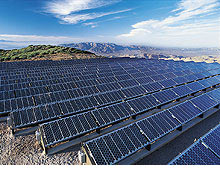
solar_panels_2ce03.jpgIt’s all about the green economy, stupid.

The United States could lose more than 116,000 green collar jobs and forgo $19 billion in green tech investment in 2009 if Congress fails to extend two tax credits crucial to the renewable energy industry, according to a new study.

One red flag about this report: It was commissioned by the American Wind Energy Association and released by the Solar Energy Industries Association — two trade groups pressing for extension of the investment tax credit and the production tax credit. Green Wombat tends to look askance at studies paid for by business and whose conclusions support the sponsors’ political agenda. But a review of the research conducted by Navigant Consulting indicates that it is solid, based on federal labor data and employment models as well as Navigant’s own market analysis.

Some background. The ITC provides a 30 percent tax credit for the installation of solar arrays and other equipment. Homeowners can claim the tax credit up to a maximum of $2,000 for residential solar arrays. There’s no cap for commercial solar arrays and the tax credit has been a key to attracting financing for large solar installations that can cost millions of dollars. (Several states, most notably California, offer even more lucrative incentives, which should help prop up demand.) The production tax credit provides a subsidy for the generation of electricity by solar, wind, geothermal and other renewable energy systems and has driven the construction of massive megawatt wind farms.

Both credits expire at the end of 2008 and the renewable energy industry and their allies in Silicon Valley and on Wall Street are pressing Congress for a long-term extension — five to eight years — to provide a stable investment climate for green projects. (Last week, executives from Google (GOOG), Hewlett-Packard (HPQ), Applied Materials (AMAT) and Credit Suisse (CS) were among those that signed a letter urging Congress to take action by March 1.)

The Navigant study projects that without the investment tax credit installations of solar arrays will fall from a projected 790 megawatts to 325 megawatts in 2009, eliminating 39,400 potential new jobs.

A couple of points to consider about those numbers. Navigant only considered the impact on the photovoltaic industry that manufactures and installs rooftop solar arrays. It did not calculate the consequences for the solar thermal business, which builds large-scale solar power plants that use mirrors to focus the sun’s rays on liquid-filled tubes or boilers to create steam to drive electricity-generating turbines. The solar thermal industry is in its infancy but utilities like PG&E (PCG), Southern California Edison (EIX) and San Diego Gas & Electric (SRE) have signed several contracts for solar power plants and negotiations for gigawatts more of solar electricity are ongoing.

The first solar power plants in California won’t go online until around 2010 but the construction and operation of those projects are expected to create thousands of jobs. Like the PV industry, solar thermal companies are dependent on the investment tax credit to attract the big money it takes to finance the construction of billion-dollar power plants. The loss of the investment tax credit would hit California particularly hard.

While rooftop solar companies worry about losing business in the future if the investment tax credit is not renewed, the more immediate concern among solar execs Green Wombat has talked to recently is finding enough workers to keep up with demand, especially in California.

Navigant projects an even bigger crash for the wind industry should the production tax credit expire, with installations falling from 6,500 megawatts to 500 megawatts in 2009 with the lose of 76,800 jobs. The wind industry has been continuously buffeted in recent years as Congress has allowed the production tax credit to expire repeatedly only to resuscitate it. In the past, the expiration of the tax credit has resulted in a 73% to 93% drop in the wind market, according to Navigant.

Read Full Post »

Twice now the renewable energy industry has narrowly lost votes in Congress to extend an investment tax credit crucial to jump-starting the market for large-scale projects like solar power plants. In December, Big Oil outmaneuvered green energy advocates and their Congressional supporters by claiming that rescinding huge tax breaks for the fossil fuel industry to pay for renewables would cost consumers at the pump. A more recent attempt to revive the tax credit also failed.

Now the American Council on Renewable Energy is bringing out its big green guns. Representatives from Silicon Valley tech giants, Wall Street investment banks and utilities signed a letter sent to the congressional leadership late Wednesday urging the long-term extension of the 30 percent investment tax credit as well as the production tax credit for the electricity produced by solar, wind, geothermal and other renewable energy systems. Among the signers urging action by March 1 are executives from )Google (GOOG), Hewlett-Packard (HPQ), Applied Materials (AMAT), Credit Suisse (CS), Wells Fargo (WFC), venture capitalists Kleiner Perkins Caufield & Byers and utility San Diego Gas & Electric, a subsidiary of energy giant Sempra (SRE).

Interestingly, the phrases “climate change” and “global warming” never appear in the letter. In a savvy move, the council has forsaken doom and gloom for a purely economic message: American jobs, competitiveness and innovation are at stake, the signers argue, and the tax incentive will spark a green tech boom at relatively little cost to the taxpayers. It’s a Silicon Valley mindset and its no surprise that while the signers represent companies from all over the United States, most hail from California.

The tax credits expire at the end of 2008 and proponents argue that a five-to-eight year extension is needed to create a stable investment climate, given that it can take three to five years for a large solar power plant to be permitted and built.

“The United States is in a historic position to lead in innovation and competitiveness in the renewable energy sector,” wrote the council’s three co-chairs, which include Dan Reicher, Google.org’s director of climate and energy initiatives. “As with all energy markets and in plans for growth in any businesses, certainty and continuity in public policy provides the confidence needed for stability in investments. We must ensure we are not creating an environment for boom and bust cycles in renewable energy and that we are not tying the hands of business owners in the sector looking to scale their technologies to meet demand and price points.”

Without an extension of the tax credits, the council warns that renewable energy projects in the pipeline that would produce 42 gigawatts of greenhouse-gas free electricity — enough to power tens of millions of homes — could grind to a halt, giving competitors in Europe and Asia the upper hand when it comes to green tech innovation.

Read Full Post »

solar-energy-bill-2.pngWith Congress back in session, renewable energy proponents are girding for a battle over legislation that could make or break the nascent solar power industry.

At stake in the energy bill now before Congress is the survival of a 30 percent investment tax credit that makes large-scale solar power plants a viable option for utilities under pressure to cut greenhouse gas emissions by obtaining more of their electricity from renewable sources. On the home front, a similar tax credit for residential solar installations is up for grabs as Congress tries to reconcile House and Senate versions of the energy legislation.

“There are at least eight or nine well-funded companies that are actually making great progress in developing large-scale solar,” says Joshua Bar-Lev, vice president for regulatory affairs for Oakland, Calif.,-based solar power plant developer BrightSource Energy. “I don’t know if any of them are going to be able to finance projects and get the permits they need without these tax credits.”

The solar companies and their allies in the utility industry and on Wall Street had been pressing for an eight-year extension of the investment tax credit. They also want to abolish a prohibition on utilities from taking advantage of the incentive if they invest directly in solar power plants. But since word hit the street that Congressional leaders were considering stripping out the incentives to speed passage of the complex legislation — catchall bills that will affect the fate of nearly every energy-related industry, from Big Oil to biofuels — solar proponents have been converging on the Capitol in an 11th-hour lobbying frenzy.

“Things are very uncertain at the moment,” says Chris O’Brien, an executive at solar panel maker Sharp who serves as chairman of the Solar Energy Industries Association, a trade group. “In recent years, we’ve seen a very sharp increase in corporate investment, project investment and financing for solar technology companies and solar projects. There’s great concern that the U.S. market continue to grow.”

Like other renewable energy sectors, solar has lived and died at the hands of tax incentives. In the 1980s a California tax break encouraged the construction of the state’s first utility-scale power plants by Luz International, founded by BrightSource’s chairman. When the incentives evaporated with the return of cheap energy that decade, the company’s business disappeared (though those Mojave Desert solar power stations continue to operate).

Global warming fears, renewable energy mandates imposed on utilities and a flood of venture capital has revived Big Solar over the past two years. The industry argues that longer term tax incentives must be put in place to ensure solar power plant builders have enough time to break into the electricity market and achieve economies of scale that will drive down the cost of green energy. This time around, the solar entrepreneurs have attracted the support of utilities like PG&E (PCG) and Edison International (EIX) as well as Wall Street titans like Goldman Sachs (GS) and Morgan Stanley (MS), both of which have invested in renewable energy companies. (Morgan Stanley, for instance, is backing BrightSource.)

“We’ve gone to Congress and talked to members about the need for multi-year commitments so we have certainty,” Rick Carter, PG&E’s director of federal government relations, told Green Wombat. “What we’ve seen over past couple years is stop-and-go with tax credits. If you have multi-year leads to build facilities, that doesn’t work.”

Take California, for example. Negotiations between a solar energy company and a utility over a power purchase agreement can last more than a year and it can take another three or four years to to obtain regulatory approval for a solar power plant, secure the site and then get the facility built and operating. PG&E, Southern California Edison and San Diego Gas & Electric (SRE) all have signed long-term power purchase agreements for solar power plants that will be financed and built over the next several years.

Given that the prime solar sites and potential economic payoff for Big Solar is in the sun-drenched West, companies like BrightSource have been targeting Congress members from western states. “We want both representatives and senators to see the benefit of this: price certainty, jobs, clean energy,” says Bar-Lev.

While the situation changes daily, action on the energy legislation is expected sometime in the next two weeks.

Read Full Post »

« Newer Posts - Older Posts »

Design a site like this with WordPress.com
Get started