Feeds:
Posts
Comments

Archive for the ‘green financing’ Category

topaz-solar-farm-app

In the green stimulus sweepstakes, big potential winners are companies like Silicon Valley startup OptiSolar.

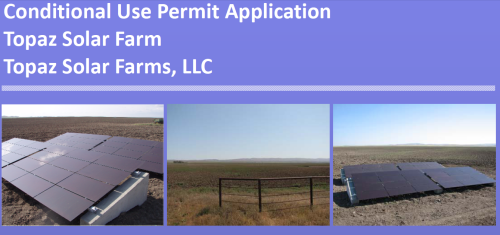
The solar-cell maker came out of nowhere last year to score a deal with utility PG&E to build the world’s largest photovolaic power plant, a 550-megawatt monster that would cover some 9 1/2 square miles on California’s central coast. OptiSolar subsequently began construction of a factory in Sacramento to produce the thousands of thin-film solar panels needed for the project. Then the economy tanked and as financing dried up, OptiSolar laid off half its workforce – some 300 employees – and halted construction of the Sacramento facility.

With a Colorado solar company executive joining President Barack Obama as he signed the $787 billion stimulus legislation into law Tuesday at a solar-powered museum in Denver, OptiSolar and other renewable energy companies stalled by the financial crisis may see their fortunes revive. The package allows builders of big renewable energy projects to apply for a government cash grant to cover 30% of construction costs in lieu of claiming a 30% investment tax credit. A dearth of investors who finance solar power plants and wind farms in exchange for the tax credits has put in jeopardy green energy projects planned for the desert Southwest and the Great Plains. The cash grant would shave about $300 million off the projected $1 billion price tag for OptiSolar’s Topaz Solar Farm.

The stimulus package also includes $2.3 billion to fund a 30% manufacturing tax credit for equipment used to make components for green energy projects, a provision OptiSolar can tap to help finance its solar cell factories. And the company may be able to take advantage of the legislation’s government loan guarantees for large renewable energy projects.

“It will lower the cost of the factory we’re building in Sacramento and make it easier to attract financing,” OptiSolar spokesman Alan Bernheimer told Green Wombat, noting the company’s priority is to complete the facility and begin production of solar panels. “The factory is more than shovel ready – our shovels are hanging on the wall where we put them when we had stop work in November.” (OptiSolar currently manufactures solar modules at its Hayward, Calif., plant.)

Fred Morse, senior adviser to Spanish solar energy giant Abengoa, says the stimulus package puts back on track a $1 billion, 280-megawatt solar thermal power plant the company will build outside Phoenix to produce electricity for utility Arizona Public Service. “With the stimulus bill we’re very confident we’ll be able to finance the project,” says Morse. He says Abengoa expects to use the government loan guarantees to obtain debt financing to fund construction of the project and then apply for the 30% cash refund. “I think the entire industry is very optimistic that these two aspects of the stimulus package, the grants and the temporary loan guarantees, should allow a lot of projects to be built.”

Mark McLanahan, senior vice president of corporate development for MMA Renewable Ventures, agrees. “I expect the government grants to attract new investors,” says McLanahan, whose San Francisco firm finances and owns commercial and utility-scale solar projects.

There are some strings attached, though.

To qualify for the cash grants, developers need to start shoveling dirt by Dec. 31, 2010. That means only a handful of big solar thermal power plants planned for California, for instance, are likely to make it through a complicated two-year licensing process in time to break ground by the deadline. One of those could be the first phase of BrightSource Energy’s 400-megawatt Ivanpah power plant on the California-Nevada border. But BrightSource’s biggest projects, part of a 1,300 megawatt deal signed with Southern California Edison (EIX) last week, won’t start coming online until 2013 at the earliest.

Another Big Solar project, Stirling Energy Systems’ 750-megawatt solar dish farm for San Diego Gas & Electric (SRE), will be racing to meet the 2010 deadline. The project is in the middle of a long environmental review by the California Energy Commission and the U.S. Bureau of Land Management which currently is scheduled to stretch into 2010.

SolarReserve CEO Terry Murphy says his Santa Monica-based startup has a couple of solar power plant projects in the works that should be able to take advantage of the stimulus provisions. “The likelihood of us being able to close on a financial deal has increased,” Murphy says.

Solar analyst Nathan Bullard of research firm New Energy Finance expects the stimulus package to prompt a push for large photovoltaic power projects. That’s because in California such solar farms – which essentially take rooftop solar panels and mount them in huge arrays on the ground – do not need approval from the California Energy Commission and can be built relatively quickly.

That’s good news for companies like thin-film solar cell maker First Solar (FSLR), which builds smaller scale photovoltaic power plants, and SunPower (SPWRA), which has a long-term contract with PG&E (PCG) for the electricity generated from a planned 250-megawatt PV solar farm to be built near OptiSolar’s project.

“It’s great for PV because you can definitely can get construction done by the end of 2010,” says Bullard. “It’s also good news for smaller and mid-sized developers who couldn’t access tax-equity financing.”

The catch, however, is that renewable energy companies still must raise money from investors in a credit-crunched market to cover construction costs, as the government doesn’t pay out the cash until 60 days after a solar power plant or wind farm goes online. And as McLanahan points out, the cost of raising capital from private equity investors is typically higher and will add to the cost of renewable energy projects. Those costs will only rise if the government is late in paying out refunds.

MMA Renewable finances large commercial arrays and solar power plants and then sells the electricity under long-term contracts to customers who host the solar systems. The loan guarantee provision of the stimulus legislation will help secure financing from investors skittish that some of MMA Renewable’s customers may default on their agreements, according to McLanahan.

Says Murphy: “The fact that we’re getting iron into the ground and getting things moving helps us.”

The wind industry also stands to gain from the stimulus package through a three-year extension of the production tax credit for generating renewable electricity as well as the government cash grants and manufacturing tax credit. Despite a record year for wind farm construction in 2008, projects have come to a standstill in recent months as the financial crisis froze development and forced the European-dominated industry to lay off workers.

“I think it’s good down payment on what needs to happen,” says Doug Pertz, CEO of Clipper Windpower, one of two U.S. wind turbine makers. “A lot more needs to be done but I think this will start to bring a lot of people back into the marketplace.”
Read Full Post »

denverairport-110

photo: WorldWater & Solar Technologies

As the financial crisis short-circuits the ambitions of green tech companies, solar financier MMA Renewable Ventures is pushing ahead with raising its fifth fund. Meanwhile, its solar power plant joint venture with Chinese solar cell maker Suntech – Gemini Solar Development – has been selected by utility Austin Energy to build a 30-megawatt solar farm in Texas.

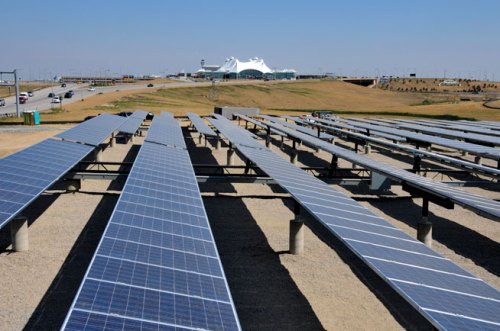
The San Francisco-based firm just completed its $200 million Solar Fund III, which invested in 20.6 megawatts of photovoltaic solar arrays for companies like Macy’s, the Gap, Lowe’s and utility FPL (FPL) as well as the Denver International Airport. MMA Renewable (MMAB.PK) provides the financing for the installation of large commercial solar arrays on big box stores and other locations while retaining ownership of the systems. The electricity produced is sold to the building owner under a long-term contract.

“The good news is that we can raise another fund in a tough market,” MMA Renewable Ventures CEO Matt Cheney told Green Wombat, adding that the company aims to raise $200 million or more for Solar Fund V.

That doesn’t mean it’ll be easy. Many of the Wall Street banks that invested in big solar systems are no more and demand for the tax credits generated by the projects has fallen faster than the Dow Jones as most companies aren’t piling up much tax liability these days.

“The ones that are left are being very picky and asking a lot,” says Cheney, adding that banks and other investors are demanding higher returns on their investments. Still, he notes, past MMA Renewable investors like Wells Fargo (WFC) remain relatively healthy. “If you look at every country in Europe and the U.S., there are good examples of financing institutions that were less impacted by the financial crisis, which is a deep one,” he says.

One possible source of new tax-equity investment may come from well-capitalized utilities that, thanks to a change to the tax laws Congress made last October, can now claim tax credits for solar projects. PG&E (PCG) CEO Peter Darbee, for instance, has said his utility plans to invest in solar power plants.

A new and potentially bigger worry is whether MMA Renewable customers – big box retailers and the like – will be survive the financial crisis. MMA Renewable’s business is built on long-term power purchase contracts – as long as 20 years – that provide a predictable and steady revenue stream to investors.

“Would you buy a corporate bond from a large U.S. company that went out 20 years today?” Cheney asks. “You would most likely tell me that’s a long time. You don’t know if you want to take that risk beyond five or ten years. That’s the equation that’s present in the marketplace today.”

In California, at least, demand for solar has remained strong: This week state regulators reported that installed solar systems more than doubled in 2008 from the previous year.

One bright spot may be the market for smaller-scale photovoltaic power plants and MMA Renewable’s Gemini joint venture with Suntech (STP).  The Austin Energy project still must be approved by the city of Austin, but Cheney says Gemini is in the midst of negotiations with other utilities as well.

When SunPower (SPWRA) reported record fourth-quarter earnings Thursday, CEO Tom Werner said the Silicon Valley solar cell maker was shifting resources to its power plant building business in 2009 and had 1,000 megawatts of projects on the drawing boards.

There was just one catch:  money. “We have a strong pipeline of projects fully permitted, or with permits in process, that will be buildable,” Werner said, ” when financing becomes available.”

Read Full Post »

kimberlina0089l1

photo: Ausra

When Green Wombat sat down for a chat with Ausra founder David Mills back in September 2007, he allowed that it was not unreasonable to expect the Silicon Valley solar startup to soon be building several massive megawatt solar power plants a year. The optimism was not unwarranted. After all, in the space of 12 months Ausra had relocated from Sydney to Palo Alto, raised $40 million from A-list venture capitalists and was about to ink a deal with utility PG&E for a 177-megawatt  solar power project.

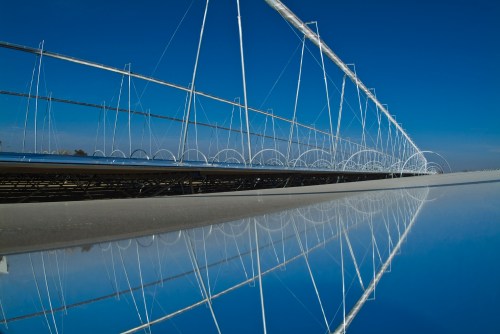
That was then. This month Ausra laid off 10% of its 108 employees amid a move to stop building Big Solar projects – for now – to focus on providing its solar thermal technology to other power plant developers and to industries that use steam. (Ausra’s compact linear fresnel reflector technology deploys flat mirrors that sit low to the ground and concentrate sunlight on water-filled pipes that hang over the mirrors. The superheated water creates steam which drives an electricity-generating turbine.)

“I think our competitors will figure this out sooner or later but nobody’s going from a five-megawatt project to a 500-megawatt project. No one’s going to finance that,” Ausra CEO Bob Fishman told Green Wombat. “If you look at the amount of money it takes to be involved in the project development business, that’s not something a startup can do.”

At least any time soon. Ausra last year opened a robotic factory in Las Vegas to make mirror arrays and other components for the many power plant projects it had on the drawing boards. Just three months ago the company flipped the switch on its five-megawatt Kimberlina demonstration power plant outside Bakersfield. But as the credit crunch hit, financing for billion-dollar solar power projects evaporated. Then in October, Congress passed legislation allowing utilities like PG&E (PCG), Southern California Edison (EIX) and San Diego Gas & Electric (SRE) to claim a 30% investment tax credit for solar projects. As the only well-capitalized institutions left standing in the energy game, utilities are stepping forward as investors.

PG&E CEO Peter Darbee says he’s prepared to make direct investments in solar power plants – projects the utility needs to comply with a California mandate to obtain 20% of its electricity from renewable sources by 2010 and 33% by 2020. Under pressure to meet those targets, California utilities have signed more than four gigawatts worth of power purchase agreements with solar power plant startups like BrightSource Energy, Solel, Stirling Energy Systems and eSolar. Utilities also have begun signing deals for electricity produced by smaller scale photovoltaic power plants built by companies like First Solar (FSLR) and SunPower (SPWRA).

Fishman said Ausra will complete the 177-megawatt Carrizo Energy Solar Farm in San Luis Obispo County on California’s central coast to supply electricity to PG&E. “If Peter Darbee wants to own Carrizo rather than buy the electricity, we’re willing to do it. It makes sense,” he says.

Ausra will also will complete a second big solar power plant planned for Arizona. But the company has quietly let drop a Florida project for utility FPL (FPL) and is negotiating to offload lease claims it filed on federal land in Arizona and Nevada for solar power plants during the solar land rush.

“Other projects in the pipeline we’ll be selling to utilities or developers for a modest amount of cash with a commitment that those developers must use our technology,” says Fishman.

Fishman notes that the cost of licensing a solar power plant can be $5 million to $10 million a year – and in California it’s a multi-year process – so Ausra will realize some immediate savings by morphing into a technology provider.

Customers for Ausra’s technology include oil companies that could inject solar-generated steam in oil wells to enhance recovery of thick petroleum as well as food processing plants and other heavy users of steam. Fishman just returned from a trip to the Middle East where he says he held talks in Kuwait, Qatar and Dubai about using Ausra’s technology for oil recovery and desalinization.

Going forward, he says Ausra’s focus will be on medium-sized power plants. “Maybe next year we’ll do four projects of 50 megawatts a year. It’s a walk before you run situation,” says Fishman. “The financial customers and financial community are going to insist we do medium scale before we do large scale. We’ll still want to do very large projects but given the project finance market, it’ll be a few years from now.”

Read Full Post »

img_1223

photo: Todd Woody

As President Barack Obama embraced renewable energy in his inaugural speech Tuesday, Clipper Windpower laid off 90 employees – about 11% of its workforce – as the global financial crisis throws a spanner in the once-booming wind industry.

The Carpinteria, Calif.-based turbine maker has seen business slow as customers delay existing orders and put off new ones because they cannot obtain financing for wind farms, Clipper CEO Doug Pertz told Green Wombat.

“In the short-term, the impact to Clipper is a reduction in 2009 turbine production,” he said. “We know that 2009 will be a challenging year, however, remain optimistic that this economic situation is temporary.  We trust that the new Obama administration will, in the not-too-distant future, enact policy to enable better financing options for wind energy projects and aggressively promote the growth of renewable energy development.”

Clipper is one of only two U.S.-owned turbine makers – the other being General Electric (GE) – in an industry dominated by European manufacturers and wind farm developers.

Like their counterparts in the solar industry – which also has been shedding workers in recent weeks – wind companies depend on tax incentives to lure investors. But with traditional investment banks all but extinct on Wall Street and other investors hoarding their cash, there’s been little appetite of late for investing in so-called tax equity partnerships to provide funding for massive wind farms or solar power plants.

Pertz said Clipper’s production is down 20% from the 750 megawatts worth of turbines it manufactured in 2008 and that he expects double-digit declines for 2009. “Customers with large balance sheets are being much more conservative and smaller independent wind developers are seeing that it is much more difficult to obtain tax-equity financing,” he noted.

Wind and solar industry lobbyists are pushing Congress to make the investment tax credit and the production tax credit refundable so those companies that don’t have tax liabilities can trade the credits for cash that can be used to finance renewable energy projects.

Founded in 2001 by wind industry veteran James Dehlsen – his first wind company is now owned by GE –  Clipper makes a 2.5-megawatt turbine called the Liberty at its Cedar Rapids, Iowa, factory that powers wind farms built by FPL (FPL) and BP (BP). Other customers include Queen Elizabeth II, who bought the prototype of a 10-megawatt offshore turbine being developed by Clipper in the U.K.

One bright spot for the wind industry, said Pertz, is an expected move by well-capitalized utilities to take ownership stakes in wind farms if a national standard is enacted requiring them to obtain a certain percentage of their electricity from renewable sources.

Read Full Post »

b_342

photo: Better Place

Electric cars, eh?

Silicon Valley startup Better Place on Thursday unveiled a deal with the government of Ontario – the Michigan of Canada – to build an electric car charging network in the automaking province. The announcement comes on the heels of agreements Better Place — the electric car infrastructure company founded by former software executive Shai Agassi — has made with governments in Australia, California, Denmark, Hawaii, Israel and Japan.  Better Place is working with the Canadian arm of Sydney-based infrastructure finance giant Macquarie to develop the Ontario electric car network.

“We need to be where the puck is going and in this case bring the puck to Ontario,” said Ontario minister of international trade Pupatello at a press conference in Toronto Thursday morning.

The Canadian deal comes amid turmoil in the nascent electric car industry. While EV companies like Think and Tesla struggle to survive the credit crisis, the big automakers – Ford (F), General Motors (GM), Toyota (TM), Honda (HMC) and Chrysler – have announced they’re accelerating plans to build electric cars and, in GM’s case, a battery-making factory.

On Thursday, the premier of Ontario, Dalton McGuinty, said his government will conduct a study on how to expedite the introduction of electric cars in the province. When the study is released in May, Better Place will detail its plan and investment timeline for building the network of charging posts and battery-swapping stations.

Better Place, said McGuinty,  “is a model with the power to reshape our province. It’s going to create new green jobs, it’s going to make life more convenient for car drivers of the future and it’s going to signal to the world that Ontario is electric-car friendly and will make it a more attractive place to build electric cars.”

Agassi has now committed to raising billions in capital to simultaneously build charging networks in five far-flung countries over the next three years. When Green Wombat talked to Agassi in November after he signed a deal to build a $1 billion San Francisco Bay Area charging network, he insisted the financial crisis would not hamper efforts to raise funding.

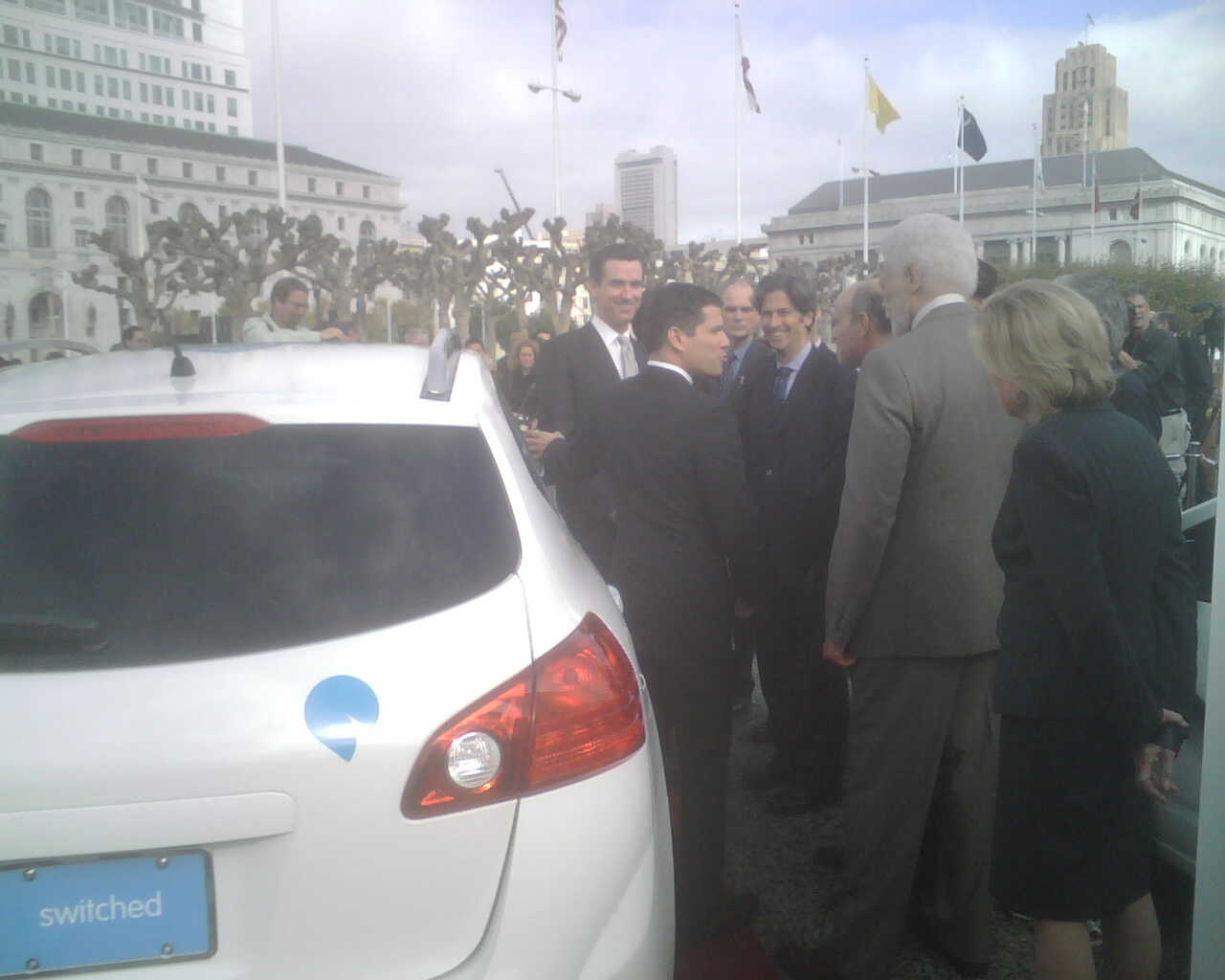
Under Better Place’s system, consumers will buy the electric cars while Better Place will own the batteries, charging subscribers to its network a fee per-mile (or kilometer) driven. Renault-Nissan is supplying electric cars for Better Place’s other networks. An electric Nissan SUV – emblazoned with little wind turbines – was parked at the press conference but company spokeswoman Julie Mullins said an electric car supplier had not yet been selected for Ontario. “Ultimately, we expect a wide range of vehicle makes and models to be available to drivers,” she wrote in an e-mail. “We are currently in talks with several car companies.”

Ontario-based Bullfrog Power will provide renewable energy – 80% hydro, 20% wind – for the Better Place network. “We’re going to create a virtual oil field across the province,” said Agassi.

Read Full Post »

think-city-8_imagelarge

photo: Think

Norwegian electric carmaker Think said Tuesday it has obtained a $5.7 million bridge loan from battery maker Ener1 Group and other investors to allow the company to resume limited production of its City urban runabout.

In December Think idled its assembly line and laid off workers as the global credit crunch took its toll and the company was unable to obtain funding to finance continued production of its electric vehicles.

Think CEO Richard Canny said in a statement Tuesday that the company is continuing negotiations to raise capital but the interim financing from Ener1, which is supplying lithium-ion batteries to Think, will allow the recall of some workers to complete cars from parts on hand.  “We have encouraging engagement with a number of potential new equity investors for our recapitalization process,” said Canny.

The Think financing comes as Ford (F), Toyota (TM), Honda (HMC) and other major automakers unveil prototypes for new electric cars and plug-in hybrids at the Detroit Auto Show.

Read Full Post »

solana1The credit crunch is taking a toll on the United States’ nascent solar industry, scuttling big renewable energy projects and curtailing expansion plans, solar executives said Wednesday as they proposed the inclusion of green incentives in the Obama economic stimulus plan.

Spanish energy giant Abengoa, for instance, has put on hold plans to build its 280-megawatt Solana solar power plant outside Phoenix to supply electricity to utility Arizona Public Service (PNW) in a $4 billion deal, said Fred Morse, senior advisor to Abengoa Solar.

“We have serious issues getting financing,” said Morse during a conference call held by the Solar Energy Industries Association. Congress in October passed a 30% investment tax credit crucial to the solar industry. But Wall Street’s meltdown has scared off investors that normally would finance large solar projects in exchange for the tax credits.

“The investment tax credit was passed but unfortunately there was no ‘I’ in the ITC,” Morse added. “We have trouble finding tax-equity investors, the financing is gone.”

Suntech America president Roger Efird said that after Congress passed the investment tax credit, the Chinese solar cell maker immediately doubled its sales force in the U.S. That expansion has now hit a wall.

“Plans to double our sales force by the end of 2009 are currently on hold, primarily because business has slowed in fourth quarter because of the credit crunch,” he said. “We had been considering establishing manufacturing in the U.S. The timing of those plans depend on the growth of the market in the U.S. and how long it takes to get through this downturn.”  Suntech’s (STP) stock – like those of rivals SunPower (SPWRA) and First Solar (FSLR) – has been walloped by the market chaos and is down 94% from its 52-week high.

Ron Kenedi of Sharp Solar said the dealers and installers who buy the Japanese solar module maker’s products have had a hard time securing credit to finance their operations.

In response, the solar industry’s trade group on Wednesday proposed that the federal government cut through the credit crunch by adopting tax and investment policies to stimulate the solar sector and create 1 million jobs.

The centerpiece of the plan is a $10 billion program to install 4,000 megawatts of solar energy on federal buildings and at military installations. “The Department of Defense alone could jump start this industry and it could have widespread impact on the use of solar, similar to what it did for the Internet,” said Nancy Bacon, an executive with Michigan thin-film solar cell maker Energy Conversion Devices (ENER).

Bacon noted that the federal government is the world’s largest utility customer, spending $5.6 billion annually on electricity. “This would create 350,000 sustainable jobs,” she said. “The solar industry is ready to deploy these systems immediately.”

The Solar Energy Industries Association also wants Congress to enact a 30% tax refundable tax credit for the purchase of solar manufacturing equipment to encourage solar companies to build their factories in the U.S. That would result in an estimated 315,000 new jobs. Making the current investment tax credit refundable would also help loosen up financing for solar projects, the association said.

Other policies on the SEIA agenda:

  • Establishment of a national Renewable Portfolio Standard that would require states to obtain a minimum of 10% of their electricity from green sources by 2012 and 25% by 2025, with 30% of the total coming from solar.
  • Rapid deployment of new transmission lines to connect cities to remote areas where wind and solar power is typically produced.
  • Expedited approval of solar power plant projects on federal land in the Southwest.
  • Creation of an Office of Renewable Energy in President-elect Obama’s office to coordinate the procurement and permitting of solar power and transmission lines.

“We are working closely with the Obama energy transition team and have been in contact with Congress,” said SEIA president Rhone Resch. “These polices are exactly the kind of shot in the arm our economy needs today.”

Read Full Post »

20081117_3625_betterplace

Photo: Better Place/Acey Harper

SAN FRANCISCO – It was a day when the shift from the past to the future was almost palpable.

It started Thursday morning in Berkeley where Green Wombat was moderating a panel of tech luminaries gathered at the University of California’s Global Technology Leaders Conference. As Shai Agassi, founder of electric car infrastructure company Better Place, makes the case for harnessing Silicon Valley’s technological innovation to Detroit’s manufacturing might to create a sustainable car industry, dispatches from the automotive apocalypse roll down my BlackBerry: Ford (F) shares sink to $1.01…GM’s (GM) stock falls to its lowest level since World War II…U.S. automakers beg for a bailout…California Congressman Henry Waxman ousts Michigan’s John Dingell — the Duke of Detroit — from his 28-year chairmanship of the powerful House Energy and Commerce Committee.

Agassi slips out of the conference and an hour later I catch up with him across the Bay at San Francisco City Hall where he and representatives of Governor Arnold Schwarzenegger and the mayors of San Francisco, San Jose and Oakland announce a $1 billion project to build a regional network of electric car charging stations. Better Place has signed similar deals with governments in Israel, Denmark and Australia, but California is the company’s first foray into the U.S. market. Planning for the Bay Area network begins in 2009 with construction scheduled to start in 2010 and commercial rollout set for 2012.

better20place202The mood is ebullient. “This is the start of a regional effort to become the capital of electric vehicles in the United States,” proclaims San Francisco Mayor Gavin Newsom before an audience that includes representatives from state and federal environmental agencies, green groups. Silicon Valley business leaders and officials from GM and Toyota (TM).

For his part, Agassi says, ” We believe this is not just a model for California, but a blueprint for the United States.”

The blueprint works like this: The mayors of the Bay Area’s three largest cities agreed to expedite permitting and installation of electric car charging stations, standardize regional regulations to promote an electric car infrastructure and offer incentives to employers to install chargers at workplaces. The mayors also agreed to pool purchases of municipal electric car fleets.

Better Place will raise the capital to install thousands of charging spots on the streets of San Francisco, San Jose and Oakland as well as stations between California cities where drivers can swap depleted batteries for fresh ones when they make longer trips. The Palo Alto-based company will own the car batteries and charge drivers for the miles driven. Automaker Renault-Nissan is developing electric cars for the Better Place network.

The big idea: Only by building an electric car infrastructure first will automakers produce the tens of millions of electric cars needed to make a significant dent in greenhouse gas emissions and the nation’s dependence on foreign oil.

That business model elicited some skepticism earlier in the day at the Berkeley conference, where Michael Marks, former CEO of electric carmaker Tesla Motors, questioned Agassi’s claim that Better Place would be able to provide electric cars that cost no more than gasoline-powered vehicles. And Jim Davidson, co-founder of Silicon Valley private equity firm Silver Lake, asked if Better Place would essentially be tapping the power grid to create a monopoly. (No, Agassi said, the Better Place network would be open to all electric cars.)

When Green Wombat sat down with Agassi and Newsom in the mayor’s offices Thursday afternoon, I asked Agassi, who brings a charismatic messianism to his mission, how Better Place would raise the billions needed to roll out an electric car infrastructure in California amid a global economic meltdown. He noted that in Australia Better Place signed up investment giant Macquarie Bank to create an infrastructure fund to finance that project while in Denmark a utility will provide financing.

“We will do the same thing here; we’re working with Morgan Stanley (MS) and Goldman Sachs (GS),” Agassi says, recounting a conversation he recently had with investors who he said were eager to put money in Better Place projects.

If anything, Newsom, 41, and Agassi, 40, and their allies regard the confluence of the financial crisis, the great Detroit car crash and the consolidation of green power in the incoming Obama administration and Congress as a once-in-a-lifetime opportunity to launch a disruptive technology on a global scale and transform the U.S. automotive industry.

“We’re uniquely positioned in that our local representative is Speaker of the House,” notes Newsom, referring to his close political ally, San Francisco Democrat Nancy Pelosi, who on Thursday sent a message of support for the Better Place initiative. “That can elevate what we’re trying to achieve out here.”

There’s no doubt that Newsom has a knack for game-changing politics. (He launched the gay marriage movement in these offices.) But the nuts and bolts of getting the bureaucracy to fall in line will be a harder challenge, as anyone who has ever tried to get a permit to do a home renovation in San Francisco can tell you. And not all of San Francisco’s collaborations with Silicon Valley tech companies have gone well — witness the collapse of the citywide Wi-Fi initiative Newsom undertook with Google (GOOG).

Agassi hesitated when I asked about plans to extend the Bay Area electric car network to the rest of California, noting that negotiating agreements with the nearly 100 municipalities that make up Greater Los Angeles poses a challenge. “I got a call the other day from the mayor of L.A. asking where are we,” Agassi says. “We hope to eventually make it an electric charging corridor from California to Seattle to Vancouver.”

On Thursday, Agassi and the politicians took pains to paint the Better Place initiative as not a California versus Michigan thing, or new economy versus old. And they just may be right. For in a strange way, by building an electric car infrastructure, California is offering Detroit a rescue package of its own: Supplying the network lays the groundwork for the mass production of electric cars that could be the auto industry’s salvation.

That may be counter to conventional wisdom, but perhaps Robert F. Kennedy Jr., environmentalist and advisor to Silicon Valley’s VantagePoint Venture Partners – a Better Place investor – put it best on Thursday at the press event when he upended the East Coast view of the Golden State: “When you come to California, you find people in touch with reality.”

Read Full Post »

deutsche-bank-green-bankPresident-elect Barack Obama may dismiss notions of a New New Deal to stave off a Great Depression 2.0, but signs of a Rooseveltian shift in thinking abound.

Case in point: This week, Deutsche Bank called for the establishment of a “national infrastructure bank” to create “green” jobs, fight global warming and ensure U.S.  energy independence by investing in an array of projects – from energy efficiency to upgrading the Eisenhower-era power grid to large-scale renewable energy power plants.

The idea of a national infrastructure bank is not new – versions have been proposed by Obama and Senators Chris Dodd (D-Conn.) and Chuck Hagel (R-Neb.) to finance the repair of the nation’s crumbling highways, water systems and cities. Deutsche’s twist is to give such an institution a green mission.

“We believe this confluence opens up an historic opportunity for a new U.S. administration and Congress to take a global leadership position on the issue of the environment and energy security, while addressing current financial problems,”  wrote Deutsche Bank’s Climate Change Investment Research team in its report.

“We’re calling for the national infrastructure bank to go green because in the long run it will save us money and create more jobs,” Deutsche senior investment analyst Bruce Kahn told Green Wombat.

He says Deutsche Bank is not putting a dollar figure on the capitalization of such bank, but the report notes others have suggested a $100 billion investment would generate two million green jobs.

Deutsche Bank (DB) recommends a green infrastructure bank focus on energy efficiency, the transmission grid, renewable energy and public transportation. The green bank would dispense federal funding, make grants to states and cities, issue loans to governments and companies, underwrite public and private bonds, and provide tax credits for public and private projects.

In Deutsche Bank’s analysis, the biggest bang for the buck would come from a massive retrofit program to increase the energy efficiency of the nation’s commercial buildings and make sure the 1.8 million new homes constructed every year are green. Buildings consume as much as 50% of the electricity generated in urban areas and emit about 20% of the country’s greenhouse gases. The work of installing energy-efficient heating, lighting and air conditioning systems is labor intensive and would spike demand for green building materials.

Upgrading and digitizing the power grid to create a “transmission super highway” to bring solar and wind energy from the deserts and Great Plains to the cities could generate as many as 500,000 jobs, according to an estimate by the American Wind Energy Association. The price tag to modernize the grid: $450 billion over the next 15 years by New Energy Finance’s estimate.

One area given short shrift by the Deutsche report is how a green infrastructure bank would support large-scale renewable energy power plants. Wind farms and solar power stations typically require billions of dollars in financing to get built and rely on investors buying the tax credits the projects generate. Those investors have been in short supply thanks to the credit crunch and the collapse of the Wall Street banks that often put up the cash for such deals.

“Everyone’s lost money, there’s no tax equity to be had,”  says Kahn. “But we expect that tax credit equity investors will return to the market, not next month, but in the next couple of years.” Kahn says an infrastructure bank could support green energy power plant projects through loans and loan guarantees.

A green bank would also be good business for Deutsche Bank.

“We have large number of investments at stake, current investments in all these sectors,” says Kahn. “It provides an investment opportunity as this infrastructure bank would not be able to exist all on its own. It would need private capital to invest alongside it.”

Read Full Post »

photo: eSolar

If Wall Street’s implosion can feel remote on the West Coast, where green tech startups largely rely on Silicon Valley venture capital, there may be no escaping the fallout from the credit crunch.

Still, even those renewable energy companies tapping East Coast cash have powered ahead amid the chaos on the Street. Take SolarReserve, a Santa Monica, Calif.-based solar power plant developer. A day after Lehman Brothers filed for bankruptcy last week, the stealth startup announced a $140 million round of funding from investors that included Citigroup (C) and Credit Suisse (CS).

Lehman does hold small stakes in wind turbine maker Clipper Windpower of Carpinteria, Calif., and Ormat Technologies, a Reno, Nev., geothermal developer. “Lehman’s exit from wind is not good news, but it’s not the end of the world,” says Ethan Zindler, head of North American research for New Energy Finance, a London-based research firm. And while Lehman holds stock lent to it from solar cell companies like SunPower (SPWR) and Evergreen Solar – potentially diluting their earnings per share if the stock is not returned – Lehman is not a big player in solar.

That’s not the case with Goldman Sachs (GS) and Morgan Stanley (MS). Both are major solar and wind investors and both were forced this week to reorganize themselves into bank holding companies to stave off shotgun marriages with other institutions. Spokespeople for Goldman and Morgan Stanley told Green Wombat that the firms’ transformation into more conventional commercial banks – at least a two-year process- will not change their green investing strategies.

But if there appears to be little immediate collateral damage from the financial crisis for green tech startups, there are longer-term consequences. Solar power plants, wind farms and other large-scale renewable energy projects require billions of dollars in bank financing.

“Credit is just going to get more expensive,” says Zindler. “We’ve already seen some pull-back for some big solar and wind deals. Bigger developers who have solid balance sheets will be OK but the smaller guys could be in trouble.”

Says Bill Gross, chairman of solar power plant developer eSolar: “I think if you’re going to get project financing, you’re just going to have to show higher returns to get people to take the money out of the mattress.”

But Gross, the founder of Pasadena, Calif.-based startup incubator Idealab, argues that given soaring electricity demand and fossil fuel prices, large-scale renewable energy projects will be an attractive investment, paricularly since utilities typically sign 20-year contracts for the power they produce. eSolar, which is backed by Google and other investors, has a long-term contract to supply Southern California Edison with 245 megawatts of green electricity. Gross says eSolar has a pipeline of other projects and interest in the company remains high, particularly overseas.

“If you can make projects that can compete with fossil fuels on a parity basis, those projects are going to be financed,” he says, “because they’re safe returns for 20 years and I think money is going to flow to them.”

Rob Lamkin, CEO of solar power plant startup Cool Earth, echoed that sentiment. “The credit crisis does give me pause,” says Lamkin, whose Livermore, Calif.-company has raised $21 million in venture funding and is developing “solar balloons” that use air pressure to concentrate sunlight on solar cells. “But the energy problem is so big that I don’t see problems raising project financing.”

The key for developers of utility-scale projects – particularly solar power plants – will be keeping their costs under control; not an easy thing when deploying new technologies amid a commodities boom.

Dita Bronicki, CEO of geothermal power plant developer Ormat Technologies (ORA), does not anticipate trouble obtaining project financing. “I think the cost of money is going to go up, but a company like Ormat with an operating fleet and operating cash flow will not be as affected,” Bronicki says. “Small companies will find that lenders will be more picky in what they will invest.”

Green entrepreneurs tend to be an optimistic bunch, so it’s not surprising they still think the future looks bright. But they had reason to be sunny this week – amid Wall Street’s meltdown, the U.S. Senate on Tuesday passed, at long last,  extensions of crucial renewable energy investment tax credits and other goodies to goose green tech, such as a tax credit worth up to $7,500 for buyers of plug-in electric cars. The Senate action now must be reconciled with similar legislation in the House of Representatives.

Solar projects, for instance, would qualify for a 30% investment tax credit through 2016.

“That is one thing that will help project finance,” says Gross. “So many people are sitting on the sidelines right now and if the investment tax credit passes that will help get these projects financed.”

Read Full Post »

« Newer Posts - Older Posts »

Design a site like this with WordPress.com
Get started