Feeds:
Posts
Comments

Archive for the ‘eSolar’ Category

solara

photo: BrightSource Energy

As the Nevada legislature debates extending tax breaks for large-scale solar power plants, a new report finds that ramping up solar development in the Silver State could produce thousands of good-paying green jobs while generating nearly $11 billion in economic benefits.

The study from San Francisco-based non-profit Vote Solar concludes that 2,000 megawatts’ worth of big solar thermal and photovoltaic farms — needed to meet Nevada’s electricity demand — would result in 5,900 construction jobs a year during the plants’ building phase, 1,200 permanent jobs and half a billion dollars in tax revenues.

“It is likely that such an investment in solar generating facilities could bring solar and related manufacturing to Nevada,” the reports authors wrote. “The economic impact of such manufacturing development is not included in this analysis, but would add significant additional benefits.”

Vote Solar’s job projections are based on an economic model developed by the National Renewable Energy Laboratory to project the impact of solar trough power plants, the most common, if dated, type of Big Solar technology.

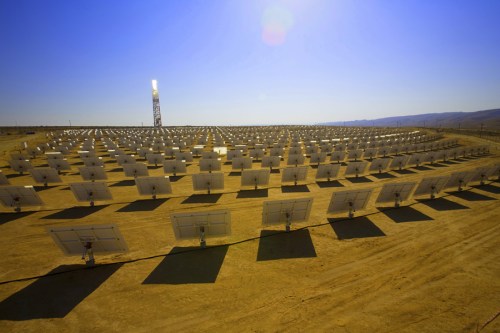
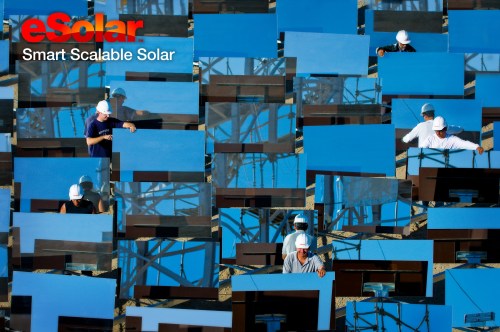
The different solar technologies set to come online in the next couple of years could change that equation. No doubt thousands of jobs will be generated by Big Solar but just how many will depend on the mix of solar thermal and photovoltaic power plants that ultimately come online. New technologies like BrightSource Energy’s “power tower,” Ausra’s compact linear fresnel reflector and Stirling Energy Systems’s solar dish may generate similar numbers of jobs. But then there’s eSolar’s power tower solar farms – which uses fields of mirrors called heliostats to focus the sun on a water-filled boiler, creating steam that drives an electricity-generating turbine.  eSolar’s small and prefabricated heliostat arrays cut out much of the skilled labor typically needed on such projects as they can be installed by two workers using a wrench.

Photovoltaic farms essentially take rooftop solar panels and put them on the ground and thus don’t require highly skilled laborers to build turbine power blocks, miles of piping and other infrastructure needed in solar thermal facilities. (They also can be built much more quickly than a solar thermal plant, which is why utilities have been striking deals with companies like First Solar (FSLR) and SunPower (SPWRA) for PV farms.)

A second report released this week — from the Large-Scale Solar Association, an industry group — found that Nevada could gain an edge over Arizona and California in luring solar power plant builders if it extended and sweetened tax incentives.  The three states form something of a golden triangle of solar, offering the nation’s most intense sunshine and vast tracts of government-owned desert land that are being opened up for solar development.

The timing of the reports was no accident. The Nevada Legislature held hearings earlier this week on extending tax breaks for Big Solar that expire in June, and Vote Solar’s utility-scale solar policy director, Jim Baak, went to Carson City to lobby legislators, hoping to head off one proposal to tax renewable energy production.

The Large-Scale Solar report, prepared by a Las Vegas economic consulting firm, found that if legislators let the tax breaks sunset, as it were, the developer of a 100-megawatt solar power plant would pay $55.1 million in taxes in Nevada during the first 15 years of the facility’s operation compared to $26.1 million in Arizona and between $36.1 and $37.9 million in California. If the current incentives are kept, tax payments drop to $25.1 million. A bigger tax break would reduce the tax burden to $14.3 million.
Read Full Post »

esolar-smart-scalable-solar

photo: eSolar

California startup eSolar said on Tuesday that it has licensed its solar power technology for the construction of up to 1 gigawatt of solar farms in India over the next decade.

The deal with Indian conglomerate ACME Group marks India’s first move into large-scale solar power and is the biggest announced foray of a United States solar power plant company overseas. The agreement calls for ACME, based in the northern Indian state of Haryana, to invest $30 million in eSolar, which will also earn fees for each of its 46-megawatt modular solar thermal power plants that are built.

A gigawatt, or 1,000 megawatts, of solar energy produces enough electricity to keep the lights on in about 750,000 energy-hogging U.S. homes. Presumably, many more homes and businesses can be powered by a gigawatt in India, where electricity shortages are common and the country relies on greenhouse-gas emitting diesel generators.

“We’re exclusively selling to ACME in India and they’re exclusively using us,” eSolar CEO Bill Gross told Green Wombat. “We’d like to do something like this in Spain, in Australia and the Middle East.”

It’s the second big deal for Pasadena-based eSolar in a week. Last Monday, the company inked an agreement to license its technology to U.S. coal-fired utility NRG (NRG) for the development of up to 500 megawatts of solar power plants in California and the Southwest for Southern California Edison (EIX) and other utilities. Meanwhile, the financial crisis is forcing the consolidation of the solar industry, with Monday’s dual deals — First Solar (FSLR) acquired the solar power plant assets of Silicon Valley OptiSolar while Spanish solar developer Fotowatio bought financier MMA Renewable Ventures’ solar portfolio.

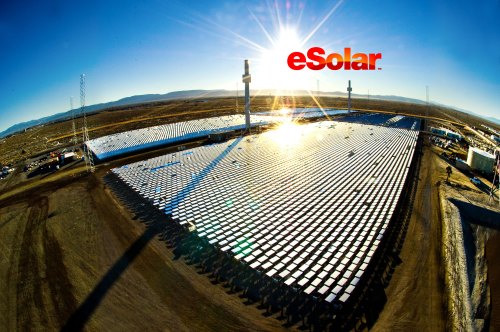
eSolar claims it can generate electricity at lower prices than natural gas-fired power plants by mass-producing mirrors called heliostats that concentrate sunlight on a water-filled receiver atop a tower to create steam that drives a turbine. The heliostats are much smaller than those made by competitors, use far less steel and can be quickly and cheaply installed in the field because they’re controlled by sophisticated software, according to Gross.

That allows eSolar to pack more mirrors into the solar field to create relatively compact power plants that can be located near urban centers rather than in the desert. ACME, which makes everything from telecommunications equipment and refrigeration systems to fuel cells, will begin construction of the first solar farm later this year.

ACME will hire contractors to build the solar power plants while eSolar will provide the heliostat fields, power towers and software systems. ACME so far has signed power purchase agreements with Indian utilities for 250 megawatts, according to eSolar.

“The eSolar system addresses obstacles that have previously plagued solar installations and presents a viable, cost-effective alternative that can scale quickly to meet India’s growing energy needs,” ACME CEO Manoj Upadhyay said in a statement.

Read Full Post »

esolar-field_wide_2b
photo: eSolar

SAN FRANCISCO — “It’s all about the software,” says eSolar CEO Bill Gross.

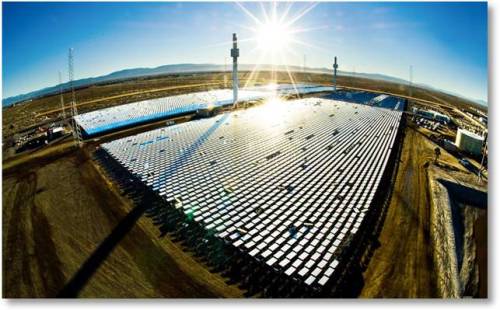
The tech entrepreneur and founder of startup incubator Idealab is explaining how eSolar’s solar power plants can produce carbon-free electricity cheaper than planet-warming natural gas. At the Cleantech Forum in San Francisco, Gross flashes a photo of eSolar’s demonstration solar farm outside the Southern California town of Lancaster, where 24,000 mirrors called heliostats surround two 150-foot towers.  The heliostats concentrate sunlight on a tower containing water-filled boilers and the resulting heat creates steam that drives an electricity-generating turbine. Rivals like BrightSource Energy use similar “power tower” technology but according to Gross, eSolar’s mirror-controlling software and modular plant design will allow it to produce cheaper solar electricity.

For instance, Gross says competitors use large, slightly curved mirrors to focus sunlight. That require big and expensive steel frames to hold the glass in place.  eSolar’s solution: make small flat mirrors the size of an LCD television screen that clamp on to a  5 x 12-inch frame and then use software and Big Iron computing to position the mirrors to create a parabola out of the entire heliostat field.

“We use Moore’s law rather than more steel,” quipped Gross, referring to Intel co-founder Gordon Moore’s maxim that computing power doubles every two years.

The heliostats roll off an assembly line in China with the wiring and sun-tracking motors built in. “The only tool required to install mirrors in the field is a hand wrench,” Gross says. “There’s  no welding in field, you just install the mirrors on the base. We’ve taken all the labor in the field and moved it to an automated factory.”

The heliostats also do not have to be precisely placed in the solar field, which saves time. “The rows can be wavy as the software will correct for it,” Gross notes. “We don’t need to do extensive surveys to design the field; we just need to leave enough space between mirrors.”

The bottom line: The five-megawatt Palmdale project was built in less than six months. “We think we can finish plants before other people start,” Gross told Green Wombat.

Gross says eSolar has also signed a 92-megawatt deal with a New Mexico utility, which he declined to identify until the agreement is announced. He said his Pasadena, Calif.-based company will also soon unveil a contract to build 500 megawatt’s worth of solar farms in Asia. So far, eSolar has spent $30 million acquiring land – mainly privately owned agricultural property – for solar power plants, according to Gross. He told Cleantech Forum participants that eSolar expects internal rates of return for its partners of between 11% and 14% for U.S. power plants and returns of 20% to 30% for overseas projects.

Also saving time and money are the power towers, which are made from two sections of a windmill tower. At 150 feet they’re half the size of competitors’ towers – again, less steel is needed. The lower height and the software systems that allow more mirrors to be crammed into smaller spaces means that eSolar’s power plants can be placed closer to urban areas where transmission lines are available.

Also unique is the boiler that sits atop the tower. Gross gave Green Wombat a close-up look the proprietary technology. About the size of a cargo shipping container, the “cavity receiver” has openings on either side. The heliostats focus sunlight into the interior of the boiler, which is lined with water-filled pipes.

“The benefit is that the light comes in and even if some light is reflected it can have multiple bounces and still hit the pipes,” Gross says. “We can get all the light inside the cavity all because of the software that controls the mirrors.”

Whether Google (GOOG)-backed eSolar’s plants produce electricity at the low rates Gross is claiming won’t be known until they start coming online. But utilities are betting that this solar software works. Southern California Edision (EIX) last year signed a 20-year-contract with eSolar for 245 megawatts of electricity while coal-dependent NRG Energy (NRG) this week agreed to invest $10 million in eSolar in exchange for the right to develop up to 500 megawatts using the company’s technology. (Southern California Edison is betting even bigger on BrightSource Energy’s power tower technology – two weeks ago the utility signed a 1,300 megawatt power purchase agreement with the Oakland startup – also backed by Google – the world’s largest solar deal to date.)

Read Full Post »

image001

photo: eSolar

NRG Energy, one of the United States’ most coal-dependent utilities, on Monday signed a deal with California startup eSolar to develop solar power plants.

The agreement calls for NRG  to invest $10 million in Pasadena-based eSolar for the right to use the startup’s technology to develop and operate three solar power projects in California and the Southwest that would generate 500 megawatts of greenhouse gas-free electricity.  NRG ranks as one of the nation’s dirtiest utilities,  spewing 70 million tons of carbon dioxide annually from its coal-fired power plants, according to a 2007 Fortune Magazine story.  But the Princeton, N.J.-based Fortune 500 company has sought to clean up its ways under CEO David Crane, pursuing carbon-capture technology and moving to build nuclear power plants.

Last year eSolar, founded by Idealab’s Bill Gross and backed by Google, won a 20-year contract to supply utility Southern California Edison (EIX) with 245 megawatts of green electricity annually. Last  April, eSolar scored $130 million in funding from Google.org, Google’s (GOOG) philanthropic arm, and other investors to develop solar thermal technology that Gross claims will produce electricity as cheaply as coal-fired power plants.

Like rivals Ausra and BrightSource Energy – which have deals with utility PG&E (PCG) – eSolar will use fields of mirrors to heat water to create steam that drives electricity-generating turbines. Gross says that eSolar’s software allows the company to individually control smaller sun-tracking mirrors – called heliostats – which can be cheaply manufactured and which are more efficient and take up less land than conventional mirrors. According to Gross, that means eSolar can build modular power plants near urban areas and transmission lines rather than out in the desert, lowering costs.

In October, eSolar’s then-CEO told Green Wombat that the company was more interested in being a solar technology provider than a power plant construction company.

The eSolar deal gives NRG (NRG), which operates coal-fired power plants in Texas and the Northeast, a foothold in the California renewable energy market. The first solar farm will go online in 2011 and NRG will have the right to develop 11 of eSolar’s 46-megawatt modular power plants. eSolar currently is building a five-megawatt demonstration power plant in Lancaster, Calif., that is expected to be completed this year.

“By coupling NRG’s construction capabilities and regional operating expertise with eSolar’s innovative … technology, we can advance NRG’s renewable energy portfolio while helping to accelerate development of these important projects on a commercial scale,” said NRG executive Michael Liebelson in a statement.

During a press conference Monday, Liebelson said NRG would be able to take advantage of the 30% investment tax credit for renewable energy projects and intends to apply for federal loan guarantees for such power plants that were included in the recently enacted stimulus package.

The deal, coming less than two weeks after BrightSource Energy signed a 1,300-megawatt power purchase agreement with Southern California Edison, shows that despite the financial crisis the market for renewable energy is showing renewed signs of life.

Read Full Post »

kimberlina0089l1

photo: Ausra

When Green Wombat sat down for a chat with Ausra founder David Mills back in September 2007, he allowed that it was not unreasonable to expect the Silicon Valley solar startup to soon be building several massive megawatt solar power plants a year. The optimism was not unwarranted. After all, in the space of 12 months Ausra had relocated from Sydney to Palo Alto, raised $40 million from A-list venture capitalists and was about to ink a deal with utility PG&E for a 177-megawatt  solar power project.

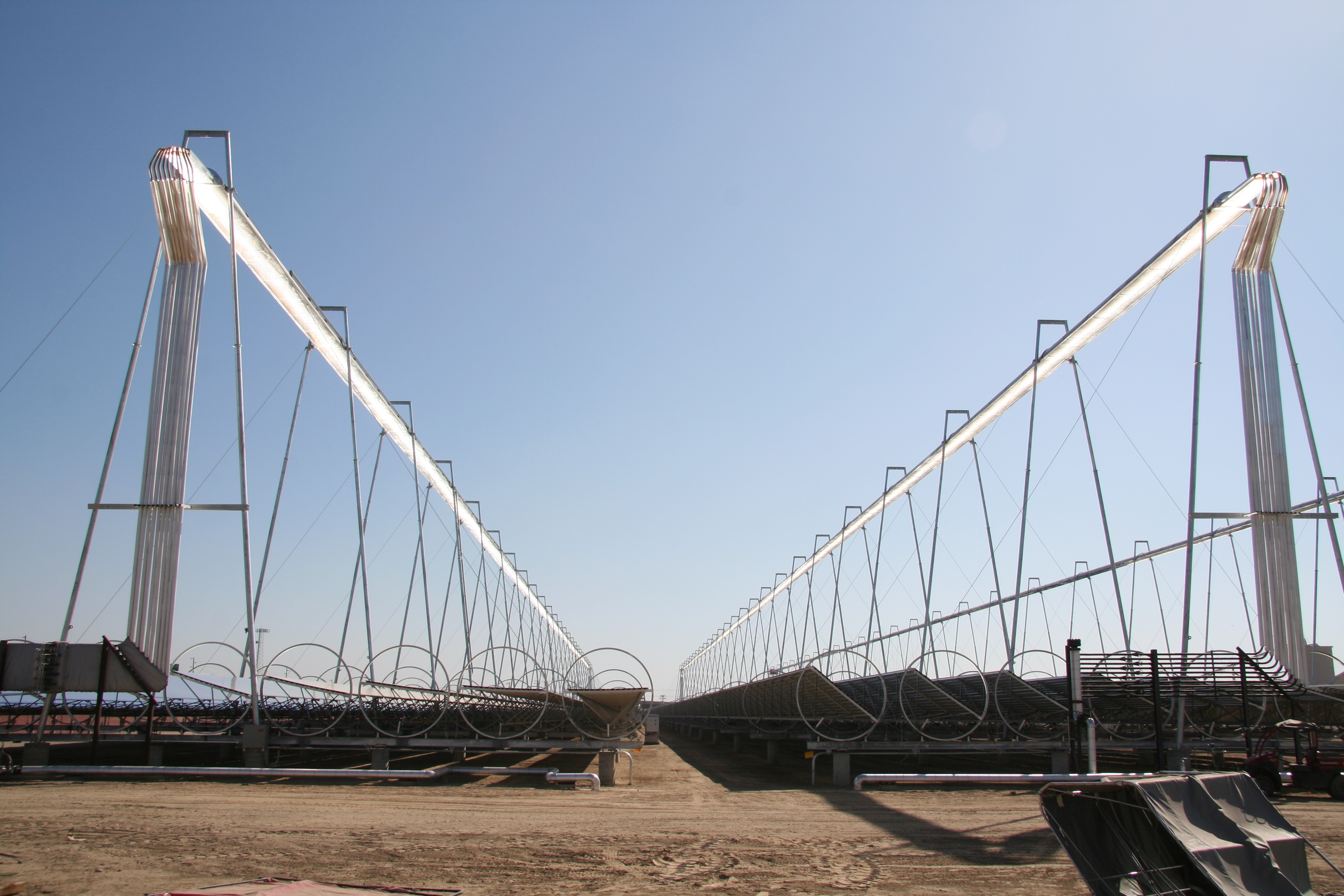
That was then. This month Ausra laid off 10% of its 108 employees amid a move to stop building Big Solar projects – for now – to focus on providing its solar thermal technology to other power plant developers and to industries that use steam. (Ausra’s compact linear fresnel reflector technology deploys flat mirrors that sit low to the ground and concentrate sunlight on water-filled pipes that hang over the mirrors. The superheated water creates steam which drives an electricity-generating turbine.)

“I think our competitors will figure this out sooner or later but nobody’s going from a five-megawatt project to a 500-megawatt project. No one’s going to finance that,” Ausra CEO Bob Fishman told Green Wombat. “If you look at the amount of money it takes to be involved in the project development business, that’s not something a startup can do.”

At least any time soon. Ausra last year opened a robotic factory in Las Vegas to make mirror arrays and other components for the many power plant projects it had on the drawing boards. Just three months ago the company flipped the switch on its five-megawatt Kimberlina demonstration power plant outside Bakersfield. But as the credit crunch hit, financing for billion-dollar solar power projects evaporated. Then in October, Congress passed legislation allowing utilities like PG&E (PCG), Southern California Edison (EIX) and San Diego Gas & Electric (SRE) to claim a 30% investment tax credit for solar projects. As the only well-capitalized institutions left standing in the energy game, utilities are stepping forward as investors.

PG&E CEO Peter Darbee says he’s prepared to make direct investments in solar power plants – projects the utility needs to comply with a California mandate to obtain 20% of its electricity from renewable sources by 2010 and 33% by 2020. Under pressure to meet those targets, California utilities have signed more than four gigawatts worth of power purchase agreements with solar power plant startups like BrightSource Energy, Solel, Stirling Energy Systems and eSolar. Utilities also have begun signing deals for electricity produced by smaller scale photovoltaic power plants built by companies like First Solar (FSLR) and SunPower (SPWRA).

Fishman said Ausra will complete the 177-megawatt Carrizo Energy Solar Farm in San Luis Obispo County on California’s central coast to supply electricity to PG&E. “If Peter Darbee wants to own Carrizo rather than buy the electricity, we’re willing to do it. It makes sense,” he says.

Ausra will also will complete a second big solar power plant planned for Arizona. But the company has quietly let drop a Florida project for utility FPL (FPL) and is negotiating to offload lease claims it filed on federal land in Arizona and Nevada for solar power plants during the solar land rush.

“Other projects in the pipeline we’ll be selling to utilities or developers for a modest amount of cash with a commitment that those developers must use our technology,” says Fishman.

Fishman notes that the cost of licensing a solar power plant can be $5 million to $10 million a year – and in California it’s a multi-year process – so Ausra will realize some immediate savings by morphing into a technology provider.

Customers for Ausra’s technology include oil companies that could inject solar-generated steam in oil wells to enhance recovery of thick petroleum as well as food processing plants and other heavy users of steam. Fishman just returned from a trip to the Middle East where he says he held talks in Kuwait, Qatar and Dubai about using Ausra’s technology for oil recovery and desalinization.

Going forward, he says Ausra’s focus will be on medium-sized power plants. “Maybe next year we’ll do four projects of 50 megawatts a year. It’s a walk before you run situation,” says Fishman. “The financial customers and financial community are going to insist we do medium scale before we do large scale. We’ll still want to do very large projects but given the project finance market, it’ll be a few years from now.”

Read Full Post »

photos: Ausra

Silicon Valley startup Ausra fired up a five-megawatt solar power plant outside Bakersfield Thursday, the first big solar station to go online in California in nearly two decades.

Ausra has a 20-year contract with utility PG&E (PCG) for a 177-megawatt solar power plant to be built some 70 miles away on the Carrizo Plains in San Luis Obispo County. But like competitors who also aim to sell solar technology untried on a large scale, Ausra constructed the demo plant, called Kimberlina, as a proof of concept for investors who will have to be persuaded in these tight times to pony up half a billion dollars or more in project financing. “It’s important because this is the technology banks’ engineers want to see so they’re comfortable recommending financing for the Carrizo Plains site,” Ausra CEO Robert Fishman told Green Wombat.

At Kimberlina’s unveiling Thursday, PG&E CEO Peter Darbee warned against letting the financial crisis derail the fight against global warming.  “The capital markets are going to distinguish between high-risk projects and low-risk projects and the high-risk projects are not going to get financed in the future,” he said. “PG&E stands ready to take on the challenge of financing renewables.”

While Ausra built Kimberlina to show that its compact linear fresnel reflector technology can generate utility-scale electricity, the plant is also designed to demonstrate that solar tech can be deployed for other industrial uses. At heart, a solar thermal power plant is a steam machine. In Ausra’s case, long rows of flat mirrors that sit low to the ground. concentrate sunlight on water-filled pipes that hang over the mirrors to create steam. That drives an electricity-generating turbine, but Ausra and other companies are looking to sell the steam as well.

For instance, take a drive around Bakersfield and you’d think you were in Texas, what with all the oil rigs rocking back and forth across a treeless landscape. Bakersfield oil is thick and heavy, so steam is injected into the ground to make it flow. Fishman wants oil companies to stop burning expensive natural gas to boil water and start using the sun.

“We’ve been doing a lot of show and tell,” says Fishman, referring to the Kimberlina plant, which sits just off the Bakersfield oil patch’s main highway. “If you look at putting a solar generator in, the economics look pretty good.”

Each 1,000-foot row, or line, of Ausra mirrors generates six megawatts of heat, according to Fishman, who says the company has talked to potential clients who would need anywhere between five and 50 lines.

Ausra also is exploring other markets for its steam technology, such as food processing.

Rival power plant builder eSolar, the Pasadena startup incubated by Bill Gross’ Idealab and funded in part by Google (GOOG), also sees other markets for its green tech. Last month, eSolar, which has a contact to supply utility Southern California Edison (EIX) with 245 megawatts of electricity, licensed its technology to stealth renewable fuels startup Sundrop, based in Pojoaque, N.M., north of Santa Fe.

Sundrop CEO John Stevens will say little about the Kleiner Perkins-backed company’s plans. “Sundrop uses low-cost concentrated solar energy to drive renewable energy into fuels,” he wrote in an e-mail. “We will produce low-cost renewable fuels.  We expect to be demonstrating scale production in 2009-2010.”

eSolar CEO Asif Ansari told Green Wombat his company will provide fields of mirrors called heliostats to Sundrop along with software and control systems to concentrate the sun’s rays on a tower. (Venture Beat uncovered documents that indicates Sundrop may plan to produce hydrogen and other fuels.)

“Basically, we’re a technology company; we don’t want to be in the construction business,” says Ansari. “What we really are trying to develop here is a standard global platform for delivering concentrated solar energy to any target that can be used for a variety of applications.”

Besides using solar energy to produce such fuels as hydrogen, Ansari, like Ausra, sees the oil industry as a potential market. He says the food processing and fertilizer industries also could substitute eSolar’s technology for natural gas to make steam.

Back in Bakersfield, California Governor Arnold Schwarzenegger presided over the official opening of Ausra’s Kimberlina solar plant on Thursday. (Live streaming his appearance.) “California is going green and it’s going green really fast,” the governator said before an audience that included PG&E chief executive Peter Darbee and Silicon Valley venture capitalists Ray Lane and Vinod Khosla.

The solar power station is plugged into the grid and will supply PG&E with enough electricity to power about 3,500 homes in central California. The mirror arrays were made at Ausra’s robotic factory in Las Vegas.

“This represents the best of American and Australian ingenuity and get-it-done attitude,” said Fishman at the ceremony, referring to Ausra’s roots in Sydney. “People don’t need to think of Ausra as an alternative energy company. As of today it is simply an energy company.”

Schwarzenegger gave the signal and Kimberlina officially came online, the 1,000-foot-long mirror arrays rotating toward the sun.

Read Full Post »

photo: eSolar

If Wall Street’s implosion can feel remote on the West Coast, where green tech startups largely rely on Silicon Valley venture capital, there may be no escaping the fallout from the credit crunch.

Still, even those renewable energy companies tapping East Coast cash have powered ahead amid the chaos on the Street. Take SolarReserve, a Santa Monica, Calif.-based solar power plant developer. A day after Lehman Brothers filed for bankruptcy last week, the stealth startup announced a $140 million round of funding from investors that included Citigroup (C) and Credit Suisse (CS).

Lehman does hold small stakes in wind turbine maker Clipper Windpower of Carpinteria, Calif., and Ormat Technologies, a Reno, Nev., geothermal developer. “Lehman’s exit from wind is not good news, but it’s not the end of the world,” says Ethan Zindler, head of North American research for New Energy Finance, a London-based research firm. And while Lehman holds stock lent to it from solar cell companies like SunPower (SPWR) and Evergreen Solar – potentially diluting their earnings per share if the stock is not returned – Lehman is not a big player in solar.

That’s not the case with Goldman Sachs (GS) and Morgan Stanley (MS). Both are major solar and wind investors and both were forced this week to reorganize themselves into bank holding companies to stave off shotgun marriages with other institutions. Spokespeople for Goldman and Morgan Stanley told Green Wombat that the firms’ transformation into more conventional commercial banks – at least a two-year process- will not change their green investing strategies.

But if there appears to be little immediate collateral damage from the financial crisis for green tech startups, there are longer-term consequences. Solar power plants, wind farms and other large-scale renewable energy projects require billions of dollars in bank financing.

“Credit is just going to get more expensive,” says Zindler. “We’ve already seen some pull-back for some big solar and wind deals. Bigger developers who have solid balance sheets will be OK but the smaller guys could be in trouble.”

Says Bill Gross, chairman of solar power plant developer eSolar: “I think if you’re going to get project financing, you’re just going to have to show higher returns to get people to take the money out of the mattress.”

But Gross, the founder of Pasadena, Calif.-based startup incubator Idealab, argues that given soaring electricity demand and fossil fuel prices, large-scale renewable energy projects will be an attractive investment, paricularly since utilities typically sign 20-year contracts for the power they produce. eSolar, which is backed by Google and other investors, has a long-term contract to supply Southern California Edison with 245 megawatts of green electricity. Gross says eSolar has a pipeline of other projects and interest in the company remains high, particularly overseas.

“If you can make projects that can compete with fossil fuels on a parity basis, those projects are going to be financed,” he says, “because they’re safe returns for 20 years and I think money is going to flow to them.”

Rob Lamkin, CEO of solar power plant startup Cool Earth, echoed that sentiment. “The credit crisis does give me pause,” says Lamkin, whose Livermore, Calif.-company has raised $21 million in venture funding and is developing “solar balloons” that use air pressure to concentrate sunlight on solar cells. “But the energy problem is so big that I don’t see problems raising project financing.”

The key for developers of utility-scale projects – particularly solar power plants – will be keeping their costs under control; not an easy thing when deploying new technologies amid a commodities boom.

Dita Bronicki, CEO of geothermal power plant developer Ormat Technologies (ORA), does not anticipate trouble obtaining project financing. “I think the cost of money is going to go up, but a company like Ormat with an operating fleet and operating cash flow will not be as affected,” Bronicki says. “Small companies will find that lenders will be more picky in what they will invest.”

Green entrepreneurs tend to be an optimistic bunch, so it’s not surprising they still think the future looks bright. But they had reason to be sunny this week – amid Wall Street’s meltdown, the U.S. Senate on Tuesday passed, at long last,  extensions of crucial renewable energy investment tax credits and other goodies to goose green tech, such as a tax credit worth up to $7,500 for buyers of plug-in electric cars. The Senate action now must be reconciled with similar legislation in the House of Representatives.

Solar projects, for instance, would qualify for a 30% investment tax credit through 2016.

“That is one thing that will help project finance,” says Gross. “So many people are sitting on the sidelines right now and if the investment tax credit passes that will help get these projects financed.”

Read Full Post »

HALF MOON BAY, Calif. – Green Wombat has been at Fortune’s Brainstorm Tech conference the past few days, the highlight of which for me was leading a session on energy with Vint Cerf. Known as the “father of the Internet” for his role in co-creating its underlying technology, Cerf is now a Google (GOOG) vice president and its chief Internet evangelist.

The idea: Brainstorm with 40 high-powered participants – everyone from Idealab’s Bill Gross (chairman of solar power plant company eSolar) to Stan Williams of Hewlett-Packard’s (HPQ) Quantum Systems Labs to venture capitalist Richard Wong of Accel Partners. The task we set out: Devise solutions to Al Gore’s challenge last week for the United States to obtain 100% of its electricity from renewable energy by 2018. Piece of cake.

Sorry, Al, we didn’t come up with a 12-step plan to kick America’s addiction to the black stuff – oil and coal. But the wide-ranging discussion underscored the complexity of the challenge and the fact that a solar-power-plant and wind-farm building boom is but one part of the big fix.

First, said one participant, we must create the “energy Internet.” In other words, a smart transmission grid that can get electricity generated from desert solar power stations and High Plains wind farms to other regions of the country as well as manage “distributed energy” from such things as rooftop solar panels. Another technological challenge that must be overcome: energy storage to capture electricity produced by solar and wind power stations for use when the sun isn’t shining and the wind isn’t blowing.

For many in the room, just as critical is the need to reduce energy demand, increase public awareness and devise the right economic incentives to promote green power and lower electricity consumption. As more than a few participants noted, Americans use more than twice as much electricity per capita as Europeans.

Gross suggests establishing a floor on electricity prices – say 10 cents/kilowatt hour – to allow renewable energy companies to get up and running and achieve economies of scale to compete against coal and natural gas.

Given the techie crowd –  Silicon Valley is just over the hill from Half Moon Bay – some of the more interesting ideas were about how to use software and Web  2.0 tools to change consumer behavior and awareness about energy consumption. For the home there needs to be an energy meter that provides constant feedback on the electricity usage – and the charges incurred –  of individual appliances and gadgets, like that laptop you left plugged in. Your mobile GPS-enabled phone could monitor your driving habits, suggesting ways to consolidate trips, report your fuel efficiency and ping you about your home energy use. Another idea;  Embed carbon footprint data in individual products, so that consumers can scan them with their phones when making purchasing decisions.

(Another provocative idea that Cerf discussed with me before the session: How to re-architect the suburbs when the aging baby boom generation begins to abandon their McMansions in search of housing and a lifestyle less isolated and closer to shops and services.)

Beyond technological innovation, the overriding sentiment was that the president and Congress must show leadership in establishing a national renewable energy policy that commits the resources and sense of urgency of a 21st century Manhattan project.

Coincidentally, the day before the session I moderated a panel at Google on renewable energy sponsored by the California Clean Tech Open, a contest that provides seed capital and services to incubate green startups with promising business plans. This year’s finalists, announced Tuesday, include several companies developing software and services to monitor and cut home and business energy consumption. Judging by the overflow crowd – some 350 people with a line out the door – there’s no shortage of talent in the Valley interested in green tech.

Among those present was Bob Cart, CEO of San Francisco-based Green Volts, which is developing concentrating photovoltaic power plants. Green Volts was a 2006 Clean Tech Open winner and Cart told Green Wombat that less than two years later the company is breaking ground this week on its first power plant, which will generate two megawatts of electricity for utility PG&E (PCG).

Green tech innovation can come from some improbable places. Rock star and home-brew technologist Neil Young closed out Brainstorm Tech on Wednesday by taking the stage for an interview with Time Inc. editor-in-chief John Huey.  Young has been working with a far-flung group of technologists and auto enthusiasts to convert a 1959 Lincoln Continental Mark IV into a 100-mpg, Internet-enabled bio-electric-hybrid. He told Huey the Continental is just one of several green car projects he has under way.

“We have an onboard fuel creation device on an Envoy in Adelaide, Australia,” Young said. That prompted Cerf to ask from the audience, “You mentioned onboard fuel production. This car doesn’t happen to run on piss, does it?”  Young laughed, “It could.”

The songwriter and political provocateur said he was focusing on land yachts  – the Continental stretches to 19.5 feet.  “Americans, a lot of them are big, and they like big cars and long highways.”

Read Full Post »

eSolar, the solar energy startup founded by Idealab’s Bill Gross and backed by Google, has signed a 20-year contract to supply utility Southern California Edison with 245 megawatts of green electricity.

The solar power plant will be built in 35-megawatt modules, with the first phase set to go online in 2011. As Green Wombat reported in April, eSolar scored $130 million in funding from Google.org, Google’s (GOOG) philanthropic arm, and other investors to develop solar thermal technology that Gross claims will produce electricity as cheaply as coal-fired power plants.

Like Ausra and BrightSource Energy – which have deals with PG&E (PCG) – eSolar will use fields of mirrors to heat water to create steam that drives electricity-generating turbines. Gross says that eSolar’s software allows the company to individually control smaller sun-tracking mirrors – called heliostats – which can be cheaply manufactured and which are more efficient and take up less land than conventional mirrors. According to Gross, that means eSolar can build modular power plants near urban areas and transmission lines rather than out in the desert, lowering costs.

eSolar’s cost claims got Southern California Edison’s (EIX) attention. “It was a competitively priced proposal,” Stuart Hemphill, the utility’s VP for renewable and alternative power, told Fortune. “We found the eSolar team very competent, motivated and willing to do a deal.”

“When it comes down to different solar technologies, competitive pricing is going to be an important part of the equation,” he adds. “They do offer a unique solution.”

eSolar is keeping mum about the exact location of the power plant, only saying it will be in the Antelope Valley region of Southern California.

One potential hitch: Getting eSolar’s electricity to Southern California Edison will depend on the construction of a major new transmission line. That line, the Tehachapi Renewable Transmission Project, has been partially approved to date.

With the eSolar deal, the utility is hedging its bets. Back in 2005, Southern California Edison signed a highly publicized deal with Phoenix’s Stirling Energy Systems to buy up to 850 megawatts of solar electricity from massive solar power plants to be built in the Mojave Desert. (Around the same time, San Diego Gas & Electric (SRE) signed a power purchase agreement with Stirling for up to 900 megawatts. ) Stirling is still perfecting its technology and has yet to file a license application for its first plant. But the company received a $100 million investment earlier this year and Hemphill says Stirling is moving forward.

“We expect that Stirling will meet its contractural obligations,” he says. “Solar thermal is definitely an emerging industry. It’s too early to tell which technologies will be the winners over the long run. It’s a time to be having a portfolio of different technologies so we can figure that out.”

Read Full Post »

« Newer Posts

Design a site like this with WordPress.com
Get started