Feeds:
Posts
Comments

Archive for the ‘environment’ Category

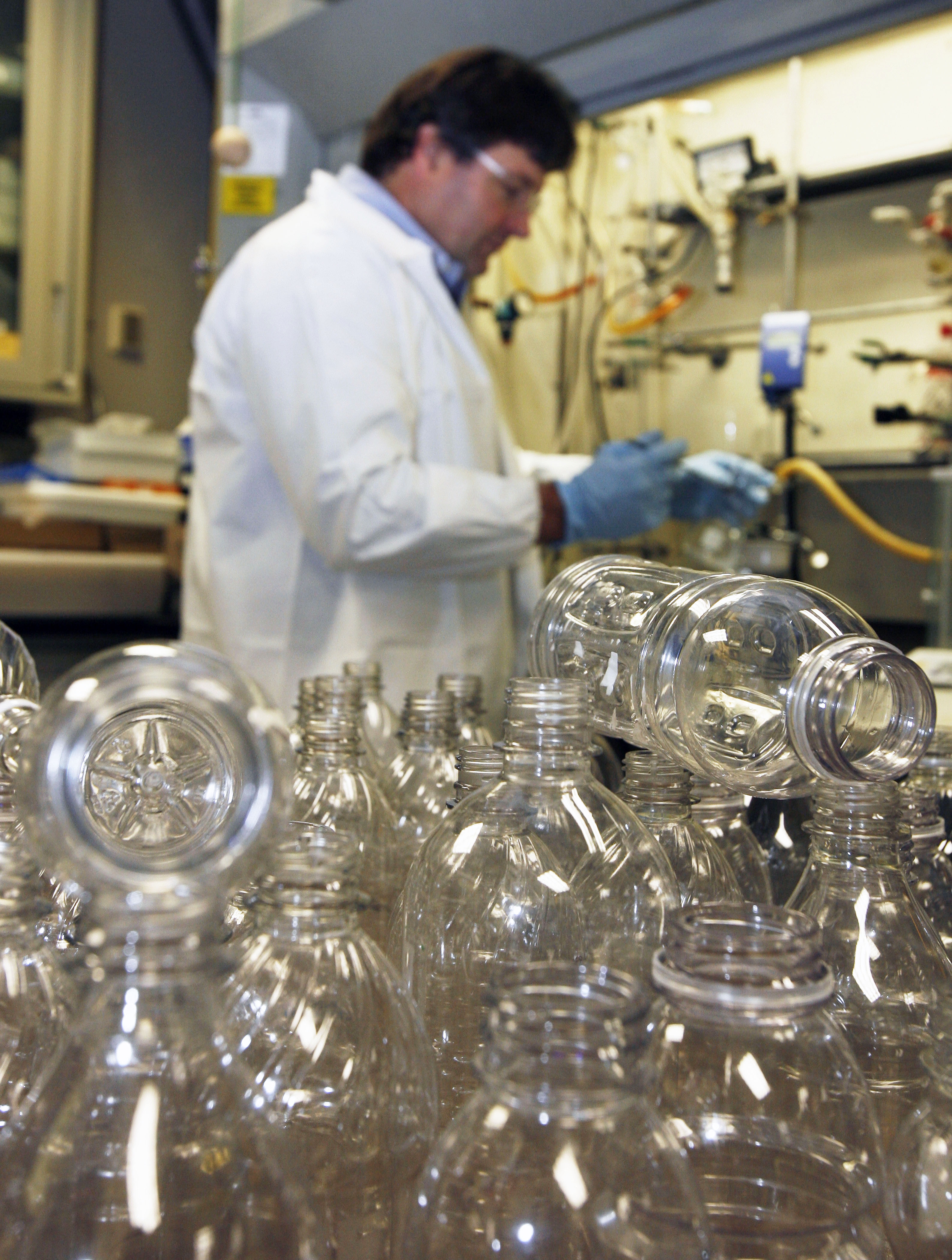
photo: IBM

In The New York Times on Tuesday, I wrote about how scientists at IBM and Stanford University have developed a new process for making plastic that could have major environmental implications:

Researchers at I.B.M. and Stanford University said Tuesday that they have discovered a new way to make plastics that can be continuously recycled or developed for novel uses in health care and microelectronics.

In a paper published in Macromolecules, a journal of the American Chemical Society, the California researchers describe how they substituted organic catalysts for the metal oxide or metal hydroxide catalysts most often used to make the polymers that form plastics.

Chandrasekhar Narayan, who leads I.B.M.’s science and technology team at its Almaden Research Center in San Jose, Calif., said the presence of metal catalysts in plastics means that they often can only be recycled once before ending up in a landfill.

“When you try to take a product and recycle it, the metal in the polymer continues to degrade the polymer so it gets increasingly less strong,” said Mr. Narayan. “If you use organic reactants, you can make certain types of new polymers that are quite different and have other properties plastics don’t have.”

That could give new life to the 13 billion plastic bottles that are thrown away each year in the United States.

“Plastic bottles can be converted to higher value plastics like body panels for cars,” said Mr. Narayan.

Organic catalysts could create a new class of biodegradable plastics to replace those that are difficult to recycle, such as polyethylene terephthalate, or PET, used in a variety of consumer products, including plastic beverage bottles.

You can read the rest of the story here.

Read Full Post »

In The New York Times on Monday, I write about IBM’s new smart grid lab in Beijing that will develop technology for the global market:

In another sign of China’s emergence as an epicenter of green technology, I.B.M. has opened a lab in Beijing to develop smart grid software for the global market.

“We’re developing solutions for around the world but we’re looking to China to see how the pieces integrate across the value chain,” said Brad Gammons, I.B.M.’s vice president for sales and distribution for the company’s Energy and Utilities division.

Mr. Gammons himself has relocated to Beijing, where he will continue to oversee worldwide sales for the unit.

“The company made a decision that China is a very, very important growth market and to put some executives here,” he said in a telephone interview from Beijing. He said I.B.M. expects the new Energy & Utilities Solutions Lab to drive $400 million in revenue over the next four years.

It is operating out of I.B.M.’s 5,000-person China Development Laboratory. The new lab is working with the State Grid Corporation of China on pilot projects to integrate wind and solar power with the grid, manage grid operations and increase the efficiency of nuclear power plants.

The Chinese government has budgeted $7.3 billion for smart grid-related energy projects this year, according to ZPryme Research & Consulting, a firm based in Austin, Tex.

Mr. Gammons said electric cars will be one focus of I.B.M.’s new lab.

You can read the rest of the story here.
Read Full Post »

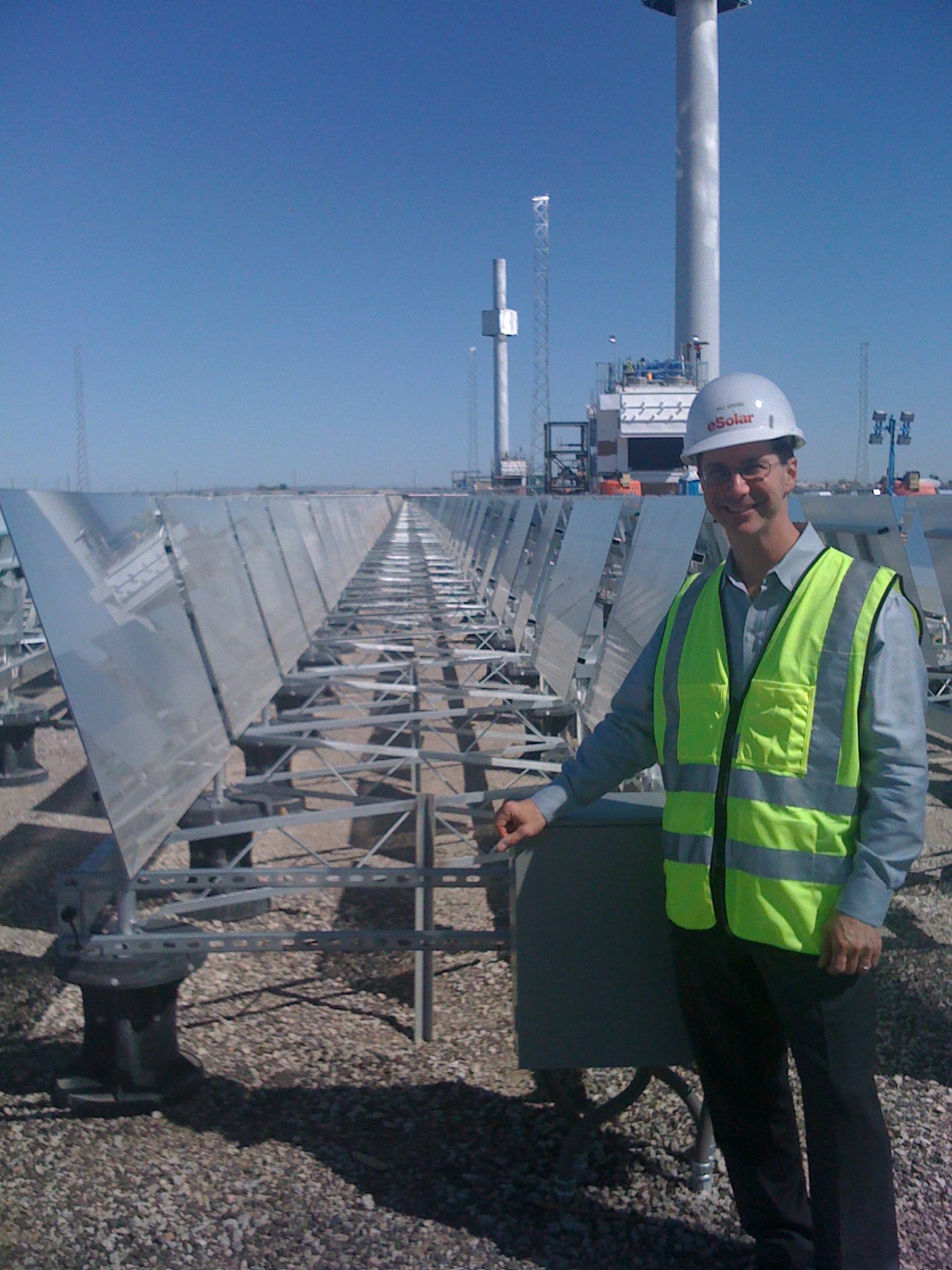
photo: Todd Woody

In an interview I did with green tech entrepreneur Bill Gross for Yale Environment 360, Gross talks about the future of solar energy, his relationship with Google, and how to avoid battles over building large solar farms in the deserts of the Southwest:

Bill Gross is not your typical solar energy entrepreneur. In a business dominated by Silicon Valley technologists and veterans of the fossil fuel industry, Gross is a Southern Californian who made his name in software. His Idealab startup incubator led to the creation of companies such as eToys, CitySearch, and GoTo.com. The latter pioneered search advertising — think Google — and was acquired by Yahoo for $1.6 billion in 2003.

That payday has allowed Gross to pursue his green dreams. (As a teenager, he started a company to sell plans for a parabolic solar dish he had designed.) Over the past decade, Gross has launched a slew of green tech startups, including solar power plant builder eSolar, electric car company Aptera, and Energy Innovations, which is developing advanced photovoltaic technology.

But it has been eSolar, backed by Google and other investors, that has been Idealab’s brightest light. In January, the company signed one of the world’s largest green-energy deals when it agreed to provide the technology to build solar farms in China that would generate 2,000 megawatts of electricity — at peak output the equivalent of two large nuclear power plants. And last week, eSolar licensed its technology to German industrial giant Ferrostaal to build solar power plants in Europe, the Middle East, and South Africa. Those deals followed eSolar partnerships in India and the U.S.

ESolar’s power plants deploy thousands of mirrors called heliostats to focus the sun’s rays on a water-filled boiler that sits atop a slender tower. The heat creates steam that drives an electricity-generating turbine. Last year, eSolar built its first project, a five-megawatt demonstration power plant, called Sierra, in the desert near Los Angeles.

This “power tower” technology is not new, but what sets the company apart is Gross’ use of sophisticated software and imaging technology to control the 176,000 mirrors that form a standard, 46-megawatt eSolar power plant. That computing firepower precisely positions the mirrors to create a virtual parabola that focuses the sun on the tower. That allows the company to place small, inexpensive mirrors close together, which dramatically reduces the land needed for the power plant and cuts manufacturing and installation costs.

“We use Moore’s law rather than more steel,” Gross likes to quip, referring to Intel co-founder Gordon Moore’s maxim that computing power doubles every two years.

You can read the interview here.

Read Full Post »

In my latest Green State column on Grist, I explore new strategies to pay for commercial energy efficiency retrofits:

On the heels of San Francisco’s announcement last week that it plans to spend $150 million greening up homes, comes a new report that studies a slew of other innovative ways to finance energy efficiency improvements for all types of buildings.

It’s no big surprise that the key to ramping up the energy efficiency industry and fostering technological advances is no-money-down financing so building owners can avoid the capital costs of retrofits.  And that’s exactly what the California Clean Energy Fund (CalCEF) is working toward.

Energy efficiency “immediately saves money for end-users, improves the bottom line for companies, reduces local exposure to electricity grid outages and offsets the need for new power plants,” wrote the authors of the report from the CalCEF, a non-profit venture capital outfit based in San Francisco. “Yet, efficiency upgrades and their respective financing options are often out of reach for most end-users, as the initial capital cost exceeds near-term savings.”

Yes, you read that right—CalCEF is a non-profit VC, a product of the California energy crisis of 2000-2001—remember Enron?—that resulted in the bankruptcy of Pacific Gas and Electric, Northern California’s dominant utility. As part of the bankruptcy settlement, CalCEF was created to accelerate energy innovation and was seeded with $30 million from PG&E.

The best known such program is Property Assessed Clean Energy, or PACE, in which cities float bonds to finance retrofits and homeowners pay back the cost through a surcharge on their property tax bills over 20 years.

While that can work well for middle and upper-middle class homeowners in environmentally conscious communities, PACE is not as useful for commercial buildings, office towers, and industrial sites, whose owners may be solely motivated by the bottom line, according to the CalCEF report.

“High upfront costs are preventing large entities from addressing energy inefficiencies,” says Paul Frankel, the managing director of CalCEF Innovations, the organization’s initiative that focuses on developing green energy financing and policy.

That led CalCEF to investigate possible solutions to the dollar dilemma, some of which are currently being implemented.

One workaround is something called on-bill financing. For instance, San Diego Gas & Electric will finance up to $100,000 in energy efficiency retrofits for commercial customers (and up to $250,000 for school and government buildings). Recipients then pay back the loans through a surcharge on their monthly utility bill.

Best of all, the loans carry zero percent interest, though business customers have to repay them in five years. In the first two years of the program, San Diego Gas & Electric financed 180 retrofits and has another 100 in the queue. Over the next two years, the utility will make $41.5 million available for on-bill retrofits.

You can read the rest of the column here.

Read Full Post »

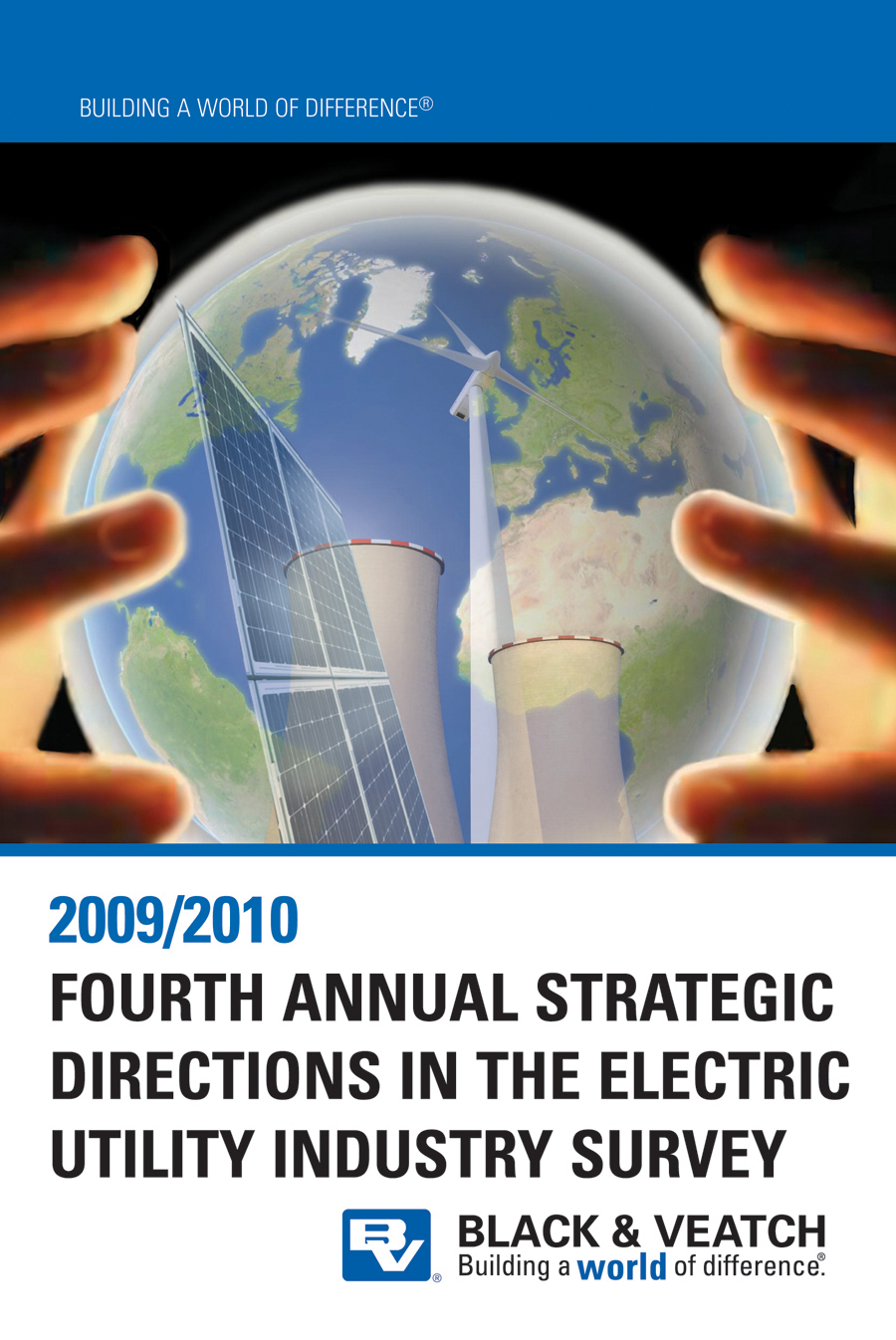
In The New York Times on Wednesday, I write about a survey of U.S. utility industry executives and insiders conducted by Black & Veatch:

American utility industry executives see nuclear energy as the most promising carbon-free power source, are skeptical of climate change science, and are uncertain about the future, according to a report to be issued Thursday by Black & Veatch, the engineering and consulting giant.

The survey of 329 executives, managers and engineers, which Black & Veatch shared with The New York Times, comes as the utility industry faces slow growth in energy consumption and a two-year fall in capital spending, the first such decline since the Great Depression.

“The industry is facing a lot of demands to spend more money to fix up an aging infrastructure, build smart grids and deal with cyber security while cutting carbon emissions,” said Bill Kemp, a Black & Veatch vice president, in an interview. “In the near term, we’ll have a difficult economic environment and a slow sales growth as regulators are reluctant to push through large rate increases while voters are still in pain.”

The stalled emissions trading legislation in Congress has added to the confusion about the future shape of the electricity market, Black & Veatch found. Despite a high-profile campaign by some utility executives to support an emissions trading market, more than 70 percent of the industry insiders surveyed oppose the current legislation and 52 percent said the United States cannot afford the proposal to cap greenhouse gas emissions.

More than 75 percent think there is a future for coal-fired power plants.

In fact, 44 percent of those surveyed don’t believe global warming is caused by human activity, according to the report, while 7 percent don’t believe the planet is warming.

“Utility respondents generally appear to be less certain of the threat of global warming than the general public and scientific community, as well as many political and policy leaders,” the report’s authors wrote.

“Utility professionals also seem to be quite disturbed about the direction of the global warming movement,” they added, “and the likelihood that their organizations will be facing what many of them seem to view as draconian changes in the short term.”

You can read the rest of the story here.

Read Full Post »

photo: Todd Woody

In a story I wrote with Clifford Krauss in Monday’s New York Times, I look at how the San Francisco Bay Area has is scrambling to prepare for the arrival of mass-market electric cars later this year:

SAN FRANCISCO — If electric cars have any future in the United States, this may be the city where they arrive first.

The San Francisco building code will soon be revised to require that new structures be wired for car chargers. Across the street from City Hall, some drivers are already plugging converted hybrids into a row of charging stations.

In nearby Silicon Valley, companies are ordering workplace charging stations in the belief that their employees will be first in line when electric cars begin arriving in showrooms. And at the headquarters of Pacific Gas and Electric, utility executives are preparing “heat maps” of neighborhoods that they fear may overload the power grid in their exuberance for electric cars.

“There is a huge momentum here,” said Andrew Tang, an executive at P.G.& E.

As automakers prepare to introduce the first mass-market electric cars late this year, it is increasingly evident that the cars will get their most serious tryout in just a handful of places. In cities like San Francisco, Portland, Ore., and San Diego, a combination of green consciousness and enthusiasm for new technology seems to be stirring public interest in the cars.

The first wave of electric car buying is expected to begin around December, when Nissan introduces the Leaf, a five-passenger electric car that will have a range of 100 miles on a fully charged battery and be priced for middle-class families.

Several thousand Leafs made in Japan will be delivered to metropolitan areas in California, Arizona, Washington state, Oregon and Tennessee. Around the same time, General Motors will introduce the Chevrolet Volt, a vehicle able to go 40 miles on electricity before its small gasoline engine kicks in.

“This is the game-changer for our industry,” said Carlos Ghosn, Nissan’s president and chief executive. He predicted that 10 percent of the cars sold would be electric vehicles by 2020.

You can read the rest of the story here.
Read Full Post »

photo: Ausra

The week kicked off with French nuclear energy giant Areva’s acquisition of Silicon Valley solar company Ausra. As I wrote Monday in the Los Angeles Times:

French nuclear energy giant Areva has jumped into the U.S. renewable energy market with the acquisition of Ausra, a Silicon Valley solar power plant startup backed by high-profile venture capitalists.
Terms of the deal were not disclosed, but in an interview on Monday, Areva executive Anil Srivastava said that the price the company paid for Ausra was in line with the $418 million that rival Siemens spent last year to acquire Solel, an Israel solar power plant builder.

That would be a decent payday for Ausra’s investors, which include marquee Silicon Valley venture capital firms Kleiner Perkins Caufield & Byers and Khosla Ventures.

“The current shareholders are very well-reputed venture capitalists and I can assure you they negotiated very well,” said Srivastava, the chief executive of Areva’s renewable energy division.

You read the rest of the story here.

And the week is ending with Thursday’s announcement of another Silicon Valley-European deal. This time, as I write in The New York Times, California’s SunPower is acquiring a European solar developer:

SunPower, a leading Silicon Valley solar company, said on Thursday that it has agreed to acquire SunRay Renewable Energy, a European photovoltaic power plant builder, in a $277 million deal.

The acquisition follows Monday’s purchase of Ausra, another Silicon Valley solar technology company, by Areva, the French nuclear energy giant in a deal that an Areva executive valued at around $400 million.

SunPower has previously supplied solar panels to SunRay, which has a pipeline of projects in Europe and Israel that totals 1,200 megawatts. SunRay, which is headquartered in Malta, is owned by its management and Denham Capital.

You can read the rest of that story here.

Read Full Post »

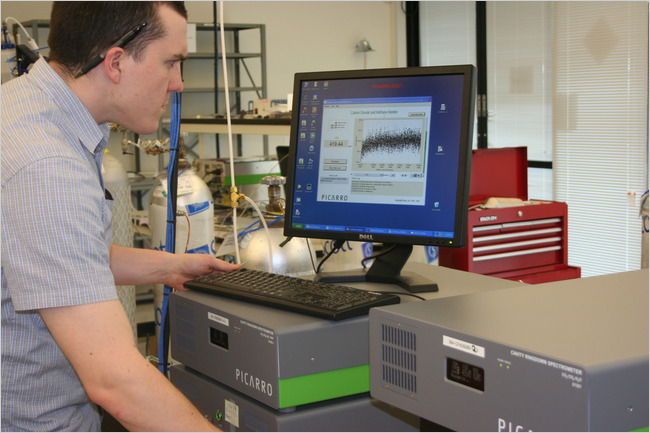
photo: Picarro

I follow up my story in Wednesday’s New York Times about California’s move to build the first statewide greenhouse gas monitoring network with a look at why such programs may be necessary to prevent a meltdown in the carbon markets:

In Wednesday’s New York Times, I write about California’s move to set up what is believed to be the world’s first statewide greenhouse gas monitoring network.

The Silicon Valley company Picarro manufacturers greenhouse gas measurement devices.
The first objective of the network, which will place analyzers around the state to measure methane in the atmosphere, will be to determine if actual emissions match estimates.

The California Air Resources Board assembles those estimates, called inventories, from computer models that rely on data such as how many grams of methane is burned per gallon of gasoline multiplied by the number of gallons sold in the state.

Such models, which follow protocols established by the United Nation’s Intergovernmental Panel on Climate Change, are used worldwide. And while monitoring stations scattered around the world measure average global greenhouse gas concentrations, they don’t identify how much methane is being released in, say, California’s Central Valley, where methane emissions from livestock are assumed to be plentiful.

The recent Copenhagen climate change talks faltered in part over the issue of how to verify emissions. And the integrity of emissions trading schemes will depend on ensuring that companies don’t game the market by deliberately or inadvertently under-reporting how much carbon they’re putting into the atmosphere.

“If the markets are not matching reality, we will find out at some point and the markets will then adjust with a huge shock,” said Pieter Tans, a senior scientist with the National Oceanic and Atmospheric Administration’s Earth System Research Laboratory in Colorado.

You can read the rest of the story here.

Read Full Post »

The ability to fast-charge electric cars is seen as key to the adoption of battery-powered vehicles. But as I wrote in The New York Times on Thursday, utilities are worried such devices will overload the grid:

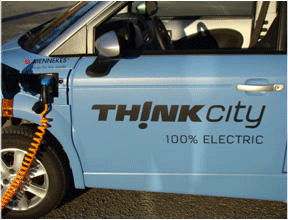
Think, the Norwegian electric automaker, announced a deal this week with a California company, AeroVironment, a maker of electric vehicle charging stations, to introduce fast-charging stations that can charge its battery-powered City car to 80 percent capacity in as little as 15 minutes.

A conventional charger can take eight or more hours to charge an electric car, depending on the battery.

“The development and deployment of very-fast-charge stations will help speed the electrification of automobiles in the United States and globally,” Richard Canny, Think’s chief executive, said in a statement.

But utilities — concerned that fast-chargers could overload the electricity grid — are more cautious.

Think and AeroVironment did not reveal the voltage of their fast-charger but such devices — known in the industry as “Level 3” chargers — generally average around 440 volts. Most household appliances run on 110 volts.

“It is premature to evaluate the feasibility or safety of Level 3 fast-charging equipment,” wrote Christopher Warner, a lawyer for the utility Pacific Gas and Electric, in a brief filed with the California Public Utilities Commission in October. “Such charging may require large investments in infrastructure and load management constraints in order to prevent ‘mini-peaks’ and localized impacts on grid reliability.”

You can read the rest of the story here.

Read Full Post »

In The New York Times on Thursday, I write about how California regulators are helping revive a once-thriving solar hot water market:

California regulators on Thursday approved a $350 million program to subsidize the installation of solar water heaters to reduce greenhouse gas emissions.

The program will allocate $250 million for the replacement of hot water heaters fueled by natural gas and $100.8 million for those powered by electricity.

Solar hot water systems typically consist of a storage tank and a rooftop array that collects heat from the sun to warm the water.

Customers of California’s three big investor-owned utilities will receive rebates of up to $1,500, or about 30 percent of the cost of replacing a residential natural-gas hot water heater with a solar system. Owners of multi-family commercial buildings are eligible for up to $500,000 in incentives.

The California Public Utilities Commission reserved 60 percent of the funds to install solar hot water systems on those buildings, with the balance going to single-family homes.

Homeowners with electric hot water heaters can receive up to $1,010 to install a solar hot water system and owners of commercial buildings will get up to $250,000. Only about 10 percent of hot water systems in California are electric, according to the utilities commission.

The program’s goal is to replace 585 therms of natural gas -– the equivalent of installing 200,000 solar hot water systems — and 150 megawatts of electricity by 2017. Incentives decrease over the eight-year life of the program.

“Today’s decision will increase consumer confidence and understanding of solar water heating technology and its benefits,” Michael R. Peevey, president of the utilities commission, said in a statement.

You can read the story of the story here.

Read Full Post »

« Newer Posts - Older Posts »

Design a site like this with WordPress.com
Get started