Feeds:
Posts
Comments

Archive for the ‘environment’ Category

In another sign that the financial crisis is not slowing the solar industry, Suntech, the giant Chinese solar module maker, made a big move into the United States market on Thursday. The company announced a joint venure with green energy financier MMA Renewable Ventures to build solar power plants and said it would acquire California-based solar installer EI Solutions.

Founded in 2001, Suntech (STP) recently overtook its Japanese and German rivals to become the world’s largest solar cell producer. The company has focused on the lucrative European market and only opened a U.S. outpost, in San Francisco, last year.  The joint venture with MMA Renewable Ventures (MMA) – called Gemini Solar – will build photovoltaic power plants bigger than 10 megawatts.

Most solar panels are produced for commercial and residential rooftops, but in recent months utilities have been signing deals for massive megawatt photovoltaic power plants. Silicon Valley’s SunPower (SPWRA) is building a 250-megawatt PV power station for PG&E (PCG) while Bay Area startup OptiSolar inked a contract with the San Francisco-based utility for a 550-megawatt thin-film solar power plant. First Solar (FSLR), a Tempe, Ariz.-based thin-film company, has contracts with Southern California Edision (EIX) and Sempre to build smaller-scale solar power plants.

Suntech’s purchase of EI Solutions gives it entree into the growing market for commercial rooftop solar systems. EI has installed large solar arrays for Google, Disney, Sony and other corporations.

“Suntech views the long-term prospects for the U.S. solar market as excellent and growing,” said Suntech CEO  Zhengrong Shi in a statement.

Other overseas investors seem to share that sentiment, credit crunch or not.  On Wednesday, Canadian, Australian and British investors lead a $60.6 million round of funding for Silicon Valley solar power plant builder Ausra. “So far the equity market for renewable energy has not been affected by the financial crisis,” Ausra CEO Bob Fishman told Green Wombat.

The solar industry got more good news Wednesday night when the U.S. Senate passed a bailout bill that included extensions of crucial renewable energy investment and production tax credits that were set to expire at the end of the year.

Read Full Post »

photo: eSolar

If Wall Street’s implosion can feel remote on the West Coast, where green tech startups largely rely on Silicon Valley venture capital, there may be no escaping the fallout from the credit crunch.

Still, even those renewable energy companies tapping East Coast cash have powered ahead amid the chaos on the Street. Take SolarReserve, a Santa Monica, Calif.-based solar power plant developer. A day after Lehman Brothers filed for bankruptcy last week, the stealth startup announced a $140 million round of funding from investors that included Citigroup (C) and Credit Suisse (CS).

Lehman does hold small stakes in wind turbine maker Clipper Windpower of Carpinteria, Calif., and Ormat Technologies, a Reno, Nev., geothermal developer. “Lehman’s exit from wind is not good news, but it’s not the end of the world,” says Ethan Zindler, head of North American research for New Energy Finance, a London-based research firm. And while Lehman holds stock lent to it from solar cell companies like SunPower (SPWR) and Evergreen Solar – potentially diluting their earnings per share if the stock is not returned – Lehman is not a big player in solar.

That’s not the case with Goldman Sachs (GS) and Morgan Stanley (MS). Both are major solar and wind investors and both were forced this week to reorganize themselves into bank holding companies to stave off shotgun marriages with other institutions. Spokespeople for Goldman and Morgan Stanley told Green Wombat that the firms’ transformation into more conventional commercial banks – at least a two-year process- will not change their green investing strategies.

But if there appears to be little immediate collateral damage from the financial crisis for green tech startups, there are longer-term consequences. Solar power plants, wind farms and other large-scale renewable energy projects require billions of dollars in bank financing.

“Credit is just going to get more expensive,” says Zindler. “We’ve already seen some pull-back for some big solar and wind deals. Bigger developers who have solid balance sheets will be OK but the smaller guys could be in trouble.”

Says Bill Gross, chairman of solar power plant developer eSolar: “I think if you’re going to get project financing, you’re just going to have to show higher returns to get people to take the money out of the mattress.”

But Gross, the founder of Pasadena, Calif.-based startup incubator Idealab, argues that given soaring electricity demand and fossil fuel prices, large-scale renewable energy projects will be an attractive investment, paricularly since utilities typically sign 20-year contracts for the power they produce. eSolar, which is backed by Google and other investors, has a long-term contract to supply Southern California Edison with 245 megawatts of green electricity. Gross says eSolar has a pipeline of other projects and interest in the company remains high, particularly overseas.

“If you can make projects that can compete with fossil fuels on a parity basis, those projects are going to be financed,” he says, “because they’re safe returns for 20 years and I think money is going to flow to them.”

Rob Lamkin, CEO of solar power plant startup Cool Earth, echoed that sentiment. “The credit crisis does give me pause,” says Lamkin, whose Livermore, Calif.-company has raised $21 million in venture funding and is developing “solar balloons” that use air pressure to concentrate sunlight on solar cells. “But the energy problem is so big that I don’t see problems raising project financing.”

The key for developers of utility-scale projects – particularly solar power plants – will be keeping their costs under control; not an easy thing when deploying new technologies amid a commodities boom.

Dita Bronicki, CEO of geothermal power plant developer Ormat Technologies (ORA), does not anticipate trouble obtaining project financing. “I think the cost of money is going to go up, but a company like Ormat with an operating fleet and operating cash flow will not be as affected,” Bronicki says. “Small companies will find that lenders will be more picky in what they will invest.”

Green entrepreneurs tend to be an optimistic bunch, so it’s not surprising they still think the future looks bright. But they had reason to be sunny this week – amid Wall Street’s meltdown, the U.S. Senate on Tuesday passed, at long last,  extensions of crucial renewable energy investment tax credits and other goodies to goose green tech, such as a tax credit worth up to $7,500 for buyers of plug-in electric cars. The Senate action now must be reconciled with similar legislation in the House of Representatives.

Solar projects, for instance, would qualify for a 30% investment tax credit through 2016.

“That is one thing that will help project finance,” says Gross. “So many people are sitting on the sidelines right now and if the investment tax credit passes that will help get these projects financed.”

Read Full Post »

After a year of stalemate that threatened to strangle the nascent United States solar industry, the U.S. Senate on Tuesday passed energy legislation that extends a key investment tax credit until 2016.

The 30% solar tax credit was part of a package of green energy incentives that includes a one-year extension of the production tax credit crucial to the wind industry and a $2,500-$7,500 tax credit for people who buy plug-in electric vehicles. (That should make General Motors (GM) happy as it prepares to roll out its ever-increasingly expensive Volt plug-in electric hybrid.)

Homeowners also won an extension of a tax credit for installing solar panels and the $2,000 cap on such systems was lifted. Put in a small wind turbine or a geothermal heat pump and you can claim up to a $4,000 and $2,000 tax credit, respectively.

The big winner was the solar industry. Congress’ failure to extend the investment tax credit threatened to scuttle scores of multibillion-dollar solar power plants in the pipeline and undermine mandates that utilities like PG&E (PCG) and Southern California Edison (EIX) obtain a growing percentage of their electricity from renewable sources.

The legislation now returns to the House of Representatives, which earlier passed a similar version of the Senate bill.

Read Full Post »

Green Wombat’s story on the Royal Turbine is in the latest issue of Fortune and available online here and below.

Her majesty’s big, honkin’ windmill

The Queen of England is buying the world’s largest wind turbine, which towers over Big Ben and will light up thousands of British homes.

By Todd Woody, senior editor

(Fortune Magazine) — It’s been a century or so since Britain ruled the waves, but Queen Elizabeth II will soon reign over the wind. Earlier this year the Crown Estate, which manages royal property worth $14 billion and controls the seas up to 14 miles off the British coast, agreed to purchase – for an undisclosed sum – the world’s largest wind turbine.

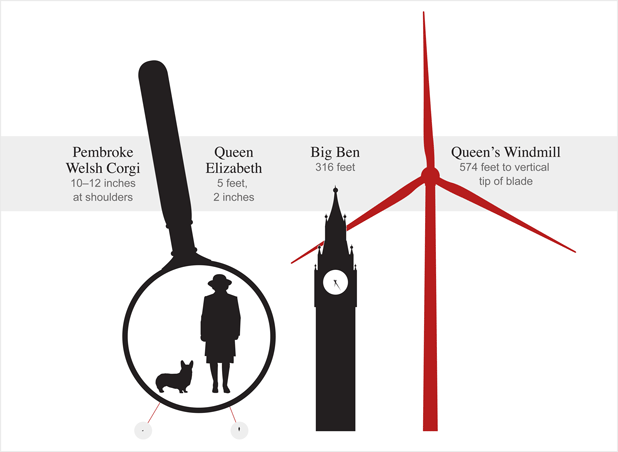
It’s a 7.5-megawatt monster to be built by Clipper Windpower of Carpinteria, Calif. Now the Royal Turbine is getting even bigger: Clipper has revealed to Fortune that Her Majesty’s windmill has been supersized to ten megawatts, producing five times the power generated by typical big turbines currently in commercial operation. The giant’s wingspan stretches the length of two soccer fields. At 574 feet, the turbine soars over Big Ben and roughly equals 111 Queen Elizabeths (the actual queen) plus one corgi stacked on top of one another.

The Queen’s turbine will displace two million barrels of oil as well as 724,000 tons of CO2 over its lifetime. This prototype will be the flagship for Clipper’s Britannia Project, an effort to create a new generation of massive-megawatt turbines to be placed on deep-sea floating platforms. When the windmill goes online in 2012 somewhere off the British coast, it could power 3,700 average homes.

Rule, Britannia, indeed.

Read Full Post »

SAN FRANCISCO – Google and General Electric said Wednesday that they will collaborate on developing geothermal power as well as technology to enable plug-in vehicles to return electricity to the grid.

During Google’s (GOOG) annual Zeitgeist conference at its Silicon Valley headquarters, Google CEO Eric Schmidt and GE (GE) chief Jeff Immelt said the two giants also would team up to push for policy changes in Washington to develop smart electricity grids to allow the widespread deployment of renewable energy.

“There’s two fundamental things that have to be done, and which we’re working with Google on,” said Immelt before an audience that included former Vice President Al Gore. “One, there has to be more capacity. The second thing is there has to be a smart grid to allow it to operate more effectively. That’s primarily software. We make the hardware.”

Schmidt quizzed Immelt about the impact of the Wall Street meltdown on green energy. “Will the craziness of last week screw some of this stuff up?” asked Schmidt. “Are we going to get set back for years because of all the shenanigans in the financial industry?”

“People should be concerned but not panicked,” replied Immelt. “The federal government is doing the right thing.”

Gore was not so sanguine, noting that Congress has failed repeatedly to extend crucial investment tax credits for renewable energy. “While Congress is voting on oil drilling and leasing oil shale – which is a move that would be game over for the climate crisis – they’re preparing to filibuster over renewable energy tax credits,” he said.

Google and GE are among scores of Fortune 500 companies that have lobbied Congress to extend the investment tax credit and the production tax credit, which is particularly important to the wind industry. ”

“I’m a lifelong Republican and I believe in free markets but over time we worship false idols,” says Immelt. “Sometimes we think the free market is whatever the price of oil is today. In the end, clean energy is both a technology and a public policy.”

He noted that because the production tax credit allowed the wind industry to scale up, wind-generated electricity now costs about six-to-seven cents a kilowatt hour, down from 15 cents 15 years ago.

“We bought Enron’s wind business for a few million dollars and now it’s worth $7 to 8 billion,” Immelt said. “I’ve made some bad decisions but that wasn’t one of them.”

Google in August invested nearly $11 million in geothermal companies developing so-called enhanced geothermal systems technology to allow the earth’s heat to be tapped nearly anywhere and turned into electricity. On Wednesday, Google and GE said they will work on technology to transform geothermal into a large-scale source of green electricity.

In a statement, the two companies said they will also “explore enabling technologies including software, controls and services that help utilities enhance grid stability and integrate plug-in vehicles and renewable energy into the grid.”

Image: Google

Read Full Post »

Green Wombat often highlights high tech when it comes to tackling global warming and energy independence. But a new study from the University of California’s Lawrence Berkeley National Laboratory shows that simply installing white roofs on homes and commercial buildings – to reflect the sun’s rays rather than absorb them – can reduce air-conditioning costs by 20% and could save $1 billion a year in energy outlays in the United States.

Switch to cool sidewalks and roads and the savings rise to $2 billion annually, according to the study by scientists Hashem Akbari and Surabi Menon and California Energy Commissioner Art Rosenfeld to be published in the journal Climate Change.

The scientists calculated that a global white roofs and roads effort would offset 44 billion metric tons of greenhouse gas emissions, or more than a year’s worth of carbon, and help stablize future C02 emission increases.

“The 44 Gt CO2-equivalent offset potential for cool roofs and cool pavements would counteract
the effect of the growth in CO2-equivalent emission rates for 11 years,” according to the authors.

Such emission reductions, of course, can be securitized into tradable carbon credits, which the study estimates would be worth $1.1 trillion. Regulated carbon market exist in places like Europe but securities based on cool roofs have not yet been created.

A global cool roofs agreement could avoid the pitfalls of Kyoto-style accords, the scientists note.  “Installing cool roofs and cool pavements in cities worldwide does not need delicate negotiations between nations in terms of curbing each country’s CO2 emission rates.”

It’s one of those low-tech, commonsense solutions to both energy use and global warming – one used for thousands of years in the regions like the Mediterranean; those picturesque villages overlooking the sea are white-washed for a reason.

In California, commercial buildings with flat roofs have been required to cool it since 2005. But one of the biggest hurdles in the U.S. to doing the white thing may be homeowner associations that dictate everything from the color of your mailbox to where you place your rubbish bin. The vast majority of homes in California either have standard black shingle roofs or Spanish-style red tiles. A proposal to paint those roofs white will likely incite architectural outrage.

But there’s another, albeit much more expensive solution, to hot roofs: Cover them with solar panels.

photo: California Energy Commission

Read Full Post »

The looming expiration of a crucial renewable energy investment tax credit doesn’t seem to have spooked investors. Silicon Valley thin-film solar startup Nanosolar said Wednesday that it has secured another $300 million in funding and is jumping into the Big Solar game as well.

Writing on the Nanosolar blog,  CEO Martin Roscheisen said that the latest financing round – the company’s funding now totals half a billion dollars –  comes from oldline utility AES (AES), French utility giant EDF and the Carlyle Group, among other investors. Nanosolar, which prints solar cells on flexible materials, will supply solar panels to the newly formed AES Solar, which will build medium-scale – up to 50 megawatts – photovoltaic power plants.

The Nanosolar news is just the latest of a spate of deals to take solar panels off rooftops and plant them on the ground to generate massive megawattage. Two weeks ago, thin-film solar startup Optisolar won a contract from utility PG&E (PCG) for a 550-megawatt PV solar power plant while SunPower (SPWR) will build a 250-megawatt photovoltaic solar farm for the utility. Leading  thin-film company First Solar (FSLR), meanwhile, has inked deals over the past few months to build smaller-scale PV power plants for Southern California Edison (EIX) and Sempre (SRE). And thin-film solar company Energy Conversion Devices is assembling a 12-megawatt array for a General Motors plant in Spain.

Read Full Post »

photos: Energy Conversion Devices

As Detroit automakers shutter SUV and truck factories, the decades-long de-industrialization of the Midwest continues apace. But amid the idled assembly lines, a new wave of manufacturing has taken root as solar energy companies set up shop in the heartland.

Just in the past week, First Solar (FSLR) announced an expansion of its Ohio plant that makes thin-film solar panels. German company Flabeg will break ground on a factory outside Pittsburgh that will manufacture parabolic solar mirrors for large-scale solar power plants planned for the Southwest. Thin-film solar company Energy Conversion Devices (ENER), meanwhile, operates three factories in Michigan and is currently doubling the production capacity of one of its plants.

In fact, nearly all the United States’ current solar manufacturing capacity is in the Midwest, save for Silicon Valley company Ausra’s factory in Las Vegas. (Thin-film startup Nanosolar is building a factory in San Jose, Calif.)

“Our processes really require high productivity, so what makes it competitive here in the Midwest is that we have a great labor force that is eager to work and well-trained already,” ECD chief executive Mark Morelli told Green Wombat on Monday.

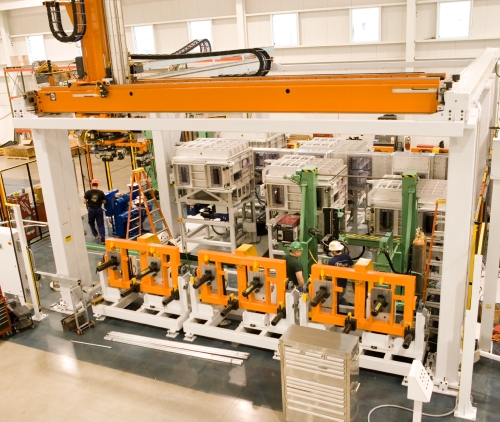
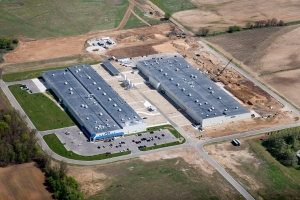
For instance, when appliance maker Electrolux shut down its Greenville, Mich., factory it left 2,700 workers unemployed in the same town where ECD is expanding its thin-film factory (see photos). The company also has recruited top executives from the ever-shrinking auto industry.

“We do a test of the available labor pool and hire the cream of the crop,” Morelli says.

Just as important are a plethora of state tax breaks and grants to retrain industrial workers for the green tech economy.

Although 70 percent of ECD’s flexible solar laminate panels are sold to European customers, Morelli anticipates the U.S. market will take off, with domestic manufacturers garnering a competitive advantage.

That all depends on whether Congress extends a crucial investment tax credit that expires this year and the policies of the next administration in Washington. Even so, demand for solar cells is expected to spike, especially given the recent unveiling of Big Solar projects by California utilities. Southern California Edison (EIX), for instance, is installing 250-megawatts’ worth of solar panels on commercial rooftops while PG&E (PCG) this month announced contracts to buy 800 megawatts of electricity from two photovoltaic power plants, including 500-megawatt thin-film solar farm being built by OptiSolar.

“As utilities begin to embrace distributed power generation, these type of things play into our natural advantage,” says Morelli, referring to his company’s lightweight solar panels that are especially suited for large rooftop arrays.

Of course, a handful of solar factories are not going to revive the Midwest’s industrial fortunes. (First Solar, for instance, operates factories in Germany and Malaysia, and Morelli doesn’t rule out locating manufacturing overseas.) But imagine a national policy that promotes the wide adoption of solar and the expansion of manufacturing in the rustbelt states becomes increasingly attractive. Shipping solar panels and mirror arrays from halfway around the world starts to make much less environmental and financial sense.

ECD’s proximity to the auto industry has already paid off. After installing solar arrays on two of General Motors (GM)’s California facilities, it won a contract in July to build a 12-megawatt rooftop array – the world’s largest by orders of magnitude – at a GM assembly plant in Spain.

Read Full Post »

T. Boone Pickens and Texas may be the kings of Big Wind but California is catching up, buying gigawatts of green electricity from turbines planted on the windswept flatlands of … Oregon.

On Monday, Southern California Edison became the latest Golden State utility to look north, announcing a 20-year contract to buy a whopping 909 megawatts from Caithness Energy’s Shepherd’s Flat project. The 303-turbine wind farm will span two Oregon counties and 30 square miles when it goes online between 2011 and 2012. PG&E (PCG), meanwhile, signed a deal in July for 240 megawatts of wind power from Horizon Wind Energy’s turbine ranch in the same area. That’s on top of 85 megawatts it agreed to buy last year from PPM Energy (now called Iberdrola Renewables) in a neighboring county that’s part of a turbine tier of counties on Oregon’s northern border.  Earlier this month the Los Angeles Department of Water and Power approved a 72-megawatt contract with Willow Creek Energy for wind power from the same area in Oregon.

So why ship electricity a thousand miles down the West Coast when California already plans to add gigawatts of in-state wind energy?  In a word, transmission.

“The beauty of this particular project is that it is already fully permitted and has transmission already available,”  Stuart Hemphill, Southern California Edison’s (EIX) vice president for renewable and alternative power, told Green Wombat.

“Oregon has a terrific wind resource,” he adds. “It far exceeds that in California.”

In December 2006 the utility signed an agreement to purchase 1,500 megawatts from a giant wind farm to be built by a subsidiary of Australia’s Allco Financial Group in Southern California’s Tehachapi region. But the project is dependent on the construction of new transmission lines – often an environmentally contentious and drawn-out process in California.

“It is expected to go online in 2010,” says Hemphill of the wind farm. “We’re just getting the transmission project up and running. The first three segments have been approved and we’re doing the building now.”

With California’s investor-owned utilities facing a 2010 deadline to obtain 20% of their electricity from renewable sources, expect the Oregon green rush to continue.

Read Full Post »

Oilman turned wind wildcatter T. Boone Pickens met with presumptive Republican presidential nominee  John McCain Friday morning to pump his Pickens Plan to wean the United States from imported oil by shifting electricity production to wind farms and using natural gas to fuel cars and trucks. On Sunday, he’ll hook up with Democrat Barack Obama.

The McCain meeting was “good…very relaxed,” Pickens said Friday during a conference call with Senate Majority Leader Harry Reid to promote next week’s National Clean Energy Summit in Las Vegas. “It was a free flowing discussion. I presented the Pickens Plan to him, and he asked a lot of questions about it. He feels like I’m an energy expert, and he wanted information.”

Pickens began a campaign in July to foster a bipartisan approach to reducing the U.S.’s dependence on imported oil, declaring the “the United States is the Saudi Arabia of wind power.” Pickens is building the nation’s largest wind farm in Texas, and he has an interest in a natural gas transportation company.

Though Nevada Democrat Reid remarked, “Who would have thought that T. Boone Pickens and Sen. Harry Reid would have been in same boat pulling the oars same way,” Pickens made clear he’s no latter-day Al Gore.

“I’d open it all up to drilling – OCS, ANWAR,” he said, referring to the outer continental shelf and the Alaskan National Wildlife Refuge – the third rail of environmental politics.

“The one place I differ with Senator McCain is that I said if you’re going to open the OCS, throw in ANWAR too,” Pickens added.

Gore and other greens have questioned the viability and environmental impact of using natural gas for transportation. Pickens, on the other hand, said he isn’t opposed to electric cars. But, he added, “We can’t make a big cut [in oil imports] in ten years without using natural gas as a transportation fuel.  Use it for trucks and let them do what they want with cars.”

For Reid’s part, he said offshore drilling was still on the table, but he’s pushing for Congress to extend the renewable energy investment tax credit that expires at the end of the year. Scores of wind and solar projects – like the massive photovoltaic power plants that California utility PG&E (PCG) unveiled Thursday with SunPower (SPWR) and OptiSolar – are contingent upon Congress renewing the 30% tax credit.

“We have people standing by willing to invest billions of dollars in renewable energy,” Reid said. “The future is not in a commodity that was discovered in the 18th century. The future is sun, wind, geothermal.”

Read Full Post »

« Newer Posts - Older Posts »

Design a site like this with WordPress.com
Get started