Feeds:
Posts
Comments

Archive for the ‘environment’ Category

solara
Images: BrightSource Energy

A ray of sunshine amid the economic gloom: While some solar companies struggle through the downturn, BrightSource Energy on Wednesday morning announced the world’s largest solar energy deal to date – a 20-year contract to supply utility Southern California Edison with 1,300 megawatts of greenhouse gas-free electricity.

That’s more than twice the size of the previous world’s-biggest-solar-deal, a 553-megawatt power purchase agreement in 2007 between California utility PG&E and Israel’s Solel. BrightSource itself last year inked a deal to provide PG&E (PCG) with 500-megawatts of solar electricity with an option for 400 megawatts more.

“This proves the energy industry is recognizing the role solar thermal will play as we de-carbonize our energy supply,”  BrightSource CEO John Woolard said Wednesday at a press conference.  “We believe now more than ever the time is right for large-scale solar thermal.”
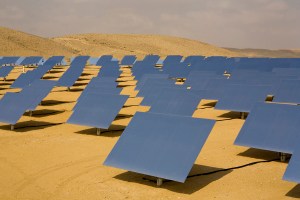
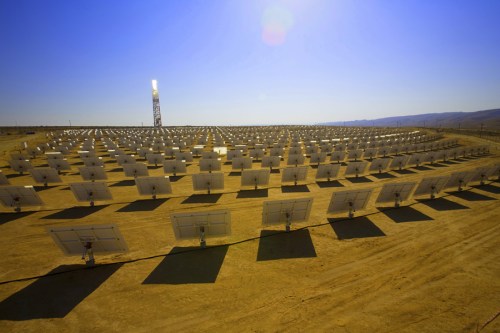
solarhOakland-based BrightSource will build seven solar power plants for Southern California Edison (EIX) using its “power tower” technology. Thousands of sun-tracking mirrors called heliostats focus the sun’s rays on a water-filled boiler that sits atop a tower. The intense heat creates steam which drives a turbine to generate electricity. BrightSource has built a prototype power plant in Israel.

BrightSource has raised more than $160 million from a blue-chip group of investors that includes Google (GOOG), Morgan Stanley (MS) and VantagePoint Venture Partners as well as a clutch of oil giants – Chevron (CVX), BP (BP) and Norway’s StatoilHydro.

If all the solar power plants are built, BrightSource’s deal with Southern California Edison will generate enough electricity to power about 845,000 homes. The agreement is a vote of confidence in the solar industry at a time when the financial crisis has forced BrightSource rivals like OptiSolar to lay off workers while Ausra retools its strategy to focus on supplying solar thermal technology to power plant developers rather than building projects itself.

Given the economic collapse, why are these massive megawatt deals still being done? First, California utilities are under tight deadlines to ratchet up the amount of electricity they obtain from renewable sources – 20% by the end of 2010 and 33% by 2020. Second, it costs nothing to sign a contract – no money has yet changed hands, and won’t unless the plants are built and begin producing electricity.

In fact, not a kilowatt of juice has been generated from the more than 5,000 megawatts of Big Solar contracts signed over the past four years by California’s three investor owned utilities (the third being San Diego Gas & Electric (SRE) ).  Still, a long-term utility contract is key for a startup like BrightSource to obtain the billions in financing required to build large-scale solar power plants. The terms of utility contracts – such as the cost of the solar electricity produced – are closely held secrets but are worth billions, if a 2008 power purchase agreement between Spanish solar company Abengoa and utility Arizona Public Service is any guide.

A significant hurdle for BrightSource – and many other solar developers – is the expansion of the transmission grid to connect remote power plants to cities. BrightSource spokesman Keely Wachs says the company has 4,200 megawatts of solar power plant projects under development.

The Southern California Edison deal is something of a homecoming for American-Israeli solar pioneer Arnold Goldman, BrightSource’s founder and chairman. In the 1980s, during the first solar boom, his Luz International built nine solar power plants in the Mojave. Those plants, most are now operated by FPL (FPL), continue to provide electricity to Edison.

The first BrightSource solar farm for Edison is expected to go online in early 2013. It’s a 100 megawatt power plant part of BrightSource’s Ivanpah complex to be built on federal land on the California-Nevada border in the Mojave Desert. That plant is currently wending its way through a complex state and federal licensing process.

Just how complex was illustrated by a meeting Green Wombat attended Tuesday in Sacramento, where a roomful of state and federal officials spent hours discussing the environmental impact of a 750-megawatt solar power plant to be built by Phoenix’s Stirling Energy Systems for San Diego Gas & Electric that would plant 30,000 solar dishes in the desert. A second Stirling solar farm will be built for Southern California Edision. When the deals were announced in 2005, they were the world’s largest at the time.

PG&E chief executive Peter Darbee recently said his utility will begin directly investing in solar power projects. On Wednesday, Southern California Edison renewable energy executive Stuart Hemphill said Edison would consider requests from solar power developers to take ownership stakes in their projects but prefers to sign power purchase agreements.

“We do see solar as the large untapped resource, particularly in Southern California,” said Hemphill.

Read Full Post »

ibm-smarter-planet1

The ecobiz buzz these days is all about greening the grid, what with tens of billions of dollars in the stimulus bill for transforming the electricity system into a digitalized, interactive version of the Internet. Just on Wednesday, the European island nation of Malta announced a $91 million deal with IBM to not only create a smart power grid but to smarten up its water system as well.

Water, in fact, is likely to emerge in coming years as big an opportunity as electricity for tech companies. Just as climate change is driving efforts to add intelligence to the power grid to more efficiently manage electricity usage and new sources of renewable energy, a warming world is making water an even scarcer resource.

“How do you look at the ecosystem of water and make it a smart grid?” asks Drew Clark, director of strategy for IBM’s Venture Capital Group.  “It really makes a lot of sense if you think about it. It’s a scarce commodity, just like electrons —  it’s more scarce, in fact. It needs to be kept secure, it needs to be kept safe, it very often is abundant except when you need it a certain time and in a certain place.”

Clark’s job is to find companies – startups usually – with technology IBM (IBM) can tap for business units like its Global Energy & Utilities Industry. These days that means companies that develop sensor networks and other technologies that can be deployed across smart grids as part of IBM’s Smarter Planet initiative to essentially create a physical version of the Internet for the natural and man-made worlds – water systems, transportation, agriculture.

That, of course, would generate untold terabytes of data that would need to be crunched, mined and analyzed, spurring demand for the type of software and Big Iron computing that is IBM’s forté.

“We look at taking otherwise less-smart systems and essentially instrument them with these sensors and make them intelligent,” Clark told Green Wombat at IBM’s San Francisco offices. “Every one of these smart grids are based on some collection, in some cases millions, of smart sensors that are sensing some characteristic. IBM looks at it and says this is an information management problem. How do we take the information from all these devices and sensors and bring it together in a way to make sense out of it, business sense out of it.”

Take water. In California, for instance, a three-year drought has put water districts under pressure to cut their customers’ consumption while conserving every drop possible. Many districts still rely on dispatching workers in trucks to check on water quality and water levels and check for pipeline leaks and breaks.

IBM is designing systems to automate that process by placing small sensors in reservoirs and along pipelines right up to homes and businesses. “These sensors are wireless and form a mesh network,” Clark says. “This one talks to this one that bridges to this one that bridges to another and every so often there is an access point that is able to gather up all the information.”

Big Blue analyzes that data and displays it on a computer dashboard that allows water managers to monitor their systems and head off problems like leaks or contamination. For example, General Electric (GE), Clark says, makes a sensor the size of a half-dollar that can detect multiple environmental conditions.

IBM has pilot projects underway with some water districts but faces a business challenge: Those public agencies typically are underfunded and don’t have millions of dollars on hand to roll out smart water systems. Money is usually not so much of a problem for Big Agriculture and Clark says IBM’s early customers are corporate farming giants like Archer Daniels Midland (an ADM spokesman points out that the company is a crop processor, not a farmer) that want sensor networks to better manage everything from irrigation systems to soil conditions.

Clark expects that after energy, water will be next up on the legislative agenda. IBM, along with other tech giants, appears to have the ear of the Obama administration. IBM chief executive Sam Palmisano joined the CEOs of Google (GOOG), Applied Materials (AMAT) and other tech companies last week in a meeting with President Barack Obama about investment in green technology.

Read Full Post »

malta-smart-grid

Photo: Visit Malta

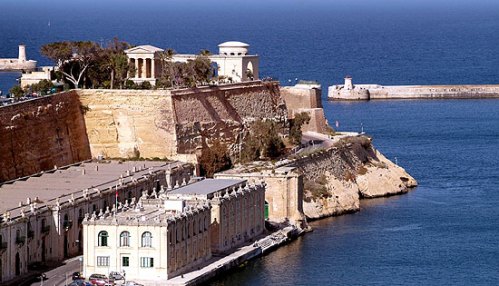
The Mediterranean island nation of Malta on Wednesday unveiled a deal with IBM to build a “smart utility” system that will digitize the country’s electricity grid and water system.

Granted, Malta is a microstate with a population of 403,500 (smaller than Sacramento; bigger than Iceland). But the world — and utility infrastructure giants like General Electric (GE) — will be watching closely. Not only is Malta the first country to green its national grid but it will also serve as a test case for whether integrating so-called smart technologies into both electricity and water systems can help mitigate the increasing deleterious effects of global warming on the island.

As with other island states, power and water are intricately linked on Malta. All of the archipelago’s electricity is generated from imported fuel oil while the country depends on energy-intensive desalinization plants for half its water supply. Meanwhile, rising sea levels threaten its underground freshwater supplies.

“About 55% of the cost of water on Malta is related to electricity – it’s a pretty staggering amount,” Guido Bartels, general manager of IBM’s Global Energy & Utilities Industry division, told Green Wombat from Malta on Tuesday.

So how can digitizing the grid help? IBM (IBM) and its partners will replace Malta’s 250,000 utility meters with interactive versions that will allow Malta’s electric utility, Enemalta, to monitor electricity use in real-time and set variable rates that reward customers that cut their power consumption.  As part of the $91 million (€70 million) project, a sensor network will be deployed on the grid  –  along transmission lines, substations and other infrastructure – to provide information that will let the utility more efficiently manage electricity distribution and detect potential problems. IBM will provide the software that will aggregate and analyze all that data so Enemalta can identify opportunities to reduce costs – and emissions from Malta’s carbon-intensive power plants. (For an excellent primer on smart grids, see Earth2Tech editor Katie Fehrenbacher’s recent story.)

A sensor network will also be installed on the water system for Malta’s Water Services Corporation. “They’ll indicate where there is water leakage and provide better information about the water network,” says Robert Aguilera, IBM’s lead executive for the Malta project, which is set to be completed in 2012. “The information that will be collected by the system will allow the government to make decisions on how to save money on water and electricity consumption.”

Cutting the volume of water that must be desalinated would, of course, reduce electricity use in the 122-square-mile (316-square-kilometer) nation.

With the U.S. Congress debating an economic stimulus package that includes tens of billions of dollars for greening the power grid, IBM sees smart grid-related technologies as a $126 billion market opportunity in 2009. That’s because what’s happening in Malta today will likely be the future elsewhere – no country is an island when it comes to climate change. Rising electricity prices and water shortages are afflicting regions stretching from Australia to Africa to California.

IBM spokeswoman Emily Horn says Big Blue has not yet publicly identified which companies will be providing the smart meters, software and other services for the Malta grid project.

Malta’s greenhouse gas emissions are expected to rise 62% above 1990 levels by 2012, according to the European Environment Agency, and as a member of the European Union the country will be under pressure to cut its carbon. A smart energy grid will help but Malta, like Hawaii and other island states, will have to start replacing carbon-intensive fuel oil with renewable energy.

The island could present opportunities for other types of smart networks. According to the Maltese government, Malta has the second-highest concentration of cars in the world, with 660 vehicles per square kilometer. That also contributes to the country’s dependence on imported oil and its greenhouse gas emissions.

Given that Silicon Valley company Better Place has described islands as the ideal location to install its electric car charging infrastructure, perhaps CEO Shai Agassi should be looking at adding Malta to the list of countries that have signed deals with the startup.

Read Full Post »

img_1216_1photo: Todd Woody

The numbers are in, and as expected 2008 set a record year for the worldwide wind industry as new wind farms generating a total of 27,000 megawatts of greenhouse gas-free electricity came online, according to the Global Wind Energy Council.

The quick-click headline was that the United States overtook the world’s green superpower, Germany, by installing 8,358 megawatts in 2008  – a 50% jump from the previous year and enough wind energy to power two million American homes. But the big story this year will be China’s rapid emergence as the next global wind power.

China last year doubled its wind energy capacity – for the fourth straight year – adding 6,300 megawatts of new electricity generation for a  total capacity of 12,210 megawatts.  A third of the world’s new wind capacity last year was installed in Asia, with China  accounting for 73% of that power. China reached its 2010 target of generating 5,000 megawatts of wind-powered electricity in 2007 and is expected to hit its 2030 goal of 30,000 megawatts years early.

“In 2009, new installed capacity is expected to nearly double again, which will be one third or more of the world’s total new installed capacity for the year,” Li Junfeng, Secretary General of the Chinese Renewable Energy Industry Association, said in a statement.

Of course, 30,000 megawatts of wind is but a flicker in a country with more than 300,000 megawatts of coal-fired energy online but it’s huge by world standards and has spawned both a burgeoning domestic wind industry and growing investment by overseas companies. Denmark’s Vestas, the world’s largest turbine maker,  will open its fifth factory in China this year and it received orders for another 200 megawatts’ worth of turbines at the end of 2008. General Electric (GE), one of only two U.S. turbine makers, also operates a factory in China and in January the company announced a joint venture with China’s A-Power Energy Generation to make turbine gearboxes. In a separate deal with A-Power, GE will supply the company with 900 turbine gearboxes starting next year.

As the financial crisis slows growth in the U.S. and Europe, India is another potential wind power. It ended 2008 with 9,645 megawatts of wind energy and added more capacity that year – 1,800 megawatts – than former world leaders Germany and Spain. Indian turbine maker Suzlon also has been moving onto European turf, relocating its international headquarters to Denmark and acquiring German turbine manufacturer REPower.

Installed global wind capacity now stands at 120.8 gigawatts with the 2008 turbine market worth $47.5 billion, according to the Global Wind Energy Council.

Read Full Post »

img_1219

photo: Todd Woody

When Green Wombat offered up as a “talking point” the observation that the wind industry now employs more people than coal mining, the post set off some vociferous chatter in the blogosphere, fueled in part by my inadvertent error of referring to the “coal industry” in a subsequent reference rather than “coal mining.”

Eoin O’Carroll at the The Christian Science Monitor‘s Bright Green Blog called the comparison between 85,000 wind industry jobs and 81,000 coal mining jobs “bogus,” citing sources pegging direct industry-wide employment in coal at 136,000 to 174,000. Other commentators pointed out that wind power currently provides only about 1-2% of the United States’ electricity while coal supplies around 49%, according to the U.S. Department of Energy.

Fair enough. But let’s add some context. As Salon‘s Andrew Leonard pointed out, “The key takeaway shouldn’t be employment, but growth rates.” Employment in the wind industry grew 70% between 2007 and 2008 as a result of a 50% jump in the amount of installed wind capacity in the United States last year. And this number bears repeating: 42% of all new U.S. electricity generation in 2008 came from wind farms, the equivalent of building 14 600-megawatt coal-fired power plants  – without the environmental devastation that comes from strip-mining and releasing tons of carbon dioxide into the atmosphere. That extraordinary growth in wind power was, until the recession hit, reviving abandoned factories in the industrial Midwest as European turbine makers and their suppliers set up shop close to what has become the world’s largest wind market.

While wind produces a tiny percentage of the country’s total electricity today, the U.S. does not have a national power grid and energy generation varies widely by state. (For instance, in-state coal-fired power plants supplied 86% of Ohio’s electricity in 2006, according to the Energy Department, but only 1.1% of California’s – though the Golden State obtains about 20% of its electricity from out-of-state coal plants, a practice being phased out by its global warming law).

In Texas, wind accounts for 4.9% of the state’s electricity generation, according to the state grid operator.  Last week, Texas regulators announced they would invest $5 billion to expand transmission lines to bring wind power from remote west Texas wind farms to big cities like Dallas and Houston. That $5 billion, no doubt, will also generate quite a few green jobs and trigger even more wind development once the credit crunch eases.

Jon Wellinghoff, the new acting chairman of the Federal Energy Regulatory Commission, has identified the Great Plains – dubbed the Saudi Arabia of wind – as the prime candidate for a massive power grid project to connect the region’s wind farms to metropolitan regions currently dependent on coal-fired power. Again, such an initiative would generate thousands of jobs. (A 2008 Department of Energy report found that if such transmission hurdles were overcome the nation could obtain as much as 20% of its electricity from wind farms.)

Obviously, coal is not going away any time soon. (And those wind turbines are made of steel, after all.) But with the Obama administration willing to spend billions on a smart power grid to expand green energy production and half the states mandating renewable energy targets – not to mention a looming national cap-and-trade system that would assign a price to the environmental cost of coal-fired electricity – it seems clear which industry will be generating the jobs of the future.

Read Full Post »

denverairport-110

photo: WorldWater & Solar Technologies

As the financial crisis short-circuits the ambitions of green tech companies, solar financier MMA Renewable Ventures is pushing ahead with raising its fifth fund. Meanwhile, its solar power plant joint venture with Chinese solar cell maker Suntech – Gemini Solar Development – has been selected by utility Austin Energy to build a 30-megawatt solar farm in Texas.

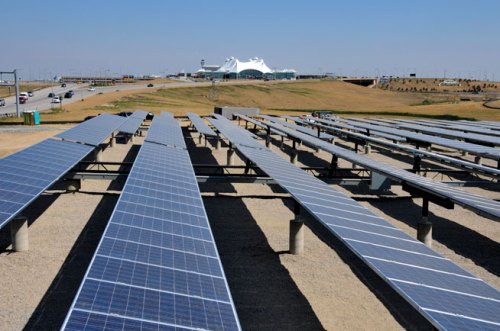
The San Francisco-based firm just completed its $200 million Solar Fund III, which invested in 20.6 megawatts of photovoltaic solar arrays for companies like Macy’s, the Gap, Lowe’s and utility FPL (FPL) as well as the Denver International Airport. MMA Renewable (MMAB.PK) provides the financing for the installation of large commercial solar arrays on big box stores and other locations while retaining ownership of the systems. The electricity produced is sold to the building owner under a long-term contract.

“The good news is that we can raise another fund in a tough market,” MMA Renewable Ventures CEO Matt Cheney told Green Wombat, adding that the company aims to raise $200 million or more for Solar Fund V.

That doesn’t mean it’ll be easy. Many of the Wall Street banks that invested in big solar systems are no more and demand for the tax credits generated by the projects has fallen faster than the Dow Jones as most companies aren’t piling up much tax liability these days.

“The ones that are left are being very picky and asking a lot,” says Cheney, adding that banks and other investors are demanding higher returns on their investments. Still, he notes, past MMA Renewable investors like Wells Fargo (WFC) remain relatively healthy. “If you look at every country in Europe and the U.S., there are good examples of financing institutions that were less impacted by the financial crisis, which is a deep one,” he says.

One possible source of new tax-equity investment may come from well-capitalized utilities that, thanks to a change to the tax laws Congress made last October, can now claim tax credits for solar projects. PG&E (PCG) CEO Peter Darbee, for instance, has said his utility plans to invest in solar power plants.

A new and potentially bigger worry is whether MMA Renewable customers – big box retailers and the like – will be survive the financial crisis. MMA Renewable’s business is built on long-term power purchase contracts – as long as 20 years – that provide a predictable and steady revenue stream to investors.

“Would you buy a corporate bond from a large U.S. company that went out 20 years today?” Cheney asks. “You would most likely tell me that’s a long time. You don’t know if you want to take that risk beyond five or ten years. That’s the equation that’s present in the marketplace today.”

In California, at least, demand for solar has remained strong: This week state regulators reported that installed solar systems more than doubled in 2008 from the previous year.

One bright spot may be the market for smaller-scale photovoltaic power plants and MMA Renewable’s Gemini joint venture with Suntech (STP).  The Austin Energy project still must be approved by the city of Austin, but Cheney says Gemini is in the midst of negotiations with other utilities as well.

When SunPower (SPWRA) reported record fourth-quarter earnings Thursday, CEO Tom Werner said the Silicon Valley solar cell maker was shifting resources to its power plant building business in 2009 and had 1,000 megawatts of projects on the drawing boards.

There was just one catch:  money. “We have a strong pipeline of projects fully permitted, or with permits in process, that will be buildable,” Werner said, ” when financing becomes available.”

Read Full Post »

img_1214

photo: Todd Woody

Here’s a talking point in the green jobs debate: The wind industry now employs more people than coal mining in the United States.

Wind industry jobs jumped to 85,000 in 2008, a 70% increase from the previous year, according to a report released Tuesday from the American Wind Energy Association. In contrast, the coal industry mining employs about 81,000 workers. (Those figures are from a 2007 U.S. Department of Energy report but coal employment has remained steady in recent years though it’s down by nearly 50% since 1986.) Wind industry employment includes 13,000 manufacturing jobs concentrated in regions of the country hard hit by the deindustrialization of the past two decades.

The big spike in wind jobs was a result of a record-setting 50% increase in installed wind capacity, with 8,358 megawatts coming online in 2008 (enough to power some 2 million homes).  That’s a third of the nation’s total 25,170 megawatts of wind power generation. Wind farms generating more than 4,000 megawatts of electricity were completed in the last three months of 2008 alone.

Another sign that wind power is no longer a niche green energy play: Wind accounted for 42% of all new electricity generation installed last year in the U.S. Power, literally, is shifting from the east to west, to the wind belt of the Midwest, west Texas and the West Coast. Texas continues to lead the country, with 7,116 megawatts of wind capacity but Iowa in 2008 overtook California for the No. 2 spot, with 2,790 megawatts of wind generation. Other new wind powers include Oregon, Minnesota, Colorado and Washington state.

But last year’s record is unlikely to be repeated in 2009 as the global credit crisis delays or scuttles new projects because developers are unable to secure financing for wind farms. Layoffs have already hit turbine makers like Clipper Windpower and Gamesa as well as companies that produce turbine towers, blades and other components.

The Obama administration’s $825 billion stimulus package includes a three-year extension of a key production tax credit that has spurred the wind industry’s expansion. But given the dearth of investors with tax liabilities willing to invest in wind projects in exchange for the credits, the stimulus is unlikely to be stimulating to the industry unless the tax credit is made refundable to developers.

The U.S. wind industry is dominated by European wind developers and turbine makers – General Electric (GE) and Clipper are the only two domestic turbine manufacturers – and those companies’ fortunes rise and fall with the global economy.  As the U.S. market has boomed, European companies have been moving production close to their customers – the percentage of domestically manufactured wind turbine components rose from 30% to 50% between 2005 and 2008, according to the American Wind Energy Association.

Read Full Post »

kimberlina0089l1

photo: Ausra

When Green Wombat sat down for a chat with Ausra founder David Mills back in September 2007, he allowed that it was not unreasonable to expect the Silicon Valley solar startup to soon be building several massive megawatt solar power plants a year. The optimism was not unwarranted. After all, in the space of 12 months Ausra had relocated from Sydney to Palo Alto, raised $40 million from A-list venture capitalists and was about to ink a deal with utility PG&E for a 177-megawatt  solar power project.

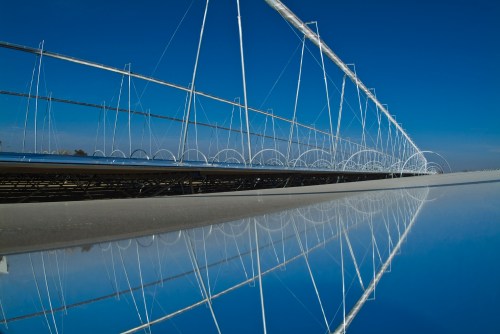
That was then. This month Ausra laid off 10% of its 108 employees amid a move to stop building Big Solar projects – for now – to focus on providing its solar thermal technology to other power plant developers and to industries that use steam. (Ausra’s compact linear fresnel reflector technology deploys flat mirrors that sit low to the ground and concentrate sunlight on water-filled pipes that hang over the mirrors. The superheated water creates steam which drives an electricity-generating turbine.)

“I think our competitors will figure this out sooner or later but nobody’s going from a five-megawatt project to a 500-megawatt project. No one’s going to finance that,” Ausra CEO Bob Fishman told Green Wombat. “If you look at the amount of money it takes to be involved in the project development business, that’s not something a startup can do.”

At least any time soon. Ausra last year opened a robotic factory in Las Vegas to make mirror arrays and other components for the many power plant projects it had on the drawing boards. Just three months ago the company flipped the switch on its five-megawatt Kimberlina demonstration power plant outside Bakersfield. But as the credit crunch hit, financing for billion-dollar solar power projects evaporated. Then in October, Congress passed legislation allowing utilities like PG&E (PCG), Southern California Edison (EIX) and San Diego Gas & Electric (SRE) to claim a 30% investment tax credit for solar projects. As the only well-capitalized institutions left standing in the energy game, utilities are stepping forward as investors.

PG&E CEO Peter Darbee says he’s prepared to make direct investments in solar power plants – projects the utility needs to comply with a California mandate to obtain 20% of its electricity from renewable sources by 2010 and 33% by 2020. Under pressure to meet those targets, California utilities have signed more than four gigawatts worth of power purchase agreements with solar power plant startups like BrightSource Energy, Solel, Stirling Energy Systems and eSolar. Utilities also have begun signing deals for electricity produced by smaller scale photovoltaic power plants built by companies like First Solar (FSLR) and SunPower (SPWRA).

Fishman said Ausra will complete the 177-megawatt Carrizo Energy Solar Farm in San Luis Obispo County on California’s central coast to supply electricity to PG&E. “If Peter Darbee wants to own Carrizo rather than buy the electricity, we’re willing to do it. It makes sense,” he says.

Ausra will also will complete a second big solar power plant planned for Arizona. But the company has quietly let drop a Florida project for utility FPL (FPL) and is negotiating to offload lease claims it filed on federal land in Arizona and Nevada for solar power plants during the solar land rush.

“Other projects in the pipeline we’ll be selling to utilities or developers for a modest amount of cash with a commitment that those developers must use our technology,” says Fishman.

Fishman notes that the cost of licensing a solar power plant can be $5 million to $10 million a year – and in California it’s a multi-year process – so Ausra will realize some immediate savings by morphing into a technology provider.

Customers for Ausra’s technology include oil companies that could inject solar-generated steam in oil wells to enhance recovery of thick petroleum as well as food processing plants and other heavy users of steam. Fishman just returned from a trip to the Middle East where he says he held talks in Kuwait, Qatar and Dubai about using Ausra’s technology for oil recovery and desalinization.

Going forward, he says Ausra’s focus will be on medium-sized power plants. “Maybe next year we’ll do four projects of 50 megawatts a year. It’s a walk before you run situation,” says Fishman. “The financial customers and financial community are going to insist we do medium scale before we do large scale. We’ll still want to do very large projects but given the project finance market, it’ll be a few years from now.”

Read Full Post »

cemex-eurus-wind-farm1

photo: CEMEX

The cement industry’s contribution to global warming is pretty concrete – it’s responsible for 5% of greenhouse gas emissions, fueled by demand from the rapidly industrializing economies of China and India.

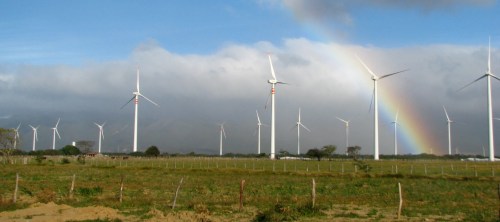
Now CEMEX, the Mexican building materials giant, has taken steps to green up its operation. Not by changing the way it makes cement but how it powers the process. Late last week, Mexican President Felipe Calderón inaugurated the first phase of what will be a $550 million, 250-megawatt Oaxaca wind farm – Latin America’s largest – that will generate the equivalent of a quarter of the electricity CEMEX consumes in Mexico.

The EURUS wind farm is a joint development between CEMEX (CX) and Acciona, the Spanish renewable energy powerhouse. The first 25 turbines will go online by March and the final phase will be completed by the end of 2009. A CEMEX spokesman said Acciona will retain ownership of the wind farm and sell the electricity to CEMEX under a 20-year contract.  The electricity from EURUS will go into the power grid and CEMEX will receive “electricity credits” for the power produced.

Mexico has become the next frontier for the wind industry. The same day Calderón presided over the opening of EURUS he also dedicated a nearby 80-megawatt wind farm built by Spanish company Iberdrola Renewables.

Read Full Post »

first-solar-11

With Big Solar thermal power plants bogged down in bureaucracy and facing environmental and financial hurdles, utilities are turning to smaller-scale thin-film solar stations that can be built in a matter of months.

In late December, PG&E (PCG), for instance, signed a 20-year contract for electricity generated  from a 10-megawatt thin-film solar power plant in Nevada owned by energy giant Sempra (SRE) that was officially dedicated on Thursday. The solar farm was built by First Solar (FSLR) in a scant six months. Meanwhile, the utility’s nearly two gigawatts worth of deals with solar thermal power companies won’t start producing power for another two years at the earliest. (Southern California Edison (EIX) and San Diego Gas & Electric signed agreements with solar dish developer Stirling Energy Systems for 1.75 gigawatts in 2005 and those projects are just now beginning to move through the regulatory approval process.) And the financial crisis has made it more difficult for solar thermal developers to obtain the billions of dollars needed to finance the construction of a massive megawatt power plant.

Solar thermal power plants typically use miles of mirrors to heat a fluid to create steam which drives an electricity-generating turbine. Photovoltaic (or PV) solar farms essentially take solar panels similar to those found on residential rooftops and mount them on the ground in huge arrays. (Thin-film solar panels are made by depositing layers of photovoltaic materials on glass or flexible materials.)

“In terms of construction, photovoltaic tends to have a much faster development and construction track,” Roy Kuga, PG&E’s vice president for energy supply, told Green Wombat. “There is a segment of mid-sized projects – in the two to 20 megawatt size – where PV shows a distinct advantage in that market. There’s a huge potential for the PV market to expand.”

That’s good news for companies like First Solar – the Tempe, Ariz.-based company backed by the Walton family that is often called the Google of solar for its stock price and market prowess – and SunPower (SPWRA), the Silicon Valley solar cell maker that’s moved into the power plant-building business.

The speed at which the Sempra-First Solar project went online owes much to the fact that it was built on the site of an existing fossil fuel power plant. “It was already permitted for power generation, transmission existed and it did not have to go through the laborious California permitting process,” says Reese Tisdale, a solar analyst with Emerging Energy Research. “As such, First Solar was able to essentially plug and play.”

Nathaniel Bullard, a solar analyst with New Energy Finance, says he expects utilities increasingly to bet on smaller-scale photovoltaic farms to help meet state mandates to obtain a growing percentage of their electricity from renewable sources. Just this week, PG&E CEO Peter Darbee said his utility plans to invest in solar power plant projects rather than just buy the power they produce.

“I think a utility could easily integrate, technically and financially, 100 megawatts of PV,” Bullard says.  If something is falling behind on your big solar thermal projects, you can plug in PV. I think you’ll see more of this with California utilities and I expect to see it more in Florida and North Carolina. It’s a great runaround to issues of siting and transmission.”

That’s because in California photovoltaic power plants do not need approval from the California Energy Commission. And smaller-scale plants take up far less land and can be built close to existing transmission lines. Most large solar thermal power plants typically are planned for the Mojave Desert and require the construction of expensive power lines to connect them to the grid.

The modular nature of PV solar farms means they can begin generating electricity as each segment is completed while a solar thermal plant only goes online once the entire project is finished.

“Certainly there is a sweet spot in which the project is large enough to gain advantages of scale,” says Tisdale. “Also, these small-to-mid-size systems can be spread about a transmission network, instead of at one site.”

Read Full Post »

« Newer Posts - Older Posts »

Design a site like this with WordPress.com
Get started