Feeds:
Posts
Comments

Archive for the ‘enviro startups’ Category

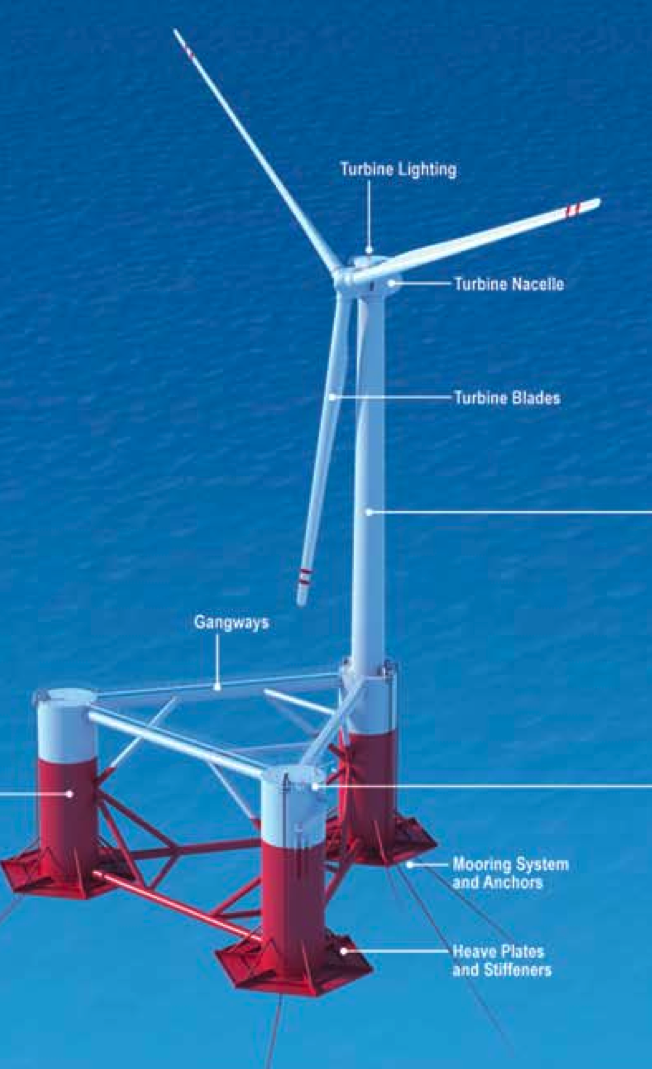
Illustration: Principle Power

A Seattle-based renewable energy startup, Principle Power, has signed an agreement to build a deep-sea, 150-megawatt wind farm to be constructed on floating platforms off the Oregon coast.

The deal with the Tillamook Intergovernmental Development Agency – which includes the local utility for a coastal county west of Portland – is very early stage but foreshadows two technological trends in the wind industry: massive megawatt turbines placed on deep-ocean platforms.

Principle Power co-founder Jon Bonanno tells Green Wombat that each floating platform – called a WindFloat – will feature a 5-megawatt turbine. By contrast, the biggest biggest land-based turbines are typically 2.5 megawatts, while General Electric (GE) makes a 3.6-megawatt turbine designed for offshore use.

Bigger turbines offer better economies of scale (important given the steep cost of developing offshore wind farms), and since a deep-ocean wind turbine is not visible from the coast, they avoid the not-in-my-backyard fights that dog near-shore projects. (Clipper Windpower of Carpinteria, Calif., is developing a ten-megawatt monster for England’s Crown Estate, while European wind companies like Enercon has been testing turbines in the six megawatt range.)

“It’s becoming an increasingly important component of the mix in Europe,” says Ethan Zindler, head of North American research for New Energy Finance, a London-based firm. “I think a lot of it is conceptual at this point. There’s still a lot of barriers in turbine design and transport.”

Beyond the technological challenges of supersizing a turbine, there’s the issue of how to get a 300-foot-tall windmill out to sea without breaking the bank. Various wind companies are tackling the problem but Principle Power’s solution is to license the WindFloat technology from a Berkeley, Calif.-based startup called Marine Innovation & Technology. The company’s founders, who previously worked on offshore platforms for the oil industry, designed the WindFloat to be semi-submersible. “The design and size of the WindFloat enables the overall structure to be assembled onshore and towed to its final location, significantly reducing construction costs,” according to Principle Power.

“The WindFloat has undergone concept development validation through numerical modeling, third party engineering verification and extensive wave tank testing,” Bonanno said in an e-mail, noting that he expects a full-scale prototype to be built within a year.

Depending on the permitting process and Principle’s ability to obtain project financing, Bonanno anticipates the wind farm to be up and operating between 2013 and 2015.  Early estimates peg the cost of the wind farm at about $375 million.

Pat Ashby, the general manager of the 19,000-customer Tillamook People’s Utility District, says his utility has a capacity of 50 megawatts so it would most likely serve as an interconnection point to transmit electricity from the wind farm to the regional power grid. “Our substations are all along the coast,” he says. “There’s only a dozen miles or less to get to a substation.”

According to Ashby, the cost of laying a transmission line is about $1 million a mile. On the other hand, if the wind farm is too close to shore, residents will likely get riled up about the impact on their views. “We’ve already had an organized group come forward to express their concerns,” he says.

Bonanno notes that if the wind farm was placed five miles off the coast, the turbines would appear to be the size of a thumb from the shore; at ten miles they would not be visible.

Read Full Post »

photo: eSolar

If Wall Street’s implosion can feel remote on the West Coast, where green tech startups largely rely on Silicon Valley venture capital, there may be no escaping the fallout from the credit crunch.

Still, even those renewable energy companies tapping East Coast cash have powered ahead amid the chaos on the Street. Take SolarReserve, a Santa Monica, Calif.-based solar power plant developer. A day after Lehman Brothers filed for bankruptcy last week, the stealth startup announced a $140 million round of funding from investors that included Citigroup (C) and Credit Suisse (CS).

Lehman does hold small stakes in wind turbine maker Clipper Windpower of Carpinteria, Calif., and Ormat Technologies, a Reno, Nev., geothermal developer. “Lehman’s exit from wind is not good news, but it’s not the end of the world,” says Ethan Zindler, head of North American research for New Energy Finance, a London-based research firm. And while Lehman holds stock lent to it from solar cell companies like SunPower (SPWR) and Evergreen Solar – potentially diluting their earnings per share if the stock is not returned – Lehman is not a big player in solar.

That’s not the case with Goldman Sachs (GS) and Morgan Stanley (MS). Both are major solar and wind investors and both were forced this week to reorganize themselves into bank holding companies to stave off shotgun marriages with other institutions. Spokespeople for Goldman and Morgan Stanley told Green Wombat that the firms’ transformation into more conventional commercial banks – at least a two-year process- will not change their green investing strategies.

But if there appears to be little immediate collateral damage from the financial crisis for green tech startups, there are longer-term consequences. Solar power plants, wind farms and other large-scale renewable energy projects require billions of dollars in bank financing.

“Credit is just going to get more expensive,” says Zindler. “We’ve already seen some pull-back for some big solar and wind deals. Bigger developers who have solid balance sheets will be OK but the smaller guys could be in trouble.”

Says Bill Gross, chairman of solar power plant developer eSolar: “I think if you’re going to get project financing, you’re just going to have to show higher returns to get people to take the money out of the mattress.”

But Gross, the founder of Pasadena, Calif.-based startup incubator Idealab, argues that given soaring electricity demand and fossil fuel prices, large-scale renewable energy projects will be an attractive investment, paricularly since utilities typically sign 20-year contracts for the power they produce. eSolar, which is backed by Google and other investors, has a long-term contract to supply Southern California Edison with 245 megawatts of green electricity. Gross says eSolar has a pipeline of other projects and interest in the company remains high, particularly overseas.

“If you can make projects that can compete with fossil fuels on a parity basis, those projects are going to be financed,” he says, “because they’re safe returns for 20 years and I think money is going to flow to them.”

Rob Lamkin, CEO of solar power plant startup Cool Earth, echoed that sentiment. “The credit crisis does give me pause,” says Lamkin, whose Livermore, Calif.-company has raised $21 million in venture funding and is developing “solar balloons” that use air pressure to concentrate sunlight on solar cells. “But the energy problem is so big that I don’t see problems raising project financing.”

The key for developers of utility-scale projects – particularly solar power plants – will be keeping their costs under control; not an easy thing when deploying new technologies amid a commodities boom.

Dita Bronicki, CEO of geothermal power plant developer Ormat Technologies (ORA), does not anticipate trouble obtaining project financing. “I think the cost of money is going to go up, but a company like Ormat with an operating fleet and operating cash flow will not be as affected,” Bronicki says. “Small companies will find that lenders will be more picky in what they will invest.”

Green entrepreneurs tend to be an optimistic bunch, so it’s not surprising they still think the future looks bright. But they had reason to be sunny this week – amid Wall Street’s meltdown, the U.S. Senate on Tuesday passed, at long last,  extensions of crucial renewable energy investment tax credits and other goodies to goose green tech, such as a tax credit worth up to $7,500 for buyers of plug-in electric cars. The Senate action now must be reconciled with similar legislation in the House of Representatives.

Solar projects, for instance, would qualify for a 30% investment tax credit through 2016.

“That is one thing that will help project finance,” says Gross. “So many people are sitting on the sidelines right now and if the investment tax credit passes that will help get these projects financed.”

Read Full Post »

Green Wombat’s story on the Royal Turbine is in the latest issue of Fortune and available online here and below.

Her majesty’s big, honkin’ windmill

The Queen of England is buying the world’s largest wind turbine, which towers over Big Ben and will light up thousands of British homes.

By Todd Woody, senior editor

(Fortune Magazine) — It’s been a century or so since Britain ruled the waves, but Queen Elizabeth II will soon reign over the wind. Earlier this year the Crown Estate, which manages royal property worth $14 billion and controls the seas up to 14 miles off the British coast, agreed to purchase – for an undisclosed sum – the world’s largest wind turbine.

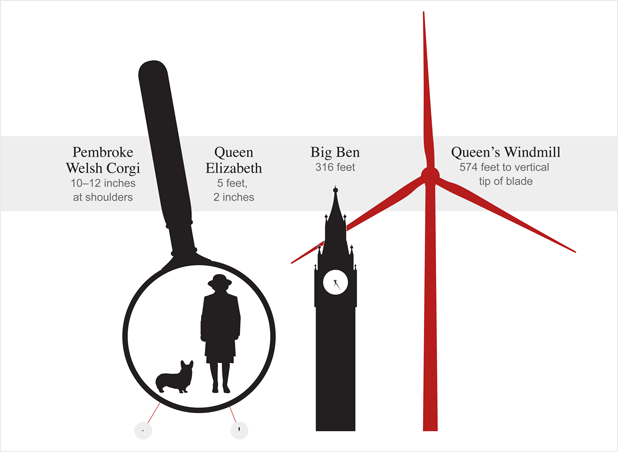
It’s a 7.5-megawatt monster to be built by Clipper Windpower of Carpinteria, Calif. Now the Royal Turbine is getting even bigger: Clipper has revealed to Fortune that Her Majesty’s windmill has been supersized to ten megawatts, producing five times the power generated by typical big turbines currently in commercial operation. The giant’s wingspan stretches the length of two soccer fields. At 574 feet, the turbine soars over Big Ben and roughly equals 111 Queen Elizabeths (the actual queen) plus one corgi stacked on top of one another.

The Queen’s turbine will displace two million barrels of oil as well as 724,000 tons of CO2 over its lifetime. This prototype will be the flagship for Clipper’s Britannia Project, an effort to create a new generation of massive-megawatt turbines to be placed on deep-sea floating platforms. When the windmill goes online in 2012 somewhere off the British coast, it could power 3,700 average homes.

Rule, Britannia, indeed.

Read Full Post »

photo: Todd Woody

Green Wombat’s story in the new issue of Fortune magazine on the solar power plant-fueled boom in demand for wildlife biologists is now online here. The photo above of the blunt-nosed leopard lizard was taken at a state reserve in San Luis Obispo County.

Or you can read the story below.

The hottest tech job in America

Giant solar plants are being built where dozens of protected species live. That’s good news for wildlife biologists.

By Todd Woody, senior editor

(Fortune Magazine) — It looks like a scene from an old episode of The X-Files: As a red-tailed hawk circles overhead and a wild pronghorn sheep grazes in the distance, a dozen people in dark sunglasses move methodically through a vast field of golden barley, eyes fixed to the ground, GPS devices in hand. They’re searching for bodies.

In this case, however, the bodies belong to the endangered blunt-nosed leopard lizard, and the crew moving through the knee-high grain are wildlife biologists hired by Ausra, a Silicon Valley startup that’s building a solar power plant for utility PG&E on this square mile of central California ranchland.

With scores of solar power stations planned for sites in the Southwest, demand for wildlife biologists is hot. They’re needed to look for lizards and other threatened fauna and flora, to draw up habitat-protection plans, and to comply with endangered-species laws to ensure that a desert tortoise or a kit fox won’t be inadvertently squashed by a solar array.

That has engineering giants like URS (URS, Fortune 500) in San Francisco and CH2MHill of Englewood, Colo., scrambling to hire biologists to serve their burgeoning roster of solar clients. “It’s a good time to be a biologist – it’s never been busier in my 15 years in the business,” says Angela Leiba, a senior project manager for URS, which is staffing the $550 million Ausra project. URS has brought onboard 40 biologists since 2007 to keep up with the solar boom. Salaries in the industry, which typically start around $30,000 and run up to about $120,000, have spiked 15% to 20% over the past year.

The work is labor-intensive. “It can take a 30- to 50-person team several weeks to complete just one wildlife survey,” says CH2MHill VP David Stein.

The economics of Big Solar ensure that wildlife biology will be a growth field for years to come. For one thing, there’s the mind-boggling scale of solar power plants. Adjacent to the Ausra project in San Luis Obispo County, for instance, OptiSolar of Hayward, Calif., is building a solar farm for PG&E that will cover 9 1/2 square miles with solar panels. Nearby, SunPower of San Jose will do the same on 3.4 square miles. Every acre must be scoured for signs of “species of special concern” during each phase of each project.

That adds up to a lot of bodies on the ground. URS, for instance, has dispatched 75 biologists to Southern California where Stirling Energy Systems of Phoenix is planting 12,000 solar dishes in the desert. “The biologists are critical to move these projects forward,” notes Stirling COO Bruce Osborn. For one project Stirling had to pay for two years’ worth of wildlife surveys before satisfying regulators.

Just about every solar site is classified as potential habitat for a host of protected species whose homes could be destroyed by a gargantuan power station. (Developers of California solar power plants, for example, have been ordered to capture and move desert tortoises out of harm’s way.) The only way to determine if a site is crawling with critters is to conduct surveys.

While that means a lot of jobs for wildlife biologists, it’s not all red-tailed hawks and pronghorn sheep for these nature boys and girls. The work can get a bit Groundhog Dayish, say, after spending 1,400 hours plodding through the same barley field in 90-degree heat in search of the same blunt-nosed leopard lizard. No wonder then when URS crew boss Theresa Miller asks for volunteers to reconnoiter a decrepit farmhouse for some protected bats on the Ausra site, hands shoot up like schoolchildren offered the chance to take the attendance to the principal’s office.

PG&E (PCG, Fortune 500) renewable-energy executive Hal La Flash worries that universities aren’t cranking out enough workers of all stripes for the green economy. “It could really slow down some of these big solar projects,” he says. Osborn can vouch for that: Biological work on the Stirling project has ground to a halt at times while the company waits for its consultants to finish up surveys on competitors’ sites.

For the young graduate, veteran biologist Thomas Egan wants to say just three words to you: Mohave ground squirrel. The rare desert dweller is so elusive that the only way to detect it on a solar site is to set traps and bag it. “There’s a limited number of people authorized to do trapping for Mohave ground squirrels,” says Egan, a senior ecologist with AMEC Earth & Environmental. “If you can work with the Mohave ground squirrel, demand is intense.”

Read Full Post »

Illustration: Genomatica

Outside of ExxonMobil (XOM), petrochemical companies would seem to be the least likely to join the sustainability movement sweeping corporations worldwide. After all, how do you green an industry predicated on petroleum as a key ingredient?

The answer, according to San Diego startup Genomatica, is to replace hydrocarbons with carbohydrates. The company is announcing Tuesday that it has bioengineered a microorganism that ingests sugar and water to produce a chemical called 1,4‐butanediol. Commonly known as BDO, the chemical is a raw material found in everything from golf balls to skateboard wheels to spandex. Although Genomatica is planning a pipeline of bioengineered chemicals, BDO alone is a $4 billion business.

“By using carbohydrates versus hydrocarbons, we can produce BDO with less energy and that translates into a smaller carbon footprint,” Genomatica CEO Christopher Gann told Green Wombat.

So far, Genomatica – founded in 2000 and backed by marquee Silicon Valley venture capital firms Mohr Davidow Ventures and Draper Fisher Jurvetson – has only produced batches of BDO in the laboratory. But Gann,  a veteran of Dow Chemical (DOW), and company president Christophe Schilling claim that by the middle of 2009 they will be able to make bioengineered BDO cheaper than the petroleum-based chemical.

“This is a disruptive technology,” Gann says.

If Genomatica lives up to its claims of success in the lab, the technology indeed could potentially turn the petrochemical industry on its head.

First, anything that removes petroleum from a manufacturing process is going to get noticed. (While transportation accounts 70% of the 20.7 million barrels of oil consumed in the United States daily, a significant portion is used for chemicals  – up to 25% in the gulf states home to the nation’s petrochemical industry, according to the U.S. Energy Information Administration.)

Second, Genomatica’s microorganism leaves behind none of the nasty byproducts of petrochemical production, avoiding the health risks and costs of containing, storing and cleaning up toxic waste.

Lastly, Gann and Schilling say Genomatica’s technology frees BDO production from vast and accident-prone petrochemical complexes. “Since the raw materials are sugar and water, we can locate next to where there’s sugar and water or locate next to where the product can be consumed,” says Gann.

The startup was spun out of the University of California at San Diego, where Schilling and his mentor, Professor Bernhard Palsson, developed a technology platform to design virtual microorganisms. Schilling compares the process to the way airliners are designed entirely on computers.

“It allows us to model and simulate how microorganisms would survive and grow,” he says. “We can now go ahead and figure out the best way to engineer the organism to perform a particular task. We use off-the-shelf technologies and some proprietary ones to produce the organisms.”

Genomatica, which has raised $20 million from the Silicon Valley VCs as well as some Icelandic angel investors, will make money by licensing its technology to chemical companies. Gann and Schilling declined to identify other chemicals in their product pipeline but said they were related to the class of petrochemicals known as “cracker-plus-one.”

Read Full Post »

photos: Energy Conversion Devices

As Detroit automakers shutter SUV and truck factories, the decades-long de-industrialization of the Midwest continues apace. But amid the idled assembly lines, a new wave of manufacturing has taken root as solar energy companies set up shop in the heartland.

Just in the past week, First Solar (FSLR) announced an expansion of its Ohio plant that makes thin-film solar panels. German company Flabeg will break ground on a factory outside Pittsburgh that will manufacture parabolic solar mirrors for large-scale solar power plants planned for the Southwest. Thin-film solar company Energy Conversion Devices (ENER), meanwhile, operates three factories in Michigan and is currently doubling the production capacity of one of its plants.

In fact, nearly all the United States’ current solar manufacturing capacity is in the Midwest, save for Silicon Valley company Ausra’s factory in Las Vegas. (Thin-film startup Nanosolar is building a factory in San Jose, Calif.)

“Our processes really require high productivity, so what makes it competitive here in the Midwest is that we have a great labor force that is eager to work and well-trained already,” ECD chief executive Mark Morelli told Green Wombat on Monday.

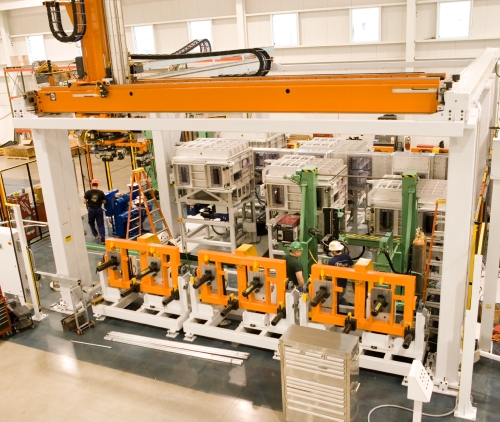
For instance, when appliance maker Electrolux shut down its Greenville, Mich., factory it left 2,700 workers unemployed in the same town where ECD is expanding its thin-film factory (see photos). The company also has recruited top executives from the ever-shrinking auto industry.

“We do a test of the available labor pool and hire the cream of the crop,” Morelli says.

Just as important are a plethora of state tax breaks and grants to retrain industrial workers for the green tech economy.

Although 70 percent of ECD’s flexible solar laminate panels are sold to European customers, Morelli anticipates the U.S. market will take off, with domestic manufacturers garnering a competitive advantage.

That all depends on whether Congress extends a crucial investment tax credit that expires this year and the policies of the next administration in Washington. Even so, demand for solar cells is expected to spike, especially given the recent unveiling of Big Solar projects by California utilities. Southern California Edison (EIX), for instance, is installing 250-megawatts’ worth of solar panels on commercial rooftops while PG&E (PCG) this month announced contracts to buy 800 megawatts of electricity from two photovoltaic power plants, including 500-megawatt thin-film solar farm being built by OptiSolar.

“As utilities begin to embrace distributed power generation, these type of things play into our natural advantage,” says Morelli, referring to his company’s lightweight solar panels that are especially suited for large rooftop arrays.

Of course, a handful of solar factories are not going to revive the Midwest’s industrial fortunes. (First Solar, for instance, operates factories in Germany and Malaysia, and Morelli doesn’t rule out locating manufacturing overseas.) But imagine a national policy that promotes the wide adoption of solar and the expansion of manufacturing in the rustbelt states becomes increasingly attractive. Shipping solar panels and mirror arrays from halfway around the world starts to make much less environmental and financial sense.

ECD’s proximity to the auto industry has already paid off. After installing solar arrays on two of General Motors (GM)’s California facilities, it won a contract in July to build a 12-megawatt rooftop array – the world’s largest by orders of magnitude – at a GM assembly plant in Spain.

Read Full Post »

Google on Tuesday took the drilling debate in a different direction – announcing that Google.org is investing nearly $11 million in technology to expand the nation’s geothermal reserves. That’s more than the U.S. government is spending on geothermal projects this year.

Traditional geothermal power plants, like those built by Calpine (CPN) in Northern California, sit atop reserves of naturally occurring steam or hot water that can be tapped to drive electricity-generating turbines. So-called Enhanced Geothermal Systems, or EGS,  hope to tap geothermal energy in any location by drilling deep underground to fracture “hot rocks” and then pump them with water to create steam that can be used in a power plant. The great potential, of course, would be to liberate the Midwest and South from their dependence on coal-fired power plants.

“While the U.S. debates drilling in the ocean for oil, we are focused on drilling for renewable energy – and lots of it – right beneath our feet,” Google.org said in a statement, citing a Massachusetts Institute of Technology study that estimates the accessible heat below the U.S. represents more than 2,500 times the nation’s annual energy consumption. (A Google.org video on geothermal is above.)

Google.org (GOOG), the search giant’s philanthropic arm,  will invest $6.25 million into AltaRock Energy, a Sausalito, startup, developing EGS technology. The investment is part of $26.25 million round of funding AltaRock revealed on Tuesday. Other investors include marquee green-tech venture capitalists Khosla Ventures and Kleiner Perkins Caufield & Byers.

Potter Drilling, a Redwood City, Calif., company developing hard-rock drilling technology to be used for geothermal, scored $4 million from Google.org. Other investors include MIT.

Google.org is granting the Southern Methodist University Geothermal Laboratory $489,521 to map North America’s geothermal reserves.

The geothermal funding is the latest investment in renewable energy by Google. It has invested in solar power plant companies BrightSource Energy and eSolar as well as in high-altitude wind company Makani and various ventures related to plug-in hybrid electric cars.

Read Full Post »

photo: David Lena

In a move that could alter the economics of the global solar industry, California utility PG&E on Thursday announced that it will buy 800 megawatts of electricity produced from two massive photovoltaic power plants to be built in San Luis Obsipo County on the state’s central coast. The 550-megawatt thin-film plant from Bay Area startup OptiSolar and a 250-megawatt PV plant from Silicon Valley’s SunPower dwarf by orders of magnitude the five-to-15 megawatt photovoltaic power stations currently in operation around the world.

Most of the industrial-scale solar plants designed to replace fossil-fuel power use solar thermal technology, meaning they deploy mirrors to heat liquids to produce steam that drives electricity-generating turbines. Photovoltaic power plants essentially take the solar panels found on suburban rooftops and put them on the ground in gigantic arrays. How gigantic? OptiSolar’s Topaz Solar Farm will cover 9 1/2 square miles of ranch land with thin-film panels like the ones in the photo above. Combined, the two solar plants would produce enough electricity to power 239,000 California households, according to PG&E (PCG).

“Obviously this is huge and a bold move,” says Reese Tisdale, a senior analyst who studies the economics of solar power for Emerging Energy Research in Cambridge, Mass. “It’s a pretty big jump in manufacturing capacity and a big opportunity for the PV industry, particularly for thin-film.”

If the power plants are ultimately built – and that’s a big if, given the challenges to get such facilities online – and other utilities follow PG&E’s lead, demand for solar modules could skyrocket. (Thin-film cells like those made by OptiSolar are deposited or printed in layers on glass or flexible metals. They are less efficient at converting sunlight into electricity than standard solar modules but they use far less expensive polysilicon and can be produced much more cheaply.)

First Solar (FSLR), a leading thin-film maker, has an annual manufacturing capacity of around 275 megawatts – which will rise to a gigawatt by the end of 2009. (First Solar is building two small-scale solar power plants for Southern California Edison (EIX) and Sempra (SRE).) SunPower (SPWR) is expected to produce 250 megawatts worth of solar modules this year; its California Valley Solar Ranch project for PG&E alone will be consume 250 megawatts.

“If we were trying to do it this year, it would be all of our production,” says Julie Blunden, SunPower’s vice president for public policy. “SunPower is ramping very quickly. By 2010 our production will be at least 650 megawatts.” SunPower’s solar power plant is set to begin producing electricity in 2010.

The PG&E deal puts OptiSolar in the spotlight. Founded by veterans of the Canadian oil sands industry, the stealth Hayward, Calif., startup has kept its operations under cover, avoiding the media as it quietly set up a manufacturing plant in the East Bay and prepared to break ground on a million-square-foot factory in Sacramento.

OptiSolar CEO Randy Goldstein told Green Wombat that the company will have no problem producing enough solar cells to build Topaz, which is scheduled to go online in 2011, as well as fulfill contracts for some 20 small-scale power plants in Canada.

“Our plan has always been to produce solar energy on a very large scale to make it cost-competitive, even in a market like California,” Goldstein says.

The terms of utility power purchase agreements like the ones OptiSolar and SunPower have signed with PG&E are closely held secrets, but it has long been an open secret that building massive photovoltaic power plants was not economically viable. Last year when I attended the opening of an 11-megawatt PV power station in Portugal – which offers generous solar subsidies – that was built by SunPower’s PowerLight subsidiary, PowerLight’s CEO told me that pursuing such projects in the U.S. was not an attractive proposition due to market incentives and public policy.

So what has changed too make constructing gargantuan PV power plants profitable?

“Lots of things have changed,” says SunPower’s Blunden. “Power prices are going up and public policy is requiring utilities to have a portfolio of renewables.”  And after building some 40 megawatts of power plants in Spain, SunPower has been able to improve its manufacturing processes and cut costs, according to Blunden.  “We could see where the cost reductions were coming down and the benefits of scale,” she says. “We saw there was a way for us to be competitive with other renewables.”

Goldstein says OptiSolar’s business model of owning the supply chain – from building its own machines to make solar cells to constructing, owning and operating power plants – will allow it to reduce costs. “By taking control of the value chain from start to finish, by being vertically integrated and cutting out the middleman,” he says, “we can be competitive not only with other renewable energy but with conventional energy.”

Photovoltaic power plants do have certain advantages over their solar thermal cousins. They don’t need to be built in the desert, thus avoiding the land rush now underway in the Mojave. PV is a solid-state technology and with no moving parts – other than the sun tracking devices used in some plants – they make little noise and are relatively unobtrusive. Most importantly in drought-stricken California, they consume minimal water. And the modular nature of solar panels means that a power plant can start producing electricity in stages rather after the entire facility has been constructed.

“The economies of scale does make PV cost competitive with other renewable energy generating technologies, and wouldn’t be possible without advances that SunPower and OptiSolar have been working on,” says PG&E spokeswoman Jennifer Zerwer. “We take a stringent look at all technologies and we’re not wedded to a particular one.”

With the PV plants, PG&E now has contracts to obtain 24 percent of its electricity from renewable sources.

But contracts are no guarantee the even a watt will be generated. The Topaz and California Valley projects must overcome a number of obstacles, not the least of which is the U.S. Congress’ failure so far to extend a crucial 30 percent investment tax credit for solar projects that expires at the end of the year. SunPower’s Blunden acknowledges the PG&E project is contingent on the tax credit being renewed.

PG&E executive Fong Wan said as much at a press conference Thursday afternoon: “That is a major hurdle. If the investment tax credit is not extended, I expect many of our projects will be delayed.”

Then there’s the question of how welcoming rural San Luis Obispo County residents will be to two massive solar power plants in the neighborhood. Along with a 177-megawatt solar thermal power plant being built by Silicon Valley startup Ausra for PG&E adjacent to the Topaz project, the county has become a solar hot spot. Ausra has run into some community opposition and state officials are growing concerned about the impact of the power plants on protected wildlife.

“The challenge is going to be the magnitude of these projects,” says Tisdale, the energy analyst. “Other projects are already facing opposition from the environmentalists.”

But for solar power companies like OptiSolar the impetus is to get big and get big fast. “I think it’s going to demonstrate that photovoltaics have the ability to be part of the energy mix,” says Goldstein of Topaz. “We can scale up and have a big impact. There’s not going to be a lot of room for niche players in the long run.”

Read Full Post »

When Intel announced this week that it was spinning off a stealth in-house startup called SpectraWatt to develop solar cells, it appeared the chip giant was just the latest old-line Silicon Valley tech firm bitten by the green bug.

After all, crosstown chipmaker Cypress Semiconductor jumped into the solar game back in 2004 when it acquired SunPower (SPWR), now a leading manufacturer of solar cells and panels and an installer of large-scale solar arrays. Then the world’s biggest chip-equipment maker, Applied Materials (AMAT), retooled machines that make flat-screen video displays to produce thin-film solar panels. And just this month, Hewlett-Packard (HPQ) unveiled a deal to license solar technology to a solar cell startup while IBM (IBM) announced it would develop thin-film solar.

But it’s not just now jumping on the enviro-biz bandwagon – Intel’s solar efforts have been quietly under development since 2004. That’s when Andrew Wilson, an 11-year Intel (INTC) veteran, was chatting with a colleague while waiting for a conference call to begin. “We were shooting the breeze and I mentioned that I had replaced all the light bulbs in my house with compact fluorescent lights and my utility bill had come down by a third,” says Wilson, SpectraWatt’s CEO. “And he said, `Hey, did you know that solar cells are made of silicon?’ ”

“We started talking about what a business plan would look like, because if something is made out of silicon then Intel should be taking advantage of that market,” Wilson told Fortune. A year later, Wilson and his colleagues had developed a marketing plan and secured funding from Intel’s new-business incubator to develop a business strategy and hone its technology. (It’s no coincidence that the nascent solar industry is populated by computer industry veterans from companies that put the silicon in Silicon Valley.)

When it comes to cutting-edge solar technology, silicon-based cells are considered a bit old-school. Silicon is currently in short supply and the resulting high prices have led venture capitalists to invest hundreds of millions of dollars in thin-film solar startups that promise to dramatically lower the cost of solar by printing or otherwise applying non-silicon solar cells to glass or flexible materials that can be integrated into walls, windows and other building materials. While thin-film solar is less efficient at converting sunlight into electricity, the expectation is that it can be produced much more cheaply than conventional cells.

But thin-film solar is still largely an early-stage technology and silicon-based cells will continue to be the big market for the near-future. So the question is, how does Intel compete with established players like SunPower, China’s Suntech (STP) and Germany’s Q-Cells as solar cells become a commodity? Intel controls some 80 to 90 percent of the worldwide chip market but it’s unlikely that it – or any other player – will replicate that experience in solar cells.

Wilson’s view is that it’s early days for the solar market and that SpectraWatt’s ace in the hole is Intel’s global manufacturing experience and history of technological innovation. “The solar industry today looks like the microelectronics industry in the late ‘70s – there’s very few standards and no one is manufacturing at scale,” says Wilson. “It’s all about manufacturing processes and material sciences that will lead to fundamental breakthroughs. The product is vastly simpler than a microprocessor but the fundamental nature of a solar cell isn’t all that different. When you think of what it takes to manufacture globally and manage supply chains, that’s Intel’s core competence.”

There certainly is room for more players, given that solar was a $30 billion market in 2007 and is expected to continue to grow at a clip of 30 to 40 percent in the coming years.

Wilson says SpectraWatt has secured silicon supplies and is developing technology that will give it a competitive edge. He’s keeping mum about the details of that technology for now. “We do believe we will have a technological advantage when we get what we’re doing in the lab to manufacturing,” Wilson says.

The company is set to begin building its manufacturing facility in Oregon later this year, with production to begin in mid-2009.

SpectraWatt launches with a $50 million investment lead by Intel Capital, the company’s investing arm. Other investors include Goldman Sachs (GS), PCG Clean Energy and Technology Fund, and German solar giant Solon. (As Green Wombat has written, Solon has invested in an array of solar startups in the United States, including Sungevity and thin-film solar company Global Solar.)

Read Full Post »

In another sign that technological innovation will drive solutions to global warming and the United States’ energy dependence, technology born of Hewlett-Packard’s imaging and printing research will be used to make more efficient and cheaper solar panels. HP is licensing its transparent transistor technology, which will eliminate the need for mechanical trackers to follow the sun, to a Livermore, Calif., startup called Xtreme Energetics

Here’s how it’s supposed to work: XE’s solar panels concentrate sunlight onto highly efficient solar cells that use a fraction of the expensive silicon found in standard solar modules. A layer of HP’s clear transistors will funnel light to the solar cell as the sun moves across the sky.

“Basically, we don’t have any mechanical gears or cogs,” says XE chief executive Colin Williams, a veteran of JPL/Caltech and a former Stanford University professor. “From an outward appearance the panel appears to be fixed, but internally light is being steered to the solar cell through the electronics.”

Doing away with bulky mechanical trackers means that more panels can be packed onto commercial rooftops, allowing energy-hungry facilities like data centers to draw more of their power from the sun. The panels will be transparent and can be colorized to blend in with building facades. Williams says XE will also produce panels for large-scale solar power plants.

That’s the goal, at least. XE, which is currently funded by its founders, is two years away from producing solar panels with HP’s (HPQ) technology and its claim that they will be twice as efficient at half the cost of conventional solar systems has yet to be proven.

For HP, the solar licensing deal is an unanticipated benefit of collaborative research by HP Labs, engineers at its imaging and printing operation in Oregon and researchers at Oregon State University. “They were looking for future ways to display images,” say Joe Beyers, HP’s vice president of intellectual property licensing. “It just turned out that Colin and his team became aware of the work we were doing with Oregon State and started the dialog.”

Beyers says other potential applications for the technology – developed as part of HP’s new approach to commercializing R&D that my colleague Jon Fortt wrote about recently – include video displays for car windshields.

Read Full Post »

« Newer Posts - Older Posts »

Design a site like this with WordPress.com
Get started