Feeds:
Posts
Comments

Archive for the ‘enviro startups’ Category

powerstring-picMost people think of National Semiconductor as a chip company. But the Silicon Valley mainstay has been moving into the solar business and on Thursday it scooped up Act Solar, a startup that makes equipment designed to maximize power production from photovoltaic panels.

Act Solar, a three-year-old Santa Clara, Calif.-based company, developed the PowerString, a device that recirculates energy in a rooftop solar array to keep all panels producing electricity in the event that shade, dirt or glitches affecting one solar module don’t impact others. PowerString also allows solar array owners to wirelessly monitor the performance of their systems.

National Semiconductor (NSM) already makes diagnostic and measuring equipment for use in maximizing electricity production from solar panels and will fold Act Solar into that division. “Early field tests and historical modeling have shown that this [Act Solar] solution can cumulatively deliver 40 to 80 percent more power over the operating life of a solar panel installation,” National Semiconductor said in a statement.

Read Full Post »

clintonbill1Another reason Green Wombat will be spending Earth Day in Southern California this year: Former President Bill Clinton will deliver the keynote speech at Fortune Magazine’s Brainstorm Green conference on April 22.

Clinton will be joining a gathering of business and environmental leaders, including Ford (F) executive chairman Bill Ford, PG&E (PCG) chief executive Peter Darbee, SunPower (SPWRA) CEO Tom Werner and executives from Fortune 500 companies like IBM (IBM),  Wal-Mart (WMT) and General Electric (GE). On the green side of the aisle, execs from the Natural Resources Defense Council, Environmental Defense Fund and Greenpeace will be attending the confab in Laguna Niguel.  Former California State Treasurer Phil Angelides, now chairman of the Apollo Alliance, and green jobs guru Van Jones will also be present.

We now end the shameless self-promotion and return to our regular Green Wombat programming.

Read Full Post »

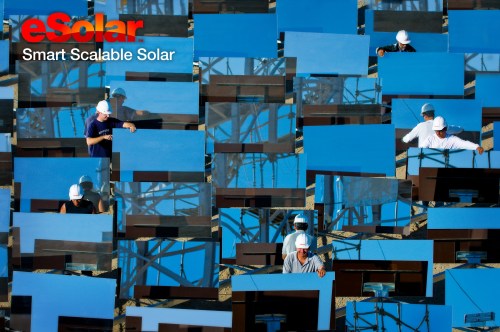
esolar-smart-scalable-solar

photo: eSolar

California startup eSolar said on Tuesday that it has licensed its solar power technology for the construction of up to 1 gigawatt of solar farms in India over the next decade.

The deal with Indian conglomerate ACME Group marks India’s first move into large-scale solar power and is the biggest announced foray of a United States solar power plant company overseas. The agreement calls for ACME, based in the northern Indian state of Haryana, to invest $30 million in eSolar, which will also earn fees for each of its 46-megawatt modular solar thermal power plants that are built.

A gigawatt, or 1,000 megawatts, of solar energy produces enough electricity to keep the lights on in about 750,000 energy-hogging U.S. homes. Presumably, many more homes and businesses can be powered by a gigawatt in India, where electricity shortages are common and the country relies on greenhouse-gas emitting diesel generators.

“We’re exclusively selling to ACME in India and they’re exclusively using us,” eSolar CEO Bill Gross told Green Wombat. “We’d like to do something like this in Spain, in Australia and the Middle East.”

It’s the second big deal for Pasadena-based eSolar in a week. Last Monday, the company inked an agreement to license its technology to U.S. coal-fired utility NRG (NRG) for the development of up to 500 megawatts of solar power plants in California and the Southwest for Southern California Edison (EIX) and other utilities. Meanwhile, the financial crisis is forcing the consolidation of the solar industry, with Monday’s dual deals — First Solar (FSLR) acquired the solar power plant assets of Silicon Valley OptiSolar while Spanish solar developer Fotowatio bought financier MMA Renewable Ventures’ solar portfolio.

eSolar claims it can generate electricity at lower prices than natural gas-fired power plants by mass-producing mirrors called heliostats that concentrate sunlight on a water-filled receiver atop a tower to create steam that drives a turbine. The heliostats are much smaller than those made by competitors, use far less steel and can be quickly and cheaply installed in the field because they’re controlled by sophisticated software, according to Gross.

That allows eSolar to pack more mirrors into the solar field to create relatively compact power plants that can be located near urban centers rather than in the desert. ACME, which makes everything from telecommunications equipment and refrigeration systems to fuel cells, will begin construction of the first solar farm later this year.

ACME will hire contractors to build the solar power plants while eSolar will provide the heliostat fields, power towers and software systems. ACME so far has signed power purchase agreements with Indian utilities for 250 megawatts, according to eSolar.

“The eSolar system addresses obstacles that have previously plagued solar installations and presents a viable, cost-effective alternative that can scale quickly to meet India’s growing energy needs,” ACME CEO Manoj Upadhyay said in a statement.

Read Full Post »

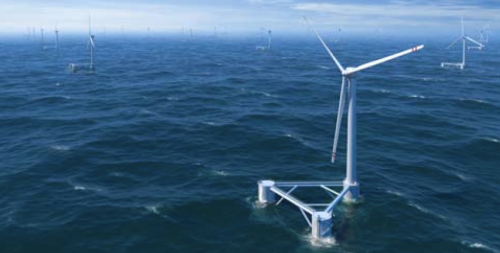
principle-power-oregon-wind-farm

Image: Principle Power

Portugal has become a prime spot for wave energy farms, given the coastal conditions and the government’s support for renewable energy projects. Now Portuguese energy powerhouse Energias de Portugal has signed an agreement with Seattle’s Principle Power for a deep-water floating wind farm.

It’s the second floating wind farm for Principle Power, which last October inked a contract to construct a 150-megawatt turbine power plant off the Oregon coast. The Oregon plan calls for 30 floating platforms that will each sport a five-megawatt wind turbine – which is about twice the size of the biggest land-based turbines in commercial operation. (General Electric (GE) makes a 3.6-megawatt turbine designed for offshore and Clipper Windpower is developing a ten-megawatt prototype.)

Details of the deal with Portugal’s EDP, however, are next to non-existent. Principle Power president Jon Bonanno told Green Wombat that the size of the Portuguese wind farm, the type of turbine it will use, its cost and build date are confidential. “What I can say is that the phased build out will result in a utility scale project, within a reasonable time frame for a plant of its size and nature,” Bonanno wrote in an e-mail.

The Seattle startup did reveal that the agreement with EDP calls for it to first deploy a single floating turbine platform, which it calls a WindFloat. “Innovative features of the WindFloat dampen wave and turbine induced motion, enabling wind turbines to be sited in previously inaccessible locations where water depth exceeds 50 meters and wind resources are superior,” Principle said in a statement.

If the WindFloat is successful, then a demonstration project will be built and a commercial wind farm will follow. Deep-water offshore wind farms pose a number of technological and economic challenges but the expected payoff is the production of  cheaper electricity from massive turbines that will be located far enough offshore to avoid the NIMBY problems that have plagued projects in the United States and elsewhere.

EDP became one of the world’s biggest wind farmers in 2007 when it acquired Horizon Wind Energy from Goldman Sachs for $2 billion.

Read Full Post »

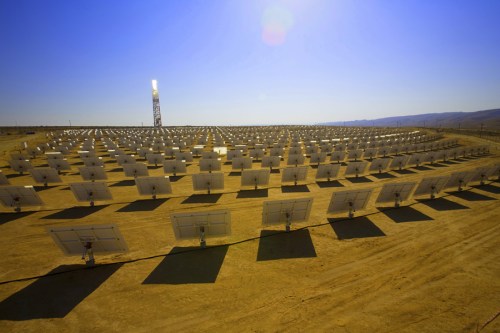
solara
Images: BrightSource Energy

A ray of sunshine amid the economic gloom: While some solar companies struggle through the downturn, BrightSource Energy on Wednesday morning announced the world’s largest solar energy deal to date – a 20-year contract to supply utility Southern California Edison with 1,300 megawatts of greenhouse gas-free electricity.

That’s more than twice the size of the previous world’s-biggest-solar-deal, a 553-megawatt power purchase agreement in 2007 between California utility PG&E and Israel’s Solel. BrightSource itself last year inked a deal to provide PG&E (PCG) with 500-megawatts of solar electricity with an option for 400 megawatts more.

“This proves the energy industry is recognizing the role solar thermal will play as we de-carbonize our energy supply,”  BrightSource CEO John Woolard said Wednesday at a press conference.  “We believe now more than ever the time is right for large-scale solar thermal.”
solarhOakland-based BrightSource will build seven solar power plants for Southern California Edison (EIX) using its “power tower” technology. Thousands of sun-tracking mirrors called heliostats focus the sun’s rays on a water-filled boiler that sits atop a tower. The intense heat creates steam which drives a turbine to generate electricity. BrightSource has built a prototype power plant in Israel.

BrightSource has raised more than $160 million from a blue-chip group of investors that includes Google (GOOG), Morgan Stanley (MS) and VantagePoint Venture Partners as well as a clutch of oil giants – Chevron (CVX), BP (BP) and Norway’s StatoilHydro.

If all the solar power plants are built, BrightSource’s deal with Southern California Edison will generate enough electricity to power about 845,000 homes. The agreement is a vote of confidence in the solar industry at a time when the financial crisis has forced BrightSource rivals like OptiSolar to lay off workers while Ausra retools its strategy to focus on supplying solar thermal technology to power plant developers rather than building projects itself.

Given the economic collapse, why are these massive megawatt deals still being done? First, California utilities are under tight deadlines to ratchet up the amount of electricity they obtain from renewable sources – 20% by the end of 2010 and 33% by 2020. Second, it costs nothing to sign a contract – no money has yet changed hands, and won’t unless the plants are built and begin producing electricity.

In fact, not a kilowatt of juice has been generated from the more than 5,000 megawatts of Big Solar contracts signed over the past four years by California’s three investor owned utilities (the third being San Diego Gas & Electric (SRE) ).  Still, a long-term utility contract is key for a startup like BrightSource to obtain the billions in financing required to build large-scale solar power plants. The terms of utility contracts – such as the cost of the solar electricity produced – are closely held secrets but are worth billions, if a 2008 power purchase agreement between Spanish solar company Abengoa and utility Arizona Public Service is any guide.

A significant hurdle for BrightSource – and many other solar developers – is the expansion of the transmission grid to connect remote power plants to cities. BrightSource spokesman Keely Wachs says the company has 4,200 megawatts of solar power plant projects under development.

The Southern California Edison deal is something of a homecoming for American-Israeli solar pioneer Arnold Goldman, BrightSource’s founder and chairman. In the 1980s, during the first solar boom, his Luz International built nine solar power plants in the Mojave. Those plants, most are now operated by FPL (FPL), continue to provide electricity to Edison.

The first BrightSource solar farm for Edison is expected to go online in early 2013. It’s a 100 megawatt power plant part of BrightSource’s Ivanpah complex to be built on federal land on the California-Nevada border in the Mojave Desert. That plant is currently wending its way through a complex state and federal licensing process.

Just how complex was illustrated by a meeting Green Wombat attended Tuesday in Sacramento, where a roomful of state and federal officials spent hours discussing the environmental impact of a 750-megawatt solar power plant to be built by Phoenix’s Stirling Energy Systems for San Diego Gas & Electric that would plant 30,000 solar dishes in the desert. A second Stirling solar farm will be built for Southern California Edision. When the deals were announced in 2005, they were the world’s largest at the time.

PG&E chief executive Peter Darbee recently said his utility will begin directly investing in solar power projects. On Wednesday, Southern California Edison renewable energy executive Stuart Hemphill said Edison would consider requests from solar power developers to take ownership stakes in their projects but prefers to sign power purchase agreements.

“We do see solar as the large untapped resource, particularly in Southern California,” said Hemphill.

Read Full Post »

csi-report

The other day I ran into Danny Kennedy, president of solar installation company Sungevity, on the playground as we were picking up our kids at Malcolm X Elementary (we live in Berkeley). I had spent the week chronicling layoffs at various solar and wind companies so it was with a bit of trepidation that Green Wombat asked Danny how business was going at at Sungevity.  “Great,” he replied as I quizzed him about the impact of the recession. “We’re as busy as ever.”

Apparently so. A report released Wednesday by the California Public Utilities Commission shows that residential and commercial rooftop solar installations in the Golden State more than doubled in 2008 from the previous year to 158 megawatts. What’s more, a record-breaking number of applications to participate in California’s $3 billion solar rebate program were filed in December as the drumbeat of bad economic news grew deafening and the state’s unemployment rate hit 9%.

Are Californians being crazily contrarian? While one would think that a $30,000 solar array would be one of those luxuries most people would put on the back burner in bad times, there are some solid economic reasons for the surge. First, rebates for solar systems under the California Solar Initiative get less lucrative in 2009 as incentives fall as the amount of installed solar rises.  Then in October Congress lifted the $2,000 cap on the federal tax credit on solar arrays, allowing homeowners and businesses to take a 30% tax credit on systems installed after Dec. 31.  Add in the state rebate and the cost of a solar system in California suddenly fell by half.

“The surge in applications occurring in the fourth quarter of 2008 is particularly noteworthy given the slowdown in the economy that occurred during the same time period,” the report’s authors noted. “In addition to environmental benefits such as cutting greenhouse gas emissions and other pollutants, it appears that solar energy is benefiting California by serving as an economic bright spot in the economy.”

And therein lies some lessons as the U.S. Congress debates how to promote green jobs. Two years into the California Solar Initiative, the taxpayers’ investment of $775 million in solar rebates has yielded $5 billion in private investment in solar projects and rapidly expanded the state’s renewable energy industry, according to the report. That’s helped create strong solar companies like solar cell maker SunPower (SPWRA) and markets for thin-film solar companies such as First Solar (FSLR). The decade-long program is on track to achieve its target of 3,000 megawatts of rooftop solar and in the first two years of the program more solar has been installed in California than in the previous 25 years.

While California regulators expect the pace to continue in 2009, the big unknown is how many homeowners and business owners will drop out of the program and cancel their applications if the economy continues to deteriorate rapidly this year. The current dropout rate is 15%, according to the report.

“We are hopeful that many of those pending projects will move forward,” Molly Tirpak Sterkel, who oversees the California Solar Initiative for the utilities commission, told Green Wombat. “We’re also cognizant of the economy and economic forces that may pose a threat to those installations.”

Demand for solar is far stronger in Northern California than in sunny SoCal. Northern California utility PG&E’s (PCG) customers have installed more than twice the megawatts of solar than Southern California Edison (EIX) customers. And the report notes that while applications for commercial arrays in PG&E’s territory rose 71% between April and December 2008, they fell 23% in Southern California Edison’s area. San Diego Gas & Electric (SRE), which covers a much smaller service area, saw applications triple for residential solar arrays.

Sterkel says it is unclear why Northern Californians are going solar at a much faster rate than their southern counterpart, but it may be due to differences in electricity pricing and more mature solar markets in regions like the San Francisco Bay Area. “There’s just that many more solar companies with experience, installations and sales channels, ” she says.

Solar panels seem to be sprouting from Bay Area rooftops like California poppies after a late winter rain. In Berkeley, the city has launched a program that pays for residential and business solar arrays upfront and let owners pay the cost back over 20 years through an annual assessment on their property taxes.

Which also may explain why I seem to be seeing more of those Sungevity signs around town.

Read Full Post »

kimberlina0089l1

photo: Ausra

When Green Wombat sat down for a chat with Ausra founder David Mills back in September 2007, he allowed that it was not unreasonable to expect the Silicon Valley solar startup to soon be building several massive megawatt solar power plants a year. The optimism was not unwarranted. After all, in the space of 12 months Ausra had relocated from Sydney to Palo Alto, raised $40 million from A-list venture capitalists and was about to ink a deal with utility PG&E for a 177-megawatt  solar power project.

That was then. This month Ausra laid off 10% of its 108 employees amid a move to stop building Big Solar projects – for now – to focus on providing its solar thermal technology to other power plant developers and to industries that use steam. (Ausra’s compact linear fresnel reflector technology deploys flat mirrors that sit low to the ground and concentrate sunlight on water-filled pipes that hang over the mirrors. The superheated water creates steam which drives an electricity-generating turbine.)

“I think our competitors will figure this out sooner or later but nobody’s going from a five-megawatt project to a 500-megawatt project. No one’s going to finance that,” Ausra CEO Bob Fishman told Green Wombat. “If you look at the amount of money it takes to be involved in the project development business, that’s not something a startup can do.”

At least any time soon. Ausra last year opened a robotic factory in Las Vegas to make mirror arrays and other components for the many power plant projects it had on the drawing boards. Just three months ago the company flipped the switch on its five-megawatt Kimberlina demonstration power plant outside Bakersfield. But as the credit crunch hit, financing for billion-dollar solar power projects evaporated. Then in October, Congress passed legislation allowing utilities like PG&E (PCG), Southern California Edison (EIX) and San Diego Gas & Electric (SRE) to claim a 30% investment tax credit for solar projects. As the only well-capitalized institutions left standing in the energy game, utilities are stepping forward as investors.

PG&E CEO Peter Darbee says he’s prepared to make direct investments in solar power plants – projects the utility needs to comply with a California mandate to obtain 20% of its electricity from renewable sources by 2010 and 33% by 2020. Under pressure to meet those targets, California utilities have signed more than four gigawatts worth of power purchase agreements with solar power plant startups like BrightSource Energy, Solel, Stirling Energy Systems and eSolar. Utilities also have begun signing deals for electricity produced by smaller scale photovoltaic power plants built by companies like First Solar (FSLR) and SunPower (SPWRA).

Fishman said Ausra will complete the 177-megawatt Carrizo Energy Solar Farm in San Luis Obispo County on California’s central coast to supply electricity to PG&E. “If Peter Darbee wants to own Carrizo rather than buy the electricity, we’re willing to do it. It makes sense,” he says.

Ausra will also will complete a second big solar power plant planned for Arizona. But the company has quietly let drop a Florida project for utility FPL (FPL) and is negotiating to offload lease claims it filed on federal land in Arizona and Nevada for solar power plants during the solar land rush.

“Other projects in the pipeline we’ll be selling to utilities or developers for a modest amount of cash with a commitment that those developers must use our technology,” says Fishman.

Fishman notes that the cost of licensing a solar power plant can be $5 million to $10 million a year – and in California it’s a multi-year process – so Ausra will realize some immediate savings by morphing into a technology provider.

Customers for Ausra’s technology include oil companies that could inject solar-generated steam in oil wells to enhance recovery of thick petroleum as well as food processing plants and other heavy users of steam. Fishman just returned from a trip to the Middle East where he says he held talks in Kuwait, Qatar and Dubai about using Ausra’s technology for oil recovery and desalinization.

Going forward, he says Ausra’s focus will be on medium-sized power plants. “Maybe next year we’ll do four projects of 50 megawatts a year. It’s a walk before you run situation,” says Fishman. “The financial customers and financial community are going to insist we do medium scale before we do large scale. We’ll still want to do very large projects but given the project finance market, it’ll be a few years from now.”

Read Full Post »

thinkcity_006

photo: Think

Here’s a bit of good news from the otherwise dreary alternative automotive world: Norwegian electric carmaker Think has put 44 laid-off employees back to work following the completion of a round of interim financing.

In December, Think halted production of its City battery-powered urban runabout and laid off half its workforce as financing to expand the company’s operations dried up. Then last week Think announced that it had obtained a $5.7 million bridge loan from investors led by Ener1, a battery maker who is supplying the City with lithium-ion power plants.

The financing has been completed and Think said Friday that it had rehired 44 workers in management, sales and supplier operations. But Think is hardly out of the Norwegian woods yet. The company still needs to raise around $40 million to resume full-scale production of the City and proceed with its plans to sell the electric car in select European markets outside Norway before expanding to the United States. Think has raised more than $100 million from European and U.S. investors, including General Electric (GE) and Silicon Valley and East Coast venture capitalists.

“We are very content that this first visible step in our plan towards restart now is in place,” said Think CEO Richard Canny, a former Ford (F) executive, in a statement. “We still need to raise the permanent capital, but this first call-back signals both internally and externally that Think is committed and able to turn the situation into a positive direction for the company.”

Read Full Post »

b_342

photo: Better Place

Electric cars, eh?

Silicon Valley startup Better Place on Thursday unveiled a deal with the government of Ontario – the Michigan of Canada – to build an electric car charging network in the automaking province. The announcement comes on the heels of agreements Better Place — the electric car infrastructure company founded by former software executive Shai Agassi — has made with governments in Australia, California, Denmark, Hawaii, Israel and Japan.  Better Place is working with the Canadian arm of Sydney-based infrastructure finance giant Macquarie to develop the Ontario electric car network.

“We need to be where the puck is going and in this case bring the puck to Ontario,” said Ontario minister of international trade Pupatello at a press conference in Toronto Thursday morning.

The Canadian deal comes amid turmoil in the nascent electric car industry. While EV companies like Think and Tesla struggle to survive the credit crisis, the big automakers – Ford (F), General Motors (GM), Toyota (TM), Honda (HMC) and Chrysler – have announced they’re accelerating plans to build electric cars and, in GM’s case, a battery-making factory.

On Thursday, the premier of Ontario, Dalton McGuinty, said his government will conduct a study on how to expedite the introduction of electric cars in the province. When the study is released in May, Better Place will detail its plan and investment timeline for building the network of charging posts and battery-swapping stations.

Better Place, said McGuinty,  “is a model with the power to reshape our province. It’s going to create new green jobs, it’s going to make life more convenient for car drivers of the future and it’s going to signal to the world that Ontario is electric-car friendly and will make it a more attractive place to build electric cars.”

Agassi has now committed to raising billions in capital to simultaneously build charging networks in five far-flung countries over the next three years. When Green Wombat talked to Agassi in November after he signed a deal to build a $1 billion San Francisco Bay Area charging network, he insisted the financial crisis would not hamper efforts to raise funding.

Under Better Place’s system, consumers will buy the electric cars while Better Place will own the batteries, charging subscribers to its network a fee per-mile (or kilometer) driven. Renault-Nissan is supplying electric cars for Better Place’s other networks. An electric Nissan SUV – emblazoned with little wind turbines – was parked at the press conference but company spokeswoman Julie Mullins said an electric car supplier had not yet been selected for Ontario. “Ultimately, we expect a wide range of vehicle makes and models to be available to drivers,” she wrote in an e-mail. “We are currently in talks with several car companies.”

Ontario-based Bullfrog Power will provide renewable energy – 80% hydro, 20% wind – for the Better Place network. “We’re going to create a virtual oil field across the province,” said Agassi.

Read Full Post »

think-city-8_imagelarge

photo: Think

Norwegian electric carmaker Think said Tuesday it has obtained a $5.7 million bridge loan from battery maker Ener1 Group and other investors to allow the company to resume limited production of its City urban runabout.

In December Think idled its assembly line and laid off workers as the global credit crunch took its toll and the company was unable to obtain funding to finance continued production of its electric vehicles.

Think CEO Richard Canny said in a statement Tuesday that the company is continuing negotiations to raise capital but the interim financing from Ener1, which is supplying lithium-ion batteries to Think, will allow the recall of some workers to complete cars from parts on hand.  “We have encouraging engagement with a number of potential new equity investors for our recapitalization process,” said Canny.

The Think financing comes as Ford (F), Toyota (TM), Honda (HMC) and other major automakers unveil prototypes for new electric cars and plug-in hybrids at the Detroit Auto Show.

Read Full Post »

« Newer Posts - Older Posts »

Design a site like this with WordPress.com
Get started