
Feeds:
Posts
Comments

Archive for the ‘enviro capitalism’ Category

Monday night, Green Wombat swung by SF Green, one of a growing number of green tech networking events sprouting up around San Francisco and Silicon Valley. The draw – beyond drinks with a standing-room-only crowd of bright-eyed twenty-and-thirtysomethings in a San Francisco art gallery – was the appearance of leading venture capitalist Ray Lane of Kleiner Perkins Caufield & Byers and Darryl Siry of Tesla Motors, maker of the Roadster electric supercar.

Despite the fact that Tesla has sued a Kleiner company, Fisker Automotive – which is producing an electric hybrid sports sedan – for alleged intellectual property theft, no sparks flew. (Though at Fortune’s recent Brainstorm Green conference, Lane couldn’t resist taking a jab at allegations that Fisker founder Henrik Fisker appropriated Tesla technology when he did design work for the Silicon Valley startup: “It’s ridiculous,” Lane said. “Henry Fisker wouldn’t know a drive train from a glass of water. He’s a designer.)

Siry, Tesla’s vp of sales, marketing & service, said five of the $100,000 Roadsters have rolled off the assembly line so far with one car tooling around Los Angeles, and others in the Bay Area and London. By year’s end, Tesla, which has been wrestling with drive train problems, should have more than 100 cars on Bay Area roads, home to many the company’s tech titan customers.

Tesla has raised $145 million, Siry noted, and will do another round before an IPO. The Roadster will always be a limited production marquee car but to mass produce its next vehicle, a five-seat sports sedan code-named White Star, Tesla will need that IPO or project financing. Siry also sketched a future where Tesla might supply electric drive trains to automakers in exchange for project financing.

“Tesla is a tech company wrapped in an automotive brand,” he said at the event co-sponsored by VentureBeat.

Lane and Kleiner Perkins have gone beyond investing in electric car companies to running one. Lane is chairman of Think North America, the U.S. arm of Norwegian electric carmaker Think Global. Kleiner and Rockport Capital took a 50 percent stake in the North American operation, which launched last month.

The Think and Fisker investments are emblematic of a new direction for VCs who have jumped into the green tech game. Unlike the first dot-com era or even the current Web 2.0 age, there’s no quick exit on the horizon for investments in green tech companies that may be years away from producing a product and require hundreds of millions, if not billions, in project financing to build car factories or solar energy power plants.

Lane compared investing in green tech to the long-term horizon needed for investing in biotech startups, where the key is to hit milestones that allow investors to calculate valuations.

Still, it’s a big gamble, given rising commodity prices and global economic upheaval.

Kleiner is also an investor in solar power plant startup Ausra. “Steel prices are killing us,” Lane said. Ausra’s power plants consist of hundred of acres of mirrors mounted on steel frames. “With Ausra, we [calculate] we could deliver solar thermal electricity at 12 cents a kilowatt-hour. But with steel prices, who knows?”

A shortage of qualified green tech workers has become an issue, according to Lane. The nascent solar power plant business relies on recruiting engineers and project developers from the carbon-based industry. “Talented people in project development at companies like Bechtel are maxed out for years on building projects,” he said.

Read Full Post »

brightsource_energy.jpgCalifornia utility PG&E on Tuesday announced contracts to buy up to 900 megawatts of electricity generated by solar power plants to be built in the Mojave Desert by BrightSource Energy. It’s one of the biggest solar deals to date — enough to power some 600,000 homes — and is another sign that that the shift from fossil fuels to carbon-free energy is well underway, at least in California.

But is it too late? PG&E (PCG) first announced it was negotiating a power purchase agreement with BrightSource, then called Luz II, on Aug. 10, 2006. Around that time, the United States’ leading climate scientist, NASA’s James Hansen, warned that the world had only a decade to take drastic action to cut carbon emissions and avert future catastrophe from global warming.

It took nearly two years alone to just hammer out the PG&E-BrightSource deal and the world now has eight years left to radically ramp up alternative energy sources. By the time the first BrightSource 100-megawatt solar power plant (image above) goes online it will be 2011 and the last one will begin generating electricity for PG&E just as the climate change alarm clock goes off. If you believe Hansen, hitting the snooze button will not be an option.

Of course, there’s no guarantee the BrightSource plants will actually be built — it will take billions to construct them and the investment climate is not exactly sunny these days, clouded by Wall Street’s meltdown and the looming expiration of a crucial solar investment tax credit. (Personally, Green Wombat is betting BrightSource pulls it off — though April Fool’s Day probably was not the best date to unveil such a deal. The Oakland, Calif.-based company was founded by solar pioneer Arnold Goldman, its CEO, John Woolard, hails from Silicon Valley and the startup is backed by Morgan Stanley (MS) and some savvy venture capitalists. )

Given the moral and regulatory imperative — California utilities must obtain 20 percent of their electricity from renewable sources by 2010 and a third by 2020 — why is large-scale solar proceeding at the pace of a Mojave Desert tortoise? (Almost three years ago, for instance, Southern California Edison (EIX) and San Diego Gas & Electric (SRE) unveiled agreements with Phoenix’s Stiring Energy Systems to buy up to 1,750 megawatts of solar electricity. Ground has yet to be broken on any of the planned power plants.)

Partly it’s because the years-long negotiations between utilities and solar power plant companies is something of a black box. Details of these power purchase agreements are kept confidential but are estimated to be worth billions — if a recent $4 billion dealstruck by utility Arizona Public Service with solar power plant builder Abengoa Solar is any indication. Regulated utilities are by their nature big and bureaucratic and can be expected to be extra-cautious when they’re placing bets on untried solar technology from companies like BrightSource and Ausra.

“Transactions of this magnitude require a fair amount of time to negotiate and due diligence must also be performed,” PG&E spokeswoman Jennifer Zerwer told Green Wombat in an e-mail. “The original [BrightSource agreement] announced in August 2006 was for 500 megawatts; the final agreement expanded on the original . . . and culminated in the execution of five separate power purchase agreements for up to 900 MW.”

Another factor is a regulatory structure that is an artifact of the fossil fuel age. California requires extensive environmental review of new power plant projects — be they clean and green or down and dirty — a process that can take a 18 months or more. And the best solar sites often are on federal land in the Mojave — securing a lease for that land is another 18-month-long process.

Still, one looks to history. When the United States entered World War II, it retooled its factories in a matter of months to produce planes and tanks. Climate change is an amorphous but no less dangerous threat and speeding up the regulatory timetable will be crucial in the fight against global warming.

The clock, after all, is ticking.

Read Full Post »

img_2698.jpg

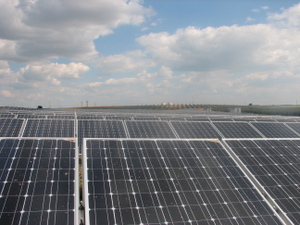
Southern California Edison plans to install 250 megawatts’ worth of solar panels on commercial rooftops, generating enough electricity to power 162,000 homes.

It’s a potentially game-changing move, one that could lower the cost of solar cells as manufacturers ramp up production to meet the utility’s schedule of installing a megawatt-a-week of arrays until it reaches the 250-megawatt target. That alone is more than United States’ entire production of solar cells in 2006 and will generate as much electricity as a small coal-fired power plant, albeit with no greenhouse gas emissions. “This project will turn two square miles of unused commercial rooftops into advanced solar generating stations,” said John Bryson, CEO of the utility’s parent company, Edison International (EIX), in a statement Wednesday night.

The $875 million initiative also marks the first big foray into so-called distributed energy by a major utility. Instead of building a centralized power station and the expensive transmission system needed to transmit electricity to the power grid, Edison will connect clusters of solar arrays into existing neighborhood circuits. A significant hurdle for the massive megawatt solar power plants planned for California’s Mojave Desert is the need in some cases to build multi billion-dollar transmission systems through environmentally sensitive lands to bring the electricity to coastal metropolises.

Solar arrays of course only generate electricity when the sun is shining, but they produce the most power during the hottest part of the day when Southern Californians crank up their air conditioners. The arrays could help spare Edison from having to fire up a fossil-fuel power plant when demand peaks.

Edison spokesman Gil Alexander told Green Wombat that the utility expects the project’s scale to allow arrays to be placed on roofs at half the cost of a typical installation. Edison’s ambitions could prove a boon for solar cell makers like SunPower (SPWR) and Suntech (STP) as well as solar installation companies such as Akeena (AKNS). One unknown is whether the demand created by Edison will drive up costs in the short term, given ongoing shortages of polysilicon, the base material of solar cells. The Edison project could also help jump-start the market for thin-film solar panels, which typically use far less silicon than conventional solar cells.

Alexander says Edison is already negotiating with solar panel makers and installers. Needless to say, the project will up local hiring of green collar workers.

Here’s how the solar roofs initiative will work: Edison will lease 65 million square feet of warehouse rooftop space from building owners. (The target area is the fast-growing “Inland Empire” of Riverside and San Bernardino counties.) The utility will contract for the installation of the arrays and will retain ownership of the solar systems. California regulators appear inclined to approve the project, which will be financed by a hike in utility rates.

“This will be a utility-scale solar power plant, if one thinks of the 100 or so buildings on which the two square miles of solar panels will be installed,” Alexander wrote in an e-mail. “One advantage of this project is that we will tap unused rooftop real estate directly in areas we serve where demand is growing rather than securing a major plat of land in a remote area and then building transmission lines to bring the power to those areas of rising demand.”

Anyone who has driven through Los Angeles can attest to the endless acres of big-box stores, warehouses and strip malls and thus the potential to generate green power from sun-baked suburban sprawl.

Edison’s solar roof ramp up is likely to put pressure on California’s other big utilities, PG&E (PCG) and San Diego Gas & Electric (SRE), to follow suit. Like Edison, they face a state mandate to obtain 20 percent of their electricity from renewable sources by 2010 and 33 percent by 2020. California’s global warming law requires the state’s greenhouse gas emissions to be rolled back to 1990 levels by 2020.

The Governator himself gave a not-so-subtle nudge to Edison’s competitors. “These are the kinds of big ideas we need to meet California’s long-term energy and climate change goals,” said Gov. Arnold Schwarzenegger in a statement. “I urge others to follow in their footsteps. If commercial buildings statewide partnered with utilities to put this solar technology on their rooftops, it would set off a huge wave of renewable energy growth.”

Read Full Post »

Ibm_big_green_3
With its Big Green initiative, IBM is parlaying its computing, data and networking expertise into environmental services. Green Wombat last week chatted with Peter Williams of the company’s Big Green Innovations group, and Drew Clark of its Venture Capital Group, about Big Blue’s burgeoning environmental business.

The company has its hand in everything from designing Stockholm’s congestion traffic pricing system to deploying weather forecasting systems to help utilities better manage the electricity grid and make more efficient use of renewable energy like wind power. It’s also creating data networks to monitor water quality and building better membranes for desalinization plants.

But Green Wombat was particularly intrigued by IBM’s (IBM) move to add carbon consulting to its huge global business consulting operation. "Were working with customers that want to take carbon out of their supply chain," says Williams, the CTO for IBM’s Big Green Innovations group. "Its like taking waste out of supply chain. We have a very large capability for computer modeling and we allow companies to optimize supply chains to take out carbon."

Demand for such services is being driven by competitive pressures to be seen as green as well as by all-but-inevitable caps on greenhouse gas emissions. IBM itself faces such pressures. "We had to submit a bid the other day where the customer requested the carbon content of our computers," says Williams, who works at IBM’s offices in the Bay Area suburb of Danville.

Adds Clark, who is director of strategic insights at IBM’s Venture Capital Group in Silicon Valley: "It becomes a competitiveness issue when everyone else is doing it and you look like the ogre of the block if you don’t." He says the pressure is particularly intense in Silicon Valley, where companies like Google (GOOG), Advanced Micro Devices (AMD) and Sun Microsystems (SUNW) increasingly compete on carbon. "Theres incredible pressure to toe the line here and be more proactive by reducing the carbon content in product design or whatever you do."

The presents an opportunity for IBM to help clients calculate their carbon footprint and then re-engineer their manufacturing processes, supply chains and other systems to minimize their contributions to global warming. The goal is to manage carbon just as a company would manage the cost of electricity, raw materials or any other aspect of its business.

Williams says the biggest demand for carbon consulting currently comes from retail and consumer goods companies under the gun from consumers to be green as well as by the pressure Wal-Mart’s (WMT) is putting on its suppliers to make their products more environmentally friendly.

"There are some humongous pitfalls in working out carbon footprints," notes Williams. "There is no agreed protocol for calculating carbon footprints. Youre going to have people make all kinds of claims." He says figuring out the carbon content of transportation and packaging is comparatively easy while calculating the carbon content of an individual product "is a tough nut to crack."

Says Clark: "We think the added value is being able to integrate carbon accounting with the rest of your business. You manage your supply chain to a set of parameters and one of those is carbon. And of course as you get carbon trading coming in, businesses want to know what their carbon position is."

"We see it as a huge growth area," he adds.

(more…)

Read Full Post »

Tp_logo
The green tech investment boom continues, with Silicon Valley venure capital firm Technology Partners announcing this morning that it has raised $300 million for its latest fund. The cash will be invested in clean tech and life sciences startups. "We think the convergence between life sciences and clean tech represents the next wave of opportunity," Ira Ehrenpreis, a general partner at Technology Partners, told Green Wombat. To Ehrenpreis, a leading green tech guru (or "cleantech" in the nomenclature preferred by some valley VCs), that means everything from bioengineering new biofuels to deploying advanced material sciences to develop new drug delivery systems. The new fund has already invested in electric car company Tesla Motors, NFocus Neuromedical, which is developing technology to treat brain aneurysms, and laser hair-removal startup SpectraGenics. The Palo Alto firm’s lastest fund has also invested in a "stealth solar company" that Ehrenpreis declined to identify in any way. It’s de rigeur these days to ask whether the big bucks being poured into such ventures herald a green tech bubble a la the dot-com bubble of yesteryear. Sure, some people will inevitably lose their shirts but the global warming-driven political and regulatory changes spurring such investments are unlikely to subside anytime soon. "I think this is just the beginning of another industrial revolution," says Ehrenpreis.

Read Full Post »

Ge_earth_rewardsGeneral Electric today is unveiling what just may be the ultimate expression of the inherent contradictions of green capitalism: a credit card designed to offset the environmental impact of the very consumerism it promotes. GE Money’s (GE) Earth Rewards MasterCard (MA) takes 1 percent of all purchases and uses the money to invest in greenhouse gas reduction projects like capturing methane, planting trees and building wind and solar power plants. The Earth Rewards site lists "3 Easy Steps toward Reducing Your Climate Impact: 1. Choose Reward. 2. Shop. 3. Offset."

"It’s important to keep in mind that we can’t ‘shop away’ global climate change," GE cautions. "The most important thing for all of us … is to use energy more wisely by being as efficient as possible in everything we do. It is also important that, whenever possible, we purchase renewable energy through our utility providers and use alternative fuels in our vehicles. The final thing to do is to offset those remaining impacts that can’t be avoided. That’s where the Earth Rewards Card comes in."

Yet shopping away your carbon footprint is the logical extension of the guilt-free carbon-offsetting trend. Sure, a lot of people these days use their credit cards for routine daily purchases and if some small part of that spending can be used to fight global warming, well, who’s to argue with that. (And for GE, it’s just good business as the conglomerate invests in renewable energy projects.) But given that American-style consumerism is one of the drivers of global warming, promoting plastic often used to buy things people can’t afford and don’t need isn’t exactly a solution to climate change. Cutting up one of your credit cards probably will do more to reduce greenhouse gas emissions.

Saving the planet: Priceless.

Read Full Post »

Bofa_redwood_2
photo: green wombat
Bank of America CEO Kenneth Lewis appeared in a redwood grove in downtown San Francisco today – the urban redwoods are planted next to the Transamerica Pyramid – to announce a first-of-its kind deal: the bank is providing 100 percent financing to the non-profit Redwood Forest Foundation to acquire 50,635 acres of redwood timberlands on Northern California’s Lost Coast. The acquisition is part of BofA’s (BAC) $20 billion green lending initiative. What makes the $65 million deal unique is that the foundation will continue to log the Usal Redwood Forest in Mendocino County, albeit on a much reduced scale and in conjunction with the restoration of the forest ecosystem. The foundation, which is buying the land from the Hawthorne Timber Company, will sell a conservation easement to ensure the forest remains intact in perpetuity and to pay down the debt it owes BofA. "We think this is an exciting new paradigm," said Redwood Forest Foundation president Art Harwood (pictured above at the podium with Lewis at left and foundation executive director Don Kemp at right). "Thanks to the flexible financing, we can delay logging operations until the forest is silviculturally and biologically ready." Logging will be limited to a maximum of three percent of the forest a year and profits from timber sales will be reinvested into the local economy, Harwood said.

This is a landmark in enviro-capitalism on several fronts. During the 1980s and 1990s bitter timber wars raged across Northern California as environmentalists fought the timber companies’ plans to log much of the remaining old-growth redwoods left in private ownership. Green activists took to the trees to block logging while their attorneys waged  legal campaigns in the courts. Green Wombat spent much of the ’90s chronicling the timber wars as a newspaper reporter, and back then it would have seemed ludicrous that enviros and a timber company could reach an agreement to buy a forest while permitting continued logging – all financed by the nation’s second largest bank.

But times have changed. These days the threat to redwood forests is not so much from clear-cutting but from subdividing, said Pete Mattson, a foundation board member and chairman of the Sonoma Land Trust. Timber owners increasingly are finding it more profitable to sell off pieces of their land to developers than to log. "I’ve been anti-logging for a long time," Mattson told Green Wombat. "But now I’ve come to see that logging is critical to preserving forests and keeping wildlife corridors intact."  The Usal Redwood Forest is second-growth timber land, meaning it has been logged over and probably would not be a candidate for preservation with public money. But by managing the forest for conservation and limited logging, the foundation will maintain a large redwood ecosystem while supporting local timber mills and permitting the land to regenerate.

"This transaction will stop fragmentation and allow the coastal redwoods to grow and provide carbon sequestration," said BofA’s Lewis. He emphasized that the bank will make money on the deal, though it is giving the foundation a discounted interest rate on the loan. "It’s a commercially viable rate of return," chimed in Don Kemp, the foundation’s executive director. And as Lewis noted, a growing forest absorbs CO2, generating marketable carbon credits.

Read Full Post »

Walmart_lbi
What’s the difference between a pickup-driving, Budweiser-swilling redneck and a Prius-owning, latte-sipping effete liberal? Not much, at least when it comes to buying environmentally friendly products, according to Wal-Mart. Since April the retailer has been tracking purchases of five eco-oriented products to gauge its 180 million customers’ attitudes toward buying green. (The products: compact fluorescent light bulbs, organic milk,  concentrated or reduced-packaging liquid laundry detergents, extended-life
paper products and organic baby food.) Today Wal-Mart (WMT) said its Live Better Index shows that 18.62 percent of residents in Republican-leaning states are making green purchases at its stores versus 18.68 percent of shoppers in Democrat-dominated states. (Of course, given the demographic of Wal-Mart’s customer base, there’s probably far
more green blue-staters – those legions of Whole Foods shoppers
who wouldn’t step foot in a Wal-Mart.)

Wal-Mart has undertaken a raft of environmental initiatives over the past year and it directed its survey results at the 2008 presidential candidates. "Live Better Index Reveals that Red and Blue States Cross Political Lines, Unite in ‘Green’ State,’ " proclaimed the headline on its press release. "The high demand for our environmentally friendly products suggests that the environment will be a hot topic for next years election," said Wal-Mart chief marketing officer Stephen Quinn in a statement. In other words, the GOP-friendly company seems to be telling presidential contenders that brown is fast falling out of fashion, even in die-hard red states. "Sales … reveal that red and blue states are embracing products that help the environment," the company said, "with blue states leading in sales of organic baby food, CFLs and concentrated/reduced-packaging liquid laundry detergent, and red states leading in sales of organic milk and extended-life paper products." 

Read Full Post »

Ecomagination
General Electric is celebrating the two-year anniversary of its "ecomagination" initiative in Los Angeles today, and to show that its putting money behind its marketing slogans, the conglomerate announced a slew of projects designed to combat global warming. Its GE (GE) Energy Financial Services unit will double its investments in renewable energy to $4 billion by 2010 and kicked off that effort by saying it’s putting $180 million in two Texas wind farms that will produce 321 megawatts of electricity. GE Energy Financial Services also will begin disclosing the greenhouse gas emissions of the power plants in which it holds ownership. The emissions revealed will reflect its ownership stake. The financial services division said it will double to $50 million annually its investment in green tech startups like A123, a Watertown, Massachusetts, electric car battery maker. Other initiatives unveiled in LA include:

  • A collaboration with BP (BP) on hydrogen power and carbon sequestration projects.
  • A deal with Wal-Mart (WMT) to install energy efficient LED display case lighting in more than 500 of the retailer’s stores.
  • A hybrid train locomotive for Union Pacific (UNP).

Oh, and the green governator is stopping by. Arnold Schwarzenegger will be chatting with GE chief Jeff Immelt at 2 p.m. 

Read Full Post »

Big_greenphoto: IBM

As spring approaches, the greening of Corporate America continues
apace. First financial services giant Citi (C) this week unveiled a $50 billion green investment initiative and today IBM (IBM) said it will spend a billion a year to green energy-hogging data centers. The Big Green project will deploy 850 "energy efficiency architects" to evaluate electricity usage in its data centers and those of its clients and then use a mix of hardware and software technologies to cut power consumption by 42 percent. That will eliminate an estimated 7,439 tons of greenhouse gas emissions a year, according to IBM. The tech giant said the Big Green initiative will allow it to double computing capacity without spiking energy usage or increasing CO2 emissions. Meanwhile, California utility PG&E (PCG) said today it’s working with IBM to slash electricity consumption in its West Coast data centers by 80 percent. The utility will accomplish that in part by replacing Unix 300 servers with six IBM System p5 servers. Use of IBM’s virtualization software will increase the server’s utilization from 10 percent of capacity to more than 80 percent while a water-cooling technology will cut heat emissions from the servers by 60 percent.

Read Full Post »

« Newer Posts - Older Posts »

Design a site like this with WordPress.com
Get started