Feeds:
Posts
Comments

Archive for the ‘energy’ Category

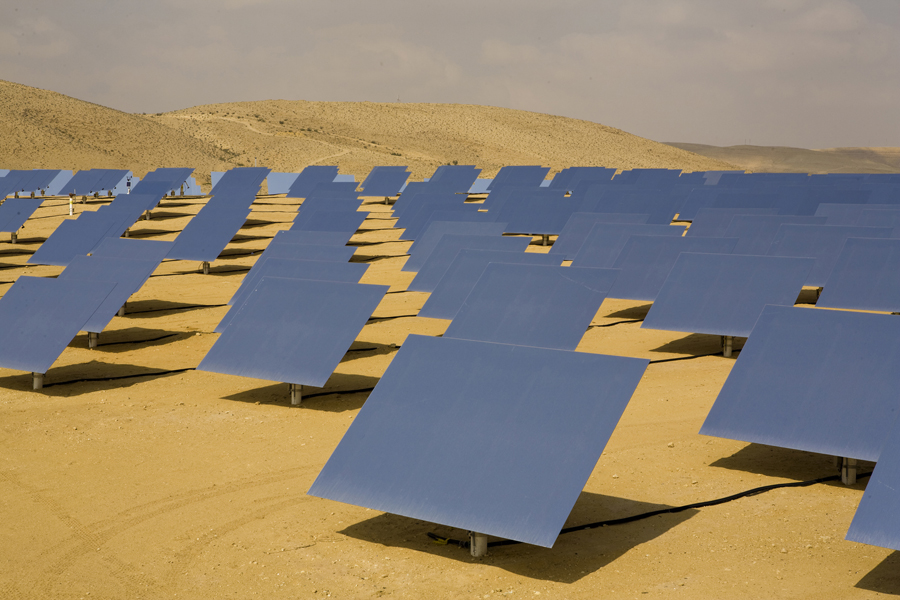
photo: BrightSource Energy

In last Thursday’s New York Times, I wrote about French industrial conglomerate Alstom’s $55 million investment in BrightSource Energy, a California-based solar power plant builder:

Alstom, the French energy giant, has taken a $55 million stake in BrightSource Energy, a solar power plant builder backed by Google, Morgan Stanley and other investors.

The investment is part of a $150 million round raised by BrightSource in one of the biggest renewable energy deals of the year. The California State Teachers Retirement System also joined the latest funding round as did the existing investors VantagePoint Venture Partners, Morgan Stanley and Draper Fisher Jurvetson.

Based in Oakland, Calif., BrightSource has now raised more than $300 million. Alstom becomes one of the startup’s largest shareholders and will take a seat on the board, according to John Woolard, BrightSource’s chief executive. The French company makes turbines and other power systems for fossil fuel, nuclear and hydro power plants and operates a division that builds high-speed trains.

BrightSource has signed contacts to build solar thermal power plants in California that would generate some 2,600 megawatts. In February, the company obtained a $1.37 billion loan guarantee from the federal government to help finance the construction of its first project, a 392-megawatt power plant to be built in the Southern California desert by Bechtel.

Mr. Woolard said Alstom would help the company as it sought to develop more efficient solar power plants.

You can read the rest of the story here.

Read Full Post »

photo: Todd Woody

Green Wombat has been in transition so I’m a bit behind on posting. In case you missed it, in the Sunday New York Times on May 9, I wrote a profile of David Gelbaum, one of the nation’s biggest — and until now — most reclusive green technology investors and environmental philanthropists:

AMID the $6 million homes perched on a beachfront cliff in this conservative Southern California enclave, the seven-year-old Honda Civic hybrid with the Obama bumper sticker is the giveaway.

It’s not the usual drive of choice for wealthy former hedge fund managers like David Gelbaum. Then again, there’s not much that is business as usual about Mr. Gelbaum, an intensely private person who happens to be one of the nation’s largest — and largely unknown — green technology investors and environmental philanthropists.

Mr. Gelbaum has invested $500 million in clean-tech companies since 2002 through his Quercus Trust, amassing a portfolio of some 40 businesses involved in nearly every aspect of the emerging green economy, be it renewable energy, the smart electric grid, sustainable agriculture, electric cars or biological remediation of oil spills. He has poured almost as much into environmental causes.

“I think his impact on green technology is huge,” says Bill Gross, the serial technology entrepreneur and founder of eSolar, a solar power start-up in which Mr. Gelbaum has invested. “He is supporting bolder and riskier bets, and he’s doing it from a different filter than a traditional venture capitalist, and I think that makes a wider opportunity for success.”

In this economic downturn, many venture capitalists have grown cautious about putting money into what Vinod Khosla, the prominent Silicon Valley green tech investor, calls “science experiments.” But Quercus Trust is still taking chances on blue-sky start-ups pursuing technological breakthroughs.

Working outside the clubby venture capital network, Mr. Gelbaum has, until recently, maintained an obsessively low profile. In Silicon Valley, he remains something of an unknown. Associates say his near-invisibility is owed to a genuine modesty and concerns over the security of his family because of his wealth. Recipients of his philanthropy, for instance, signed confidentiality agreements that forbade mention of his name.

Mr. Gelbaum says he decided to break his long silence upon becoming chief executive in February of Entech Solar, one of his portfolio companies that is publicly traded. “This is what’s best for the company,” he says, pointing out that Entech benefits if he maintains a more public profile.

It is too early to predict whether Mr. Gelbaum’s big green bets will pay off. But he’s been capitalizing on two trends: the rapid decline in the price of photovoltaic power, and a focus on cutting capital costs as solar power competition with China intensifies.

His environmental philanthropy also gives him an influence beyond laboratories and boardrooms. He has given $200 million to the Sierra Club and $250 million to the Wildlands Conservancy, a land trust he co-founded that has acquired and preserved 1,200 square miles of land in California, including more than a half million acres of the Mojave Desert.

You can read the rest of the story here.
Read Full Post »

photo: Todd Woody

In The New York Times on Wednesday, I write about California regulators’ preliminary decision to reject requests by two big utilities to install grid-connected fuel cells:

While Google, Wal-Mart and other corporations have embraced fuel cells, California regulators have turned down requests from the state’s two biggest utilities to install the technology.

In a preliminary decision, an administrative law judge with the California Public Utilities Commission found unwarranted an application from Pacific Gas and Electric and Southern California to spend more than $43 million to install fuel cells that would generate six megawatts of electricity.

The technology transforms hydrogen, natural gas or other fuels into electricity through an electrochemical process, emitting fewer or no pollutants, depending on the type of fuel used.

“It is unreasonable to spend three times the price paid to renewable generation for the proposed Fuel Cell Projects, which are nonrenewable and fueled by natural gas,” wrote the administrative law judge, Dorothy J. Duda, in a proposed ruling issued last week. “In addition, the applications do not satisfactorily address how full ratepayer funding of utility-owned fuel cell generation would enhance private market investment and market transformation of the fuel cell industry.”

You can read the rest of the story here.

Read Full Post »

In The New York Times on Monday, I write about IBM’s new smart grid lab in Beijing that will develop technology for the global market:

In another sign of China’s emergence as an epicenter of green technology, I.B.M. has opened a lab in Beijing to develop smart grid software for the global market.

“We’re developing solutions for around the world but we’re looking to China to see how the pieces integrate across the value chain,” said Brad Gammons, I.B.M.’s vice president for sales and distribution for the company’s Energy and Utilities division.

Mr. Gammons himself has relocated to Beijing, where he will continue to oversee worldwide sales for the unit.

“The company made a decision that China is a very, very important growth market and to put some executives here,” he said in a telephone interview from Beijing. He said I.B.M. expects the new Energy & Utilities Solutions Lab to drive $400 million in revenue over the next four years.

It is operating out of I.B.M.’s 5,000-person China Development Laboratory. The new lab is working with the State Grid Corporation of China on pilot projects to integrate wind and solar power with the grid, manage grid operations and increase the efficiency of nuclear power plants.

The Chinese government has budgeted $7.3 billion for smart grid-related energy projects this year, according to ZPryme Research & Consulting, a firm based in Austin, Tex.

Mr. Gammons said electric cars will be one focus of I.B.M.’s new lab.

You can read the rest of the story here.
Read Full Post »

photo: Todd Woody

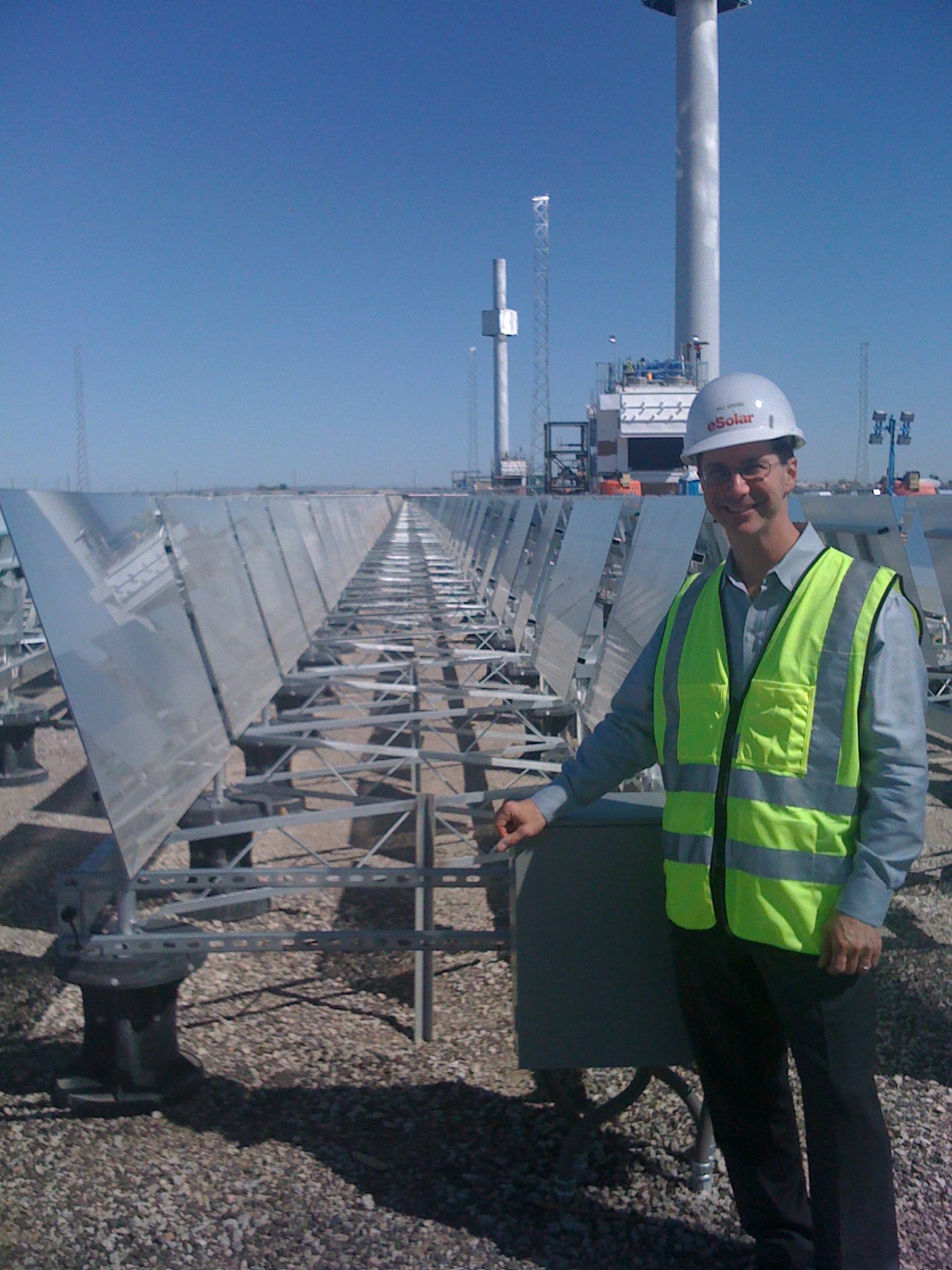
In an interview I did with green tech entrepreneur Bill Gross for Yale Environment 360, Gross talks about the future of solar energy, his relationship with Google, and how to avoid battles over building large solar farms in the deserts of the Southwest:

Bill Gross is not your typical solar energy entrepreneur. In a business dominated by Silicon Valley technologists and veterans of the fossil fuel industry, Gross is a Southern Californian who made his name in software. His Idealab startup incubator led to the creation of companies such as eToys, CitySearch, and GoTo.com. The latter pioneered search advertising — think Google — and was acquired by Yahoo for $1.6 billion in 2003.

That payday has allowed Gross to pursue his green dreams. (As a teenager, he started a company to sell plans for a parabolic solar dish he had designed.) Over the past decade, Gross has launched a slew of green tech startups, including solar power plant builder eSolar, electric car company Aptera, and Energy Innovations, which is developing advanced photovoltaic technology.

But it has been eSolar, backed by Google and other investors, that has been Idealab’s brightest light. In January, the company signed one of the world’s largest green-energy deals when it agreed to provide the technology to build solar farms in China that would generate 2,000 megawatts of electricity — at peak output the equivalent of two large nuclear power plants. And last week, eSolar licensed its technology to German industrial giant Ferrostaal to build solar power plants in Europe, the Middle East, and South Africa. Those deals followed eSolar partnerships in India and the U.S.

ESolar’s power plants deploy thousands of mirrors called heliostats to focus the sun’s rays on a water-filled boiler that sits atop a slender tower. The heat creates steam that drives an electricity-generating turbine. Last year, eSolar built its first project, a five-megawatt demonstration power plant, called Sierra, in the desert near Los Angeles.

This “power tower” technology is not new, but what sets the company apart is Gross’ use of sophisticated software and imaging technology to control the 176,000 mirrors that form a standard, 46-megawatt eSolar power plant. That computing firepower precisely positions the mirrors to create a virtual parabola that focuses the sun on the tower. That allows the company to place small, inexpensive mirrors close together, which dramatically reduces the land needed for the power plant and cuts manufacturing and installation costs.

“We use Moore’s law rather than more steel,” Gross likes to quip, referring to Intel co-founder Gordon Moore’s maxim that computing power doubles every two years.

You can read the interview here.

Read Full Post »

photo: Todd Woody

In my latest Green State column in Grist, I take a look at why, despite the hype, Bloom Energy’s fuel cell breakthrough could change the energy game:

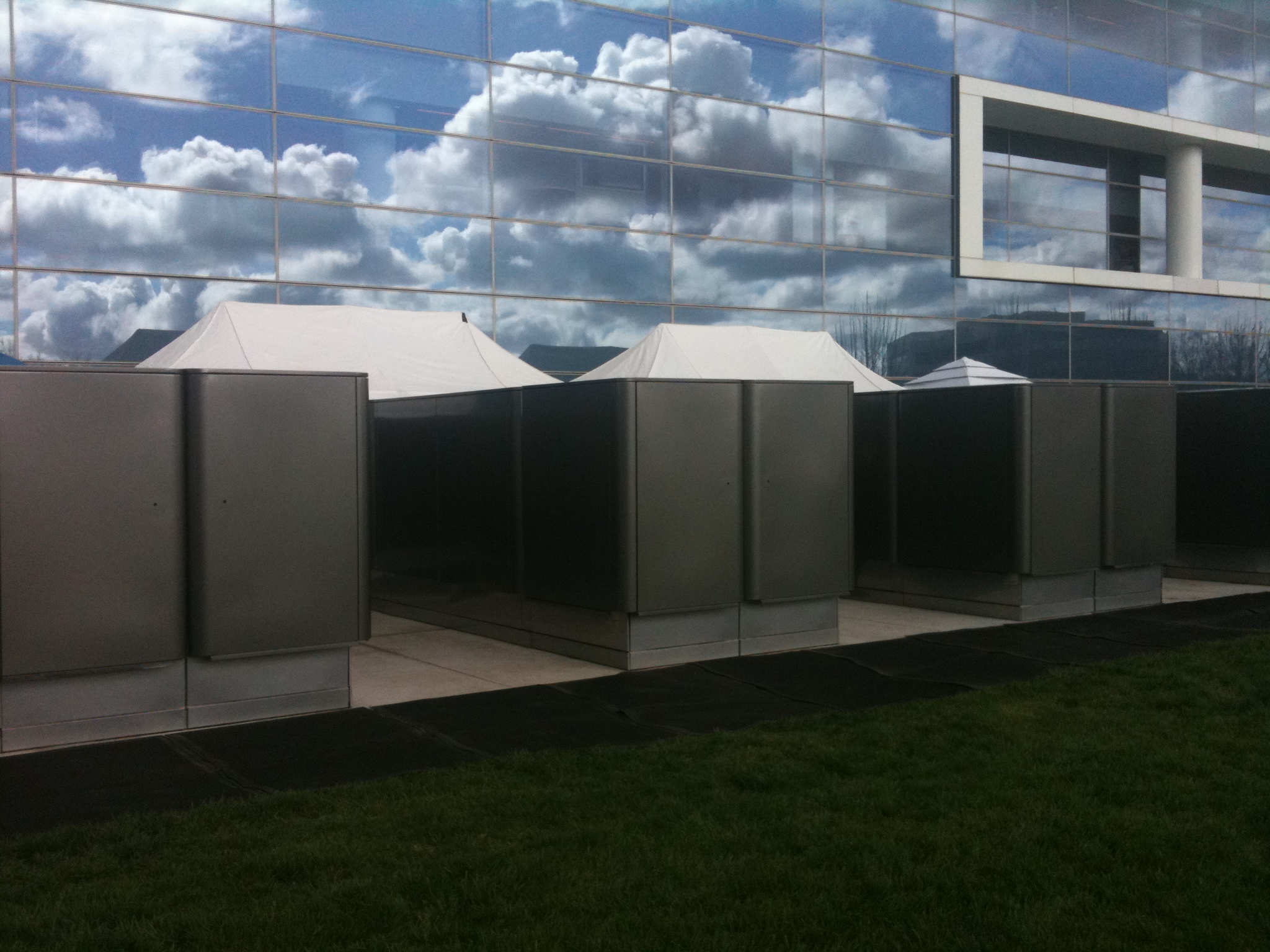
Green tech had its Google moment this week in Silicon Valley when one of the most secretive and well-funded startups around, Bloom Energy, literally lifted the curtain on what it claims is a breakthrough in fuel cell technology: affordable electricity! Fewer greenhouse gas emissions! And that’s all before they throw in the bamboo steamer.

After eight years in stealth mode—until this week, Bloom’s website featured the company’s name and little else—the startup pulled out the stops in a carefully stage-managed media blitz that recalled the high-flying dot-com days of a decade ago. First came a report on “60 Minutes” that got the blogs abuzz along with stories in Fortune and The New York Times.

It all culminated in a star-studded press conference at eBay’s headquarters in San Jose on Wednesday, where California Governor Arnold Schwarzenegger introduced Bloom’s co-founder and chief executive, K.R. Sridhar, and gave him a bear hug before several hundred suits, environmental movement honchos and a bank of television cameras.

Before Colin Powell, the former secretary of state and a Bloom board member, delivered the benediction, testimonials were offered by Google co-founder Larry Page and top executives from Wal-Mart, eBay, Federal Express, Coca-Cola, and other Fortune 500 companies that had quietly purchased 100-kilowatt Bloom Energy Servers over the past year.

New York Mayor Michael Bloomberg and Senator Dianne Feinstein (D-Calif.), meanwhile, beamed in a bipartisan endorsement via video.

“This technology is going to fundamentally change the world,” the California Democrat declared.

But is it?

That’s the $400 million question (what some of Silicon Valley’s most storied venture capitalists have poured into Bloom so far).

With the hype—the apparently brilliant but unassuming Sridhar was compared to Steve Jobs at one point Wednesday—comes the backlash. Almost immediately analysts and competitors began asking hard questions about Bloom’s claims.

And there are some big unknowns. Will the fuel cell stacks last as long as the company anticipates or will frequent replacement undermine the economics of going off the grid, for both Bloom and their customers?

What’s the total cost of ownership for customers? Bloom says the energy servers have a lifespan of 10 years and a payback period of three to five years. That’s based on the current price of natural gas—which is one fuel used by the devices—and state and federal subsidies that halve the cost of the machines that sell for between $700,000 and $800,000. Will Bloom be able to scale up manufacturing and continue to innovate to bring the price of the energy server down? Can they be competitive without subsidies?

All legitimate questions. But it’s important not to lose sight of what looks to be some fundamental breakthroughs, not only in energy technology but in the way some major corporate players are embracing distributed generation-placing electricity production where it is consumed.

You can read the rest of the column here.

Read Full Post »

photo: TXU Energy

In The New York Times on Thursday, I wrote about Texas utility TXU Energy hooking up with Silicon Valley’s SolarCity to offer its Dallas area customers the option of going solar:

TXU Energy, a Texas utility with two million customers, is making it possible for homeowners in the Dallas area to lease or buy rooftop solar-power systems in one of the first programs of its kind.

The energy provider said Wednesday that it had signed a deal with SolarCity, a Silicon Valley start-up that finances and installs residential rooftop arrays, to manage the initiative.

“Our vision is to supply solar power to millions of homes and businesses,” said Lyndon Rive, SolarCity’s chief executive. “The only way to achieve this is by partnering with companies that are providing power today. If we can partner with energy providers, adoption will happen much faster.”

Homeowners will sign up for the TXU Energy Solar Program through the utility, and SolarCity will design and install the solar-panel systems. Under the lease program, the owner of a three- to four-bedroom house would typically pay about $35 a month after tax incentives, according to TXU Energy.

SolarCity retains ownership of the photovoltaic arrays and responsibility for their maintenance. The solar-power system could be bought outright for about $26,000, TXU Energy said.

SolarCity will pay a referral fee to TXU Energy for each system leased or sold.

You can read the rest of the story here.

Read Full Post »

In my latest Green State column on Grist, I explore new strategies to pay for commercial energy efficiency retrofits:

On the heels of San Francisco’s announcement last week that it plans to spend $150 million greening up homes, comes a new report that studies a slew of other innovative ways to finance energy efficiency improvements for all types of buildings.

It’s no big surprise that the key to ramping up the energy efficiency industry and fostering technological advances is no-money-down financing so building owners can avoid the capital costs of retrofits.  And that’s exactly what the California Clean Energy Fund (CalCEF) is working toward.

Energy efficiency “immediately saves money for end-users, improves the bottom line for companies, reduces local exposure to electricity grid outages and offsets the need for new power plants,” wrote the authors of the report from the CalCEF, a non-profit venture capital outfit based in San Francisco. “Yet, efficiency upgrades and their respective financing options are often out of reach for most end-users, as the initial capital cost exceeds near-term savings.”

Yes, you read that right—CalCEF is a non-profit VC, a product of the California energy crisis of 2000-2001—remember Enron?—that resulted in the bankruptcy of Pacific Gas and Electric, Northern California’s dominant utility. As part of the bankruptcy settlement, CalCEF was created to accelerate energy innovation and was seeded with $30 million from PG&E.

The best known such program is Property Assessed Clean Energy, or PACE, in which cities float bonds to finance retrofits and homeowners pay back the cost through a surcharge on their property tax bills over 20 years.

While that can work well for middle and upper-middle class homeowners in environmentally conscious communities, PACE is not as useful for commercial buildings, office towers, and industrial sites, whose owners may be solely motivated by the bottom line, according to the CalCEF report.

“High upfront costs are preventing large entities from addressing energy inefficiencies,” says Paul Frankel, the managing director of CalCEF Innovations, the organization’s initiative that focuses on developing green energy financing and policy.

That led CalCEF to investigate possible solutions to the dollar dilemma, some of which are currently being implemented.

One workaround is something called on-bill financing. For instance, San Diego Gas & Electric will finance up to $100,000 in energy efficiency retrofits for commercial customers (and up to $250,000 for school and government buildings). Recipients then pay back the loans through a surcharge on their monthly utility bill.

Best of all, the loans carry zero percent interest, though business customers have to repay them in five years. In the first two years of the program, San Diego Gas & Electric financed 180 retrofits and has another 100 in the queue. Over the next two years, the utility will make $41.5 million available for on-bill retrofits.

You can read the rest of the column here.

Read Full Post »

photo: Ausra

The week kicked off with French nuclear energy giant Areva’s acquisition of Silicon Valley solar company Ausra. As I wrote Monday in the Los Angeles Times:

French nuclear energy giant Areva has jumped into the U.S. renewable energy market with the acquisition of Ausra, a Silicon Valley solar power plant startup backed by high-profile venture capitalists.
Terms of the deal were not disclosed, but in an interview on Monday, Areva executive Anil Srivastava said that the price the company paid for Ausra was in line with the $418 million that rival Siemens spent last year to acquire Solel, an Israel solar power plant builder.

That would be a decent payday for Ausra’s investors, which include marquee Silicon Valley venture capital firms Kleiner Perkins Caufield & Byers and Khosla Ventures.

“The current shareholders are very well-reputed venture capitalists and I can assure you they negotiated very well,” said Srivastava, the chief executive of Areva’s renewable energy division.

You read the rest of the story here.

And the week is ending with Thursday’s announcement of another Silicon Valley-European deal. This time, as I write in The New York Times, California’s SunPower is acquiring a European solar developer:

SunPower, a leading Silicon Valley solar company, said on Thursday that it has agreed to acquire SunRay Renewable Energy, a European photovoltaic power plant builder, in a $277 million deal.

The acquisition follows Monday’s purchase of Ausra, another Silicon Valley solar technology company, by Areva, the French nuclear energy giant in a deal that an Areva executive valued at around $400 million.

SunPower has previously supplied solar panels to SunRay, which has a pipeline of projects in Europe and Israel that totals 1,200 megawatts. SunRay, which is headquartered in Malta, is owned by its management and Denham Capital.

You can read the rest of that story here.

Read Full Post »

Photo: Golub Corporation

In The New York Times on Wednesday, I write about a New York grocery store chain that has installed a low-emission fuel cell to power one of its supermarkets:

A supermarket in Albany is among the first grocery stores in the country to install a fuel cell to supply cleaner, greener electricity along with heat and hot water.

Fuel cells reform natural gas to produce hydrogen that’s combined with oxygen to generate electricity, heat and water. The process produces a fraction of the carbon dioxide and other pollutants emitted by power plants.

The Price Chopper store in Albany, owned by the Golub Corporation, is using a 400-kilowatt PureCell fuel cell made by U.T.C. Power, a division of United Technologies.

The fuel cell provides most of the electricity for the 69,000-square-foot supermarket, and in the event of a blackout it can operate off the grid to keep the lights on.

Benny Smith, vice president of facilities for Golub, said the company began investigating fuel cells in 2007 when electricity prices spiked in the Northeast, where it operates 120 Price Chopper stores.

“You have to plan your own destiny,” said Mr. Smith. “After meeting with the U.T.C. folks, we decided to go with a fuel cell since a combined heat and power system is more efficient and had a positive cash flow.”

A major consideration, according to Mr. Smith, was the availability of financial incentives from the New York State Energy Research Development Authority. He said the agency gave U.T.C. an $800,000 grant, which the company factored into a lease agreement with Golub.

The fuel cell, which feeds electricity into the power grid, began operating last month. During the winter, it supplies about 90 percent of the store’s electricity and heats the facility. “We’re producing at a much more effective cost due to the combined heat and power,” said Mr. Smith.

You can read the rest of the story here.

Read Full Post »

« Newer Posts - Older Posts »

Design a site like this with WordPress.com
Get started