Feeds:
Posts
Comments

Archive for the ‘energy’ Category

In another sign that the financial crisis is not slowing the solar industry, Suntech, the giant Chinese solar module maker, made a big move into the United States market on Thursday. The company announced a joint venure with green energy financier MMA Renewable Ventures to build solar power plants and said it would acquire California-based solar installer EI Solutions.

Founded in 2001, Suntech (STP) recently overtook its Japanese and German rivals to become the world’s largest solar cell producer. The company has focused on the lucrative European market and only opened a U.S. outpost, in San Francisco, last year.  The joint venture with MMA Renewable Ventures (MMA) – called Gemini Solar – will build photovoltaic power plants bigger than 10 megawatts.

Most solar panels are produced for commercial and residential rooftops, but in recent months utilities have been signing deals for massive megawatt photovoltaic power plants. Silicon Valley’s SunPower (SPWRA) is building a 250-megawatt PV power station for PG&E (PCG) while Bay Area startup OptiSolar inked a contract with the San Francisco-based utility for a 550-megawatt thin-film solar power plant. First Solar (FSLR), a Tempe, Ariz.-based thin-film company, has contracts with Southern California Edision (EIX) and Sempre to build smaller-scale solar power plants.

Suntech’s purchase of EI Solutions gives it entree into the growing market for commercial rooftop solar systems. EI has installed large solar arrays for Google, Disney, Sony and other corporations.

“Suntech views the long-term prospects for the U.S. solar market as excellent and growing,” said Suntech CEO  Zhengrong Shi in a statement.

Other overseas investors seem to share that sentiment, credit crunch or not.  On Wednesday, Canadian, Australian and British investors lead a $60.6 million round of funding for Silicon Valley solar power plant builder Ausra. “So far the equity market for renewable energy has not been affected by the financial crisis,” Ausra CEO Bob Fishman told Green Wombat.

The solar industry got more good news Wednesday night when the U.S. Senate passed a bailout bill that included extensions of crucial renewable energy investment and production tax credits that were set to expire at the end of the year.

Read Full Post »

After a year of stalemate that threatened to strangle the nascent United States solar industry, the U.S. Senate on Tuesday passed energy legislation that extends a key investment tax credit until 2016.

The 30% solar tax credit was part of a package of green energy incentives that includes a one-year extension of the production tax credit crucial to the wind industry and a $2,500-$7,500 tax credit for people who buy plug-in electric vehicles. (That should make General Motors (GM) happy as it prepares to roll out its ever-increasingly expensive Volt plug-in electric hybrid.)

Homeowners also won an extension of a tax credit for installing solar panels and the $2,000 cap on such systems was lifted. Put in a small wind turbine or a geothermal heat pump and you can claim up to a $4,000 and $2,000 tax credit, respectively.

The big winner was the solar industry. Congress’ failure to extend the investment tax credit threatened to scuttle scores of multibillion-dollar solar power plants in the pipeline and undermine mandates that utilities like PG&E (PCG) and Southern California Edison (EIX) obtain a growing percentage of their electricity from renewable sources.

The legislation now returns to the House of Representatives, which earlier passed a similar version of the Senate bill.

Read Full Post »

Green Wombat’s story on the Royal Turbine is in the latest issue of Fortune and available online here and below.

Her majesty’s big, honkin’ windmill

The Queen of England is buying the world’s largest wind turbine, which towers over Big Ben and will light up thousands of British homes.

By Todd Woody, senior editor

(Fortune Magazine) — It’s been a century or so since Britain ruled the waves, but Queen Elizabeth II will soon reign over the wind. Earlier this year the Crown Estate, which manages royal property worth $14 billion and controls the seas up to 14 miles off the British coast, agreed to purchase – for an undisclosed sum – the world’s largest wind turbine.

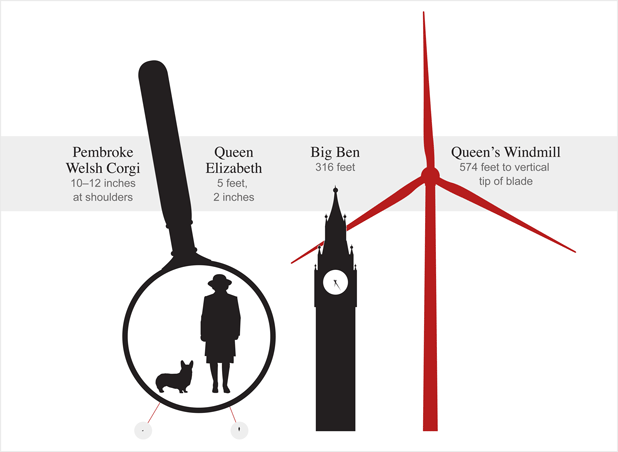
It’s a 7.5-megawatt monster to be built by Clipper Windpower of Carpinteria, Calif. Now the Royal Turbine is getting even bigger: Clipper has revealed to Fortune that Her Majesty’s windmill has been supersized to ten megawatts, producing five times the power generated by typical big turbines currently in commercial operation. The giant’s wingspan stretches the length of two soccer fields. At 574 feet, the turbine soars over Big Ben and roughly equals 111 Queen Elizabeths (the actual queen) plus one corgi stacked on top of one another.

The Queen’s turbine will displace two million barrels of oil as well as 724,000 tons of CO2 over its lifetime. This prototype will be the flagship for Clipper’s Britannia Project, an effort to create a new generation of massive-megawatt turbines to be placed on deep-sea floating platforms. When the windmill goes online in 2012 somewhere off the British coast, it could power 3,700 average homes.

Rule, Britannia, indeed.

Read Full Post »

photo: Todd Woody

Green Wombat’s story in the new issue of Fortune magazine on the solar power plant-fueled boom in demand for wildlife biologists is now online here. The photo above of the blunt-nosed leopard lizard was taken at a state reserve in San Luis Obispo County.

Or you can read the story below.

The hottest tech job in America

Giant solar plants are being built where dozens of protected species live. That’s good news for wildlife biologists.

By Todd Woody, senior editor

(Fortune Magazine) — It looks like a scene from an old episode of The X-Files: As a red-tailed hawk circles overhead and a wild pronghorn sheep grazes in the distance, a dozen people in dark sunglasses move methodically through a vast field of golden barley, eyes fixed to the ground, GPS devices in hand. They’re searching for bodies.

In this case, however, the bodies belong to the endangered blunt-nosed leopard lizard, and the crew moving through the knee-high grain are wildlife biologists hired by Ausra, a Silicon Valley startup that’s building a solar power plant for utility PG&E on this square mile of central California ranchland.

With scores of solar power stations planned for sites in the Southwest, demand for wildlife biologists is hot. They’re needed to look for lizards and other threatened fauna and flora, to draw up habitat-protection plans, and to comply with endangered-species laws to ensure that a desert tortoise or a kit fox won’t be inadvertently squashed by a solar array.

That has engineering giants like URS (URS, Fortune 500) in San Francisco and CH2MHill of Englewood, Colo., scrambling to hire biologists to serve their burgeoning roster of solar clients. “It’s a good time to be a biologist – it’s never been busier in my 15 years in the business,” says Angela Leiba, a senior project manager for URS, which is staffing the $550 million Ausra project. URS has brought onboard 40 biologists since 2007 to keep up with the solar boom. Salaries in the industry, which typically start around $30,000 and run up to about $120,000, have spiked 15% to 20% over the past year.

The work is labor-intensive. “It can take a 30- to 50-person team several weeks to complete just one wildlife survey,” says CH2MHill VP David Stein.

The economics of Big Solar ensure that wildlife biology will be a growth field for years to come. For one thing, there’s the mind-boggling scale of solar power plants. Adjacent to the Ausra project in San Luis Obispo County, for instance, OptiSolar of Hayward, Calif., is building a solar farm for PG&E that will cover 9 1/2 square miles with solar panels. Nearby, SunPower of San Jose will do the same on 3.4 square miles. Every acre must be scoured for signs of “species of special concern” during each phase of each project.

That adds up to a lot of bodies on the ground. URS, for instance, has dispatched 75 biologists to Southern California where Stirling Energy Systems of Phoenix is planting 12,000 solar dishes in the desert. “The biologists are critical to move these projects forward,” notes Stirling COO Bruce Osborn. For one project Stirling had to pay for two years’ worth of wildlife surveys before satisfying regulators.

Just about every solar site is classified as potential habitat for a host of protected species whose homes could be destroyed by a gargantuan power station. (Developers of California solar power plants, for example, have been ordered to capture and move desert tortoises out of harm’s way.) The only way to determine if a site is crawling with critters is to conduct surveys.

While that means a lot of jobs for wildlife biologists, it’s not all red-tailed hawks and pronghorn sheep for these nature boys and girls. The work can get a bit Groundhog Dayish, say, after spending 1,400 hours plodding through the same barley field in 90-degree heat in search of the same blunt-nosed leopard lizard. No wonder then when URS crew boss Theresa Miller asks for volunteers to reconnoiter a decrepit farmhouse for some protected bats on the Ausra site, hands shoot up like schoolchildren offered the chance to take the attendance to the principal’s office.

PG&E (PCG, Fortune 500) renewable-energy executive Hal La Flash worries that universities aren’t cranking out enough workers of all stripes for the green economy. “It could really slow down some of these big solar projects,” he says. Osborn can vouch for that: Biological work on the Stirling project has ground to a halt at times while the company waits for its consultants to finish up surveys on competitors’ sites.

For the young graduate, veteran biologist Thomas Egan wants to say just three words to you: Mohave ground squirrel. The rare desert dweller is so elusive that the only way to detect it on a solar site is to set traps and bag it. “There’s a limited number of people authorized to do trapping for Mohave ground squirrels,” says Egan, a senior ecologist with AMEC Earth & Environmental. “If you can work with the Mohave ground squirrel, demand is intense.”

Read Full Post »
SAN FRANCISCO – Google and General Electric said Wednesday that they will collaborate on developing geothermal power as well as technology to enable plug-in vehicles to return electricity to the grid.

During Google’s (GOOG) annual Zeitgeist conference at its Silicon Valley headquarters, Google CEO Eric Schmidt and GE (GE) chief Jeff Immelt said the two giants also would team up to push for policy changes in Washington to develop smart electricity grids to allow the widespread deployment of renewable energy.

“There’s two fundamental things that have to be done, and which we’re working with Google on,” said Immelt before an audience that included former Vice President Al Gore. “One, there has to be more capacity. The second thing is there has to be a smart grid to allow it to operate more effectively. That’s primarily software. We make the hardware.”

Schmidt quizzed Immelt about the impact of the Wall Street meltdown on green energy. “Will the craziness of last week screw some of this stuff up?” asked Schmidt. “Are we going to get set back for years because of all the shenanigans in the financial industry?”

“People should be concerned but not panicked,” replied Immelt. “The federal government is doing the right thing.”

Gore was not so sanguine, noting that Congress has failed repeatedly to extend crucial investment tax credits for renewable energy. “While Congress is voting on oil drilling and leasing oil shale – which is a move that would be game over for the climate crisis – they’re preparing to filibuster over renewable energy tax credits,” he said.

Google and GE are among scores of Fortune 500 companies that have lobbied Congress to extend the investment tax credit and the production tax credit, which is particularly important to the wind industry. ”

“I’m a lifelong Republican and I believe in free markets but over time we worship false idols,” says Immelt. “Sometimes we think the free market is whatever the price of oil is today. In the end, clean energy is both a technology and a public policy.”

He noted that because the production tax credit allowed the wind industry to scale up, wind-generated electricity now costs about six-to-seven cents a kilowatt hour, down from 15 cents 15 years ago.

“We bought Enron’s wind business for a few million dollars and now it’s worth $7 to 8 billion,” Immelt said. “I’ve made some bad decisions but that wasn’t one of them.”

Google in August invested nearly $11 million in geothermal companies developing so-called enhanced geothermal systems technology to allow the earth’s heat to be tapped nearly anywhere and turned into electricity. On Wednesday, Google and GE said they will work on technology to transform geothermal into a large-scale source of green electricity.

In a statement, the two companies said they will also “explore enabling technologies including software, controls and services that help utilities enhance grid stability and integrate plug-in vehicles and renewable energy into the grid.”

Image: Google

Read Full Post »

BERKELEY, Calif. – The Berkeley City Council Tuesday night gave final approval for the nation’s first municipal program to finance solar arrays for homes and businesses.

The city’s Sustainable Energy Financing District could accelerate the adoption of rooftop solar by overcoming one of the biggest obstacles to homegrown green energy: the $20,000 to $30,000 upfront costs and long payback time for a typical solar system.

Here’s how the program will work: Berkeley will seek bond financing up to $80 million for the solar program – enough to install solar arrays on 4,000 homes and pay for some energy efficiency improvements. For those who sign up, Berkeley will pay for the solar arrays and add a surcharge to the homeowners’ tax bill for 20 years. When the house is sold, the surcharge rolls over to the new owner.

According to city staff, a typical solar array will cost $28,077 – you won’t find many McMansions in this city by the bay) – and after state rebates, $22,569 will need to be financed at an estimated interest rate of 6.75%. Berkeley is counting on obtaining a favorable interest rate given that the debt will be secured by property tax revenue. (And to answer the inevitable question, the foreclosure rate in Berkeley is low and property values have been relatively stable. How the meltdown on Wall Street will affect the program is another matter.)

For a typical solar system, the homeowner will be assessed an extra $182 a month on her property tax bill. To put that in perspective, the property tax bill on a $800,000 house – your basic middle-class home here if it was bought within the past three years – runs about $900 a month.

Electric bills are relatively low in Berkeley due to the temperate climate – Green Wombat’s was $15 in August. The real benefit of the program may come if it is used for solar hot water systems and expanded to pay for energy efficiency measures, such as installing new windows and insulation in Berkeley’s housing stock, most of which dates from the early 20th century.

The remaining hurdle is for the city to secure financing at a favorable rate. Once that is obatined, the program. which has won the support of local utility giant PG&E (PCG), should also be boon for solar panel makers and installers like SunPower (SPWR), SunTech (STP), Akeena (AKNS) and Sungevity.

The solar program is designed to help Berkeley meet a voter-approved mandate to cut its greenhouse gas emissions 80 percent by 2050.

Read Full Post »

The looming expiration of a crucial renewable energy investment tax credit doesn’t seem to have spooked investors. Silicon Valley thin-film solar startup Nanosolar said Wednesday that it has secured another $300 million in funding and is jumping into the Big Solar game as well.

Writing on the Nanosolar blog,  CEO Martin Roscheisen said that the latest financing round – the company’s funding now totals half a billion dollars –  comes from oldline utility AES (AES), French utility giant EDF and the Carlyle Group, among other investors. Nanosolar, which prints solar cells on flexible materials, will supply solar panels to the newly formed AES Solar, which will build medium-scale – up to 50 megawatts – photovoltaic power plants.

The Nanosolar news is just the latest of a spate of deals to take solar panels off rooftops and plant them on the ground to generate massive megawattage. Two weeks ago, thin-film solar startup Optisolar won a contract from utility PG&E (PCG) for a 550-megawatt PV solar power plant while SunPower (SPWR) will build a 250-megawatt photovoltaic solar farm for the utility. Leading  thin-film company First Solar (FSLR), meanwhile, has inked deals over the past few months to build smaller-scale PV power plants for Southern California Edison (EIX) and Sempre (SRE). And thin-film solar company Energy Conversion Devices is assembling a 12-megawatt array for a General Motors plant in Spain.

Read Full Post »

In another sign of a nuclear revival, Louisiana Governor Bobby Jindal on Tuesday announced a deal with The Shaw Group and Westinghouse for the nation’s first factory to build nuclear power plant components.

Louisiana tossed in tax breaks and other incentives worth $248 million over the next decade to lure the project to the Port of Lake Charles. The assembly plant will be a joint venture between engineering and construction firm Shaw (SGR) and Westinghouse, the nuclear plant builder now owned by Toshiba. The two companies are constructing four nuclear power stations in China and say they’re looking at 14 power plants in the United States.  There hasn’t been a new nuke plant licensed in the U.S. in more than three decades.

“The agreement to fabricate modules for the AP1000 nuclear power plant in Louisiana again proves that the nuclear renaissance is now a reality,” said Westinghouse executive Dan Lipman in statement.

Of the many hurdles to reviving the U.S. nuclear industry – the unresolved waste disposal issue, huge capital costs, environmental opposition –  the withering away of the infrastructure to produce power plant components has been one that has received relatively little attention.

Read Full Post »

photos: Energy Conversion Devices

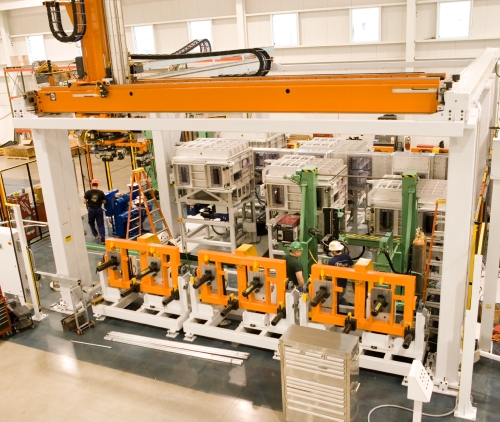
As Detroit automakers shutter SUV and truck factories, the decades-long de-industrialization of the Midwest continues apace. But amid the idled assembly lines, a new wave of manufacturing has taken root as solar energy companies set up shop in the heartland.

Just in the past week, First Solar (FSLR) announced an expansion of its Ohio plant that makes thin-film solar panels. German company Flabeg will break ground on a factory outside Pittsburgh that will manufacture parabolic solar mirrors for large-scale solar power plants planned for the Southwest. Thin-film solar company Energy Conversion Devices (ENER), meanwhile, operates three factories in Michigan and is currently doubling the production capacity of one of its plants.

In fact, nearly all the United States’ current solar manufacturing capacity is in the Midwest, save for Silicon Valley company Ausra’s factory in Las Vegas. (Thin-film startup Nanosolar is building a factory in San Jose, Calif.)

“Our processes really require high productivity, so what makes it competitive here in the Midwest is that we have a great labor force that is eager to work and well-trained already,” ECD chief executive Mark Morelli told Green Wombat on Monday.

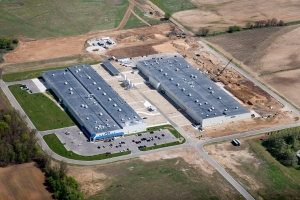
For instance, when appliance maker Electrolux shut down its Greenville, Mich., factory it left 2,700 workers unemployed in the same town where ECD is expanding its thin-film factory (see photos). The company also has recruited top executives from the ever-shrinking auto industry.

“We do a test of the available labor pool and hire the cream of the crop,” Morelli says.

Just as important are a plethora of state tax breaks and grants to retrain industrial workers for the green tech economy.

Although 70 percent of ECD’s flexible solar laminate panels are sold to European customers, Morelli anticipates the U.S. market will take off, with domestic manufacturers garnering a competitive advantage.

That all depends on whether Congress extends a crucial investment tax credit that expires this year and the policies of the next administration in Washington. Even so, demand for solar cells is expected to spike, especially given the recent unveiling of Big Solar projects by California utilities. Southern California Edison (EIX), for instance, is installing 250-megawatts’ worth of solar panels on commercial rooftops while PG&E (PCG) this month announced contracts to buy 800 megawatts of electricity from two photovoltaic power plants, including 500-megawatt thin-film solar farm being built by OptiSolar.

“As utilities begin to embrace distributed power generation, these type of things play into our natural advantage,” says Morelli, referring to his company’s lightweight solar panels that are especially suited for large rooftop arrays.

Of course, a handful of solar factories are not going to revive the Midwest’s industrial fortunes. (First Solar, for instance, operates factories in Germany and Malaysia, and Morelli doesn’t rule out locating manufacturing overseas.) But imagine a national policy that promotes the wide adoption of solar and the expansion of manufacturing in the rustbelt states becomes increasingly attractive. Shipping solar panels and mirror arrays from halfway around the world starts to make much less environmental and financial sense.

ECD’s proximity to the auto industry has already paid off. After installing solar arrays on two of General Motors (GM)’s California facilities, it won a contract in July to build a 12-megawatt rooftop array – the world’s largest by orders of magnitude – at a GM assembly plant in Spain.

Read Full Post »

Google on Tuesday took the drilling debate in a different direction – announcing that Google.org is investing nearly $11 million in technology to expand the nation’s geothermal reserves. That’s more than the U.S. government is spending on geothermal projects this year.

Traditional geothermal power plants, like those built by Calpine (CPN) in Northern California, sit atop reserves of naturally occurring steam or hot water that can be tapped to drive electricity-generating turbines. So-called Enhanced Geothermal Systems, or EGS,  hope to tap geothermal energy in any location by drilling deep underground to fracture “hot rocks” and then pump them with water to create steam that can be used in a power plant. The great potential, of course, would be to liberate the Midwest and South from their dependence on coal-fired power plants.

“While the U.S. debates drilling in the ocean for oil, we are focused on drilling for renewable energy – and lots of it – right beneath our feet,” Google.org said in a statement, citing a Massachusetts Institute of Technology study that estimates the accessible heat below the U.S. represents more than 2,500 times the nation’s annual energy consumption. (A Google.org video on geothermal is above.)

Google.org (GOOG), the search giant’s philanthropic arm,  will invest $6.25 million into AltaRock Energy, a Sausalito, startup, developing EGS technology. The investment is part of $26.25 million round of funding AltaRock revealed on Tuesday. Other investors include marquee green-tech venture capitalists Khosla Ventures and Kleiner Perkins Caufield & Byers.

Potter Drilling, a Redwood City, Calif., company developing hard-rock drilling technology to be used for geothermal, scored $4 million from Google.org. Other investors include MIT.

Google.org is granting the Southern Methodist University Geothermal Laboratory $489,521 to map North America’s geothermal reserves.

The geothermal funding is the latest investment in renewable energy by Google. It has invested in solar power plant companies BrightSource Energy and eSolar as well as in high-altitude wind company Makani and various ventures related to plug-in hybrid electric cars.

Read Full Post »

« Newer Posts - Older Posts »

Design a site like this with WordPress.com
Get started