Feeds:
Posts
Comments

Archive for the ‘energy’ Category

clintonbill1Another reason Green Wombat will be spending Earth Day in Southern California this year: Former President Bill Clinton will deliver the keynote speech at Fortune Magazine’s Brainstorm Green conference on April 22.

Clinton will be joining a gathering of business and environmental leaders, including Ford (F) executive chairman Bill Ford, PG&E (PCG) chief executive Peter Darbee, SunPower (SPWRA) CEO Tom Werner and executives from Fortune 500 companies like IBM (IBM),  Wal-Mart (WMT) and General Electric (GE). On the green side of the aisle, execs from the Natural Resources Defense Council, Environmental Defense Fund and Greenpeace will be attending the confab in Laguna Niguel.  Former California State Treasurer Phil Angelides, now chairman of the Apollo Alliance, and green jobs guru Van Jones will also be present.

We now end the shameless self-promotion and return to our regular Green Wombat programming.

Read Full Post »

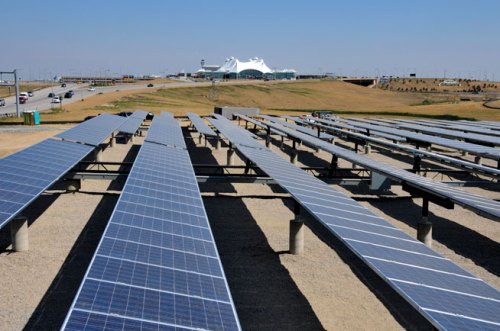
denverairport-110

photo: WorldWater & Solar Technologies

The consolidation of the solar industry got underway Monday with the acquisition of San Francisco-based green energy financier MMA Renewable Ventures by Spanish solar developer Fotowatio.

The Madrid-based company will purchase most of MMA Renewable’s solar assets – including the world largest photovoltaic power plant and its pipeline of projects – making it one of the biggest solar developers in the United States.

The financial terms of the deal were not disclosed.

MMA Renewable CEO Matt Cheney told Green Wombat that he’ll continue as CEO of what will be called, for now, Renewable Ventures and that his staff will be joining him. MMA Renewable Ventures was a subsidiary of Municipal Mortgage & Equity, which has been hit hard by the financial crisis.

Fotowatio, on the other hand, scored $350 million in funding last July from General Electric (GE) and Grupo Corporativo Landon. “You’re taking a very robust player in the European market see how much opportunity and potential there is in the U.S. market,” says Cheney. “It’ll produce one of the biggest, if not the biggest, independent solar power producers. It’s the story of consolidation.”

MMA Renewable Ventures raises funds to invest in big commercial solar arrays and photovoltaic power plant projects. The company finances the construction of solar systems by companies like SunPower (SPWRA) and retains ownership of the arrays, selling the electricity under long-term power purchase agreements.

Last year MMA Renewable and Chinese solar giant Suntech (STP) created a joint venture called Gemini Solar to build large-scale photovoltaic power plants.  Cheney said Gemini will continue under Fotowatio.

When the deal closes, Fotowatio will gain 35 megawatts of solar projects in the U.S. with another 400 megawatts under development.

Cheney says the Fotowatio acquisition is a sign of the times as the global economic crisis and falling prices for solar cells disrupts the renewable energy market. “There’s a shakeout in the marketplace and there’s opportunities for consolidation.”

Read Full Post »

three_in_row_hi_medium

San Francisco on Friday made a bid to rule the waves, filing an application to build a 30-megawatt wave energy farm off its coast in a move to sink a Seattle company’s claim on a nearby patch of ocean.

The company, Grays Harbor Ocean Energy, has filed applications with the Federal Energy Regulatory Commission, or FERC, for wave projects to be built from New Jersey to Hawaii. Wave energy technology remains in its infancy but there’s been something of a land – or sea – rush to secure rights to the most promising ocean sites to produce clean green electricity.

Last October, Grays Harbor filed for a preliminary permit to test technology for a 100-megawatt wave park to be floated 20 to 25 miles off the San Francisco coast.  Grays’ San Francisco Ocean Energy Project “may also generate power from wind turbines” placed on the wave-energy converters, according to the company’s application.

So far the project has generated heated opposition from a coalition of environmental groups, surfers and commercial fishing organizations that have intervened in the case.  They argue that the wave farm’s location in federally protected marine sanctuaries near the Farallon Islands could harm endangered whales, turtles and seabirds as well as interfere with surfers, sailors and pose a navigation hazard for oil tankers and other ships.

“Wave energy projects raise many potential environmental concerns, including elevated hydrocarbon concentrations, electromagnetic field effects, interruption of migratory patterns, toxic releases from leaks or spills, impacts to sensitive spawning areas,” wrote the coalition, which includes the Natural Resources Defense Council, in a Jan. 26 letter to FERC.

The next day, the city of San Francisco moved to intervene in the Grays case, saying it would file a competing application. On Friday, the city did so, asking federal regulators to give priority to its Oceanside Wave Energy Project, arguing there’s only room for one wave farm off the San Francisco coast.

The city’s project would be located eight miles offshore, outside the marine sanctuaries. As San Francisco Mayor Gavin Newsom – a Democratic gubernatorial candidate for 2010 – blogged about the municipal wave farm on Friday, the city filed an affidavit from its consultant stating that the Grays project would “impact the nature, quality and direction of the waves” to be used by the Oceanside wave energy plant.

It’s not the first time that San Francisco has tried to scuttle other wave projects. In June 2007, the city unsuccessfully petitioned FERC to deny utility PG&E’s (PCG) application for wave farms hundreds of miles up the coast from San Francisco, contending companies were trying to lock up choice sites.

Despite the rush to file claims, there’s no guarantee that any wave farm will be built. The preliminary permit that San Francisco has applied for would give it the ability to conduct a feasibility study and test wave energy technology with first rights to secure a license build a full-scale wave energy plant.

Although a range of wave technologies are being developed, they generally involve devices that float or are anchored to the seabed that that transform the motion of waves into mechanical energy which drives an electricty generating turbine. The electricity is transmitted through undersea cables to an onshore substation.

In its application, San Francisco said it was considering a number of technologies but anticipates floating between ten and 30 1-megawatt wave energy converters.  The city estimates it would spend between $1 million and $3 million on the feasibility study over the next three years.

San Francisco’s green scheme isn’t the only headache for Grays. Like the company’s other proposed wave energy projects, the San Francisco wave farm would sit on the outer continental shelf. The U.S. Department of the Interior’s Minerals Management Service claims jurisdiction over projects on the outer continental shelf and a fight has broken out between the agency and FERC over who gets to issue permits for OCS wave projects. On Jan. 26, the agency filed a challenge to FERC’s right to license eight of Grays wave farms that would also feature wind turbines.

Wrote Interior Department attorneys: “Some believe the preliminary permit application is part of an attempt to stake a claim to certain areas through the FERC process with the objective of siting wind energy projects, over which FERC does not claim jurisdiction, or then, according to press accounts, selling those rights.”

image: Pelamis Wave Power

Read Full Post »

solar_and_your_home_header
photo: Sungevity

Berkeley on Friday hands over checks to the first two homeowners who tapped the California city’s pioneering solar financing program to install solar arrays.

The city fronts the cash for rooftop solar panels for any Berkeley business or homeowner, who pays back the cost through a 20-year surcharge on their property tax bill. If a home is sold, the surcharge rolls over to the new owner. The city council created a Sustainable Energy Financing District and launched a $1.5 million pilot program for the Berkeley FIRST Financing Initiative for Renewable and Solar Technology) in November to finance 40 rooftop systems. It took all of nine minutes for those 40 slots to be filled when the online application went live.

Berkeley issued a bond for the programs that was bought by Oakland-based Renewable Funding, which financed the solar arrays and whose president, Francisco DeVries, devised the Berkeley program when he served as Mayor Tom Bates’ chief of staff. Renewable Funding now is taking the program nationwide as cities from Portland to Tuscon consider adopting similar solar financing schemes. Under legislation enacted last year, any California city can implement a Berkeley-style program.

Municipal financing of solar arrays has become even more attractive since October when Congress lifted a $2,000 cap on federal tax credits for residential systems. Homeowners now can claim a tax credit for 30% of the cost of a solar system. When a state rebate is added, the cost of going solar in California has fallen by half.

Municipal financing programs are good news for solar panel makers and installers like SunPower (SPWRA), SunTech (STP), Akeena (AKNS) and First Solar (FSLR), the thin-film solar company that recently jumped into the residential market.

On Friday, Berkeley homeowner Jeanne Pimentel will receive a check from the mayor to hand over Borrego Solar, which installed her solar panels while homeowner Aaron Mann will sign his check over to Sungevity.

Read Full Post »

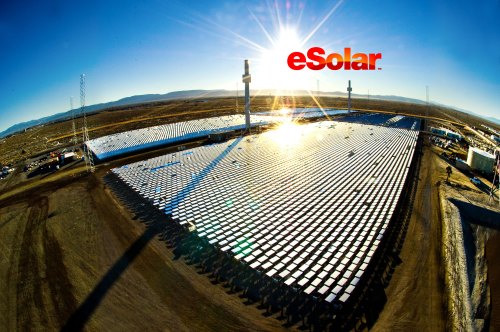
esolar-field_wide_2b
photo: eSolar

SAN FRANCISCO — “It’s all about the software,” says eSolar CEO Bill Gross.

The tech entrepreneur and founder of startup incubator Idealab is explaining how eSolar’s solar power plants can produce carbon-free electricity cheaper than planet-warming natural gas. At the Cleantech Forum in San Francisco, Gross flashes a photo of eSolar’s demonstration solar farm outside the Southern California town of Lancaster, where 24,000 mirrors called heliostats surround two 150-foot towers.  The heliostats concentrate sunlight on a tower containing water-filled boilers and the resulting heat creates steam that drives an electricity-generating turbine. Rivals like BrightSource Energy use similar “power tower” technology but according to Gross, eSolar’s mirror-controlling software and modular plant design will allow it to produce cheaper solar electricity.

For instance, Gross says competitors use large, slightly curved mirrors to focus sunlight. That require big and expensive steel frames to hold the glass in place.  eSolar’s solution: make small flat mirrors the size of an LCD television screen that clamp on to a  5 x 12-inch frame and then use software and Big Iron computing to position the mirrors to create a parabola out of the entire heliostat field.

“We use Moore’s law rather than more steel,” quipped Gross, referring to Intel co-founder Gordon Moore’s maxim that computing power doubles every two years.

The heliostats roll off an assembly line in China with the wiring and sun-tracking motors built in. “The only tool required to install mirrors in the field is a hand wrench,” Gross says. “There’s  no welding in field, you just install the mirrors on the base. We’ve taken all the labor in the field and moved it to an automated factory.”

The heliostats also do not have to be precisely placed in the solar field, which saves time. “The rows can be wavy as the software will correct for it,” Gross notes. “We don’t need to do extensive surveys to design the field; we just need to leave enough space between mirrors.”

The bottom line: The five-megawatt Palmdale project was built in less than six months. “We think we can finish plants before other people start,” Gross told Green Wombat.

Gross says eSolar has also signed a 92-megawatt deal with a New Mexico utility, which he declined to identify until the agreement is announced. He said his Pasadena, Calif.-based company will also soon unveil a contract to build 500 megawatt’s worth of solar farms in Asia. So far, eSolar has spent $30 million acquiring land – mainly privately owned agricultural property – for solar power plants, according to Gross. He told Cleantech Forum participants that eSolar expects internal rates of return for its partners of between 11% and 14% for U.S. power plants and returns of 20% to 30% for overseas projects.

Also saving time and money are the power towers, which are made from two sections of a windmill tower. At 150 feet they’re half the size of competitors’ towers – again, less steel is needed. The lower height and the software systems that allow more mirrors to be crammed into smaller spaces means that eSolar’s power plants can be placed closer to urban areas where transmission lines are available.

Also unique is the boiler that sits atop the tower. Gross gave Green Wombat a close-up look the proprietary technology. About the size of a cargo shipping container, the “cavity receiver” has openings on either side. The heliostats focus sunlight into the interior of the boiler, which is lined with water-filled pipes.

“The benefit is that the light comes in and even if some light is reflected it can have multiple bounces and still hit the pipes,” Gross says. “We can get all the light inside the cavity all because of the software that controls the mirrors.”

Whether Google (GOOG)-backed eSolar’s plants produce electricity at the low rates Gross is claiming won’t be known until they start coming online. But utilities are betting that this solar software works. Southern California Edision (EIX) last year signed a 20-year-contract with eSolar for 245 megawatts of electricity while coal-dependent NRG Energy (NRG) this week agreed to invest $10 million in eSolar in exchange for the right to develop up to 500 megawatts using the company’s technology. (Southern California Edison is betting even bigger on BrightSource Energy’s power tower technology – two weeks ago the utility signed a 1,300 megawatt power purchase agreement with the Oakland startup – also backed by Google – the world’s largest solar deal to date.)

Read Full Post »

image001

photo: eSolar

NRG Energy, one of the United States’ most coal-dependent utilities, on Monday signed a deal with California startup eSolar to develop solar power plants.

The agreement calls for NRG  to invest $10 million in Pasadena-based eSolar for the right to use the startup’s technology to develop and operate three solar power projects in California and the Southwest that would generate 500 megawatts of greenhouse gas-free electricity.  NRG ranks as one of the nation’s dirtiest utilities,  spewing 70 million tons of carbon dioxide annually from its coal-fired power plants, according to a 2007 Fortune Magazine story.  But the Princeton, N.J.-based Fortune 500 company has sought to clean up its ways under CEO David Crane, pursuing carbon-capture technology and moving to build nuclear power plants.

Last year eSolar, founded by Idealab’s Bill Gross and backed by Google, won a 20-year contract to supply utility Southern California Edison (EIX) with 245 megawatts of green electricity annually. Last  April, eSolar scored $130 million in funding from Google.org, Google’s (GOOG) philanthropic arm, and other investors to develop solar thermal technology that Gross claims will produce electricity as cheaply as coal-fired power plants.

Like rivals Ausra and BrightSource Energy – which have deals with utility PG&E (PCG) – eSolar will use fields of mirrors to heat water to create steam that drives electricity-generating turbines. Gross says that eSolar’s software allows the company to individually control smaller sun-tracking mirrors – called heliostats – which can be cheaply manufactured and which are more efficient and take up less land than conventional mirrors. According to Gross, that means eSolar can build modular power plants near urban areas and transmission lines rather than out in the desert, lowering costs.

In October, eSolar’s then-CEO told Green Wombat that the company was more interested in being a solar technology provider than a power plant construction company.

The eSolar deal gives NRG (NRG), which operates coal-fired power plants in Texas and the Northeast, a foothold in the California renewable energy market. The first solar farm will go online in 2011 and NRG will have the right to develop 11 of eSolar’s 46-megawatt modular power plants. eSolar currently is building a five-megawatt demonstration power plant in Lancaster, Calif., that is expected to be completed this year.

“By coupling NRG’s construction capabilities and regional operating expertise with eSolar’s innovative … technology, we can advance NRG’s renewable energy portfolio while helping to accelerate development of these important projects on a commercial scale,” said NRG executive Michael Liebelson in a statement.

During a press conference Monday, Liebelson said NRG would be able to take advantage of the 30% investment tax credit for renewable energy projects and intends to apply for federal loan guarantees for such power plants that were included in the recently enacted stimulus package.

The deal, coming less than two weeks after BrightSource Energy signed a 1,300-megawatt power purchase agreement with Southern California Edison, shows that despite the financial crisis the market for renewable energy is showing renewed signs of life.

Read Full Post »

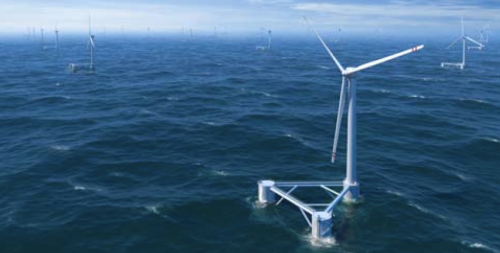
principle-power-oregon-wind-farm

Image: Principle Power

Portugal has become a prime spot for wave energy farms, given the coastal conditions and the government’s support for renewable energy projects. Now Portuguese energy powerhouse Energias de Portugal has signed an agreement with Seattle’s Principle Power for a deep-water floating wind farm.

It’s the second floating wind farm for Principle Power, which last October inked a contract to construct a 150-megawatt turbine power plant off the Oregon coast. The Oregon plan calls for 30 floating platforms that will each sport a five-megawatt wind turbine – which is about twice the size of the biggest land-based turbines in commercial operation. (General Electric (GE) makes a 3.6-megawatt turbine designed for offshore and Clipper Windpower is developing a ten-megawatt prototype.)

Details of the deal with Portugal’s EDP, however, are next to non-existent. Principle Power president Jon Bonanno told Green Wombat that the size of the Portuguese wind farm, the type of turbine it will use, its cost and build date are confidential. “What I can say is that the phased build out will result in a utility scale project, within a reasonable time frame for a plant of its size and nature,” Bonanno wrote in an e-mail.

The Seattle startup did reveal that the agreement with EDP calls for it to first deploy a single floating turbine platform, which it calls a WindFloat. “Innovative features of the WindFloat dampen wave and turbine induced motion, enabling wind turbines to be sited in previously inaccessible locations where water depth exceeds 50 meters and wind resources are superior,” Principle said in a statement.

If the WindFloat is successful, then a demonstration project will be built and a commercial wind farm will follow. Deep-water offshore wind farms pose a number of technological and economic challenges but the expected payoff is the production of  cheaper electricity from massive turbines that will be located far enough offshore to avoid the NIMBY problems that have plagued projects in the United States and elsewhere.

EDP became one of the world’s biggest wind farmers in 2007 when it acquired Horizon Wind Energy from Goldman Sachs for $2 billion.

Read Full Post »

cpuc-rps-report

California quadrupled the amount of renewable energy it installed in 2008 over the previous year, according to a report released Wednesday by the state’s Public Utilities Commission.

The 500 megawatts of green electricity brought online last year represents 60% of all renewable energy generation built since 2002, when California mandated that the state’s investor-owned utilities obtain 20% of their power from renewable sources by 2010. In November, Governor Arnold Schwarzenegger signed an executive order raising the Renewable Portfolio Standard, or RPS, to 33% by 2020.

“Clearly, 2008 was a turning point for the RPS program and contracted projects are beginning to deliver in large numbers,” the California Public Utilities Commission report stated.

The CPUC in 2008 approved projects that would generate 2,812 megawatts of renewable energy for California’s Big Three utilities – PG&E (PCG), Southern California Edison (EIX) and San Diego Gas & Electric (SRE). Impressive numbers but the utilities have acknowledged they are unlikely to meet their renewable energy targets by the 2010 deadline because it takes years to get solar and wind projects online and some will inevitably fail. For instance, the financial crisis has raised questions about just how many of the Big Solar power plants the utilities are relying on will actually get built, though the $787 billion stimulus packaged signed into law Tuesday by President Barack Obama has brightened the solar industry’s prospects.

California increasingly is depending on solar energy to meet its commitments to reduce greenhouse gas emissions under the state’s landmark 2006 global warming law. According to regulators, utilities received 30% more bids for solar power projects in 2008 than in the previous year while wind farm proposals dropped by half and “very few” geothermal tenders were filed.

The fact that utilities received 24,000 megawatts’ worth of renewable energy bids last year (more than enough, if built, to meet the 33% renewable energy target) speaks to the frothy state of the market. But before solar power plants and other green energy projects can go online they face years-long and often contentious environmental reviews, while a lack of transmission lines to bring all this electricity from the desert to coastal cities remains the green elephant in the room.

Meanwhile, regulators are reviewing a policy change that would seem to undercut the state’s goal of encouraging utilities to generate more renewable energy. On March 12 Feb. 20,the California Public Utilities Commission will consider whether to allow utilities to buy so-called tradable renewable energy credits, or TRECs, from other entities  to meet their green electricity mandates. Such credits are associated with the electricity generated by wind farms, solar power plants and other projects and can be bought and sold. In other words, if a utility finds itself falling short of its renewable energy goals – or just doesn’t want to spend the money procuring green power – it could buy TRECs on the open market.

Green Wombat is awaiting a reply from the utilities commission on whether California utilities could purchase TRECs generated by out-of-state projects – which, of course, would do nothing to reduce the state’s own greenhouse gas emissions.  UPDATE: CPUC spokeswoman Terrie Prosper says that utilities will be able to buy out-of-state TRECs as long as they meet California’s eligibility requirements.

Read Full Post »

freescale-pwr-conversion_lr1

photo: Freescale

Freescale Semiconductor on Monday is unveiling a new power conversion technology that the chipmaker says will dramatically enhance the efficiency of solar cells and other devices by allowing them to operate at low voltages.

That means a single solar cell attached to a mobile phone or other handheld device could charge the gadget. The bigger potential is to maximize the electricity generated from rooftop solar panels. which typically contain a dozen or more solar cells each. When a cloud or a tree shades part of a solar panel, power output from all the solar cells drops because they are linked together. By integrating Freescale’s power convertersamsung-blue-earth1 into each solar cell, those that aren’t shaded can still produce electricity, according to Arman Naghavi, general manager of Freesale’s Analog, Mixed-Signal & Power Division.

That’s because each solar cell can operate at much lower voltages when Freescale’s (FSL) converter is used. While most electronics need a jolt of 700 millivolts to begin working, Freescale’s technology allows them to operate on as little as 320 millivolts. (See video below.)

Sounds geeky but the consequences could be far-ranging, reducing electricity consumption and opening the door to a new generation of solar-powered devices.  One big hurdle to using solar cells to power everything from laptops to street lights is that it takes too many of them to produce enough power to be practicable. After all, who’s going to carry around a solar panel to charge their MacBook.

Freescale’s technology could change that equation. “For instance, you wouldn’t have to put a battery in a garage door opener – just add a solar strip on the remote control,” Kevin Parmenter, a Freescale applications engineering manager, told Green Wombat. (Samsung last week announced it would start selling a mobile phone (photo above) equipped with a solar panel but it’s unclear just how much talk or texting time it would allow.)

Other uses are more sci-fi: self-powered nanosensors that tap the technology to harvest ambient heat or friction in the environment.

The converter will hit the market in the second half of 2009. Potential customers include solar cell makers like SunPower (SPWRA) and Suntech (STP) as well as biomedical companies and defense contractors. Freescale, headquartered in Austin, Texas, was spun out of Motorola (MOT) in 2004.

“It really helps the entire green movement,” says Naghavi. “We are seeing a tremendous interest from lots of areas historically we have never touched or played in.”


Read Full Post »

ibm-smarter-planet1

The ecobiz buzz these days is all about greening the grid, what with tens of billions of dollars in the stimulus bill for transforming the electricity system into a digitalized, interactive version of the Internet. Just on Wednesday, the European island nation of Malta announced a $91 million deal with IBM to not only create a smart power grid but to smarten up its water system as well.

Water, in fact, is likely to emerge in coming years as big an opportunity as electricity for tech companies. Just as climate change is driving efforts to add intelligence to the power grid to more efficiently manage electricity usage and new sources of renewable energy, a warming world is making water an even scarcer resource.

“How do you look at the ecosystem of water and make it a smart grid?” asks Drew Clark, director of strategy for IBM’s Venture Capital Group.  “It really makes a lot of sense if you think about it. It’s a scarce commodity, just like electrons —  it’s more scarce, in fact. It needs to be kept secure, it needs to be kept safe, it very often is abundant except when you need it a certain time and in a certain place.”

Clark’s job is to find companies – startups usually – with technology IBM (IBM) can tap for business units like its Global Energy & Utilities Industry. These days that means companies that develop sensor networks and other technologies that can be deployed across smart grids as part of IBM’s Smarter Planet initiative to essentially create a physical version of the Internet for the natural and man-made worlds – water systems, transportation, agriculture.

That, of course, would generate untold terabytes of data that would need to be crunched, mined and analyzed, spurring demand for the type of software and Big Iron computing that is IBM’s forté.

“We look at taking otherwise less-smart systems and essentially instrument them with these sensors and make them intelligent,” Clark told Green Wombat at IBM’s San Francisco offices. “Every one of these smart grids are based on some collection, in some cases millions, of smart sensors that are sensing some characteristic. IBM looks at it and says this is an information management problem. How do we take the information from all these devices and sensors and bring it together in a way to make sense out of it, business sense out of it.”

Take water. In California, for instance, a three-year drought has put water districts under pressure to cut their customers’ consumption while conserving every drop possible. Many districts still rely on dispatching workers in trucks to check on water quality and water levels and check for pipeline leaks and breaks.

IBM is designing systems to automate that process by placing small sensors in reservoirs and along pipelines right up to homes and businesses. “These sensors are wireless and form a mesh network,” Clark says. “This one talks to this one that bridges to this one that bridges to another and every so often there is an access point that is able to gather up all the information.”

Big Blue analyzes that data and displays it on a computer dashboard that allows water managers to monitor their systems and head off problems like leaks or contamination. For example, General Electric (GE), Clark says, makes a sensor the size of a half-dollar that can detect multiple environmental conditions.

IBM has pilot projects underway with some water districts but faces a business challenge: Those public agencies typically are underfunded and don’t have millions of dollars on hand to roll out smart water systems. Money is usually not so much of a problem for Big Agriculture and Clark says IBM’s early customers are corporate farming giants like Archer Daniels Midland (an ADM spokesman points out that the company is a crop processor, not a farmer) that want sensor networks to better manage everything from irrigation systems to soil conditions.

Clark expects that after energy, water will be next up on the legislative agenda. IBM, along with other tech giants, appears to have the ear of the Obama administration. IBM chief executive Sam Palmisano joined the CEOs of Google (GOOG), Applied Materials (AMAT) and other tech companies last week in a meeting with President Barack Obama about investment in green technology.

Read Full Post »

« Newer Posts - Older Posts »

Design a site like this with WordPress.com
Get started